© 2016 Leonidas Pachacama et al. This is an open access article distributed under the terms of the Creative Commons Attribution License -NonCommercial-ShareAlikeUnported License (http://creativecommons.org/licenses/by-nc-sa/3.0/).
Journal of Applied Pharmaceutical Science Vol. 6 (08), pp. 135-141, August, 2016 Available online at http://www.japsonline.com
DOI: 10.7324/JAPS.2016.60821 ISSN 2231-3354
Evaluation of microalgae’s (
Chlorella
sp. and
Synechocystis
sp.)
pollutant removal property: Pig effluent as a live stock discharge
Leonidas Pachacama
1,2*,Juan Ortiz Tirado
1, Jessica Duchicela
2, Bangeppagari Manjunatha
1, Rajesh R. Kundapur
3,
Bugude Rajeswari
41
Department of Life Sciences, Laboratory of Water Resources and Aquaculture, Universidad de las Fuerzas Armadas-ESPE, P.O.BOX: 171-5-231B, Sangolquí, Ecuador, South America. 2Carrer of Engineering Biotechnology, Universidad de las Fuerzas Armadas–ESPE, Sangolquí, Ecuador. 3Department of Zoology, University of Pune, Pune, India. 4Department of Botany, Yogi Vemana University, Kadapa, India.
ARTICLE INFO ABSTRACT
Article history: Received on: 16/04/2016 Revised on: 20/05/2016 Accepted on: 06/06/2016 Available online: 30/08/2016
The ability of microalgae to remove nitrogen and phosphorus from wastewater has been used in recent years as an alternative treatment for discharges from livestock slurry, which generate a negative environmental impact on vulnerable ecosystems. With this background and the feasibility of using microalgae, we have evaluated the effect of Chlorella sp. and Synechocystis sp., in removing contaminants from the pig manure collected from El Prado ESPE. Slurry samples were collected, filtered and autoclaved, and the supernatant was further diluted to three different concentrations of 40%, 60% and 80%. The microalgal growth and pollutants removal property was evaluated up to 15 days in batch culture. The cell density was determined by counting in a Neubauer hemocytometer, and the pollutants removal was analyzed by standard colorimetric methods. The microalgae Chlorella sp. showed a maximum cell growth of 1.70 ± 0.09 x10⁷ cells/mL at 60% effluent concentration on day 6. While Synechocystis sp. showed a maximum growth of 1.04 ± 0.05 x10⁷ cells/mL, at 60% concentration on day 9. On the other hand, there exists a competition when microalgae used as a consortium. The cell growth of Chlorella sp. was higher at all concentrations compared to Synechocystis sp.. Overall, efficiency of pollutant removal were between 40% and 90%, which demonstrate the feasibility of using microalgae in tertiary swine wastewater treatment.
Key words:
Chlorella sp., Synechocystis sp., nitrogen, phosphorus, wastewater.
INTRODUCTION
The pollution resulting from wastewater of animal origin which contains high loads of nitrogen and phosphorus has created serious threats to the aquatic environment, the main problems are eutrophication of waters, air pollution by
volatilization of ammonia and land degradation (Godos et al.,
2010). In Ecuador, the pork sector presented a dynamic growth in recent years and equally, posing an environmental threat because of their improper disposal. The ability of microalgae to remove nitrogen and phosphorus from wastewater has allowed the use of microalgae cultures as tertiary treatment, presenting great advantages over physical and chemical conventional systems, because they do not generate secondary pollutants and presents
* Corresponding Author
Pachacama Leonidas, Department of Life Sciences, Laboratory of Water Resources and Aquaculture, Universidad de las Fuerzas Armadas– ESPE, P.O. BOX: 171-5-231B, Sangolqui, Ecuador, South America. Email: [email protected]
an efficient recycling of nutrients (De la Node and De Pauw 1988). Furthermore, the use of microalgae in the wastewater treatment reduces costs by not adding chemicals, and at the same time recovering nutrients as biomass that could be used as fertilizer, animal nutritional supplement, and bio fuels (Kim and Park 2007).
Microalgae from the genera Chlorella, Scenedesmus,
Botryococcus, Spirulina and Phormidium microalgae have been
used in the treatment of industrial and animal wastewater, due to its particular tolerance to the conditions of the effluents and high
removal efficiency (Pittman et al., 2011). Furthermore, the use of
microalgae for nutrient removal from wastewater in swine has
been previously established (Zhu et al., 2013). Wastewater from
This study evaluated the optimal conditions for the
growth of microalgae, the efficiency of NH4
+
and PO4
+
removal, the reduction of Chemical Oxygen Demand (COD) and Biodegradable Oxygen Demand (BOD), using pig effluent as a wastewater.
MATERIALS AND METHODS
Microalgae strain and pre-culture conditions
The microalgae Chlorella sp. and Synechocystis sp. were
provided by the Department of Biotechnology at Universidad de las Fuerzas Armadas, Ecuador and preserved in leaf Nitrofoska and complete BG11 medium. The Nitrofoska leaf medium composed of the following ingredients (g/L): N (300), P (100), K (100), Mg (6), S (40), Mn (2), Fe (2), Cu (1), Zn (0.6), B (1.5) and Mo (0.1). Furthermore, the BG11 complete medium consisted of
(g/L): NaNO3 (1.5), MgSO4.7H2O (7), CaCl2.2H2O (3.6),
K2HPO4.3H2O (4), EDTA (0.1), Na2CO3 (2), H3BO3 (2.86),
MnCl2.4H2O (1.81), ZnSO4.7H2O (0.22), NaMoO4.5H2O (0.39),
CuSO4.5H2O (0.8), Co(NO3)2.6H2O (0.05), FeCl3 (0.22),
additionally added (35) NaCl. The growth of microalgae was performed in two plastic bottles of 5 liters capacity each one, maintained at a temperature of 20 ± 2°C, irradiation (78.8 μmol
quanta m-2 s-1) and with the continuous aeration (Jonte et al.,
2003).
Culture of Chlorella sp. and Synechocystis sp. in swine wastewater
The pig effluent was collected from the pig rearing units at El Prado farm - IASA I –Universidad de las Fuerzas Armadas - ESPE, Ecuador. The pre-treatment of wastewater was filtered in a plastic strainer N° 8 to remove large solid and insoluble particles. After filtration, the sample was autoclaved for 20 min at 121°C, and stored at 4°C for 2 days for sedimentation of any visible solid
particles (Zhu et al., 2013). The supernatant was used in the
growth assays and nutrient removal. The characteristics of raw and autoclaved wastewater are summarized in Table 1.
Table 1: Characteristics of raw and autoclaved swine wastewater used in the
experiment.
Parameter Original
Concentration
Autoclaved Concentration
NH4+ (mg/L) 203 ± 3.08 189 ± 1.47
Conductivity (uS) 960.25 ± 22.78 905.25 ± 9.72
DBO5(mg/L) 2875 ± 47.87 2580 ± 52.28
DQO (mg/L) 3525 ± 43.3 3333.3 ± 54.43
PO4+ (mg/L) 99.75 ± 2.02 94 ± 2.12
pH 6.55 ± 0.06 7.55 ± 0.16
TDS (mg/L) 525 ± 24.77 467.5 ± 11.98
Temperature (°C) 20.88 ± 0.24 20.65 ± 0.12
The autoclaved supernatant was diluted with distilled water at concentrations of 40%, 60%, and 80% slurry. A volume of 850 ml of swine wastewater of above mentioned dilutions were placed in different 1.5 L bottles. A volume of 150 mL of micro
algal culture with a cell density of 5x10⁷ cells/mL determined in a
Neubauer hemocytometer was added to each bottle. Nine
treatments were specified in the study. Chlorella sp. and
Synechocystis sp. individually and in consortium with effluent
dilutions of 40%, 60% and 80% was evaluated.
Analytical procedures
Sampling and nutrients analysis
For the analysis of nutrient removal a volume of 10 ml was collected at the beginning and end of the batch culture. The samples were centrifuged at 1000 rpm for 20 min, the resultant
supernatant was further diluted and analyzed for NH4+ and PO4+
content using the spectrophotometer (SpectroFlex WTW 6600). COD was determined by the oxidation of potassium dichromate
(K2Cr2O7) method and Oxitop WTW was used for BOD5
measurement. The removal rate was obtained using the following equation:
(Zhu et al., 2013)
Where Co and Ci are the mean values of the concentration of
nutrients at the initial time (to) and time (ti), respectively.
Determination of microalgae growth
Cell number was determined by cell count with Neubauer hemocytometer under the light microscope. Cell density was determined using the following equation:
(Bermúdez et al., 2004)
Where N is the average number of cells in relation to quadrants
used in Neubauer hemocytometer, 104 is the conversion factor of
0.1 µL to 1 mL and FD is the dilution factor.
The specific growth rate (μ) in an exponential phase was measured using the following equation:
(Zhu et al., 2013)
Where N1 and N2 are defined as cell density (cells mL-1) at time t1
and t2, respectively. All data were expressed as a mean and
standard error.
RESULTS
Microalgae growth
The growth characteristics of Chlorella sp.,
Synechocystis sp. and consortium (Chlorella sp. - Synechocystis
sp.) under the three concentrations of slurry were evaluated up to 15 days, as shown in Fig. 1. The curves illustrate all phases of characteristic growth of microalgae batch culture.
In case of Chlorella sp., the lag phase was not apparent
in all concentrations. In the exponential phase a significantly increased cell density (P <0.0001) was observed on day six. Meanwhile, the specific growth rate μ in 40%, 60% and 80%
slurry concentrations was found to be 0.13, 0.16 and 0.17 days-1,
respectively. In the stationary phase, fluctuations between 6 and 12
days were observed. The maximum cell density (1.70 ± 0.09 x10⁷
In case of Synechocystis sp., a lag phase in 40% and 80% slurry concentrations within the first three days was observed, while the exponential phase showed early at begin of batch culture in of 60% concentration. The stationary phase was shown between the days 9 and 15. In 40% and 80%, there was adecline in cell density between day 6 and 9 before reaching the stationary phase. The specific growth rate in exponential phase in all concentrations
was 0.10, 0.17 and 0.08 days-1, respectively. The maximum cell
density reached was 1.04 ± 0.05 x10⁷ cells/mL at 60% slurry
concentration. In the microalgal consortium, a wide latency phase
was observed in Synechocystis sp. for all concentrations, in
contrast to Chlorella sp. was observed within the day 3 of batch
culture. On the other hand, in Chlorella sp. with compare to other
concentration there was a delay in reaching an exponential phase
at 40% concentration was observed. In case of Synechocystis sp.
exponential phase was not evident, a decline in growth occurred between days 6 and 9, followed by a stationary phase until the end
of the batch culture. The specific growth rate showed by Chlorella
sp. at all concentrations were 0.10, 0.16 and 0.18 days-1,
respectively. While for Synechocystis sp. it was 0.01, 0.06 and
0.03 day -1, respectively. As per as achiveing maximum cell density was concerned, for both species it was observed at 60%
and 80% concentration, for Chlorella sp. it was 8.93 ± 0.55 x10⁶
cells/mL and for Synechocystis sp. it was 9.66 ± 0.69 x10⁶
cells/mL, respectively.
Nutrient Removal
Removal property of ammonium (NH4
+
), phosphate
(PO4
+
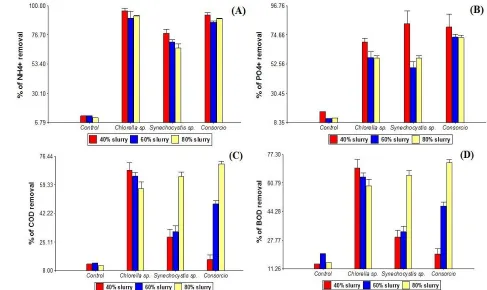
), and variations observed in COD and BOD, values in different concentrations of swine wastewater upto 15 days in batch culture are shown in Fig. 2. Ammonium decreased dramatically in
the presence of Chlorella sp. and the microalgal consortium,
.
whereas Synechocystis sp. showed a lower efficiency relative to
other treatments, with respect to control, the removal percentage
was between 10% and 12%. The Chlorella sp. showed a highest
removal efficiency (95.92%) at 40% slurry concentration. Concomitantly, in all treatments, the percent efficiency was in the range between 66% to 95%.
With respect to the phosphate concentration, within 15
days of culture, Synechocystis sp. showed a greater removal
(75.41%) than the other treatments. While Chlorella sp. showed a
removal percentage 69.45% and the microalgal consortium showed 80.56%, at 40% slurry concentration. Furthermore, at concentrations of 60% and 80% removal rates were between 50% and 73.08%.
COD was drastically decreased in all treatments. The
Chlorella sp. showed anaverage removal porcentage of 64.27%.
On the other hand, Synechocystis sp. and the microalgal
consortium showed removal percentages of 64.44% and 71.85% respectively at 80% slurry concentration. In addition, the
Synechocystis sp. did not show much difference in removal
Fig. 2: Nutrient removal by microalgae (Chlorella sp., Synechocystis sp. and microalgal consortium) in three concentrations of pig manure within 15 days (Mean ± S.E.). Slurry concentration was 40%, 60% and 80% diluted with distilled water. (A) Percentage of NH4+ removal. (B) Percentage of PO4+ removal. (C)
percentage at 60% and 80 % slurry concentration which was 28% to 31.25%. In the microalgal consortium a slight removal (14.67%)
was noted at 40%. In relation to the control group, the percentages were lower between 11% and 12% for all concentrations of
wastewater.
Furthermore, as BOD is directly related to the COD, so the percentage reductions were similar in both parameters. The highest percentages of reduction in BOD were observed at 80%
concentration by Synechocystis sp. it was 65.39% and for the
microalgal consortium it was 72.62%. With respect to Chlorella
sp. there was no significant difference in the reduction of BOD between different slurry concentrations. At 40% slurry concentration, 69.34% percentage of removal was observed.
DISCUSSION Microalgal Growth
Microalgae like other microorganisms, has four stages of
growth: latency, exponential, stationary and decline (Li et al.,
2011). In the treatment with Chlorella sp. no stationary phase was
observed, due to the fact that the inoculum was at the exponential
phase (Li et al., 2011). Similarly, Chlorella sp. can be adapted to
different concentrations of wastewater with a lower latency phase
at day 1 (Ryu et al., 2014). Subsequently, there was a decline in
growth before reaching the stationary phase, which may be due to
low light availability resulting from high cell density (Li et al.,
2011).
As per as the Synechocystis sp., is concerned, there was a
latency period observed in first three days at 60% and 80% slurry
concentration which is in support of previous studies (Ding et al.,
2015). Subsequently, a difference in an exponential phase was observed, followed by a decay before reaching the stationary phase. The large decay was observed microalgal culture could be related to the depletion of certain nutrients, primarily nitrogen and
carbon (Li et al., 2011).
In microalgae consortium (Chlorella sp.- Synechocystis
sp.), a lag phase was observed in the first 3 days for both species.
Subsequently, Chlorella sp. showed evident exponential phase,
whereas Synechocystis sp. cellular growth started to decline. This
might be due to green algae (Chlorella sp.) which has a high
demand for nitrogen and phosphorus in relation to other species; plus nitrogen absorption is favored when the phosphorus concentration is relatively high (Prescott 1968).
On the other hand, the competition between
cyanobacteria (Synechocystis sp.) and microalgae (Chlorella sp.),
limits availability of nutrients, and considering the advantage of
Chlorella sp. takes advantage of this to assimilate nutrients
(Prescott 1968), which results decline in the growth
of Synechocystis sp. Finally, both species enter stationary phase,
around nineth day, presenting Synechocystis sp. with lower cell
density.
Nutrient Removal
High removal percentages of NH4
+
and PO4
+
were achieved in all treatments. Previous studies have reported that
algae can assimilate NH4-N, nitrate and organic nitrogen simple
forms such as urea, acetic acid, and amino acids, from wastewater
(Su et al., 2011). Moreover, absorbed nitrogen is used by
microalgae for the synthesis of proteins, nucleic acids, and
phospholipids (Zimmo et al., 2003). The removal of NH4
+
from wastewater by microalgae could be affected by precipitation of
NH4
+
and separation of NH3. Separation of NH3 usually occurs in
an alkaline medium, high temperature and the presence of
abundant urea in wastewater (Matusiak et al., 1976). In previous
studies, high rates of removal in municipal wastewater were determined, where the main form of soluble nitrogen was
ammonia (Woertz et al., 2009).
The nitrogen removal is dominated by the absorption of nutrients by microalgae and bacteria during growth, on the other
hand, the volatilization of ammonia at high pH (Min et al., 2011),
could influence the percentages of removal of certain treatments. With regard to the control treatments without microalgae
inoculums, the low percentage of NH4
+
removal could be due to abiotic processes such as chemical precipitation and gasification of
ammonia at high pH (Ji et al., 2013).
In relation to phosphorus removal from pig wastewater, it
was mainly used and consumed by Synechocystis sp. and the
microalgal consortium. One of the factors related to the disposition of phosphorus in the medium is the pH. The increase in pH in cultures could contribute to the precipitation of phosphorus and
increased phosphate absorption by microalgae (Ruiz Marinet al.,
2010), which could be directly related to the given percentages of removal in this study. The increase in pH above 8 in the solution inoculated with microalgae could cause coagulation and
adsorption of inorganic phosphate (Li et al., 2011). Furthermore, it
is known that the microalgal biomass contains only 0.5-3.3% phosphorus (Richmond 2004), therefore, a high percentage of phosphorus may have been removed by sedimentation. The energy generated by the oxidation of phosphorous under aerobic conditions is used by microalgae for cell growth and metabolism
(Lananan et al., 2014). Also, ammonium consumption is directly
related to the concentration of phosphorus, which acts as a constraint on growth; the ideal range of N:P (nitrogen-phosphorus)
for microalgal growth is 6:3 (Ramos Tercero et al., 2014).
Similarly, the phosphate may play a significant role in the synthesis of valuable products such as astaxanthin and PUFAs (Chen and Chen 2006). On the other hand, COD and BOD values
were decreasedwhen inoculated with Chlorella sp. (90%). While
treatments with Synechocystis sp. and microalgal consortium, it
was 60% and 70%, respectively. The COD is related to carbon levels in the effluent, thus reducing this parameter could be attributed to carbon is a necessary macronutrient for microalgal growth. Furthermore, since this organic carbon and light in the
medium is considered a mixotrophic growth, in which the CO2 and
organic carbon are simultaneously assimilated (Min et al., 2011).
be directly related to the separation of VOCs. With respect to COD
removal percentages of Chlorella sp., it has found that the
Chlorella metabolic pathway can be altered supplying organic
substances (organic acids, glucose, etc.) allow it to adapt to heterotrophic growth rather autotrophic (Eny 1951). Furthermore,
the COD removal correlates with growth of Chlorella sp., the
highest cell density, could be related to a heterotrophic growth
which is faster metabolic pathway (Burrell et al., 1984).
With regard to treatment with the microalgal consortium,
Synechocystis sp. improved the efficiency of nutrient removal by
Chlorella sp., because Synechocystis sp. is capable of
bioconverting contaminants in stable forms of ammonia and
phosphorus (Lananan et al., 2014), which could subsequently
assimilated by Chlorella sp., where in the cell density of Chlorella
sp. it was significantly greater than the density of Synechocystis sp.
In this study, the swine wastewater was autoclaved before inoculation with microalgae. However, the air supply compressor not sterilized (membrane filter, etc.), so the culture could contain
bacteria introduced by air (Zhu et al., 2013), which could
contribute to the degradation of pollutants (Chen et al., 2012). The
microalgae can improve bacterial activity by releasing certain
extracellular compounds like glycolic acid (Wang et al., 2009),
while bacterial growth can improve microalgal metabolism, reducing oxygen concentrations in the environment and releasing growth promoting factors (Gonzalez and Basan 2000), or degrading large compounds into assimilable forms for microalgae
(Zhu et al., 2013). Furthermore, bacterial growth can be harmful to
the microalgal cultivation because it increases the pH, alters temperature or release inhibitory metabolites (Gonzalez and Basan 2000). Also could form a bacterial layer on the walls of the container, affecting the microalgal photosynthesis by interfering
the penetration of light (Zhang et al., 2012). Therefore, the
interaction between microalgae and bacteria is difficult to predict, since is directly related to environmental conditions.
CONCLUSION
Porcine wastewater with three different concentration
levels were efficiently treated with Chlorella sp., Synechocystis sp.
and microalgal consortium in batch culture upto 15 days. Chlorella
sp. and microalgal consortium largely assimilated the NH4
+
with percentages of 92.69% and 89.62%, respectively. Meanwhile, the
PO4
+
was assimilated in greater proportion by Synechocystis sp.
with 75.41%. Regarding COD, Chlorella sp. presented a removal
efficiency of 64.27%, being the highest in relation to other
treatments. The specific growth rate of microalgae Chlorella sp.,
Synechocystis sp. and the microalgal consortium inoculated in
wastewater at different concentrations was in ranges from 0.13 to
0.17 (day -1), from 0.10 to 0.13 (day -1) and from 0.04 to 0.18 (day
-1
), respectively. The Chlorella sp. showed a maximum cell growth
of 1.70 ± 0.09 x10⁷ cells/mL at 60% effluent concentration on day
6. While Synechocystis sp. has a maximum growth of 1.04 ± 0.05
x107 cells/mL, at 60% concentration on day 9. During interaction
of microalgae as a consortium cell growth of Chlorella sp. was
higher at all concentrations compared to Synechocystis sp.
ACKNOWLEDGEMENTS
This scientific work has been funded from Universidad de las Fuerzas Armadas-ESPE (2015-PIC-005). We would like to acknowledge the contributions of colleagues in our respective institutes for helpful comments on the manuscript.
CONFLICT OF INTERESTS
The authors declare that there is no conflict of interest regarding the publication of this paper.
REFERENCES
Bermúdez, J., Rosales, N., Loreto, C., Briceño, B., Morales, E. Exopolysaccharide, pigment and protein production by the marine microalga Chroomonas sp. in semicontinuous culture. World Journal of Microbiology & Biotechnology, 2004; 179-183.
Burrell, E., Inniss, E., Mayfield, I. Development of an optimal heterotrophic growth medium for Chlorella Vulgaris. Applied Microbiology and Biotechnology, 1984; 281-283.
Chen, QQ., Chen, F. Growing phototrophic cells without light. Biotechnology letters, 2006; 607-616.
Chen, R., Li, R., Deitz, L., Liu, Y., Stevenson, R., Liao, W. Freshwater algal cultivation with animal waste for nutrient removal and biomass production. Biomass and Bioenergy, 2012; 128-138.
De la Node, J., De Pauw, N. The potential of microalgal biotechnology: A review of production and uses of microalgae. Biotech. Adv.1988.
Ding, J., Zhao, F., Cao, Y., Xing, L., Liu, W., Mei, S., Shujun, L. Cultivation of Microalgae in Dairy Farm Wastewater Without Sterilization. International Journal of Phytoremediation, 2015; 222-227.
Eny, DM. Respiration studies on Chlorella. II. Influence of various organic acids on gas exchange. Plant Physiology, 1951; 268-289.
Godos, L., Vargas, V., Blanco, S., González MC., Soto, R., García -Encina, P., Muñoz, R. A comparative evaluation of microalgae for the degradation of piggery wastewater under photosynthetic oxygenation. Bioresource Technology, 2010; 5150-5158.
Goldberg, I., Cohen, Z. The effect of phosphate starvation on the lipid and fatty acid composition of the freshwater eustigmatophyte Monochussubterraneous. Phytochemistry, 2006; 696-701.
Gonzalez, L., Bashan, Y. Increased growth of the microalga Chlorella vulgaris when coimmobilized and cocultured in alginate beads with the plant-growth-promoting bacterium Azospirillum brasilense. Applied Environmental and Microbiology, 2000; 1527-1531.
Ji, M. K., Kim, HC., Sapireddy, V., Yun, HS., Abou-Shanab, R., Choi, J., Jeon, B. H. Simultaneous nutrient removal and lipid production from pretreated piggery wastewater by Chlorella vulgaris YSW-04. Environmental Biotechnology, 2013; 2701-2710.
Jonte, L., Rosales, N., Briceño, B., Morales, E. La salinidad and la irradiancia modulan el crecimiento de la cianobacteria Synechocystis minuscula en cultivos discontinuos. Redalyc. 2003.
Kim, M., Park, JJ. Enhanced production of Scenedesmus spp. (green microalgae) using a new medium containing fermented swine wastewater. Bioresource Technology, 2007.
Lananan, F., Abdul Hamid, S., Sakinah Din, W., Ali, N., Khatoon, H., Jusoh, A., Endut, A. Symbiotic bioremediation of aquaculture wastewater in reducing ammonia and phosphorus utilizing Effective Microorganism (EM-1) and microalgae (Chlorella sp.). International Biodeterioration & Biodegradation, 2014; 127-134.
highly concentrated municipal wastewater for nutrient removal and biodiesel production. Bioresource Technology, 2011; 5138-5144.
Matusiak, K., Pryztocka Jusiak, M., Leszczynska Gerula, K., Horoch, M. Studies on the purification of wastewater from the nitrogen fertilizer industry by intensive algal cultures. Acta Microbiol. Pol., 1976; 361-374.
Min, M., Wang, L., Li, Y., Mohr, M., Hu, B., Zhou, W., Ruan, R. Cultivating Chlorella sp. in Pilot-Scale Photobioreactor Using Centrate Wastewater for Microalgae Biomass Production and Wastewater Nutrient Removal. Applied Biochemistry Biotechnology, 2011; 123-137.
Pittman, J., Dean, A., Osundeko, O. The potential of sustainable algal biofuel production using wastewater resources. Bioresource Technology. 2011.
Prescott, G. The algae: a review book. Houghton Mifflin company, 1968; 279-294.
Ramos Tercero, E., Sforza, E., Morandini, M., Bertucco, A.Cultivation of Chlorella protothecoides with Urban Wastewater in Continuous Photobioreactor: Biomass Productivity and Nutrient Removal. Applied Biochemistry Biotechnology, 2014; 1470-1485.
Richmond.Handbook of Microalgal Culture. Oxford,UK: Blackwell Science. 2004.
Ruiz Marin, A., Mendoza-Espinosa, L., Stephenson, T.Growth and nutrient removal in free and immobilized green algae in batch and semi-continuous cultures treating real wastewater. Bioresource Technology, 2010; 58-64.
Ryu, BG., Kim, E., Kim, HS., Kim, J., Choi, YE., Wang, JW. Simultaneous Treatment of Municipal Wastewater and Biodiesel Production by Cultivation of Chlorella vulgaris with Indigenous Wastewater Bacteria. Biotechnology and Bioprocess Engineering, 2014; 201-210.
Su, Y., Mennerich, A., Urban, B. Municipal wastewater treatment and biomass accumulation with a wastewater-born and settleable algal-bacterial culture. Water Research, 2011; 3351-3358.
Wang, L., Min, M., Li, Y., Chen, P., Chen, Y., Liu, Y., Ruan, R. Cultivation of Green Algae Chlorella sp. in Different Wastewaters from Municipal Wastewater Treatment Plant. Applied Biochemistry and Biotechnology, 2009.
Woertz, I., Feffer, A., Lundquist, T., Nelson, Y. Algae Grown on Dairy and Municipal Wastewater for Simultaneous Nutrient Removal and Lipid Production for Biofuel Feedstock. Journal of Environmental Engineering, 2009; 1115-1121.
Zhang, L., Jahng, D. Enhanced anaerobic digestion of piggery wastewater by ammonia stripping: effects of alkali types. J Hazard Mater, 2010; 536-543.
Zhang, Y., Su, H., Zhong, Y., Zhang, C., Shen, Z., Sang, W., Zhou, X. The effect of bacterial contamination on the heterotrophic cultivation of Chlorella pyrenoidosa in wastewater from the production of soybean products. Water Research, 2012; 5509-5516.
Zhu, L., Wang, Z., Shu, Q., Takala, J., Hiltunen, E., Feng, P., Yuan, Z. Nutrient removal and biodiesel production by integration of freshwater algae cultivation with piggery wastewater treatment. Water Research, 2013; 1-10.
Zimmo, O., Van der Steen, N., Gijzen, H. Comparison of ammonia volatilization rates in algae and duckweed-based waste stabilization ponds treating domestic wastewater. Water Research, 2003; 4587-4594.
How to cite this article: