L2 Learners’ Strategy Preference in Metaphorical
Test Performance: Effects of Working Memory and
Cognitive Style
Mahmood Hashemian*
Ph.D. in Applied Linguistics, Shahrekord University, Iran
Batool Fadaei**
M.A. in TEFL, Shahrekord University, Iran
Received: May 17, 2012; Accepted: November 2, 2012
Abstract
Although investigating the factors that influence test scores is important, a majority of stakeholders show a paucity of attention towards individual learner differences due to having large classes of L2 learners. This study sought to explore the possible effect of working memory and cognitive style on L2 learners’ metaphorical test performance. The study was conducted in 2 phases. The first phase was quantitative, and the second consisted of a series of case studies using “think-aloud protocol” and “retrospection.” In the statistical phase, aimed at shedding light on the effect of the cognitive style of field (in)dependence (FI/FD) on metaphorical test performance, 80 senior undergraduates majoring in English Translation were selected through a truncated test of TOEFL adopted from Barron (2004). Metaphorical test performance was analyzed through recognition, text-based true-false, and scripturally implicit questions, refined by conducting factor analysis. Moreover, the participants’ cognitive style of FI/FD was identified via GEFT. In the qualitative part, after analyzing the verbal reports of 8 informants, the participants’ strategy preferences were examined. Results revealed the impact of the cognitive style of FI/FD and working memory on the participants’ strategy preferences. Due to the advent of learner-centered approaches, this study has some implications for L2 pedagogy discussed in the paper.
Keywords: metaphorical test performance, working memory, cognitive style of field (in)dependence (FI/FD)
INTRODUCTION
Not only being a linguistic device to add color to texts, metaphor is an important feature of our thinking and education (Jensen, 2006). All the same, within the framework of L2 research, virtually several empirical works from the cognitive science (e.g., Gibbs, 1994; Lakoff & Johnson, 1980; Lakoff & Turner, 1989; Turner, 1996) show that metaphor is not a sheer linguistic or rhetorical figure but a fundamental part of people’s ordinary thought. One overarching consideration is that various definitions have been proposed for metaphor.
Kövecses (2002, p. 4) defines metaphor as “understanding one conceptual domain in terms of another conceptual domain” called conceptual metaphor. Technically speaking, based on Kövecses, every conceptual metaphor “consists of two conceptual domains, in which one domain is understood in terms of another” (p. 4). The source domain is a more concrete or physical concept that helps us draw metaphorical expressions. The target domain is a more abstract concept that is understood this way. Thus, argument, love, idea, and social organizations are all target domains, and war, journey, food, and plant are all source domains.
From another angle, Lakoff (1993) believes that, the same as our linguistic system, the system of our conceptual metaphor is unconscious, automatic, and used without any effort. In fact, Tendahl and Gibbs (in press) argue that particular key words from the source domain may activate a conceptual metaphor that involves understanding one conceptual domain in the light of another conceptual one and, accordingly, the inference occurs. The aforementioned model is in congruence with Lakoff and Johnson’s (1980) model of conceptual mappings.
Just the same, through proposing conceptual blending theory, Fauconnier and Turner (2002) introduced another major development, which is of paramount importance in cognitive linguistics relevant to metaphor. Through extending this theory to the realm of metaphorical language, metaphorical meaning is captured by a blended space having in common some structure from both source and target domains (Tendahl & Gibbs, in press).
experience. Of such variables, the cognitive style of field (in) dependence (FI/FD) and working memory (WM) have been suggested as potentially important in L2 learning. Thus, it is worth mentioning that there are, to say at least, three main benefits of knowing the aforementioned differences:
L2 learners who are conscious of their style make better use of L2 learning opportunites.
L2 learners learn better when they are provided with L2 learning opportunities that enhance their learning preferences.
L2 learners work better with new learning styles when they are given guided opportunities to practice them.
This study is based on the premise that an awareness of such individual differences as WM and the cognitive style of FI/FD in L2 learning will make L2 educators and program designers, in all probability, more sensitive to the roles of these differences in L2 teaching. Although quantitative studies can provide certain results in the realm of test performance, we tended to carry out this research through conducting both a quantitative and qualitative research study. The first phase of the current study included quantitative interpretations regarding the effect of the cognitive style of FI/FD on L2 learners’ metaphorical test performance. And, in the second phase, the association of WM in metaphorical test performance was investigated retrospectively. In essence, due to the fact that verbal reports can clearly provide an account of L2 learners’ conceptual performance, they seem a promising tool in data collection.
LITRETURE REVIEW
The new view bases metaphor on the everyday and ordinary conceptual system. On the other hand, the classical view regards metaphor as a matter of language not thought. The classical view defines metaphors as poetic linguistic expressions in which words are used outside of their normal meaning. In contrast, metaphors are a matter of thought in the contemporary view. They are not just poetic expressions. Therefore, they are conceptual and part of the ordinary system of thought and language.
Yet on a closer look, L2 pedagogy has piqued L2 educators’ interest in understanding L2 learner differences. One is the attempt to match the kind of instructional activities to L2 learners’ preferred styles. Therefore, determining the factors influencing L2 test scores has long been focused in different scientific enquiries (e.g., Alderson, 1991; Anivan, 1991; Salmani-Nodoushan, 2006, 2009).
As for cognitive styles, one such area that has received attention from L2 researchers (Altun & Cakan, 2006; Daniels, 1996; Ford & Chen, 2001) is the cognitive style of FI/FD, which has possibly the widest application to the educational concerns. According to Brown (2000), FD learners pay attention to the whole of a learning task containing many items and rely on the surrounding field. On the contrary, FI learners pay attention to particular items and perceive objects as separate from the field. In a nutshell, as it is evident from Ford and Chenʼs (2001) claim, FD learners concentrate first on making the overall picture of the subject area, and then, consider the details. Therefore, FD learners have a tendency to undertake global strategies, whereas FI learners focus first on the individual parts of an object.
The other important dimension of individual L2 learner differences is the WM of L2 test-takers. Then, by introducing a memory model including a sensory store, short-term memory (STM), and long-term memory (LTM), Miller (1956) has stated that the incoming information is first registered in the sensory store. Then, a limited amount of this information passes into the STM, and information not attended to is lost. In the absence of rehearsal, the information in STM will decay, but rehearsed information is saved in LTM.
that temporarily store a limited amount of information. Thus, WM is closely interwoven to a central component named the central executive and three subsystems named the phonological loop, visuo-spatial sketch pad, and the episodic buffer.
Regarding studies on storing information in WM, Alptekin and Ercentin (2009) compared the performance of L2 readers and their amount of storage. Investigating the relationship between L2 reading, literal, and inferential understanding, they portrayed WM as a significant factor affecting reading, especially in the case of inferential comprehension. This study jumped on the bandwagon of Kintsch (1998) who found out that inferential reading was more difficult than literal one due to the heavier demands it placed on WM.
It is worth mentioning that reviewing the miscellaneous research studies conducted in the field of metaphor (e.g., Amanzio, Geminiani, Leotta, & Cappa, 2007; Blasko, 1999; Black, 2000; Charteris-Black & Ennis, 2001; Delfino & Manca, 2007; Leavy, McSorley, & Bote′, 2007) reveals the pervasive use of metaphor in different domains. Metaphor comprehension has also been a matter of enquiry in neuropsychology since the late 1970s. In this regard, Blasko (1999, cited in Chiappe & Chiappe, 2007) found a link between WM capacity and metaphor comprehension. By studying 163 male and female individuals, Blasko found that the high WM individuals produced deeper interpretations of metaphors. This study closely interrelated with the one by Chiappe and Chiappe (2007) who believed in the effectiveness of WM capacity as an important factor in metaphor processing in line with the fact that high WM capacity individuals could make better interpretations of metaphors.
In their study of L2 learners’ explanations of conceptual metaphor and cognitive style variables, Boers and Littlemore (2000), through using the Ridingʼs (1991) computer-assisted test, asked a group of 71 students of Business and Economics in the University of Brussels to explain three conceptual metaphors. Then, Boers and Littlemore classified the participants’ cognitive styles into analytic/holistic and imagers/verbalizers. The results revealed that the holistic thinkers tended to blend their conception of the target domain with the source domain, and the imagers were more likely to refer to images to explain the metaphors.
attention on the comprehension processes of metaphorical language, rather than the production side. Hence, the production side lacks the attention it rightfully deserves. With all this amount of emphasis laid on such vital and fruitful areas as the comprehension side of metaphorical language (Harris, Friel, & Mickelson, 2006), most advanced L2 learners are likely to experience moments of difficulty reading a passage replete with metaphors.
Possibly, metaphor and its understanding have been a mind-boggling concern for L2 learners. Still more, because the majority of L2 learners study in the environment of a whole class and often in a large one, in designing L2 tests and curriculum, there is lack of attention on the characteristics of L2 learners as individuals and the great difficulties understanding a metaphorical sentence. Therefore, it stands to good reason to have an investigation into such a field as metaphor test performance.
PUPRPOSE OF THE STUDY
In sum, there is a shortage of studies documenting the effect of the cognitive style of FI/FD and WM on metaphorical use of language in recognition and text-based tests of metaphor. Therefore, one would spot areas of neglect in this research area, whereas, according to Kövecses (2002), metaphor has an important role in human thought and understanding. In addition, metaphor can make our social, cultural, and psychological reality. Furthermore, qualitative studies, to the best of the present researchers’ knowledge, have been rarely used to investigate these phenomena. It is, then, from this standpoint that the present researchers depart.
With regard to the above considerations, four major questions were raised and pursued to be answered in the present study:
1. Is there any difference between the performances of FI/FD learners on recognition test of metaphor?
2. Is there any difference between the performances of FI/FD learners on text-based true-false test of metaphor?
4. Is there any difference between FI/FD learners, their strategy preferences, and their WM activities towards performance on recognition and text-based tests of metaphor?
METHOD
The present study was divided into two main sections: The first was a statistical phase, and the second made use of “think-aloud protocol” and “retrospective analysis.” The two aforementioned phases of the study are delineated separately in the following parts.
Quantitative Research
Participants
For the purpose of the first phase, 80 senior undergraduates majoring in English Translation were selected from the University of Isfahan, Shahrekord University, and Shahid Chamran University of Ahvaz. The participants were selected in line with their mean scores and standard deviations, from a pool of 110 students through a truncated form of a TOEFL test adopted from Barron (2004). In the current study, the reliability coefficient of this test was pretty high (Cronbachʼs alpha = .82). The participants were both male and female, and their age range was from 21 to 26. The reason for the selection of the abovementioned L2 participants was that they had passed a course on Application of Metaphorical Expressions in Translation/Language. Therefore, it was assumed that these undergraduates had familiarity with tropes.
Instrumentation
For the present study, the materials were as the followings: The first one was a truncated form of a TOEFL test adopted from Barron (2004; the Listening section was removed) to gauge the participants’ proficiency knowledge. The test consisted of 30 structure questions and 30 reading comprehension questions. As to the validity of the test, two experts in the field inspected the test and confirmed its validity.
complex shape). In this test, the participants who managed to recognize the hidden figures from the fields were regarded as FI learners, and those who failed to do this task were designated as FD learners. Of the vital importance is that Witkin et al. (1971) reported a Spearman-Brown reliability coefficient of .82 for their instrument. It should be mentioned that the reliability of GEFT was also examined for the current study via Cronbachʼs alpha, which turned out to be .78.
Through a handful of recommendable tests in the literature to assess the cognitive style of FD/FI, trying to jump on the bandwagon of Altun and Cakanʼs (2006) reasons for choosing GEFT in their study, there were three reasons for applying GEFT in the current study. First, due to being a nonverbal test and asking a minimum level of language skill, GEFT was an easy task to perform. Second, the psychometrical properties of the instrument had been investigated and accepted as quite reasonable. In addition, GEFT needed an individualized approach for data collection and could be administered to an entire sample at once. The third material was the metaphor tests consisting of three parts: recognition, text-based true-false, and text-based scripturally implicit questions from the books English Idioms in Use (McCarthy & O’Dell, 2002) and Idioms Organiser (Wright, 1999), given to the participants in order to investigate their metaphorical performance. The metaphor tests consisted of 15 multiple-choice recognition questions of metaphor and three passages as text-based part of the tests. Each passage consisted of five true-false and five scripturally implicit questions. Thus, every passage included 10 questions, and the total number of the questions regarding the passages was 30. Every correct answer had one score. Concerning the true-false questions, each item was followed by three answers: true, false, and not given. In addition, the scripturally implicit questions were 15 open-ended sentences to be completed by one of the alternatives presented in the form of a multiple-choice test. The monumental characteristic of scripturally implicit questions, according to Alderson (2000), is that the aforementioned questions require the test-takers to integrate text information with their background knowledge to find the correct responses to the questions.
many coefficients of .3 and above. The Kaiser-Meyer-Oklin value was .618, exceeding the recommended value of .6 (Kaiser, 1970/1974) and Bartlett’s Test of Sphericity (Bartlett, 1954) reached statistical significance, supporting the factorability of the correlation matrix. The PCA revealed the presence of five components with eigenvalues exceeding one, explaining 28.41%, 8.64%, 7.8%, 5.03%, and 4.24% of the variance, respectively. An inspection of the screeplot revealed a break after the third component. Therefore, using Catell’s (1966) screeplot, it was decided to retain the three components for further investigation. This was further supported by the results of parallel analysis.
The three-component solution explained a total of 44.85% of the variance. To aid in the interpretation of the three components, Oblimin rotation was performed. The rotated solution revealed the presence of a simple structure (Thurstone, 1947), with the three components showing a number of strong loadings. The interpretation of the three components showed 15 items loading on components 1, 2, and 3, respectively. The results of this analysis supported the use of the recognition, text-based true-false, and text-based scripturally implicit questions as separate constructs, respectively. It should be noted that the items that were not loaded on the three main components were eliminated, and there was a weak negative correlation between the components (r = -.28).
Data Collection Procedure
Overall, the quantitative research consisted of three phases: assessing proficiency, cognitive style, and metaphorical test performance, each with its own specific procedures. To collect the data, first, the TOEFL test was administrated to the participants. As Table 1 shows, according to the proficiency mean score (M = 26) and the standard deviation (SD = 11) assessed by SPSS, 80 participants from among 110 ones whose scores were from 15 to 37 were selected.
figures in the first section of the test were just for the purpose of familiarizing the participants with the test procedure, and they were not considered in scoring the test. Thus, the scores in GEFT ranged between 0-18. It took 10 min to conduct the second and third sections. It is worth mentioning that every GEFT had a code, and the participants were identified through that code during the test.
Table 1: The TOEFL score and standard deviation of the TOEFL test
Scores
N Min Max Mean SD
110 6.00 46.00 26.26 11.36
As the last part of the data collection, in order to assess the participants’ metaphorical test performance, the metaphor tests consisting of recognition, text-based true-false, and text- based scripturally implicit questions were given to the participants according to their code for GEFT. The participants were required to choose their alternatives by putting a check mark (√) in the answer-sheets distributed among them. The data collected (i.e., the scores on the English metaphor tests and GEFT) were subjected to inferential statistics. As for the quantitative phase, the researchers, using SPSS, ran one-way multivariate analysis of variance (MANOVA) to compare the groups and to see if there was any significant difference among them. Concerning the qualitative phase, it was based upon applying “think-aloud protocol” and “retrospective analysis.” The data obtained and the discussions related to the quantitative and qualitative results are elaborated separately in the following parts.
RESULTS
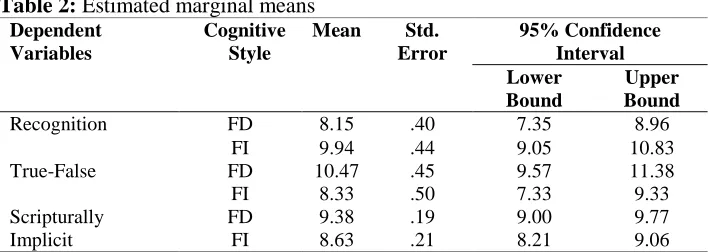
The raw data gathered from the FI/FD participants in the three kinds of metaphor tests (i.e., recognition, text-based true-false, and text-based scripturally implicit questions) were submitted to SPSS, and the subsequent computations were made as presented in Table 2.
metaphor, the mean score for the FD participants was more than the FI participants, which indicated the FD participants had a better performance. At last, in the scripturally implicit test of metaphor, the mean score for the FD participants was more than the FI participants. Although statistically significant, the actual difference in the two mean scores was small, almost less than one scale point.
Table 2: Estimated marginal means Dependent
Variables
Cognitive Style
Mean Std.
Error
95% Confidence Interval Lower Bound
Upper Bound
Recognition FD 8.15 .40 7.35 8.96
FI 9.94 .44 9.05 10.83
True-False FD 10.47 .45 9.57 11.38
FI 8.33 .50 7.33 9.33
Scripturally Implicit
FD 9.38 .19 9.00 9.77
FI 8.63 .21 8.21 9.06
In order to compare the FD and FI participants and to analyze the mean differences between the aforementioned groups in all the three kinds of metaphor tests, one-way MANOVA was applied. In this study, the abovementioned metaphor tests were recognized as the dependent variables, and the cognitive style of FI/FD was recognized as the two levels of the independent variable. To test for multivariate normality, we calculated Mahalanobis distances. In order to decide whether a case was an outlier, we compared the Mahalanobis distance value against the critical value reported by Pallant (2007, p. 280) through the chi-square critical value table. According to Pallant (2007), individuals whose mah-1 scores exceed those critical values are considered outliers. In Table 3, Mahalanobis distance value is 17.76.
Table 3: Residual statistics
Minimum Maximum Mean SD N
Predicted Value 1.00 1.89 1.45 .19 80
Std. Predicted Value -2.28 2.19 .00 1.00 80
Standard Error of Predicted Value
.06 .22 .10 .03 80
Adjusted Predicted Value 1.00 2.09 1.45 .20 80
Residual -.87 .75 .00 .45 80
Std. Residual -1.87 1.61 .00 .98 80
Stud. Residual -2.08 1.70 -.001 1.00 80
Deleted Residual -1.09 .84 -.001 .48 80
Stud. Deleted Residual -2.13 1.73 .000 1.01 80
Mahalanobis Distance .50 17.76 2.96 3.07 80
Cook’s Distance .00 .26 .01 .03 80
Centered Leverage Value .00 .22 .03 .03 80
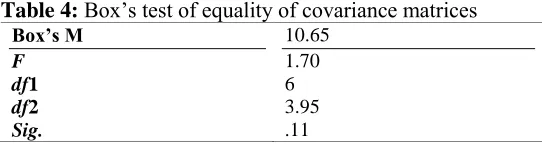
In the next stage, the assumption of linearity between the dependent variables was checked. To test whether the data violated the assumption of homogeneity of variance-covariance matrices, Boxʼs Test of Equality of Covariance Matrices was studied. The Boxʼs M Sig. value was .116, which was larger than .001; therefore, this assumption was not violated as shown in Table 4:
Table 4: Box’s test of equality of covariance matrices Box’s M
F df1
df2
Sig.
10.65 1.70 6 3.95 .11
To test equal variances, the next box to consider is the Levene’s Test of Equality of Error Variance shown in Table 5:
Table 5:Leveneʼs test of equality of error variances
F df1 df2 Sig.
Recognition 1.48 1 78 .226
True-False .19 1 78 .658
Scripturally Implicit
1.62 1 78 .206
p < .05
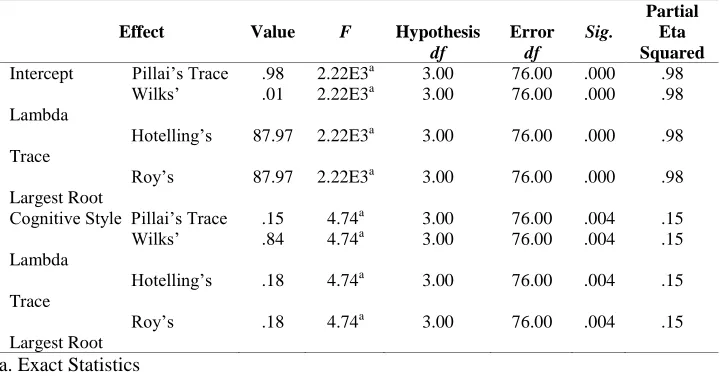
assumed, and the assumption of the equality of variance was not rejected. In order to see whether there were statistically significant differences among the groups on a liner combination of the dependent variables, the set of multivariate tests of significance was studied. One of the most commonly reported statistics, according to Pallant (2007), is Wilkʼs Lambda as presented in Table 6:
Table 6: Multivariate testsb
Effect Value F Hypothesis
df
Error
df
Sig.
Partial Eta Squared
Intercept Pillai’s Trace .98 2.22E3a 3.00 76.00 .000 .98 Wilks’
Lambda
.01 2.22E3a 3.00 76.00 .000 .98
Hotelling’s Trace
87.97 2.22E3a 3.00 76.00 .000 .98
Roy’s Largest Root
87.97 2.22E3a 3.00 76.00 .000 .98
Cognitive Style Pillai’s Trace .15 4.74a 3.00 76.00 .004 .15 Wilks’
Lambda
.84 4.74a 3.00 76.00 .004 .15
Hotelling’s Trace
.18 4.74a 3.00 76.00 .004 .15
Roy’s Largest Root
.18 4.74a 3.00 76.00 .004 .15
a. Exact Statistics
b. Design: Intercept + Cognitive Style
The Wilkʼs Lambda value was .842, with a significant value of .004 that is less than .05; therefore, there was a statistically significant difference between the FI/FD participants in terms of their metaphorical performance. Because a significant result was obtained on the multivariate test of significance, there was a chance to investigate further in relation to each of the dependent variables. Thus, the Test of Between-Subject Effects output box should be studied. Due to a number of separate analyses, Pallant (2007) suggests a higher alpha level to reduce the chance of a type I error. The most common way is to apply what is known as Bonferroni adjustment. In its simplest form, this involves dividing the original alpha level of .05 by a number of analyses that the researchers intend to do.
style) pinpointed a significant value less than the cut-off point (with the Sig. values of .004, .002, and .011). Thus, the significant difference between the FI/FD participants was on all kinds of the metaphor tests.
Table 7: Tests of between-subjects effects
Source Dependent
Variable
Type III Sum of Squares
df Mean
Square
F Sig.
Partial Eta Squared Cognitive
Style
Recognition 63.11 1 63.11 8.79 .004 .10
.11
.07 True-False
91.01 1 91.01 10.01 .002
Scripturally Implicit
11.06 1 11.06 6.70 .011
Error Recognition 559.77 78 7.17
True-False 708.97 78 9.08 Scripturally
Implicit
128.73 78 1.65
Total Recognition 7049.00 80 True-False 8039.00 80 Scripturally
Implicit
6692.00 80
Corrected Total
Recognition 622.88 79
True-False 799.98 79
Scripturally Implicit
139.80 79
a. R Squared = .10 (Adjusted R Squared = .09)
b. R Squared = .114 (Adjusted R Squared = .102)
c. R Squared = .079 (Adjusted R Squared = .067)
again considered somehow a large effect and which represents 11.4% of the variance. Finally, for the scripturally implicit test of metaphor, the Partial Eta Squared was .079, which is considered quite a moderate effect and which represents 7.9% of the variance.
Qualitative Research
To collect meticulous data from the “think-aloud protocol” and “retrospective analysis,” as Ghonsooly and Barghchi (2011) mentioned in their qualitative study, there are some key points pertaining to the number of participants and the criterion for their selection. Gathering verbal reports about the mental processes arising while doing a kind of cognitive activity stems from two myths. First, eloquent participants should be taken into account, the reason of which may lie in the fact that they are able to report their thought processes clearly. The second important concern for researchers is to make a choice between the participants’ L1 and L2. We opted for the participants’ L1 because, true as it may seem, most L2 learners express moments of difficulty thinking in English when they are engaged in comprehending metaphors. Furthermore, based on Ghonsooly and Barghchi (2011), insisting on the participants to use L2 in their verbal reports, researchers would miss some important facts about the cognitive tasks.
Participants
Eight L2 participants (i.e., four FD participants with high scores in the text-based test of metaphor and four FI participants with high scores in the recognition test of metaphor) were chosen to take part in this section. They were selected from the pool of the participants in the first phase of the study. To glean the data, the criterion was the participants’ metaphoric performance and their cognitive style of FI/FD.
Procedure
posted that the main aim of the test was to understand their thought processes by listening to their recorded voices later. In order to take a wide perspective on the cognitive tasks, we asked the participants to verbalize as many thought processes as possible. As an attempt to remedy the potential shortcomings, one of the researchers verbalized his thought process as an example. It should be mentioned that the applied scheme in the current study was somehow similar to the one used by Ghonsooly and Barghchi (2011) with some minor modifications.
Having finished the task, the participants were asked to go back to their reported strategies and comment on what they did. This aforementioned “retrospective” activity could be regarded as a useful measure. Because the information about the questions and the way of their understanding were still in the participants’ WM, doing “retrospection” immediately after the “think-aloud protocol” could be recognized as having an enormous influence. The point about this fact is the nearest to the view taken by Ghonsooly and Barghchi (2011). As they noted, spending more time between the completion of a task and retrospection would force the participants to retrieve information from their LTM, that is of little use for researchers. The processing strategies are classified in Tables 8 and 9:
Table 8: FI learners’ processing strategies
Strategy Example
Applying reprocessing, the learners go back, reread a sentence, and try to think more about that metaphor.
e.g., I knew all Justin’s stories were exaggerated. I saw through him the first time I met him./I will go back to the beginning and reread it.
Applying L1 equivalent, the learners try to find an equivalent for that metaphor in their mother tongue.
e.g., even if you are going to have some bad luck, it isn’t the end of the world./For the feeling of hopelessness in L1.
Applying mental mappings, particular keywords from the source domain may activate a conceptual metaphor that involves understanding one conceptual domain in the light of another conceptual one, and accordingly, the inference occurs.
e.g., keep your head down./The boss is in a bad mood. So, when somebody has his head down, he only pays attention to his own work not to make the boss angry.
Conceiving the two domains of metaphor (i.e., source domain and target domain) asdistinct domains, the learners try to understand metaphors.
explain the metaphors. through life with her head in the cloud./let me imagine that. When I dream . . . . Focusing on the separate parts, the
learners try to get the meaning of metaphors.
e.g., one minute she is on top of the world; the next she is very depressed./To be depressed and on top of the world, two separated parts with different meanings. Note taking, highlighting metaphors,
and underlining, the learners try to separate what they did not understand form the rest.
e.g., let me highlight this part in order to separate it from the rest and focus on it more later.
Table 9: FD learners’ processing strategies
Strategy Example
Applying the background and world knowledge, the learners try to draw inferences from the text and comprehend it.
e.g., based on what I know about the meaning of down and dumps, when somebody feels down in the dumps, makes me think that it must refer to low energy or unhappiness.
Having read the passage and gain a holistic understanding of each passage, the learners try to answer the questions.
e.g., Ok, I will read the text to get a total understanding of the metaphors mentioned. Then, I will answer the questions.
Applying deduction, the learners try to come to a conclusion and use what is perceived from the text in a logical way.
e.g., doing run-of-the mill tasks/I don’t know its meaning, but I know it must be about a state or mood of doing a task. Because John stayed in that company for a couple of years, it should show the mood of boredom.
Applying conceptual blending theory, metaphorical meaning is captured by a blended space having in common some structure from both source and target domains.
e.g., let me consider job as a ladder. When somebody is at the very bottom of that, he is novice and does not have a good position.
Applying previewing, the learners attempt to form a gist of the entire passage and get an idea of what it is about.
e.g., Ok, I will read it once to see what it is about.
Monitoring statement problem identification at sentence level, the learners identify a problem.
DISCUSSION
In brief, the results of the study indicate that the cognitive style of FI/FD is a source of systematic variance in metaphor test performance. According to the results of the recognition test, there was a significant difference in the mean scores of the FD and FI learners. Thus, the difference between these two groups may be attributed to the cognitive style of FI/FD in a way that the FI learners performed better in the recognition test of metaphor. Therefore, the first null hypothesis of this study is rejected:
H01: There is no difference between the performance of the FI/FD
learners on the recognition test of metaphor.
Also, the effect of the cognitive style of FI/FD was significant based on the mean scores of the text-based true-false test of metaphor. This means that the FD learners outperformed the FI ones in such questions. Therefore, the second null hypothesis of the current study is also rejected:
H02: There is no difference between the performance of the FI/FD
learners on the text-based true-false test of metaphor.
The third significant difference was between the mean scores of the FD/FI groups in the sciptally implicit test of metaphors. In fact, the FD learners outperformed the FI ones in answering the scripturally implicit questions of metaphor. Thus, the third null hypothesis below is rejected:
H03: There is no difference between the performance of the FI/FD
learners on the text-based scripturally implicit test of metaphor.
able to ignore the irrelevant context. In the former, FI learners use the approach of mapping across two distinct domains of source and target, which is in accord with Lakoff and Johnson’s (1980) model of conceptual metaphor. Regarding the latter, using the model of blending or conceptual integration of different domains, Fauconnier and Turner (1994, 1995, 1998) believe that FD learners conceive the source and target domains of metaphors as an integrated entity.
However, different L2 learners with different cognitive styles apply various strategies, albeit with a preference for one, and their preferred strategies match aspects of their cognitive styles. Therefore, they process conceptual metaphors in different ways.
A plane of this work attests to Oxford and Anderson’s (1995) hypothesis, explaining that holistic individuals study the whole picture of a problem, whereas analytic individuals focus on the separate parts of the problem. As in the current study, the FD participants focused on the text-based tests of metaphor consisting of true-false and scripturally implicit questions, whereas the FI participants outperformed on the recognition test of metaphor. In addition, the findings of the present study support the claims of researchers like Salmani-Nodoushan (2006) who claim that the cognitive style of FI/FD could be a factor affecting L2 learners’ performance on such different reading task types such as true-false— because holistic L2 learners should read the passage, gain a holistic understanding of each passage, and then answer the questions, they outperform their analytic counterparts on true-false tasks.
Another plane of this study pinpoints the significance of L2 learners’ WM in metaphor comprehension. As Baddeley (2002) acknowledges, it appears to be compelling evidence pointing to the fact that, through using central executive, FI learners have the ability to suppress the irrelevant information, whereas, through using the visuo-spatial sketch pad as one of the highly fruitful and important dimensions of WM, FD learners maintain the visual and special information.
process conceptual metaphors in different ways—through using different subcomponents of their WM. Based on the claims of Chiappe and Chiappe (2007), high WM capacity individuals could make better interpretations of metaphors. It is based on the premise that WM capacity is an important factor in metaphor processing.
CONCLUSIONS AND IMPLICATIONS
Being at the nexus of mind and language, metaphor manifests itself in a unanimous agreement among several scholars (Gibbs, 2006; Lankton, 2002; Roberts & Kreuz, 1994) who believe that the mind is metaphorical in nature. Everyday verbal or written communication, in line with its abundant uses of metaphor, is a testimony to so many occurrences of metaphorical language, and one cannot deny the main role of metaphor in the mental structure of thought.
Based on the pervasiveness of metaphor, L2 learners need to develop awareness of metaphor and strategies to comprehend this ilk of metaphorical language. MacLennan (1993) also advocates explicit classroom attention to metaphor and claims that metaphor is an integral part of language because learning the metaphorical patterns may pave the way for the acquisition of vocabulary. Also, L2 teachers should suggest some activities to help L2 learners develop strategies for comprehending metaphors.
What is more, the identification of the precise role of individual L2 learner differences and the way these differences debilitate or facilitate L2 learners’ metaphorical test performance are all of paramount importance. From another angle, different L2 learners apply various strategies, albeit with a preference for one and their preferred strategies match the aspects of their cognitive styles. For instant, L2 teachers can expect FD learners to face difficulties when the aforementioned learners are required to focus and maintain attention on text-based tests of metaphor in which both relevant and irrelevant stimuli are available. Therefore, it requires greater attempt to structure classroom and curriculum content to facilitate learning.
mysteries. Therefore, test developers do not need to stick to fixed tests to measure metaphors.
Last but not least, although quantitative studies can provide certain results in the realm of test performance, we tended to provide an avenue for future studies through conducting both a quantitative and qualitative study.This study was based on the premise that an awareness of individual differences in L2 learning would make L2 educators and program designers, in all probability, more sensitive to the roles of these differences in L2 teaching.
Bio-data
Mahmood Hashemianis an assistant professor at Shahrekord University and has published articles in academic journals like IJAL, IJLS, JALS, Linguistik Online, JLTR, TPLS, Iranian EFL Journal, IJEL, and International Journal of Social Sciences. Also, he has given lectures in national and international conferences.
Batool Fadaei is an M.A. TEFL graduate from Shahrekord University. She has publications in international journals like JLTR. She has recently published a book entitled Essential Collocations to Write English Articles (2012). Also, she has given lectures in national and international conferences.
References
Alderson, J. Ch. (1991). Language testing in the 1990s: How far have we come? How much further do we have to go? In S. Anivan (Ed.), Current developments in language testing (pp. 1-26). Singapore: SEAMEO Regional Language Center.
Alderson, J. Ch. (2000). Assessing reading. New York: Cambridge University Press.
Alptekin, C., & Ercentin, G. (2009). Assessing the relationship of memory working to L2 reading: Does the nature of comprehension process and reading span task make a difference? System, 37(4), 627-639.
Amanzio, M., Geminiani, G., Leotta, D., & Cappa, S. (2007). Metaphor comprehension in Alzheimer’s disease: Novelty matters. Brain and Language, 107(1), 1-10.
Anivan, S. (Ed.). (1991). Current developments in language testing. Singapore: SEAMEO Regional Language Center.
Baddeley, A. D. (2002). Is working memory still working? European Psychologist, 7(2), 85-97.
Barron. (2004). How to prepare for the TOEFL. New York: Barron’s Educational Series, Inc.
Bartlett, M. S. (1954). A note on the multiplying factors for various chi-square approximations. Journal of the Royal Statistical Society, 16, 296-298.
Blasko, D. (1999). Only the tip of the iceberg: Who understands what about metaphor? Journal of Pragmatics, 31(12), 1675-1683. Boers, F., & Littlemore, J. (2000). Cognitive style variables in
participants’ explanations of conceptual metaphors. Metaphor and Symbol, 15(3), 177-187.
Brown, H. Do. (2000). Principles of language learning and teaching (4th ed.). White Plains, NY: Addison Wesley Longman.
Charteris-Black, J. (2000). Metaphor and vocabulary teaching in ESP economics. English for Specific Purposes, 19(2), 149-165.
Charteris-Black, J., & Ennis, T. (2001). A comparative study of metaphor in Spanish and English financial reporting. English for Specific Purposes, 20(3), 249-266.
Chiappe, D. L. & Chiappe, P. (2007). The role of working memory in metaphor production and comprehension. Journal of Memory and Language, 56(2), 172-188.
Cohen, J. W. (1988). Statistical power analysis for the behavioral sciences (2nd ed.). Hillsdale, NJ: Lawrence Erlbaum Associates. Daniels, H. L. (1996). Interaction of cognitive style and learner control
of presentation mode in a Hypermedia environment. Unpublished doctoral dissertation, Blacksburg, Virginia.
Delfino, M., & Manca, S. (2007). The expression of social presence through the use of figurative language in a web-based learning environment. Computers in Human Behavior, 23(2), 2190-2211. Fauconnier, G., & Turner, M. (1994). Conceptual projection and middle
Fauconnier, G., & Turner, M. (1995). Conceptual integration and formal expression. Metaphor and Symbolic Activity, 10(3), 183-204. Fauconnier, G., & Turner, M. (1998). Conceptual integration networks.
Cognitive Science, 22(2), 133-187.
Fauconnier, G., & Turner, M. (2002). The way we think: Conceptual blending and the mind’s hidden complexities. New York: Basic Books.
Ford, N., & Chen, Sh. Y. (2001). Matching/Mismatching revisited: An empirical study of learning and teaching styles. British Journal of Educational Technology, 32(1), 5-22.
Gathercole, S. E., Pickering, S. J., Ambridge, B., & Wearing, H. (2004). The structure of working memory from 4 to 15 years of age. Developmental Psychology, 40(2), 177-190.
Ghonsooly, B., & Barghchi, B. (2011). An introspective study of L2 reading anxiety. The Journal of Teaching Language Skills, 3(1), 65-98.
Gibbs, R. W. Jr. (1994). The poetics of mind: Figurative thought, language, and understanding. Cambridge: Cambridge University Press.
Gibbs, R. (2006). Metaphor interpretation as embodied simulation. Mind and Language, 21(3), 434-458.
Harris, R. J., Friel, B. M., &Mickelson, N. R. (2006). Attribution of discourse goals for using concrete- and abstract-tenor metaphors and similes with or without discourse context. Journal of Pragmatics, 38(6), 863-879.
Jensen, D. F. N. (2006). Metaphors as a bridge to understanding educational and social contexts. International Journal of Qualitative Methods, 5(1), 1-17.
Kaiser, H. (1970). A second generation little jiffy. Psychometrika, 35(4), 401-415.
Kaiser, H. (1974). An index of factorial simplicity. Psychometrika, 39(1), 31-36.
Kintsch, W. (1998). Comprehension: A paradigm for cognition. Cambridge: Cambridge University Press.
Kövecses, Z. (2002). Metaphor: A practical introduction. New York: Oxford University Press.
Lakoff, G., & Johnson, M. (1980). Metaphors we live by. Chicago: University of Chicago Press.
Lakoff, G., & Turner, M. (1989). More than cool reason: A field guide to poetic metaphor. Chicago: University of Chicago Press.
Lankton, S. R. (2002). Foreword. In R. Battino (Ed.), Metaphoria: Metaphor and guided metaphor for psychotherapy and healing (pp. 5-15). Williston, VT: Crown House.
Leavy, A. M., McSorley, F. A., & Bote′, L. A. (2007). An examination of what metaphor construction reveals about the evolution of preservice teachers’ beliefs about teaching and learning. Teaching and Teacher Education, 23, 1217-1233.
MacLennan, C. (1993). Metaphor in language classroom: A case for change. ILEJ, 10(2), 137-152.
McCarthy, M., & OʼDell, F. (2002). English idioms in use. Cambridge: Cambridge University Press.
Miller, G.A. (1956). The magical number seven, plus or minus two: Some limits on our capacity for processing information. Psychological Review, 63(2), 81-97.
Miyake, A., & Shah, P. (Eds.). (1999). Models of working memory: Mechanisms of active maintenance and executive control. Cambridge: Cambridge University Press.
Oxford, R. L., & Anderson, N. J. (1995). A cross-cultural view of learning styles: State of the art article. Language Teaching, 28(4), 201-215.
Pallant, J. (2007). SPSS survival manual: A step by step guide to data analysis using SPSS for windows (3rd ed.). Maidenhead: Open University Press.
Riding, R. J. (1991). Cognitive styles analysis. Birmingham: Learning and Training Technology.
Roberts, R. M., & Kreuz, R. J. (1994). Why do people use figurative language? Psychological Science, 5(3), 159-163.
Salmani-Nodoushan, M. A. (2006). Is field dependence or independence a predictor of EFL reading performance? TESL Canada Journal, 24(2), 82-108.
Tendahl, M., & Gibbs, R. W. Jr. (in press). Complementary perspectives on metaphor: Cognitive linguistics and relevance theory. Journal of Pragmatics.
Thurstone, L. L. (1947). Multiple factor analysis. Chicago: University of Chicago press.
Turner, M. (1996). The literary mind. New York: Oxford University Press.
Witkin, H. A., Rastkin, E., Oltman, P. K., & Karp, S. A. (1971). Group embedded figures test manual. Palo Alto, CA: Consulting Psychologist Press.