Co 1. 2.
Med
Med
_______________ orresponding autho Musculoskeletal Re Sciences, Ahvaz, Ir Rehabilitation Rese Rehabilitation Scie
Predictiv
assessm
Seifollah Jaha
Received: 6 M
Abstract Background risk of falling community-dw Methods: In published from and specificity studies (QUAD Results: Of t to 61% in the in specificity of th Conclusion: was not possibl controlling the predictive accu
Keywords: Fa
Conflicts of Interes Funding:None *This work has bee Copyright© Iran
Cite this artic
systematic review
Introducti
Almost one experience fa health proble from mild inj studies, which people, the he early identific sary for adop ments of bala reported risk
dical Journa
J Islam Repub Ir
________________ or: Dr Akram Azad, a
ehabilitation Resea ran, & University of earch Center, Depa ences, Iran Universit
ve accura
ment for f
antabi-Nejad1,
ay 2018
d: Performance . The purpose welling older adu
this study, Pub m 1987 to 2017 t . The methodol DAS-2).
the 121 identifi ncluded studies he POMA rang Due to heterog le to determine e significant po uracy of POMA
lls, Older adult
st: None declared
en published under
University of Medi
cle as:Jahantabi w. Med J Islam R
on
e third of olde alls at least o em (1). A wi
jury to death h may cause a ealth system, cation of indiv pting fall prev
ance and gait factors for fal
al of the Islam
ran. 2019(1 May)
_
[email protected] rch Center,Ahvaz U Medical Sciences, T artment of Occupati
ty of Medical Scienc
acy of pe
falls in ol
, Akram Azad*
Published:
e Oriented Mob of this system ults. This revie bMed, EMBAS that aimed at v logical quality o
ied studies, 12 m s. The POMA c
ed from 24-91 geneity of the ty
a specific cuto otential confoun A for falls in old
ts, Sensitivity, S
rCC BY-NC-SA 1.0 li
ical Sciences
i-Nejad S, Azad
Repub Iran. 2019
r adults aged once a year, ide range of has been rep a significant fi
and the comm viduals at risk ventive strateg
are among th ll in older adu
mic Republic
);33.38. https://do
University of Medic Tehran, Iran ional Therapy, Scho ces, Tehran, Iran
erforman
lder adul
*2
1 May 2019
bility Assessme matic review w
w could provid SE, CINHAL, C
alidating POMA of the selected
met the inclusio cutoff point for
to 37-97, respe ype of studies, p off point for PO
nders (eg, age, der adults.
Specificity, Sys
icense.
A. Predictive a (1 May);33:38. h
60 years and o which is a m fall conseque ported in prev inancial burde munity (2). He k of falls is n gies (3, 4). Im
he most impo ults (5). There
c of Iran (MJ
oi.org/10.34171/m
cal
ool of
↑W
Fal phy two be
→
Th Mo ide
nce orien
lts: A sys
ent (POMA) is was to determi de useful inform Cochrane Libra
A and reporting studies was ass
on criteria and discriminating ectively.
participants, the OMA. In additio
, gender, and c
stematic review
accuracy of perfo https://doi.org/10.
older major ences vious en on ence, eces- mpair-ortant efore,
bala falls Bo asse a go they pare mult gest seve
IRI)
mjiri.33.38
What is “already
lling is a comm ysical and psyc o important fac considered in e
→What this artic
is systematic obility Assessm entifying risk of
nted mob
stematic
a commonly u ine the overall mation to use PO ary, EBSCO, an
g predictive val sessed using the
were entered in fallers from no
e definition of f on, using the sam
comorbidities)
w
ormance oriented .34171/mjiri.33.3
ance and gait s s in older adul oth single- an ess risk of fall ood choice for y have less va ed to multi-ite tifactorial nat ed the use of eral risk facto
y known” in th
mon problem in hological comp ctor in assessm evaluation.
cle adds:
review reve ment (POMA) f falls in older a
bility
review
used screening t predictive acc OMA in both re nd SCOPUS we lue with sufficie e Quality Asses
n the final anal n-fallers varied
fall, and use of me version and
would provide
d mobility assess 8
should be cons ts.
d multi-item i s. Although s r assessment i alidity and se em instrumen ure of falls, p multi-item ins ors for falls (
his topic:
in older people plications. Bala ment of risk of f
ealed Perform ) is an appro adults.
tool for identif curacy of POM esearch and clin ere searched to ent data to calc ssment of Diagn
lysis. Fall rate r d from 15 to 26
different versio d scoring metho
e better inform
sment for falls in
sidered in eva
instruments c single-item ins
in time-limite ensitivity to c nts (6, 7). Con
previous studi struments that (8). Assessme
e. It can lead t ance and gait ar falls that shoul
mance Oriente opriate tool fo
fying patients a MA for falls in nical settings.
identify studie culate sensitivity
nostic Accuracy
ranged from 5% . Sensitivity and
ons of POMA, i d of POMA and mation about th
n older adults: A
aluating risk o
an be used to struments are ed conditions, changes
com-nsidering the ies have sug-t invessug-tigasug-ted ent of risk of
o re d
d or
at n
es y y
% d
it d e
A
of
f
j
Predicting fa
falls is usuall assessment to the importan strength, bala ample, chair while Timed Index (DGI) tively (9-12). Assessment (P require muscu trol, and gait. been used in total score of and gait. The ance; 2. arisin ing balance nudged (subje er as possible ject’s sternum (at maximum sitting down) and 16. The g (immediately height; 3. step timated in re serve excursi course); 6. tr and maximum items (eg, ite items 1-4 and perform) or 1 2-6, 8 and 9 o the gait subs tive), or 2 (no sion, there ar names and sc Tinetti test, T Mobility Sco bility Assessm ure for predi and has vario confirmed the 0.75-0.97) (17 also been repo 17). The sens a range of 24%
Because o equipment, a has been used different sett Hence, it seem ate tool for id reasons for fa tive values o difficult to tra ting. Thus, co useful inform propriate scre the aim of th was to examin
alling risk by P
ly performed ools. Most of nt risk factors
ance, function -standing tes Up & Go (T assess functio . However, P
POMA) inclu uloskeletal fun
The original most studies, f 28 that inclu
balance subs ng; 3. attemp (first 5 secon ect is at a pos e, the examin m with palm o m position #6 , with a minim gait subscale h
after being t p symmetry; elation to floo
ion of a foo runk; 7. walk m score of 0 ems 1 and 7 d 7 of the gait 1 (cannot per of the balance cale) are sco ormal) (13). I e several vers coring method Tinetti Balanc ore, and Tinet ment). POMA icting risk of ous versions ( e reliability of 7-21). Concur orted using B sitivity of this
%-95% (13, 1 f ease of im and the minim d to assess th tings, includi ms reasonable dentifying fall
alls in older ad f POMA rep anslate the kn onducting a s mation to guid
eening tool in his systematic
ne the predict
POMA
using multi-it these tools as s for falls, i nal mobility, a st evaluates
TUG) test an onal mobility erformance O udes different nctions, balan version of th is the 16-item udes two sub cale has 9 item t to arise; 4. nds); 5. stan sition with fee ner pushes lig of hand 3 time 6); 8. turning mum and max has 7 items (1
told “go”); 2. 4. step contin or tiles, 12-in ot over about king stance),
0 and 12, res of the balan t subscale) are form), while e subscale and
red as 0 (abn In addition to sions of this t ds (eg, Tinetti ce Scale, Tin tti Performan A is used as an f falls in diffe
(14-16). Previ f POMA in old
rrent validity o BS (0.91) and test has been 17, 22-31). mplementation mum need for e risk of falls ing commun e to use POM
ers and non-fa dults. Howev orted in the l nowledge for u
systematic rev e its use as an n older adult c review with tive accuracy
tem or functio ssess only on including mu and gait. For
muscle stren nd Dynamic G
and gait, resp Oriented Mob
manoeuvres nce, postural c
is test, which m POMA, wi
scales of bala ms (1. sitting
immediate sta nding balance
et as close tog ghtly on the s es); 7. eyes clo 360 degrees ximum score o
. initiation of . step length nuity; 5. path nch diameter, t 10 feet of with a minim spectively. So nce subscale e scored as 0 (
others (eg, it d items 5 and normal), 1 (ad
the original v est with diffe i Fall Risk Ind netti Balance nce-Oriented M
n outcome m erent populati ious studies h der adults (IC of the POMA d TUG (-0.68)
reported to b
n, use of si r training, PO s of older adul
ity settings MA as an appr
fallers and pos er, various pr literature mak use in clinica view may pro n accurate and s (32). There hout meta-ana of POMA to i
onal e of uscle ex-ngth,
Gait
pec-ility that
has ith a ance bal- and-e; 6.
geth- sub-osed s; 9. of 0 gait and
(es- ob-the mum ome and (can tems 6 of
dap- ver-erent
dex, and Mo- meas-ions have CC = A has ) (9, be in
imple OMA ults in (13). ropri-ssible redic-kes it al
set-ovide d ap-efore, alysis
iden-tify
M
Se
Di EMB SCO com “Per Bala Fall “PO artic sion the 2017
St
Th parti diso ton’ large false (TN
No vide POM
Qu
Th by tw agno view betw risk of th selec The item risk mati
Flo
Fi tles judg on t extra follo gend defin cy ta artic ty w POM
In
St or on
risk of falls in
Methods
earch strategy
ifferent elect BASE, CINH OPUS, were s mbinations [M rformance-Ori ance and gait
Risk Index” OMA-B”, and cles in the En n of POMA (1 search includ 7 (Update 30/
tudy selection
he inclusion c icipants aged orders such as
s disease, and er; and (3) st e positive (FP N) data needed
ondiagnostic e enough infor MA were excl
uality assessm
he methodolog wo reviewers ostic Accurac wer resolved a ween authors w
of bias and a he risk of bia ction, index t
application o ms was also ju
of bias), and ion).
ow and timin
irst, all duplic and abstracts ging) were as the inclusion acted and ent owing items: t der distributio nition of fall a able was creat cles were ente were assessed MA in differen
dex test
tudies in whic ne of the eval
n older adults.
y
tronic databa HAL, Cochran
searched. The eSH terms] w iented Mobil
scale”, “Tinet ”, “Tinetti Te
“POMA-G”. nglish languag 6-item POMA ded the article
3/2018).
n and data ext
criteria were over 60 yea s stroke, Park d dementia; (2 tudies that rep P), true positi
to obtain pred and diagnosti rmation about uded.
ment
gical quality o based on the y Studies (QU any disagreem
was 86%. The applicability r as assessment est, reference of studies in udged by yes (
unclear optio
g
cate publicatio as well as ful sessed, and s and exclusion tered in evide the type and s on, cutoff po and follow-up ted and FN, T red in the tabl to investigate nt studies.
h POMA was uation tools w .
ases, includin ne Library, E e following te were used fo lity Assessme
tti Mobility T est”, “Tinetti Searches we ge. Since the A) was develo es published f
traction
as follow: (1 ars who had rkinson’s dise 2) the sample ported false n ive (TP), and
dictive accura ic studies tha t the predictiv
of the studies e Quality Asse UADAS-2), a ment. The agre e QUADAS-2 related concer t include pati e standard, flo the first 3 c (low risk of b ons (lack of su
ons were exc ll-texts (in cas studies were s n criteria. Th ence table tha setting of the oint used in t p period. A 2 × TP, FP, and TN le. Sensitivity e the predictiv
s used as the o were selected.
ng PubMed, EBSCO, and erms or their r the search: ent”, ‘Tinetti Test”, “Tinetti i”, “POMA”, ere limited to original ver-oped in 1987, from 1987 to
) studies with not comorbid ease, Hunting e size of 30 o negative (FN) d true negative
acy of POMA at did not pro ve accuracy o
was evaluated essment of Di and a third re eement percen 2 evaluates the rns (31). Item ient or sample ow and timing
cases of these bias), no (high ufficient infor
cluded. The ti se of difficulty selected based hen, data were at included the study, age and the study, and × 2 contingen N values of the y and specifici
ve accuracy o
only index tes h d g-or
), e . o-of
d i- e-nt
e ms e g. e h
r- i-y d e e d d
n-e i-of
st
Reference s
In the prese considered: “ ing on the gro
Results
Study selec
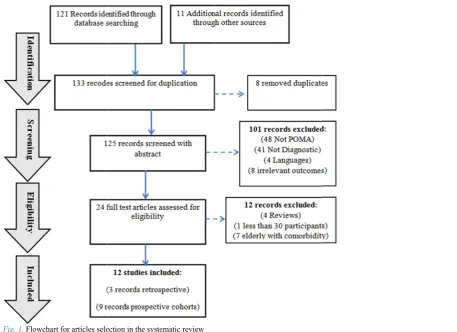
Overall, 13 fied. Eight du stracts were inclusion crite ing 24 article lowing reaso sample size l with comorbi ed in this syst
Study chara
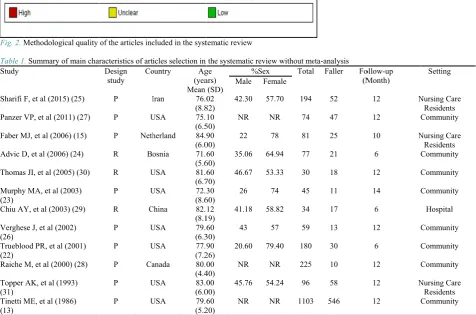
Of the 12 in low-up period 25-28, 31) an history during (24, 29, 30) community-d retrospective on older adul tive studies) ( to hospitals (
Fig. 1.Flowchar
standard
ent study, the Sudden chang ound or an obj
ction
33 potentially uplicate abstra
also excluded eria. By review es, 12 articles
ns: 4 articles less than 30, id disorders. F tematic review
acteristics
ncluded studi d between 6 a nd 3 were retr g the past 6 t
(Table 1). Ei dwelling older
studies) (13, lts residing in (17, 25, 31), a (retrospective
rt for articles sele
following def ges in the bod
ject (3)”.
y eligible abst acts were exc d after screen wing the full-s were exclud s were review
and 7 had e Finally, 12 art w (Fig. 1).
es, 9 were pro and 14 month rospective an to 12 months ight studies w r adults (6 p 22-24, 26-28 n nursing hom and one on old ) (29). The n
ection in the syste
finition of fall dy state due to
tracts were id luded and 10 ning based on
text of the rem ded due to the w article, 1 h lderly particip ticles were inc
ospective with hs (13, 17. 22 d investigated
using recall were conducte
prospective an , 30), 3 were mes (only pros
der adults adm number of pa
ematic review
l was o
fall- denti-1 ab-n the main-e fol-had a
pants
clud-h fol-2, 23,
d fall form ed on and 2 done spec-mitted
artici-pant 1103 23, How spec stud
ble 1
of 7 clud spec In clud follo clud past 41% ies w to 2 feren repo 100% parti the repo repo rang rosp
ts in 9 include 3, with a samp 25-27, 31) an wever, the num
ctive studies r dies had a sam
1). Mean ± SD 72.30±8 - 84. ded prospectiv
ctive studies (2 n this study, 50 ded prospectiv ow-up period. ded retrospecti year was 27 % to 83% of th
were female. 6, with sensit nt included s orted by 65% o
% of the parti icipants witho 12 included s orted in Faber orted in any s ge 54%-92% a pective studies
ed prospective ple size less th nd larger than mber of partic ranged from 3 mple size larger D age of the p
90±6 and 71 ve (13, 17, 22
24, 29, 30), re 0% to 61% of ve studies had The number ive studies wh % (24), 55% he participants Different cut tivity of 24% tudies. The u of all participa cipants with a out fall history studies, ceiling r study (17). T study. POMA and 64%-79% s, respectively
e studies rang han 200 in 7 s n 200 in 2 stu
cipants in 3 i 34 to 77 and er than 200 (24 participants wa .60±6 - 82.12 2, 23, 25-28, espectively (T
f the participan d experienced r of participan ho experienced
(30), and 59 s in different toff points ran %-95% were re use of assistiv ants in Faber a fall history a y in Thomas g and floor ef The time of f A accuracy w % in the prosp
y.
ged from 45 to tudies (17, 22 udies (18, 28) ncluded retro none of these 4, 29, 30) (Ta
as in the range 2±8 in the in
31) and retro
Table 1). nts in the 9 in d falling in the nts of the 3 in
d falling in the 9% (29). Also
included stud nging from 15 eported in dif ve device wa study (17) and and 72% of the study (30). O ffect was only falling was no
as reported to ective and ret
o 2, ).
o-e
a-e n-
o- n-e
n-e o,
d-5 f-as
d e Of y ot o
Predicting fa
Study quali Figure 2 sh sessment of QUADAS-2, was moderate mains of app 25, 27, 28, 33 (26, 31, 32) studies (17, 2 participants’ s fall definition up period, mo of bias. Based unclear, and h 29), 2 (30, 33
Predictive a
Among pro and Panzer dwelling olde nal version o cutoff point o spective studi
Fig. 2.Method
Table 1.Summ Study
Sharifi F, et al
Panzer VP, et
Faber MJ, et a
Advic D, et al
Thomas JI, et
Murphy MA, e (23) Chiu AY, et al
Verghese J, et (26) Trueblood PR (22) Raiche M, et a
Topper AK, et (31) Tinetti ME, et (13)
Abbreviations: P that describes re
alling risk by P
ity
hows a summ the 12 inc the overall q e. Six studies plicability con
3). There was and unclear 29, 30). Due t selection (ie, n (eg, referenc
ost studies we d on applicab high level of c 3), and 3 (26, 3
accuracy of th
ospective stud (27) conduc er adults and u of the POMA of 15, 25, an ies of the Tru
dological quality
mary of main cha
l (2015) (25)
al (2011) (27)
al (2006) (15)
(2006) (24)
al (2005) (30)
et al (2003)
l (2003) (29)
al (2002)
, et al (2001)
al (2000) (28)
t al (1993)
al (1986)
P=Prospective (A st esearch information
POMA
mary diagram luded studie quality of the s were rated ncerns and ris a high risk of risk of bias to the lack of
selection bias ce standard), a ere rated as hi bility concerns concern in 7 ( 31, 32) studie
he included st
dies, Tinetti ( cted a study used the total (eg, total sco nd 26, respect ueblood (22),
of the articles inc
racteristics of art Design
study Co
P I
P U
P Neth
R Bo
R U
P U
R C
P U
P U
P Ca
P U
P U
tudy that involves ta from the past.), NR
of the quality s. Based on e included stu
as low in all sk of bias (19 f bias for 3 stu
for the remai information a s), criteria use and lack of fol igh or unclear s, there was a 17, 19, 24, 25 s, respectively
tudies
(13), Riache y on commu
score of the o ore of 0-28), tively. In the Murphy (23)
cluded in the syst
icles selection in ountry Ag (yea Mean Iran 76.0
(8.8
USA 75.
(6.5 herland 84.9
(6.0 osnia 71.6
(5.6
USA 81.6
(6.7
USA 72.3
(8.6 China 82.
(8.1
USA 79.6
(6.3
USA 77.9
(7.2 anada 80.0
(4.4
USA 83.0
(6.0
USA 79.6
(5.2
aking a cohort of inf R=Not Reported
y as-n the
udies l do-9, 24,
udies ining about ed for llow-r llow-risk
low, 5,
27-y.
(28),
unity- origi-with
pro-, and
Verg olde poin scor of 1 the F whic care
O setti sion used cuto sion Chiu to ho
Se
Am cuto of P port used
tematic review
the systematic re ge
ars) (SD)
%S Male
02 82)
42.30
10 50)
NR
90 00)
22
60
60) 35.06 60
70)
46.67
30 60)
26
12 19)
41.18
60 30)
43
90
26) 20.60 00
40)
NR
00 00)
45.76
60 20)
NR
formation and watc
ghese (26) th er adults, bala nt of 12, 12, a re of the origi
9, 19, and 20 Faber (17), Sh ch were cond e centres (Tabl
f the retrospe ings, one stud n of POMA, w d the score o off point of 11 n of POMA, w
u study, which ospitals (Tabl
ensitivity anal
mong 12 inclu off point of 20 POMA in elde ed the highes d the score o
eviewwithout me Sex Total
Female
57.70 194
NR 74
78 81
64.94 77
53.33 30
74 45
58.82 34
57 59
79.40 180
NR 225
54.24 96
NR 1103
ching them over a lo
hat investigate ance subscale and 10 was u inal version o 0, was used in harifi (25), and ducted in elder
les 1 and 2). ective studies y used the tot with cutoff poin
f POMA bal (30). The tot with cutoff po h was conduct
es 1 and 3).
lysis
uded studies, for the total s erly residents
st sensitivity of POMA bal
eta-analysis Faller Fo
(M
52
47
25
21
18
11
17
13
30
10
58
546
ong period.), R=Retr
ed the commu of the POM used, respectiv of POMA, wit n the prospect d Topper (31) rly residents
s conducted tal score of th int of 18 (24), lance subscale tal score of th oint of 21, wa ted on older a
Topper (31) s score of the or
of nursing ca (93%). Of th lance subscal
ollow-up Month)
12 N
12
10 N
6
12
14
6
12
6
12
12 N
12
trospective (A histo
unity-dwelling MA with cutof
vely. The tota th cutoff poin tive studies o ), respectively of the nursing
in community he original ver
and one study e (0-16), with he original ver as only used in adults admitted
study that used riginal version are centres, re he studies tha e, the highes
Setting
Nursing Care Residents Community
Nursing Care Residents Community
Community
Community
Hospital
Community
Community
Community
Nursing Care Residents Community
rical cohort study
g ff al nt of y, g
y
r-y h
r-n d
d n e-at st
sensitivity (83 cutoff point o
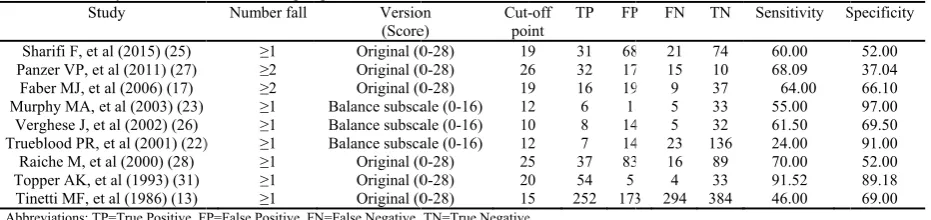
Of the 12 in was reported tres (31) usin original versio score of POM (97%) was f with cutoff po
Considering ies that used t cutoff point w ficity), as rep ies that used MA, the best with 91% sen
Discussion
POMA is w falls in older POMA are al resulting in w and clinical s sults of previ types, target p record fall co the studies, cu tive power of of the predic adults that pr about POMA
Retrospecti sectional stud 21 (24, 29, 3 by POMA an Since various cutoff points clinical or res retrospective accuracy was also very sma
Table 2.Summ St
Sharifi F, et Panzer VP, e
Faber MJ, et Murphy MA, Verghese J, e Trueblood PR, Raiche M, et Topper AK, e Tinetti MF, e
Abbreviations: T Table 3.Summ
Advic D, e Thomas JI,
Chiu AY,
Abbreviations: T
3%) was obtai of 11 in comm ncluded studie
for elderly re ng cutoff point on of the POM MA balance s found for com
oint of 12 (23) g both sensiti the score of PO was 11 (with 8
orted by Murp the total score t cutoff point nsitivity and 8
n
widely used as r adults. Diffe lso needed for widespread use settings. How ous studies is populations, d onsequences, utoff points, a f POMA. This ctive accuracy
rovides accur A predictive ac ive studies co dies that repor 0). These stu nd considered s factors may could not be search setting studies condu s less than 78
all (eg, less t
mary of main char tudy
al (2015) (25) et al (2011) (27)
t al (2006) (17) et al (2003) (23) et al (2002) (26)
et al (2001) (22) t al (2000) (28) et al (1993) (31) et al (1986) (13)
TP=True Positive, FP
mary of main char Study
et al (2006) (24) et al (2005) (30) et al (2003) (29)
TP=True Positive, FP
ined in Thoma munity-dwellin
es, the highest esidents of the t of 20 for the MA. Of the stu subscale, the h mmunity-dwel
).
vity and spec OMA balance 83% sensitivi phy (23). How e of the origin t was reported 9% specificity
s a functional erent manoeuv r doing activit e of the POMA wever, general
s difficult due definition of fa versions of th and parameters s was the first y of POMA rate and cons ccuracy. onducted on P
rted cutoff poi dies evaluated d fall history y affect balan used as optim s. Moreover, ucted on the and the num than 22 partic
racteristics of pro Number fall
≥1 ≥2 ≥2 ≥1 ≥1 ) ≥1 ≥1 ≥1 ≥1
P=False Positive, F
racteristics of retr Number f
≥2
) ≥1
≥1
P=False Positive, F
as study (30), ng older adults t specificity (8 e nursing care
e total score o udies that use highest specif lling older ad
cificity in the e subscale, the
ty and 75% s wever, of the nal version of d by Topper y (Tables 2 an
tool for predi vres performe ties of daily liv A in both rese lization of th e to different s
all, method us he POMA use s related to pr
systematic re for falls in o sistent inform
POMA were c ints of 11, 18 d balance and in different ti nce function, t mal cutoff poin the sample si POMA predi mber of fallers cipants). As d
ospective articles Versio
(Score Original (0 Original (0 Original (0 Balance subsca Balance subsca Balance subsca Original (0 Original (0 Original (0
N=False Negative,
rospective articles
fall Ve
(sc Origin Balance sub
Origin
N=False Negative,
with s. 89%) e
cen-of the ed the ficity dults,
stud-e bstud-est
speci- stud-f PO-(31),
nd 3).
icting ed in iving, earch he
re-study sed to ed in redic-eview
older mation
cross , and d gait imes. these nts in ize of ictive s was
deter-mini need not b
In accu were of th 31). heal of fu hosp tions the poss well may with stud 225 num in 2 exce size othe som the c cann adul stud POM addi used stud a ce cuto tive olde able nal very POM
on e)
Cut-poi 0-28) 1 0-28) 2 0-28) 1 ale (0-16) 12 ale (0-16) 10 ale (0-16) 12 0-28) 2 0-28) 20 0-28) 1
TN=True Negative
s ersion
core)
C
nal (0-28) ubscale (0-16) nal (0-28)
TN=True Negative
ing the cutof ds a large sam be trusted (Ta
n the included uracy in older e reported for he original ve Some of the lthy communi function, while
pitals or nurs s selected in th
heterogeneity sible explanat l as sensitivity y be the differ h sample size dies (Tinetti st (28); and Tru mber of fallers
of the 3 stud ept for the Tin and number er hand, cutof me included pr ceiling effect not be appropr lts. Furthermo dies (22, 23,
MA. Because ition to balanc d to predict ris dies (22, 23) r
eiling effect o off point is als study of Tin er adults with e for determin version of PO y low sensitiv MA in this stu
-off int
TP FP
9 31 68 6 32 17 9 16 19
2 6 1
0 8 14
2 7 14
5 37 83 0 54 5 5 252 173
e
Cut-off point
TP
18 11 11 15 21 14
e
ff point in d mple size, the r
able 3). prospective s
adults, cutoff r predicting fa ersion of POM
se studies sel ity-dwelling o e others selec ing care cent hese studies m y of appropri tion for hetero y and specifici
rent sample si of equal to o tudy, n = 110 ueblood study was very sma dies, all the in netti study, hav
of fallers an ff points of 2 rospective stu of POMA. Th riate for detec ore, some of 26) only use falling depen ce, the results sk of falls in o eported cutoff of POMA bal
so questionab netti, conducte
a large sampl ing the diagn OMA for risk vity (46%) an udy, the cutoff
P FN TN
8 21 74 7 15 10 9 9 37 5 33 4 5 32 4 23 136 3 16 89
4 33 3 294 384
FP FN TN
18 10 38 4 3 11 6 3 11
diagnostic acc results of thes
studies on POM ff points betw
alls based on MA (13, 17, 2
lected the par older adults w cted the elder tres. Thus, va may be one of riate cutoff p ogeneity of c ity of POMA ize of the inc or larger than 03 (13); Riac y, n = 180 (2 all (equal to o ncluded prosp ve a disadvan nd cannot be 25 and 26 we udies (27, 28) herefore, these cting risk of fa f the include ed the balanc nds on mobili s of these stud older adults. T ff point of 12,
lance subscal ble. Thus, only
ed on commu le size (n = 11 nostic accurac
k of falls. Ho nd specificity f point of this
Sensitivity S
60.00 68.09 64.00 55.00 61.50 24.00 70.00 91.52 46.00
Sensitivity
53.00% 83.00% 82.40%
curacy studie se studies can
MA predictive een 15 and 26 the total score 22, 23, 25-28 rticipants from with high leve
rly admitted to arious popula f the reasons o point. Anothe cutoff point a in older adult cluded studies 180 only in 3 che study, n = 22)). Since the or less than 30
ective studies tage in sample
cited. On the ere reported in ) that are nea
e cutoff point alls in all olde ed prospective ce subscale o
ity and gait in dies cannot be Two of these 3 which is nea e. Hence, thi y the prospec unity-dwelling 103), was suit
y of the origi owever, due to
(69%) of the study (i.e. 17
Specificity
52.00 37.04 66.10 97.00 69.50 91.00 52.00 89.18 69.00
Specificity
68.00% 75.00% 64.70%
s
n-e 6 e 8, m el o a-of er as ts s, 3 = e 0) s, e e n ar ts er e of n e 3 ar s
c-g t- i-o e 7)
Predicting fa
cannot be use risk of falls in are warranted POMA to pre The heterog and settings standardizatio col explained item POMA) risk of falls in
Considering populations, n scale used in of POMA can in older adult
Conclusion
The results particularly o of aging and n older adults. risk of falls in search and cli
Acknowled
This paper tional therapy University of
Conflict of I
The author interests.
Reference 1.Park SH, Lee in prediction f 2.Yamashita T, dwelling olde 2012;52(6):82 3.Nevitt MC, C A prospective 4.Jazaeri SZ, A
Saberi ZS, et on postural c 2018;13(2):e0 5. Rubenstein L strategies for p 6. Diamantopou tive indicator 2001;38(2):26 7.Taghizadeh G of sensory-mo motor functio Ther. 2018;31 8.Scott V, Voto mobility asses ty, home-supp 2007;36:130– 9. Berg KO, W
balance in th Health. 1992; 10.Hernandez D
not fall using 2008;89(12):2 11.Herman T, I The dynamic
alling risk by P
ed as an opti n older adults d to determine edict risk of fa geneity of typ precluded m on of assessm d in the origina ) should be u n older adults g the heteroge number of fa
the included nnot be sugge s.
n
s of this artic occupational th
need a good to POMA is an n older adults inical settings
dgement
was extracted y in School o f Medical Scie
Interests
rs declare th
es
e YS. The diagno falls. West J Nurs , Noe DA, Bailer er adults: logistic
22-32. Cummings SR, Hu
e study. J Geronto Azad A, Mehdiz al. The effects o ontrol in patient 0192168. LZ. Falls in older
prevention. Age A ulos A, Winklhof rs: An alternativ 69–77.
G, Azad A, Kashe otor training on on in patients wit
1(4):486-93. ova K, Scanlan A ssment tool for fa port, long-term –9.
Wood-Dauphinee he elderly: Valid
83(2):S7–11. D, RoseDJ. Pred
the 30-second ch 2309-3315. Inbar-Borovsky N
gait index in hea POMA
imal cutoff po (Table 2). Th e the optimal alls in older ad
e of studies, o eta-analysis, ment condition al version of th used in future
using POMA eneity of type allers, and typ studies, a sp ested for pred
cle are useful herapists who ool for predic appropriate to s, which can b s.
d from a PhD of Rehabilitat ences, Tehran,
hat they hav
stic accuracy of t s Res. 2017;39(1
AJ. Risk factors regression tree a
udes ES. Risk fac ol. 1991;46(5):M zadeh H, Habibi of anxiety and ext s with Parkinson
r people: Epidemi Ageing. 2006;35 fer HM. Index co ve to scale devel
efi S, Fallah S, D hand and upper th idiopathic Park
A, Close J. Multif all risk among old
and acute care
SL, Williams J dation of an inst
dicting which ol hair stand test. A
N, Brozgol M, G lthy older adults:
oint for predi hus, further stu
cutoff point o dults. outcome meas
and thus a b based on a p he POMA (i.e e studies to a
.
e of studies, t pe of POMA ecific cutoff p dicting risk of
for all therap o work in the
ting risk of fa ool for identif be used in bot
thesis on occ ion Sciences, , Iran.
ve no comp
the Berg Balance 1):1502-25.
of falls in comm analysis. Geronto
ctors for injurious 164-70.
SA, Najafabadi ternal attentional n's disease. PLoS
iology, risk facto (2):37-41. onstruction with f
lopment. J Mark
Daneshjoo F. The extremity sensor kinson disease. J
factorial and func der adults in com settings. Age A
I, Maki B. Mea trument. Can J P
der adults will o rch Phys Med Re
iladi N, Hausdor the role of stair c
icting udies of the
sures, better
proto-e, 16-assess
target sub-point f falls
pists, field alls in fying th
re- cupa-, Iran
peting
e Scale
munity-ologist.
s falls:
i MM, l focus S One.
ors and
forma-k Res.
effect ry and J Hand
ctional mmuni-Ageing.
asuring Public
or will ehabil.
rff JM.
climb-in 12.
fu 19 13.T in 14.Y
Re Or 20 15.P an di 16.S
et m 17.F
of 20 18.M
Ti 19.
an ye 20.
of 20 21.H
to Ph 22.T D ty 20 23.M
in 24.A
fa 20 25.S M nu 26.V
al vi 27.P
m Ar 28.R at 20 29.
tes Re 30.T of Re 31.T of typ 32.K m 33.W
Re m 20
g, fear of falling Podsiadlo D, Ric unctional mobilit
991;39(2):142–8. Tinetti ME. Perfo
elderly patients. Yucel SD, Sahin eliability and va riented Mobility 012;9:149-59.
Park J, Koh SB, nd reliability stud
sease. J Mov Dis Schulien S, Pflug
al. German tran ent according to T Faber MJ, Bossch f the performan 006;86(7):944–54
McGinty SM, Ma inetti gait and bal
Mecagni C, Sm nkle range of mo ears: A correlation Protas EJ, Harris f balance and gai 000;22:372–8.
Harada N, Chiu V improve functio hys Ther. 1995; 7 Trueblood PR, H . Performance an -dwelling elderl 001;24(1):2-6.
Murphy MA, Ols community-dwe Avdic D, Pecar D
ll risk factor in 006;6(1):50-7.
Sharifi F, Fakhrz MA, et al. Predicti
ursing home. Arch Verghese J, Busc . Validity of divi duals: A prelimin Panzer VP, Wak ent: Sensitivity a rch Phys Med Re Raiche M, Heber risk of falli 000;356(9234):10
Chiu AY, Au-Y sts in discriminat ehabil. 2003;25(1 Thomas JI, Lane f 4 measures of f ehabil. 2005;86(8 Topper AK, Mak f balance and gai pe of fall? J Am G Kopke S, Meyer ent. Z Gerontol G Whiting PF, Ru eitsma JB, et al. ent of diagno 011;155(8):529–3
and gender. Gait chardson S. The
y for frail elde
ormance-oriented J Am Geriatr Soc F, Dogu B, Kur alidity of Turkis y Assessment.
Oh E, Kim JS, Y dy of Korean Tin
ord. 2018;11(1):2 gard L, Petersen nslation of perfor Tinetti. Z Geront her RJ, Van Wie nce-oriented mo 4.
asters LD, Till D ance assessment ith JP, Roberts K otion in commun nal study. Phys T s C, Moch C, Rus it in frail nursing
V, Fowler E, Lee oning of older pe 75(9): 830–8. Hodson-Chennaul nd impairment-ba ly: Sensitivity
son SL, Protas E lling elderly. J A D. Significance o n the third age
zadeh H, Memar ing risk of the fal h Gerontol Geriat chke H, Viola L, ded attention task nary study. J Am
efield DB, Hall C and specificity of ehabil. 2011;92(6) rt R, Prince F, Co ng with the 001–2.
eung SS, Lo SK ting fallers from n 1):45–50.
JV. A pilot study falls risk in frail 8):1636–40. ki BE, Holliday P
it in the elderly p Geriatr Soc. 1993 r G. The Tinetti Geriat. 2006;39:2 utjes AW, Westw
QUADAS-2: A r ostic accuracy 36.
Posture. 2009;29 timed “Up & Go erly persons. J
d assessment of m c. 1986;34(2):119 rsakal S, Sahin T sh version of th Eur Rev Agi
Yun JU, Kown DU inetti mobility te
24-9.
H, Lutz M, Voll rmance oriented tol Geriatr. 2017; eringen PC. Clino
obility assessme
DB. Inter-tester re scale. Issues Agi KE, O’Sullivan nity-dwelling wo Ther. 2000;80(10) sk M. Sensitivity g home residents
e M, Reuben DB eople in resident
lt N, McCubbin ased assessments and specificity
EJ, Overby AR. S Aging Phys Act. 2 of specificity of B
of life. Bos J
ri A, Najafi B, all among aged ad atr. 2015;61(2):12 Katz M, Hall C ks in predicting f Geriatr Soc. 200 CB, Wolfson LI f measurement se 6):905-12.
orriveau H. Scree Tinetti balance
K. A comparison non-fallers in old
y to explore the p l elderly patients
PJ. Are activity-b predictive of risk 3;41(5):479–87.
test. Babylon in 88-91. wood ME, Mall revised tool for t studies. Ann
9(2):237–41. o”: A test of basi
Am Geriatr Soc
mobility problem 9-26.
T, Kuran B, et al. he
Performance-ing Phys Act.
U, et al. Validity st for Parkinson
land Schussel K, mobility assess-50(6):498-505. ometric propertie ent. Phys Ther
eliability using th ing. 1999;22:3–5 SB. Balance an omen aged 64–8
):1004–11. of a clinical scal . Disabil Rehabi
. Physical therap tial care facilities
A, Young clark among communi y. Issues Aging
Screening for fall 003;11:66–80. B-POMA test an
Basic Med Sc
Nazari N, Khoe dult residents of 24-30.
C, Kuslansky G, e falls in older indi 2;50(9):1572–6. . Mobility assess ets in older adults
ening older adult e scale. Lancet
of four functiona der people. Disabi
predictive validit . Arch Phys Me
based assessment k of falling and/o
n geriatric assess
lett S, Deeks JJ the quality assess n Intern Med ic c.
ms
es r.
he . d 7
le l.
y s.
ke i-g.
ls
d i.
ee a
et
i- s-s.
ts t.
al il
ty d
ts or
s-J, s-d.