15 Available online at www.ijiere.com
International Journal of Innovative and Emerging
Research in Engineering
e-ISSN: 2394 - 3343 p-ISSN: 2394 - 5494
Studies on Development of Refining process for Biodiesel
using polyamide Nanofiltration Membrane
Prof. M.K.Ahire
a, Prof.P.P.Joshi
b, Nidhi Adke
ca,b,c K.K.WAGH I.E.E.& R ,Nasik , Maharashtra, India.
ABSTRACT:
In this study Nanofiltration polyamide spiral wound membrane module were used separately to refine crude biodiesel containing glycerol and unreacted oil. The polyamide nanofiltration membrane module was operated at permissible range of pressure. The permeate was collected and analyzed for composition using GC and physical parameters such as density and kinematic viscosity, calorific value and flash point are investigated using standard testing procedures. The quality of biodiesel obtained through nanofiltration membrane module is compatible with diesel and meet all requirements as compared to international commercial grade biodiesel.
Keywords:Biodiesel, transesterification, Nanofiltration, commercial grade.
I. INTRODUCTION
Biodiesel is a renewable fuel which consists of fatty acid methyl ester currently produced by transesterification of triglycerides (oil and animal fats) with methanol or ethanol. Methanol is preferred due to stability of product. After biodiesel synthesis the downstream processing steps involve the purification of crude biodiesel, as well as separation of excess methanol (recyclable), glycerol as by product. For conventional process water washing is the only step left creating effluent. For refining a biodiesel of production capacity 20 Litre/hr the energy cost is 15 Rs/hr, whereas in present work refining using membrane technology such as nanofiltration, the cost of same production is reduce to 1/2 of the conventional process with enhanced refinement and saving in the energy and water for water washing and decreasing NOx removal as our process removes the unreacted oil, glycerol and soap[3].
A. Biodiesel: “Biodiesel is a renewable fuel that consist of fatty acid methyl ester currently produced by transesterification of triglyceride with suitable alcohol especially methanol” [4].Biodiesel is prepared from renewable natural source such as vegetable oil, animal fat and microalgae oil. Carbon-dioxide to a greater extent than that contributed to the atmosphere when used as fuel in diesel engines. Also, biodiesel has similar physicochemical properties to that of Diesel produced from crude oil and can be used directly to run existing diesel engines without major modifications or as a mixture with petroleum diesel and produces less harmful gas emission such as sulphur oxide.
B. General Biodiesel production process
Transesterification consist of consecutive and reversible reactions as follows [4]
Volume 2, Issue 9, 2015
16 Methanol attacks acid component in triglyceride molecule forming diglyceride along with fatty acid methyl ester (biodiesel) molecule. Generally this reaction is carried out at 60° C.
STEP 2:
Further methanol attacks acid component in diglyceride molecule forming monoglyceride along with fatty acid methyl ester (biodiesel) molecule.
STEP 3:
At the last methanol attacks acid component in monoglyceride molecule forming glycerol along with fatty acid methyl ester (biodiesel) molecule. The reactions are reversible although the equation lies towards production of fatty acid esters and glycerol. The stepwise reactions are reversible and little excess of alcohol is used to shift the equilibrium towards the formation of esters. The presence of excess alcohol make forward reaction pseudo first order and reversible reaction is found to be second order. After transesterification, usually glycerol is separated by conventional sedimentation from biodiesel. Biodiesel and glycerol are sparingly mutually soluble .There is palpable difference in density between biodiesel (880 Kg/m3) and glycerol (1050 kg/m3) phases [4]. This difference in density is sufficiently enough for the application of simple technique such as gravitational settling or centrifugation for separation of biodiesel and glycerol phases. We can obtain about 80 % pure glycerol by this means. However, emulsions and soap presence decreases separation efficiency. This process is normally followed by a FAME washing step to remove free glycerol, soap, alcohol excess and residual catalyst. In this step, large water volumes are used, generating a wastewater stream that must be treated.
CVarious technologies for manufacturing of biodiesel:
Sr.
no. Variable
Base catalyst
Acid catalyst
Lipase catalyst
Supercritical alcohol
Heterogeneous catalyst
1 Reaction temperature 60-70 °C 55-80 °C 30-40 °C 239-385 °C 180-220 °C
2 Free fatty acid in raw material
Saponified
product Esters
Methyl
esters Esters Non sensitive
3 Water in raw material Interfere with reaction
Interfere with reaction
No
influence --- Non sensitive
4 Yield of methyl ester Normal Normal Higher Good Normal
5 Recovery of glycerol Difficult Difficult Easy --- Easy
6 Purification of methyl ester
Repeated washing
Repeated
washing None --- Easy
7 Production cost of
catalyst Cheap Cheap
Relatively
expensive Medium
17 D. Comparison between biodiesel and diesel
Table: 1 Comparison between Biodiesel and diesel
Parameters Diesel Biodiesel
Cetane number 45 60
Carbon residue 0.35% 0.002%
Flash point(°C ) 60 145
Sulphur 05 Nil
Biodegradable No Yes
O2 Nil 10%
Aromatics 5% Nil
Lubricity 2000-5000 7000
II. OBJECTIVE OF RESEARCH WORK
To make oil and glycerol free biodiesel.
To make biodiesel with lower kinematic viscosity and density.
Higher kinematic viscosity means problems for pumping, combusting and atomizing the fuel to fuel injector of the diesel engine.
To study membrane processes that are available like microfiltration, ultrafiltration and nanofiltration.
To make biodiesel refining process cost effective.
To develop biodiesel refining process with minimum or no water consumption.
III.EXPERIMENTALPROCEDURE.
Crude biodiesel was purchased from K.M.T. Agro processing LTD, Hingane ,Satara, Maharashtra.
Density, kinematic viscosity, composition of crude biodiesel was analyzed by standard methods.
These values were tabulated in observations.
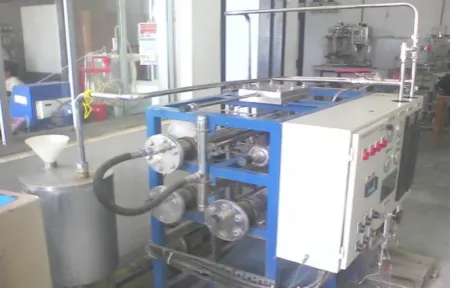
The setup used for refining shown below.
Polyamide membrane with pore size of 0.2micron and surface area 1.75 cm2 spiral wound microfiltration membrane module was used for refining of biodiesel.
Accurately measured quantity of crude biodiesel was taken in feed tank.
12 liter of crude biodiesel feed was charged to feed tank.
The crude biodiesel was passed through nanofiltration membrane module at various membrane pressures.
Inlet and outlet membrane pressure , permeate flow rate and reject flow rate were observed and recorded for each run.
Permeate and reject were collected in separate container, measured and permeate was analyzed using gas chromatography to know composition of permeate.
Physical parameters like density, kinematic viscosity were measured using standard procedure.
A. Proposed membrane technology
The major problem in refining of biodiesel is energy used in thin film evaporator and distillation, whereas membrane module work at lower energy input.
The setup for biodiesel refining is as shown below.
Volume 2, Issue 9, 2015
18 B. Refining using nanofiltration process
The nanofiltration setup used for refining is shown in fig: 1 Crude biodiesel with partially separated glycerol is taken 12 liter in feed tank. Following table shows feed characteristics of crude biodiesel
Table 2. Analysis of feed biodiesel
Unreacted oil Glycerol Biodiesel Density
(kg/m3) Kinematic viscosity (mm
2/sec)
9.2325 24.5223 66.2452 886.2 9.62
The crude biodiesel is passed through nanofiltration polyamide spiral wound membrane module with surface area 1.75cm2 with Feed rate of 6LPM. Permeate and reject are collected in separate container and permeate is analyzed using Gas chromatography. The results are as shown.
Table 3. Observation Table
Sr
No. Run
Batch
Volume Pi Po Pt QP Qr Vp Vr
Nano Filtration Liter Kg/cm2 Kg/cm2 Kg/cm2 LPM LPM Liter Liter
1 NF1 12 6 0.5 3.25 1.8 11 8 4
2 NF2 12 6.5 0.5 2.75 1 11.3 7.6 4.4
3 NF3 12 7 0.5 3.25 0.8 11.5 7.0 5
All the composition are analyzed by G.C at 200°C
Table 4. Results
Sr. No.
Oil Rejected %
Glycerol Rejected%
Biodiesel Rejected %
Biodiesel Processed %
Density of
permeate
( kg/m3)
Kinematic
viscosity
(mm2/sec)
NF1 89.34 88.64 40.4 59.6 860.9 6.89
NF2 90 87.8 47 53 860.6 6.80
NF3 90.6 89.5 47.8 52.2 860.6 6.79
C. Results and discussion
Above results clearly tells us the effectiveness of membrane technology where glycerol and unreacted oil are successfully removed through crude biodiesel .Effectiveness of nanofiltration is addressed. Refining efficiency of nanofiltration is high. There is a tremendous decrease in kinematic viscosity and density of a biodiesel.
19
IV.CONCLUSIONS
Biodiesel is a noticeable product for future energy needs, where any waste, edible, non edible oil is a promising material for production of biodiesel commercially. Commercially biodiesel is produced from such feed stock oil using transesterification process by methanolysis in presence of acid or base catalyst. Biodiesel obtained after completion of transesterification and removal of glycerol contain fraction of unreacted oil, free glycerol, hence called as crude biodiesel. For improving quality of crude biodiesel, nanofiltration membrane technology is adapted where polyamide spiral wound nanofiltration membrane is used in this work. Refining of biodiesel using nanofiltration membrane completely avoid utilization of water and thus refining of biodiesel takes place without water and hence water consumption is minimized. The nanofiltration membrane separation processes have many advantages that improve the total efficiency of biodiesel refining, high purity of final biodiesel product, and economics of biodiesel refining as compared to other traditional as well as emerging methods.
REFERENCES
[1] Atadashi I.M. ,M.K.Aroua, A.R.Abdul Aziz, N.M.N Sulaiman, “ Membrane biodiesel production and refining technology” , Elsevier rser.2011.07.051, 2011
[2] Anton A. Kiss , Radu M. Ignat , “Enhanced methanol recovery and glycerol separation in biodiesel production – DWC make it happen”, Elsevier applied energy vol.99 pg. 146-153 , 2012.
[3] BabaganaGutti, Shittu S. Bamidele and Idris M. Bugaje , “Biodiesel Kinematics Viscosity Analysis of BalaniteAegyptiaca seed oil” ARPN Journal of Engineering and Applied Sciences , 2012.
[4] Brayan R. Moser , “Biodiesel production , properties and feed stocks” , Spinger , 2009 .
[5] D. Ramesh ,A.Sampathrajan , P.Venkatachalam, “Production of biodiesel from jatrophacurcas oil by using pilot biodiesel plant”,Study report shared in 2001.