Copyright © The Author(s). All Rights Reserved. Published by American Research Institute for Policy Development DOI: 10.15640/jea.v6n1a4 URL: https://doi.org/10.15640/jea.v6n1a4
A Participatory Educational Experiment of Engaging Children in Reshaping Built
Environments - A Mutual Impact: Children and Cityscapes
Dania Abdel-Aziz
1,& Hanin I. Shuqair
2Abstract
This paper addresses the need for transformational changes and adaptations in city-design thinking of today, on both local Jordanian and international levels; adaptations that are to make cities of today more inclusive, sustainable and resilient. The change in viewing conventional planning processes discussed is to further enhance global design and planning shifts towards participatory planning by embracing new input from different city users; also children, where their ideas are to be creatively channelled into creating quality living spaces and enhance place-making mechanisms. This research aims at shedding light on both the possibility and capability of integrating children in different design tasks regarding improving their environments. This research also emphasizes on the importance of giving children an opportunity to express their views and gain an understanding and appreciation of how planning is intimately linked to many aspects of their daily lives and the future of their communities, but also incorporating their imagination and experiences into making better places for happier people of all ages, on many city scales. Through a series of carefully designed workshops, children's perception of their built environments, their experiences, their judgement and decision-making on finding solutions and alternatives to problems of resource allocation for example, spatial relationships among different land uses, proximity of health facilities and educational services and environmental protection were explored, based on what they themselves would like to change in reference to their own daily lives. Qualitative observations were taken and analysed, and afterwards summarized and compared to prevailing planning and design practices and concepts.
Keywords: City, design and planning, integration, participation, workshop, youth, place-making.
1.Introduction
1.1. A right to participate
Modern cities must respond to the needs of diverse citizens in order to establish safe well-functioning communities. All citizens have something to contribute and a right to be heard and this includes children and youth as well. We often hear of slogans such as “children and youth are our future”, but their opinions and needs are rarely considered in decisions affecting the future of their communities. One of the UNICEF`s messages is for every child to be heard, then why not also in planning and design?
Generally, and throughout history, children were excluded from the direct involvement in planning and design processes, and were regarded more as an issue that needed to be cared for, designed for and protected. More contemporary planning approaches open the door wide for willing city dwellers to take part in all planning phases from design to implementation, and this is where this research finds it crucial to also consider the youth and children in similar processes, to promote the best interests of not only children more effectively, but all city dweller as well. Article 12 of the Convention on the Rights of the Child (UNCRC), assures that states parties should take into consideration children's point of views in all aspects that contribute in forming their own lives in accordance with the age, maturity and the capability of forming ideas of the child.
1 Department of Architecture, The University of Jordan, Amman, Jordan. Email: [email protected]
This right advocates their involvement in decision-making, it speaks to the right to be heard when decisions are being made that affect them and is a form of participatory democracy that promotes responsible citizenship, noting that this does not give children and youth a right to self-determination (Unicef, 1989). The capacity for responsible citizenship is shaped in childhood through education, practice, observation, involvement and opportunity (U.S. Department of Education, 2005). Youth participation also promotes the capacities of children and resiliency by building on youth strengths, including energy, enthusiasm, and creativity (Lansdown, 2011) (Canadian Institute of Planners). Moreover, the Committee on the Rights of the Child considers that recognising the right of the child to express views and to participate in various activities, according to her or his evolving capacities, is beneficial for the child, the family, the community, the school, the state and democracy (Lansdown, 2011).
The experience of children participation internationally, although in very basic ways, provides a growing body of evidence with a widespread positive impact. Extensive studies by researchers and advocacy groups, such as the University of Minnesota Division of General Paediatrics & Adolescent Health and the US-based Search Institute, showed that children who feel involved, safe, valued, and connected are less likely to engage in risky behaviours (Canadian Institute of Planners).
Taking children‟s views into account helps them acquire decision-making and problem-solving skills, develop children‟s self-esteem, build competence, develop meaningful relationships, gain confidence, cognitive abilities, extend aspirations, social skills and respect for others. These benefits are known to protect youth against risk-taking behaviour that impacts negatively on health both in the short and long-term (Kränzl-Nagl & Zartler, 2009).
This knowledge and experience relate to both matters affecting children as individuals and matters of wider concern to children as a group. Realizing the fact that, children have a unique body of knowledge about their lives, needs and concerns, together with ideas and views which derive from their direct experience involving them in the planning process will positively help whom are responsible for decision making and programs to fulfil the available resources more relevant, more effective and more sustainable towards finding more successful approaches to issues affecting children (Wiens, 2016).
This research aims at extending these basic rights even further by integrating them into action channels where children`s rights are not only advocated for but also reflected physically in every aspect of the living environment, bringing more quality and positive change into communities overall, especially in cities of the third world countries. Children with awareness of where they live and an understanding of how city systems work are expected to lead to more direct and indirect positive change with time as they spread awareness among peers and spark an eagerness for development and growth. Through the promotion of children‟s and youth‟s right to be heard and to participate also in planning their communities, planners and educators of all levels will acquire an appreciation for children and youth inputs, leading to more responsive solutions and a safer and healthier tomorrow.
1.2. Amman, a Middle Eastern Metropolis: Most Pressing Issues
Planning in most third world countries has long been practiced by planners and still is, representing a game of monopoly with a little opportunity given to those impacted by decisions to participate or express. International experiences, although more participatory in many cases, still lacks mature mechanisms to involve all urban dwellers in different planning and implementation processes, although strongly encouraged for example by the 1989 United Nations Convention on the Rights of the Child.
Amman, the capital city of Jordan of 799.93 km2 and a population of 4 million inhabitants (Greater Amman Municipality, 2015), is a city that went through a lot of changes throughout the past centuries, driven mainly by spurts of immigration and political situations, hence it grew to form a multi-cultural, diverse and complex metropolis (Daher, 2008). Amman`s complex composition and tough topography and the need to accommodate for changes resulted in muddling through the approach to design and planning, reflecting an unsustainable, poorly serviced neighborhoods, and lack of attention to open and public spaces.
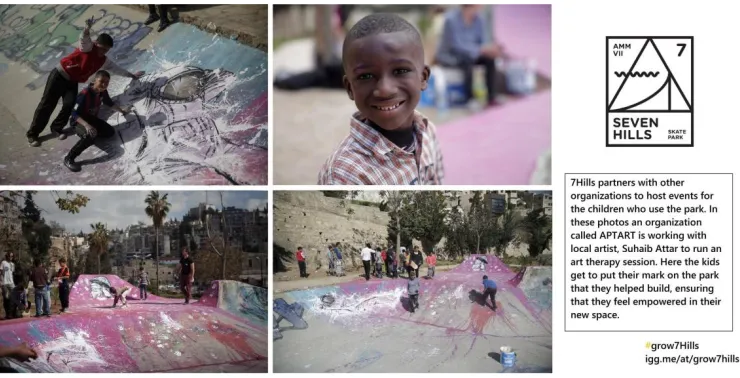
Figure 1. 7 Hills Skatepark in Amman. Source: 7 Hills Skatepark, 2015.
Jordan is a highly motorized country; with a high car ownership rate with 1 out of every 5 Jordanians owning a private car according to traffic studies, with predictions that this rate will increase further (Central Traffic Department, 2013), with Amman facing this problem in folds due to the concentration of population and services.
Public transportation is still behind and fails to respond to the urging needs, pedestrian and other non-motor-vehicle means of transportation are extremely primitive and unsafe. A number of projects were suggested and partially implemented but not operated to enhance public transportation, for example, the BRT, yet none of them has proven to be a viable solution to increasing car ownership, at least not till the moment. One local initiative, Maannasel, took matters into hand and collaborated with residents to produce a comprehensive and interactive unofficial map of public transportation in Amman, providing Ammani citizens with information regarding routes, destinations and times of different available public transportation means (Maannasel, 2017). Children in most cases depend entirely on parents or relatives for their commutes, mostly in private cars, especially in the absence of the concept of walkability in the distribution of activities.
Land use is another problem present, where a fair mixture of activities, built-up areas and open spaces are often disconnected either by distance and the need for transportation, or the difficulty of arriving to desired places which require the crossing of heavy used roads with no proper, safe and age-friendly facilities for crossing, making it not only difficult for adults but also for youth and children, resulting in them being bound to their houses and private gardens, if available, or local streets. The pedestrian experience in the capital in extremely disrupted by trees planted on sidewalks, private vendors selling their produce on the side of streets, and the sidewalks being of poor construction with no street furniture or respect to users with special needs (Al-Asad, 2004), check Figure (2).
Figure 2. A scene often seen on Ammani`s streets, a sidewalk interrupted by a large tree. Source: CSBE, 2004.
A block is a piece of a neighbourhood and the very smallest part of a community in a city (city, town, village, etc.). The block that a child lives in represents his/her first real contact with the world outside their homes. How that block functions will determine a young person‟s interaction with neighbours and with the community that they live in (Canadian Institute of Planners).
The Neighbourhood as a collection of blocks is an important piece of any community. It is described as a large geographically and diverse space to be explored. The Cambridge English Dictionary defined The Neighbourhood as "the area of a town that surrounds someone's home, or the people who live in this area by taking a closer look at this specific area, you can see how it looks and feels, how it is designed, what it contains and how it has changed" (Dictionary, 2007). In a more simplified way, a neighbourhood is described as having rows of homes, many streets, and people that live there.
Neighbourhoods are compact, pedestrian-friendly, and mixed-use with many activities of daily life available within walking distance (U.S. Department of Housing and Urban Development and The Urban Institute, 2000). The way this neighbourhood is arranged or “planned” affects many aspects of a young person‟s life, whether they can walk to school or the park, and whether or not they can go to the store by themselves. New development should help repair existing neighbourhoods or create new ones and should not take the form of an isolated “project.” As those young people get older their movement within this neighbourhood expands exponentially giving them more freedom in moving because they become more independent and responsible.
If children understood their neighbourhoods this will widen their awareness of the form and function of their immediate surroundings, encouraging them to think about how they work and feel, and what makes them good places to live in.
1.3.2. Elements of the city
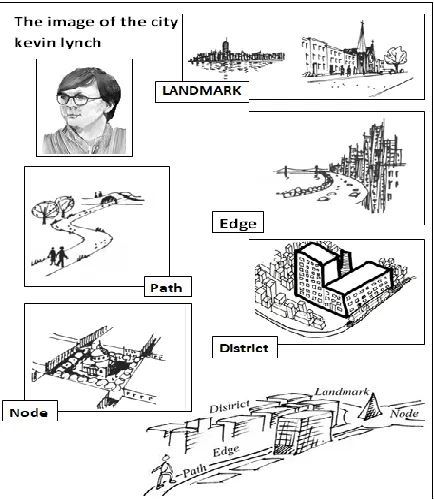
A city as perceived by children might vary from the image of adults and might be described as a large town made up of tall buildings, markets, banks, schools, post offices, libraries, parks and made up of neighbourhoods. Image of the city is a book written by Kevin Lynch in 1960, that has long been a useful resource for planners to understand cities, in his book he illustrated what elements in a built structure of a city are important in the perception of the city, see Figure (3).
According to Kevin Lynch, a city is constructed in space, but on a vast scale. It is described with its surroundings and elements and perceived by the viewer‟s mind which is important. Each city is formed by elements that he listed, nodes, paths, districts, edges and landmarks, see table (1) below. In order to effectively be involved in designing new inclusive, dynamic, sustainable cities or develop existing ones, we need to make a visual plan (map), analyse the forms and public areas and understand problems, opportunities and apply them (Lynch, 1960).
Table (1): Kevin Lynch`s Elements of the City summarized. Source: (Lynch, 1960)
Element Definition Example
Paths are the channels along which you move. Walkways, streets and highways are paths.
Edges are boundaries between two regions Rivers, forests, mountains, and hills all create edges.
Nodes are strategic spots in the community Junctions or crossings of paths, circles, gates, and forum.
District an inside area of recognizable character. Every community is made up of a number of districts.
Landmark a simply defined physical object. Sign, statute, and building
1.3.3. Community Planning Principles
As this research believes that a basic knowledge of primary city elements is not sufficient for being able to manipulate plans and experiment with them, children will also be introduced to some of the tools that planners use to direct growth and change in cities and communities. All are instructed in a simple and fun manner through examples. What would happen if we didn‟t try to control how and where buildings are built in our community? How important is planning to communities? Why do we need planning anyway? Are only are few brain teasers to be used in the workshops to stimulate children`s interaction and interest.
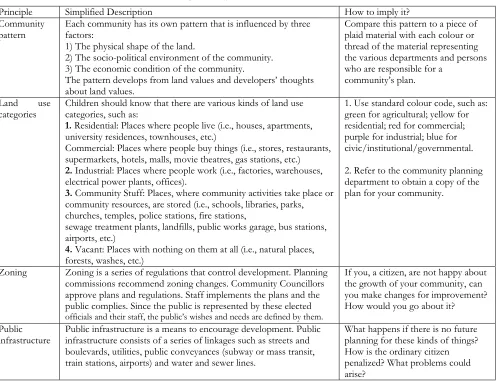
Table 2. Community Planning Principles. Source: (Canadian Institute of Planners)
Principle Simplified Description How to imply it?
Community
pattern Each community has its own pattern that is influenced by three factors: 1) The physical shape of the land.
2) The socio-political environment of the community. 3) The economic condition of the community.
The pattern develops from land values and developers‟ thoughts about land values.
Compare this pattern to a piece of plaid material with each colour or thread of the material representing the various departments and persons who are responsible for a
community‟s plan.
Land use
categories Children should know that there are various kinds of land use categories, such as:
1. Residential: Places where people live (i.e., houses, apartments, university residences, townhouses, etc.)
Commercial: Places where people buy things (i.e., stores, restaurants, supermarkets, hotels, malls, movie theatres, gas stations, etc.)
2. Industrial: Places where people work (i.e., factories, warehouses, electrical power plants, offices).
3. Community Stuff: Places, where community activities take place or community resources, are stored (i.e., schools, libraries, parks, churches, temples, police stations, fire stations,
sewage treatment plants, landfills, public works garage, bus stations, airports, etc.)
4. Vacant: Places with nothing on them at all (i.e., natural places, forests, washes, etc.)
1. Use standard colour code, such as: green for agricultural; yellow for residential; red for commercial; purple for industrial; blue for civic/institutional/governmental.
2. Refer to the community planning department to obtain a copy of the plan for your community.
Zoning Zoning is a series of regulations that control development. Planning
commissions recommend zoning changes. Community Councillors approve plans and regulations. Staff implements the plans and the public complies. Since the public is represented by these elected officials and their staff, the public‟s wishes and needs are defined by them.
If you, a citizen, are not happy about the growth of your community, can you make changes for improvement? How would you go about it?
Public
infrastructure Public infrastructure is a means to encourage development. Public infrastructure consists of a series of linkages such as streets and boulevards, utilities, public conveyances (subway or mass transit, train stations, airports) and water and sewer lines.
1.3.4. Children and Teamwork
Workshops are carefully planned to evoke a higher degree of collaboration and interaction, through group exercises and the mutual exchange of thoughts and ideas. To work successfully in groups, children are encouraged to work with others and do things they might only know how to do individually. Children are expected to be able to explain their ideas to others, listen to alternative ideas and perspectives, reach consensus, delegate responsibilities, coordinate efforts, resolve conflicts and integrate the contributions of multiple team members (Barkley et. al, 2005).
2. Problem statement
With city planning approaches evolving and changing to face new global challenges and to turn cities into more inclusive, habitable and sustainable places of living, children as seen by this research, are a still to be an exploited potential. This research aims at examining children`s capabilities of experimenting with planning solutions that are influenced by their own experiences in their environments and the applicability of their input in the different design and implementation processes. Also, this research will look into the effects of early exposure to concepts of social and physical aspects of cities of today by children.
With the exposure of children to planning and design concepts and exercises, where they are expected to explore their initial responses and capability to reflect on the different aspects of potential and hurdles as the main research topic, children`s awareness and understanding of primary city components; including open areas, built-up areas & the connective tissue represented in infrastructure and roads, is to be encouraged.
Throughout a series of experimental workshops, children were introduced to the basic terminologies used to describe a given master/site plan, to enhance their capabilities of communicating ideas and solutions. In doing so, children were able to understand basic relationships between different parts of a master/site plan and were able to come up with notes and observations regarding what is positive and what is negative and suggest solutions and actions to correct, enhance, and replace issues present. Children were also made aware of what makes an environment good or bad, and why, simply through discussion sessions, enabling them to search for ways to turn a bad neighbourhood for example into a good one, as they came up with guidelines of pros and cons inspired by their own daily lives and experiences.
2.1 The workshop
Workshops are carefully designed to give children the maximum opportunity to invent, use their intuitive skills and think with the minimum influence of the researchers, which did not exceed a general introductory session to assess children`s awareness and perception of their environments and a few guidelines of what cities are generally composed of and how a city cares for its residents, and encouraged to always bear in mind their own daily experiences and what they would want to change.
2.1.1. Target Group
This research focuses on children 6-12 years of age throughout all the workshops. Children are randomly selected, with different backgrounds and residing in different geographic areas across Amman but with no specific order of selection and with no prior involvement in any similar activities. The number of children in one session or workshop should not exceed 10 children, divided into groups of 3 to 5 children.
2.1.2. Design of workshops
A typical workshop would last 2 full hours, divided into a short introductory session and a second more elaborate design session, guided by the researchers and a number of volunteers.
Workshops are to take place in a well-prepared space, hosted by an architecture for children studio, equipped with all needed drawing and construction material.
And to aid children in understanding the varying scales of cities, workshops are designed to help children imagine their cities from a bird's eye view starting from their suggested house designs and expanding through blocks and neighbourhoods.
Once the children are comfortable enough, they will be asked to draw simplified maps of their newly designed cities; and afterwards, build them up building by building. It is important for children not to be shy and use the terminologies learned and apply the words and symbols while working.
o Desired outcomes
oGeneral outcomes
A basic understanding of city components: built-up areas (positive space), open areas (negative space) and connective infrastructures and services.
Establish a familiarity with some general and planning specific terminologies, to enable both verbal communication and expression through maps. Terminologies include; house, garden, street, block, neighborhood, scale, park, sidewalk, yard, buildings (of different functions), car, pedestrian, market, map, top view, plan, etc.
Comprehend the role of city elements in how a city works.
The importance of the 5 senses in experiencing a space.
Children are to be encouraged to come up with notes and observations to be used as design guidelines for their work.
oResearch specific outcomes
Children`s capability to respond to problems and to suggest solutions and actions to correct, enhance, and replace issues present and as experienced by them is to be examined, through a critical observation and evaluation method of their responses as they design on paper and produce related models.
o Methodology
After welcoming children and giving them safety instructions, a number of photographs of Amman and its varying areas are presented to the children (printed):
a.Different city components are discussed and listed.
b.Differences and similarities between the different photos are indicated:
i. All houses and buildings have a common purpose: protection and providing services for the wellbeing of people.
ii. Buildings differ in their height, density, details, type (single units or apartments), etc.
2..1. Introductory session
Is simply a brief introduction of 30 minutes of basic terminologies, city elements and functions, through a series of questions and brainstorming activities. Through the introductory session, children will also understand that we perceive the world around us not only through eyesight but through other senses as well. Walking around a block is a way to take a closer look at a community, observe how it is shaped, and develop ideas about how it could be made an even better place to live. Using your eyes, ears, and nose, you can discover a lot! To begin with, children are asked whether they know what senses are and what senses humans have, check Figure (4).
Figure 4. Brainstorming Introductory Session. Source: Researchers, 2017. 2..2. Design Session
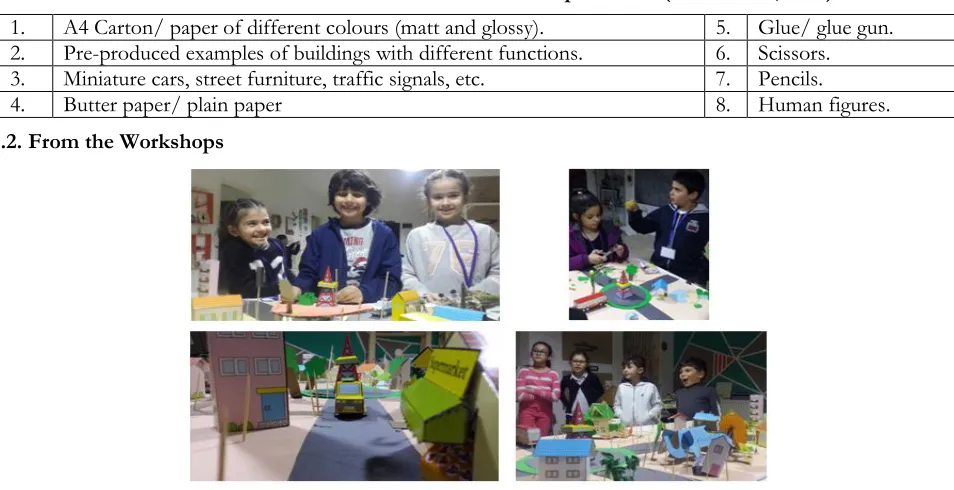
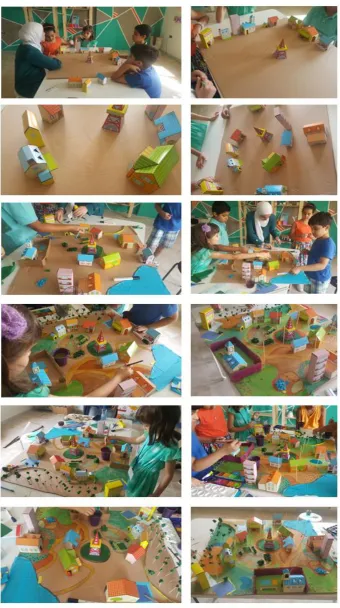
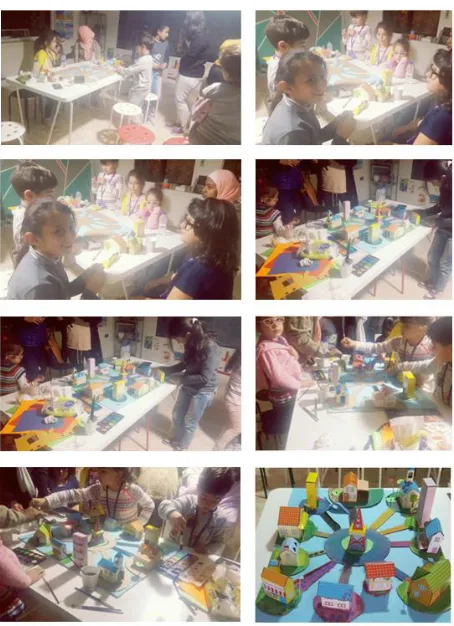
Children are now asked to reproduce their city by drawing it on A1 contour cartoon by simply making a map. This included identifying the buildings types, street network, green spaces, and any places they think it was important to them (supermarket, mosque, school...etc). A sample of their work is shown in Figures (5, 6, 7, 8, 9, 10) below. It is important to make sure that all children do incorporate all their ideas, knowledge as well as feelings in the workshop. Children`s work is discussed collectively as each member expresses what the work is about. Deep discussion negotiated, where to locate the residential area?, how to take in mind different categories of our community (children, youth, adults, handicapped people,...etc), what kind of roads shall we make? where to place parks and public facilities? and much more. Then they used different tools and materials such as, pre-modelled houses and buildings blocks, coloured carton, watercolours to convert their 2d map into a 3d model, check table (3) below. They also learnt how to cut, glue and paint what they think would make a suitable portrait of where they live, see Figures (5, 6, 7, 8, 9, 10) below. Discussions and reflections on their final work are inspired by the questions such as, what made those cities better than the one we live in? In what ways they were similar or different?
Table 3. Tools & Materials used in the workshop. Source: (researchers, 2017)
1. A4 Carton/ paper of different colours (matt and glossy). 5. Glue/ glue gun. 2. Pre-produced examples of buildings with different functions. 6. Scissors. 3. Miniature cars, street furniture, traffic signals, etc. 7. Pencils.
4. Butter paper/ plain paper 8. Human figures.
2.3.2.From the Workshops
Figure 7. Group -C- creates a model for their ideal city during the workshop. Source: (researchers, 2017)
Figure 9. Group - E- creates a model for their ideal city during the workshop. Source: (researchers, 2017)
Figure 10. Group - F- creates a model for their ideal city during the workshop. Source: (researchers, 2017) 3.Results
This discussion also took into account the environment, transportation as well as Parks & Recreation areas (what you did to dismiss the traffic jam and parking lots problem? Is there a public transportation network? what procedures did you make to ease ambulance and emergency movement? how many parks does your community, are they enough? what facilities do those parks contain?).
3.1. Children`s perspective
It was found that children had a more focused attention on the following matters:
3.1.1. Public Spaces
The number and spread of parks and open spaces was the main problem. Even some children live in highly populated areas without any single park and they use parking lots as open spaces. They also raised the issue of unclean parks that don't have public services such as, toilets. Some of them mentioned that there were no parks near to their living places and therefore it is difficult to play outside while some have to go out in search of play spaces to the streets, where they become more prone to accidents. Some highlighted that the available spaces are either occupied by smoking teenagers, or construction trash and due to lack of toilet facilities people use these spaces for defecation. They highlighted that playing is an integral part of childhood as recreation is very important for mental, physical and ecological growth. Through sports, they learn a number of lessons like leadership quality, team spirit, etc. Therefore it is imperative that parks are built with trees, benches, grass and children from all economic classes play together.
3.1.2. Transport and safety:
Children discussed issues of transport in their city. Some of them compared it to the other cities they had visited. They stated that they mainly depend on private cars to go their daily trips and the public transpiration network is poor. They negotiated that this made their trips longer and caused a lot of car accidents, and makes it difficult for them to cross roads safely. This was the main reason why their parents don't allow them to go to short destinations alone and made their movement in their neighbourhoods difficult. This even contributed in expanding their feeling of being unsafe and afraid of pedestrians accidents. Some of them highlighted that having more vehicles on road contributes pollution both air pollution and noise as well. They noted that education of using zebra crossing lines, footbridges and tunnels was spread in schools and families, although there was a lack of them in some streets. The traffic signals and street-lights are often dysfunctional and very often, the signals get covered by the branches of nearby trees. They suggested that ideally, the city should have lanes for bicycles and a wide covered public transport system.
4. Findings
The parents as an audience were enchanted by the details of the project and the children who participated in the workshop enjoyed it, too. We were bubbling over with enthusiasm for what we saw as the potential inherent in teaching design thinking.
Children understood that they are part of multiple locations at the same time. They understood what makes up the different locations such as neighbourhoods and cities. We live in many different places at once. Baring in mind that children are the assets of a nation, necessary steps should be taken to, keep them safe, raising the quality of their life and make them more involved in planning and design decisions. Children, although in some cases found logical yet hard to implement ideas, were found to pay attention to their small scale in the large city, pedestrian life and car-free areas were often suggested, plenty of accessible open spaces and services were located in proximity to residential dwellings and every experience no matter how big or small had to be designed to be unique and enjoyable. To the researchers` surprise many ideas and concepts did go along with worldwide best practice, and hence would be a great addition to planning inputs, especially in detailed designs for open spaces. Moreover, training children from young ages through similar activities, would awake a sense of responsibility and belonging in the children, where they will also be able to use the knowledge acquired to understand the environment surrounding them.
4.1. Key Messages
The badly designed street network is directly affecting children‟s movement in their neighborhoods.
Children observed that the cities are not friendly for people walking or cycling; only cars and heavy vehicles take up space and in turn cause traffic jams and pollute the air.
Children observed that many of the built-up areas in Amman are too dense with no play areas with too high heights (for example the relationship between school and house). Suggesting that there must be enough open/play spaces that should have amenities, separating areas for different age groups and even disabled people. Landscapes: no seating areas, no water features, shading, car access, outdoor activities, etc.
They suggested that ideally, the city should have footbridges and subways. In case that is not possible at least, footpaths should be made.
A follow-up workshop must be held to teach children Lessons on environmental protection importance (the importance of keeping the public spaces clean, thus widen the awareness and responsibility in their daily life routines).
References
Al-Asad, M. (2004). Sidewalks of Amman, Urban Crossroads #10: http://www.csbe.org/sidewalks-of-amman/?rq=sidewalk
Article Publication / Jordan Property Magazine (Dec '07 / Jan '08, Issue 14). Title of article: Celebrating and Qualifying Amman: The City of Many Hats. Pp. 32-39
Barkley, E.F., Cross, K.P., and Major, C.H. (2005). Collaborative learning techniques: A handbook for college faculty. San Francisco: Jossey-Bass.
Butros, R. (2015). Public (Dis) Places. http://beamman.com/index.php/on-the-street/places/item/260-public-dis-places
Canadian Institute of Planners. Guide, A. K. S. A Kid‟s Guide to Building Great Communities: A Manual for Planners and Educators.
Dictionary, O. E. (2007). Oxford English dictionary online.
Greater Amman Municipality (2015). http://www.amman.jo/ar/gam/amman.aspx Jordan Central Traffic Department (2013). Central Traffic Department Study.
Kränzl-Nagl, R., & Zartler, U. (2009). 15 Children‟s participation in school and community. A Handbook of Children and Young People‟s Participation, 164.
Lansdown, G. (2011). Every child‟s right to be heard: a resource guide on the un committee on the rights of the child general comment no. 1 UNICEF and Save the Children.
Lynch, K. (1960). The image of the city (Vol. 11). MIT press. Maannasel (2017). http://maannasel.net/
U.S. Department of Education (2005). Helping your child become a responsible citizen.
U.S. Department of Housing and Urban Development and The Urban Institute (2000). Principles for Inner City Neighborhood Design.
Unicef. (1989). Convention on the Rights of the Child. Child Labor, 8.