47
_______________________________________________________________
_______________________________________________________________
DEVELOPMENT AND VALIDATION OF RP-HPLC METHOD FOR
SIMULTANEOUS ESTIMATION OF AMOXYCILLIN AND
SULBACTAM IN BINARY MIXTURE
P.Chandana⃰⃰, N.Srinivas, G.Tuljarani
Department of Pharmaceutical Analysis & Quality Assurance, Mallareddy Institute of Pharmaceutical sciences, Maisammaguda, Secunderabad, Hyderabad, Telangana, India.
ABSTRACT
A simple, precise, rapid and accurate RP- HPLC method was developed for simultaneous estimation of Amoxycillin (AMX) and Sulbactam (SUL) in Pharmaceutical dosage forms using Inertsil ODS 4.6x250mm, with 5 μm particle size. The mobile phase composed of acetonitrile: phosphate buffer (50mM KH2PO4) in the ratio of 10:90v/v (pH adjusted to 4.6 with
orthophosphoric acid) was used for separation. The flow rate was maintained at 1.2 ml/min and the effluents were monitored at 238 nm. The retention times observed for Amoxycillin and Sulbactam were 3.297min and 5.157 respectively. The detector response was linear in the concentration of 336 - 784 μg/ml for AMX and 144-336 μg/ml for SUL. The Limit of Detection (LOD) is 399.45μg for AMX and 1481.967μg for SUL. The Limit of Quantification (LOQ) is 1210.441μg for AMX and 4490.81μg for SUL. The percentage assay of AMX and SUL were found to be 99.16%, 98.19% respectively. The method was validated by determining its accuracy, precision and system suitability. The results of the study showed that the proposed RP-HPLC method is simple, rapid, precise and accurate, which is useful for the routine determination of AMX and SUL in bulk drug and in its pharmaceutical dosage forms.
Key words: Amoxycillin sodium, Sulbactam sodium, High performance liquid chromatography, Validation, Simultaneous estimation.
INTRODUCTION
Amoxicillin is a semi-synthetic β-lactam antibiotic belonging to the group of penicillins. The chemical structure of amoxicillin consists of d-4-hydroxyphenylglycine side chain attached to 6-aminopenicillanic acid (6-APA) moiety. Chemically it is [(2S, 5R, 6R)-6- [(2R)-2-Amino-2-(4-hydroxyphenyl) acetyl] amino]-3, 3-dimethyl-7-oxo-4-thia-1-azabicyclo [3.2.0] heptane-2-carboxylic acid trihydrate (Fig.1). The molecular formula is C16H19N3O5S and molecular weight
is 419.45 gm/mol [1]. Because of its broad spectrum of bactericidalactivity it is widely used in medicines, various preparations of this drug aloneincluding capsules, tablets, powder for oral suspension, and injections as well as in combination with other ingredients, e.g. amoxicillin/ clavulanate, amoxicillin/Sulbactam. β-lactam antibiotics are used in health and medical circles due to their high efficiency ineradication of many infectious diseases [2]. Sulbactam is an irreversible inhibitor of β–lactamase which binds the enzyme and does not allow it to interact
with the antibiotic. Hence it is given in combination with β–lactam antibiotics. β-lactamases are a family of enzymes that inactivate lactam antibiotics by opening the β-lactam ring. Different β-β-lactamase differ in their substrate affinities. Sulbactam Sodium chemically is Sodium (2, 5)-3, 3-dimethyl-7-oxo-4-thia-1-azabicycloheptane-2-carbo xylate 4, 4-dioxide (Fig.2). The molecular formula is C8H11NO5S and molecular weight is 233.24.gms/mol [3,
4]. Sulbactam is a semisynthetic β–lactamase inhibitor. Sulbactam is penicillin acid Sulphone with β–lactamase inhibitory properties. It has a β–lactam ring but does not possess any antibacterial activity on its own, but inhibits a wide variety of β–lactamase [5, 6].
Although, the simultaneous estimation of sulbactam sodium and ampicillin sodium has been reported, [7] the key merits of this method is shorter run times, economy and simplicity. All of these properties are very important in practice, particularly when a large number of samples are to be analyzed in various applications. The non-interference of the common *Corresponding Author P.Chandana E mail: [email protected]
International Journal
of
Pharmacy Review & Research
www.ijprr.com
48
excipients as evident by the absence of additional peaks in the chromatograms offers wider applicability. Two liquid Chromatographic methods have been reported for the simultaneous estimation of amoxicillin sodium and sulbactam sodium [8]. The present work discusses a simple Reverse Phase HPLC to estimate the concentrations of amoxicillin sodium and sulbactam sodium simultaneously in a pharmaceutical dosage form.
EXPERIMENTAL
Materials / Chemicals and Reagents
AMX and SUL were obtained as a gift samples from Chandra laboratories, Hyderabad, Telangana. acetonitrile, methanol and water used were of HPLC grade (Qualigens). Potassium dihydrogen orthophosphate and ortho-phosphoric acid used were of AR grade. Commercially available tablets (AMPHY IBL, Profic organic Ltd.) were procured from local market.
Chromatography Instrument
Quantitative HPLC was performed on liquid Chromatography, SHIMADZU LC-20 AT, UV detector module equipped with manual injector with injection volume 20 μl, and 2693 pump. An Inertsil ODS 3V, RP-C18 Column (250x4.6 mm i.d; particle size 5 μ) was used. The HPLC system was equipped with spinchrome software. The column was maintained at 250C and eluted under isocratic conditions over 7 min at a flow rate of 1.2 ml/min.
HPLC Conditions
The contents of the mobile phase consisting of 6.8 gms of KH2PO4 in 1000 ml of water adjusting the pH
upto 4.6 with dilute orthophosphoric acid and acetonitrile both were mixed in the ratio of 90 : 10 v/v ( 50mM KH2PO4: acetonitrile ). This was filtered before use,
through a 0.45 μm membrane filter, and pumped from the respective solvent reservoirs to the column at a flow rate of 1.2 ml/min. The run time was set at 10.0 min and the column temperature was ambient. Prior to the injection (20 μl) of the drug solution, the column was equilibrated for at least 30 min with the mobile phases flowing through the system. The eluents were monitored at 238 nm [9,10].
Preparation of the Primary Standard/Stock Drug Solution
A standard stock solution of the drug was prepared by dissolving 280 mg of AMX, 150 mg of SUL in 50 ml volumetric flask containing 15 ml of diluent (buffer: acetonitrile 90:10 v/v), sonicated for about 10 min and then made up to 50 ml with the mobile phase to get standard stock solution of 5600 µg/ml of AMX, 2400 µg/ml of SUL.
Preparation of the Working Standard Drug Solution
5ml of the above stock solution was taken in 50 ml volumetric flask and made up to 50 ml with diluents (buffer: acetonitrile - 90:10 v/v) to get a concentration of each 560 μg/ml of AMX, 240 μg/ml of SUL respectively.
Preparation of Sample solution
Twenty tablets (AMPHY IBL - Profic organic Ltd.) were weighed, and then powdered. A sample of the powdered tablets, equivalent to mixture containing concentration of each 5600 µg/ml of AMX, 2400 µg/ml of SUL active ingredients, were mixed with 15 ml of diluent ( buffer : acetonitrile 90:10 v/v ) in 50 ml volumetric flask. The mixture was allowed to stand for 1 hr with intermittent sonication to ensure complete solubility of the drugs, and then filtered through a 0.35 μm membrane filter, followed by adding diluent up to 50 ml to obtain a stock solution. 5ml of the above sample stock solution was taken in 50 ml volumetric flask and made up to 50 ml with diluent to get a concentration of each 560 μg/ml of AMX, 240 μg/ml of SUL respectively.
Method Validation Tests
The method was validated in terms of the following parameters; linearity, specificity, accuracy, precision, and system suitability parameters as per the ICH guidelines.
Accuracy
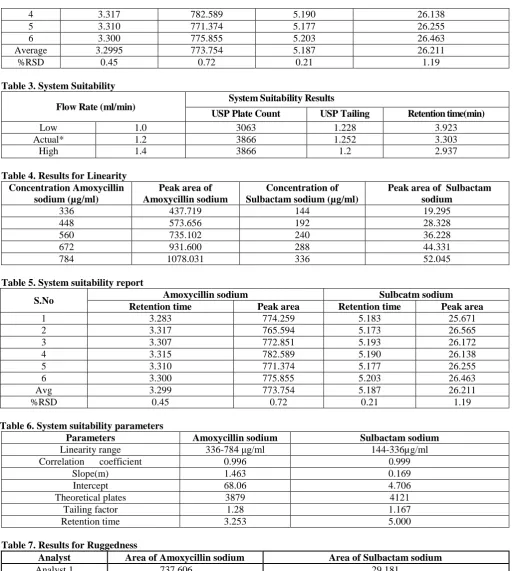
Accuracy is the closeness in agreement between the accepted true value or a reference value and the actual results obtained. Accuracy studies are usually evaluated by determining the recovery of a spiked sample of the analyte into the mixture of the sample to be analysed.A known amount of pure drug at three different levels i.e. 80%, 100%, and 120% was added to preanalyzed sample solutions and total concentration was determined by the proposed HPLC method. Recovery of the individual substances at 80%, 100%, and 120% of specified concentrations were between 99.37% -101.95%, which proves the accuracy of the method. Results of the recovery studies are tabulated in Table no. 1. From the data obtained, it is obvious that the method is remarkably accurate, which ensures that this method produces reliable results.
Precision
Method precision was determined by injecting six replicates of the drug sample solution. The retention times and peak areas of six replicates are recorded. The precision expresses as the %RSD of peak areas and it should not be more than 2%. The low value (<1%) of RSD indicates the repeatability of the method. These data indicate a considerable degree of precision and reproducibility for the method both during one analytical run and between different runs (Table no. 2).
Linearity
49
of standard AMX, SUL stock solutions were taken in different 10 ml volumetric flasks and diluted up to the mark with the mobile phase such that the final concentrations of AMX, SUL were in the range of 336-784 μg/ml and 144-336 μg/ml respectively. Each of these drug solutions (20μL) was injected three times into the column, and the peak areas and retention times were recorded. Calibration graphs were obtained by plotting peak area versus concentration of AMX, SUL (Fig. 3&4). The plot of peak areas of each sample against respective concentration of AMX, SUL were found to be linear in the range of 336-784 μg/ml and 144-336 μg/ml with correlation coefficient of 0.99. The regression characteristics, such as slope, intercept, and %RSD were calculated for this method. The results obtained were presented in Table no. 4.
Robustness
The robustness of an analytical procedure is a measure of its capacity to remain unaffected by small, but deliberate variation in method parameters and provides an indication of its reliability during normal usage. There was no change in system suitability parameters. The result of robustness studies along with its different parameters are tabulated in Table no. 3.
Ruggedness
Ruggedness is a measure of reproducibility of test results under normal, expected operational conditions from laboratory, and from analyst to analyst. There was no marked difference obtained in results. The results are tabulated in Table no .7.
Limit of Detection and Quantification
Limit of Detection (LOD) of the method was determined as the lowest concentrations of active pharmaceutical ingredients producing a signal-to-noise (S/N) ratio of about 3. The Limit of Quantitation (LOQ) was determined as the lowest concentrations of active pharmaceutical ingredients capable of being quantified with acceptable accuracy and precision producing signal-to-noise (S/N) ratio of about 10. The Limit of Detection (LOD) was found to be 399.45, 1481.9 μg for AMX and SUL. The Limit of Quantification (LOQ) analyzed was 1210.4, 4490.8 μg for AMX, SUL respectively. These values reflect the sensitivity of the method, which is of great importance in most studies and also indicating the method can be used for detection and quantification of analytes in a very wide concentration range.
System suitability
The peak resolution, theoretical plates, tailing
factor, peak symmetry were calculated for the standard solutions. Results shown in Table no. 6. The results obtained indicate the suitability of the system for the analysis of the drug combination and the system suitability parameters are within the range during method. The system suitability report tabulated in Table no.5.
Assay
10 μl of sample solution (AMPHY IBL - Profic organic Ltd.) was injected into the injector of liquid chromatography. The retention times were found to be 3.303 min for AMX and 5.177 min for SUL successively. The amount of drug present per tablet was calculated by comparing the peak area of the sample solution with that of the standard solution. The data are presented in Table no. 8.
RESULTS AND DISCUSSION
HPLC Method Development and Optimization
In response to lack of simple, reliable and easy-to-use method for the determination of AMX and SUL concentrations in pharmaceutical matrices, an isocratic Reversed-Phase HPLC method was developed for quantification of above mentioned, API. We examined several HPLC method variables with respect to their corresponding effects on the result of analysis. To optimize the chromatographic conditions, different combinations of methanol-water, and sodium acetate buffer-acetonitrile and acetonitrile-di-potassium phosphate buffer were tested. Acetonitrile with Phosphate buffer system [pH 4.6] was promisingly preferred, because it resulted in greater resolution of API after several preliminary investigatory runs, compared with other mobile phases. The other parameters in this factorial design were temperature, flow rate, detection wavelength and volume of injection. Buffer molarity was changed and optimum buffer strength was selected as 50mM on the basis of theoretical plate number. At 238 nm, UV responses of two active pharmaceutical analytes were good and free from interferences. Under these conditions, the analyte peaks were well defined and free from tailing. Considering the whole body of the data obtained from this extensive study, the set of conditions indicated earlier in this article was selected for further validation. Typical chromatogram of AMX, SUL (Standard and Sample) has been shown in Fig: 3 & 4.
The system suitability tests were carried out on freshly prepared working stock solutions of AMX and SUL. Parameters that were studied to evaluate the suitability of the system were discussed and presented in Table 5&6.
50 Figure 3.Calibration curve of Amoxycillin sodium
Figure 4. Calibration curve of Sulbactam sodium
Figure 5. Chromatogram of Standard
Figure 6. chromatogram of sample
Table 1. Results for Accuracy
Levels of recovery Amount Present (µg/ml)
Added conc. (μg/ml)
Total amount recovered (μg/ml)
% recovery
DRUG AMX SUL AMX SUL AMX SUL AMX SUL
80 448 192 112 48 563.91 242.22 100.70 100.93 100 448 192 224 96 685.07 286.19 101.95 99.37 120 448 192 336 144 791.87 340.13 101.00 101.23
Table 2. Results for Precision
S.No Amoxycillin sodium Sulbactam sodium
Retention time Peak area Retention time Peak area
1 3.280 774.259 5.183 25.671
2 3.283 765.594 5.173 26.565
51
4 3.317 782.589 5.190 26.138
5 3.310 771.374 5.177 26.255
6 3.300 775.855 5.203 26.463
Average 3.2995 773.754 5.187 26.211
%RSD 0.45 0.72 0.21 1.19
Table 3. System Suitability
Flow Rate (ml/min) System Suitability Results
USP Plate Count USP Tailing Retention time(min)
Low 1.0 3063 1.228 3.923
Actual* 1.2 3866 1.252 3.303
High 1.4 3866 1.2 2.937
Table 4. Results for Linearity Concentration Amoxycillin
sodium (µg/ml)
Peak area of Amoxycillin sodium
Concentration of Sulbactam sodium (µg/ml)
Peak area of Sulbactam sodium
336 437.719 144 19.295
448 573.656 192 28.328
560 735.102 240 36.228
672 931.600 288 44.331
784 1078.031 336 52.045
Table 5. System suitability report
S.No Amoxycillin sodium Sulbcatm sodium
Retention time Peak area Retention time Peak area
1 3.283 774.259 5.183 25.671
2 3.317 765.594 5.173 26.565
3 3.307 772.851 5.193 26.172
4 3.315 782.589 5.190 26.138
5 3.310 771.374 5.177 26.255
6 3.300 775.855 5.203 26.463
Avg 3.299 773.754 5.187 26.211
%RSD 0.45 0.72 0.21 1.19
Table 6. System suitability parameters
Parameters Amoxycillin sodium Sulbactam sodium
Linearity range 336-784 μg/ml 144-336µg/ml
Correlation coefficient 0.996 0.999
Slope(m) 1.463 0.169
Intercept 68.06 4.706
Theoretical plates 3879 4121
Tailing factor 1.28 1.167
Retention time 3.253 5.000
Table 7. Results for Ruggedness
Analyst Area of Amoxycillin sodium Area of Sulbactam sodium
Analyst 1 737.606 29.181 Analyst 2 756.494 28.265
Table 8. Results for Assay
Drug Label claim %Assay Amount present
Amoxycillin sodium 350 mg 99.16 501.4
Sulbactam sodium 150mg 98.19 50.35
CONCLUSION
A simple, precise, accurate, robust, rugged and economical RP-HPLC method was developed in this study
easy-52
to-use and its simplicity. All of these properties are very important in practice, particularly when a large number of samples are to be analyzed in various applications. The absence of additional peaks in the chromatogram indicates non-interference of the common excipients used in the
tablets, giving the benefit of wider applicability. The results of validation tests were collectively indicative for a method with a relatively wide linear range, acceptable precision.
REFERENCES
1. Indian Pharmacopoeia. Govt. of India, Ministry Of Health and Family Welfare. New Delhi; Published by the controller of publications; 3rd ed. 1996, I, 148.
2. United States of Pharmacopoeia USPXXVII United States Pharmacopoeial Convention, INC, Rockville, 2000. 3. British Pharmacopoeia. The Department of Health, Social service and Public safety. vol. I & II, 2003.
4. Surrender NP. A Text book of Medicinal Chemistry. vol. II, 2002.
5. Tripathi KD. Essentials of Medical pharmacology, 4th ed. Jaypee Brothers Medical Publishers, 2000.
6. Remer’s WA, Delagado JN. Wilson and Griswold’s. Textbook of organic medicinal and pharmaceutical chemistry".10th ed. Philadelphia, New York: Lippincott -Raven Publishers, 1998, 274–290.
7. Mahgoub H, Ahmed Ally F. UV-Spectrophotometric determination of ampicillin sodium and sulbactam sodium in two-component mixture. J. Pharm. Biomed. Anal., 1998, 12733-12788.
8. Wang P, Qi M, Sun Y, Yang J. A liquid chromatographic method for simultaneous determination of amoxycillin sodium and sulbactum sodium in a combination formulation. J. Pharm. Biomed. Anal., 2, 2009, 433-439.
9. Munozdela PA, Valenzuela A, Espinosa-Mansilla A, Sanchez-Maqueda R. 2. Stopped-flow fluorimetric determination of amoxycillin and clavulanic acid by partial least-squares multivariate calibration.Talanta, 56, 2002, 635– 642.