31
Research in Engineering
e-ISSN: 2394 - 3343 p-ISSN: 2394 - 5494
Experimental Investigation Of Expansive Soil On Stabilization
With Waste Paper Ash And Marble Dust Powder At Optimum
Value Of Opc 43 Grade
VishwajeetBiradar
1, GuruprasadJadhav
2,Dr.V.M.Devappa
3Bheemanna Khandre Institute Of Technology Bhalki-585328 Dist: Bidar, Karnataka123
Abstract
The preliminary investigation of Expansive soil that is Black Cotton soil was collected from crossroad village which is 6km away from Bhalki Taluka shows that it belongs to Inorganic clays of high plasticity (CH) in Unified Soil Classification System (USCS), respectively. Soil comes under these conditions will not fit for engineering use for that reason it was treated with ordinary Portland cement- waste paper ash, marble powder and blend in stepped percentages or concentration of 0,2,4,6 and 8% by dry weight of soil for waste paper ash and 0,4,8, and 12% by dry unit weight for the marble powder. Compaction method was carried by light compaction .The liquid limit increased from 60% to 73%for the natural black cotton soil at 6% WPA,/6%OPC and the liquid limit increased from 60% to 77% for the natural black cotton soil at 8%MP/4%OPC . And while plasticity limit decreases from 25.6% To 21% from the natural black cotton soil at 6%WPA/6%OPC and plasticity limit decreases from 25.6 to 18.7 from the natural black cotton soil 8%MP/4%OPC respectively. Unconfined compressive strength values of 78.6 for third, 189.93 for seventh and 220.14 kN/m² for eleventh days recorded for natural soil were increased to 785.15 for third, 947.44 and 1022.3 kN/M² for eleventh days at 6%WPA/6%OPC and Unconfined compressive strength values of N/M² recorded for the natural soil were increased to the values KN/M² at 8%MP/4%OPC using British standard lights.
Keywords: Black cotton Soil, Soil classification System, Plasticity limit
I. INTRODUCTION
To the Geotechnical Engineer, soil is uncemented accumulation of mineral particles formed by weathering of rocks. Soils are used in foundation as a road sub base, tunneling, and construction materials. A class of soil called as expansive soils, when used as construction material is usually affected under environmental condition and they undergo detrimental volumetric and hydraulic conductivity changes because of change in the moisture conditions. Expensive soils are the soils with potential for shrinking or swelling under changing moisture conditions. As therefore by using such kind of soil causes much damages buildings, pavements, and other civil apertures. It also causes more damages during natural hazards, earthquake and floods.
II. AIM AND OBJECTIVES
The aim of the processes to establish the proper use of the waste paper ash and marble dust powder as an admixture on the engineering as well as geotechnical properties of cement blend black cotton soil.
The objectives are highlighted as follows.
1. Determine the physical and natural properties of the black cotton soil. 2. Determine the properties of the admixture of WPA and MDP).
3. Investigation of the effect of WPA and MDP (0,2,4,6 and 8% by dry weight of soil) on the index and the strength properties of the black cotton soil stabilized with cement ( 0,2,4,6, and 8% by dry weight of the soil) To find the optimum percentage cement blended with waste paper ash and Marble dust powder with is sufficient for the stabilization
III. MATERIALS USED IN THIS INVESTIGATION
The two main materials used in this investigation were black cotton soil stabilizers they are A. Paper Waste Ash (PWA)
B. Marble Dust Powder(MDP)
32 Table 1. Geotechnical Properties of the Soils
Parameters Black cotton Soil
Specific gravity 2.7
Liquid Limit % 60
Plastic Limit % 25.6
Plastic Index % 34.4
OMC % 24
MDD (gm/cc) 1.3
Colour Grayish black
Dominant Clay Montmorillonoite
A. Paper Waste Ash
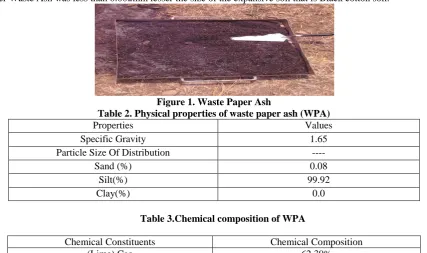
Stabilizer Paper Waste Ash used for this study were obtained from humnabad Taluka from a Paper production Industry. It is nearly 35km away from Bhalki Taluka. The waste was completely air dried and that was completely burnt at B.K.I.T Bhalki under atmospheric condition, sealed up in plastic bags and transported to the laboratory [23]. The size of the Paper Waste Ash was less than 0.002mm lesser the size of the expansive soil that is Black cotton soil.
Figure 1. Waste Paper Ash
Table 2. Physical properties of waste paper ash (WPA)
Properties Values
Specific Gravity 1.65
Particle Size Of Distribution ----
Sand (%) 0.08
Silt(%) 99.92
Clay(%) 0.0
Table 3.Chemical composition of WPA
Chemical Constituents Chemical Composition
(Lime) Cao 62.39%
(Silica), sio2 23.25%
Al2O3 5.26%
MgO 2.46%
Iron Oxide, Fe2O3 0.77%
Sulphate, SO3 0.58%
Sodium Oxide, Na2O 0.42%
Potassium Oxide, K2O 0.35%
L.O.I 4.50%
B. Marble Polish Powder:
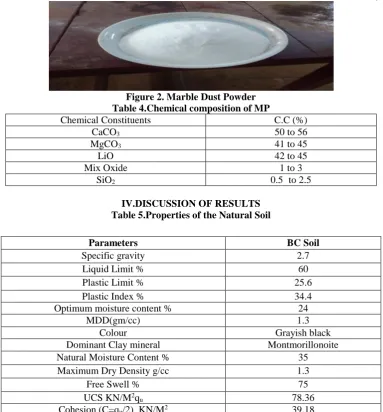
33 Figure 2. Marble Dust Powder
Table 4.Chemical composition of MP
Chemical Constituents C.C (%)
CaCO3 50 to 56
MgCO3 41 to 45
LiO 42 to 45
Mix Oxide 1 to 3
SiO2 0.5 to 2.5
IV.DISCUSSION OF RESULTS Table 5.Properties of the Natural Soil
Figure 3. Particle size distribution curve of the natural soil A. Atterbergs Limits:
a) Liquid limit:
The change in the liquid limit of the soil and the soil cement with the stabilizer Paper Waste Ash and the Marble Powder shown in below figures. This is the property at which soil exhibit its dynamic shear strength and the addition of the Paper Waste Ash and Marble Powder with the cement which produce calcium for its strength that causes the repulsive force thereby needing more water to maintain its dynamic shear strength.
0 10 20 30 40 50 60 70 80 90 100
0.01 0.1 1 10
P
er
ce
n
tage
f
in
er
Particle sizes mm
%finer
%finer
Parameters BC Soil
Specific gravity 2.7
Liquid Limit % 60
Plastic Limit % 25.6
Plastic Index % 34.4
Optimum moisture content % 24
MDD(gm/cc) 1.3
Colour Grayish black
Dominant Clay mineral Montmorillonoite
Natural Moisture Content % 35
Maximum Dry Density g/cc 1.3
Free Swell % 75
UCS KN/M2q
u 78.36
34 Figure 4. Liquid Limit v/s Waste Paper Ash
b)Plastic Limit:
The variation in the Plastic limit of the soil and the soil/cement with the stabilizer Paper Waste Ash and the Marble Powder shown in below figures. Plastic limit generally decreases with higher content of admixture, this reduction is due to the cat ion exchange reaction which results in increase of active higher valent cat ions thereby the soil and soil/cement with the stabilizer is replaced by weakly bonded oils in the soil structure [17].
Figure 5. Plastic Limit v/s W.P.A
B. Compaction Characteristics: a)Maximum dry density:
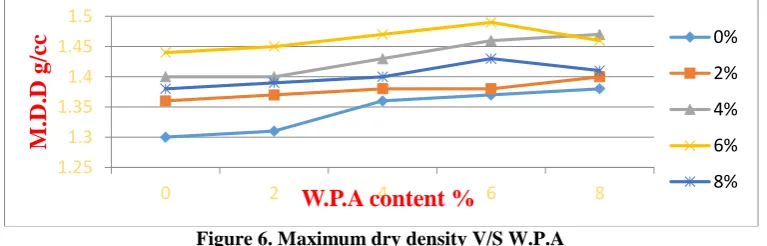
The variation in the Maximum Dry Density (MDD) of the soil and the soil/cement with the stabilizer Paper Waste Ash and the Marble Powder shown in below figures. For general stabilizer whose size is less than that of expansive soil the Maximum Dry Density (MDD) value will increases due to the availability of cement/ash particles which will fill the voids reduce the porosity within the soil structure [20].
Figure 6. Maximum dry density V/S W.P.A
b) Optimum Moisture Content:
The corresponding values of the moisture contents at maximum dry density (MDD), was formulated from the graph of dry density against the moisture contents, gives the optimum moisture contents (OMC).The variation in the Maximum Dry Density (MDD) of the soil and the soil/cement with the stabilizer Paper Waste Ash and the Marble Powder shown in below figures.
Figure 7. Optimum Moisture Content V/S W.P.A
50.0
55.0
60.0
65.0
70.0
75.0
80.0
0 2 4 6 8
L
iq
u
id
li
m
it
%
W.P.A content %
0% 2% 4% 6% 8% 19 20 21 22 23 24 25 26 27 28 29 30 31 32 33
0 2 4 6 8
P
lastic
li
m
it
%
W.P.A content %
0% 2% 4% 6% 8% 1.25 1.3 1.35 1.4 1.45 1.5
0 2 4 6 8
M
.D.D
g/cc
W.P.A content %
0% 2% 4% 6% 8% 15 17 19 21 23 25 27 29 31 33 35 37 39
0 2 4 6 8 10
35 C. Unconfined compressive strength:
a) 3 days curing period:
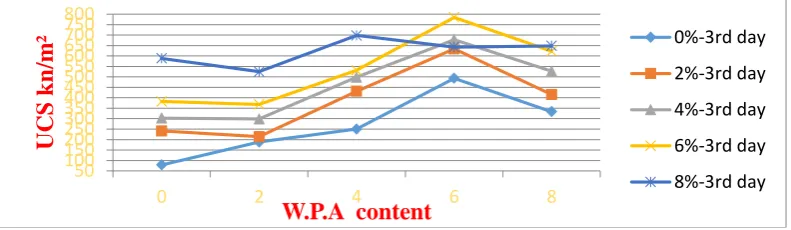
The variation in the Unconfined Compressive Strength (UCS) of the soil and the soil/cement cured for 3 days with the stabilizer Paper Waste Ash and the Marble Powdercompactive efforts are shown in Fig. The UCS values compaction showed a sharp increase from 78.36 KN/M2 for the natural soil to 785.15 KN/M2 at 6% OPC/6% for the
stabilizer Paper Waste Ash (PWA). And the UCS values shows increase in the value from 78.36% for the natural soil to 985.46 KN/M2 at 4% OPC/8% for the stabilizer Marble Powder (MP) [27]. Further treatment did not produce the positive
result because; the UCS value reduces to 642.66 KN/M2 at 6% OPC/8%PWA and 798.24 at 4%OPC/16% MP
Figure 7. UCS V/S W.P.A (3 days curing)
b) 7 days curing period:
The UCS values compaction showed a linearly increase from 189.93 KN/M2 for the natural soil to 947.44
KN/M2 at 6% OPC/6% for the stabilizer Paper Waste Ash (PWA). And the UCS values shows increase in the value from
189.93 KN/M2 for the natural soil to 1038.66 KN/M2 at 4% OPC/8% for the stabilizer Marble Powder (MP)[28]. Further
treatment did not produce the positive result because; the UCS value reduces to 916.41 KN/M2 at 6% OPC/8%PWA and
875.34 at 4%OPC/16% MP.
Figure 8. UCS V/S W.P.A (7 days curing)
c) 11 days curing period:
The variation in the Unconfined Compressive Strength (UCS) of the soil and the soil/cement cured for 11 days with the stabilizer Paper Waste Ash and the Marble Powdercompactive efforts are shown in Fig. The UCS values compaction showed a linearly increase from 220.14 KN/M2 for the natural soil to 1022.3 KN/M2 at 6% OPC/6% for the
stabilizer Paper Waste Ash (PWA)[26]. And the UCS values shows increase in the value from 220.14 KN/M2 for the
natural soil to 1126.5 KN/M2 at 4% OPC/8% for the stabilizer Marble Powder (MP). Further treatment did not produce
the positive result because; the UCS value reduces to 906.48 KN/M2 at 6% OPC/8%PWA and 893.2 at 4%OPC/16% MP
[16].
Figure 9. UCS V/S W.P.A (11 days curing) V. CONCLUSION
50 100 150 200 250 300 350 400 450 500 550 600 650 700 750 800
0 2 4 6 8
UC
S
k
n
/m
²
W.P.A content
0%-3rd day
2%-3rd day
4%-3rd day
6%-3rd day
8%-3rd day
0 200 400 600 800 1000
0 2 4 6 8
UC
S
k
n
/m
²
W.P.A content%
0%-7thday
2%-7thday
4%-7thday
6%-7thday
8%-7thday
0 500 1000 1500
0 2 4 6 8
U
CS
KN/
M²
W.P.A CONTENT%
0%-11thday
2%-11thday
4%-11thday
6%-11thday
36 The natural soil has high moisture content of 35%. It has liquid limit of 60%, plastic limit of 25.6%, plastic index of 34.4, free swell of 75%, and specific gravity of 2.7. All these values indicate that the soil is highly plastic with about 90% of the soil is finer
In an effort to raise the soil’s suitability for the engineering use, the air dried samples were treated with OPC/PWA and OPC/MP in stepped concentration of 0, 2,4,6,8 for PWA and 0,4,8,12,16 for MP by dry weights of the soil. The tests conducted showed that the liquid limit of the natural soil increased from 60% to 73% at 6% OPC/6% PWA and 60% to 77% at 4%OPC/8% MP. The plastic limit however, decreased from 25.6% for the natural soil to 21% at 6% OPC/6% PWA and 25.6% to 18.7% at 4% OPC/8% MP receptively. The peak MDD values recorded for compactive efforts are respectively are 1.49 g/cc at 6% OPC/ 6% PWA and 1.48 g/cc at 4% OPC/ 8% MP. The optimum moisture contents values at the natural states increased from 24% to 40% for PWA and 24% to 39% for MP respectively. The unconfined compressive strength (UCS) values for natural soil Compacted and tested for 3 days periods are 78.36 KN/M2
for the natural soil which increased to 678.32 KN/M2at 6%OPC/6% WPA and 985.46 KN/M2 for MP with stabilizer
treated respectively.
The 7 days curing period UCS obtained showed that/WPA/MP blend has long term advantages in terms of the strength gain. The 7th days curing period UCS produced a peak values of 947.44 KN/M2 at 6% OPC/6% WPA and
1038.66 KN/M2 at 4% OPC/8% MP soil for this blend can be used as base course of pavement materials. The 11th day of
UCS value produce a sharp increase value of 1022.3 KN/M2 at 6% OPC/6% WPA and 1126.5 at 4% OPC/8% MP
respectively.
REFERENCES
[1] Aitken, D. H. (1971). “Transportation of geomechanics to roads and bridges. Proc.Of the 1st Australia-New Zealand Conference on Geomechanics, Melbourne. Vol. 2, p. 489
[2] Baser O (2009), “Stabilization of Expansive Soils Using Waste Marble Dust”, Middle East, Technical University.
[3] Biswas (2012), “Utilization of Rice husk with Lime in Sub-grade Soil for a Rural Road. “International Conference on Emerging Frontier in Technology for Guwahati
[4] ChavhanPooja J (2014), “To Study the Behavior of Marble Powder as SupplementaryCementitous Material in Concrete”,Journal Environment &Research and Department,
[5] Chen F. H. (1988) “foundations on expansive soils” Chen and Associates, Elsevier Publications
[6] Choudhary A K, Gill K S and Jha K N (2011), “Improvement in CBR Values of Expansive Soil Sub Grade Using Geo-Synthetics”, pp. 569-572.
[7] Demirel B (2010), “The Effect of the Using Waste Marble Dust as Fine Sand on the Mechanical Properties of the Concrete”, Turkey, International Journal.
[8] Ergu A N (2010), “Effects of the Usage of Diatomite and Waste Marble Powder as Partial Replacement of Cement on the Mechanical Properties of Concrete”, Turkey, Construction and Building Materials, Vol. 25, pp. 806-812.
[9] Fredlund, D. G. and Reharjo, H. (1993). Soil Mechanics for Unsaturated Soils, Wiley,New York
[10] Gourley C S, Newill D and Shreiner H D (1993), “Expansive Soils”, TRL’s Research Strategy, Proc. 1st Int. Symp. On Engineering Characteristics of Arid Soils.
[11] Gourley et al. 1993 “problems related to black cotton soil”.
[12] Gupta Chayan and Sharma Ravi Kumar (2014), “Influence of Marble Dust, Fly Ash and Beas Sand on Sub-Grade Characteristics of Expansive Soil”, Journal of Mechanical & Civil Engineering, pp. 13-18.
[13] Hameed M S and Sekar A S S (2009), , India, ARPN Journal Vol. 4, No. 4, pp. 83-89.
[14] Hebhoub H, Aoun H, Belachia M, Houari H and Ghorbel E (2010), “Use of Waste Marble Aggregates in Concrete”, Vol. 25, pp. 1167-1171.
[15] Maclean, D. J. (1953). “Investigation on some problems in soil stabilization”. Proceedings of the 3rd Intn’l Conference on Soil Mechanics and Foundation Engineering,
London, pp. 134-144
[16] Nelson, D. and Miller, J. (1992). Expansive Soils: Problems and Practices in Foundation and Pavement Engineering. John Wiley and Sons, Inc. New York.
37 [19] Nontananandh S., Amornfa K. and Jirathanathaworn T. (2003) (4th RSID), Bangkok, Thailand, Apr 3rd- 5th.
[20] Ola, S. A. (1974) “Need for estimated cement requirement for stabilizing lateritic soil.” J. Transport Div., ASCE, Vol. 17, No 8, pp. 379-388.
[21] Ola, S. A. (1978) “The geology and geotechnical properties of the black cotton soils of North Eastern Nigeria.” Engineering Geology, Vol. 12, pp. 375- 391.
[22] O’Flaherty, C. A. (2002). Highway: The Location, Design, Construction and Maintenance of Pavement. 4th Ed., Butterworth Heinemann. Pp. 175-182.
[23] Osinubi, K.J.(1999)“Evaluation of admixture stabilization of Nigerian black cotton soil.” Nigerian Society of Engineers Technical Transactions, Vol. 34, No 3, pp. 88-96
[24] Palaniappan K A and Stalin V K (2009), “Utility Effect of Solid Wastes in Problematic 31.Soils”, IJERI Applications, Vol. 2 No. 1, pp. 313-321.
[25] Sabat A K and Nanda R P (2011), “Effect of Marble Dust on Strength and Durabilityof Rice Husk Ash Stabilized Expansive Soil”, International Journal of Civil and Structural Engineering, Vol. 1, No. 4, pp. 939-948.
[26] Saranjeet Rajesh Soni et al. (2011), “Disposal of Solid Waste for Black Cotton Soil Stabilization”, IJOAET Vol. 8, No. 1, pp. 113 -120.
[27] Şenol A., Edil T.B., Acosta H.A., Benson C.H. (2005) Soft subgrades stabilization by using various fly ashes. Resources, Conservation and Recycling 46 (2006) 365–376.
[28] Şenol A., Edil T.B., Benson C.H. and Bin-Shafique Md.S. (2002) Use of Class C Fly Ash for Stabilization of Soft Subgrade25-27 September 2002 Istanbul Technical University, Istanbul, Turkey.
[29] Swami B L (2002), “Feasibility Studies of Marble Dust in Highway Sector”, Highway Research Bulletin, Vol. 67, December, pp. 27-36.