61
Correlations of Biomechanical Characteristics with Ball Speed in Penalty Corner Push-In
Effect of Specific Skill Training Package with and without Computer Assisted Training on
Selected Physical Fitness Variables among College Women Kabaddi Players
P.Mathiarasi1 & Dr.J.Sathiah2
1Ph.D., Research Scholar, Department of Physical Education, Tamilnadu Physical Education and Sports University. Chennai, Tamilnadu, India. 2Director of Physical Education (Retd), Madurai Kamaraj University, Madurai, Tamilnadu, India.
Received 20th December 2016, Accepted 16th January 2017
Abstract
The purpose of the study was to investigate the effect of specific skill training package with and without computer assisted training on selected physical fitness variables among college women kabaddi players. To achieve the purpose of the study, sixty students studying in under the jurisdiction of Manonmaniam Sundaranar University Tirunelveli, Tamilnadu were randomly selected as subjects. The age of the subjects ranged from 18 to 20 years. The subjects selected for this study were randomly divided into three experimental groups of twenty in each. The groups I, II and III were named as specific skill training group, specific skill training with computer assisted training group and control group respectively. All the subjects in the experimental groups were given their respective training programme for 12 weeks duration. The control group did not get any type of training through this study. The pre test and post test scores were subjected to statistical analysis using Analysis of Covariance (ANCOVA) to find out the significance among the mean differences, whenever the ‘F’ ratio for adjusted test was found to be significant, scheffe’s post hoc test was used. In all cases 0.05 level of significance was fixed to test hypotheses. The specific skill training package with computer assisted training group showed significant improvement in selected physical fitness variables than the specific skill training package group and control groups.
Keywords: Specific Skill Training, Computer Assisted Training, Kabaddi.
© Copy Right, IJRRAS, 2017. All Rights Reserved.
Introduction
The present century is rightly technological due to the influence of advancements in the field of science and technology on the varied aspects of life, resulting in its modernization. Today's world of science and technology make use of computer in all fields of human operation, i.e. in factory, government office, educational institution, hospital and business centre. Hence, computer literacy is a must for everyone, the academic discipline that deals with computer education. Student can use computer as a self-learning device and medium, to progress at his own rate, making use of computers in the teaching-learning process is otherwise known as computer in education. Computer assisted instruction is an interesting innovation in the education technology. Its marvels have been demonstrated and seem to revolutionaries the whole spectrum of education. It has better flexibility and is more versatile than any of the existing teaching methods. Although instruction is a part of each of these examples, they are more accurately categorized as uses of tool software rather than computer assisted instruction. Tools of this allow the work to be
Correspondence
P.Mathiarasi
E-mail: [email protected],Ph. +9199527 38169
completed easily. However, one may not necessarily acquire the new information by using tool software (Alvarez, 1992).
A wide variety of computer assisted instruction is available in part because so many sizes of computers are in the market. Because the computers are frequently classified by size, a brief explanation may be helpful. Computers are often categorized into three groups based on the amount of memory they contain. Although instruction is part of each of these examples, they are more accurately categorized as uses of tool software rather than computer assisted instruction. Tools of this sort allow the work easily. However, one may not necessarily acquire the new information by using tool software. A more useful approach often suggested by instructional technologists is to base the classification system on the unique qualities of the medium. After considering the features of the computer and comparing the computer to other types of instructional technology or to the traditional teacher based instruction, one may conclude that our earlier list of computer assisted instruction classification might be more meaningful if it were expressed in another way.
Methodology
The purpose of the study was to investigate the effect of specific skill training package with and without
International
Mathiarasi et al. 2017 ISSN: 2349 – 4891
62
computer assisted training on selected physical fitness variables among college women kabaddi players. To achieve the purpose of the study, sixty students studying in under the jurisdiction of Manonmaniam Sundaranar University Tirunelveli, Tamilnadu were randomly selected as subjects. The age of the subjects ranged from 18 to 20 years. The subjects selected for this study were randomly divided into three experimental groups of twenty in each. The groups I, II and III were named as specific skill training group, specific skill training with computer assisted training group and control group
respectively. All the subjects in the experimental groups were given their respective training programme for 12 weeks duration. The control group did not get any type of training through this study. The pre test and post test scores were subjected to statistical analysis using Analysis of Covariance (ANCOVA) to find out the significance among the mean differences, whenever the ‘F’ ratio for adjusted test was found to be significant, scheffe’s post hoc test was used. In all cases 0.05 level of significance was fixed to test hypotheses.
Results
Table 1
Computation of analysis of covariance of mean of specific skill training package, specific skill training package with computer assisted training and control groups on speed
SSTPG SSTPCATG Control
Group
Source of Variance
Sum of
Squares df
Means
Squares F-ratio
Pre-Test
Means 8.77 8.73 8.80
BG 0.05 2 0.02
0.79
WG 1.94 57 0.03
Post-Test
Means 8.38 8.20 8.79
BG 3.61 2 1.80
96.61*
WG 1.06 57 0.01
Adjusted Post-Test Means
8.38 8.20 8.79
BG 3.56 2 1.78
94.04*
WG 1.06 56 0.01
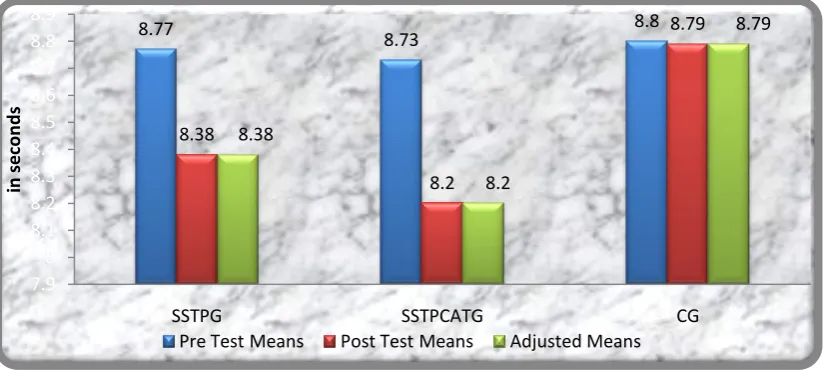
An examination of table 1 indicated that the pre test means of specific skill training package, specific skill training package with computer assisted training and control groups were 8.77, 8.73 and 8.80 respectively. The obtained F-ratio for the pre-test was 0.79 and the table F-ratio was 3.15. Hence the pre-test mean F-ratio was insignificant at 0.05 level of confidence for the degree of freedom 2 and 57. This proved that there were no significant difference between the experimental and control groups indicating that the process of randomization of the groups was perfect while assigning the subjects to groups. The post-test means of the specific skill training package, specific skill training package with computer assisted training and control groups were 8.38, 8.20 and 8.79 respectively. The obtained F-ratio for the post-test was 96.61 and the table F-ratio was 3.15. Hence the post-test mean F-ratio was
63
Table 2
The scheffe’s test for the differences between the adjusted post test paired means on speed
Adjusted Post-test means
Mean Difference Required CI SSTPG SSTPCATG Control Group
8.38 8.20 --- 0.18*
0.07
8.38 --- 8.79 0.41*
--- 8.20 8.79 0.59*
* Significant at 0.05 level of confidence
The multiple comparisons showed in Table 2 proved that there existed significant differences between the adjusted means of specific skill training package and specific skill training package with computer assisted training (0.18), specific skill training package and control group (0.41), specific skill training package with
computer assisted training and control group (0.59) at 0.05 level of confidence with the confidence interval value of 0.07. The pre, post and adjusted means on speed were presented through bar diagram for better understanding of the results of this study in Figure-1.
Figure I
Pre post and adjusted post test differences of the skill training package, specific skill training package with computer assisted training and control groups on speed
Table 3
Computation of analysis of covariance of mean of skill training package, specific skill training package with computer assisted training and control groups on leg strength
SSTPG SSTPCATG Control
Group
Source of Variance
Sum of
Squares df
Means
Squares F-ratio
Pre-Test
Means 49.82 50.39 50.50
BG 5.33 2 2.66 0.67
WG 226.46 57 3.97
Post-Test
Means 60.10 62.72 50.82
BG 1562.58 2 781.29 271.46*
WG 164.04 57 2.87
Adjusted Post-Test Means
60.17 62.69 50.77
BG 1570.22 2 785.11 281.09*
WG 156.41 56 2.79
8.77 8.73 8.8
8.38
8.2
8.79
8.38
8.2
8.79
7.9 8 8.1 8.2 8.3 8.4 8.5 8.6 8.7 8.8 8.9
SSTPG SSTPCATG CG
in
sec
o
n
d
s
Mathiarasi et al. 2017 ISSN: 2349 – 4891
64
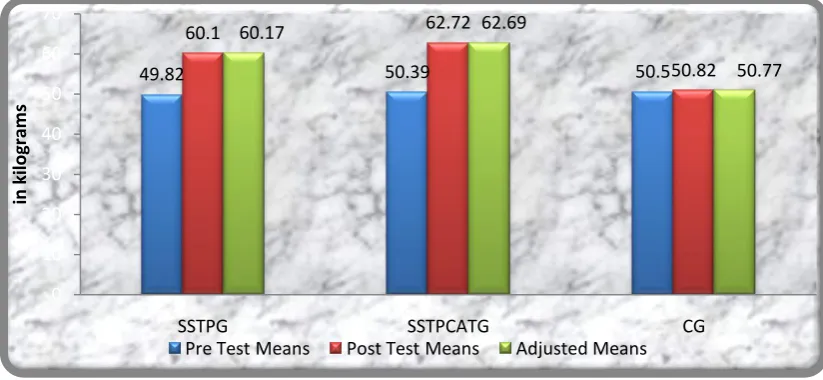
An examination of table 3 indicated that the pre test means of specific skill training package, specific skill training package with computer assisted training and control groups were 49.82, 50.39 and 50.50 respectively. The obtained F-ratio for the pre-test was 0.67 and the table F-ratio was 3.15. Hence the pre-test mean F-ratio was insignificant at 0.05 level of confidence for the degree of freedom 2 and 57. This proved that there were no significant difference between the experimental and control groups indicating that the process of randomization of the groups was perfect while assigning the subjects to groups. The post-test means of the specific skill training package, specific skill training package with computer assisted training and control groups were 60.10, 62.72 and 50.82 respectively. The obtained F-ratio for the post-test was 271.46 and the table F-ratio was 3.15. Hence the post-test mean F-ratio
was significant at 0.05 level of confidence for the degree of freedom 2 and 57. This proved that the differences between the post test means of the subjects were significant. The adjusted post-test means of the specific skill training package, specific skill training package with computer assisted training and control groups were 60.17, 62.69 and 50.77 respectively. The obtained F-ratio for the adjusted post-test means was 281.09 and the table ratio was 3.16. Hence the adjusted post-test mean F-ratio was significant at 0.05 level of confidence for the degree of freedom 2 and 56. This proved that there was a significant difference among the means due to the experimental trainings on leg strength. Since significant differences were recorded, the results were subjected to post hoc analysis using Scheffe’s post hoc test. The results were presented in Table 4.
Table 4
The scheffe’s test for the differences between the adjusted post test paired means on leg strength
Adjusted Post-test means
Mean Difference Required CI SSTPG SSTPCATG Control Group
60.17 62.69 --- 2.52*
1.32
60.17 --- 50.77 9.40*
--- 62.69 50.77 11.92*
* Significant at 0.05 level of confidence
The multiple comparisons showed in Table 4 proved that there existed significant differences between the adjusted means of specific skill training package and specific skill training package with computer assisted training (2.52), specific skill training package and control group (9.40), specific skill training package with
computer assisted training and control group (11.92) at 0.05 level of confidence with the confidence interval value of 1.32. The pre, post and adjusted means on leg strength were presented through bar diagram for better understanding of the results of this study in Figure-II.
Figure II
Pre post and adjusted post test differences of the skill training package, specific skill training package with computer assisted training and control groups on leg strength
49.82 50.39 50.5
60.1 62.72
50.82
60.17 62.69
50.77
0 10 20 30 40 50 60 70
SSTPG SSTPCATG CG
in
ki
lo
gr
am
s
Conclusions
From the analysis of the data, the following conclusions were drawn:
1. The specific skill training package with computer assisted training group had shown significant improvement in all the selected physical fitness variables among kabaddi players after undergoing specific skill training package with computer assisted training for a period of twelve weeks. 2. The specific skill training package group had
shown significant improvement in all the selected physical fitness and performance variables among kabaddi players after undergoing specific skill training package for a period of twelve weeks. 3. The specific skill training package with computer
assisted training group showed significant improvement in selected physical fitness variables than the specific skill training package group and control groups.
References
1. Alvarez-Pons, FA. (1992). The Effectiveness of Computer Assisted Instruction in Teaching Sport Rules, Scoring Procedures, and Terminology.
Unpublished Doctoral Dissertation, College of Education, Florida State University.
2. Ananthapadmanabha Prabhu & Kishore Kumar, C.K. (2014). Common Injuries among Kabaddi and Kho-Kho Players – an Empirical Study.
International Journal of Engineering Research and Sports Science,1,7.
3. Ashish Kumar Singh , Kannan. A & Radha Raman Singh (2014). Prediction of kabaddi playing ability in the Anthropometric and bio- motor contexts.
Academic Sports Scholar, 3 , 2.
4. Avinash Yadav, & Vivek B Sathe (2016). Investigation of level of speed among national, state and district kabaddi players. International Journal of Academic Research and Development. 1, 4, 59-60.
5. Nageswara Rao, Singamaneni.., (2004). Methods and Techniques of Teaching, New Delhi: solani Publication.
6. Rink.E. Judiht., and French E. Kaven., (1996).