
International Journal of Advances in Engineering Research
SURVEY ON ENERGY-EFFICIENT CLOUD
COMPUTING SYSTEMS
*Mohammad Toufiq Ahmed, **Abrar Hussain
*Lecturer, Department of EEE, East Delta University, Chittagong, Bangladesh
Email: [email protected] **Lecturer, Department of EEE, Southern University, Chittagong, Bangladesh
Email: [email protected]
ABSTRACT
The goal of the computer system design has been shifted to power and energy efficiency. To identify open challenges in the area and facilitate future advancements, it is essential to synthesize and classify the research on power and energy-efficient design conducted to date. In this study, we discuss causes and problems of high power/energy consumption, and present the taxonomy of energy-efficient design of computing systems covering the hardware, operating system, virtualization, and data center levels. We study various key works in the area and map them onto our taxonomy to guide future design and development efforts. This paper concludes with a discussion on advancements identified in energy-efficient computing and our vision for future research directions.
Keywords-energy-efficient computing, taxonomy
INTRODUCTION
International Journal of Advances in Engineering Research
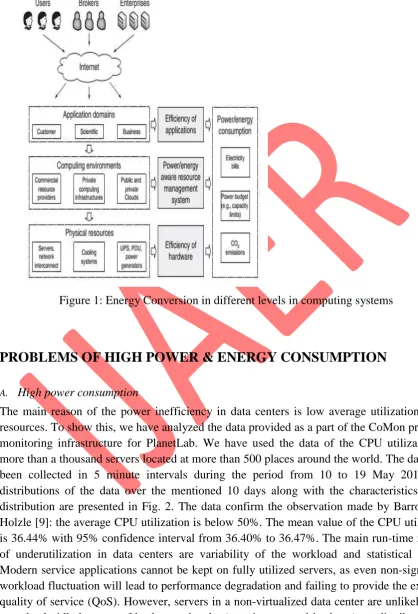
current efficiency trends, the energy consumption tends to double again by 2011, resulting in 7.4 billion dollars annually. Energy consumption is not only determined by hardware efficiency, but it is also dependent on the resource management system deployed on the infrastructure and the efficiency of applications running in the system. This interconnection of the energy consumption and different levels of computing systems can be seen in Fig. 1. Energy efficiency impacts end-users in terms of resource usage costs, which are typically determined by the total cost of ownership (TCO) incurred by a resource provider. Higher power consumption results not only in boosted electricity bills but also in additional requirements to a cooling system and power delivery infrastructure, that is, uninterruptible power supplies (UPS), power distribution units (PDU), and so on. With the growth of computer components density, the cooling problem becomes crucial, as more heat has to be dissipated for a square meter. Apart from the overwhelming operating costs and the total cost of acquisition (TCA), another rising concern is the environmental impact in terms of carbon dioxide (CO2) emissions caused by high energy consumption. Therefore, the reduction of power and energy consumption has become a first-order objective in the design of modern computing systems.
Table I
Estimated Average Power Consumption per Server Class (w/u) from 2000 to 2006 [2]
Server Class
2000 2001 2002 2003 2004 2005 2006
Volume 186 193 200 207 213 219 225
Mid-range
424 457 491 524 574 625 675
International Journal of Advances in Engineering Research
Figure 1: Energy Conversion in different levels in computing systems
PROBLEMS OF HIGH POWER & ENERGY CONSUMPTION
A. High power consumption
International Journal of Advances in Engineering Research
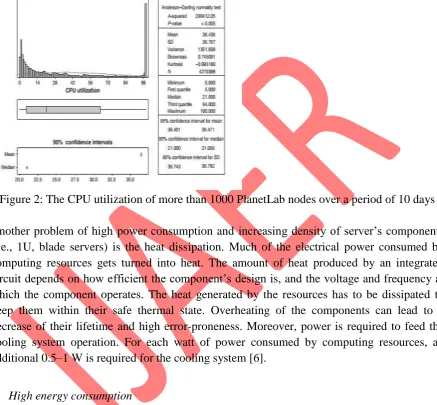
bases or file systems. Data distribution helps to tackle load-balancing problem and improves fault tolerance. Furthermore, despite the fact that the resources have to be provisioned to handle theoretical peak loads, it is very unlikely that all the servers of a large-scale data centers will be fully utilized simultaneously.
Figure 2: The CPU utilization of more than 1000 PlanetLab nodes over a period of 10 days
Another problem of high power consumption and increasing density of server’s components (i.e., 1U, blade servers) is the heat dissipation. Much of the electrical power consumed by computing resources gets turned into heat. The amount of heat produced by an integrated circuit depends on how efficient the component’s design is, and the voltage and frequency at which the component operates. The heat generated by the resources has to be dissipated to keep them within their safe thermal state. Overheating of the components can lead to a decrease of their lifetime and high error-proneness. Moreover, power is required to feed the cooling system operation. For each watt of power consumed by computing resources, an additional 0.5–1 W is required for the cooling system [6].
B. High energy consumption
International Journal of Advances in Engineering Research
computing resources themselves in few years can be reached soon. Therefore, it is crucial to develop and apply energy-efficient resource management strategies in data centers.
TAXONOMY OF POWER/ENERGY MANAGEMENT IN COMPUTING
SYSTEMS
International Journal of Advances in Engineering Research
Figure 3: High-level taxonomy of power and energy management
C. Hardware and Firmware Level
The problem could be easily solved if transitions between power states would cause negligible power and performance overhead. However, transitions to low power states usually lead to additional power consumption and delays caused by the reinitialization of the components. For example, if entering a low-power state requires shutdown of the power supply, returning to the active state will cause a delay consisting of turning on and stabilization of the power supply and clock, reinitialization of the system, and restoring the context [23]. In the case of non-negligible transitions, efficient power management turns into a difficult online optimization problem. A transition to low-power state is worthwhile only if the period of inactivity is longer than the aggregated delay of transitions from and into the active state, and the saved power is higher than the required to reinitialize the component.
.
D. Operating System Level
International Journal of Advances in Engineering Research
Figure 4: Operating system level taxonomy
International Journal of Advances in Engineering Research
utilization of all of the processors in the system in a centralized way that can become a significant overhead with increase in the number of CPUs. To overcome this problem, the authors in [19] have proposed a parallel sampling independently for each CPU. Another improvement that can increase the performance for multiprocessor systems is to have dedicated kernel threads for the governor and do sampling and changing of frequencies in the context of a particular kernel thread.
E. Eco System
Zeng et al. [37,38] have proposed and developed ECO system—a framework for managing energy as a first-class OS resource aimed at battery-powered devices. The authors’ fundamental assumption is that applications play an important role in energy distribution opportunities that can be leveraged only at the application level. ECO system provides an interface to define a target battery lifetime and applications’ priorities used to determine the amount of energy that will be allocated to applications at each time frame.
The authors split OS-level energy management into two dimensions. Along the first dimension, there is a variety of system devices (e.g., CPU, memory, disk storage, network interface) that can consume energy concurrently. The other dimension spans applications that share the system devices and cause the energy consumption. To address the problem of accounting the energy usage by both devices and applications, the authors have introduced a new measurement unit called currency. One unit of currency represents the right to consume a certain amount of energy during a fixed period of time. When the user sets the target battery lifetime and prioritizes the applications, ECO system transforms these data into an appropriate amount of currency and determines how much currency should be allocated to each application at each time frame. The length of the timeframe has been empirically determined as 1 s that is sufficient to achieve smooth energy allocation. An application expends the allocated amount of currency by utilizing the CPU, performing disk and memory accesses and consuming other system resources. An application can accumulate currency up to a specified limit. When an expenditure of an application exceeds the allocated amount of currency, none of the associated processes are scheduled or otherwise serviced.
The system has been implemented as a modified Linux kernel and has been experimentally evaluated. The obtained results show that the proposed model can be effectively used to meet different energy goals, such as achieving a target battery lifetime and proportional energy distribution among competing applications.
VIRTUALISATION LEVEL
International Journal of Advances in Engineering Research
resource and ensuring the performance and failure isolation between VMs sharing a single physical machine. The virtualization layer lies between the hardware and OS and, therefore, a virtual machine monitor (VMM) takes the control over resource multiplexing and has to be involved in the system’s power management. There are two ways of how a VMM can participate in the power management:
1. A VMM can act as a power-aware OS without distinction between VMs: monitor the overall system’s performance and appropriately apply DVFS or any DCD techniques to the system components.
2. Another way is to leverage OS’s specific power management policies and application-level knowledge, and map power management calls from different VMs on actual changes in the hardware’s power state or enforce system-wide power limits in a coordinated manner.
Implications of Cloud Computing
Cloud computing has become a very promising paradigm for both consumers and providers in various areas including science, engineering, and not to mention business. A Cloud typically consists of multiple resources possibly distributed and heterogeneous. Although the notion of a Cloud has existed in one form or another for some time now (its roots can be traced back to the mainframe era [66]), recent advances in virtualization technologies and the business trend of reducing the TCO in particular have made it much more appealing compared to when it was first introduced. There are many benefits from the adoption and deployment of Clouds, such as scalability and reliability; however, Clouds in essence aim to deliver more economical solutions to both parties (consumers and providers). By economical, we mean that consumers only need to pay per their use and providers can capitalize poorly utilized resources.
CONCLUSIONS
International Journal of Advances in Engineering Research
REFERENCES
[1] G.E. Moore, Cramming more components onto integrated circuits, Proc. IEEE 86 (1)
(1998) 82–85.
[2] J.G. Koomey, Estimating Total Power Consumption by Servers in the US and the World,
Analytics Press, Oakland, CA, 2007.
[3] L. Barroso, The Price of Performance, ACM Press, Queue, 2005, vol. 3 (7), p. 53.
[4] R. Brown, E. Masanet, B. Nordman, B. Tschudi, A. Shehabi, J. Stanley, et al., Report to
Congress on
Server and Data Center Energy Efficiency: Public Law 109–431, Lawrence Berkeley National
Laboratory, Berkeley, CA, USA, 2008.
[5] L. Minas, B. Ellison, Energy Efficiency for Information Technology: How to Reduce
Power Consumption in Servers and Data Centers, Intel Press, USA, 2009.
[6] P. Ranganathan, P. Leech, D. Irwin, J. Chase, Ensemble-level power management for
dense blade
servers, in: Proceedings of the 33rd International Symposium on Computer Architecture
(ISCA 2006), 2006, pp. 66–77.
[7]S.Rowe,Usenetarchives.http://groups.google.com/group/comp.misc/browse_thread/thread/
5c4db94663b5808a/f99158e3743127f9, 1992.
[8] V. Venkatachalam, M. Franz, Power reduction techniques for microprocessor systems,
ACM Comput. Surv. CSUR 37 (3) (2005) 195–237.
[9] L.A. Barroso, U. Holzle, The case for energy-proportional computing, Computer 40 (12)
(2007) 33–37.
[10] X. Fan, W.D. Weber, L.A. Barroso, Power provisioning for a warehouse-sized computer,
in: Proceedings of the 34th Annual International Symposium on Computer Architecture
(ISCA 2007), ACM New York, NY, USA, 2007, pp. 13–23.
[11] M. Blackburn, Five Ways to Reduce Data Center Server Power Consumption, The Green
Grid, USA, 2008.
[12] American Society of Heating and Refrigerating and Air-Conditioning Engineers,
International Journal of Advances in Engineering Research
[13] G. Dhiman, K. Mihic, T. Rosing, A system for online power prediction in virtualized
environments using Gaussian mixture models, in: Proceedings of the 47th ACM/IEEE Design
Automation Conference, Anaheim, CA, USA, 2010, pp. 807–812.
[14] G. Koch, Discovering multi-core: extending the benefits of Moore’s law, Technology 1
(2005).
[15] F. Petrini, J. Moreira, J. Nieplocha, M. Seager, C. Stunkel, G. Thorson, et al., What are
the future trends in high-performance interconnects for parallel computers? in: Proceedings of
the 12th Annual IEEE Symposium on High Performance Interconnects, 2004, p. 3.
[16] C. Pettey, Gartner estimates ICT industry accounts for 2 percent of global CO2
emissions, http:// www.gartner.com/it/page.jsp?id¼503867, 2007.
[17] S. Devadas, S. Malik, S. Devadas, S. Malik, A survey of optimization techniques
targeting low power VLSI circuits, in: Proceedings of the 32nd ACM/IEEE Conference on
Design Automation, 1995, pp. 242–247.
[18] V. Tiwari, P. Ashar, S. Malik, Technology mapping for low power, in: Proceedings of
the 30th Conference on Design Automation, 1993, pp. 74–79.
[19] V. Pallipadi, A. Starikovskiy, The on demand governor, in: Proceedings of the Linux
Symposium, 2006, vol. 2.
[20] E. Elnozahy, M. Kistler, R. Rajamony, Energy-efficient server clusters, Power Aware
Comput. Syst. 2325 (2003) 179–197.
[21] E. Pinheiro, R. Bianchini, E.V. Carrera, T. Heath, Load balancing and unbalancing for
power and performance in cluster-based systems, in: Proceedings of the Workshop on
Compilers and Operating Systems for Low Power, 2001, pp. 182–195
[22] R. Buyya, C.S. Yeo, S. Venugopal, J. Broberg, I. Brandic, Cloud computing and
emerging IT platforms: vision, hype, and reality for delivering computing as the 5th utility,
Future Generation Comput. Syst. 25 (6) (2009) 599–616.
[23] L. Benini, A. Bogliolo, G.D. Micheli, A survey of design techniques for system-level
dynamic power management, IEEE Trans. VLSI Syst. 8 (3) (2000) 299–316.
International Journal of Advances in Engineering Research
[25] M.B. Srivastava, A.P. Chandrakasan, R.W. Brodersen, Predictive system shutdown and
other architectural techniques for energy efficient programmable computation, IEEE Trans.
VLSI Syst. 4 (1) (1996) 42–55.
[26] C.H. Hwang, A.C. Wu, A predictive system shutdown method for energy saving of
event-driven computation, ACM Trans. Des. Autom. Electron. Syst. 5 (2) (2000) 241.
[27] F. Douglis, P. Krishnan, B. Bershad, Adaptive disk spin-down policies for mobile
computers, Comput. Syst. 8 (4) (1995) 381–413.
[28] G. Buttazzo, Scalable applications for energy-aware processors, in: Embedded Software,
2002, pp. 153–165.
[29] M. Weiser, B. Welch, A. Demers, S. Shenker, Scheduling for reduced CPU energy,
Mobile Comput. (1996) 449–471.
[30] K. Govil, E. Chan, H. Wasserman, Comparing algorithm for dynamic speed-setting of a
low-power CPU, in: Proceedings of the 1st Annual International Conference on Mobile
Computing and Networking (MobiCom 2005), Berkeley, CA, USA, 1995, p. 25.
[31] A. Wierman, L.L. Andrew, A. Tang, Power-aware speed scaling in processor sharing
systems, in: Proceedings of the 28th Conference on Computer Communications (INFOCOM
2009), Rio, Brazil, 2009.
[32] L.L. Andrew, M. Lin, A. Wierman, Optimality, fairness, and robustness in speed scaling
designs, in: Proceedings of ACM International Conference on Measurement and Modeling of
International Computer Systems (SIGMETRICS 2010), New York, USA, 2010.
[33] A. Weissel, F. Bellosa, Process cruise control: event-driven clock scaling for dynamic
power management, in: Proceedings of the 2002 International Conference on Compilers,
Architecture, and Synthesis for Embedded Systems, Grenoble, France, 2002, p. 246.
[34] K. Flautner, S. Reinhardt, T. Mudge, Automatic performance setting for dynamic voltage
scaling, Wireless Netw. 8 (5) (2002) 507–520.
[35] S. Lee, T. Sakurai, Run-time voltage hopping for low-power real-time systems, in:
Proceedings of the 37th Annual Design Automation Conference, Los Angeles, CA, USA,
2000, pp. 806–809.
[36] J.R. Lorch, A.J. Smith, Improving dynamic voltage scaling algorithms with PACE, ACM
International Journal of Advances in Engineering Research
[37] H. Zeng, C.S. Ellis, A.R. Lebeck, A. Vahdat, Ecosystem: managing energy as a first class
operating system resource, ACM SIGPLAN Notices 37 (10) (2002), 132.
[38] H. Zeng, C.S. Ellis, A.R. Lebeck, Experiences in managing energy with ecosystem, IEEE
Pervasive Comput. 4 (1) (2005) 62–68.
[39] R. Neugebauer, D. McAuley, Energy is just another resource: energy accounting and
energy pricing in the nemesis OS, in: Proceedings of the 8th IEEE Workshop on Hot Topics
in Operating Systems, Elmau/Oberbayern, Germany, 2001, pp. 59–64.
[40] D.G. Sachs, W. Yuan, C.J. Hughes, A. Harris, S.V. Adve, D.L. Jones, et al., GRACE: a
hierarchical adaptation framework for saving energy, University of Illinois at
Urbana-Champaign, Technical Report, UIUCDCS, 2003, pp. 2004–2409.
[41] V. Vardhan, D.G. Sachs, W. Yuan, A.F. Harris, S.V. Adve, D.L. Jones, et al., Integrating
fine grained application adaptation with global adaptation for saving energy, in: International
![Figure 4: Operating system level taxonomy Pallipadi and Starikovskiy [19] have developed an in-kernel real-time power manager for the](https://thumb-us.123doks.com/thumbv2/123dok_us/8847060.1798504/7.595.91.504.97.650/figure-operating-taxonomy-pallipadi-starikovskiy-developed-kernel-manager.webp)
