w w w . i j m r e t . o r g I S S N : 2 4 5 6 - 5 6 2 8 Page 75
Optimal combination of operators in Genetic Algorithmsfor VRP
problems
Borja Vicario Medrano
1, Iván Colodro Sabell
1, Javier López Ruiz
1, Antonio
Moratilla Ocaña
1, Eugenio Fernández Vicente
11
(Computer Science, University of Alcalá, Spain)
ABSTRACT : The well-known Vehicle Routing Problem (VRP) consist of assigning routeswith a set ofcustomersto different vehicles, in order tominimize the cost of transport, usually starting from a central warehouse and using a fleet of fixed vehicles. There are numerousapproaches for the resolution of this kind of problems, being the metaheuristic techniques the most used, including the Genetic Algorithms (AG). The number of approachesto the different parameters of an AG (selection, crossing, mutation...) in the literature is such that it is not easy to take a resolution of a VRP problem directly. This paper aims to simplify this task by analyzing the best known approaches with standard VRP data sets, and showing the parameter configurations that offer the best results.
KEYWORDS -Optimization, Vehicle Routing Problem, Genetic Algorithms, Operators.
I. INTRODUCTION
At present, the usual operation of freight transport operators isbased on the distribution of productsfrom a base of operations or central warehouse to different destinations or customers.There are many variants that make the problem more or less complex, such as optimization of the load, conditions that impose incompatible loadson the same vehicle, restrictions impose by customers, routes prohibited by law to vehicles with certain products, availability of workers and vehicles... In short, we could say that there are a large number of problems of this type, and that they areincludedinproblems that are known as Vehicle Routing Problem (VRP).
1. Vehicle Routing Problem
In general, we can say that a VRP consist of determining a set of minimum cost routes starting and ending in the depots, with a set of dispersed customers and a fleet of vehicles given.Manyextensions of VRP have emerged over the years, among which the most discussed are the following:
CVRP (Capacitated VRP): each vehicle has a limited capacity.
MDVRP (Multi-Depot VRP): the seller uses multiple depots to supply customers.
PRVP (Periodic VRP): orders can only be carried out on certain days.
SDVRP (Split Delivery): customers can be supplied by different vehicles.
SVRP (Stochastic VRP): some values such as the number of customers, their demands, service time or travel time are random.
VRPB (VRP with Backhauls): customers can return products.
VRPPD (VRP with Pick-Up and Delivering): customers have the option of returning some goods to the depot.
VRPSF (VRP with Satellite Facilities): vehicles can be supplied without returning to the warehousein other auxiliaries during the route.
VRPTW (VRP with Time Windows): each customer must be attended in a certain time window.
w w w . i j m r e t . o r g I S S N : 2 4 5 6 - 5 6 2 8 Page 76
We can affirm that the VRP and all the extensions listed previouslyare a generalization of the well-known Travel Salesman Problem (TSP) and, therefore, are included in the combinatorial optimizationproblems, which makes it, from the point of view of computationalcomplexity, one of the most complex because it is of the NP-Complete type: it is not possible to solve them in polynomial time (Balinzki and Quandt, 1964; Garvin et al, 1957; Toth et al, 2002).
For its resolution, there are a lot of techniques that can be classified into three maincategories: exact, heuristic and metaheuristic methods. Exact methods are efficient in problems up to 50 deposits(Azi et al., 2010)due to computational time constraints, and we classify them into three groups: direct tree search, dynamic programming and linear and integer programming. On the other hand, heuristic methods provide us with procedures that obtain acceptable solutions through a limited exploration of the search space. Within these methods we have constructive methods, insertion heuristics and elementary allocation methods. A review of these can be found at (Olivera, 2004). Finally, metaheuristic techniques, developed in the late 1990s, perform a search procedure to find acceptable solutions through the application of domain independent operators that modify intermediate solutions guided by the fitness of their objectivefunction. These include Neural Networks, Tabu Search, Genetic Algorithms or Ants Algorithms, among others. A review of these can be seen in (Contardo, 2005).
2. Genetic Algorithms
One of the most widely used metaheuristic techniques in VRP problems, and object of this paper, are the Genetic Algorithms that, in a basic way, obtain solutions by using concepts coming from the world of biology such as crossing and mutation as well as the natural rules of self-repair and adaptation of living beings. The use of genetic algorithms in optimization problems such as VRP has become very popular in recent years, as they often offer successful results in real applications (Reeves, 2003).
This technique differs from others in four basic aspects:
1. They work with a coding of parameters (or genotype) and not with the parameters themselves (phenotype), so that each solution (member of the population) is represented by a vector called chromosome, in which each of its components (gene) represents a parameter of the solution.
2. They search from a population of solutions and not from a single solution, which, according to (LeBlanc, 1999), ensures the exploration of a largeportion of the solutions space and avoids the fall in local optimal.
3. They use the information from the evaluation of the fitness function to guide the search, not auxiliary knowledge. 4. They use both probabilistic and
non-deterministic transition rules.
In a general way, the process of a Genetic Algorithm is as follows:
Perform an adequate representation or coding of individuals
Select an initial population of individuals
As long as the completion condition is not
satisfied…
o Select two membersfrom the
population for crossing.
o Cross these members with a certain probability.
o Mutate the two descendants with a certain probability.
o Evaluate the new generated individuals.
o Insert new individuals into the population.
II. APPROACH
w w w . i j m r e t . o r g I S S N : 2 4 5 6 - 5 6 2 8 Page 77
professionals to design algorithms that are appropriate for each case.
In the case of coding, there are several variants (binary, integer, real...), although the most commonly used coding is binary (Holland, 1975). With respect to population size, different studies relating to population size have determined that, for chromosomes with binary coding and a length "L", this size grows exponentially with the size of the chromosome (Goldberg, 1989). Under these assumptions, we can find work that suggests, based on scientific evidence, that a population size between L and 2L is sufficient to be successful in solving problems(Alanderk, 1992).
The selection operators most frequently used and analyzed in this work are:
Tournament Selection (TS): Selects the best fit individual from a subset of the population.
Roulette Wheel Selection (RWS): Places the individuals in a roulette distributing portions according to the fitness of each one, following the idea of normalized fitness.
Stochastic Universal Sampling (SUS): It bases its idea on the roulette of the previous method, establishing a system of equidistant marks on the roulette to make a single turn and obtain from a single spin the positions for each mark.
There are many crossing operators that have been proposed, the most widely used and analyzed in this work are the following:
Partially Mapped Crossover (PMX): a part of the string representing one parent is matched with an equal part of the other parent's string, exchanging the remaining information.
Cycle Crossover (CX): Creates a descendant from the parents, so that each position is occupied by the corresponding element of one of the parents.
Order Crossover (OX): builds descendants by choosing a sub tour of one parent and preserving the relative order of the other parent's cities.
With respect to the mutation operators most used, and object of analysis, we have:
Displacement Mutation (DM): starts by selecting a random substring. It is extracted from the tour and inserted in a random place.
Exchange Mutation (EM): randomly selects two individuals in the population and changes them.
Simple Inversion Mutation (SIM): Selects randomly two cut-off points on the string, then reverses the substrings between them.
Only by using the previous operators would we have 27 possible combinations or configurations of the genetic algorithm to use in practice. If we take into account that there are many other operators, along with the other parameters to select, the possibilities increase significantly, which makes it practically unmanageable for someone who has no experience with a genetic algorithm in real applications.
In order to clarify the selection of one operator or another (regarding selection, crossing and mutation) a genetic algorithm is programmed together with the operators mentioned above, and an exhaustive study of their use is carried out with standard test databases to analyze the pertinence of using one or the other.
w w w . i j m r e t . o r g I S S N : 2 4 5 6 - 5 6 2 8 Page 78
cut-off points will be used to make a graphical representation of the solution obtained.
To contrast the results obtained, the established tests will be run for four standard datasets defined by different authors and used over the last few years by the entire scientific community. A description of these can be found at http://neo.lcc.uma.es/vrp/vrp-instances/. The four specific instances used are:
A-n32-k5.vrp
B-n43-k6.vrp
E-n76-k7.vrp
att-n48-k4.vrp
III. RESULTS
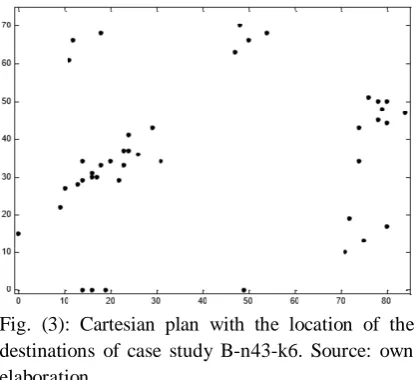
Once the tests have been carried out on the data instances mentioned, repeating these tests a statistically significant number of times, we obtain the results.In each case study the enclosed figures with Cartesian plan showa representation of the location of the destinations (central warehouse and clients) according to their coordinates on a Cartesian axis.
1. First case study: A-n32-k5
Based on the results, the selection operator that obtains the best solutions in this case is the TS, followed by the RWS and SUS, with a more than remarkable difference between them. However, this difference is not so pronounced in the analysis of crossing and mutation operators. The crossing operator that seems to get the best results is the OX, followed closely by the PMX and a little further away by the CX. On the other hand, the mutation operator that behaves better is EM, although the SIM operator also approaches results. The DM operator remains behind in the trend of the other two types of mutations.
Fig. (2): Cartesian plan with the location of the destinations of case study A-n32-k5. Source: own elaboration.
2. Second case study: B-n43-k6
The first case study discussed above is not sufficient to reach the conclusions that motivate this work, so a new case study is then carried out with the second of the study data. This new analysis aims to consolidate the assumptions made in the first case and clarify those ideas that could not be demonstrated, in addition to adding some experimental richness to the work by having a battery of tests with a greater volume of results.
Following this criterion, the mentioned data are taken as the set of initial conditions that will use the genetic algorithm to solve the VRP problem, with a greater volume of data than the one used in the previous case, motivated by a greater number of destinations. This implies that the size of the chromosome will be larger, as well as the size of the population, so that each iteration of the algorithm will increase the time required for the execution and memory occupation of the data structures used.
Fig. (3): Cartesian plan with the location of the destinations of case study B-n43-k6. Source: own elaboration.
The results obtained show a pattern similar to the one seen in the previous case study. The selection operator with the best results is again TS, although it should be noted that in some cases the RWS obtains similar solutions. On the other hand, the SUS operator continues to show results too far behind expectations. In the case of the crossover operator, the OX operator gets the best solutions, followed closely by the PMX and then the CX. The best mutation operator appears to be EM, followed by SIM and DM operators.
w w w . i j m r e t . o r g I S S N : 2 4 5 6 - 5 6 2 8 Page 79
The data obtained so far are beginning to show clear indications of the operators' contribution to the execution of the algorithm, but analysis is still needed to provide a wider range of information in order to reach the desired conclusions. Therefore, a new case study will be carried out with the third of the four datasets selected for this work. It should be noted that in each new case study, initial data are used that form more complicated problem configurations to be optimally solved.
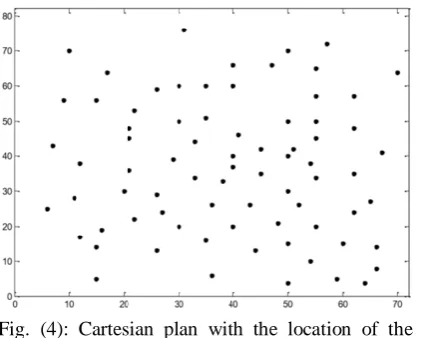
This new initial data set represents a considerable increase in the size of the problem due to the increased number of destinations. This means that chromosome and population sizes will be larger, so test runtime and memory occupancy will increase significantly. This case presents a better distributed layout of the locations on the plan, as shown in Fig4, contrary to what happened in the previous case where the facilities were grouped into areas.
Fig. (4): Cartesian plan with the location of the destinations of case study E-n76-k7. Source: own elaboration.
In this case study with a large amount of data, the great differences that already existed in previous cases with respect to certain combinations of operators are again highlighted. However, the comparison of solutions obtained by other combinations of operators is adjusted more closely and it is difficult to determine which one works best, so the tendency of solutions to approach the best solution will prevail. The selection operator with the best overall performance for all cases is the TS, closely followed by the RWS. The SUS operator gets poorer quality results, so it can be ruled out as a potential selection operator of choice. In the case of the crossing operator, the OX operator brings back the best solutions, but the PMX also provides very close results on average.
The CX operator also sometimes gets good results, but on other occasions he is ranked as the worst of the three. In terms of mutation, the EM operator continues to stand out, followed by SIM and DM.
4. Fourth case study: att-n48-k4
To finalize this analysis of the genetic algorithm and its operators, a last case study will be carried out with the fourth dataset. Their particularity lies in the positioning of the installations on the plane, so that this time the coordinates have a much wider range of values, having greater distances that is why the distance units in which the journeys are measured are significantly greater and will test the capacity of the algorithm to find solutions with a good total distance value.
The initial placement is reflected in Fig. 5 with the same representation system used in the previous cases to make the graphical presentation of the map. The destinations are not as dispersed as in the previous case study, but are sufficiently dispersed not to consider area dispersion as in the second case study.
Fig. (5): Cartesian plan with the location of the destinations of case study att-n48-k4. Source: own elaboration.
w w w . i j m r e t . o r g I S S N : 2 4 5 6 - 5 6 2 8 Page 80
because the SIM brings too many ups and downs and the chosen one has more constant values.
IV. EVALUATION OF RESULTS
After performing the necessary tests to examine the behavior of the genetic algorithm, it is time to carry out an evaluation process to determine which operators are the ones who bring the best qualities to the algorithm in order to achieve the best possible performance. Based on the results obtained in the tests carried out for four case studies with different initial datasets, a relatively common pattern can be observed in the value of the solutions, and it may be noted that the TS operator generally obtains better results, followed by the RWS and SUS operators. In the case of the crossing operator, the quality order would be defined by the operators OX, PMX and CX. Finally, the mutation operator that adapts best is EM, and then SIM and DM operators in that order of choice.
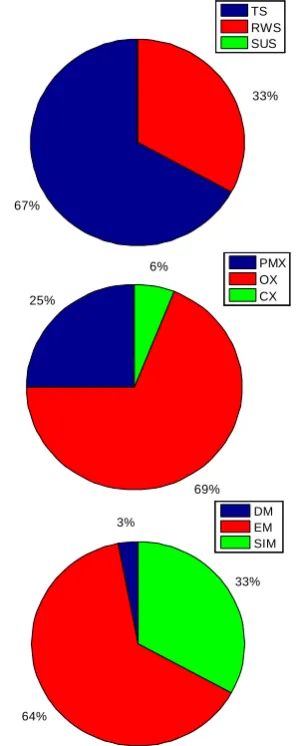
These conclusions are preliminary statements obtained from a first visual evaluation to compare previous results. To corroborate this proposal, it is necessary to carry out a more exhaustive comparison of the results in order to obtain reliable and generalized data on the implication that each operator has in the execution of the genetic algorithm. Based on the results obtained in the tests, a proportionality relationship has been established between the best solutions provided by the algorithm and the number of solutions related to certain selected operators. Based on this, the combination of operators that best adapts to the execution of the genetic algorithm can be determined in order to obtain the best possible results, as we can see in the graphical results in Figure 6. This combination is composed of the Tournament Selection Operator (TS), Order Crossing Operator (OX) and Exchange Mutation Operator (EM).
To finalize the evaluation of the results and reach the objective of this paper, a relationship will be established between the conclusions obtained in terms of total distances and runtimes. It had been established that the best combination of operators analyzing distances is the Tournament Selection Operator (TS), Order Crossing Operator (OX) and Exchange Mutation Operator (EM). On the other hand, the combination of operators with the best performance according to runtimes was formed by the Tournament Selection Operator (TS), the Partially Mapped Crossing Operator
(PMX) and the SimpleInversion Mutation Operator (SIM).
Fig. (6): Ratio of best distance results for selection, crossover and mutation operators. Source: own elaboration.
Comparing both conclusions, the first important observation that can be made is that the TS selection operator is the best of these operators when it comes to achieving a good level of algorithm efficiency and fits perfectly into any of the possible operator combinations. The next step is to find the right crossover and mutation operators, since the conclusions obtained are different in terms of distances and runtimes.
Analyzing the results on the crossing operators in more detail, the best operator minimizing distances is the OX, followed by the PMX and CX. However, the order of choice changes to PMX, CX and OX by analyzing in terms of runtimes. The OX operator gets the best results in terms of distance, but has the
67%
33% TS RWS SUS
25%
69%
6% PMX
OX CX
3%
64%
w w w . i j m r e t . o r g I S S N : 2 4 5 6 - 5 6 2 8 Page 81
disadvantage of being the operator that consumes longer runtime. On the other hand, the PMX operator is the one with the best times and is the second operator in terms of distances, being close to the first one in quality. Following this reasoning, the PMX operator presents considerably better times than the OX and, although in terms of distances it is slightly worse, the differences are minimal. In this way, it can be said that the PMX operator is best suited for the algorithm to maintain efficiency criteria.
Similarly for mutation operators, the best operator, determined by distances, is EM, followed by SIM and DM. However, the choices are different if the runtime is taken into account, choosing the SIM, MS and DM operators in that order. Continuing with this idea, the EM operator achieves the best distance results, while the SIM is a little behind in performance. On the other hand, both operators get good runtimes, slightly better SIM results. With this, in view of the provision of very similar times, it is recommended to evaluate the distances obtained in the results to achieve the desired efficiency, so that the operator that best fits this requirement is EM.
V. CONCLUSION
The resolution of VRP (Vehicle Routing Problem) is satisfactorily addressed through the use of Genetic Algorithms. However, there are a large number of approaches to the different operators used. After extensive testing with different datasets, we can say that the ideal combination for best algorithm performance is composed of the Tournament Selection Operator (TS), the Partial Correspondence Crossing Operator (PMX) and the Exchange Mutation Operator (EM).
REFERENCES
[1] Alanderk, J.T. (1992) “On optimal population size of genetic algorithms”. Proceedings CompEuro 1992, Computer Systems and Software Engineering, 6th Annual European Computer Conference, 65-70.
[2] Archetti, C.; Mansini, R. and Speranza M. G. (2001),“The split delivery vehicle routing problem with small capacity”, Technical Report n. 201, Department of Quantitative Methods, University of Brescia.
[3] Azi, N., Gendreau, M. y Potvin, J., “An exact algorithm for a vehicle routing problem with time windows and multiple use of vehicles”, European Journal of Operational Research, Vol. 202, No. 3, 2010, pp 756-763.
[4] Baker, J. E. (1987). “Reducing bias and inefficiency in the selection algorithm”,in Proceedings of the
SecondInternational Conference on Genetic Algorithms and Their Application, pages 14{21, Hillsdale, NJ, USA. L. Erlbaum Associates Inc.
[5] Balinzki, M. L. y Quandt, R. E. (1964) “On an Integer Program for a Delivery Problem”, Operational Research, Vol. 12, No. 2, 1964, pp 300-304.
[6] Banzhaf, W. (1990) “The molecular traveling salesman”, Biological Cybernetics, 64, 7-14.
[7] Baptista, S.; Oliveira, R. C. and Zúquete, E. “A period vehicle routing case study”, European Journal of Operational Research, 139:220-229, Elsevier, 2002.
[8] Bard, J. F.; Huang, L.; Dror, M. and Jaillet, P. “A branch and cut algorithm for the VRP with satellite facilities”, IIE Transactions 30, pp. 821-834. 1997.
[9] Contardo, C.A. (2005), “Formulación y solución de un problema de ruteo de vehículos con demanda variable en tiempo real, trasbordos y ventanas de tiempo”, Memoria para optar al título de ingeniero civil matemático, Departamento de Ingeniería Matemática, Universidad de Chile, Santiago de Chile, Chile, 2005.
[10] Cordeau, J.-F.; Desaulniers, G.; Desrosiers, J.; Solomon, M. M. and Soumis, F. “VRP with time windows”. In P. Toth and D. Vigo (eds.): The vehicle routing problem, SIAM Monographs on Discrete Mathematics and Applications, vol. 9, Philadelphia, PA, 157-193. 2002.
[11] Davis, L. (1985) “Applying adaptive algorithms to epistatic domains”, inProceedings of the International Joint Conference on Artificial Intelligence, 162-164.
[12] Dror, M.; Laporte G. and Trudeau P. “Vehicle routing with split deliveries”, Discrete Applied Mathematics 50, 239-254. 1994.
[13] Garvin, W. W.; Crandall, H. W.; John J.B. y Spellman, R. A. (1957) “Applications of Linear Programming in the Oil Industry”, Management Science, Vol. 3, 1957, pp 407.
[14] Goldberg, D.E. (1991). “A comparison of selection schemes used in genetic algorithm”,in G.E. Rawlins (ed.), Foundations of Genetic Algorithms. Morgan Kaufmann Publishers, pp. 69-93.
[15] Goldberg, D. E. (1989) “Genetic Algorithms in Search, Optimization, and Machine Learning”. Addison-Wesley Professional, 1 edition, January.
[16] Goldberg, D.E., Lingle, Jr. R. (1985). “Alleles, loci and the traveling salesman Problem”, in Proceedings of the First International Conference on Genetic Algorithms and Their Applications, 154-159.
w w w . i j m r e t . o r g I S S N : 2 4 5 6 - 5 6 2 8 Page 82 Conference on Genetic Algorithms and Their
Applications, 160-165.
[18] Hjorring, C. “The vehicle routing problem and local search metaheuristics”, Chapter 2. PhD thesis, Department of Engineering Science, The University of Auckland, 1995.
[19] Holland, J. (1975) “Adaptation in Natural and Artificial System’s”, University of Michigan Press, Ann Arbor.
[20] Jacobs-Blecha, C. and Goetschalckx, M. “The vehicle routing problem with backhauls: properties and solution algorithms”. Technical Report, School of Industrial and Systems Engineering, Georgia Institute of Technology, Atlanta, Georgia. Presented at the National Transportation Research Board, January 13-15, 1992, Washington DC.
[21] Laporte, G. and Louveaux, F. V. “Solving stochastic routing problems with the integer L-shaped method”. In: Fleet Management and Logistics, T.G. Crainic and G. Laporte (eds.), 159-167, Kluwer Academic Publishers, Boston, 1998.
[22] LeBlanc, L., Shtub, A., and Anandalingam, A., “Formulating and solving production planning problems”,in European Journal of Operational Research, No. 112, 1999.
[23] Michalewicz, Z. (1992) “Genetic Algorithms + Data Structures = Evolution Programs”, Springer-Verlag, Berlin Heidelberg.
[24] Oliver, I.M.; Smith, D.J.; Holland, J.R.C (1987). “A study of permutation crossover operators on the TSP”, in Genetic Algorithms and Their Applications: Proceedings of the Second International Conference, 224-230.
[25] Olivera, A. (2004), “Heurísticas para problemas de ruteo de vehículos”, reporte de investigación, Instituto de Computación – Facultad de Ingeniería, Universidad de la República, Montevideo, Uruguay, 2004.
[26] Ralphs, T.; Hartman, J. and Galati, M. “Capacitated vehicle routing and some related problems”. Rutgers University, 2001.
[27] Reeves, C., “Genetic algorithms”, in Glover, F. and
Kochenberger, G. (Ed.), Handbook of
metaheuristics,Kluwer academic publisher, 2003.
[28] Righini, G. “Approximation algorithms for the vehicle routing problem with pick-up and delivery”, Note del Polo - Ricerca 33, Polo Didattico e di Ricerca di Crema, Università degli Studi di Milano, July 2000.