The Open Journal of Occupational Therapy
The Open Journal of Occupational Therapy
Volume 5
Issue 1 Winter 2017 Article 9
January 2017
Evaluation of a Coaching Experiential Learning Project on OT
Evaluation of a Coaching Experiential Learning Project on OT
Student Abilities and Perceptions
Student Abilities and Perceptions
Erin A. Phillips
St. Ambrose University - USA, [email protected]
Follow this and additional works at: https://scholarworks.wmich.edu/ojot
Part of the Occupational Therapy Commons
Recommended Citation Recommended Citation
Phillips, E. A. (2017). Evaluation of a Coaching Experiential Learning Project on OT Student Abilities and Perceptions. The Open Journal of Occupational Therapy, 5(1). https://doi.org/10.15453/2168-6408.1256
This document has been accepted for inclusion in The Open Journal of Occupational Therapy by the editors. Free, open access is provided by ScholarWorks at WMU. For more information, please contact
Evaluation of a Coaching Experiential Learning Project on OT Student Abilities Evaluation of a Coaching Experiential Learning Project on OT Student Abilities and Perceptions
and Perceptions
Abstract Abstract
IInnovative teaching methods to address emerging practice needs are critical components of effective occupational therapy education. Experiential learning strategies can enhance skill development and translation of knowledge into OT clinical practice. In addition, skills such as coaching may provide important links to health promotion practices. Thirty-two occupational therapy students took part in an experiential project to connect occupational engagement and health for a community of older adults. A pretest/posttest design was used to evaluate program outcomes in student perceived abilities, and narrative reflection papers provided postexperience qualitative information. The students improved in all 10 areas of abilities self-assessment with mean total scores from pretest (M = 42) improving significantly at posttest (M = 58). Themes from reflection papers indicated a positive response to experiential learning and a desire for more opportunities to prepare for clinical practice, including the use of interprofessional training. The students improved in their abilities to use coaching and health promotion strategies through the use of experiential learning methods. Outcomes suggest that experiential learning opportunities are an effective way to enhance student competencies in coaching, improve readiness for wellness
programming, and increase student confidence in application of skills in future clinical practice.
Keywords Keywords
health promotion, lifestyle management, occupational therapy education, prevention services
Cover Page Footnote Cover Page Footnote
Correspondence concerning this work should be addressed to Erin Casey Phillips, OT Department, St. Ambrose University, Center for Health Sciences Education, 1320 West Lombard, Davenport, IA 52804 email: [email protected]
Acknowledgments: This project was prepared in fulfillment of the post-professional doctorate degree at St. Catherine University and presented at the AOTA Education Summit in 2015. The author would like to thank Dr. Kathleen Matuska and the faculty of St. Catherine University for their support of this work and the occupational therapy students who participated in this project.
Credentials Display
Erin Casey Phillips, OTD, OTR/L
Copyright transfer agreements are not obtained by The Open Journal of Occupational Therapy (OJOT). Reprint permission for this Topics in Education should be obtained from the
corresponding author(s). Click here to view our open access statement regarding user rights and distribution of this Topics in Education.
DOI: 10.15453/2168-6408.1256
Throughout the long history of occupational
therapy (OT), the profession’s core beliefs have
supported health promotion and wellness
(Hildenbrand & Lamb, 2013). Today, the
profession is armed with strong women and men
ready to listen carefully to the core beliefs of our
past and ready to voice these values in the present.
Ann Grady (1995) stated, “The promise of
occupational therapy lies in our ability to
continuously combine the mandates put forth in the
early tenets of our discipline with our constantly
changing practice” (p. 307). By taking a look back,
the profession can ground itself in stability, as once
again changes in health care create new educational
demands and practice opportunities. In order to
create a workforce ready to meet these demands and
explore these opportunities, OT education needs to
respond with substantiated outcomes. Coaching is a
specific entry-level skill noted in the profession’s
Blueprint for Entry-Level Education (American Occupational Therapy Association [AOTA], 2010),
a document outlining content knowledge for current
and emerging practice preparation. This project
demonstrates the implementation of a coaching
experiential learning project to prepare OT students
to position themselves as unique, occupationally
focused team members in health care reform efforts
to promote preventive services.
Literature Review
Health care changes are demanding a shift in
practice and a focus on preventive care and healthy
aging (National Prevention Council, 2011). The
National Prevention Strategy: America’s Plan for
Better Health and Wellness (2011) outlines the objectives for empowering individuals, creating
healthier communities, and establishing services for
disease prevention. In summary, the goal of this
initiative is to “increase the number of Americans who are healthy at every stage of life” (National
Prevention Council, 2011, p. 3). Berwick, Nolan,
and Whittington (2008), from the Institute for
Health Care Improvement, defined a framework
entitled the Triple Aim to improve the provision of
health care services. In general, these aims suggest
a need for improved patient care, improved
population health, and reduced costs. The
implementation of the Triple Aim initiative,
however, will require a new look at health
promotion and the provision of these services.
The current political climate is mandating
that health care professionals develop preventive
services, which may present as an “open window of
opportunity” for the OT profession (Hildenbrand &
Lamb, 2013, p. 270). Daily activities and habits
contribute to health at every stage of life. While
working adults may be experiencing the stress of
multiple roles and responsibilities, the older adult
population is experiencing health problems due to a
loss of leisure competence and occupational roles
(Chang & Yu, 2013). The number of adults over 65
years of age is expected to double by 2026, and a
major concern is the increased demand for health
care among this population (Wilson & Palha, 2007).
A change in performance patterns or occupational
deprivation may put some older individuals at risk
for stress and associated illnesses. OT addresses the
roles and patterns of daily life, and educators should
leverage this expertise to educate students and
participation needs of society, including the specific
needs of our aging population.
OT in Health Promotion
AOTA updated a position statement in
2008 titled Occupational Therapy’s Role in Health Promotion and Disease Prevention. This statement advocates for wellness programming and defines
the specific ways in which practitioners might
provide these services. According to Filiatrault and
Richard (2005), OT “could play a larger role on the
side of prevention . . . not only to consumers of
home care, but also to the entire population of a
community, whether that is high-risk groups or
healthy individuals” (p. 47). Radomski (2011)
suggested that OT focus on adherence with lifestyle
changes as a way to impact sustainable change, both
on a direct service level and on a societal level. She
commented that many of the health challenges we
face as a society are a result of “people’s inability to
stick with health-promoting lifestyle changes even
when they know better” (p. 475).
The role of OT in health promotion is well
supported in the Occupational Therapy Practice Framework: Domain and Process (AOTA, 2014) and in the professional literature. Educational
standards are proposed for the instruction of
wellness and prevention knowledge in entry-level
education (Accreditation Council for Occupational
Therapy Education, 2012). However, there is
limited information on whether this knowledge is
being adequately translated into skills for clinical
practice. Workforce trends indicate only 4.3% of
clinicians work in community settings (AOTA, n.d.).
Serwe and Schultz (2014) suggested fieldwork
opportunities as a way to enhance student readiness
to take on the challenges of prevention services. In
summary, in order to serve our clients and our
society more effectively, OT educators must
continue to create innovative educational models to
develop a workforce ready and able to address
health and wellness needs.
Coaching
Lifestyle change and adherence to
professional recommendations may be the
foundation of preventive care (Radomski, 2011).
Coaching for lifestyle change is supported by the
literature as a strategy to enhance health promotion
programming and improve participation and health.
Professional coaching is the process of engaging
individuals in talk-based sessions in order to help
them make changes in their daily activity patterns
(Heinz & Pentland, 2009). The coach serves as the
motivator, guide, and support to help people
achieve their goals for healthier living. The
literature presents emerging evidence for the use of
coaching as an effective intervention for stress and
associated illness, with the potential for application
to an aging population. The evidence is
inconsistent for the treatment fidelity of coaching as
intervention; however, several key program themes
emerge as consistent aspects of effective
programming and the evidence-based use of
coaching in the promotion of health. The themes
are the use of a positive psychology approach to
facilitate change, individualized goal setting, and
use of a client-centered approach. These themes
have been found to be effective coaching tools in
creating positive health outcomes, and these
strategies align with OT practice (AOTA, 2014).
Evidence shows that using a positive
psychology approach to coaching interventions is an
important feature of effective coaching programs.
Solution-focused coaching uses a positive strengths
approach to problem solving and goal setting (Grant,
2012; Green, Grant, & Rynsaardt, 2007).
Researchers have focused on the solution to a
self-selected problem, rather than the problem itself.
Positive motivation and self-management are key to
this type of programming. Several studies
demonstrated the efficacy of motivational
interviewing as a positive psychology approach to
promote goal achievement (Butterworth, Linden,
McClay, & Leo, 2006) and define it as a strategy
focused on collaboration around a central goal in
order to coach a client toward lifestyle change
(Olsen & Nesbitt, 2010).
Individualized goal setting also emerged as a
common thread to facilitate healthy living, and
researchers found coaching programs that used
solution-focused goal setting were able to achieve
positive health outcomes and facilitate adherence
and goal attainment (Graham, Rodger, & Ziviani,
2013; Grant, Curtanye, & Burton, 2009; Hebden,
Chey, & Allman-Farinelli, 2012). In a randomized
control trial, Grant et al. (2009) supported the use of
value-centered goal setting to improve goal
attainment, cognitive hardiness, and workplace
well-being. The OT literature shows that using the
therapist as coach was an effective way to assist
mothers in valued goal setting, and the outcomes
showed a positive impact on child performance and
parenting perceptions (Graham et al., 2013). The
recent work of Hilton, Ackermann, and Smith (2011)
is also occupationally based. This study looked at
coaching efficacy to determine supports and barriers
of goal setting and adherence. The findings
suggested that having a mentor or coach and general
peer support from others were positive ways to
sustain goal-oriented behavior.
Finally, evidence suggests the use of a
client-centered approach in coaching individuals
toward lifestyle change. Recommendations from
this evidence include the use of client-centered,
one-on-one coaching sessions; personal support;
and follow-up coaching by clinicians to achieve
positive outcomes in health behavior changes
(Giuseffi et al., 2011; Grant et al., 2009). The
national guideline Healthy Lifestyles, from the Institute for Clinical Systems Improvement (2011),
provides the recommendation that collaborative
decision making will help to motivate individuals in
making and sustaining changes to lifestyle
behaviors. Coaching is effective when instituted
one-on-one and may be combined with traditional
therapeutic tools, like biofeedback, to enhance
effectiveness (Kiffer & McKee, 2007).
These three coaching themes align with OT
as foundational tools in clinical practice; however,
they may not be adequately addressed in the OT
curricula or applied in clinical practice. There is a
gap between the national and professional initiatives
for health care reform and the OT profile of national
practice. According to an AOTA workforce survey,
the majority of occupational therapists are
employed in long-term care, hospitals, and schools
(AOTA, n.d.). The skills of managing lifestyle
behaviors and daily occupations are the tools of
coaching and the tools of occupational therapists
profession is well prepared to use coaching as a
strategy to enhance interventions in the promotion
of health for individuals, and that this process may
be specifically applied to a population of older
adults experiencing a transition of habits and
routines.
Experiential Learning
Health professional andragogy demands
creating student competency in current techniques
while developing the clinical reasoning tools needed
to advance practice into the future. OT is grounded
in the concepts of engagement to facilitate
performance skills, and it is from this perspective
that health professionals should approach the
educational model for students. How best can
educators facilitate a translation of OT knowledge
into clinical practice to address population health
needs? Learning theory provides a link between
occupational engagement and successful student
outcomes through experiential learning strategies.
Kolb (1984) defines experiential learning as a
continuous cyclical process “whereby knowledge is
created through the transformation of experience”
(p. 41). Kolb’s model suggests a four-stage cyclical
process that includes concrete experience, reflective
observation, abstract conceptualization, and active
experimentation (Kolb, 1984). With regard to
academia, the student learner actively experiences
learning by putting knowledge into action. The
learner then reflects on the experience and generates
concepts to inform future action. The final
component is experimentation, where the new
knowledge is applied to planning. The process is
ongoing and represents an effective way to
construct knowledge and provide a path to
translation into clinical practice.
Law (2010) supports learning by doing as
she connects Kolb’s work to the nature of OT
practice:
In education, we speak with student
occupational therapists about
lifelong learning. Yet we have not
integrated this process into the
creation, transfer and use of
knowledge in our discipline.
Occupational therapy values
participation in meaningful
occupation. Should we not focus on
the experiential characteristics or the
‘doing’ of the learning process? (p.
15)
Additional evidence supports the use of
experiential service-learning activities, specifically
in OT training, as a cost-effective method of
increasing student learning outcomes while
supporting the Centennial Vision of the profession
(Horowitz, 2012). In a study of experiential
learning opportunities, results indicated that this is
an effective method to enhance the understanding
and application of OT knowledge in clinical
practice (Knecht-Sabres, 2013). The authors
suggested “additional experiential learning
opportunities would serve to help ‘bridge the gap’ between academia and clinical practice”
(Knecht-Sabres, 2013, p. 32). Supported by the evidence,
the purpose of this article and study was to create a
link between the coaching skills needed for
emerging practice in health promotion and the
effectiveness of experiential teaching methods for
OT students.
Methods
Participants
Thirty-two second year Master of
Occupational Therapy (MOT) students who were
enrolled in an established health promotion and
wellness course at a Midwestern university
participated in the project. All of the students were
required to complete the course projects and
assignments; however, allowing the use of course
materials as data collection for this project was
voluntary and confidential. The students were
asked to complete a consent form on the first day of
the semester to indicate their desire to participate in
the research portion of the course experience by
allowing the primary investigator, who was also the
course instructor, access to survey responses and
course reflection materials. In order to eliminate
any chance of instructor bias, all consent forms
were sealed and held until fall semester grades for
this course were submitted to the university
registrar. The aim of the work was identified as an
attempt to better understand the impact of both an
innovative education model and teaching methods
on student learning and future practice.
Course Enhancement
Lifestyle Redesign (Clark et al., 2015) is an evidence-based program that can act as a scaffold to
the development of health promotion programs
intended to improve the health and quality of life in
older adults. This program consists of a series of 12
modules related to aging, health, transportation,
relationships, home and community safety, and
community exploration. In general, the program is
designed to inform older adults of the impact of
activity performance on health. The current health
promotion course was enhanced with the addition of
three modules as an evidence-based approach to
health and quality of life for older adults. These
modules represent three content units focused on
programming to increase older adult participation in
meaningful activities.
In addition, course content was enhanced as
the students were introduced to coaching-specific
theory, principles, and strategies to promote healthy
changes in occupational participation patterns. For
example, coaching activities for values clarification,
solution-focused goal setting, social circles of
influence, and the use of powerful open-ended
questions, were intervention tools that the students
learned and applied to a community-based coaching
relationship. Coaching tools were used with
permission granted from Learning Journeys: The
International Center of Coaching
(www.learningjourneys.net).
Experiential Project
A 5-week health promotion program was
developed for implementation at a local church
community serving an independently living, well
elderly population. Older adult parishioners, 65
years of age and older, were recruited for the
program. Group presentations were prepared based
on the three modules of the Lifestyle Redesign program (Clark et al., 2015), and eight OT students
led each group. All of the older adult participants
took part in the group presentations. Following
each full group session, two MOT students paired
up with a single older adult to provide
In the first group module, titled Occupation,
Health, and Aging, the older adults were introduced
to the concepts of occupational roles and patterns
and asked to reflect on how they were experiencing
their daily activities. They were given an
opportunity to meet with student coaches to outline
an occupational profile and complete a values
clarification exercise to allow for reflection on
current patterns and desired patterns of engagement.
In the second group module, titled Health through
Occupation: Physical and Mental Activity, the older
adults were asked to reflect on the link between
activity and health. They were given an opportunity
to meet with student coaches to create a plan for any
areas that they would like to address in order to
improve or maintain participation in the community.
In the third group module, titledRelationships and
Occupation, the older adults were encouraged to
discuss how relationships impact health and our
ability to stay active. Following this group session,
the students provided an activity to help the older
adults understand the presence of barriers and
supports in their daily lives. The final 2 weeks of
the project consisted of the students providing the
older adults with individual coaching sessions over
the phone or electronically, as determined by the
older adult. These individual sessions were held
once each week and the student coaching focused
on the environmental context of change and
progression toward the participant’s goals. Outlines
of suggested coaching content were provided to
guide the sessions. The students were required to
document field notes for each group and the
individual sessions as structured self-reflection
journal entries, addressing each stage of the learning
cycle: experience, reflection, summary, and plan.
Instrumentation
The Student Abilities Self-Assessment
survey, a student pre-post experience instrument,
was created to assess the students’ perceived
abilities. This survey was modeled after the
essential OT competency evaluation developed by
Knecht-Sabres (2013). The survey consisted of a
10-item questionnaire using a 7-point Likert scale.
Scores range from 1 (unable to perform a task) to 7 (I think I perform that very well). Total score range was from 10 to 70. Survey questions were created
from the course learning outcomes to reflect basic
competencies related to the content of this project:
health promotion programming and coaching
strategies for evaluation and intervention. A copy
of this survey is included in the Appendix. A final
student reflection assignment was developed to
provide a series of open-ended questions for student
summary, reflection, and application of experiential
learning.
Procedures
The students participated in a health
promotion course and a five-week experiential
learning project during the fall 2014 semester. All
of the students were asked to complete pre-post
course surveys evaluating their abilities related to
health promotion and coaching skills. This
information was used for course evaluation. Only
those students who consented to allow their course
materials to be used for research purposes were
included in the quantitative data analysis of skill
development and competencies. All of the students
were asked to submit the final reflection summary
on the experiential project as part of the course
requirements. For those consenting to participate in
the research, the final reflection summary was used
as data for qualitative analysis of learning themes
and perceptions of the experience.
Data Analysis
Quantitative. Thirty-two students
completed the Student Abilities Self-Assessment
pretest and posttest pairs. Quantitative data for the
students’ responses on the skills self-assessment
form were analyzed using SPSS (Version 19.0).
The mean, standard deviation, and range were
calculated for all 10 items using scores from the
7-point Likert scale. A paired sample t-test was used
to test differences between preexperience and
postexperience mean scores. The level of
significance for each analysis was set at p ≤ 0.05.
Qualitative. Final reflection summaries
were collected at the end of the experiential project.
Thirty-two students submitted narrative information
for qualitative analysis. The primary investigator
performed a thematic analysis. Themes were
identified with manual coding and validated with
word frequencies using Nvivo software. Relevant
passages from the students’ narratives were
collected using text search inquiries.
Results
Thirty-two second year MOT students
participated in the project. The ages of the students
ranged from 21 to 36 years (M = 24). Five males
and 27 females participated.
Student Abilities Self-Assessment Survey
Quantitative data was collected from the
Student Abilities Self-Assessment survey (see
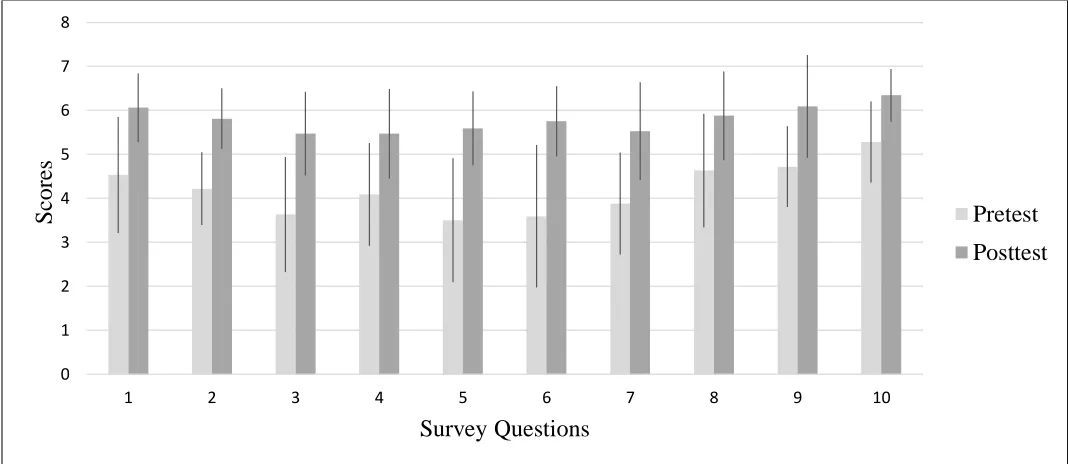
Appendix). Figure 1 shows the total mean scores
for preexperience and postexperience for the 10
items on the survey.
Figure 1. Paired mean scores on the Student Abilities Self-Assessment survey. N = 32. Horizontal axis represents questions from the survey (see Appendix). Error bars indicate ± one SD.
0 1 2 3 4 5 6 7 8
1 2 3 4 5 6 7 8 9 10
S
core
s
Survey Questions
Pretest
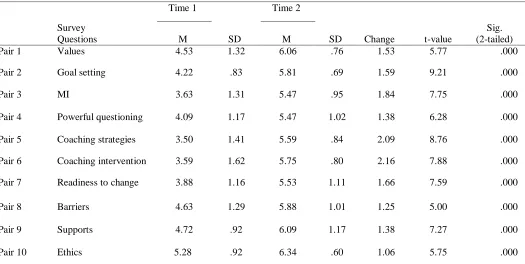
Table 1 shows the specific results for
individual items on the Student Abilities
Self-Assessment survey. Descriptive statistics for each
question are shown. A paired-samples t-test was
conducted to compare the change in mean scores for
each question. The results indicate that the mean
scores for each of the 10 questions were
significantly greater at the postexperience (Time 2)
than at the preexperience of the experiential
learning project (Time 1). The greatest
improvements were demonstrated in the areas of
use of coaching tools and use of coaching as
intervention. These areas showed a 2-point change
in mean scores of perceived abilities from pretest to
posttest (M = 2.09 and M = 2.16, respectively).
Table 1
Paired Differences for Individual Items on Student Abilities Self-Assessment Survey
Time 1 Time 2
Survey
Questions M SD M SD Change t-value
Sig. (2-tailed)
Pair 1 Values 4.53 1.32 6.06 .76 1.53 5.77 .000
Pair 2 Goal setting 4.22 .83 5.81 .69 1.59 9.21 .000
Pair 3 MI 3.63 1.31 5.47 .95 1.84 7.75 .000
Pair 4 Powerful questioning 4.09 1.17 5.47 1.02 1.38 6.28 .000
Pair 5 Coaching strategies 3.50 1.41 5.59 .84 2.09 8.76 .000
Pair 6 Coaching intervention 3.59 1.62 5.75 .80 2.16 7.88 .000
Pair 7 Readiness to change 3.88 1.16 5.53 1.11 1.66 7.59 .000
Pair 8 Barriers 4.63 1.29 5.88 1.01 1.25 5.00 .000
Pair 9 Supports 4.72 .92 6.09 1.17 1.38 7.27 .000
Pair 10 Ethics 5.28 .92 6.34 .60 1.06 5.75 .000
Note. N = 32 and significance level set as *p < .05; MI = motivational interviewing
A paired-samples t-test was conducted to
evaluate differences in total Student Abilities
Self-Assessment survey scores over two testing periods.
The results indicated that the mean total scores for
abilities at the end of the teaching intervention (M =
58, SD = 6.44) were significantly greater than the
mean total scores at the start of the course (M =
42.06, SD = 8.60). This outcome was statistically
significant: t(31) = 11.259; p= .000. These
outcomes represent a significant improvement in the
students’ perceived abilities following coursework
and experiential learning.
Student Reflection Narratives
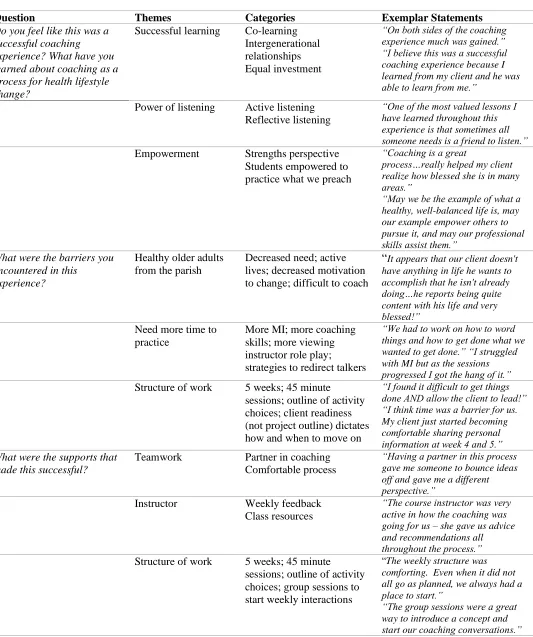
Each of the five open-ended questions was
analyzed separately and the outcomes were grouped
according to general themes with branch categories
and specific quotations from the students as
supporting evidence. Table 2 includes themes for
each question on the reflection assignment,
categories that emerged in each theme, and
examples of the students’ comments.
Table 2
Qualitative Outcomes from Reflection Narratives
Question Themes Categories Exemplar Statements
Do you feel like this was a successful coaching experience? What have you learned about coaching as a process for health lifestyle change?
Successful learning Co-learning Intergenerational relationships Equal investment
“On both sides of the coaching experience much was gained.” “I believe this was a successful coaching experience because I learned from my client and he was able to learn from me.”
Power of listening Active listening Reflective listening
“One of the most valued lessons I have learned throughout this experience is that sometimes all someone needs is a friend to listen.” Empowerment Strengths perspective
Students empowered to practice what we preach
“Coaching is a great
process…really helped my client realize how blessed she is in many areas.”
“May we be the example of what a healthy, well-balanced life is, may our example empower others to pursue it, and may our professional skills assist them.”
What were the barriers you encountered in this
experience?
Healthy older adults from the parish
Decreased need; active lives; decreased motivation to change; difficult to coach
“It appears that our client doesn't have anything in life he wants to accomplish that he isn't already doing…he reports being quite content with his life and very blessed!”
Need more time to practice
More MI; more coaching skills; more viewing instructor role play;
strategies to redirect talkers
“We had to work on how to word things and how to get done what we wanted to get done.” “I struggled with MI but as the sessions progressed I got the hang of it.” Structure of work 5 weeks; 45 minute
sessions; outline of activity choices; client readiness (not project outline) dictates how and when to move on
“I found it difficult to get things done AND allow the client to lead!” “I think time was a barrier for us. My client just started becoming comfortable sharing personal information at week 4 and 5.”
What were the supports that made this successful?
Teamwork Partner in coaching Comfortable process
“Having a partner in this process gave me someone to bounce ideas off and gave me a different perspective.”
Instructor Weekly feedback Class resources
“The course instructor was very active in how the coaching was going for us – she gave us advice and recommendations all throughout the process.” Structure of work 5 weeks; 45 minute
sessions; outline of activity choices; group sessions to start weekly interactions
“The weekly structure was comforting. Even when it did not all go as planned, we always had a place to start.”
Positive attitude of community
Very open; talkative; motivated
“We were blessed to have awesome clients. We thought we were helping them, when all along they were helping us and being supportive.” Environment to
support fellowship
Open space; meal shared together; prayer to start sessions
“I really enjoyed the fact that we gathered as a group and had a meal together.” “I think this created an atmosphere of comfort and community.”
How is coaching like the OT process and what is an example of use in future practice?
Coaching parallels OT process
Interview/rapport; evaluation tools for data collection; goal setting; and intervention
“Coaching can be made to follow OT process: there is the stage of getting to know the person (occupational profile); identifying values, occupations, supports and barriers (assessment and
evaluation); develop goals and implement them via lifestyle changes, compensation and adaptation (intervention); and finally following up on the client’s progress…to refine interventions according to the client’s needs.” Client centered OT
practice
Listening; MI approach; individualized goal setting
“When the individual is in charge…it can impact how they create goals and how they follow through with their desired change.”
What are suggestions for educational methods to increase your readiness to take on health, wellness services?
More practice Role plays; mock interviews; case studies
“Learning about the techniques is a good foundation, but seeing in it action was the most helpful.”
Experiential learning Hands-on learning effective; “realistic” learning helpful; community application
“The best way for me to learn is hands-on because you are able to get more out of an experience than reading about it…”
Implement in traditional practice settings
Demonstrate use in current practice areas
Work with more “at risk” clients
“I think it would be beneficial now to have another coaching
experience in the community…or to have a FW assignment…all so I can feel ready to use it in my future practice as an OT.”
Interprofessional training
Teamwork with others Pro bono clinic
“Experience this project working with a team composed of nurses and PA’s?”
Note: Thematic analysis performed with manual coding and supported with Nvivo software.
Several important themes emerged from the
open-ended questions in the students’ reflections. It
was reported that successful learning occurred
through application of coaching strategies and
through mutual empowerment between the students
and the older adults. Empowerment was seen as the
use of a strengths perspective with the older adults
and motivation for the students themselves to
embrace healthy living. The students commented
that coaching, as a client-led practice skill, allowed
them to experience the power of listening. This
involved the use of skills for active and reflective
listening. Co-learning and intergenerational
learning were also prominent themes in student
success. The students reported a sense of “equal
investment” between generations, which included
both teaching and learning from this community of
older adults.
The students’ suggestions for future learning
included additional practice in coaching and
application of coaching strategies in a variety of
settings. Some of the ideas presented to create
additional readiness for the community project were
practice with mock role-plays and video transcript
analysis. The students commented that they would
like to have more hands-on experiences with
coaching in traditional practice settings and with
populations with increased need. Themes from
question five reflect the students’ self-assessment of
their readiness to apply coaching strategies in
clinical practice. These qualitative outcomes
indicate an appreciation for this type of learning and
a desire for additional experiential learning
opportunities.
In order to learn from our work as educators,
it is important to review the supports and barriers to
a project in order to inform future efforts. The
students reported supportive aspects of the
experiential project and coursework, which were
identified as the group activities prior to coaching,
the use of student coaching partners, the positivity
of the community, and class structure and resources.
Barriers to student learning were identified as the
overall health of the community, which made it
difficult to identify a need for change; the time
constraints of the project; and the email electronic
coaching portion of the experience. The students, in
general, preferred face-to-face interactions and
found it difficult to translate coaching strategies to
an email format. Overall, the results indicated that
the students’ perceptions and abilities were
impacted in a positive way by the experiential
learning project involved in this course. Both
quantitative and qualitative data support successful
student learning and improved skills at the
conclusion of the course and experiential project.
Discussion
The objective of this project was to expand
student experiential learning opportunities with the
use of evidence-based health promotion
programming, enhanced with the introduction of
coaching strategies. The need for this preparation is
supported by the literature, which calls for OT
professionals to define and expand a role in health
prevention (Hildebrand & Lamb, 2013). Changes
in the mean scores on the Student Abilities
Self-Assessment Scale indicated a significant growth in
the students’ abilities to provide coaching strategies
following the experience. This supports the use of
innovative teaching methods in order to prepare OT
students for future practice. The importance of skill
building is a critical component of OT education,
and this project illustrated how the students applied
newly learned coaching skills in real life situations.
The translation of skills to OT practice is a process
discussed by Coker (2010) and Knecht-Sabres
(2013). The authors emphasized that skill building
should involve experiential learning as an effective
method to “bridge the gap between academia and clinical practice” (Knecht-Sabres, 2013, p. 32) and “foster the skills needed for students to successfully enter today’s healthcare environment” (Coker, 2010,
The outcomes of this project indicate that
the use of health promotion educational content
enhanced with coaching strategies and experiential
teaching methods can positively impact student
learning outcomes. This innovative educational
approach was shown to prepare students for
application of preventive service interventions for
older adults in community practice. This is an
important contribution to the evidence to support
OT education in health promotion programming and
experiential learning, and suggests that coaching
strategies, used in conjunction with evidence-based
interventions, may assist older adults in lifestyle
change to positively impact their health.
Limitations
Several limitations occurred in the
preparation and implementation of this project. The
project time frame was bound by the academic
semester and may have limited the ability of the
students to connect fully with the community before
the experiential project. Strategies to improve this
outcome might include introduction of the didactic
content of motivational interviewing and coaching
strategies in prior academic semesters for provision
of a developmental process that would lead to
community practice application. Another limitation
is the recruitment of individuals for health
promotion programming. The overall health of the
older adults presented as a common barrier to the
students in the coaching process, as the students
found participants reported minimal desire for
lifestyle change.
Implications for Future Research
Future research might include the
application of similar community experiential
projects with a variety of populations seeking
lifestyle change to impact health, including at-risk
populations for chronic disease, populations with
low access to health promotion services, and well
groups of individuals who are exploring
maintenance of healthy lifestyles. In addition, work
in this area might be explored as interprofessional
education, incorporating a team approach to
teaching and community application. Future
research will need to follow these student learners
as they transition into professional practice to
document the long-term outcomes of this type of
learning. The anticipated result would be increased
participation and delivery of effective OT
prevention services meeting societal needs.
Conclusion
It is apparent that experiential learning can
assist OT graduates in gaining confidence for
application of skills in future practice. The
outcomes of this project have the following
implications for OT education and practice: (a) the
incorporation of specific health promotion content,
including coaching strategies, can enhance student
competencies in providing preventive care services
and (b) experiential learning projects are effective
methods to provide OT students with opportunities
to apply classroom skills and facilitate the
translation of those skills into future practice. This
project used experiential methods to create
opportunities to practice coaching strategies for
health promotion. As educators and practitioners
working in a dynamic health care system, it is
important that we prepare for change and emerging
practice areas. Education of future practitioners
with health promotion and coaching opportunities
will increase student confidence and impact the
services they will provide and, ultimately, the role
of OT in preventive care.
As the profession moves forward,
confidently embracing a unique and powerful role
in health and wellness, the services of OT will be
taught and practiced, and enhanced with a return to
the client-centered, occupation-based foundation of
our past. In this way, the proactive wisdom of
Grady (1995) is honored as the profession responds
to the changing needs of society and health care.
The promise of OT lies in the educators’ abilities to
develop evidence for a new focus on experiential
learning and the use of coaching strategies to
promote healthy aging.
Erin Phillips, an Assistant Professor of Occupational Therapy at St. Ambrose University, earned her MSOT from Washington University and post-professional OTD from St. Catherine University. This paper is a culmination of her doctoral studies and research on coaching in OT education and practice. Erin, a certified life coach and yoga instructor, teaches a “coach approach” to OT practice in traditional settings, health promotion, and lifestyle management and she mentors the use of coaching in the university Student Led Interprofessional Clinic. Erin is married, with five children and a passion for OT and its powerful relevance in a changing health system.
References
Accreditation Council for Occupational Therapy Education. (2012). 2011 Accreditation Council for Occupational Therapy Education (ACOTE) standards. American Journal of Occupational Therapy, 66(Suppl. 6), S6-S74. http://dx.doi.org/10.5014/ajot.2012.66S6 American Occupational Therapy Association. (n.d.). Your
career in occupational therapy: Workforce trends in occupational therapy. Retrieved from
http://www.aota.org/-/media/Corporate/Files/EducationCareers/ Prospective/Workforce-trends-in-OT.pdf American Occupational Therapy Association. (2008).
Occupational therapy services in the promotion of health and the prevention of disease and disability. American Journal of Occupation Therapy, 62(6), 694-703. http://dx.doi.org/10.5014/ajot.62.6.694
American Occupational Therapy Association. (2010). Blueprint for entry-level education. American Journal of Occupational Therapy, 64(1), 186-203. http://dx.doi.org/10.5014/ajot.64.1.186
American Occupational Therapy Association. (2014). Occupational therapy practice framework: Domain and Process (3rd ed.). American Journal of Occupational Therapy, 68(Suppl. 1), S1-S48. Retrieved from http://ajot.aotapress.net
Berwick, D., Nolan, T. W., & Whittington, J. (2008). The triple aim: Care, health, and cost. Health Affairs, 27(3), 759-769.
http://dx.doi.org/10.1377/hlthaff.27.3.759
Brachtesende, A. (2005). Life goals don’t have to end with
injuries. OT Practice, 10(9), 7-8.
Butterworth, S., Linden, A., McClay, W., & Leo, M. C.(2006). Effect of motivational interviewing-based health coaching on employees’ physical and mental health status. Journal of Occupational Health Psychology, 11(4), 358–365. http://dx.doi.org/10.1037/1076-8998.11.4.358
Chang, L.-C., & Yu, P. (2013). Relationships between leisure factors and health-related stress among older adults. Psychology, Health, and Medicine, 18(1), 79-88.
http://dx.doi.org/10.1080/13548506.2012.686621
Clark, F., Blanchard, J., Sleight, A., Cogan, A., Floríndez, L., Gleason, S., . . . Vigen, C. (2015). Lifestyle redesign: The intervention tested in the USC Well Elderly studies (2nd ed.). Bethesda, MD: AOTA Press. Coker, P. (2010). Effects of an experiential learning program
on the clinical reasoning and critical thinking skills of occupational therapy students. Journal of Allied Health, 39(4), 280-286.
Filiatrault, J., & Richard, L. (2005).Theories of behavior change through prevention and health
promotion interventions in occupational therapy. Canadian Journal of Occupational Therapy, 72(1), 45-56.
http://dx.doi.org/10.1177/000841740507200110
Giuseffi, D. L., Bedrosian, R.C., Schwartz, S. M., Wildenhaus, K. J., Wang, C., Yu, A., & Wiegand, B. (2011). Women using a web-based digital health coaching programme for stress management: Stress sources, symptoms and coping strategies. Stress & Health: Journal of the International Society for the Investigation of Stress, 27(3), e269-e281. http://dx.doi.org/10.1002/smi.1389
Grady, A. (1995). Building inclusive community: A challenge for occupational therapy. American Journal of Occupational Therapy, 49(4), 300-310. http://dx.doi.org/10.5014/ajot.49.4.300
self-competence. American Journal of Occupational Therapy, 67(4), 10-18.
http://dx.doi.org/10.5014/ajot.2013.004648 Grant, A. M.(2012). Making positive change: A randomized
study comparing solution-focused vs. problem-focused coaching questions. Journal of Systemic Therapies, 31(2), 21-35.
http://dx.doi.org/10.1521/jsyt.2012.31.2.21 Grant, A. M., Curtayne, L., & Burton, G. (2009). Executive
coaching enhances goal attainment, resilience and workplace well-being: A randomized controlled study. The Journal of Positive Psychology, 4(5), 396-407. http://dx.doi.org/10.1080/17439760902992456 Green, S., Grant, A., & Rynsaardt, J. (2007). Evidence-based
life coaching for senior high school students:
Building hardiness and hope. International Coaching Psychology Review, 2(1), 24-32.
Hebden, L., Chey, T., & Allman-Farinelli, M. (2012). Lifestyle intervention for preventing weight gain in young adults: A systematic review and meta-analysis of RCTs. Obesity Reviews, 13(8), 692-710.
http://dx.doi.org/10.1111/j.1467-789X.2012.00990.x Heinz, A., & Pentland, W. (2009). Professional coaching for
life balance. In K. Matuska & C. Christiansen (Eds.),
Life balance: Multidisciplinary theories and research
(pp. 241-254). Bethesda, MD: AOTA Press.
Hildenbrand, W. C., & Lamb, A. J. (2013). Occupational therapy in prevention and wellness: Retaining relevance in a new health care world. American Journal of Occupational Therapy, 67(3), 266-271. http://dx.doi.org/10.5014/ajot.2013.673001 Hilton, C. L., Ackermann, A. A., & Smith, D. L.(2011).
Healthy habit changes in pre-professional college students: Adherence, supports, and barriers. OTJR: Occupation, Participation & Health, 31(2), 64-72.
http://dx.doi.org/10.3928/15394492-20100325-01
Horowitz, B. (2012). Service learning and occupational therapy education: Preparing students for community practice. Education Special Interest Section
Quarterly/American Occupational Therapy Association, 22(2), 1-4.
Institute for Clinical Systems Improvement. (2011). Healthy lifestyles. Guideline summary NGC-8572.
Bloomington, MN: Institute for Clinical Systems Improvement. Retrieved from
https://www.icsi.org/guidelines__more/catalog_guide lines_and_more/catalog_guidelines/catalog_preventi on__screening_guidelines/healthy_lifestyles/ Kiffer, J. F., & McKee, M. G. (2007). Executive health
coaching consultation to reduce stress and enhance life satisfaction. Biofeedback, 35(3), 101-104. Knecht-Sabres, L. J.(2013). Experiential learning in
occupational therapy: Can it enhance readiness for clinical practice? Journal of Experiential Education, 36(1), 22-36.
http://dx.doi.org/10.1177/1053825913481584
Kolb, D. (1984). Experiential learning: Experience as the source of learning and development. Engelwood-Cliffs, NJ: Prentice Hall.
Law, M. (2010). Learning by doing: Creating knowledge for occupational therapy. WFOT Bulletin, 62(1), 12-18. http://dx.doi.org/10.1179/otb.2010.62.1.004 National Prevention Council. (2011). National prevention
strategy: America’s plan for better health and wellness. Washington, D.C.: U.S. Department of Health and Human Services, Office of Surgeon General. Retrieved from
http://www.surgeongeneral.gov/priorities/prevention/ strategy/report.pdf
Olsen, J. M., & Nesbitt, B. J.(2010). Health coaching to improve healthy lifestyle behaviors: An integrative review. American Journal of Health Promotion, 25(1), e1-e12. http://dx.doi.org/10.4278/ajhp.090313-lit-101
Radomski, M. V. (2011). More thangood intentions: Advancing adherence to therapy recommendations. The American Journal of Occupational Therapy, 65(4), 471-477.
http://dx.doi.org/10.5014/ajot.2011.000885 Serwe, K., & Schultz, S. (2014). Fieldwork opportunities for
enhancing occupational therapy’s role in preventive care. Education Special Interest Section
Quarterly/American Occupational Therapy Association, 24(3), 1-4.
Wilson, D. M., & Palha, P. (2007). A systematic review of published research articles on health promotion at retirement. Journal of Nursing Scholarship, 39(4), 330-337.
http://dx.doi.org/10.1111/j.1547-5069.2007.00189.x
Appendix
Student Abilities Self-Assessment Survey
Please evaluate your current abilities by scoring the following statements from 1 to 7. Circle the corresponding number.
Pretest-Posttest Evaluation Form Last 4 digits of phone number: __________________
1. Ability to perform a client centered values assessment
Unable 1 2 3 4 5 6 7 very well
2. Ability to write solution focused and client centered goals
Unable 1 2 3 4 5 6 7 very well
3. Ability to use motivational interviewing techniques
Unable 1 2 3 4 5 6 7 very well
4. Ability to guide the client toward understanding their personal needs with regard to occupational
performance using powerful open-ended questioning
Unable 1 2 3 4 5 6 7 very well
5. Ability to implement specific coaching strategies to impact lifestyle behaviors
Unable 1 2 3 4 5 6 7 very well
6. Ability to modify a coaching intervention plan before, during, or after a visit
Unable 1 2 3 4 5 6 7 very well
7. Ability to identify client readiness to change and choose appropriate interventions to match this
stage
Unable 1 2 3 4 5 6 7 very well
8. Ability to identify barriers (personal and environmental) to change in lifestyle behavior and ultimate
goal attainment
Unable 1 2 3 4 5 6 7 very well
9. Ability to identify supports (personal and environmental) to change in lifestyle behavior and
ultimate goal attainment
Unable 1 2 3 4 5 6 7 very well
10. Ability to use ethical and non-judgmental guidance for individuals in a coaching relationship