High Performance Concrete
Dr. Vidula Sohoni Shubham Jain
Professor UG Student
Department of Civil Engineering Department of Civil Engineering
Bharati Vidyapeeth College of Engineering, Pune, India Bharati Vidyapeeth College of Engineering, Pune, India
Shubham Bajaj Himanshu Shekar
UG Student UG Student
Department of Civil Engineering Department of Civil Engineering
Bharati Vidyapeeth College of Engineering, Pune, India Bharati Vidyapeeth College of Engineering, Pune, India
Saurav Kumar Verma UG Student
Department of Civil Engineering
Bharati Vidyapeeth College of Engineering, Pune, India
Abstract
The objective of this study is to analyse the performance of Microsilica and Fly Ash in concrete when it is mixed in cement concrete for workability and strength of concrete using OPC 53 grade. Efforts are to improve and develop high performance concrete with the help of past years result which suggests that by the use of cement replacement materials for some determined percentage along with admixtures can help to increase the strength and consistency characteristics of concrete. This study analyzes the performance of concrete mix for compressive strength of cubes at 7 and 28 days and flexural strength of beams for 28 days respectively for M-25 grade concrete. To analyse these properties of concrete, the total investigation was conducted into three groups. The first beam will be a normal beam (Type N); in second beam we replace aggregate by microsilica and fly ash in tension zone (Type NT); in third beam we will replace aggregate in whole beam by fly ash and microsilica (Type NA). Super plasticizer was used to increase the workability at water-cement ratio of 0.43 for all combinations. On the basis of past result the replacement of cement by Microsilica and Fly Ash was found to increase in strength.
Keywords: Fly ash, High Performance Concrete, Microsilica, Super plasticizers, Workability
_______________________________________________________________________________________________________
I. INTRODUCTION
High Performance Concrete
High Performance concrete has the same basic ingredient but has a totally different microstructure than ordinary concrete and is obtained through a careful proportioning of its constituents. The microstructure is attained because of the low water cement ratio. From high performance concrete we got to know that strength is inversely related to water binder ratio and the weakest part in the concrete can be consider as aggregate .It plays a significant role in increasing the design life of structure by improving the resistance to environmental influences or substantially increased the structural capacity, it also reduces the construction time without compromising the long term serviceability. High performance concrete has the properties like low porosity, low permeability, high resistance to chemical attack, low heat of hydration, low water cement ratio, high workability, less bleeding, low shrinkage and high early strength.The constituents of the high performance concrete are cement, water, fine sand, fly ash, microsilica and super plasticizer. The constituents can be summarized as follows: low water cement ratio, particular percentage of flyash and microsilica, small aggregates and fine sand, high dosage of super plasticizers. The workability of HPC is good at low value of the slumps. This type of concrete is generally used in big structures such as high rise buildings because of its low cost and high durability.
Fly Ash
in achieving the strength as well as durability of the concrete. Past study shows that replacement of cement of fly ash upto 15% gives the higher value of strength than the ordinary Portland cement.
Microsilica
Microsilica is the most reactive supplementary cementing materials available for modifying the ordinary Portland cement which to provide improved cementing properties. All supplementary cementing materials have pozzolanic action. At low water to cement ratios and when these are used with modern superplasticisers, micro silica can be very supporting to the quality of concrete formed by using it as partial cement replacement. The microsilica have very fine particle size and also have very high silica content which in turn help to gain higher early strength .This alkali reaction provides very fine grained, homogenous , almost ceramic like bond matrix corresponding to with very low water binder ratio that finally governs the characteristic cube strength of concrete. Results in a more homogeneous fine-grained cement structure. Fine spherical nature of Microsilica provides compact and dense packing density and eliminates micro voids.Marked changes in transition zone (between cement and aggregates), indicating non- micro cracked dense matrix as a result of removal of bleed water. This remove the weak zones and allowing a properly blended material in which the aggregate can also be used as a working component and not just a void filling material.
II. MATERIALS AND ABBREVIATIONS
To investigate properties of concrete, the total experimentation will be sub-divided into three groups. N beams (normal beam)
NT beams(replacing aggregate by microsilica and fly ash in tension zone)
NA beam(replacing aggregate in whole of the beam by microsilica and flyash) OPC will be used of 53 grade and this proportion is computed to obtain M 25 mix by referring respective code:
Water: cement: F.A.: C.A. = 0.43: 1: 1.82:3.845
A well graded river sand free from unwanted chemicals and clay having a fineness modulus of 3 and passing through 1.18 mm sieve will be used.
Locally available crushed coarse aggregate passing through 12.5 mm sieve and retained on 4.75mm sieve with fineness modulus 4.01 will be used which satisfy both ASTM and Indian Standard.
Portable water having pH value 7.0 will be used for mixing purpose.
Microsilica will be supplied by Elkem Ltd., Mumbai,. The physical and chemical analysis constituents of microsilica and fly ash will be obtained from waltar enterprises Ltd., Mumbai, Maharashtra.
Super-Plasticizer named “pozzocat” will be used for decreasing water binder ratio.
III. FORMULATION OF PROBLEM
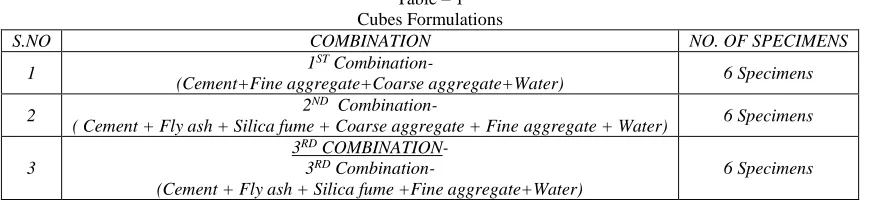
Formulation of Cube
Table – 1 Cubes Formulations
S.NO COMBINATION NO. OF SPECIMENS
1 1
ST Combination-
(Cement+Fine aggregate+Coarse aggregate+Water) 6 Specimens
2 2
ND Combination-
( Cement + Fly ash + Silica fume + Coarse aggregate + Fine aggregate + Water) 6 Specimens
3
3RD COMBINATION-
3RD Combination-
(Cement + Fly ash + Silica fume +Fine aggregate+Water)
6 Specimens
Formulation Of Beam Problem
Beam Size –( 750 X 150 X 150 Mm)
2500 =1440 × x +2.27× x ×1520+3.27× x ×1500 2500 =1440x + 3466x + 4205x
2500 =9811x x =0.254 ȳ=75 Compression Zone = 1202.55kg/m³ NT Type 1440×0.70×0.254+1440×0.15×0.254+350×0.15×0.254+1520×2.28×0.254+1500×3.27×0.254 = 2448.83 kg/m³
Tension
1440×0.70×0.254+1400×0.15×0.254+350×0.15×0.254+1520×2.28×0.254 = 1202.96kg/m³
ȳ = 2448.83×112.5+1202.96×37 2448.83+1202.96 =87.79m
NA type
a) Tension Zone
1400×0.254×0.70+1400×0.15×0.254+350×0.15×0.254+1520×2.28×0.254 = 1202.96
ȳ=75
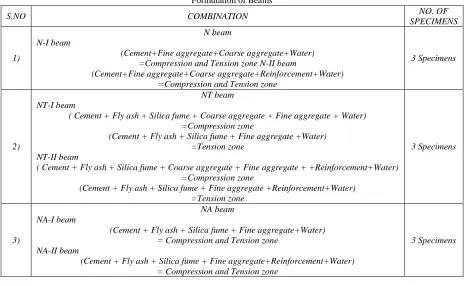
Table – 2 Formulation of Beams
S.NO COMBINATION NO. OF
SPECIMENS
1)
N beam N-I beam
(Cement+Fine aggregate+Coarse aggregate+Water) =Compression and Tension zone N-II beam
(Cement+Fine aggregate+Coarse aggregate+Reinforcement+Water) =Compression and Tension zone
3 Specimens
2)
NT beam NT-I beam
( Cement + Fly ash + Silica fume + Coarse aggregate + Fine aggregate + Water) =Compression zone
(Cement + Fly ash + Silica fume + Fine aggregate +Water) =Tension zone
NT-II beam
( Cement + Fly ash + Silica fume + Coarse aggregate + Fine aggregate + +Reinforcement+Water) =Compression zone
(Cement + Fly ash + Silica fume + Fine aggregate +Reinforcement+Water) =Tension zone
3 Specimens
3)
NA beam NA-I beam
(Cement + Fly ash + Silica fume + Fine aggregate+Water) = Compression and Tension zone
NA-II beam
(Cement + Fly ash + Silica fume + Fine aggregate+Reinforcement+Water) = Compression and Tension zone
3 Specimens
IV. OBSERVATIONS
Table - 3
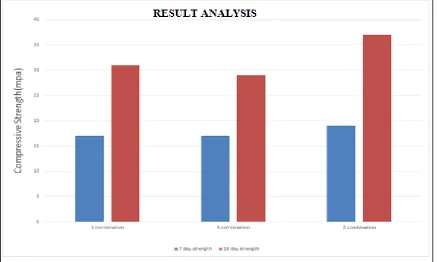
7 Days 28 Days S. no Stress ( N/mm² ) Stress ( N/mm² )
1. 17.68 34.75
2. 18.3 24.7
3. 17.96 28.9
Avg. 17.96 Avg. 29.45
Fly ash+ microsilica (2nd Combination)
Table - 4
7 Days 28 Days
S .no Stress ( N/mm² ) % increase Stress ( N/mm² ) % increase 1. 18.88
2.17%
37.9
28.35%
2. 17.42 35.5
3. 18.75 40
Avg. 18.35 Avg. 37.8
Without coarse agg. (3rd Combination)
Table - 5
7 Days 28 Days
S .no Stress ( N/mm² ) % increase Stress ( N/mm² ) % increase 1. 9.68
-37.75%
25.20
13.21%
2. 11.42 20.67
3. 12.44 22.13
Avg. 11.18 Avg. 22.66
Graph 2: Fly Ash and Microsilica All Specimens
Graph 3: Result Analysis
Observation of Beams
Type N
Table - 6 N Type
With Steel Reinforcement
Table – 7
N Type with Reinforcement
Type NT
Table – 8 NT Type
With Steel Reinforcement
Table – 9
NT Type with Reinforcement
4. 101 3.61 9.78% 8.408% Type NA
Table – 10
With Steel Reinforcement
Table – 11
NA Type with Reinforcement
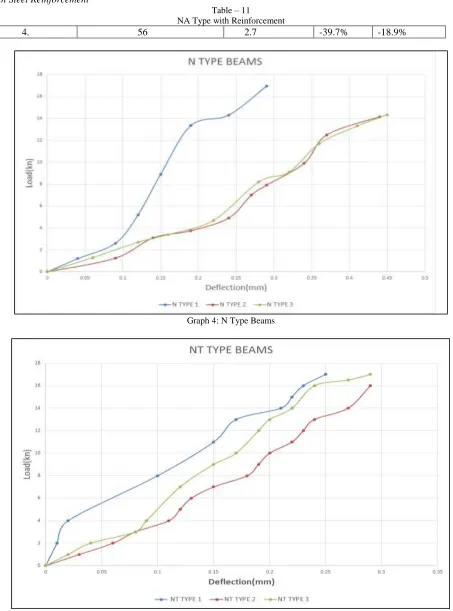
4. 56 2.7 -39.7% -18.9%
Graph 4: N Type Beams
Graph 6: NA Type Beams
Graph 7: N Type, NT Type, NA Type Beams with Reinforcement
V. CONCLUSION
With the addition of fly ash and micro silica and thereby decreasing the content of cement the flexural strength of the concrete beam was seen to be increased by 13.3%.
With the addition of fly ash and micro silica as cement replacement and henceforth reducing the content of cement the seven day compressive strength of cube increases by 2.17%.
With the addition of reinforcement and by adding 10% of fly ash and silica fume(of weight of cementious material) each as cement replacement the flexural strength of the concrete beam increases by 9.78% .
With the addition of super plastisizer named Pozocat and with the addition of 1% of the weight of cement the slump value obtains was zero i.e. self-compacting concrete.
From the 3rd combination i.e. NA the addition of aggregate is must as it is seen that without coarse aggregate we are not able
to obtain desired strength also.
As per experimentation we came to know that the removal of aggregate in tension side shows no impact on flexural strength of beam.
ACKNOWLEDGEMENTS
We would like to express our special thanks of gratitude to our project guide (Dr. Vidula Sohoni) as well as our principal (Dr. Anand Bhalerao) who gave me the golden opportunity to do this wonderful project on the topic High Performance Concrete, which also helped us in doing a lot of Research and we came to know about so many new things, we are really thankful to them. We would also use this platform to put our gratitude towards AMIX INFRA CONCRETE SOLUTIONS whose sponsorship motivated us to achieve success in our respective task.
Secondly we would like to thank our parents and friends who helped us a lot in finalizing the project within the limited time frame.
REFERENCES
[1] Heba A Mohamad ( IISTE MiniaUniversity)-“Effect of fly ash and silica fume on compressive strength of self-compacting concrete under different curing
conditions”-International Journal of scientific research and management (IJSRM)-pg-31-71
[2] Prof. BalasahebE.Gite, Prof. Madhuri K. Rathi, Prof.RajeshS.Rajguru, Prof. AsifP.Shaikh –“Advance Construction Material – Micro Silica In Concrete”
-IOSR Journal of Mechanical and Civil Engineering (-IOSR-JMCE) pg.4
[3] Dr. V.Bhaskar Desai* , Mr. A. Sathyam** * Professor, Dept. of Civil Engineering, JNTUA College of Engineering, Anantapuramu – 515002, A.P-“Some
Studies on Strength Properties of Light Weight Cinder Aggregate Concrete”-International Journal of scientific research and management (IJSRM)-pg-8
[4] Jianxin Ma1 and Marko OrgassDipl. –Ing.,InstitutfürMassivbau und Baustofftechnologie, Universität Leipzig –“Comparative Investigations on Ultra-High
Performance Concrete with and without Coarse Aggregates” : International Journal of Engineering Trends and Technology (IJETT) pg-5
[5] S.P.ZhangandL.ZongDepartment of Civil Engineering and Architecture,Nanjing Institute of Technology,Nanjing211167,China “Evaluation of Relationship
between Water Absorption and Durability of Concrete Materials” International Journal of Emerging Technology and Advanced Engineering Website: www.ijetae.com (ISSN 2250-2459, ISO 9001:2008 Certified Journal, Volume 4, Issue 10, October 2014).-pg7
[6] IS 10262:2009 for Mix Design Calculation.
[7] IS 456:2000 (Plain Concrete and RCC Concrete).