Vol. 3, 2013, 9-15
ISSN: 2320 –3242 (P), 2320 –3250 (online) Published on 25 October 2013
www.researchmathsci.org
9
Fuzzy Matrix Solution for the Study of Teacher’s
Evaluation
Vivek Raich, Archana Gawande* and Seema Modi**
*Govt. Autonomous Holkar Science College, A.B. road Indore M.P., India **Christian Eminent College, RSS Nagar Indore, M.P., India
Affiliated to Devi Ahilya University, Indore, M.P.
Email: [email protected], [email protected], [email protected]
Received 19 September 2013; accepted 30 September 2013
Abstract. Researchers who study teacher quality put a great interest in investigating the
quality of effective teacher. A number of policy makers and researchers have proposed that effectiveness, as determined by teachers’ contribution to student learning, should be an important component of assessing teacher quality. Therefore, teacher quality measurement is important. Fuzzy relation provides solutions of our daily life problems depend on two different situations. In this paper we will try to obtain conclusion about teachers performance by giving membership grades to his/her quality from 0 to 1 in the fuzzy relation matrix Ro (an occurrence relation obtained by observations on sufficient number of teacher), Rc (a conformability relation confirmed by expert in education
sector) and Rs (a matrix which contains degree of specialty seen by educationist for
testing the model).
Keywords: FMS, Max. Min. Rule, Min. Max. Rule, Education system, Teacher quality
AMS Mathematics Subject Classification (2010): 08A72, 15B15
1. Introduction
Zadeh was the first mathematician who tried to overcome such problems of uncertainty by introducing Fuzzy set theory about 60 year ago , which is a generalization of classical set theory, in the sense that a given universe χ and a subset A of it, any element x of χ, instead of having a degree of membership either 0 or 1 in A as postulated under the classical set theory, can have a membership value µA (x) є [0,1] in a set A which
represents the degree of its belonging to A. In other word, A is a fuzzy subset of universe
χ, characterized by the membership function µA(x), x єχ.
Teacher quality matters a great deal in terms of student’s performance.
The teacher has three levels of responsibility to his students in relation to giving advice: 1. The first is fulfillment of the prerequisite of getting to know his students individually,
10
their lives. As the teacher's familiarity grows, so the potency of his advice deepens proportionately.
2. Secondly, the teacher must express love and affection toward his students. It is this affection that dissolves the students' natural tendency to resist being told what to do. Thus, the advice can penetrate more deeply and effectively.
3. Finally, the teacher must take time to reflect upon his students' progress, refining and adjusting his vision of how best to influence them toward positive change. This is an ongoing requirement because students quickly "outgrow" old advice, and the categories of what is beautiful and what is ugly change with each new stage of growth.
The purpose of this study was to research educators’ perception of teacher quality and whether it derives meaning from a social construct of both policy—No Child Left Behind— and environmental factors.
The purpose of this study is three fold
1.to review how the terms excellence and quality are shaped by socially constructed realities
2.to identify how educators perceive teaching quality, and 3.to review how school districts develop teacher quality. The research questions include
1. How does the social construction of reality interplay with the terms quality/excellence?
1. How does the No Child Left Behind law shape a definition of quality teaching? 2. How is student achievement connected to teacher quality?
3. What are administrators’ and teachers’ perceptions of quality teaching attributes? 4. How do educators who are identified by administrators as quality teachers identify
and Develop attributes of teacher quality in them? 5. How do school districts cultivate quality?
Fuzzy Matrix Theory provides fuzzy relation matrix Ro (an occurrence relation obtained by observations on sufficient number of teachers), Rc (a conformability relation
confirmed by expert in education sector) and Rs (a matrix which contains degree of
specialty seen by educationist for testing the model). R.Vivek, et.al.[4,6] apply Fuzzy Modeling Approach for Predicting Diarrhea Stage. and Prediction of diarrhea stages Using FMS, are basic papers to develop this work.
The aim of this paper is to assess the Teacher quality which is suitable for different types student using F.M.S.(Fuzzy matrix solution) for the improvement of student performance in the education institute.
2. Definition and Methodology
Definition 2.1. The Study of Occurrence relation Ro and Conformability relation RC in education sector using fuzzy matrices is useful because a Specialty may likely to occur with a given award but may also commonly occur with several other distinctions, therefore limiting its power as a discriminating factor among them is important. On the other hand, another Specialty may be relatively with a given awards.
11
frequency of appearance of Specialty when the specific distinction is present i.e. How often does the Specialty occur with award.
Definition 2.3. A Conformability relation Rc describes the discriminating power of the
Specialty to confirm the presence of the award i.e. how, strongly does the Specialty confirm awarded. The distinction between occurrence and conformability is important because a specialty may occur with given award may be commonly occur with several other awards.
Remark: The above said relations are determined from expert in education system as
well as from psychologist and observation over the related teacher in the school education system. By giving membership grades to linguistic terms always, often, unspecific, seldom, and never 1, .75, .5, .25, or 0 respectively in fuzzy relation Ro and Rc investigator can draw different types of conclusions about the problem. This can be explained with an example given in our main result.
Definition 2.4. Product of two fuzzy matrices:
Since product of two fuzzy Matrix multiplications under usual method is not a fuzzy matrix. So we need to define a compatible operation analogous to product that the product again happens to be a fuzzy matrix. However even for this new operation if the product XY is to be defined we need the number of columns of X is equal to the number of rows of Y. The two types of operations which we can have are max-min operation and min-max operation. Let
be a 4x5 fuzzy matrix and
be a 5x3 fuzzy matrix.
12 where,
C11 = max {min (0.3, 0.8), min (1, 0.7), min (0.7, 1), min (0.2, 0.5), min (0.5, 0.4)}
=max {0.3, 0.7, 0.7, 0.2, 0.4} =0.7.
C12 = max {min (0.3, 0.3), min (1, 0), min (0.7, 0.7), min (0.2, 0.4), min (0.5, 0)}
=max {0.3, 0, 0.7, 0.2, 0} =0.7 …. and so on.
0.8 0.4 1
XY = 0.8 0.4 0.8
0.7 0.6 0.7 is a 3 × 3 matrix.
Now suppose for the same X and Y we adopt the operation as min. max Rule we get
D11 D12 D13
D21 D22 D23
D = D31 D32 D33
D41 D42 D43
where
D11 = min {max (0.3, 0.8), max (1, 0.7), max (0.7, 1), max (0.2, 0.5) max (0.5, 0.4)}
= min {0.8, 1, 1, 0.5, 0.5} = 0.5.
D12 = min {max (0.3, 0.3), max (1, 0), max (0.7, 0.7), max (0.2, 0.4), max (0.5, 0)}
= min {0.3, 1, 0.7, 0.4, 0.5} = 0.3… and so on .
Thus we have
0.5 0.3 0.5
D = 0.4 0.1 0.7
0.4 0.4 0.2 0.6 0.5 0.7
2.5 Methodology for Calculation
For calculation of our main result we can use following steps
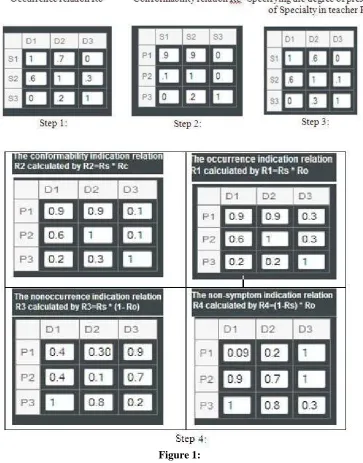
Step 1: Obtain the matrix for occurrence relation RO = S x D, (indicates the frequency of occurrence of specialty with awards D)
Step 2: Obtain the matrix for confirmative relation Rc = S X D, (corresponds to the
degree to which specialty confirms the award D.)
Step 3: Now assuming a fuzzy relation RS = P X S construct fuzzy matrix (specifying the
degree of presence of specialty S1, S2, S3, for the teachers. This indicates the degree to
which the specialty is present in teachers P.)
Step 4: Using relations RS, RO, and RC four different indication relations will be
calculated as below,
The occurrence indication relation R1 calculated by R1= Rs*RO
The conformability indication relation R2 is calculated by R2 = Rs*RC
The nonoccurrence indication relation R3 calculated by R3 = Rs*(1- RO)
13
Step 5: The process of fuzzy matrix multiplication is tedious and time consuming. So we
calculate it by a computer program using Java Language as developed in [4, 5].
3. Main results
The Model prescribed by Raich at al [4, 5] is used in our case study as below. Consider, three sets S, D, P Where,
Set of Specialty/ Nature/ quality of Teachers, S = {S1, S2, S3}
S1 = Teacher has quality of passionate about teaching, and tries to motivate his
student. He has uses the latest technology in teaching, uses creativity and variety.
He has the quality of Computer Aided Instructor (CAI).
He has the fulfillment of the prerequisite to get to know his student individually. He has expression and affection towards his student.
Influencing his student towards positive change
S2 = Teaching is effective.
Teaching is good.
In teaching he uses of Teaching aid Made by own Low Cost Teaching Aid ). Teaching Method used according to the students and content demand
(For example-Demonstration, Method, Inductive-Deductive Approach, Project, Role playing, Problem Solving etc.)
S3= Teaching style by traditional methods.
Problem solution is average. Teaching is not well.
He never spend time thinking about student. Often gets angry and Doesn’t listen to students.
D = {D1, D2, D3 }
where,
D1 = represent the Excellent Teachers (Suitable for Excellent Student)
D2 = represent Good Teachers (Suitable for Good Student)
D3 = represent Average Teachers (Suitable for Average/ Bad Student)
P = {P1, P2, P3} set of teachers considered for testing in our study.
14
Figure 1:
4. Conclusion and Results
In R1, (P2, D2) and (P3, D3) = 1 shows that teacher P2 occur good category and P3
occur average category.
In R2 again (P2, D2) and (P3, D3) = 1 it means it is confirm by expert and our observation.
In non occurrence indication relation R3 the value of (P3, D1) = 1 shows P3 never
occurred excellent teacher.
15
that, P1, P2 has no any symptoms to be average teacher and P3 as excellent teacher.
REFERENCES
1. A.Di Nola, W.Pedrycz, S.Sessa and E.Sanchez, Fuzzy relation equations theory as a basis of fuzzy modeling: an overview, Fuzzy Sets and Systems, 40 (1991) 415. 2. M.Gavalec, Solvability and unique solvability of max-min fuzzy equations, Fuzzy
Sets and Systems, 124 (2001) 385-393.
3. G.J.Klir and B.Yuan, Fuzzy Sets and Fuzzy Logic: Theory and Applications, Prentice-Hall, Englewood Cliffs, NJ, 1995.
4. R.Vivek, T.Rakesh and D.Sanat, Prediction of diarrhea stages using FMS, Search
and Research, 1(3) (2010) 24 - 28.
5. R.Vivek, G.Archana and T.Rakesh, Assessment of school student using fuzzy matrix solution (FMS), International Journal of Fuzzy Mathematics and Systems, 3(3) (2013) 197-202.