Mediated L2 Writing and Temporal Distribution of
Cognitive and Metacognitive Processes
1Mohammad Amiryousefi2
Received: 03/07/2016 Accepted: 06/10/2016
Abstract
This study examined the effects of cognitive task complexity increase on the complexity, accuracy, and fluency (CAF) as well as the temporal distribution of the cognitive and metacognitive processes involved in computer-mediated L2 written production. To this end, the study employed a between-subjects experimental design with 85 EFL learners from a language learning institute in Iran. Participants were assigned to one of 3 groups: low-, medium-, and high-complexity groups. Each group performed one of the 3 computer-mediated letter writing tasks of varying levels of complexity, from the lowest level (low-complexity) to the highest level (high-complexity) of cognitive demand. Participants were also asked to complete L2 writing Cognitive Processes Scale (CPS) and Metacognitive Processes Scale (MPS) to measure the differentials in time and attention allocated to these processes by the participants in each group. Results revealed that the increases of task complexity (1) affected the fluency positively and the accuracy negatively, with no significant effects on the complexity; (2) directed the participants’ attention more toward the processes such as task formulation and generation of new ideas, which could help them manage the conceptual pressure imposed; and (3) contrary to the assumptions, directed the participants’ attention away from the processes such as thinking about language aspects, which could direct their attention to the linguistic aspects of the tasks. Implications are discussed and avenues for future research are outlined.
Keywords: Task Complexity; L2 Writing; Cognitive Processes; Trade-Off Hypothesis; CAF
1Please cite this paper as follows:
Amiryousefi, M. (2017). Effects of task complexity increase on computer-mediated L2 writing and temporal distribution of cognitive and metacognitive processes. Journal of Research in Applied Linguistics, 8(2), 187-210.
1. Introduction
Writing is considered to be a necessary yet a cognitively demanding skill for language learners. To generate, express, and refine their ideas in a writing task, language learners need to synchronize a number of writing cognitive processes, including planning, formulation, evaluation, and revision as well as metacognitive processes, including generation, organization, and elaboration of new ideas. Furthermore, language learners need to pay attention to both form (complexity and accuracy) and content (fluency) at the same time and must be able to manage them during second language (L2) writing task performance (Frearer & Bitcher, 2015; Ong & Zhang, 2013). Thus, L2 writing can be best perceived as a two-way task in which language learners need to make a series of decisions regarding how much time and attention to allocate to each of these writing processes and production dimensions (complexity, accuracy, and fluency, henceforth CAF) to continuously develop content and text to meet the task objectives (Myles, 2002).
Hence, a question that merits study is the following: What governs the decisions L2 learners make as they write? Research has shown that a number of variables, including cognitive complexity or the processing demands of tasks influence L2 learners’ decisions regarding the amount of time and attention that should be devoted to each of the writing processes and dimensions and hence affect their writing performance (Frearer & Bitcher, 2015; Roca de Larios, Manchón, Murphy, & Marín, 2008). Task complexity is operationalized as the cognitive demands imposed on L2 learners by those inherent and fixed features of tasks, including whether the task allows any planning time or how many elements the task involves (Adams, Alwi, & Newton, 2015; Long, 2015).
To date, a few attempts have been made to investigate the effects of these task characteristics mainly on L2 oral production (e.g., Gilabert, 2007; Levkina & Gilabert, 2012). What is underresearched is to examine the differential effects of tasks of varying levels of cognitive complexity on all the three dimensions of L2 writing (CAF) simultaneously, especially in a computer-mediated L2 written context. Moreover, a few research studies have been conducted to examine the influence of variables such as language of composition (Manchon & de Larios, 2008), L2 proficiency (Roca de Larios et al., 2008), and task conditions (Ong, 2014) on the temporal distribution of L2 writing cognitive and metacognitive processes, with no attention to the effects of cognitive task complexity on them.
2. L2 Writing as a Set of Cognitive and Metacognitive Processes
Without doubt, the model presented by Flower and Hayes (1981) has been the most influential one in both L1 (first language) and L2 writing research. Flower and Hayes (1981) cast doubt on the credibility of stage models of writing, which considered writing as consisting of a series of stages, including prewriting, writing, and rewriting, which could occur one after another in a linear fashion, “the problem with stage descriptions of writing is that they model the growth of the written product, not the inner process of the person producing it” (p. 367). They proposed a cognitive process model of writing that focuses on the mental processes involved during a writing task. Based on this model, to do a writing task successfully, writers need to go through these cognitive processes and manage them in a cyclical fashion.
Though L2 and L1 writing are strategically, rhetorically, and linguistically different, L2 writing researchers have extensively used the underpinning tenets of the L1 cognitive models, such as the one presented by Flower and Hayes (1981), to study the cognitive and metacognitive processes involved in L2 writing and to test the influence of a number of variables such as L2 proficiency and task conditions on the frequency with which these processes are used (Ong, 2014; Ong & Zhang, 2013; Roca de Larios et al., 2008; Sasaki, 2000). For example, Roca de Larrios et al. (2008) used protocol data obtained from Spanish learners of English to identify the main writing processes involved in L2 writing as well as to examine whether L2 proficiency influences the amount of time devoted to them. They identified seven main L2 writing cognitive processes, namely reading the prompt, planning, formulation, evaluation, revision, and metacommenting. Furthermore, the results of their study revealed that proficiency level can influence the amount of time allocated to each of these processes.
Taken together, the results of these studies show that L2 writing incorporates a number of cognitive and metacognitive processes. Because L2 learners have limited attentional and memory capacity, they cannot allocate equal amount of time to all of these processes; trade-off effects are, therefore, expected to happen among them. Moreover, the amount of time and attention devoted to these processes is influenced by a number of learner variables, including L2 proficiency and task implementation variables including task conditions. However, little research has examined the influence of task complexity on the temporal distribution and frequency of occurrence of these processes.
3. Task Complexity
Task complexity is characterized as the cognitive demands task characteristics put on learners. These task characteristics are divided into two subcategories, namely resource-directing and resource-dispersing factors (Adams, Alwi, & Newton, 2015; Long, 2015; Robinson, 2007). Resource-directing factors, which include whether the task requires reference to the past or present (±here-and-now) and few vs. many elements (±few elements), are believed to put conceptual demands on L2 learners and hence direct their attentional and memory resources to the linguistic aspects of L2; this can facilitate noticing of these aspects “and so speeding up L2 grammaticization in conceptual domains” (Robinson, 2007, p. 17). Resource-dispersing factors, which include whether the task involves any planning time (±planning time) and gives any background information (±prior knowledge), are, on the other hand, believed to put procedural demands on L2 learners; these demands do not lead to “development, and acquisition of new L2 form-concept mappings, but rather automatic access to an already established interlanguage system” (Robinson, 2007, p. 18).
a critical limit on a finite pool of attention, as Skehan does, is theoretically questionable” (Ishikawa, 2007, p. 137).
According to the followers of the cognitive hypothesis (Housen, Kuiken, & Vedder, 2012; Philp, Adams, & Iwashita, 2013; Robinson, 2011, 2005; Robinson & Gilabert, 2007), increases of task complexity along resource directing factors overtax L2 learners’ attentional and working memory capacities in such a manner that can make them attend to the linguistic aspects of their production. For example, when L2 learners are required to consider many elements (+few elements), their attention will be directed toward the linguistic aspects of the task to be able to accommodate the required elements in their L2 production. On the other hand, increases of task complexity along resource-dispersing factors can increase the demands on learners’ cognitive resources in a way that do not lead to a focus on the linguistic aspects of L2 production. For instance, when learners are required to perform a task with no prior planning (-planning time), their attention will be directed toward the procedural demands of the task to see how they can perform the task at the same time that they are thinking about the content being communicated; this will, therefore, move their attention away from the linguistic aspects of the task. As such, according to the cognitive hypothesis, increases of task complexity can contribute to the accuracy and complexity of L2 production along resource directing factors, and can cause a decrease in the accuracy and complexity of L2 production along resource-dispersing factors (Robinson, 2005, 2007).
Nonetheless, these studies have mostly focused on CMC text chats. What is underresearched is whether increases of cognitive task complexity have an effect on the CAF of EFL learners’ L2 written production, especially in a computer-mediated context. The only study available in the literature of L2 writing is the one by Frear and Bitchener (2015). They examined the effects of increases of task complexity along resource-directing dimension (±few elements) on the syntactic complexity of 34 nonnative speakers of English studying in New Zealand for whom English was an L2. The data were obtained through a letter writing task that had three versions with varying levels of complexity (low-, medium-, and high-complexity). The results showed a significant effect for task complexity on decreases in syntactic complexity and increases in lexical complexity. However, Frear and Bitchener (2015) focused on just complexity in a non-CMC context with limited number of participants.
4. Research Questions
The present study aimed at examining the effects of increases of cognitive task complexity on CAF as well as temporal distribution of the cognitive and metacognitive processes involved in computer-mediated L2 written production. It was guided by the following research questions:
1. What are the effects of increases of cognitive task complexity along ±few elements (resource-directing dimension) on the CAF of EFL learners’ task-based, computer-mediated L2 writing?
2. What are the effects of increases of cognitive task complexity along ±few elements on the temporal distribution of L2 writing cognitive processes?
3. What are the effects of increases of cognitive task complexity along ±few elements on the frequency of occurrence of the metacognitive processes that L2 learners are engaged in during the task formulation or the composing process of L2 writing?
The cognitive hypothesis assumes that more complex tasks along resource-directing factors direct learners’ attention toward the linguistic aspects of the task and, hence, can contribute to the accuracy and complexity of their L2 production. Therefore, the following hypotheses were stated based on the predictions made by the cognitive hypothesis:
H2: Increases of cognitive task complexity along resource-directing factors (±few elements) will lead learners’ attention more toward evaluation and revision processes, which mostly deal with the linguistic aspects of the writing task.
H3: Increases of cognitive task complexity along resource-directing factors (±few elements) will lead learners’ attention more toward metacognitive process of thinking about the language aspects.
5. Method
5.1 Participants
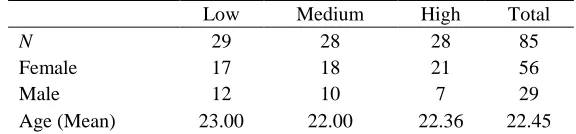
Eighty-five EFL learners from a language learning institute in Iran, with an average age of 22.45 (ranging from 17 to 32), volunteered to participate in this study. The sample comprised 56 females and 29 males. They were attending an online English course at the e-learning center of the institute at the time of the study (summer and fall 2015 semesters). They had some experience of English learning at school, university, and/or English institutes through traditional programs. However, based on their responses to the background questionnaire, that was the first time for all of them to learn English with computers. Moreover, none of them had ever been to an English-speaking country and had no opportunity to use English outside the classroom. They all grew up in Iran with Persian as their L1.
Table 1 summarizes the background information of the participants in each group. The participants were informed in advance that they would participate in a research project, but they were not informed of the research objectives:
Table 1. Background Information of Participants in Each Group.
Low Medium High Total
N 29 28 28 85
Female 17 18 21 56
Male 12 10 7 29
Age (Mean) 23.00 22.00 22.36 22.45
5.2 Tasks
avoiding any structures and phrases that could be used by the participants as well as any opinions that could help the participants form any ideas or reasons why Iran is worth visiting. Task 2 (medium-complexity), however, involved more elements and reasoning demands and, hence, stimulated a higher level of cognitive complexity based on Robinson’s (2001, 2011) triadic componential framework. Task 2, based on Frear and Bitchener (2015), involved medium level of cognitive complexity. To do Task 2, the participants were provided with a set of instructions and some information about two restaurants in Isfahan, Iran. The instructions envisaged a situation in which an English-speaking friend would visit Iran and would intend to try a restaurant in Isfahan. Based on the information provided, the participants were asked to write a letter in which they would tell the friend which restaurant they had selected and why. As is clear, this task involved more elements as well as required higher levels of attention and reasoning capacity compared with Task 1.
Finally, Task 3 (high-complexity) was similar to Task 2, but it involved a higher level of cognitive complexity by increasing the number of elements involved; hence, it required a higher level of attention and reasoning capacity compared with Task 2. Task 3 involved a situation in which an English-speaking friend would intend to visit Iran and try a restaurant in Isfahan. The participants were provided with information about the preferences of this friend as well as three restaurants in Isfahan. Additionally, they were given information about two more friends who would visit Iran at the same time and would plan to eat in one of the restaurants in Isfahan. The participants were asked to write a letter to the English-speaking friend in which they would tell him or her about the restaurant they had selected and why, considering the preferences of this friend and two other friends.
Due to the cultural differences, some changes were made to the tasks used by Frear and Bitchener (2015); the foods were substituted with the most famous traditional foods in Isfahan, Iran. Additionally, the information about the restaurants (location, opening time, critics’ reviews, etc.) was changed accordingly (see Appendix A).
5.3 Retrospective Questionnaires
To examine the effects of task complexity on the temporal distribution and frequency of occurrence of L2 writing cognitive and metacognitive processes, two sets of retrospective questionnaires, namely L2 writing Cognitive Processes Scale (henceforth CPS) and L2 writing Metacognitive Processes Scale (henceforth MPS) were developed and used in the present study.
5.3.1. CPS
instrument consisted of eight items that measured the time spent on: (1) reading the prompt (the time spent on total or partial reading and/or translation of the given prompt), (2) conceptualizing the task (the amount of time the participants spend to understand task demands), (3) task planning (the amount of time spent by the participants on goal setting, generation of new ideas, retrieval of already formed ideas, and establishment of logical connections between the ideas), (4) task formulation or composition (the amount of time spent on converting the ideas and thoughts into language), (5) evaluation (the time the participants spend to assess the appropriateness of pragmatic, textual, and linguistic decisions made), (6) revision (the amount of time spent on the deletion, addition to, and/or modification of the previously written parts), (7) metacomments (on-task) ( the time spent on considering how the task is progressing and/or the mental processes involved) , and (8) metacomments (off-task) (the amount of time spent on the things not related to the task such as personal issues).
CPS was formed based on a comprehensive review of the literature and the results of Roca de Larios et al.’s (2008) study. The participants were asked to report the amount of time they spent on each of these processes in min or seconds. To neutralize the effects of individual variations with regards to time on task, the reported raw time was changed to time percentages.
5.3.2. MPS
To measure the frequency of occurrence of the metacognitive processes that the learners were engaged in during the composing or task formulation process of L2 writing, MPS was used (see Appendix B). This self-report instrument consisted of five items that measured the frequency of occurrence of: (1) generation of new ideas (thinking of new information or opinions to be used in L2 writing), (2) organization of new ideas (to sequence the ideas and information during L2 writing), (3) elaboration of new ideas (to extend an opinion by providing examples, facts, reasons, etc.), (4) conversion of the formed ideas and thoughts into language, and (5) thinking about language aspects of the task (word choice, sentence structure, grammar, etc.). The participants rated each item on an 8-point Likert type scale, ranging from 1 (the least occurrence) and 8 (the greatest occurrence; see Appendix C).
5.3.3. Validity and reliability of CPS and MPS
CPS and MPS were subject to review by five experts in the field of L2 writing research and CMC, and the revision suggestions were incorporated. To assess the internal consistency reliability of these instruments, they were, then, given to 64 EFL learners when they were performing an L2 writing task that was similar in nature to the tasks used in the present study. The Cronbach’s alphas obtained were .75 and .81 for CPS and MPS, respectively, showing that these instruments were internally consistent.
5.4 Production Measures
To test whether there were any significant differences between the letters prepared by the participants in the different groups, the writing samples were analyzed for CAF using the measures employed by Wigglesworth and Storch (2009). The reason why these measures were used was that they are developed for the analysis of written texts and are well documented in the literature. Following their model, at first, the length of each letter in words was measured using the computer word count function. Then, each letter was divided into T-units, clauses, and dependent clauses. Wigglesworth and Storch (2009) define a T-unit as an independent clause plus all subordinate clauses that are attached to or embedded in it (e.g., “we can visit some historical places, / if we can afford the time” //; 1 T-unit, the end of which is denoted by // composed of 2 clauses separated by / as shown). Finally, the identified T-units, clauses, and dependent clauses that were error-free were counted. Errors of capitalization, spelling, and lexical choice, unless meaning was impeded, were not counted (e.g., approprate instead of appropriate and intentions instead of preferences in the sentences “I reviewed your intentions” and “I found restaurant A approprate”). CAF was, then, measured in the following ways:
Fluency
o Average number of words per text
o Average number of T-units per text
o Average number of clauses per text
Complexity
o Proportion of clauses to T-units
o Proportion of dependent clauses to total clauses
Accuracy
o Percentage of error-free T-units
5.5 Procedure
As there were not enough learners at the intermediate level at the e-center of the institute in one single semester, the experiment was conducted in two phases during two consecutive semesters. In phase one (summer 2015 semester), 59 and, in phase two (fall 2015 semester), 32 EFL learners who had already enrolled at the high-intermediate level were approached and invited to take part in the study. Their level of English proficiency had already been determined based on their scores on the institute’s placement test. Additionally, they were given the Oxford Placement Test (OPT, 2004) to further ensure their homogeneity. Based on their scores on the OPT, six learners who had lower levels of proficiency were discarded; the remaining (85) were at the upper-intermediate level (score range from 135 to 149).
The participants were invited to take part in a meeting before the study started. During the meeting, they were given a prewriting task in which they were required to talk about Iranian universities to a tourist. The purpose was to see whether they were comparable in terms of CAF in L2 writing prior to receiving any treatments. Then, CPS and MPS were introduced to the participants. To ensure that they were familiar with L2 writing main processes (CPS) and the metacognitive processes L2 learners engaged in during the task formulation or composing process (MPS) of an L2 writing task, the researcher described them one by one and instructed the participants how to respond to CPS and MPS. Finally, they were assigned to three groups: low-complexity (n = 29), and medium-complexity (n = 28) groups during phase one and high-complexity group (n = 28) in phase two.
measures stated above by three experienced scholars independently. The interrater reliability was established (.78).
6. Results
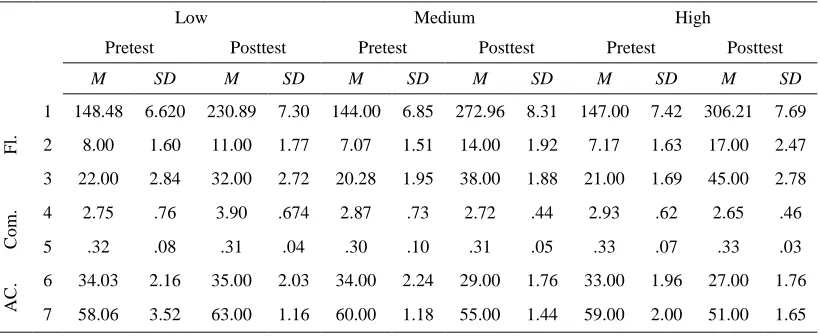
Table 2 shows the descriptive statistics for the participants’ scores on both prewriting task and the letter writing tasks. Research question # 1 inquired if increases of cognitive task complexity could cause differentials in the CAF of the EFL learners’ task-based, computer-mediated L2 writing. To answer this question, a number of one-way ANOVAs and Kruskal-Wallis Tests were conducted to test if the results were significant:
Table 2. Descriptive Scores for Pretest and Posttest Scores.
Low Medium High
Pretest Posttest Pretest Posttest Pretest Posttest
M SD M SD M SD M SD M SD M SD
F
l.
1 148.48 6.620 230.89 7.30 144.00 6.85 272.96 8.31 147.00 7.42 306.21 7.69 2 8.00 1.60 11.00 1.77 7.07 1.51 14.00 1.92 7.17 1.63 17.00 2.47 3 22.00 2.84 32.00 2.72 20.28 1.95 38.00 1.88 21.00 1.69 45.00 2.78
Co
m
. 4 2.75 .76 3.90 .674 2.87 .73 2.72 .44 2.93 .62 2.65 .46
5 .32 .08 .31 .04 .30 .10 .31 .05 .33 .07 .33 .03
AC.
6 34.03 2.16 35.00 2.03 34.00 2.24 29.00 1.76 33.00 1.96 27.00 1.76 7 58.06 3.52 63.00 1.16 60.00 1.18 55.00 1.44 59.00 2.00 51.00 1.65
Note. Fl. = Fluency, Com. = Complexity, Ac. = Accuracy, 1 = Average number of words, 2 = Average
number of T-units, 3 = Average number of clauses, 4 = Proportion of clauses to T-units, 5 = Proportion of dependent clauses to total clauses, 6 = Percentage of error-free T-units, 7 = Percentage of error-free clauses
The post-hoc analyses revealed that, in the case of fluency measures (i.e., number of words, number of T-units, and number of clauses), an increase in cognitive task complexity resulted in a significant increase in the mean scores for these measures. It means that the high-complexity group had a significantly higher mean than the medium-complexity group, and the medium-complexity group had a significantly higher mean than the low-complexity group. For accuracy measures, the opposite was reported: An increase in cognitive task complexity resulted in a significant decrease in the mean scores for the percentage of error- free T-units and the percentage of error-free clauses, meaning that the low-complexity group had a significantly higher mean than the complexity group, and the medium-complexity group had a significantly higher mean than the high-medium-complexity group (see Table 2). Thus, these results suggest that cognitive task complexity affected L2 writing fluency positively and L2 writing accuracy negatively in the present study.
Question # 2, on the other hand, investigated whether the increases of cognitive task complexity affected the temporal distribution of the main cognitive processes of L2 writing. As mentioned previously, the raw time spent on these processes was converted to percentages of time spent on them to neutralize intersubject variability regarding time on task. Table 3 shows the descriptive statistics for the percentages of time devoted to each of these processes by the participants in the three groups. As shown in Table 3, the participants in the three groups devoted the highest amount of their time to task formulation and revision processes. The results of Kruskal-Wallis tests revealed that the increases of cognitive task complexity significantly affected the percentages of time devoted to reading the prompt, H(2) = 68.969, p = .000; conceptualizing the task, H(2) = 75.380, p = .000; planning for the task, H(2) = 13.834, p = .001; formulating the task, H(2) = 74.840, p = .000; evaluation, H(2) = 54.392, p = .000; revision, H(2) = 47.958, p = .000; metacomments (on task), H(2) = 74.884, p = .000; and metacomments (off task), H(2) = 74.996, p = .000 (all main cognitive processes).
Table 3. Descriptive Scores for Percentages of Time Spent on Cognitive Processes
Low Medium High
M SD M SD M SD
1 1.05 .31 2.50 .25 2.85 .14
2 2.65 .15 6.71 .14 7.13 .08
3 3.32 .16 4.00 1.19 4.28 1.24
4 46.86 2.03 55.78 2.23 67.53 2.35
5 6.79 1.29 7.14 1.38 3.14 1.00
6 17.48 1.59 18.57 1.45 14.42 1.47
7 5.71 .20 3.13 .22 .40 .02
8 15.27 1.98 1.85 .24 .28 .01
Note. 1 = Reading the prompt, 2 = Conceptualizing the task, 3 = Planning for the task, 4 = Formulating
The post-hoc analyses revealed that the increases of task complexity resulted in a significant increase in the amount of time reported for reading the prompt, conceptualizing the task, and formulating the task. However, for metacomments (both on task and off task), the opposite was reported: The increases of task complexity caused a meaningful decrease in the amount of time reported for them. For planning, evaluation, and revision, the results were somehow different. For planning, the amount of time reported by the high- and medium-complexity groups were significantly higher than the low-complexity group; for evaluation, the high-complexity group reported a significantly lower amount of time than the medium- and low-complexity groups; finally, for revision, there were significant differences among the three groups: The medium-complexity group reported the highest amount of time and the high-complexity group reported the lowest amount of time in this regard (see Table 3). Based on these results, it can be suggested that task complexity can affect the temporal distribution of L2 writing main cognitive processes.
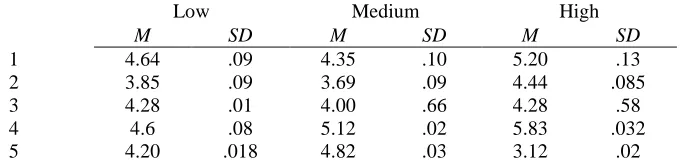
Finally, the intention behind imposing research question # 3 was to investigate whether the increases of cognitive task complexity could affect the frequency of occurrence of the metacognitive processes involved during the composing or formulation process of L2 writing. Table 4 shows the descriptive scores for the frequencies of occurrence of the metacognitive processes. The results of the data analysis revealed that there were significant differences among the three groups in terms of generation of new ideas, H(2) = 73.377, p = .000; elaboration of new ideas, F(2, 82) = 531.504, p = .000; conversion of the formed ideas and thoughts into language, H(2) = 75.016, p = .000; and thinking about the language aspects of the writing task, H(2) = 75.119, p = .000:
Table 4. Descriptive Scores for Frequency of Occurrence of Metacognitive Processes
Low Medium High
M SD M SD M SD
1 4.64 .09 4.35 .10 5.20 .13
2 3.85 .09 3.69 .09 4.44 .085
3 4.28 .01 4.00 .66 4.28 .58
4 4.6 .08 5.12 .02 5.83 .032
5 4.20 .018 4.82 .03 3.12 .02
Note. 1= Generation of new ideas, 2 = Elaboration of new ideas, 3 = Organization of new ideas, 4 = Conversion of the formed ideas and thoughts into language, 5 = Thinking about language aspects
post-hoc analyses showed that the increases of cognitive task complexity caused significant increases in the frequencies of occurrence of this process, meaning that the frequencies reported by the medium-complexity group were significantly higher than those reported by the low-complexity group, and the frequencies reported by the high-complexity were significantly higher than the ones reported by the medium-complexity group. Finally, as for thinking about the language aspects, the post-hoc analyses revealed that there were significant differences among the three groups, as well: The highest frequencies were reported by the participants in the medium-complexity group and the lowest frequencies were reported by the participants in high-complexity group. Thus, based on these results, it is safe to suggest that the increases of cognitive task complexity can affect the frequency of occurrence of L2 metacognitive processes.
7. Discussion and Conclusion
The present study was an attempt to investigate the effects of the increases of cognitive task complexity along resource-directing factors (±few elements) on (1) CAF in computer-mediated L2 written production, (2) temporal distribution of L2 writing main cognitive processes, and (3) the frequency of occurrence of the metacognitive processes that L2 learners are engaged in during the task formulation or the composing process of L2 writing. This study extends the literature considering that, to the author’s best of knowledge, it is for the first time that the effects of the increases of cognitive task complexity on all the three dimensions of L2 written production (CAF), especially in a computer-mediated context, as well as on the temporal distribution of L2 writing cognitive and metacognitive processes are being investigated.
7.1 Hypothesis # 1: Effects of Task Complexity on CAF
finding appears to support Skehan’s (2009) argument, suggesting that there is a trade-off effect between form (complexity and accuracy), on the one hand, and meaning (fluency), on the other, meaning that devoting cognitive and memory resources to one of these can cause L2 learners to pay less attention to others.
Additionally, the results of the present study do not concur with the results of Frear and Bitchener’s (2015) study that showed that task complexity along ±few elements can increase L2 learners’ lexical complexity. The differences between the results of the present study and Frear and Bitchener’s (2015) study might be because of the differences in the settings: The present study was done in a computer-mediated EFL setting, whereas Frear and Bitchener’s (2015) study was conducted in a traditional ESL setting. As for task implementation factors, in the present study, the participants were assigned to three groups and each group performed just one of the tasks. However, in Frear and Bitchener’s (2015) study, due to the limited number of the participants, the three tasks were done by all the participants; they might have had the chance to familiarize with the task procedures.
Research (Kern, 1995; Kung, 2004) has shown that factors such as task implementation factors, familiarity or nonfamiliarity with task procedures, and the setting in which a task is conducted (traditional vs. computer-mediated) can cause variation in L2 writing performance. For example, Kern (1995) and Kung (2004) argue that, in CMC, the discourse of text is characterized by low accuracy and complexity, and L2 learners rarely use their linguistic and cognitive resources to monitor their production. This might explain why cognitive task complexity had beneficial effects on just fluency in the present study. However, more studies should be done to come up with concrete results in this regard.
7.2 Hypothesis # 2: Effects of Task Complexity on Temporal Distribution of L2 Writing Cognitive Processes
Nonetheless, for evaluation, and revision, the high-complexity group reported a significantly lower amount of time than the medium- and low-complexity groups (see Table 3). These results can provide further support for the trade-off hypothesis; as L2 learners have limited attentional and memory resources, they cannot allocate equal amount of time to all L2 writing cognitive processes; attention to some of these processes can compete with their attention to others. This might explain why the increases in the amount of time spent on reading the prompt, conceptualizing the task, formulating the task, and planning caused the participants in the high-complexity group to spend less time on evaluation, and revision.
These results also support the argumentation raised by Roca de Larious et al. (2008) and Flower and Hayes (1981) that writing should not be considered as consisting of several stages that can happen one after another in a linear model, but rather as an intellectual activity that consists of a set of cognitive processes that can occur at demands. Furthermore, the results of the present study show that the model presented by van den Bergh and Rijlaarsdam (1999) for L1 writing can also be the case for L2 writing. In their model, they consider two types of factors that have the potential to influence the choice of and attention to the writing processes, namely internal and external factors. The internal factor consists of the strategies that the writers have at their disposal. The external factor is task environment, which consists of the demands incurred and goals set by the task. The results of the present study revealed that task demands can play a role in the allocation of time and attentional resources to L2 writing processes as well.
7.3 Hypothesis # 3: Effects of Task Complexity on Frequency of Occurrence of L2 Writing Metacognitive Processes
Consequently, these results can provide support for the results of the previous studies (Ong, 2014; Roca de Larios et al., 2008), indicating that there are trade-off effects among L2 writing cognitive and metacognitive processes. However, more research is needed to show concrete results with respect to the claims made regarding the effects of task complexity on the temporal distribution and frequency of occurrence of L2 writing cognitive and metacognitive processes in this study.
Despite the potential contribution of this study to computer-mediated L2 writing research, some limitations need to be acknowledged as they may have implications for future research. First, the task instructions given to the three groups were not similar, and the amount of lexical items supplied in the task instructions increased as task complexity increased. Kormos (2011) believes that L2 learners produce texts by using the information provided by task instructions or memory; this might have been the reason for the increases in fluency in the medium- and high-complexity groups. Therefore, there is a need to do similar research studies with other task types where the effects of task instructions are controlled. Second, the data for L2 writing cognitive and metacognitive processes were obtained through retrospective questionnaires. Flower and Hayes (1981) assert that this type of analysis of what the L2 learners did whereas writing might be inaccurate because it can be influenced by their beliefs regarding what they should have done, rather than what they actually did. Therefore, the inclusion of other instruments such as protocol analysis and/or interviews could enable the present researcher to get a better understanding of the kind of cognitive and metacognitive processes employed, especially in a CMC context and the possible reasons for the differentials in the time and attention devoted to them by the participants in the present study. Third, the present study did not investigate the mediating influence of learner variables, including self-regulation, self-confidence, self-concept, and working memory capacity as well as explicit instruction of L2 writing strategies and processes on the effects of task complexity, text quality, and temporal distribution of the cognitive and metacognitive processes. According to Devine, Railey, and Boshoff (1993), as well as Roca de Larious et al. (2008), these variables can influence L2 learners’ task performance. Finally, Devine, Railey, and Boshoff (1993) and Roca de Larious et al. (2008) argue that L2 learners’ mental model of writing, which is defined as L2 learners’ conceptions of their abilities, the task requirements and the way the task should be done, and the writing strategies and their usefulness can guide their writing performance. Future research might want to focus on these elements.
attention they allocate to L2 writing cognitive and metacognitive processes. Moreover, in line with the trade-off hypothesis, the results suggest that L2 learners have limited attentional resources and cannot allocate equal amount of time and attention to the processes and dimensions (CAF) of L2 production, and that these limitations should be considered in explaining the effects of cognitive task complexity on L2 learning and performance as well as in utilizing cognitively demanding tasks. Furthermore, the results show that factors such as the setting in which a task is performed (computer-mediated vs. pen-and-paper) and task implementation variables might have mediating influence on the effects of task complexity. As such, in studying the effects of task complexity, the mediating influence of these factors should be considered as well.
From the pedagogical perspective, the results can suggest that, to obtain the beneficial effects assumed for the increases of cognitive task complexity, such as helping learners get ready for real world tasks, promoting interaction, and increasing learning from the input (Robinson & Gilabert, 2007), teachers should increase task complexity as L2 learners’ cognitive and attentional resources are increased, and L2 structures and concept-form mappings are automatized. Consequently, the use of the recent innovations such as task and procedural repetition, which can help EFL learners increase their processing and attentional resources, along with cognitively demanding tasks can be more effective.
References
Adams, R., Alwi, N. A. N. M., & Newton, J. (2015). Task complexity effects on the complexity and accuracy of writing via text chat. Journal of Second Language Writing, 29, 64-81.
Baralt, M. (2010). Task complexity, the cognition hypothesis, and interaction in CMC and FTF environments. Retrieved 3 March 2015, from the World Wide Web: http://gradworks.umi.com/34/12/3412595.html
Devine, J., Railey, K., & Boshoff, P. (1993). The implications of cognitive models in L1 and L2 writing. Journal of Second Language Writing, 2(3), 203-225.
Flower, L., & Hayes, J. R. (1981). A cognitive process theory of writing. College Composition and Communication, 32(4), 365-387.
Frear, M. W., & Bitchener, J. (2015). The effects of cognitive task complexity on writing complexity. Journal of Second Language Writing, 30, 45-57.
Gilabert, R. (2007). Effects of manipulating task complexity on self-repairs during L2 oral production. IRAL-International Review of Applied Linguistics in Language Teaching, 45(3), 215-240.
Housen, A., Kuiken, F., & Vedder, I. (Eds.). (2012). Dimensions of L2 performance and proficiency: Complexity, accuracy, and fluency in SLA. Amsterdam: John Benjamins Publishing.
Ishikawa, T. (2007). The effect of manipulating task complexity along the (±here-and-now) dimension on L2 written narrative discourse. In C. M. García Mayo (Ed.), Investigating tasks in formal language learning (pp. 136-156). Clevedon, UK: Multilingual Matters.
Kern, R. G. (1995). Restructuring classroom interaction with networked computers: Effects on quantity and characteristics of language production. The Modern Language Journal, 79(4), 457-476.
Kormos, J. (2011). Task complexity and linguistic and discourse features of narrative writing performance. Journal of Second Language Writing, 20(2), 148-161.
Kuiken, F., & Vedder, I. (2011). Task complexity and linguistic performance in L2 writing and speaking. In P. Robinson (Ed.), Second language task complexity: Researching the cognition hypothesis of language learning and performance (pp. 91-104). Amsterdam: John Benjamins Publishing.
Kung, S.-C. (2004). Synchronous electronic discussions in an EFL reading class. ELT Journal, 58(2), 164-173.
Levkina, M., & Gilabert, R. (2012). The effects of cognitive task complexity on L2 oral production. In F. Kuiken & I. Vedder (Eds.), Dimensions of L2 performance and proficiency investigating complexity, accuracy, and fluency in SLA (pp. 171-198). Amsterdam: John Benjamins Publishing.
Long, M. (2015). Second language acquisition and task-based language teaching. Malden, USA: John Wiley & Sons.
Manchón, R. M., & de Larios, J. R. (2008). Writing-to-learn in instructed language learning contexts. In E. A. Soler & P. S. Jordà (Eds.), Intercultural language use and language learning (pp. 101-121). Dordrecht, Netherlands: Springer.
Myles, J. (2002). Second language writing and research: The writing process and error analysis in student texts. TESL-EJ, 6(2), 1-20.
Ong, J., & Zhang, L. J. (2010). Effects of task complexity on the fluency and lexical complexity in EFL students’ argumentative writing. Journal of Second Language Writing, 19(4), 218-233.
Ong, J., & Zhang, L. J. (2013). Effects of the manipulation of cognitive processes on EFL writers' text quality. TESOL Quarterly, 47(2), 375-398.
Pennington, M. C. (1996). Writing the natural way: On computer. Computer- Assisted Language Learning, 9(2-3), 125-142.
Philp, J., Adams, R., & Iwashita, N. (2013). Peer interaction and second language learning. New York: Routledge.
Robinson, P. (2001) Task complexity, task difficulty, and task production: Exploring interactions in a componential framework. Applied Linguistics, 22(1), 27-57.
Robinson, P. (2005). Cognitive complexity and task sequencing: Studies in a componential framework for second language task design. IRAL—International Review of Applied Linguistics in Language Teaching, 43(1), 1-32.
Robinson, P. (2007). Criteria for classifying and sequencing pedagogic tasks. In C. M. García Mayo (Ed.), Investigating tasks in formal language learning (pp. 7-26). Clevedon, UK: Multilingual Matters.
Robinson, P. (Ed.). (2011). Second language task complexity: Researching the cognition hypothesis of language learning and performance. Philadelphia: John Benjamins Publishing.
Robinson, P., & Gilabert, R. (2007). Task complexity, the cognition hypothesis and second language learning and performance. IRAL-International Review of Applied Linguistics in Language Teaching, 45(3), 161-176.
Roca de Larios, J., Manchón, R., Murphy, L., & Marín, J. (2008). The foreign language writer's strategic behavior in the allocation of time to writing processes. Journal of Second Language Writing, 17(1), 30-47.
Sasaki, M. (2000). Toward an empirical model of EFL writing processes: An exploratory study. Journal of Second Language Writing, 9(3), 259-291.
Skehan, P. (1996) A framework for the implementation of task-based instruction. Applied Linguistics, 17(1), 38-62.
Skehan, P. (1998) A cognitive approach to language learning. Oxford: Oxford University Press.
Skehan, P. (2003) Task-based instruction. Language Teaching, 36(1), 1-14.
van den Bergh, H., & Rijlaarsdam, G. (1999). The dynamics of idea generation during writing. In M. Torrance & D. Galbraith (Eds.), Knowing what to write (pp. 99-121). Amsterdam: Amsterdam University Press.
Wigglesworth, G., & Storch, N. (2009). Pair versus individual writing: Effects on fluency, complexity, and accuracy. Language Testing, 26(3), 445-466.
Appendix A
Task 2 (Medium-Complexity; Adopted From Frear and Bitchener, 2015, p. 55).
Directions:This activity is about writing a letter to a friend. Read the information below then write a letter based on the situation and following the instructions.
Situation:
1. Your friend John is coming to Iran for one weekend, and there are two restaurants in Isfahan he really wants to try.
2. There is only time to go to one restaurant. As a result, John wants you to choose one restaurant. 3. Neither of the restaurants you have checked are perfect for John and your requirements.
Instructions:
1. Look at John’s requirements in list A. 2. Look at the restaurant information in list B. 3. Consider your own personal preferences.
4. Using the information from lists A and B and your own preferences, write John a letter telling him which restaurant you have chosen and why you choose it.
Task 2: Supplementary Information (Lists A and B) List A. Information Regarding You and John John’s Information:
1. He is arriving on Thursday morning and leaving on the following Saturday afternoon. 2. He likes to try Iranian foods, such as khoresht mast Isfahan, chelow kabab, and beryani Isfahan.
3. He generally eats a lot. 4. He only speaks English.
5. He will be staying with you during his time here, so transportation will be your responsibility.
Your Information: 1. When you are considering the restaurant, consider your actual personal preferences.
List B: Restaurant Information Restaurant 1:
Opening Times: 11 am to 11pm, all weekdays.
Prices: Main courses (main meal) cost around $45.
Availability: Usually, the restaurant is very busy and bookings (reserve a table) are necessary to get a table.
Critic’s Review of Food Quality
Drink: Dough and other nonalcoholic drinks are served at reasonable prices.
Staff: Some staff speak English.
Service: The service is quick, but the staff do not appear friendly. However, the service is very slow during the weekend or holidays, because it becomes too crowded.
Entertainment: No entertainment.
Location: In the center of Isfahan close to the most famous historical attractions and Zayanderud River.
Parking: Restaurant supplies no parking.
Restaurant 2:
Opening Times: 11 am to 11pm, all weekdays.
Prices: Main courses cost around $35.
Availability: Quiet during the week, sometimes busy on the weekend. No booking is necessary.
Critic’s Review of Food Quality
Khoresht mast Isfahan is good and the quality is good. Chelow kabab is good quality. Beryani Isfahan is high quality. The desserts are very high quality. Portions are larger than average size. The interior of this restaurant is decorated in a very nice traditional way, and you can enjoy your meal in the setting of the old baths.
Drink: Dough and nonalcoholic beverages are served at reasonable prices.
Staff: Some staff members speak English.
Service: The service is efficient, and the members of staff are helpful.
Entertainment: There are entertaining activities, such as showing you how to make your own Kebab and traditional music performance.
Location: Far away from the center of the city and tourist attractions.
Parking: Restaurant supplies a small amount of parking for customers, though much less than the restaurant requires.
Appendix B
L2 Writing Conative Processes Scale (CPS)
Directions:When you were performing the task, how much time (in min or seconds) did you spend on:
1. Reading the Prompt: reading the prompt or translating it into your L1. Time spent:………..
2. Conceptualizing the Task: trying to understand the task demands. Time spent: ………..
3. Planning for the Task: trying to figure out how to do the task and what ideas and thoughts to include.
Time spent: ………..
4. Formulating the Task: converting the formed ideas and thoughts into language. Time spent:………..
5. Evaluation: assessing the efficacy of your pragmatic, textual, and linguistic decisions. Time spent: ………..
6. Revision: changing, adding to, or deleting the previously written parts. Time spent:………..
7. Metacomments (on task): thinking of how the task is progressing and/or your mental processes involved.
Time spent: ………..
8. Metacomments (off task): thinking of the issues not related to the task such as looking out of the window or the things around you.
Appendix C
L2 Writing Metacognitive Processes Scale (MPS)
During the task formulation or composing process of the writing task, how often did you find yourself ………….……….
Never 1 2 3 4 5 6 7 8 Always
1. Generating new ideas and thoughts to be used in the letter
2. Organizing the generated thoughts and ideas
3. Elaborating the generated thoughts and ideas
4. Converting the formed ideas and thoughts into language