Teaching Requestive Downgraders in L2: How Effective are Input-Based and Output-Based Tasks?
Abdolhossein Ahmadia
Ph.D. Candidate, Science and Research Branch, Islamic Azad University, Tehran, Iran
Reza Ghafar Samar b
Assistant Professor, Tarbiat Moddares University, Tehran, Iran
Massood Yazdanimoghaddam c
Assistant Professor, Garmsar Branch, Islamic Azad University, Iran
Received 4 January 2011; revised 23 July 2011; accepted 10 August 2011
Abstract
The present study examines the impact of focused tasks on the development of
Iranian EFL learners’ pragmatic competence. To this end, we compared the
effectiveness of the dictogloss (DIG) as an output-based task and the consciousness raising (CR) as an input-based task in teaching English requestive downgraders. Prior to the experiment, 147 Iranian EFL learners participated in the study to develop the instruments. Also, 43 American native English speakers provided the
a Email address:[email protected]
Corresponding address: Department of English Language and Literature, Islamic Azad University, Larestan Branch, Fars, Iran; Tel: 0917-781-1709
bEmail address: [email protected]
cEmail address:[email protected]
baseline data for the construction of the recognition test and the instructional treatment. We matched 60 Iranian EFL learners in two groups based on their scores on the Oxford Placement Test (2004). The groups were then randomly assigned to instructional conditions; namely, the DIG and CR tasks. The instructional treatment continued for 8 sessions. The results revealed that neither the effects of instructional treatment nor the effects of time were significant between the groups on pragmatic measures. The findings also demonstrated that participants in both tasks preformed significantly better in the immediate and delayed posttests than in the pretest. Similarly, participants in both groups maintained the positive effects of the treatment in the delayed posttest on the production and perception measures. For the recognition measure, however, the participants in the DIG condition significantly fell to a lower level in the delayed posttest.
Keywords: Consciousness raising task; Dictogloss task; Input and output based-tasks; Instructed interlanguage pragmatics; Pragmatics; Request; Requestive downgraders
Introduction
Despite the fact that research on the effects of instruction in second language pragmatics is a part of the literature on instructed second language acquisition, pragmatics as a learning target has not figured prominently in the recent surveys (Rose, 2005). Similarly, Takahashi (2005) pointed out that, as a parallel to mainstream SLA research, interlanguage pragmatic (ILP) researchers have recently borrowed the principles of instructed SLA and explored the instructional effects on
learners’ acquisition of L2 pragmatic features. Kasper likewise proposed that a
significant portion of the literature has only focused on ILP use rather than development (2001).
With regard to the extension of the instructed SLA principles to pragmatics,
Kasper (2001) stated that “since pragmatics is never only form” (p. 51), the
application of the principles of grammar instruction to pragmatics might seem inappropriate. To extend focus on form to pragmatics, Kasper proposed that similar to the shift from focus on meaning to a focus on form triggered by a grammatical error, the shift from pragmatic action to metapragmatic comment can be triggered by a contextually inappropriate pragmalinguistic feature. Doughty and William
(1998) also argued that the term ‘form’ is treated as a cover term and includes all levels and components of language, from phonology to discourse.
Due to the limited available data on the developmental pragmatic studies, Jean and Kaya (1996) argued that the findings should not be taken as definitive unless ILP studies are examined in greater detail from different perspectives (as cited in Takimoto, 2009). Furthermore, not only have the bulk of the studies focused on the implicit and explicit teaching of L2 pragmatic features but only few studies have
investigated the effects of focused tasks on the learners’ acquisition of L2
pragmatic features. Therefore, future studies need to compare the effects of focused
tasks with varying degrees of explicitness and implicitness on the learners’
enhancement of L2 pragmatic ability.
In this study, the researchers utilized focused tasks to teach the requestive downgraders as the instructional treatments. The speech act of request was chosen because requests differ cross-linguistically, there is some evidence to suggest that the acquisition of requests follows a developmental path, and even advanced learners experience difficulties in performing requests (Ellis, 1994, 1997). Furthermore, according to Dalton-Puffer and Nikula (2006), directives and requests are common in the classroom discourse.
As emphasized by Ellis (1994), requests are subject to modifications taking the
form of downgraders, “a pragmatic resource for mitigating the strengths of a
statement or request” (Takimoto, 2009, p. 8). Blum-Kulka, House and Kasper
(1989) theoretically divided downgraders into three categories i.e., internally modified lexical-phrasal downgraders, internally modified syntactic downgraders and externally modified downgraders (as cited in Fukuya, 2002).
Blum-kulka and Olhstein (1998), Hassel (2001) and House and Kasper (1987) demonstrated that even advanced EFL learners did not modify their requests internally as often as native speakers did, or employed supportive moves that
included redundant elements. They reported that most studies revealed the learners’
overuse of external downgraders (as cited in Alcon-Soler, Jorda & Martinez-Flor, 2005). Hill (1997) also found that Japanese EFL learners tended to use mono-clausal requestive downgraders when bimono-clausal requestive downgraders were more appropriate (as cited in Takimoto, 2009). Therefore, in compliance with EFL
learners’ need for more formal instructions on the internal requestive downgraders, this study investigated the effects of focused tasks on this pragmatic feature.
Focused Tasks
Focused tasks can be theoretically supported by implicit learning and skill-based theories (Ellis, 2003). Based on Ellis and Takimoto (2009), focused tasks can be divided into structure-based production tasks and input-based tasks.
Consciousness raising as an input-based task.
Input-based tasks designed “to obligate learners to process a specific feature in oral
or written input” (Ellis, 2003, p. 157) assume that acquisition is a result of input
processing or, in other words, intake is the offshoot of consciousness to linguistic form in the input (ibid).
Unlike input enrichment and interpretation tasks which can be organized around the content of a general nature, the consciousness raising tasks (CR) require learners to talk about a language point using their own linguistic resources (Ellis, 2003). While Ellis put CR tasks in a separate category, it is still regarded as an input-based task. Takimoto (2009) asserted that while the goal of both CR and structured input tasks is to make better form-meaning connections, CR tasks lead to more overt instructions than structured input tasks.
In the realm of SLA, a number of studies (e.g., Fotos, 1994; Fotos & Ellis,
1991) have stipulated the effectiveness of CR tasks in the learners’ development of
L2 explicit grammar. Fotos (1993) also argued that the explicit knowledge acquired from the completion of CR tasks can have a later effect on the acquisition of implicit knowledge (as cited in Ellis, 2003).
Ellis (2002) argued that operations embedded in CR tasks develop the declarative knowledge of a specific grammatical feature. These operations include (a) isolating specific linguistic features, (b) providing data to illustrate the target features, (c) promoting learners to utilize their intellectual effort to understand the target features, and (d) requiring learners to verbalize the rules describing the grammatical structures. Following Takimoto (2009), we revised the above mentioned operations for pragmatic teaching purposes. Revisions included isolating specific pragmalinguistic features, providing learners with data for the
target pragmatic features, engaging learners’ intellectual efforts, and requiring students to understand and verbalize the pragmalinguistic and sociopragmatic features of the target structures.
Dictogloss as a structure-based production task.
Structure-based production tasks were defined as “focused tasks directed at
eliciting production of specific structures” (Ellis, 2003, p. 350). In this respect,
Doughty and William (1998) emphasized that when “a proactive approach” (p.
198) to a problem is adopted, tasks should be designed in a way to ensure ‘the task
essentialness’ of the target features. This means that the use of linguistic features is
vital to task completion and if learners do not use the linguistic features in the task,
it will not be completed satisfactorily (Ellis). Ellis’s proposal for the dictogloss
(DIG) task is the rationale behind the selection of it as a structure-based production
task in this study. He proposed that not only does this task meet ‘the essential
requirement’ of a task but also it results in very explicit attention to ‘form’ that is
the characteristic of CR tasks.
The DIG task was defined by Wajnryb (1990) as “a procedure that requires
learners to reconstruct a short text after listening to it twice. The text is specifically designed to focus attention on a specific grammatical feature so it constitutes a type
of focused task” (as cited in Ellis, 2003, p. 341). A number of studies such as
Swain (1998) and Kowal and Swain (1997, as cited in Ellis) reported that students both noticed and produced the target features as a result of the implementation of
the DIG task. Swain and Lapkin’s (2001) study showed no significant differences
in the number of ‘language related episodes’ observed in the dialogue resulting
from the implementation of the DIG and jigsaw tasks (as cited in Ellis).
Since previous ILP researchers had not utilized this task in pragmatic studies, this study extended its use beyond grammar studies to include ILP studies as well. According to Doughty and William (1998), the DIG task is unfolded in three phases of lesson, modeling, and reflection. To make it compatible with the pragmatic teaching purposes, the researchers implemented the task as follows: (a) presenting a request letter with a focus on the pragmalinguistic and sociopragmatic
features (i.e., lesson), (b) students’ reconstruction of the same or similar text (i.e.,
lesson), (c) the comparison of the students’ production (i.e., modeling), and (d)
students’ reflections on their own and peer productions and then metapragmatic
discussion on the pramalingusitc and sociopragmatic features (i.e., reflection).
Empirical Interventional Studies
Tateyama (2001) examined the effects of explicit and implicit teaching of three
functions of ‘getting attention’, ‘apologizing’ and ‘expressing gratitude’ on
beginning Japanese foreign learners. While the results showed no statistically significant differences between groups in a role play task, the examination of errors in the multiple choice task showed that participants in the explicit groups could choose better the answers which required higher formality of the linguistic expressions.
In similar studies, Rose and Ng Kwai-fun (2001) and Takahashi (2001) came to the same results. Rose and Ng Kwai-fun compared the effects of inductive and deductive approaches to teaching of English compliments to university level learners of English in Hong Kong. The results for compliment responses revealed that while both experimental groups gained proficiency in pragmatics, it was only the deductive group which showed sociopragmatic proficiency.
To examine the effects of input enhancement in varying degrees on the development of English request strategies by Japanese EFL learners, Takahashi (2001) set up four conditions: explicit teaching, form comparison, form- search, and meaning focused conditions. To measure the effects of the treatment on the learning of request strategies, he used an open ended DCT. The results indicated that the explicit instruction helped the learners both develop their pragmatic competence and enhance their confidence in performance to a greater extent than the other conditions.
Alcon (2005) also investigated the effects of the explicit and implicit teaching
of requests on the development of learners’ pragmatic competence. His findings
revealed no significant differences between the experimental groups. He postulated
that learners’ awareness of the requests benefited from both instructional
conditions. Similarly, Martinez-Flor and Fukuya (2005) stated that explicit and implicit groups, unlike the control group, showed significant post instructional improvements in their production of appropriate and accurate suggestions.
Koike and Pearson (2005) also examined the effectiveness of teaching the speech act of suggestion through the use of explicit or implicit pre-instruction and explicit and implicit feedback to English-speaking learners of third-semester
Spanish. The results indicated that groups experiencing explicit pre-instruction and feedback outperformed other groups significantly in multiple-choice items. The performance of the group which received implicit instruction with implicit feedback was also significantly better in the open ended dialogue. The delayed posttest, however, indicated that such distinctions between the implicit and explicit group were no longer apparent.
Takimoto (2006, 2009) explored the effects of focused tasks on the acquisition
of learners’ requestive downgraders. Takimoto (2006) brought CR and CR with
feedback as two types of input-based instructions within the realm of pragmatics.
The learners’ performance on the English requestive forms was compared before
and after the treatment. The results revealing no significant differences between experimental groups showed that both groups outperformed the control group on a planned discourse completion and a planned role-play test. Takimoto (2009) also evaluated the effectiveness of three types of input-based tasks (i.e., structured input tasks with and without explicit information and problem solving tasks) in teaching English polite request forms to Japanese intermediate learners of English. The results indicated that the treatment groups performed significantly better than the control group on a discourse completion task, a listening test, and an acceptability judgment test. However, the group receiving the structured input tasks with information did not maintain the positive effects of the treatment between the posttest and follow up test on the listening test.
The review of literature above suggests that although there is a slight advantage in the explicit teaching of different speech acts (e.g. Rose & Ng Kwai-fun, 2001; Takahashi, 2001; Tateyama, 2001), some studies such as Alcon (2005) and Martinez-Flor and Fukuya (2005) claimed no significant differences between the explicit and implicit teaching of pragmatic features. Other studies such as Koike and Pearson (2005) revealed that both types of instructions may be matched for different measures of pragmatic competence. This review also indicates the scarcity of research (only Takimoto, 2006, 2009) on the effects of the focused tasks
on the development of EFL learners’ pragmatic competence. The above summary
implies some missing points in the literature which need to be taken up in further research. For instance, the results on the implicit and explicit teaching of pragmatic features are inconclusive. It is also observed that only few studies have focused on the implicit and explicit teaching of pragmatics through input-based tasks. More important, no studies have compared the effects of input-based and output-based
tasks on the learners’ learning of L2 pragmatic features. Finally, future studies need to be designed in a way to measure the effects of instructional treatments on EFL
learners’ long term learning of pragmatic features.
The Present Study
In the light of the above discussions, this study examines the effects of the CR as an input-based task and the DIG as an output-based task on the improvement of
EFL learners’ L2 pragmatic ability. The logic behind the selected tasks is to
investigate whether the inclusion of input and output can lead to a difference when
the learners’ attention is explicitly drawn to target features in both tasks. The
effects of these tasks are measured on the learners’ immediate and delayed
perceptions concerning the nature of language, recognition and production of the requestive downgraders. Therefore, the following research questions are investigated in this study:
1. Are the effects of CR as an input-based task and DIG as an output-based
task significant on Iranian EFL learners’ language perception, recognition
and production of requestive downgraders?
2. Are the effects of time significant on Iranian EFL learners’ language
perception, recognition and production of requestive downgraders from the immediate to delayed posttest?
Method Participants
Prior to the experimental phase of the study, 147 Iranian EFL learners studying at Islamic Azad University, Larestan Branch were employed to take part in the study over a semester to prepare the instruments. These senior students majoring in the English language and literature at the B.A. level were 26 males and 121 females ranging in age from 21 to 26 (only one learner was 33). The participants had never experienced life in a second language environment and their exposure to the English language was only through formal education in high school and university.
To provide the baseline data for different phases of the study, 43 American native speakers of English were asked to take part in the study. The participants in this phase were 34 males and 9 females ranging in age from 20 to 63. Native
speakers were from different fields of the study e.g., physics, history, linguistics, etc and their education backgrounds ranged from B.A. to Ph.D. To obtain the most representative and natural answers, we did not restrict native speakers in terms of their age and education.
For the experimental phase of the study, 1501 Iranian EFL learners (who had not
taken part in the earlier phases of the study) initially sat for the Oxford Placement Test (2004). Based on the OPT scores, the researcher matched 60 students with two standard deviations (SD = 15) above and below the mean (M=120) in the two experimental groups. More specifically, there were five upper intermediate, 10 intermediate and 15 elementary learners in each group. Eight males and 22 females ranging in age from 18 to 26 comprised the participants in each group. They were mainly juniors and seniors but some freshmen and sophomores were also included.
Instruments
From 147 participants taking part in the study to prepare the instruments, 70 Iranian EFL learners (15 males and 55 females), with the same characteristics as the participants in the experimental phase, were employed to construct the request
scenarios. Following Liu (2007), scenarios were constructed in three phases: ‘the
exemplar generation stage’, ‘the likelihood situation’ and ‘metapragmatic
assessment’. Based on Hudson, Detemer, and Brown (1995), the contextual
variables of power, social distance and the size of imposition embedded in requests
were defined in the ‘exemplar generation stage’ (as cited in Hudson, 2001). Then,
the students were asked to generate scenarios for two combinations: In combination A, the request was to a person with equal or greater power than the
speaker, who was unknown and for a relatively big favor, [±/-power, +social
distance, + imposition]. In combination B, the request was to a person with equal or less power than the speaker, who was known, and for a relatively small favor,
[±/+power, -social distance, - imposition].
In the next stage, 60 relevant scenarios were selected and subjected to ‘the
likelihood situation’ and ‘the metapragmatic assessment’ stages. In ‘the likelihood
situation’ stage, scenarios were translated into Persian and another group of 20
Iranian EFL learners rated the likelihood that the situation would occur in their daily lives on a scale of one to five. On a similar scale, metapragmatic assessment
eliciting the participants’ judgment of the contextual variables in each scenario was
used to select the relevant scenarios for combination A and B. These scenarios served as the production and recognition tests.
Production test.
This test assessing Iranian EFL learners’ written production of the requestive
downgraders required them to write their requests for each situation. It investigated
the effects of input-based and output-based tasks on the learners’ production of
appropriate and accurate requests. Prior to the study, the accuracy and appropriateness of the situations and wordings of the instrument were examined and modified by two native speakers (see Appendix A). This instrument was pretested with another group of 20 Iranian EFL learners, which showed the
reliability (i.e., Cronbach's ά) of 0.80.
To promote the content validity, according to Takimoto (2009), the test items were matched by the theoretical framework that outlines the three contextual variables; that is, the test included five scenarios for [ + power, - social distance, -
imposition], five for [± power, - social distance, - imposition], five for [- power, +
social distance, + imposition] and five for [± power, + social distance, +
imposition].
Following Fukuya and Hill (2002), Koike and Pearson (2005) and
Martinez-Flor and Fukuya (2005), an analytic assessment was used to score the learners’
responses to the production test. According to them, while the pragmatic appropriateness and the grammatical accuracy of the utterances were significant for the assessment, the main focus was on the pragmatic appropriateness of the utterances. Therefore, when the participants could internally modify the target head acts in the appropriate context they were rewarded for their grammatical accuracy. On the contrary, if they used an accurate linguistic form in an inappropriate context, they would receive no points. If the employed form was pragmatically appropriate but linguistically inaccurate, half of the score was given.
Recognition test.
Following Farhadi, Jafarpour and Birjandi (1994), a test including 20 scenarios was constructed to investigate the impact of input-based and output-based tasks on the
development of Iranian EFL learners’ recognition of the requestive downgraders.
The design of the test required learners not only to select the best choices for the
provided scenarios but to explain why they had not selected other choices (see Appendix B).
To determine the best choices, the researchers constructed the test based on
native speakers’ judgment. To this end, four choices which were grammatically
correct were constructed for each scenario and sent to 18 American native speakers. They were asked to underline the most appropriate requestive form or forms or write their own suggestions if they preferred other forms of the requests not included in the test. Therefore, the most frequently selected answer by the native speakers served as the linguistically accurate and pragmatically appropriate utterance.
The second option, the pragmatically appropriate but linguistically inaccurate utterance, was also constructed in the light of the data collected from the native speakers. The utterance selected by the native speakers with a similar or close frequency to the most frequently selected answer (i.e., the best choice) was employed. In case they selected only one option for a scenario and other options were regarded as inappropriate, the same option or the option suggested as appropriate one by the native speakers was chosen. The selected utterance was linguistically manipulated to serve the option. The linguistic manipulation was
done in the light of Iranian EFL learners’ deviations observed in responding to the
test in an open-ended format (i.e., when the reliability of the test was to be estimated). For the third option, the utterances which were not selected by the native speakers were chosen as the pragmatically inappropriate but linguistically accurate utterances.
Finally, the distractors were constructed in the light of the data collected from Iranian EFL learners similar to the participants in the experimental study. Since the same scenarios were already responded to by these learners, the utterances which were linguistically inaccurate and pragmatically inappropriate were selected as the distractors. Prior to the study, the recognition test was pretested (i.e., with the same groups employed to pretest the production test) and its reliability was shown to be 0.92.
Perception questionnaire.
This instrument measured Iranian EFL learners’ perceptions concerning the nature
of language. The objective was firstly to examine whether Iranian EFL learners
perceive the target language only in terms of linguistic components or see social factors equally important. Secondly, the possible effects of the instructional
treatments on Iranian EFL learners’ perceptions toward the target language were
also investigated.
To this end, a 22 item questionnaire was constructed. It involved items addressing the nature of language such as the importance of linguistic skills for appropriate interactions, the significance of politeness, and so forth (see Appendix C). Although a directly relevant questionnaire was not found in the literature,
attitude questionnaires or the questionnaires of students and teachers’ belief about
language and language learning (e.g., Cid, Granena & Tragant, 2009; Clemente, 2001; Yang, 1999) were informative to construct the items in the questionnaire. To ensure that all participants understood the items, the researchers translated the questionnaire into Persian. Both the questionnaire and its translation were reviewed by two experienced academics and their comments were used to modify the content and wordings of the questionnaire. Finally, the instrument was pretested with
another group of 37 Iranian EFL learners and its Cronbach ά reliability was
estimated at 0.78.
Treatment
Target requestive downgraders.
Since this developmental study investigated the impact of teaching pragmatic features on Iranian EFL learners within a limited time, a single speech act was the focus of the study. The significance of requests highlighted by Dalton-Puffer and Nikula (2006) and Ellis (1994, 1997) was mentioned earlier. The focus on the downgraders was also justified in the light of the previous research (see the introduction). Therefore, in line with earlier baseline studies such as Fukuya and Hill (2002, 2006); Hill (1997, as cited in Takimoto, 2009); Takahashi (2005), and the data collected from the American native speakers of English, syntactic downgraders (e.g., I am/was wondering…); clausal downgraders (e.g., I would appreciate it if…) and lexical downgraders (e.g., can you possibly…) were used for combination A and lexical internal downgraders (e.g., do you think…would you mind…) were used for combination B. Fukuya and Hill (2006) labeled
combination A as ‘less likely’ (LL) since the requests of this kind seem to involve
a relatively less likelihood of obtaining compliance. Requests for combination B
were conversely labeled ‘more likely’ (ML).
Instructional treatments.
To examine whether or not the inclusion of input or output in the instructional
treatments could make a difference in the learners’ performance on different
pragmatic measures, the researchers employed CR as an input-based task and the
DIG as an output-based task to explicitly raise the learners’ awareness of
requestive downgradres. The treatments were implemented for eight sessions, each lasting 60 minutes.
Following Takimoto (2009), the CR task was implemented in four stages: Firstly, in a pragmalinguistic activity, the participants were asked to read two dialogues, compare the underlined requestive forms and state the differences between them. Secondly, a sociopragmatic-focused activity aimed to make the learners aware of the relationship between the interlocutors in the dialogue and the size of imposition of the requests. In this activity, the learners were required to rate the interlocutor's relationship and the size of imposition of the requests on a five point scale. Thirdly, in a pragmalinguistic-sociopragmatic connection activity, the researcher asked the participants how the interlocutors in each dialogue tried to be polite and what social factors governed the choice of specific forms in making their requests. Finally, the participants and the teacher discussed the features of target structures.
The aim of the first three activities was to provide the participants with step-by-step problem-solving opportunities through which they could develop their own explicit knowledge about the target features. In turn, this explicit knowledge would help the participants reinforce the pragmalinguistic-sociopragmatic connections during their metapragmatic discussions of the features of the target structures.
Similar to the CR task, the DIG task not only results in explicit attention to form (Ellis, 2003) but also provides opportunities for collaborative learning and production on the part of the learners (Doughty & William, 1998). Therefore, students with low proficiency level were paired with more proficient ones in this study.
At the beginning of the class, the teacher read a request letter suited for combination A or B (see the instrument) and the students were asked to listen and take notes. Each pair discussed, shared their ideas and wrote a similar request letter for the situation which the teacher introduced in the class. In the next phase, the
teacher randomly asked some of the groups to read their letters. While the students were reading their letters, the teacher tried to make some comments on the linguistic accuracy of their letters and then wrote the requestive downgrader forms used by the learners on the board. In this stage, the learners were given some time
to reflect on their own and other groups’ requestive forms, compare the forms and
finally, with the help of the teacher, decide the most appropriate and accurate requestive form. The same procedures were repeated for the requestive form from another combination. In the last phase, the teacher explicitly drew learners' attention to different requestive forms and explained the sociolinguistic variables such as power, social distance and the size of imposition governing the choice of the requestive form for each situation.
Procedure
Following Ary, Jacob, and Razavieh (1996), this research employed randomized matched subjects pre-test/posttest control group for the study. Prior to the experimental study, the OPT (2004) was administered to Iranian EFL learners to ensure the homogeneity of the participants. The results were released in a week and some arrangements were made with the students regarding their grouping and their free time to attend the classes. Based on their scores, the participating learners were matched in two groups and the groups were randomly assigned to different experimental conditions. About 6 weeks later, the participants took part in pretests which took place over 2 days. The production test lasting about 60 minutes was administered on the first day and the recognition test, taking about 70 minutes, was administered on the second day. This order of administration withheld learners form carrying any clues to the second test. Furthermore, the participants were not informed in advance about follow up tests. A week after the pretests, the instructional treatments started. The treatments were offered in eight sessions over 7 weeks. Since the researchers were also teaching some courses to the participants as part of their curriculum, they were cooperative and took part in all sessions. Right after the treatment, immediate posttests with the same procedure and order of test presentations as the pretests were administered to the participating learners. Delayed posttests were similarly held 4 weeks after the treatment.
Data Analysis
The researchers utilized ‘Independent Samples T-Test’ to examine both the
homogeneity of the participants in different groups and the effects of instructional treatment and time respectively in the immediate and delayed posttests on pragmatic measures. In addition to this test, the researchers also employed
‘Multivariate Repeated Measure’ encompassing a number of tests to investigate the
effects of treatment and time on different measures. While ‘MANOVA’ analyzed
the effects of ‘treatment and time’ in the aggregate on the average dependant
variables, the ‘Univariate Test’ did the same on separate dependant variables. Since
these two tests did not separate the effect of time from that of treatment in their
analyses, we also took advantage of ‘Test of within subject Contrast’. Finally, a
pair-wise comparison was conducted to specifically investigate the effects of treatment and time within each experimental group on different pragmatic measures.
Results
Prior to the study, the researchers matched participants in the experimental groups based on their OPT scores. Table 1 illustrates no significant differences between
experimental groups on the OPT test, T (58) = .050; P = 0.966.
Table 1
T-Test results showing the homogeneity of participants on OPT Leven’s Test T-Test for Equality of Means
Measures F P T df P MD
OPT .652 .423 .050 58 .966 .20 Note: P*<.05; MD=Mean Differences
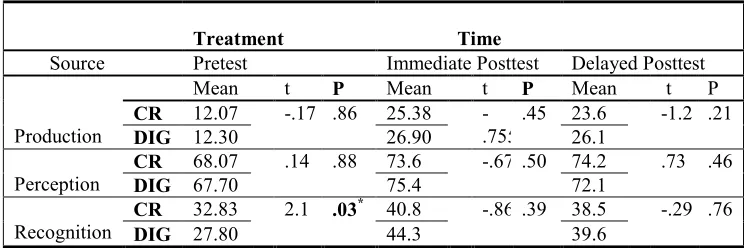
Findings in Table 2 reveal that participants in the CR and DIG tasks were statistically the same in the pretest on the perception and production measures. Findings also unveil that the effects of treatment and time were not significant on these measures.
Table 2
Independent samples T-test results on the different pragmatic measures
P*<.05; degree of freedom (df) in all cases is 58.
Since the participants in the DIG and CR tasks were significantly different on the recognition measure in the pretest, the non-significant effects of treatment between the two tasks might not be trusted (see Table 2). Therefore, the pretest-posttest mean differences might be helpful to compare the tasks. Findings demonstrate that the participants in the DIG task gained more benefits (44.3 - 27.80
= 16.5) from the treatment than those in the CR task (40.80 – 32.83 = 7.97). This
implies that the DIG task was more effective in the development of learners’
recognition ability than the CR task.
To examine whether the effects of treatment and time were significant on pragmatic measures within each group, the researchers employed the doubly multivariate repeated measure. According to the multivariate test, the effects of
‘treatment and time’ in the aggregate were significant on all dependant variables in
average, F (6) =40.00, P =.000. The analyses also showed a significant interaction
between the grouping factors and the effects of ‘treatment and time’, F (6) =2.47, P
= .024. Although the MANOVA results were revealing, the researchers employed
the univariate testto explore the effects of ‘treatment and time’ in the aggregate on
separate measures.
Treatment Time
Source Pretest Immediate Posttest Delayed Posttest Mean t P Mean t P Mean t P Production CR DIG 12.07 12.30 -.17 .86 25.38 26.90 -.755.45 23.6 26.1 -1.2 .21 Perception CR DIG 68.07 67.70 .14 .88 73.6 75.4 -.67 .50 74.2 72.1 .73 .46 Recognition CR 32.83 2.1 .03
* 40.8 -.86 .39 38.5 -.29 .76
DIG 27.80 44.3 39.6
Table 3
The univariate test results on the pragmatic measures
Note: P*<.05; df = degree of freedom; MD = mean differences
Results in Table 3 reveal that the effects of ‘treatment and time’ in the aggregate
were significant on all pragmatic measures. This table also displays a significant
interaction between the ‘grouping factor’ and the effects of ‘treatment and time’ on
the recognition test. Although highly informative, MANOVA and univariate tests did not separate the effect of treatment from that of time on pragmatic measures; therefore, the researchers employed tests of within subject contrasts.
Table 4
Within subject contrast results on the effect of treatment and time on pragmatic measures
P*<.05; Note: MS=Mean Score; df = degree of freedom
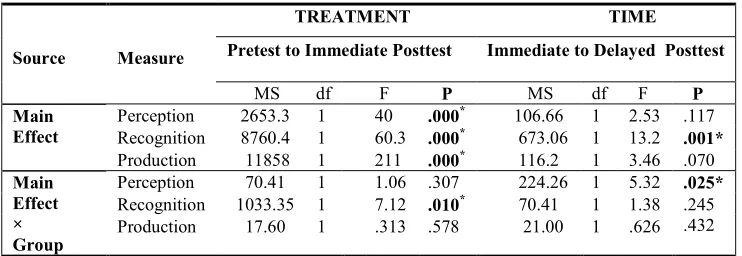
Findings in Table 4 demonstrate that the effects of treatment were significant on all measures. It is also shown that the effect of time was only significant on the recognition measure. This means that the participants did not maintain the positive effects of the treatment on the recognition measure in the delayed posttest. The
significant interactions between the effects of the ‘treatment and grouping factor’
P F
df MS Measure
Source
.000*
26.33 1.87 792.50 Perception
‘Treatment & Time’ Recognition 1.54 3025.1 41.89 .000* .000* 165.16
1.83 3934.5 Production
.143 1.99
1.87 60.11 Perception
‘Treatment & Time’ ×
Group .015*
4.98 1.54 360.1
Recognition
.408 .884
1.78 21.07 Production
TREATMENT TIME
Measure
Source Pretest to Immediate Posttest Immediate to Delayed Posttest
P F df MS P F MS df
.117 2.53 1 106.66 .000* 40 2653.3 1 Perception
Main
Effect Recognition 8760.4 1 60.3 .000* 673.06 1 13.2 .001* .070 3.46 1 116.2 .000* 211 11858 1
Production .025* 5.32 1 224.26 .307 1.06 70.41 1
Perception Main Effect × Group .245 .432 1.38 1 70.41 .010* 7.12 1033.35 1
Recognition .626 1 21.00 .578 .313 17.60 1
Production
on the recognition measure and the effects of ‘time and grouping factor’ on the perception measure are also illuminating in Table 4.
In the final analysis, the researchers carried out a pair-wise comparison to specifically investigate the effects of treatment and time within each experimental
group on different pragmatic measures. The ‘Estimated Marginal Mean Plot’ was
also utilized to depict the effects of the instructional conditions on each measure.
Table 5
Bonferroni pair-wise comparison on the pragmatic measures
P*<.05; Note: MD=Mean Difference
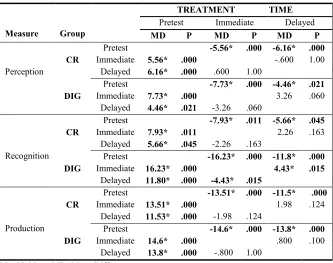
Findings in Table 5 illuminate that participants in both tasks performed significantly better on the perception measure in the immediate and delayed posttests than they did in their pretest. Analyses reveal that the effect of time was not significant on this measure for either group. This means that both groups
Measure Group
TREATMENT TIME
Pretest Immediate Delayed
MD P MD P MD P
Perception CR
Pretest -5.56* .000 -6.16* .000
Immediate 5.56* .000 -.600 1.00
Delayed 6.16* .000 .600 1.00
DIG
Pretest -7.73* .000 -4.46* .021
Immediate 7.73* .000 3.26 .060
Delayed 4.46* .021 -3.26 .060
Recognition CR
Pretest -7.93* .011 -5.66* .045
Immediate 7.93* .011 2.26 .163
Delayed 5.66* .045 -2.26 .163
DIG
Pretest -16.23* .000 -11.8* .000
Immediate 16.23* .000 4.43* .015
Delayed 11.80* .000 -4.43* .015
Production
CR
Pretest -13.51* .000 -11.5* .000
Immediate 13.51* .000 1.98 .124
Delayed 11.53* .000 -1.98 .124
DIG
Pretest -14.6* .000 -13.8* .000
Immediate 14.6* .000 .800 .100
Delayed 13.8* .000 -.800 1.00
maintained the positive effects of the treatment in the delayed posttest. Although
mean plot in Figure 1 verifies a significant ‘time by group’ interaction (see Table
4) for the participants in the DIG task, the effect of time was observed to have only a tendency to be significant in Table 5.
Delayed Posttest Immediate
Posttests Pretests
76
74
72
70
68
66
dictogloss CR
Figure 1: Mean plot for the perception measure
According to analyses in Table 5, the effects of treatment were significant on the recognition measure for both groups. Mean plot in Figure 2 also testifies to the
significant ‘treatment by group’ interaction observed in Table 4. While the
participants in the DIG task had a lower mean in the pretest they outperformed the participants in the CR task in the immediate posttest. Results in Table 5 indicate that the effect of time was significant on the recognition measure for the participants in the DIG task. This means that the participants in this task, unlike those in the CR task, could not maintain the positive effects of treatment on this measure.
Delayed Immediate Pretest
30.00
25.00
20.00
15.00
10.00
dictogloss CR
Figure 2: Mean plot for the recognition measure Figure 3: Mean plot for the production measure
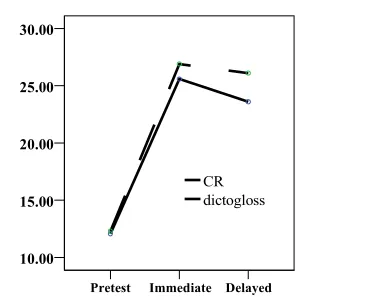
Findings in Table 5 reveal that the effects of treatment were significant on the production measure for both groups. This means that participants in both instructional conditions performed significantly better in the immediate posttest than the pretest. It is also demonstrated that the effect of time was not significant. That is, participants in both tasks maintained the positive effects of the treatment in
the delayed posttest although Figure 3 illustrates a slight fall for the CR group.
Discussion
This study not only compared the effects of the two explicit focused tasks on
Iranian EFL learners’ development in the different measures of pragmatic
competence but investigated whether or not the opportunity for output could make a difference. In line with previous studies (Rose & Ng Kwai-fun, 2001; Takahashi, 2001; Takimoto, 2006, 2009; Tateyama, 2001) showing the merits of the explicit teaching of pragmatic features, findings revealed that both the DIG as an output-based task and the CR as an input-output-based task were effective in the enhancement of
EFL learners’ pragmatic ability. Based on the results, it can be stated when the
learners’ attention is explicitly drawn to the target features, input-based and
output-based tasks can work successfully. In the CR condition, participants had to pay attention to highlighted requests in the two dialogues and compare the request forms before the metapragmatic discussions of the target features. In the DIG condition, the participants produced the target forms, reflected on their own and
Delayed Immediate Pretest
45.00
40.00
35.00
30.00
25.00
dictogloss CR
group
peer productions, and then the teacher explicitly discussed the target features with them if needed.
In the light of the findings, both tasks were effective in the development of
learners’ pragmatic ability from the pretest to the immediate posttest (i.e., the effect
of treatment). However, the results from the immediate to the delayed posttest (i.e., the effect of time) were a little mixed, which requires explanation and discussion.
For the recognition measure, while the participants in the input-based condition (i.e., CR) maintained the positive effects of the treatment in the delayed posttest, those in the output-based condition significantly fell to a lower level. This can be a result of the nature of the tasks and the test structure. Since the test required the participants not only to select the best choice but also to identify the source of errors for other options, it may be logical to expect them to miss some grammatical or pragmatic points over a month. Furthermore, the deep processing and discovery procedure involved in the CR condition (Ellis, 2003) may not be present in the DIG task. Therefore, following Ellis (2003) and Takimoto (2009), it is proposed that when the participants focused on the pragmalinguistic-sociopragmatic connection of the target features through problem solving activities embedded in the CR task, they may have been inclined to process the meanings at a deeper level, leading to a greater retention. In the same vein, Ellis stated that more research is needed to assure whether or not learners really learn target structures through structure-based production tasks.
For the perception measure, although participants in both groups maintained the positive effects of the treatment in the delayed posttest, the participants in the DIG task had a tendency (see Table 5) to fall significantly to a lower level in the delayed posttest. Therefore, the results for the perception and recognition measures are possibly in line with what Craik and Lockhart (1972, as cited in Takimoto, 2009)
and Ellis (2003) stated. Craik and Lockhart proposed that “the quality of memory
trace depends on the level or depth of perceptual and mental processing where
meaning plays an important role” (as cited in Ellis, p. 615). As a result, it might be
argued that the deeper processing and the discovery learning (Ellis) involved in the CR task can help learners maintain their ability in the delayed posttest.
The fact that learners in the output-based task maintained the positive effects of the treatment on the production measure, but not the recognition, in the delayed
posttests may be justified in the light of the learners’ language proficiency level. The learners in the present study were matched in the experimental groups from the elementary, intermediate and upper intermediate levels of language proficiency. Therefore, it is likely that when it comes to the detailed analysis of the language such as recognition (see Appendix B) and perception measures, problem solving activities inherent in the CR task may benefit different learners.
Unlike the recognition measure, findings on the production measure demonstrated that participants in the DIG task maintained the positive effects of the
treatment in the delayed posttest. With regard to Baily’s (1996) compatibility of the
testing and teaching promoting beneficial washback, it can be further proposed that since the DIG task involves the production of the target features, this instructional condition in the long run can also be beneficial to EFL learners when it comes to their performance on the production measure.
Conclusion
As stated earlier, since previous studies have not compared the effects of the
explicit input-based and explicit output-based tasks on learners’ pragmatic
competence, the justification and discussion here are speculative; therefore, similar studies may more firmly assert the role of input-based and output-based tasks in pragmatics. In the light of the results of this study, some conclusions providing grounds for further research and pedagogical implications for teachers and practitioners are reached.
The results not only confirm the teachability of the pragmatic features but also reveal the applicability of the focused tasks and activities in the realm of pragmatics; therefore, in EFL contexts where exposure to the second language and culture is limited, formal instruction can help EFL learners enhance their pragmatic
competence. The current research also shows when the learners’ attention to the
target features is raised explicitly both input-based and output-based tasks can be effective. This conclusion can provide some grounds for further research. Future studies can investigate the efficacy of input-based and output-based tasks in the
improvement of EFL learners’ pragmatic ability when their attention to target
features is implicitly raised. In line with this conclusion, a pedagogical implication can be presented to teachers. For the perception and recognition measures, a better performance of the participants in the DIG and the CR tasks respectively in the
immediate and delayed posttests shows that the combination of both tasks in language classes may lead to a better result.
Finally, in addition to EFL learners’ pragmalinguistic competence, their
sociopragmatic ability should also be paid some heed. The gap in learners’
perceptions before and after the treatment in the present study can show teachers
the necessity for raising learners’ awareness of cross cultural differences and
non-linguistic factors in the process of L2 acquisition.
Note on Contributors:
Abdolhossein Ahmadi is a Ph.D. Candidate in TEFL at Islamic Azad University of Tehran, Science and Research Branch. He received his M.A. in TEFL from Tarbiat Moallem University. His areas of interest are Pragmatics and Materials Evaluation. He has presented papers in international conferences.
Reza Ghafar Samar is an assistant professor of (Socio)linguistics and Applied Linguistics at Tarbiat Modares University. He specializes in Sociolinguistics and its application in Second/Foreign Language Acquisition. He is the author of numerous books and articles appearing as book chapters or in journals such as International Journal of Bilingualism.
Massood Yazdanimoghaddam is an assistant professor at Islamic Azad University, Garmsar Branch. His areas of research interests are Sociolinguistics, Discourse Analysis, and Critical Pedagogy and he has published on these areas. He has been teaching different B.A & M.A courses in Applied Linguistics.
References
Alcon-Soler, E. (2005). Does instruction work for learning pragmatics in the EFL
context? System, 33, 417-435.
Alcon-Soler, E., Safont Jorda, P., & Martinez-Flor, A. (2005). Towards a typology
of modifiers for the speech act of requesting: A sociopragmatic approach. Retrieved from http://www.dialnet.unirioja.es/servlet/articulo?codigo.pdf
Allen, D. (2004). Oxford placement test 1. Oxford: Oxford University Press.
Ary, D., Jacobs, L. C., & Razavieh, A. (1996). Introduction to research education
(5th ed.). Orlando, Fl: Harcourt Brace College.
Baily, K. (1996). A review of washback concept in language testing. Language Testing, 13, 257-278.
Cid, E., Granena, G., & Tragant, E. (2009). Constructing and validating the foreign
language attitude and goals survey (FLAGS). System, 37, 496-513.
Clemente, M. A. (2001). Teachers' attitude within a self directed language teaching
scheme. System, 29, 45-67.
Dalton-Puffer, C., & Nikula, T. (2006). Pragmatics of content based instruction:
Teacher and student directive in Finnish and Austrian classrooms. Applied
Linguistics, 27(2), 241-267.
Doughty, C., & William, J. (1998). Pedagogical choices on focus on form. In C.
Doughty & J. Williams (Eds.), Focus on form in second language acquisition
(pp. 114-139). Cambridge: Cambridge University Press.
Ellis, R. (1994). Understanding second language acquisition. Oxford: Oxford
University Press.
Ellis, R. (1997). SLA research and language teaching: Oxford: Oxford University
Press.
Ellis, R. (2002). Grammar teaching- Practice or Consciousness raising? In J. C.
Richards & W. A. Renandya (Eds.), Methodology in language teaching: An
anthology of current practice (pp.167-175). Cambridge: Cambridge University Press.
Ellis, R. (2003). Task-based language learning and teaching. Oxford: Oxford
University Press.
Farhadi, H., Jafarpour, A., & Birjandi, P. (1994). Testing language skills: From
theory to Practice. Tehran: SAMT Publication.
Fotos, S. (1994). Integrating grammar instruction and communicative language use
through grammar consciousness-raising tasks. TESOL Quarterly, 28(2),
323-351.
Fotos, S., & Ellis, R. (1991). Communicating about grammar: A task based
approach. TESOL Quarterly, 25(4), 605-628.
Fukuya, Y. J. (2002). Consciousness raising of downgraders in requests. Hawaii:
University of Hawaii. (ERIC Document Reproduction Service No. ED466100)
Fukuya, Y. J., & Hill, Y. Z. (2002). Effects of recasts on EFL learners’ acquisition
of pragmalinguistic conventions of request. Second Language Studies, 21(1),
1-47.
Fukuya, Y. J., & Hill, Y. Z. (2006). The effect of recasting on the production of
pragmalinguistic conventions of request by Chinese learners of English. Issues
inApplied Linguistics, 15(1), 59-91.
Hudson, T. (2001). Indicators for pragmatic instructions: Some quantitative tools.
In K. R. Rose & G. Kasper (Eds.), Pragmatics in language teaching (pp.
283-301). Cambridge: Cambridge University Press.
Kasper, G. (2001). Classroom research on interlanguage pragmatics. In K. R. Rose
& G. Kasper (Eds.), Pragmatics in language teaching (pp. 33-60). Cambridge:
Cambridge University Press.
Koike, D. A., & Pearson, L. (2005). The effect of instruction and feedback in the
development of pragmatic competence. System, 33, 481-501.
Liu, J. (2007). Developing a pragmatic test for Chinese EFL learners. Language
Testing, 24(3), 391-415.
Martinez-flor, A., & Fukuya, Y. J. (2005). The effects of instruction on learners’
production of appropriate and accurate suggestion. System, 33, 463-480.
Rose. K. R. (2005). On the effects of instruction in second language pragmatics. System, 33, 385-399.
Rose, K. R., & Ng Kwai-fun, C. (2001). Inductive and deductive teaching of compliment and compliment resposnses. In K. R. Rose & G. Kasper (Eds.), Pragmatics in language teaching (pp. 145-171). Cambridge: Cambridge University Press.
Swain, M. (1998). Focus on form through conscious reflection. In C. Doughty & J.
Williams (Eds.), Focus on form in second language acquisition (pp. 64-81).
Cambridge: Cambridge University Press.
Takahashi, S. (2001). The role of input enhancement in developing pragmatic
competence. In K. R. Rose & G. Kasper (Eds.), Pragmatics in language
teaching (pp. 171-200). Cambridge: Cambridge University Press.
Takahashi, S. (2005). Pragmalinguistic awareness: Is it related to motivation and
proficiency? Applied Linguistics, 26(1), 90-120.
Takimoto, M. (2006). The effect of explicit feedback and form-meaning processing on the development of pragmatic proficiency in consciousness-raising tasks. System, 34, 601-614.
Takimoto, M. (2009). The effect of input-based tasks on the development of
learners’ pragmatic proficiency. Applied Linguistics, 30, 1-25.
Tateyama, Y. (2001). Explicit and implicit teaching of pragmatic routines:
Japanese summiaasen. In K. R. Rose & G. Kasper (Eds.), Pragmatics in
language teaching (pp. 200-223). Cambridge: Cambridge University Press. Yang, N. D. (1999). The relationship between EFL learners' beliefs and learning
strategy use. System, 17(4), 515-535.
Acknowledgement
The researchers would like to express their sincere gratitude to Dr. A. Reza Tahriri, Mr. Mohsen Pornour, Mrs. Fiona Jackson and Mr. Amjad Badiee for their
constructive comments on early drafts and proofreading of themanuscript.
Appendices
Appendix A: A Sample of Open Discourse Completion Test as the Production Test
Name Student Number
Direction: The following test including twenty scenarios needs a REQUEST as the response. Please, read the situations carefully and make an accurate and appropriate request for each situation, as shown in the example.
Example: Since you have got an appointment with your doctor, you want your sister to take care of your son for an hour.
Your Request: Jane, can you take care of Tom for an hour? I have an appointment with my doctor.
1. Your score in 'Methodology' is not what you are expecting. Therefore, you ask
your teacher to examine your paper again. Your Request:
2. One of your M.A. students whom you have got a friendly relationship with is good at editing the text. You have written a paper for a journal. You ask him to
proofread it for you. Your Request:
3. You are shopping in one of the city's mall and find out that you have forgotten money and credit cards. You want your close friend to lend you some money. You
will promise to pay him back as soon as you return to the dormitory. Your
Request:
4. Your paper is due (i.e., to be given to your teacher) tomorrow but you have lost your typed paper because of a virus on your computer. You ask your teacher who is very strict with deadlines to give you some more time to type your paper again. Your Request:
5. Your brother is going to the bank. You also give him some money to deposit
(i.e., put) into your account. Your Request:
6. You are a geography student and have written an article about 'global Warming'. Since your English is not good, you ask one of the English students who has been
recommended by your supervisor to edit your paper. Your Request:
Appendix B: A Sample of Recognition Test
ﯽﻣاﺮﮔيﻮﺠﺸﻧاد : ﻞﻣﺎﺷﺮﺿﺎﺣنﻮﻣزآ 20 ﺪﺷﺎﺒﯿﻣﺖﯿﻌﻗﻮﻣ . رﺎﻬﭼﺖﯿﻌﻗﻮﻣﺮﻫ دﯽﻣراﺮﻗﺎﻤﺷرﺎﯿﺘﺧارداربﺎﺨﺘﻧا ﺪﻫ . ﺮﻫباﻮﺟرد ﺪﻧاهﺪﺷﯽﺣاﺮﻃﺮﯾزيﺎﻬﺗرﻮﺻﻪﺑوﺪﻨﺷﺎﺒﯿﻣﯽﺴﯿﻠﮕﻧانﺎﺑزﻪﺑﯽﯾﺎﻬﺘﺳاﻮﺧردفﺮﻌﻣﺎﻫﻪﻨﯾﺰﮔ،ﺖﯿﻌﻗﻮﻣ : -ظﺎﺤﻟزا يرﻮﺘﺳد ) يﺮﻣاﺮﮔ ( ﺢﯿﺤﺻ ﺐﺳﺎﻨﻣ و ﺖﯿﻌﻗﻮﻣ ﺪﺷحﺮﻄﻣ ﺪﺷﺎﺒﯿﻣه . ) ﻪﻨﯾﺰﮔ ﻦﯾﺮﺘﻬﺑ ( -ظﺎﺤﻟزا يرﻮﺘﺳد ) يﺮﻣاﺮﮔ ( ﺢﯿﺤﺻ ﯽﻟو ﺐﺳﺎﻨﻣﺎﻧ ﺖﯿﻌﻗﻮﻣ ﺪﺷﺎﺒﯿﻣهﺪﺷحﺮﻄﻣ . -ﺖﯿﻌﻗﻮﻣظﺎﺤﻟزا هﺪﺷحﺮﻄﻣ ﺐﺳﺎﻨﻣ ﯽﻟو يرﻮﺘﺳد ) يﺮﻣاﺮﮔ ( ﺪﺷ ﺎﺑ ﯽﻤﻧ . -يرﻮﺘﺳد ﻪﻧ ) يﺮﻣاﺮﮔ ( و ﺐﺳﺎﻨﻣ ﻪﻧ ﺖﯿﻌﻗﻮﻣ ﺪﺷﺎﺒﯿﻣهﺪﺷحﺮﻄﻣ . ﮔ ﻦﯾﺮﺘﻬﺑ اﺪﺘﺑا ،ﺖﯿﻌﻗﻮﻣ ﺮﻫ ﻖﯿﻗد ﻪﻌﻟﺎﻄﻣ زا ﺲﭘ ياﺮﺑ اردﻮﺧ ﻞﯾﻻد ﺲﭙﺳ و هدﻮﻤﻧبﺎﺨﺘﻧا ارﻪﻨﯾﺰ بﺎﺨﺘﻧا ندﺮﮑﻧ ﺪﯿﻨﮐﺺﺨﺸﻣرﺪﺑﺮﺿﺖﻣﻼﻋﺎﺑﺮﮕﯾديﺎﻫﻪﻨﯾﺰﮔ .
1. For your wedding anniversary, you have invited a number of your friends for dinner. Since there are a lot of things to do, you ask your younger sister who has got a day off to help you with dinner.
ﯽﻟو يرﻮ ﺘﺳ د ﺐ ﺳﺎﻨ ﻣ ﺎﻧ و يرﻮ ﺘﺳ د ﺎﻧ ﺐ ﺳﺎﻨ ﻣ ﺎﻧ ﺎﻧ ﯽﻟو يرﻮ ﺘﺳ د ﺐ ﺳﺎﻨ ﻣ
A. Hey, Cindy, come to my house tomorrow and help me with dinner. Some friends are coming over for our anniversary and we could really use a hand (i.e. need some help).
B. Cindy, can you help me with dinner tomorrow, please? Some friends are coming over for our anniversary and we could really use a hand (i.e. need some help).
C. Cindy, mind you coming home and help me with dinner, please? Some friends are coming over for our anniversary and we could really use a hand (i.e. need
Appendix C: Perception Questionnaire some help).
D. Cindy, Some friends are coming over for our anniversary and we could really use a hand. I will be very happy if you help me to passed this party.
S
tr
on
gl
y
di
sag
ree
di
sa
gr
ee
U
ndec
id
ed
ag
ree
S
tr
on
gl
y
ag
ree
ITEMS 1 2 3 4 5
1. Oral translation from Persian to English and vice versa is enough to have appropriate communication with English native speakers. 2. Written translation from Persian to English and vice versa is enough to have appropriate
communication with English native speakers. 3. To communicate appropriately with English native speakers in different contexts, linguistic skills and components such as speaking, listening, grammar, vocabulary and pronunciation are enough.
4. I think politeness is a social concept and it does not need to be taught.
5. To communicate appropriately with English native speakers in different contexts, linguistic skills and components such as speaking, listening,
are not , vocabulary, pronunciation and grammar
enough.
6. I think the addition of social skills such as politeness in the English language to English textbooks is necessary.
7. To learn the English language, words, structures and idioms are more important than knowing a custom or culture of the English community.
8. In learning the English language, linguistic skills and components such as speaking, grammar, vocabulary, etc. are more important than considering social positions, job, age and sex of the people we are talking to.
9. To communicate appropriately with English native speakers through e-mail and chat, the knowledge of vocabulary, structure,
enough. is not
pronunciation etc
10. To communicate appropriately with English native speakers, sex of the person whom we are
an important role. play
does not talking to
11. To communicate appropriately with English native speakers, age of the person whom we are
play an important role. does not
talking to
12. To communicate appropriately with English native speakers, social position of the people we
play an important role. does not
are talking to
13. I think teaching vocabulary, structure, expressions, etc. is more important than teaching
social skills (i.e., how to talk to one’s boss or
friend).
14. 'Politeness' is a social concept and not related to language.
15. Since I know how to be polite in Persian, I can also be polite in English.
16. To communicate appropriately with English native speakers, knowledge of linguistic skills and components such as speaking, listening, grammar, vocabulary, pronunciation is enough.
17. To communicate appropriately with English native speakers, awareness of the politeness is
to be taught. does not need
enough to use it and it
18. English courses at university are enough to communicate appropriately with English native speakers.
19. English courses at universities are enough to acquire the social skills such as politeness in the English language.
20. Accuracy of English language forms is more important than other factors such as social status, social power, occupation, etc. to communicate appropriately with English native speakers. 21. I think class activities such as the
memorization of dialog, vocabulary, sentence formation are enough to communicate appropriately with English native speakers.
22. I think to learn English, language skills such as speaking, listening, writing, vocabulary and etc
related to other factors such as education, are not
social status, social distance, sex, age and etc.