in the population sciences published by the Max Planck Institute for Demographic Research Konrad-Zuse Str. 1, D-18057 Rostock · GERMANY www.demographic-research.org
DEMOGRAPHIC RESEARCH
VOLUME 27, ARTICLE 1, PAGES 1-24
PUBLISHED 03 JULY 2012
http://www.demographic-research.org/Volumes/Vol27/1/ DOI: 10.4054/DemRes.2012.27.1
Research Article
Do women delay family formation in expensive
housing markets?
William A.V. Clark
© 2012 William A.V. Clark.
This open-access work is published under the terms of the Creative Commons Attribution NonCommercial License 2.0 Germany, which permits use, reproduction & distribution in any medium for non-commercial purposes, provided the original author(s) and source are given credit.
1 Introduction 2
2 Theory 3
3 Previous research and literature 5
4 Data and methods 7
5 Interpretations of fertility across housing markets 9 5.1 Place effects on fertility 11
6 Individual level effects on age at first birth 15
7 Completed fertility 16
8 Observations and conclusions 18
9 Acknowledgements 19
Do women delay family formation in expensive housing markets?
William A.V. Clark1
Abstract
BACKGROUND
Recent research by demographers and economists has examined the link between living costs and fertility outcomes. The literature has provided some evidence that high rents, or high housing costs, discourage fertility.
OBJECTIVE
I re-examine the hypothesis that delayed fertility (age at first birth) is related to the costs of housing measured either as rents or sales prices.
METHODS
I use data from the American Community Survey for 2006-2008 to construct mean age at first birth for women in a sample of 25 US metropolitan areas stratified by rents and sales prices. The sales prices for those metropolitan areas were from the National Association of Realtors. I use models of both aggregate relationships of mean age at first birth and metropolitan housing cost level measures and individual analyses of mean age and measures of ethnicity, education and labor force participation.
RESULTS
The effect of being in an expensive housing market is a delay of first births by three to four years, after controlling for education, ethnicity and labor market participation. However, the relatively modest fit of individual models suggest that while the housing market may play a role it is also clear that there is a complex structure to the decision- making around fertility, labor force participation and housing market entry. Overall completed fertility does not appear to be changed.
1. Introduction
The average age at which women have their first child has increased steadily in Europe and the United States. Although there is considerable variation from country to country, women are now an average of three to four years older when they have their first child than their mothers were when they first had a child (Martin, 2004). There is also overall decreased completed fertility across most industrial countries. What is behind these changes, and why has the age at which fertility first takes place increased so much in just a few decades? There is a growing body of demographic literature and parallel studies in the economics of the family that has worked to explain these changes (Burch, 1996; Hirschman, 1994; Sweeney, 2002; Dykstra and Wagner, 2007). Recently that literature has gone beyond the arguments about transitions to education, labor force participation and the impact of economic insecurity, to suggest that housing markets themselves are, through the costs of ownership, affecting the timing of pregnancy. It is this question which is at the center of this analysis which considers both the nature of metropolitan structures (Plane, et al 2005) and the nature of housing market costs specifically.
The increasing age at first birth and the overall comparatively high ages at which birth occurs for many women is coincident with the new low levels of fertility that are a function of the rapid rise in birth postponement. This change in fertility behavior is seen as the hallmark of the “second demographic transition” (Lesthaeghe and Neels, 2002). It is a transition which reflects increasing levels of education in post-industrial societies, increasing labor force participation by women and, increasingly, a concern about economic uncertainty (Blossfeld and Hofmeister, 2006). We also know that households often want to enter homeownership before starting a family, or at the least to buy within some period of family formation, but this is increasingly difficult in high cost housing markets.
It has also been suggested that the recent rapid rise and then decline in housing costs in the United States has had a “shock” effect on fertility behavior, as it has increased uncertainty for couples who wish to start families. Uncertainty has already been identified as an important element in understanding fertility behavior more broadly (Mills and Blossfeld, 2003). In many housing markets in the United States, especially in the last decade, the cost of housing doubled and some instances this occurred in a very short period of time with concomitant issues of affordability and housing price stability. There have been rapid housing price increases in the past but the recent increase and subsequent decline has created significant regional differences in housing prices. The growing regional variation has further stimulated an interest in the links between housing prices and fertility.
It does seem plausible, as others have argued, that housing and housing costs may be factors in the decision to engage in parenthood, and thus likely to influence fertility levels and tempo (Mulder and Billari, 2010, Lutz and Skirbekk, 2005). In addition, in those societies which fail to provide adequate support for child care or where child care is expensive (or even unavailable) there are implications for the ability of women to participate in the labor market and have families. Women have often entered the labor market to increase household resources and to make home ownership possible or to maintain it. It is possible that the strong emphasis on homeownership and where child care is problematic that it creates a situation where couples who are unwilling to forgo ownership decide to delay fertility. It is in this context of high desire for homeownership where housing costs are either high or appreciating rapidly, that the specific issue of housing costs become central, and is the issue at the heart of this paper. This paper asks, what is the relationship between housing costs and fertility, and how does the geographic variation in housing costs affect the timing of initial fertility and the level of completed fertility? In other words, why is age at first birth so much higher in large metropolitan areas like Boston and New York in contrast with smaller cities like Peoria, Springfield and Toledo?
2. Theory
which provides the stability, safety and access to services which are a critical part of raising a family. The latter may be the most important motivating factor in housing choice, as “ownership neighborhoods” rather than “rental neighborhoods” may provide the special combination of factors that households who wish to have children see as important. These factors range from access to good schools to a whole spectrum of urban amenities.
But it is not just children versus housing; housing alone is likely to require two incomes to purchase and meet monthly costs in expensive housing markets. As Skaburskis (1997) demonstrated in Canadian housing markets, household formation, tenure choice and housing expenditure are interactive. In this broader conceptualization we can think of a triangle of interactions and decisions. Decisions are about fertility, about workforce participation and housing ownership are interconnected. Thus, it is not a linear decision, rather it is a triangulated process with trade-offs at several intersections. Moreover, this decision takes place within the changing economics of growth and decline in the labor market where the decisions to stay in the labor force or exit are made.
Clearly, the evidence shows that ownership and labor force participation are linked. There is evidence that women work to maintain a mortgage and that the likelihood of labor force participation is higher for first time buyers when the mortgage burden is greater (Fortin, 1995). Thus, the evidence that the labor supply of women is constrained by mortgage commitments feeds into the argument that there is a set of inter-related links between housing investment, and labor market participation. At the same time, we do not have a specific test of whether fertility is in turn delayed.
make some progress towards disentangling the multiple factors in this choice process, and, at the least on a micro scale, we can ask whether there is an observable outcome in fertility choices across US housing markets and whether we can see that in structural outcomes by size and cost (Plane et al, 2005).
One additional context is relevant. Although there has been some decline in overall migration and mobility, still about 15 percent of households move each year and about 5 percent make longer distance moves between labor markets. These migrations may not be independent of fertility decisions, either moving up to take new jobs and delaying fertility, or moving down and having children. This process is embedded in the life course. The decision to relocate or to stay is made to accommodate the needs of the partners involved (tied movers and stayers). We can imagine highly educated women who want professional careers moving to urban centers with greater job opportunities. In effect, the decision to move is part of a life course response to opportunities and then the outcome of lower fertility in expensive markets is a function of both the cost of living and the selection into those markets by highly educated women.
3. Previous research and literature
Broadly speaking, families move to bring their housing needs into adjustment with their family needs (Kulu and Milewski, 2007). There is substantial research which links home ownership and family formation, and in particular, the link between the shift from renting to ownership and the formation of families (Clark and Davies Withers, 2007; Mulder and Wagner, 1993, Mulder, 2006). As households progress through the life course, life events create the need for new housing, larger housing, or housing in a different place, especially at the beginning of the life course. The outcome of life course events is an eventual shift from a younger rental population to an older home-owning population. Housing tenure changes from rental to ownership and from multi-family dwellings to single family dwellings as children come into the family and houses are purchased (Clark and Onaka, 1983; Mulder and Wagner, 1998, Feijten and Mulder, 2002). Whether it is a birth event, a separation, or some other contextual effect in family composition before or after a residential change, it emphasizes how families and residential change are intertwined (Michielin and Mulder, 2008). The evidence of a link between family formation and ownership is further strengthened by research which shows that couples in single-family houses have a much greater probability of conception than couples living in apartments (Kulu and Vikat 2007).
increasingly required to balance the competing demands of family formation and nurturing, with participating in the work force (LeClere and McLaughlin 1997; Clark and Davies Withers 2002). There is both popular and academic literature which addresses the issue of how families deal with the costs of having and raising children and entering the housing market (Haveman and Wolfe, 1994).
Previous literature established that there is a link between mobility and fertility and fertility and housing market behavior (Clark and Davies Withers, 2009; Enström Öst, 2012). Enström Öst in particular argues that there are two decisions that a household faces: whether or not to purchase a house and whether or not to begin a family. Her study of housing and children using Swedish data explores if and how housing markets and economic conditions can affect fertility. The study examines three cohorts who entered the housing market at different periods in the economic cycle in Sweden, and the choices of both becoming a parent and becoming a homeowner are modeled simultaneously. While both childbearing and homeownership increase with age, there are significant differences in both entry to ownership and having a first child across cohorts. The cost of being a homeowner is significant in the childbearing decision but it is more crucial for the latest cohort in which both economic outcomes were more uncertain and women had a higher tendency to participate in the labor force. They are simultaneous effects and are clearly greater for young adults in the latest cohort as they face increasing problems in entering the housing market.
In the context of changing family structures and a volatile housing market research has turned specifically to the issue of the cost of ownership and how it might compete with having and raising children (Courgeau and Lelièvre 1996). That housing cost may matter in housing decisions was first suggested in studies of the price of living space and overall living arrangements (Börsch-Supan, 1986; Haurin et al 1993). Housing cost was also shown to affect the likelihood of leaving home to establish an independent residence (Ermisch, 1999; Lauster, 2006; Clark and Mulder, 2000). More specifically, economists have related the demand for children to the price of living space. Now, several researchers have attempted specific studies of fertility and the price of living space. Two studies are notable. Sato (2007) showed that large city sizes were accompanied by in migration, higher wages, high land prices and lower fertility. In Sato's formulation, the higher wages in larger, more expensive cities could induce women to substitute more market work for less household work, and possibly away from child quantity and more towards child quality. In this conceptualization, larger cities with higher wages may be more attractive to career oriented women who have low desired total fertility. To examine these questions more closely, Simon and Tamura (2009) studied whether high rents discourage fertility.
They do this for the United States over the period 1940 to 2000, and show that pooled analysis of individual data demonstrates that fertility is related to wife’s and husband’s age, negatively related to education, and of course, lower for women who participate in the labor market. The variable of most interest, rental rates per room, is strongly and significantly related to age at first birth. They conclude that the price of living space has a small but economically and statistically significant effect on the fertility decisions of households, both on women’s age at first birth and on completed fertility.
Other related research also suggests a link between homeownership and fertility.2 In the United Kingdom, homeowners seem to have fewer children than renters and to have them later (Hakim, 2003). Strom (2010) suggests that the size of the dwelling is important and, whether or not fertility is enhanced, it seems that couples change their housing situation in the time period in which they are waiting for their child to be born (Kulu, 2008). At the aggregate level, Mulder and Billari (2010) showed that there is a link between what they call “housing regimes” and fertility. Prices do affect the likelihood of leaving home for young adults and tighter housing markets and higher regional housing market costs make an impact upon the process as well (Ermisch and Di Salvo, 1997; Ermisch, 1999). At country-level, there is evidence that housing regimes with high ownership, but limited availability of mortgages have quite low fertility, and moderately high mean age at first birth. Now, while this is a useful interpretation of the fertility -- housing market link, as the authors recognize, it is complicated by the issue of causality. Quite obviously, inferring causality between housing costs and fertility is not straightforward, and relationships could run either way, or even be related to some other factor which affects both processes. To make some progress in disentangling causality and outcomes, the recent focus has been on micro-level data, as a way of understanding links between housing and fertility, and specifically between the cost of housing and fertility. That is the approach of the research reported here.
4. Data and methods
To examine the questions which arise from the review of previous work I organize the data to answer the two central questions – is fertility lower in more expensive housing markets, and can we identify housing market effects on completed fertility?
Twenty five metropolitan areas were randomly sampled from the distribution of 156 metropolitan areas ordered by 2008 median sales prices for houses. Five
2 There is important related literature on marriage and fertility and on the behavior of low and high income
metropolitan areas were chosen from each of the five quintiles of ordered sales prices. The selected metropolitan areas ranged from Toledo, Ohio, with the lowest median sales price of $92,000, to San Francisco, with a median sales price of over $600,000. Those sales prices had been higher at the height of the housing bubble in 2006/2007. Data on average gross rents and median housing values (in U.S. Dollars) for the 25 metro areas was also collected from the 2008 American Community Survey.3 The sales prices, house values, and gross rents for the five housing value groups are reported in Table 1. The rents range from an average of $654 in the lowest ranking housing markets (Toledo, Buffalo, Peoria, Ill, Rochester NY and Springfield Mo) to $1254 average monthly rents for the five metro areas with the most expensive housing and rents (San Francisco, Nassau, NY, Miami, Boston, and Anaheim-Santa Ana). The relatively large gap between the five most expensive housing markets and the next sets, which are much closer in rents, values and sales, is notable, and will be an important context for the discussion of the housing market fertility relationship.
Table 1: Mean rents, sales and values for metropolitan groups
Metro group 5 Highest 4 3 2 1 Lowest
Rents (monthly) $1254 $859 $743 $675 $654 Sales price (2008) $447.000 $196,000 $159,000 $136,000 $111.000 House value (2008) $491,900 $225,700 $171,200 $140,000 $124,300
Source: American Community Survey and National Association of Realtors (2010) Median Sales Prices of existing homes
The American Community Survey (ACS)4 is used to compute age at the time of first birth for all women aged 20-44 and for women 20-44 years of age in married couple families. It is also the source of the measure of completed fertility. The measure of completed fertility uses the number of own children reported in the ACS, and may be a small underestimate of total completed fertility, as some children may have left home and not been reported in the census count. However, the issue here is a relative measure of fertility across housing markets, and any bias is unlikely to be systematic across housing markets. The completed fertility measure is computed by examining the number of own children at ages 30-35 or 40-44 by level of education. As fertility is closely intertwined with level of education, I compute completed fertility by either age
3 I did not compute price per square foot because the correlation between price per sq foot and sales price and
rents is very high, and I am concerned with an overall metro market affect which I believe is captured by sales price.
4 The ACS is now conducted in place of the US decennial census “long form” to collect detailed
interval 35-39 or 40-44 and by education. The number of own children is higher for older age groups for more educated women, as has been documented previously.
5. Interpretations of fertility across housing markets
In this first descriptive section I outline how fertility varies across housing markets and by education, labor market participation and ethnicity. This is followed by analyses of place effects on fertility and of completed fertility.
Women’s mean age at first birth is clearly lower in less expensive housing markets (Table 2). It is lower for all births to women 20-44 and for births to women 20-44 in married couples. Fertility is also lower in less expensive markets for all education levels, labor force participation and for first births to white and black women. However, it is not very different across housing markets for Hispanic women.
Table 2: Age at first birth for all women (20-44) by demographic
characteristics
Education Labor force Ethnicity
Group All HS College Advanced Labor no Labor yes White Black Hispanic
1 28.0 26.2 27.9 30.2 26.5 28.5 28.1 25.1 29.9 2 29.3 26.8 29.9 31.8 28.3 29.7 29.5 27.9 29.5 3 29.0 27.4 28.9 31.5 28.6 29.2 29.6 27.9 27.8 4 29.4 27.6 29.6 31.5 28.3 30.0 29.5 28.7 28.9 5 31.5 29.7 31.4 33.1 30.7 31.9 32.1 30.2 30.0
Source: American Community Survey 2008
A breakdown of age at first birth by metropolitan housing cost group, education and ethnicity provides enriched detail on the findings reported above. Whether it is high school, some college, or advanced degrees, age at first birth varies across housing markets, but of course it also varies markedly across education levels and by ethnicity (Table 3).
Table 3: Age at first birth for all women (20-44) by housing market sales level
and education
Mean sales Price group
Education (all) White Black Hispanic
1 (low) HS 25.5 24.2 22.5
College 28.1 26.0 26.1
Advanced 30.2 - 29.8
2 HS 26.9 26.2 26.9
College 29.7 29.3 31.2
Advanced 32.1 30.0 32.1
3 HS 27.9 26.3 27.0
College 29.5 27.6 27.8
Advanced 31.3 31.4 31.6
4 HS 28.0 24.5 30.3
College 29.3 30.9 27.3
Advanced 31.6 28.1 30.0
5 (high) HS 30.2 28.4 29.3
College 31.7 30.9 29.9
Advanced 33.5 32.1 32.9
Source: American Community Survey 2008
Figure 1: Age at first birth for births to women 20-44 by education level by metro ranking
Note: 1=lowest median sales price, 5=highest median sales price.
5.1 Place effects on fertility
To model the place effects from housing markets, I plot age at first birth as a function of sales and rents and then add potential controls/explanations for the variations in age at first birth.
There is a significant and positive relationship between age at first birth and both rents and sales prices (Figure 2).5 The relationship is stronger for rents and age at first birth than for housing market sale prices, possibly the outcome of recent sales volatility. Rents have not shown the same volatility. For housing market rents, the R2 of .63 is prima face strong support for the view that first births are related to housing costs. However, the plots suggest that there is a considerable underlying complexity. In both cases there is considerably more variability in cities with lower rents. In the case of sales, we can suggest that a threshold function might better describe the relationship between sales and first births. In the cities with lower rents the age at first birth can vary from 26 to 31, but general support for the overall relationship of housing costs and births is provided by the fact that, of the 15 cities with rents under $800 a month, 11
5
cities have first births between 26 and 28.5 while the four most expensive cities have first births at close to 32 years of age.
Figure 2: Age at first birth for all women (20-44) and home sales prices/
and rents
Significant at p> .001
But does housing cost explain the delay in first births when controls for education, ethnicity and income are added? I examine this question with both the aggregate metropolitan level data and with individual data.
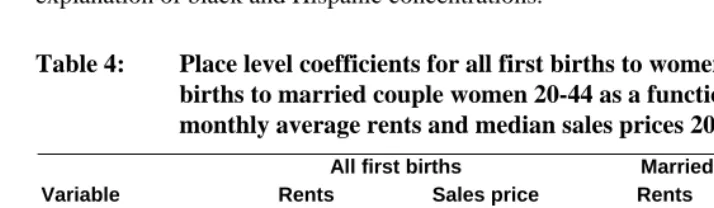
The regression models of age at first birth against rents and sales prices, controlling for the percent black and percent Hispanic in the metro areas, percent of college attendance, and log of family income are significant but clearly the added variables do not provide additional explanatory power (Table 4). The only significant coefficients are for black and Hispanic in the models for married couple households. The finding may seem counter intuitive but the overall model explanations do not increase over those of the simple models with rents and sales prices only. It appears that the coefficients likely reflect the size of the metropolitan areas rather than an intrinsic explanation of black and Hispanic concentrations.
Table 4: Place level coefficients for all first births to women 20-44 and first
births to married couple women 20-44 as a function of metropolitan monthly average rents and median sales prices 2008
All first births Married couple first births
Variable Rents Sales price Rents Sales price
Intercept 18.379 13.016 8.898 6.194
% Black .038 .052 .056* .062*
% Hispanic .026 .034 .042* .046*
% College .029 .005 .009 -.001
nl Family income 1.408 3.302 4.239 5.160
Rent/sales .004 .005 .002 .002
Adj R2 .60** .58** .64** .63**
**Significant at .001, *significant at .05
Examining the simple intercorrelations provides further explanatory power for the place effects. The strong correlation between rent levels and purchase prices (.92) and between college education and rent levels (.75) and between college education and purchase prices (.76) and in turn between college education with the log of family income (.87) suggest the sorting which is occurring in high cost housing markets. They are tending to be markets where significant proportions of more educated women have clustered and consequently the outcome of older ages at first births.
we would expect) than in the less expensive markets. For women in the labor force in either inexpensive or expensive markets there is much less variation by age of first birth. In the expensive markets the variation is much lower whether or not women are in the labor force. The intercept for the regression lines is approximately 2 years different for the two groups. While fertility is clearly affected by labor force participation what is new here is the evidence of different patterns in expensive and inexpensive markets.
Figure 3: Age at first birth for births to all women 20-44 and labor force
participation by average monthly rent (2008)
6. Individual level effects on age at first birth
Using individual data from a large sample of metropolitan areas, Simon and Tamura (2009) showed that, over time and across metropolitan areas, fertility was lower in more expensive housing markets (Simon and Tamura, 2009). I have already shown that there are place effects, and that there is some evidence of delayed fertility in expensive housing markets. At the same time much of that relationship was driven by the outcomes in the most expensive markets and it was the difference between the lowest cost and highest cost housing markets which provided much of the power behind the relationship. I also demonstrated that the confluence of high proportions of college education and high incomes also characterized those housing markets, and are obvious indications of selection effects as suggested by the observations on location choice by highly educated couples (Costa and Khan, 2000).
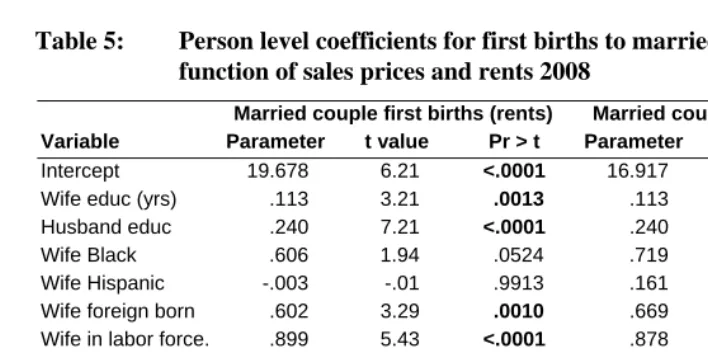
To further explore the relationship between housing costs and delayed fertility I examine individual level data for first births in married couple households for all 25 metropolitan areas. I use variables that have already been the focus of the place effects investigation- education, ethnicity and labor force participation and add to those specific measures of wife’s years of education, husband’s years of education, wife’s race and ethnicity, foreign born or native and tenure. For metro areas the models include percent with college education, log of family income, and rents and sales for the respective metropolitan area.
Table 5: Person level coefficients for first births to married couples as a function of sales prices and rents 2008
Married couple first births (rents) Married couple first births (sales) Variable Parameter t value Pr > t Parameter t value Pr > t
Intercept 19.678 6.21 <.0001 16.917 5.44 <.0001
Wife educ (yrs) .113 3.21 .0013 .113 3.22 .0013
Husband educ .240 7.21 <.0001 .240 7.21 <.0001
Wife Black .606 1.94 .0524 .719 2.29 .0219
Wife Hispanic -.003 -.01 .9913 .161 .69 .4878 Wife foreign born .602 3.29 .0010 .669 3.66 .0003
Wife in labor force. .899 5.43 <.0001 .878 5.30 <.0001
Own home 2.573 15.04 <.0001 2.634 15.30 <.0001
% college .065 2.64 .0084 .031 1.20 .2317
Metro family Inc. -.635 -.70 .4851 .802 .93 .3522 Rents/Sales .004 7.71 <.0001 .005 6.37 <.0001
Adj.R2 .16 .17
7. Completed fertility
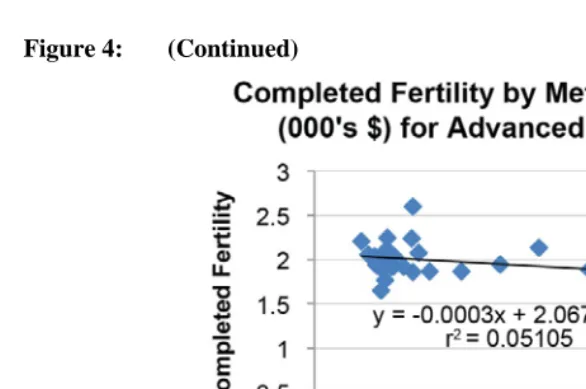
The Simon and Timura (2009) study suggested that not only is fertility delayed in high cost housing markets, but that the total number of births is smaller in these housing markets. They find that there is a modest decline in completed fertility in more expensive housing markets. It has not been possible to confirm that finding in this study. The analysis of sales and completed fertility and rents and completed fertility is not significant (Figure 4). While there is a slight positive relationship for completed fertility and completed fertility for those with only high school education, both college education and advanced education levels are slightly negative though statistically insignificant. It would be a stretch to suggest then, based on this data, that completed fertility declines with increased housing costs. This raises a conundrum. There is modest evidence that fertility is delayed in the most expensive housing markets but that it is not creating an aggregate response of total decreased fertility.
Figure 4: (Continued)
8. Observations and conclusions
The recent rise and fall in housing prices in the U.S. has refocused attention on the issue of how the housing market intersects with the life course. Part of that attention has looked again at how families negotiate the difficult issues of family formation, labor market participation and housing careers. The results in this paper can be interpreted as a response to very expensive housing markets. Clearly, in those markets the age at first birth for married couples is significantly higher than for married couples in less expensive housing markets. At the same time, it is also clear that these expensive housing markets contain large proportions of college-educated households, especially those with women holding advanced degrees, when there is a much later age at first birth. It is these women who are delaying fertility, and we can see the outcome as an outcome in expensive housing markets. We can also see the outcome as a selection effect of the concentration of highly educated households in selected housing markets where, in turn, higher family incomes can be translated into higher housing prices and higher rents.
housing markets in the age at first birth. We can suggest that high cost housing markets create a threshold for fertility behavior.
The individual affects analysis provided new data, but data that was similar to other studies of the relationship of fertility. However, the research can be used to make three important points. First, the overall adjusted R2 values are quite modest in this study and in other studies, which suggests that there is considerable variability in the behavioral response to the cost of housing. It is one of the variables that enter into the matrix of calculation for households but it is one which has considerable variance built into it. Second, the introduction of tenure emphasizes the importance of the housing career in the process of fertility behavior. Those households who choose to live in expensive housing markets and also choose to enter the homeowner market are facing additional difficulties in their life course decisions. Finally, it is important to reiterate the confluence of circumstances which occur in a few expensive housing markets in which there is a concentration of populations with advanced degrees, high family incomes and high housing costs. It is in these markets that the threshold for fertility has been raised.
Nevertheless, this study could not find evidence of significantly lower completed fertility in those markets. From this study it does not appear that completed fertility is being affected by the later age at first birth. For now at least, women who have delayed fertility are still able to complete their fertility expectations, or, expressed differently, they match the average fertility outcomes of the nation as a whole. Further research can examine this issue by looking at the time span between the births of children. It is possible that the time between births may be shorter but this will require panel data on births.
9. Acknowledgements
References
Blossfeld, H.-P. and Hofmeister, H. (2006). Globalization, Uncertainty, and Women’s Careers: An International Comparison. Cheltenham: Edward Elgar.
Börsch-Supan, A. (1986). Household formation, housing prices and public policy impacts. Journal of Public Economics 30(2): 145-164. doi:10.1016/ 0047-2727(86)90042-3.
Burch, T.K. (1996). Icons, straw men and precision: Reflections on demographic theories of fertility decline. The Sociological Quarterly 37(1): 55-81. doi:10.1111/j.1533-8525.1996.tb02331.x.
Clark, W.A.V. and Davies Withers, S. (2002). Disentangling the interaction of migration, mobility and labor-force participation. Environment and Planning A 34(5): 923-945. doi:10.1068/a34216.
Clark, W.A.V. and Davies Withers, S. (2007). Family migration and mobility sequences in the United States: Spatial mobility in the context of the life course. Demographic Research 17(20): 591-622. doi:10.4054/DemRes.2007.17.20.
Clark, W.A.V. and Davies Withers, S. (2009). Fertility, mobility and labor-force participation: A study of synchronicity. Population, Space and Place 15(4): 305-321. doi:10.1002/psp.555.
Clark, W.A.V. and Mulder, C.H. (2000). Leaving home and entering the housing market. Environment and Planning A 32(9): 1657-1671. doi:10.1068/a3315.
Clark, W.A.V. and Onaka, J.L. (1983). Life cycle and housing adjustment as explanations of residential mobility. Urban Studies 20(1): 47-57. doi:10.1080/713703176.
Costa, D.L. and Kahn, M.E. (2000). Power couples: Changes in the locational choice of the college educated, 1940-1990. Quarterly Journal of Economics 115(4): 1287-1315. doi:10.1162/003355300555079.
Courgeau, D. and Lelièvre, É. (1996). Changement de paradigme en démographie. Population (French Edition) 51(3): 645-654. doi:10.2307/1534487.
Dykstra, P.A. and Wagner, M. (2007). Pathways to childlessness and late-life outcomes. Journal of Family Issues 28(11): 1487-1517. doi:10.1177/ 0192513X07303879.
Easterlin, R.A. and Crimmins, E.M. (1985). The Fertility Revolution: A Supply Demand Analysis. Chicago: University of Chicago Press.
Edin, K. and Kefalas, M. (2005). Promises I Can Keep. Why Poor Women Put Motherhood Before Marriage. Berkeley: University of California Press.
Edin, K. and Reed, J. (2005). Why don’t they just get married? Barriers to marriage amongst the disadvantaged. The Future of Children 15(2): 117-137. doi:10.1353/foc.2005.0017.
Enström Öst, C. (2011). Housing and children: Simultaneous decisions? – A cohort study of young adults' housing and family formation decision. Journal of Population Economics 25(1): 349-366. doi:10.1007/s00148-010-0345-5.
Ermisch, J. (1999). Prices, parents, and young people’s household formation. Journal of Urban Economics 45(1): 47-71. doi:10.1006/juec.1998.2083.
Ermisch, J. and Di Salvo, P. (1997). The economic determinants of young people’s household formation. Economica 64(256): 627-644. doi:10.1111/1468-0335. 00103.
Feijten, P. and Mulder, C.H. (2002). The timing of household events and housing events in the Netherlands: A Longitudinal Perspective. Housing Studies 17(5): 773-792. doi:10.1080/0267303022000009808.
Fortin, M. (1995). Allocation inflexibilities, female labor supply, and housing assets accumulation: Are women working to pay the mortgage? Journal of Labor Economics 13(3): 524-557. doi:10.1086/298384.
Hakim, C. (2003). Models of the Family in Modern Societies: Ideals and Realities. Aldershot: Ashgate.
Haurin, D.R., Hendershott, P.H., and Kim, D. (1993). The impact of real rents and wages on household formation. Review of Economics and Statistics 75(2): 284-293. doi:10.2307/2109434.
Haveman, R. and Wolfe, B. (1994). Succeeding generations: On the effects of investments in children. New York: Russell Sage Foundation.
Kulu, H. (2008). Fertility and spatial mobility in the life course: Evidence from Austria. Environment and Planning A 40(3): 632-652.
Kulu, H. and Milewski, N. (2007). Family change and migration in the life course: An introduction. Demographic Research 17(19): 567-590. doi:10.4054/ DemRes.2007.17.19.
Kulu, H. and Vikat, A. (2007). Fertility differences by housing type: The effect of housing conditions or of selective moves? Demographic Research 17(26): 775-802. doi:10.4054/DemRes.2007.17.26.
Lauster, N.T. (2006). A room of one’s own or room enough for two? Access to housing and new household formation in Sweden, 1968–1992. Population Research and Policy Review 25(4): 329-351. doi:10.1007/s11113-006-9000-y.
LeClere, F.B. and McLaughlin, D.K. (1997). Family migration and changes in women's earnings: A decomposition analysis. Population Research and Policy Review 16(4): 315-335. doi:10.1023/A:1005781706454.
Lesthaeghe, R. and Neels, K. (2002). From the first to the second demographic transition: An interpretation of the spatial continuity of demographic innovation in France, Belgium and Switzerland. European Journal of Population 18(4): 325-360. doi:10.1023/A:1021125800070.
Lutz, W. and Skirbekk, V. (2005). Policies addressing the tempo effect in low-fertility countries. Population and Development Review 31(4): 699-720. doi:10.1111/ j.1728-4457.2005.00094.x.
Martin, S.P. (2004). Women’s education and family timing: Outcomes and trends associated with age at marriage and first birth. In: Neckerman, K.M. (ed.). Social Inequality. New York: Russell Sage Foundation: 79-119.
Michielin, F. and Mulder, C.H. (2008). Family events and the residential mobility of couples. Environment and Planning A 40(11): 2770-2790. doi:10.1068/a39374.
Mills, M. and Blossfeld, H.-P. (2003). Globalization, uncertainty and changes in early life courses. Zeitschrift für Erziehungswissenschaft 6(2): 188-218. doi:10.1007/s11618-003-0023-4.
Mulder, C.H. (2006). Home-ownership and family formation. Journal of Housing and the Built Environment 21(3): 281-298. doi:10.1007/s10901-006-9050-9.
Mulder, C.H. and Wagner, M. (1993). Migration and marriage in the life course: A method for studying synchronized events. European Journal of Population 9(1): 55-76. doi:10.1007/BF01267901.
Mulder, C.H. and Wagner, M. (1998). First-time home-ownership in the family life course: A West German-Dutch comparison. Urban Studies 35(4): 687-713. doi:10.1080/0042098984709.
Plane, D.A., Henrie, C.J., and Perry, M.J. (2005). Migration up and down the urban hierarchy and across the life course. PNAS 102(43): 15313-15318. doi:10.1073/pnas.0507312102.
Sato, Y. (2007). Economic geography, fertility and migration. Journal of Urban Economics 61(2): 372-387. doi:10.1016/j.jue.2006.08.002.
Simon, C.J. and Tamura, R. (2009). Do higher rents discourage fertility? Evidence from U.S. cities, 1940-2000. Regional Science and Urban Economics 39(1): 33-42. doi:10.1016/j.regsciurbeco.2008.08.002.
Skaburskis, A. (1997). Gender differences in housing demand. Urban Studies 34(2): 275-320. doi:10.1080/0042098976186.
Strom, S. (2010). Housing and first births in Sweden, 1972-2005. Housing Studies 25(4): 509-526. doi:10.1080/02673031003711519.