University of New Orleans University of New Orleans
ScholarWorks@UNO
ScholarWorks@UNO
University of New Orleans Theses and
Dissertations Dissertations and Theses
Fall 12-17-2011
A Study of Organizational Structures Impacting Noncredit
A Study of Organizational Structures Impacting Noncredit
Workforce Education and their Effects on Determining Workforce
Workforce Education and their Effects on Determining Workforce
Development Strategies in Louisiana's Community and Technical
Development Strategies in Louisiana's Community and Technical
Colleges
Colleges
William S. Wainwright
University of New Orleans, [email protected]
Follow this and additional works at: https://scholarworks.uno.edu/td
Part of the Community College Leadership Commons, and the Educational Assessment, Evaluation, and Research Commons
Recommended Citation Recommended Citation
Wainwright, William S., "A Study of Organizational Structures Impacting Noncredit Workforce Education and their Effects on Determining Workforce Development Strategies in Louisiana's Community and Technical Colleges" (2011). University of New Orleans Theses and Dissertations. 1350.
https://scholarworks.uno.edu/td/1350
This Dissertation is protected by copyright and/or related rights. It has been brought to you by ScholarWorks@UNO with permission from the rights-holder(s). You are free to use this Dissertation in any way that is permitted by the copyright and related rights legislation that applies to your use. For other uses you need to obtain permission from the rights-holder(s) directly, unless additional rights are indicated by a Creative Commons license in the record and/ or on the work itself.
A Study of Organizational Structures Impacting Noncredit Workforce Education and their Effects on Determining Workforce Development Strategies
in Louisiana‟s Community and Technical Colleges
Dissertation
Submitted to the Graduate Faculty of the University of New Orleans in partial fulfillment of the requirements of the degree of
Doctor of Philosophy in
Educational Administration
By
William S. Wainwright
B.S., University of Louisiana Lafayette, 1995 M. Ed., Northwestern State University, 1998
ii
TABLE OF CONTENTS
LIST OF FIGURES ...v
LIST OF TABLES ...vi
ABSTRACT ...vii
Chapter 1 Introduction Noncredit Enrollment Trends ...2
The Role of Decision Making and Organizational Structure in Noncredit Education ....3
Funding Formula and the LCTCS...7
Statement of the Problem ...9
Significance of the Study ...11
Research Questions ...14
Delimitations and Limitations of the Study ...15
Summary ...17
Chapter 2 Literature Review Introduction ...19
Noncredit Education Evolution of Noncredit Education ...20
Value of Noncredit Education ...23
Noncredit Education as a Local Economic Factor ...25
Accounting for Noncredit Education ...26
Role of Faculty in Noncredit Education ...28
Purpose of Noncredit Education ...30
A Description of Adult Learners as Noncredit Education Students ...31
Organizational Structure ...33
Decision Making Theory ...42
Current Role of Noncredit Workforce Education ...46
Funding Formula Overview ...50
Georgia & Texas: A Comparative Analysis ...51
Implications of Noncredit Education and Research ...54
Summary ...56
Chapter 3 Methodology Purpose ...59
Research Questions ...59
Pilot Study ...59
Conceptual Framework ...60
iii
Case Study ...63
Selection of Participants ...66
Research Setting...67
College Profiles ...68
College 1 ...68
College 2 ...69
College 3 ...70
College 4 ...72
Qualitative Design ...73
Role of Researcher ...75
Gaining Entry ...77
Collection of Data ...78
Data Analysis ...81
Interpretation of Data ...82
Summary ...84
Chapter 4 Findings Identification of Themes ...87
Relationships as a Means of Establishing Credibility...88
At the college level ...88
At the administrative level ...91
At the business and industry level ...92
Decentralized Structure as a Characteristic of Noncredit Education ...94
Institutional Conflict in Meeting the Needs of Stakeholders ...102
Summary ...109
Chapter 5 Discussion Analysis and Discussion ...111
The Noncredit Education Dilemma ...113
The Essence of Decision Making ...114
Structuring the Organization ...121
Answering the Research Question ...130
How does existing state policy on formula funding impact noncredit workforce education strategies within colleges? ...134
How are noncredit workforce education divisions organized within colleges? ..135
How do college leaders reconcile workforce training demand with existing organizational structures and current policy for higher education institutions? ..136
iv
What‟s at Stake? ...138
Implications & Further Study ...139
Conclusions ...141
REFERENCES ...144
APPENDICES Appendix A – Informed Consent ... ..151
Appendix B – Introduction Letter to Participants ... ..153
Appendix C – Gate Keeper Letter & Consent ... ..154
Appendix D – Interview Questions... ..155
Appendix E – IRB Approval... ..157
v
List of Figures
vi
List of Tables
vii
ABSTRACT
The Lumina Foundation (2007) indicates that 54 million adults in the workforce are seeking
noncredit education opportunities in a credit course/program delivery system designed to meet the
needs of traditional college students. Working adults seeking continuing education coupled with
dislocated workers as a result of changing economic situations represents this growing population.
Community and technical colleges in Louisiana benefit from a for-credit formula funding model
and do not benefit from a formula funding mechanism that supports noncredit education
enrollments. As Louisiana‟s community and technical colleges face continuous budget challenges
resulting from economic recession, college leaders are making critical decisions in restructuring
college business models. These models are becoming increasingly important as they support
increased revenues and sustainable ventures that will carry the college through difficult times.
The significance of this study and contributions associated with findings provide important
insights into decision making, organizational change, and policy factors considered in determining
workforce development strategies. Utilizing Multiple Criteria Decision Making by (Zeleny) 1981 in
addition to Mintzberg‟s Five Basic Parts of an organization (1979) as a conceptual framework,
causes and effects of decision making on organizational structures and workforce development
strategies were examined and analyzed providing insight and recommendations for future
consideration. Findings in this study suggest that as organizational structures are challenged due to
simultaneous issues related to economic recovery and reduced budgets, noncredit education is
impacting strategic decision making by college leaders evidenced by current college reorganization
efforts, joint credit and noncredit curriculum development activities, and innovation associated with
enhanced workforce development strategies.
1
Chapter 1 Introduction
Noncredit education enrollments are rising and higher education institutions are taking
notice (Boggs, 2004). Van Noy (2008) suggests that the primary response to noncredit
enrollment growth over the last several years is attributed to workforce training and education.
Surges in noncredit enrollments are resulting in the potential for increased revenues and
heightened awareness of the role, scope, and mission of colleges and universities. Industry
demand, diverse occupations, and an employment culture that lends itself to multiple job changes
for individuals are only a few of the economic conditions fueling the increase in noncredit
education enrollments (Boggs). These economic conditions coupled with increasing noncredit
enrollments, have positioned Louisiana‟s community and technical colleges to play a pivotal role
in expanding noncredit workforce training to address business and industry needs within
organizational structures designed to support for credit education. In addition, colleges struggle
to sustain noncredit education without formula funding policy and related data to document
success at meeting the training needs of the workforce.
Current Louisiana state funding mechanisms do not support funding for noncredit
workforce education. However, demand for noncredit workforce training continues to increase
while organizational structures are challenged to respond to environmental changes related to
economic recession. Organizational change in most cases is a result of a series of processes
directly attributed to college environment rather than resulting from innovation or effective
organizational planning and structure (March, 1981). In response to increasing demand for
noncredit workforce education as evidenced by increases in noncredit safety training within
Louisiana‟s community and technical colleges, sustainable financial mechanisms supportive of
2
technical colleges and prompt corresponding changes in organizational structures while
supporting the economy of the State of Louisiana.
Noncredit workforce education course offerings vary from leisure learning to industry-
based certifications necessary for continued employment or increased employability skills.
Noncredit workforce education is defined as a course or series of courses that support industry
demand such as industry-based certifications or entry-level training, and do not carry credit
applicable to a two or four year degree (Van Noy, 2008). For the purposes of this study,
noncredit workforce education is differentiated from contract training or customized training
which includes either credit or noncredit training and is developed under a specific set of terms
and conditions mutually agreed upon by the institution and employer.
Noncredit Enrollment Trends
According to the National Center for Educational Statistics (1998) noncredit enrollment
increased 90% in 1995 and continued to increase to exceed credit enrollment by 8% in 1999.
Due to varying tracking systems accounting for noncredit education, it is difficult to determine
the scale of the most recent increases in noncredit enrollment (Van Noy, 2008). The growth of
noncredit education enrollment to a level that surpasses credit courses suggests the importance of
noncredit education in serving a specific training need. The Lumina Foundation (2007) indicates
that there are 54 million working adults seeking continuing and/or noncredit education in a
postsecondary system structure that is designed around the traditional college student. For
example, admissions processes for traditional students require transcripts whereas for noncredit
enrollment, prior academic performance may not be required for admission to the college. With
continued increases in enrollment and demand for noncredit training courses, higher education
3
responding to shifts in local and regional economies. This circumstance may lead to challenges
within the college organizational structure related to existing policy and procedure centered on
credit enrollment for the traditional college student. Processes designed for traditional credit
college coursework such as admissions, teaching methodology, and tuition and fee structure are
challenged when noncredit education students enroll within a system solely designed for credit
enrolled students. For example, elements within an academic program application for credit may
require additional information such as course transcripts as opposed to a short-term noncredit
course where there is no qualifying admissions requirement.
The Role of Decision Making and Organizational Structure in Noncredit Education
Weick (1976) describes „loose coupling‟ within the organization as follows: “Loose
coupling is evident when elements affect each other suddenly (rather than constantly), negligibly
(rather than significantly), indirectly (rather than directly), and eventually (rather than
immediately)” (Weick, 1982, p. 380). For example, rapidly expanding economies leading to job
loss or job creation places demands on existing policies and challenge processes within colleges
related to noncredit workforce education. As colleges implement noncredit workforce training
strategies within existing bureaucracies and departments to meet demands for training,
organizational structures are impacted both directly and indirectly leading to unpredictable
outcomes.
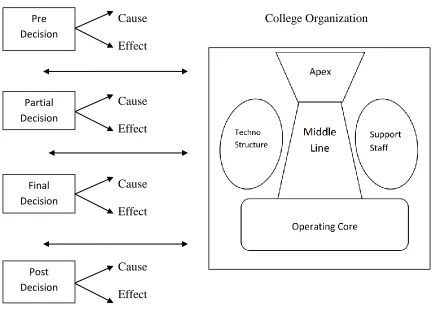
Multiple Criteria Decision Making, by Zeleny (1981), identifies a four stage process for
decision making that begins with two approaches: one that is “outcome oriented” and one that is
“process oriented.” The outcome oriented approach identifies an end result at the front of the
decision making process. For example, established college strategic planning outcomes that
4
oriented approaches focus on how decisions are made in order to determine outcomes. For
example, executing noncredit workforce training strategies based on an established cost recovery
model represents a process oriented approach. This challenge requires the establishment of
processes outside of traditional college policies necessary to secure adequate funding to support
noncredit workforce training. These two approaches support a four stage process of decision
making encompassing Predecision, Partial Decisions, Final Decision, and Postdecision.
Zeleny (1981) suggests that “conflict” guides predecision and fosters “decision
motivating tension” guiding the decision maker to identify alternatives creating new ideas and
solutions. In relation to noncredit education, workforce training strategies such as customized
training efforts to meet the needs of business and industry requiring alterations to existing
curriculum would serve as an example of “conflict” leading to discovery of alternatives to satisfy
desired outcomes. For example, while existing curriculum may contribute to the building of
noncredit courses, additional course development may be necessary to satisfy desired outcomes
of business and industry. Evaluation of predecision outcomes lead to partial decision in which
desired outcomes and established alternatives are assessed to determine effective solutions. The
transparency associated with this process is key to managing conflict in the decision making
process. For example, inclusion of academic and workforce development staff in the curriculum
development process structured to meet an established customized training request will lessen
conflict as the final decision emerges. Consensus building and acknowledgement of all factors
associated with alternatives presented represents final decision. At this point, the decision maker
has demonstrated an outcome that represents all alternatives for consideration. For example, new
policy centered on standard operating procedures reflective of a culmination of alternatives and
5
represents the final decision stage. Post-decision represents the process of evaluating outcomes
of the final decision and determining additional factors that may enhance the final decision.
Post-decision regret accounts for the process of determining how Post-decisions could have been made
differently.
All four stages present a complex series of actions that guide the decision maker in
deducing viable strategies leading to a final decision. Implementation of the final decision
provides an evaluation assessment that guides the decision maker in identifying modifications to
ensure optimal success. In this study, Multiple Decision Making by Zeleny (1981) will be used
as a foundation to analyze institutions with emphasis on decision making practices by college
leaders and the implications for organizational structure impacting workforce development
strategies. An evaluation and analysis of Multiple Decision Making Criteria will provide the
mechanism to dissect and analyze noncredit education in Louisiana‟s Community and Technical
Colleges.
With recent changes in the formula funding implementation for strictly credit
coursework, higher education institutions in Louisiana will be required to respond with sudden
shifts in organizational structure while managing budget reductions as a result of deteriorating
economic conditions. These considerations lead to decision-making practices that influence all
levels within the organization and foster changes in how colleges meet the workforce training
needs of business and industry. Multiple Criteria Decision Making (Zeleny, 1981) will provide a
framework for determining how each college leader participating in this study makes decisions
and organizes the college as it relates to noncredit education and the resulting effect on
workforce strategies within community and technical colleges. Critical decisions supporting
6
enrollment trends, and in implementing workforce development strategies. Particularly within
rapidly changing environments, structures within the college become a central focus in
effectively executing noncredit workforce training activities.
Mintzberg (1979) defines structure as a division of labor within an organization with
specified tasks that are coordinated among divisions. Mintzberg also suggests that coordination
and standardization of practices are fueled by formal and informal communication. At the core of
his research is the framework of the five basic parts of an organization. Mintzberg illustrates his
model beginning with the strategic apex.
The illustration shows a small strategic apex connected by a flaring middle line to
a large, flat operating core. These three parts of the organization are shown in the
uninterrupted sequence to indicate that they are typically connected through a
single line of formal authority. The technostructure and the support staff are
shown off to either side to indicate that they are separate from this main line of
authority, and influence the operating core only indirectly (Mintzberg, 1979, p.
20).
Apex
Middle Line
Operating Core
Support Staff
7
Figure 1. Five Basic Parts of an Organization (Mintzberg, 1979)
Mintzberg‟s (1979) organizational theory provides important groundwork from which to
launch this study. The application of Mintzberg‟s five basic parts of an organization provides a
framework for analysis of the administration of noncredit education programs and will provide
critical insight into decision making as it relates to structuring an organization supportive of
delivering noncredit education. Understanding the decision making practices of college leaders
tied to organizational structures and the coordination efforts of workforce development divisions
will enhance the ability of those institutions to respond to business and industry needs and to
increase existing knowledge to formulate noncredit workforce education funding policy
considerations and sustainability of workforce development strategies.
Funding Formula and the Louisiana Community and Technical College System
“The mission of the Louisiana Community and Technical College System (LCTCS) is to
prepare Louisiana‟s citizens for improved quality of life, workforce success, and continued
learning” (LCTCS Website, 2008). By design, flexible courses are necessary for a diverse credit
and noncredit delivery system supported by Louisiana‟s community and technical colleges. As
Louisiana‟s community and technical colleges continue to evolve, the creation of traditional
credit course offerings becomes difficult when coupled with the need to design flexible
curriculum to meet the needs of business and industry. Current formula funding policy does not
account for noncredit workforce education through a noncredit formula funding model. This
occurrence can lead to challenges in organizational structures as they relate to the areas of
curriculum development and processes associated with sustaining workforce strategies. This
circumstance necessitates the consideration of alternative funding strategies in order to address
8
supports industry funding of noncredit education, such revenues are often unpredictable and only
cover the variable costs associated with training.
Formula funding policy is defined as funding based on an established set of criteria
designated by the Louisiana Board of Regents; the coordinating body for Louisiana‟s higher
education institutions (BOR Website, 2010). This definition is not exclusive to Louisiana. From
a national perspective, the development of appropriation requests for college and university
funding formula calculations often vary by state and are determined by enrollment trends,
programming, and demands that support continued growth of the institution. As the name
implies, formula budgeting funding is the application of one or more formulas in the budgeting
process (Caruthers and Orwig, 1979). With the implementation of a formula funding model,
advantages and disadvantages emerge. Advantages include a defined parameter for equity in
distribution of funds and the process of prescribed decisions that remove politics from the
process. Disadvantages include the lack of qualitative data incorporated into funding formula
models. (Paulsen and Smart, 2001).
The Louisiana Community and Technical College System currently funds credit courses
through a performance based formula. The formula recognizes credit enrollment growth in high
demand occupations as defined by the Louisiana Workforce Commission and is based on a
weighted model that accounts for enrollment in high demand occupations such as nursing.
Though not fully implemented in 2009-2010, the formula was applied in a one-third; two-thirds
ratio. One-third of the formula was based on the performance components and two-thirds of the
formula was based on a pro-rata share of the State General Fund (SGF). The two-thirds funding
included primarily Full Time Equivalents (FTE) generated by the college and the application of a
9
formula funding model for Louisiana is important as it helps to frame the context of the problem
for this study.
Statement of the Problem
Louisiana's Community and Technical Colleges are charged with the task of developing
and implementing strategies that directly address the state‟s workforce needs. Exploring all
mechanisms by which to provide trained workers is imperative for the state to attract new
industry. Both credit and noncredit training policies impact opportunities for meeting business
and industry needs. Louisiana currently does not have a noncredit formula funding
policy. Policy revisions which allow for support of noncredit education would enable
Louisiana‟s community and technical colleges to carefully align organizational structures with
funding mechanisms leading the college to establish a clear vision of its credit and noncredit
workforce education divisions. As it exists today, noncredit workforce education delivery
mechanisms place higher education institutions in a position of extreme instability with regard to
consistent funding structures that directly support the needs of business and industry. The
purpose of this study is to investigate organizational structures used by college leaders to make
decisions affecting noncredit education and how these decisions impact workforce development
strategies in Louisiana‟s Community and Technical Colleges.
Louisiana‟s higher education system provides a formula funding mechanism based on
performance and related student full-time equivalent (FTE) that does not take into account
noncredit activities. The formula funding structure only accounts for students enrolled in credit
coursework. As prescribed by the LCTCS mission statement, college leaders are required to
address business and industry needs and often do so through noncredit offerings. Additionally,
10
honors credit enrollment only. This funding mechanism drives the development of organizational
structures and institutional responses that may or may not align with the college mission. For
example, noncredit courses must generate sufficient revenue to address all expenses related to
the course. Typically, this method of funding causes noncredit courses to be more expensive and
may prohibit enrollment by some who can ill afford higher tuition. Additionally, since the
college is not funded for noncredit courses some courses do not occur because insufficient
revenue is generated from tuition and the campus cannot provide training at a deficit. The
development of a sustainable funding structure that supports noncredit education may be critical
to serving the mission of the college and meeting the workforce training demands of the state.
Students enrolled in noncredit courses are primarily served through workforce
development divisions within colleges. These divisions, often referred to as enterprises, are
sustained through restricted funds that are generated from revenues over expenses. According to
Van Noy et.al., (2008) funding of noncredit workforce education nationally is accomplished
through models that are based on a formula centered on contact hours, consolidated funds, and
utilization of funding strategies that support college discretion. These funding strategies are
based on the concept of excess revenue over expense. Only noncredit courses that generate
sufficient revenue to cover expenses are considered for delivery. This differs from the traditional
formula funding policy. The traditional policy will support credit courses even without excess
revenue over expense in the short term with the promise of future revenue generated from FTE‟s.
Because Louisiana does not currently have a formula funding structure for noncredit
workforce education, colleges facilitate partnerships with business and industry when possible
and align credit courses with industry training needs to ensure a sustainable investment in the
11
community and technical colleges to address workforce training needs, the issue is that
partnerships are often not formalized, fluctuate with economic conditions, are cumbersome, and
require long lead time from course development to implementation. To effectively meet the
needs of business and industry, training demand should be addressed quickly and efficiently.
Current organizational structures supporting the noncredit workforce education delivery
system in Louisiana‟s Community and Technical Colleges vary in levels of development.
Funding priorities by college leaders have sustained some noncredit education efforts. This
variance in approach to delivering noncredit education implies a reduced status in the minds of
policy makers as unimportant relative to for-credit education. Efforts by Louisiana‟s Governor
to draw attention to the need for a better prepared Louisiana workforce have led to policy
adjustments that impact credit courses but the adjustments have not been adequate to include
issues related to noncredit education courses.
Significance of the Study
Economic uncertainty has placed higher education institutions in positions of extreme
instability as enrollments rise due to unemployment and budgets decline.
Over the past four to five years, state and national economies have trembled from
the shock and aftershock of major businesses and industries cutting back, closing
down, and moving operations offshore. Hoards of dislocated workers exist while
struggling employers are frustrated by shortages of skilled workers needed to
sustain and grow businesses. At the same time, higher education institutions have
seen their budgets slashed and have been forced to downsize faculty and staff
12
These shortfalls also negatively impact credit course offerings as their funding is derived directly
from the state. The uncertainty of traditional funding further complicates the financial
environment thus making the ability to meet the demand for noncredit courses even more
tenuous. The willingness of the institution to attempt an unsupported venture is further
diminished during difficult economic times. This uncertainty leaves community and technical
college organizational structures challenged to sustain critical workforce training efforts that
meet the needs of local and regional economies trying to recover from economic crisis.
As organizational structures are challenged due to simultaneous issues related to
economic recovery and reduced budgets, strategic decision making by college leaders will
become critical for survival. Noncredit workforce education funding decisions will result in
institutional responses that may have an unintentional impact on organizational structure.
Institutional response may include: offering courses that are inexpensive and do not generate
revenue such as income tax filing or private investigation training, deferring courses that are
requested by industry because a certain number of students would need to enroll to break even,
or outsourcing training to private entities to ensure the needs of local business and industry
partners are met without incurring liability.
An additional challenge to funding noncredit education is that colleges continue to
struggle with communicating the potential positive results of noncredit workforce education on
local economies.
It is very difficult to measure the economic impact of community colleges without
a way to measure the amount and types of noncredit activities. Community
13
demonstrate how they successfully meet the needs of business and industry and
serve their communities (Phillippe, 2003, p. 7).
The current data systems utilized by community and technical colleges in Louisiana
account for noncredit education differently than credit courses and in some cases do not account
for noncredit activity at all. Future considerations for noncredit workforce education include
efforts to improve common reporting by colleges that will provide consistent outcomes thus
illustrating the positive impacts of noncredit education for colleges and communities.
Community and technical colleges struggle to articulate the positive impact of noncredit
workforce education as a result of varying success metrics used in reporting data. Accounting for
noncredit workforce education is integral to a funding mechanism based on performance.
Performance based funding is the cornerstone of credit courses and likely should be considered a
criterion for funding noncredit courses. The lack of data is not uncommon to community and
technical colleges in Louisiana. The problem is related to college data systems designed to
capture data on credit activity only. A college data system that captures both credit and noncredit
enrollment activities would serve as a mechanism to measure enrollment trends and guide
colleges in decision making related to mission. Noncredit workforce education divisions are
working within existing credit data systems that do not offer the flexibility of capturing unique
data sets that provide clear reportable outcomes.
Voorhees and Milam (2005) point out that the design of credit data systems are not
accommodating to the flexibility required by noncredit programs. For example, most credit data
systems report by “class” rather than “individual unit systems” needed to accurately report
noncredit workforce education outcomes. In addition, Van Noy et.al., (2008) reports that
14
undocumented immigrants, home grown data systems that are paper driven and inefficient, and
the nature of noncredit workforce education programs where program entry is fluid. Though
these issues make a funding formula for noncredit courses more challenging, it does not diminish
the need or importance of noncredit courses at addressing business and industry needs, nor does
it diminish the necessity to address the issue at all levels to seek a solution. Accounting for the
impact of noncredit workforce education will play a critical role in decision making by college
leaders impacting organizational structures as they determine the effectiveness and sustainability
of workforce development divisions.
Budget shortfalls and increased workforce training demand influence noncredit
workforce development strategies impacting organizational structures in higher education
institutions. “As noncredit workforce education evolves, it is creating organizational changes
within the community college that reflect its importance and its likely influence on the content of
credit programs” (Van Noy, et.al., 2008, p. 18). Noncredit course content dictated by business
and industry needs determines the organizational structure for administration of noncredit
education and provides the impetus for researching organizational structures impacting noncredit
education and the effects on determining workforce development strategies in Louisiana‟s
community and technical colleges.
Research Questions
Research questions that will guide this study focus on organizational structures associated
with noncredit education funding and the impact on determining workforce development
strategies in Louisiana‟s community and technical colleges. The primary question in the study is
How do college leaders make decisions on college organizational structures to address noncredit
15
policy on formula funding impact noncredit workforce education strategies within colleges? 2)
how are noncredit workforce education divisions organized within colleges? 3) how do college
leaders reconcile workforce training demand with existing organizational structures and current
funding policy for higher education institutions?
It will be important to document community and technical colleges as units of analysis
and utilize qualitative data displays to study how colleges determine credit and noncredit
offerings within institutions. An analysis of course offerings as a direct result of funding
potential will provide insight into the decision making process. In addition, the use of decision
making theory will aid in the translation of actions of college leaders in response to a growing
dilemma of how to fund noncredit education in light of the increasing demand and decreasing
budgets. A formal literature review will begin with a thorough overview of past and present
studies on noncredit workforce training. Theory on organizational structure and decision making
practices will be linked by literature to illustrate the implications of these structures and practices
on decisions affecting noncredit education programs. A comparative analysis will illustrate how
the Texas and Georgia higher education systems are structured under existing formula funding
policy for noncredit workforce education in comparison to Louisiana. The review of literature
will conclude with implications for theory and practice with discussion to identify future
considerations for a formal policy and structure for noncredit workforce education for the State
of Louisiana.
Delimitations and Limitations of the Study
A case study will serve as the primary method for conducting fieldwork to explore the
impact of noncredit education on funding, organizational structure, and decision making by
16
„complexities‟ of an activity or activities of a „single‟ event. Initially, this case study focused on
carefully constructed interviews of college leaders and workforce development directors to
establish an exploratory research foundation centered on decision making practices by college
leaders and an understanding of existing organizational structures. In an effort to identify
delimitations, it was important to determine relevant aspects of the limitations from the onset of
the study.
The availability of quantitative data illustrating the historical impact of noncredit
education is minimal. As a result, college leaders may be reluctant to discuss specific planning
and funding strategies tied to success or failure of the workforce training enterprise with the
researcher. In addition, workforce development directors may attempt to communicate anecdotal
data to compensate for lack of numerical data. The success or failure of the workforce
development divisions in providing business and industry training is critical now more than ever
during difficult budgetary circumstances resulting from economic recession. Research will center
on decision making by college leaders, organizational structures, and policies associated with
noncredit education funding and the impact on determining workforce development strategies in
Louisiana‟s community and technical colleges.
According to Creswell (2002) it is often difficult to identify limitations within a
qualitative study before the study has been conducted. While difficult, Creswell suggests that it is
important for researchers to anticipate challenges in the study in an effort to aid in the collection
and analysis of data. Weaknesses anticipated in this study include the rapidly changing financial
landscape for all higher education institutions paralleling instantaneous changes in organizational
structures to accommodate budget realities. In addition, broad generalizations may be limited due
17
capture the changes in organizational structures and decision making by college leaders as it
relates to noncredit workforce education while at the same time similar decisions are being made
for all operations and divisions with the college. Carefully constructed interview questions will
be essential in navigating strategies to limit weaknesses of the study.
Summary
Noncredit workforce education is defined as a course or series of courses which do not
carry credit applicable to a two or four year degree and that support industry demand such as
industry-based certifications or entry-level training (Van Noy, 2008). While recent studies such
as The Landscape of Noncredit Education by Van Noy (2008) and Mapping the Misunderstood
Population of Adult Students by Ashburn (2007) focus on implications of increased noncredit
enrollment growth, there is little research on the overall impact on higher education institutions.
Additional considerations include the lack of research on policy that supports or hinders
noncredit enrollment trends coupled with inadequate formula funding models that lead to
competition among divisions of credit and noncredit education. A research study that focuses on
how these issues impact Louisiana‟s community and technical colleges can result in
recommendations that influence policy development, positive organizational change, and
improved strategies to address workforce development needs. Current budgetary shortfalls
increase the significance in the role of noncredit workforce education as a potential source of
additional revenue now more than ever.
The purpose of this study is to assess decision making by college leaders impacting
organizational structures and policies associated with noncredit education funding and the impact
on determining workforce development strategies in Louisiana‟s community and technical
18
have a profound influence on the long-term effectiveness of the Louisiana Community and
19
Chapter 2 Literature Review
Introduction
Noncredit education is rapidly expanding in community and technical colleges
throughout the country. “More people than ever are taking classes for love or money, but not for
credit” (Burnett, 2001, p. 3). Burnett (2003) discusses the fact that the Lumina Foundation has
invested resources in understanding what is termed the “hidden college.” The premise behind the
“hidden college” is that noncredit students are unaccounted for in colleges across America and
are considered a “misunderstood” population because of limited tracking systems. College
leaders and policy makers are not sure how to deal with them and do not recognize the goals of
noncredit students. Guiding the formal literature review will be the discussion of major studies
provided by the Education Commission of the States, Community College Policy Center,
Lumina Foundation, Community College Research Center, American Association of Community
Colleges and the Ford Foundation. These studies represent the latest research and practice related
to the development of noncredit workforce education in the United States. The literature will
provide an assessment of the context and background information on noncredit education
including: a formal review of literature, a focus on literature to date, an overview of
organizational structure and funding configurations, and decision making theory and research.
Existing literature on noncredit workforce education coupled with relevant theories on
organizational structure and decision making will help to build the foundation upon which
institutional response and decision making by college leaders is based.
Four key bodies of research will focus on the impact of noncredit workforce training
education on workforce development strategies and decision making: First, the evolution of
20
organizational structure and decision making; and finally, an analysis and synthesis of noncredit
workforce education data in Georgia and Texas and a comparison of systems in an effort to
determine the implications of various methods of noncredit education funding. To better
understand role and scope of noncredit education and the impact on determining workforce
development strategies in Louisiana‟s community and technical colleges it is important to
examine higher education systems, funding for credit and noncredit programs, decision making
by college leaders and organizational structures that provide noncredit workforce education.
Texas and Georgia‟s higher education systems, while different in strategic planning and
structure, currently provide noncredit education incentives that guide decisions of college
leaders, whereas the Louisiana system provides little support.
Noncredit Education
The Evolution of Noncredit Education
Community Colleges and the Equity Agenda: The Potential of Noncredit Education by
Grubb, Badway, and Bell (2002) provides a theoretical approach to the role of noncredit
workforce education and the challenges community colleges face in serving a poorly identified
and under-served student population of non-traditional learners. The authors described the role of
the nontraditional learner and the impact of noncredit workforce education on colleges that serve
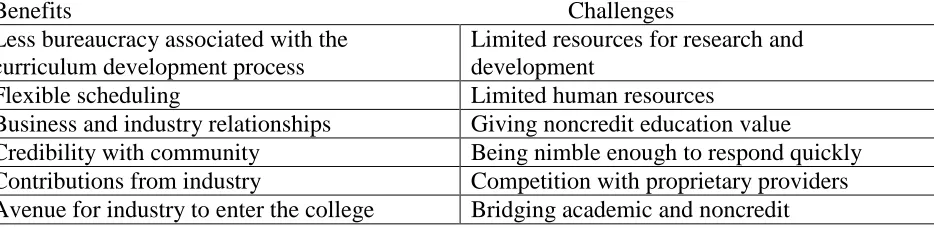
nontraditional learners. Impacts included increased flexibility, employer engagement, serving a
forgotten student population, and decreased bureaucracy. The authors conducted telephone
interviews with directors of noncredit workforce education divisions in 13 community colleges.
They identified challenges for community colleges offering noncredit workforce education.
These include lack of funding, lack of recognition due to inadequate data reporting systems, and
21
and technical colleges to serve both credit and noncredit students in a traditional higher
education organizational structure based on the needs of four-year colleges and universities.
Grubb, Badway, and Bell (2002) identify what is termed “stratification” within higher
education leading to an “inequity” agenda. The stratification is manifested in a hierarchy of
higher education institutions followed by universities with less stringent admissions requirements
followed by community colleges and then workforce training institutions (Grubb, Badway, and
Bell). Noncredit workforce education positioned within the higher education arena represents a
unique form of stratification. The authors also discuss what they term the “dark side” of
noncredit workforce education which is the inadequate funding incentives for those community
colleges that serve noncredit students. As newly developed workforce training legislation is
implemented within Louisiana‟s higher education system, elements of stratification which
currently exist may be brought to the forefront. For example, the current formula funding rate for
developmental education provided by universities is funded at a higher rate than that of
community colleges. It will be critical that Louisiana‟s community and technical colleges
understand the elements of the “inequity agenda” and work closely with universities to build
career pathways that transcript previous credit earned and document certification of skills within
colleges and universities.
Colleges are beginning to recognize the potential for increased enrollment of noncredit
education students into credit programs. Van Noy, et al. (2008) provides evidence of this
emerging trend. Colleges are beginning to recognize “migration” between credit and noncredit
workforce education programs and see a role for noncredit workforce education in recruiting
students for traditional credit programs (Van Noy et.al). Student recruitment and the potential for
22
influence of noncredit workforce education on higher education institutions. Community and
technical colleges in Louisiana are currently structured with noncredit divisions that primarily
focus on meeting the needs of business and industry. Articulation of noncredit to credit course
work is not currently a prevalent practice among community and technical colleges in Louisiana.
Louisiana‟s community and technical colleges have traditionally viewed noncredit
workforce education separately from credit courses and provided limited oversight and
accountability of such efforts. As a result of increasing enrollments in noncredit workforce
education, accrediting bodies are beginning to recognize the value to the institution. Cantor
(2000) articulates the value of noncredit education by noting that the Southern Association of
Colleges and Schools (SACS) has recognized noncredit education as a path for lifelong learners
documented through continuing education credits. This acknowledgement illustrates the
importance of the growing role of noncredit education and the potential need for formula funding
policy that supports workforce training strategies for Louisiana‟s community and technical
colleges.
The impact of noncredit workforce training education on higher education institutions has
benefited from various forms of study. Noncredit enrollment trends provide an understanding of
noncredit students and noncredit workforce training divisions.
Noncredit enrollment trends provided in a 2004 National Study of Continuing
Education include: 54% are enrolled in for credit and 46% in non-credit courses,
noncredit students are more likely than other students to be first generation
college students, more than half were employed full-time, they selected their
programs based primarily on affordability, convenience, and reputation, fewer
23
education divisions, 65% of continuing education divisions made a profit, about a
third of continuing education faculty members had Ph. D‟s, while slightly less
than 10% had not earned a bachelor‟s degree, and few institutions offered child
care to students. (Ashburn, 2007, p. 35)
The results of Ashburn‟s study illustrate a diverse noncredit student population; a situation that
demands change in organizational structure and policy within higher education institutions to
meet diverse needs. Change is not only a result of an expanding student population, but also one
of a complex network of stakeholders made up of business and industry including local chambers
of commerce and economic development authorities that depend on the success of the college in
workforce training.
Value of Noncredit Education
It is important to understand the consequences of changing higher education systems in
ways that would recognize the value of noncredit workforce training education. Cantor (2000)
articulates the value of noncredit education by noting that the Southern Association of Colleges
and Schools (SACS) has recognized noncredit education as a path for lifelong learners
documented through continuing education credits. Increasing enrollments in noncredit workforce
education in community and technical colleges is facilitated by the establishment of workforce
training divisions with designated leadership and coordinated activities. Colleges expanding
noncredit workforce training education courses are often closely aligned with local economies
and support programs that are flexible, immediate, and specific. According to the Lumina
Foundation (2007) colleges recognize that noncredit workforce education training programs link
to the potential for expanded credit program opportunities in addition to the potential for
24
noncredit education to consolidate programs, elevate noncredit education administratively within
the college, and promote workforce development as a major college mission. Most are working
to engage faculty and increase their appreciation of noncredit workforce education” (Van Noy et.
al., 2008, p. 2).
Ashburn (2007) claims that noncredit education students are hard to identify and track
and often referred to as a “misunderstood population” within a “hidden college.” While colleges
and universities continue to strive to account for noncredit students, there are no universal
institutional characteristics to identify this growing population. Jenkins and Boswell (2007)
further suggest that community colleges struggle to document the impact of noncredit workforce
education training on local and regional economies nor are they able to communicate impact to
policy makers or the public at large.
A case study of Elgin Community College located outside of Chicago, Illinois, provides
further insight into the impact of a growing noncredit student population (Burnett, 2001). The
college had a noncredit enrollment that exceeded the credit enrollment. A careful study of the
population served by the college resulted in a demand for expanded noncredit course offerings.
For example, the results of the survey indicated a rapidly expanding senior citizen population in
addition to an increased demand for industry based certifications as a primary cause for
enrollment growth in noncredit education. A benefit of the enrollment increase has resulted in
additional revenue that supports the college as a whole regardless of course classification as
credit or noncredit (Burnett). This understanding is important because the noncredit courses are
not a stable source of income and do not represent a means by which the college can meet
25
consistent source of funding. Not only is it important to study trends, but it is essential to
understand the drivers of growth experienced by colleges.
George Boggs (2004) in Community Colleges in a Perfect Storm has found additional
factors for increases in noncredit enrollments throughout the nation‟s higher education
institutions. Factors include unpredictable employment sectors, rapidly changing economies, and
the need for individuals to certify skills necessary to meet the demands of today‟s workforce.
Boggs detailed efforts of colleges and universities to become flexible in the delivery of diverse
course offerings relevant to the customers they serve. He provided an indication of the impact of
noncredit education on consumers and other stakeholders. Boggs also described the impact of
noncredit enrollment trends on funding for colleges and universities that often goes unnoticed by
policy makers. Impacts include working within policy and procedures designed for a different
course credit delivery system that does not yield sufficient revenue to support noncredit
activities. Because noncredit workforce education is demand driven, policy makers may not be
aware of efforts by institutions to sustain crucial enterprises that meet local and regional
employment demands. This becomes critical in preparing for emerging industries not yet realized
by economies.
Noncredit Education as a Local Economic Factor
Many colleges fail to provide all of the necessary workforce education training and
support to local and regional economies even when business and industry want to assist
financially. This issue was explored in the Johnson County Community College Survey (1999)
when their Board of Trustees conducted a telephone survey of 501 Johnson County companies in
which their noncredit workforce education division had not provided training within the last
26
full costs of training for noncredit education. Most had resorted to training existing employees
using internal trainers.
Three quarters of all responding companies indicated they provided formal
training to their employees in the past year; the training was provided by a wide
variety of companies, organizations, and institutions. Almost 40 percent of these
companies conducted their own training; about 25 percent of these companies
cited their vendors or suppliers as the source of training for their employees
(Johnson County Community College Survey, 1999, p. 1).
Most employers surveyed were not opposed to receiving noncredit workforce education by the
college, but rather were unaware of services provided. This finding is consistent with most
Louisiana community and technical colleges offering noncredit workforce education, as many do
not have adequate resources to market noncredit training offerings.
Accounting for Noncredit Education
Noncredit workforce education is delivered within higher education institutions in a
manner that affects many internal structures. As a result of increased enrollment trends in
noncredit education, organizational structures are challenged and changing (Boggs, 2004).
Integrated structures such as partial noncredit formula funding models have been developed in
some states and are supported by state policy that guides formula funding design. Van Noy et al.,
(2008) defined funding formulas as those that consist of funding by contact hour, coupled with
college discretion or fixed funding amounts.
In addition, historic efforts to accurately document the success of noncredit education
27
Most community colleges and technical schools reported tracking some education
and employment outcomes for their students, but differences in state reporting
requirements preclude aggregating these performance data to report on the
proportion of students nationwide that graduate, transfer to 4-year institutions,
pass licensing examinations, or gain employment (Ayers & Miller, 2004, p. 6).
While most states require reporting of noncredit education students, standards vary and many are
limited. “Many states have reporting requirements for noncredit workforce education in
conjunction with funding and several are seeking to collect more comprehensive data” (Van Noy
et al., p. 46). States continue to explore reporting structures that accurately account for the
enrollment, placement, and completion of noncredit workforce training education students.
Increased enrollments in noncredit workforce education in higher education institutions
provide many challenges related to funding structures influenced by policy, consumer demand,
faculty teaching within existing credit programs, and student data reporting systems that are not
designed to support workforce education and training opportunities outside of the credit program
offering. According to Jenkins and Boswell (2002) existing formula funding models for two-year
higher education institutions primarily serve credit bearing course offerings. Those states that
fund noncredit workforce education do so through supporting mechanisms such as a business
model or enterprise model for revenue generation or provide a portion of self-generated revenue
of the college. Other states fund noncredit workforce education by contact hour. These
approaches leave college administrators searching for various funding support structures that
serve demands of noncredit students and local economies while falling in-line with higher
28
Funding structures require accurate reporting of outcomes. Outcomes for noncredit
learners can be defined in many ways that include course completion, job placement, transfer
into a credit program, and securing industry-based certification (Jenkins and Boswell, 2002).
Louisiana currently does not have a higher education formula funding structure for noncredit
workforce education. Internal decisions are made by individual institutions to fund noncredit
workforce education activities and are reflected in organizational structures. Louisiana‟s
community and technical colleges utilize innovative partnerships with business and industry,
seek grant opportunities, and design customized training cost recovery programs to off-set the
costs of noncredit workforce education.
Role of Faculty in Noncredit Education
Faculty qualification and flexibility play a critical role in noncredit workforce education
and training. While one benefit of noncredit training programs at higher education institutions is
the opportunity for students to transition to college or transfer directly into a related program,
funding and teaching qualifications often create an unintended void between credit and noncredit
divisions. Credit faculty often teach noncredit coursework outside of the traditional teaching load
and work overtime if they are required or have an interest in teaching noncredit learners. In
addition, qualifications for teaching noncredit courses are not necessarily the same as those of
faculty teaching in for-credit programs. Experience and certification may be required for
teaching a noncredit industry-based certification program. For example, some noncredit training
programs in technical colleges in Louisiana leading to industry-based certification require faculty
credentialing determined by outside licensing agencies such as the Bureau of Emergency
29
licensing requirement is necessary for the EMT – Basic training program but is not recognized in
credit learning courses as academic in nature. Thus, transferability to credit courses is unlikely.
The nature of noncredit education course delivery is centered on providing flexible
course offerings that require specific levels of expertise in faculty who do not require advanced
levels of higher education. For example, a noncredit course offering in tax accounting may
require the credentials of a certified public accountant rather than an individual with a Master‟s
degree alone. In addition, many noncredit course offerings do not fall under traditional credit
faculty hiring practices nor are they recognized by college and university accrediting agencies. It
is not uncommon for credit and noncredit faculty to battle for resources and value one division
over the other. Nunley (2007) suggests that credit and noncredit programs are commonly divided
within institutions. Frequently, both credit and noncredit faculty mingle, but seldom do they
work together on a mutually beneficial planning strategy on behalf of the college. While credit
faculty question the quality of noncredit workforce training programs, noncredit education
administrators question the responsiveness of for-credit programs and faculty when it comes to
meeting the immediate needs of stakeholders.
Faculty participation in noncredit workforce education was explored in a recent study by
Michelle Van Noy.Van Noy (2008) noted that while faculty express an interest in noncredit
teaching, colleges indicate concerns regarding increased teaching load and suggest blending of
both credit types for common course offerings to increase faculty engagement. For example,
Anne Arundel Community College (Maryland) job descriptions are flexible and support common
credentialing for faculty upon hiring for both credit and noncredit instruction for credit and
noncredit course offerings that are related. While college leaders may find this supportive of
30
whether such an approach is too restrictive. “Other noncredit leaders commented that not all
faculty have the skills or abilities to teach noncredit courses and that they screen faculty carefully
to make sure that they can teach the material” (Van Noy, et.al., 2008, p. 23).
Purpose of Noncredit Education
Several states are beginning to recognize the role and impact of noncredit workforce
education on higher education systems. While formula funding varies from state to state, 32
states are beginning to provide funding mechanisms to support noncredit education (Jenkins &
Boswell, 2002). Some states use a percentage of self-generated funds to support noncredit
education and others provide policy that supports colleges to build revenue generating tuition
practices that support adequate training and program sustainability. For those states that provide
line item funding for noncredit education, special attention goes to those courses directly tied to
career pathways and support credit and noncredit workforce education programs (Jenkins &
Boswell). The Lumina Foundation (2007) reported that states are fostering better coordinated
efforts between credit and noncredit divisions. This results in better overall assessment of
students, identification of career goals, tracking of student transfer, and identification of
additional training needs.
The adaptation of student information systems that recognize noncredit workforce
education supports consumers and higher education institutions by accounting for coordinated
tracking of students. This effort includes a wide range of relevant data varying from student
transfer to employment history. A case study of Louisiana‟s community and technical colleges
will result in a formal accounting of how noncredit workforce education students are
31
administrators. This information will be critical in studying organizational structure, decision
making, and developing future considerations for policy analysis related to noncredit education.
A Description of Adult Learners as Noncredit Students
During the late 1960‟s and early 1970‟s community colleges were the primary service
provider for adult learners (Nunley, 2007). Ashburn (2007) describes adult learners as those
older students who must balance work and family and participate in a higher education system
that is designed around serving a younger traditional student population. Additionally, he
discusses the concept that adult students are at a higher risk of failing due to enrollment in
“nontraditional pathways” that are not well documented by higher education institutions. Many
of these adult learners were beneficiaries of noncredit workforce education training
opportunities. As a result of increased demand, community colleges then worked hard to
strengthen and tailor student support services, develop noncredit student information systems,
and keep tuition low to ensure the needs of adult learners, also known as non-traditional learners
and consumers, were met. Nunley (2007) discusses the impact of community colleges in their
early attempts to serve adult learners. She describes community colleges as the “innovators” and
those best positioned to serve the immediate needs of the community. Nunley also suggests that
while community colleges continue efforts to provide diverse services to adult learners, they
must also address the fact that credit enrollments by adult learners are dropping at a rapid rate.
In addition, with regard to the impact of noncredit workforce education on adult learners,
it is important to identify the role of noncredit workforce training education and its impact on
first generation college students. Historically, first generation college students were not well
studied and many entered college by testing the college environment through the noncredit
32
college students as those that “…are more likely to be women, older than traditional college age,
employed full time, and to support dependents living at home” (Nomi, 2005, p. 1). Many pursue
the completion of an associate‟s degree as a primary career goal. In addition, first generation
college students make up a large portion of the community college student population.
According to the National Center for Education Statistics (2005), first-generation 2003 college
students made up 45 percent of the public community college population.
Nunley (2007) suggests three reasons why credit enrollments among adult learners are
decreasing among higher education institutions in our nation. They center on organizational
change and the fact that community college credit programs are supported by inflexible practices
and procedures. Nunley also notes the chasm between credit and noncredit divisions and the
tendency that credit programs are supply driven while most noncredit programs are demand
driven based on the needs of business and industry. These findings support the need for states
such as Louisiana to study organizational structure and funding formula policy that supports
noncredit workforce training education.
A primary need for enrollment in community colleges for nontraditional students is to
increase job skills. Central to the mission of the Louisiana Community and Technical College
System, today‟s rapidly changing workforce necessitates increased job skills training as an
opportunity for licensure, continuing education units, and industry-based certifications which are
most commonly provided by noncredit workforce education training programs. As colleges
support increasing demand for noncredit workforce training programs in Louisiana,
organizational structures will become critical in the successful implementation and execution of
33
Organizational Structure
Mintzberg (1979) defines structure as a division of labor within an organization with
specified tasks that are coordinated among divisions. Mintzberg also suggests that coordination
and standardization of practices are fueled by informal and formal communication. Current
strategic planning processes support formula funding for budgetary planning for credit
coursework only and workforce development divisions that provide noncredit instruction are
expected to function as self-sustaining enterprises. Minimal provisions are in place to address
rapidly deteriorating economies and the development of organizational structures to support
workforce strategies for noncredit training.
According to Van Noy et.al. (2008) two types of organizational structures exist which
support noncredit workforce education in community colleges, those that are separate and those
that are integrated. „Separate‟ structures represent unique divisions within the college where
credit course offerings are separate from the noncredit division while „integrated‟ organizational
structures exist when noncredit workforce education efforts are blended with academic credit
divisions. For example, a workforce development division sustaining a self-generated budget by
facilitating noncredit course development and delivery for business and industry would represent
a separate structure. An integrated structure would be represented by a workforce division or
function of the college blended with the academic division generating both credit and noncredit
course delivery to serve currently enrolled students and meet the needs of business and industry.
Both structures exist within the Louisiana Community and Technical College System. How
organizations respond to noncredit workforce education structures varies depending on levels of
collaboration between administration, faculty, and staff which facilitates the development and