ENGINEERING AND GINNING
Influence of Grid Bar Shape on Field Cleaner Performance – Field Testing
John D. Wanjura*, Gary R. Gamble, Gregory A. Holt, and Mathew G. Pelletier
J.D. Wanjura*, G.A. Holt, and M.G. Pelletier, USDA - ARS Cotton Production and Processing Research Unit, 1604 East FM 1294, Lubbock, TX 79403; G.R. Gamble, USDA – ARS Quality and Safety Assessment Research Unit, 950 College Station Road, Athens, GA 30605
*Corresponding author: [email protected] ABSTRACT
A field study was conducted to evaluate the influence of grid bar cross sectional shape on cot-ton stripper field cleaner performance in terms of cleaning efficiency, seed cotton loss, and fiber and yarn quality. Three field cleaner configura -tions were tested on the same cotton stripper and included a production model John Deere 7460 field cleaner with 1) round cross section grid bars installed around both saws (FC1), 2) round grid bars installed around the top saw and experimental grid bars with a flat approach and angled relief installed around the bottom saw (FC2), and 3) experimental grid bars with a flat approach and 38.1 mm straight relief installed around both saws (FC3). Two additional harvest treatments were tested which included the same cotton stripper with the field cleaner bypassed (NFC) and a spindle picker harvester (picked). Four cotton cultivars were used in the study to in -vestigate differences in field cleaner performance across varying crop conditions. Results indicate that FC1 and FC2 had equal cleaning efficiencies but seed cotton loss was higher for FC2. FC3 had the poorest cleaning efficiency but the lowest seed cotton loss of the field cleaner configurations tested. Differences in fiber and yarn properties were primarily observed between picker and stripper harvest methods. Minimal differences were observed between cotton stripper harvest treatments with or without the field cleaner for fiber and yarn quality parameters.
F
ield cleaners used on cotton strippers are extractor-type cleaners which remove foreignmatter from harvested seed cotton before in-field
storage and ginning. Foreign matter is removed
by centrifugal force as seed cotton is pulled across a series of grid bars by a rotating saw cylinder. Burs, sticks, and other heavy foreign matter are
removed from seed cotton with greater efficiency than leaf or fine trash in extractor cleaners as a
result of the inertia-based cleaning method. Many
factors influence the performance of extractors
including machine design, cotton moisture level, processing rate, adjustments, speed and condition of the machine, the amount and nature of trash in the cotton, distribution of seed cotton across the machine, and the cotton cultivar (Baker et al., 1994). Field cleaners have been shown to improve
lint turnout, leaf and color grades of ginned lint,
and can help reduce the influence of immature fibers and neps on spun yarn for stripper harvested
cotton (Baker and Brashears, 2000; Bennett et al., 1995; Brashears, 1991; Kulkarni et al., 2005).
Field cleaners further improve the profitability
of stripper-harvested cotton by reducing per bale ginning charges. For example, if ginning charges are $0.0661/kg ($3/cwt) of incoming seed cotton
weight (module weight) and lint turnout for field cleaned and non-field cleaned stripper-harvested
cotton are 30% and 25%, respectively, the producer will realize a savings in total ginning charges of about $10 per bale (1 lint bale = 218 kg).
Research on the development of extractor cleaners has focused on identifying machine design and operating parameters that increase cleaning
efficiency and reduce seed cotton loss. Kirk et al. (1970) tested the influence of saw speed, grid bar
spacing (the distance between grid bars installed around the saw cylinder), saw to grid bar clearance, grid bar diameter, and feeding rate on the
clean-ing efficiency and seed cotton loss of an extractor
cleaner. They found that grid bar spacing and grid bar diameter were the most important factors in
predicting cleaning efficiency and seed cotton loss.
Barker et al. (1969), Kirk et al. (1970), and Smith and Dumas (1982) showed that faster cleaning saw speeds improved foreign matter removal.
cleaners used on Allis Chalmers (Milwaukee, WI) cotton strippers. They found that acceptable levels of seed cotton loss could be achieved by spacing the round grid bars wider apart at the top of the reclaim-ing saw and narrower toward the bottom of the saw. Brashears (1986) showed that seed cotton loss could be reduced while maintaining foreign matter removal, by reversing the spacing recommendations made by Wilkes et al. (1982).
Recent research on lint cleaner grid bar cross sectional shape conducted by Armijo et al. (2011) demonstrated the ability of newly designed grid bars to remove seed coat fragments from ginned lint. Whi-telock and Anthony (2003) and Ray (2006), evalu-ated the cleaning performance and seed cotton loss for cylinder cleaners using grid bars with round and square cross sections. However, the work by Whi-telock and Anthony (2003), Ray (2006), and Armijo
et al. (2011) did not investigate the influence of grid
bar shape on the performance of extractor cleaners.
Wanjura et al. (2011) investigated the influence
of grid bar cross section shape on foreign matter
removal, seed cotton loss, and fiber quality during a laboratory screening test on a field cleaner from
a John Deere model 7445 cotton stripper (Moline,
IL). They found that several of the field cleaner configurations using experimental grid bar cross section shapes improved cleaning efficiency and
reduced seed cotton loss compared to a
conven-tional configuration that used round cross section
grid bars. On the other hand, they observed that
fiber quality was not affected by field cleaner con
-figurations utilizing grid bars with experimental
cross sectional geometry and concluded further investigation of the experimental grid bars under
field conditions was warranted.
This investigation is a continuation of the work by Wanjura et al. (2011) and was conducted to
in-vestigate the influence of experimental grid bar cross section geometry on cotton stripper field cleaner per
-formance operating under field conditions. The study
was designed to quantify differences by harvesting
treatment in terms of cleaning efficiency, seed cotton loss, and fiber and yarn quality.
MATERIALS AND METHODS
Harvesting. Three harvest treatments with
dif-ferent field cleaner configurations were tested on
a John Deere model 7460 cotton stripper (Moline,
IL). The field cleaner was 152 cm (60 in) wide
and utilized 33.7 cm (13.25 in) diameter primary cleaning (top) and reclaiming (bottom) saws. The
first configuration (FC1) was the original factory configuration consisting of round cross section grid
bars installed around both saws (Figure 1). The
second field cleaner configuration (FC2) consisted
of conventional round cross section grid bars in-stalled around the top saw and experimental grid
bars with a flat approach and angled relief installed
around the bottom saw (Figure 2). The screening test conducted by Wanjura et al. (2011), resulted in
FC2 having the highest cleaning efficiency of the 28 machine configurations tested. It is hypothesized that grid bars with a flat approach are able to remove
foreign matter from seed cotton more easily than the conventional round cross section grid bars be-cause there is no portion of the grid bar that extends above the cleaning point, impeding the travel path of foreign matter separated from the seed cotton
(the cleaning point is defined here as the point on
the grid bar in closest radial distance to the saw cylinder surface). The angled relief increases the open space between successive grid bars allowing for increased foreign matter removal. The third
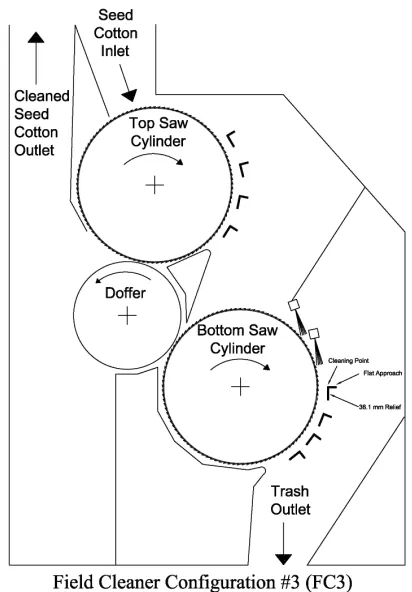
field cleaner configuration (FC3) in the Wanjura
et al. (2011) study consisted of grid bars with a
flat approach and 38.1 mm (1.5 in) relief installed
around both saws (Figure 3). The 38.1 mm straight relief reduces seed cotton loss by closing the open space between grid bars and holding cotton close to the saw over the length of the grid bar relief sec-tion. In the screening test conducted by Wanjura et al. (2011), FC3 exhibited the best balance between
maximum cleaning efficiency and minimum seed cotton loss. The cleaning efficiency and seed cotton loss of the three field cleaner configurations mea -sured during the laboratory screening test (Wanjura et al., 2011) are presented in Table 1.
The experimental grid bars used in FC2 and FC3 were constructed from 1.9 mm (14 ga) sheet metal formed on a press break to produce the desired grid bar cross sectional shape (4.76 mm bend radius). For each of the experimental grid bars used in FC2
and FC3, the flat approach section lies along a radial
The same John Deere 7460 cotton stripper used
for FC1, FC2, and FC3 with the field cleaner by -passed (NFC) and a John Deere model 9996 cotton picker (Moline, IL) were included in the study to
provide reference ginning and fiber quality data for
machine harvested cotton that was not processed
through a field cleaner.
The four cotton cultivars used in this test were planted 23 May 2008 on a center-pivot irrigated
field near Lubbock, TX. The cultivars included DPL
143B2F (Monsanto, St. Louis, MO), AFD 5065B2F, FM 9063B2F and FM 9180B2F (Bayer CropScience, Research Triangle Park, NC). The cultivars spanned a range in crop maturity: FM 9180B2F and AFD 5065B2F early maturing, FM 9063B2F early/mid season maturity, and DPL 143B2F – mid season
Table 1. Cleaning efficiency and seed cotton loss for FC1, FC2, and FC3 measured in a laboratory screening test conducted by Wanjura et al. (2011).
Field Cleaner
Configuration Cleaning Efficiency (%) Seed Cotton Loss (%) FC1 (Factory
Configuration) 30.9 0.36
FC2 44.3 0.76
FC3 37.7 0.05
Figure 1. Schematic diagram of field cleaner configuration 1, factory configuration (FC1).
Figure 2. Schematic diagram of field cleaner configuration 2 (FC2).
cleaner was calculated on an area basis and samples
of the foreign material were collected, five per run,
for fractionation analysis. Fractionation analysis was
conducted on seed cotton and field cleaner foreign
matter samples according to the method described
by Shepherd (1972). Seed cotton loss due to field
cleaning was calculated for FC1, FC2, and FC3 from fractionation results on samples collected from the
foreign matter removed by the field cleaner. Total and component foreign matter cleaning efficiencies
were calculated using fractionation results from seed cotton samples collected from the harvester basket and samples of the foreign matter removed by the
field cleaner.
Ginning. A 100 kg seed cotton sample was collected after the seed cotton weight was mea-sured for each plot. These samples were ginned at the USDA ARS Cotton Production and Processing Research Unit, Lubbock, TX, on commercial scale ginning equipment. The machinery sequence used to process each sample included: suction telescope, green boll separator, feed control, dryer #1 (no heat), #1 inclined cylinder cleaner, combination bur/stick machine, dryer #2 (no heat), #2 inclined cylinder cleaner, 3 saw stick machine, auger distributor, extractor feeder, 93 saw gin stand, lint cleaner #1, lint cleaner #2, battery condenser, and bale press. All seed cotton cleaning equipment prior to the
auger distributor was 1.83 m wide. Seed cotton samples were collected at the extractor feeder apron for fractionation and seed cotton moisture content (w.b.) analyses (Shepherd, 1972). Seed weights and lint weights were measured after ginning and used to determine turnout values.
maturity. Based on seed company data and visual observations at harvest, the cultivars ranked in order of increasing storm-resistance were: DPL 143B2F (loosest boll type), FM 9063B2F, FM 9180B2F, and AFD 5065B2F (tightest boll type). Differences in
yield and fiber quality were anticipated given the
range in crop maturity and boll conformation by cultivar. Differences by cultivar were considered advantageous for evaluating harvesting treatments over varying crop conditions.
The field study was a randomized complete block
design with 3 replications (blocks) of each cultivar
with five cleaner configurations for a total of 60 runs.
Four-row wide plots (102 cm row spacing) with an average area of 0.31 ha were harvested during each run at about 6.4 km/h (4 mi/h). Total seed cotton weight was measured for each run with a cotton weigh wagon equipped with load cells. Seed cot-ton yield was calculated using the total seed cotcot-ton weight and row length measured for each plot. Lint and seed yield were determined from seed cotton yield for each plot using lint and seed turnout val-ues determined after ginning. Wet basis (w.b.) seed cotton moisture content (two samples per run) was measured at harvest using the procedure described by Shepherd (1972). Seed cotton fractionation samples for determining foreign matter content were collected before the harvested cotton entered the
field cleaner for FC1, FC2, and FC3 runs (five per run) and again from the harvester basket (five per
run) for all harvest treatments. The foreign matter
removed by the field cleaner over a 30.5 m length of
each plot was collected and weighed for FC1, FC2,
and FC3. Total foreign matter removed by the field
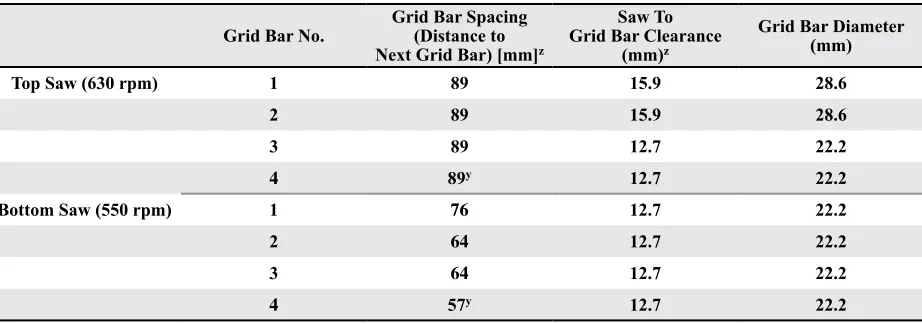
Table 2. Grid bar spacing and clearance values for all field cleaner configurations (FC1, FC2, and FC3).
Grid Bar No. Grid Bar Spacing (Distance to Next Grid Bar) [mm]z
Saw To Grid Bar Clearance
(mm)z
Grid Bar Diameter (mm)
Top Saw (630 rpm) 1 89 15.9 28.6
2 89 15.9 28.6
3 89 12.7 22.2
4 89y 12.7 22.2
Bottom Saw (550 rpm) 1 76 12.7 22.2
2 64 12.7 22.2
3 64 12.7 22.2
4 57y 12.7 22.2
z The same grid bar spacing distances and saw to grid bar clearances used for FC1 were used for FC2 and FC3. Grid bar spacing is the center to center distance for round grid bars or distance between cleaning points for experimental grid bars.
Fiber and Yarn Testing. Lint samples from each run were collected after two stages of lint cleaning
for high volume instrument (HVI) and advanced fiber information system (AFIS) fiber quality analyses at the USDA AMS Cotton Classing Office (Lubbock,
TX) and Cotton Incorporated (Cary, NC),
respec-tively. A substantial range in fiber length, length
uniformity, strength, micronaire, and maturity was observed between cultivars and was spanned by DPL 143B2F and FM 9180B2F. Thus, lint from these two varieties was selected for spinning evaluations at the USDA ARS Cotton Quality Research Station in Clemson, SC. Lint lots of approximately 27 kg were used for spinning and treatment replications were
maintained from the field through spinning.
Opening and cleaning of the lint was conducted with the following machine sequence: blending hop-per (Fiber Controls, M&M Electric Service, Gastonia, NC), Axi-Flo opener/cleaner, GBRA blending hopper,
RN cleaner, RST cleaner, and a DUSTEX fine dust
cleaner (Trützschler, Mönchengladbach, Germany). All cotton was processed through a DK 803 card (Trützschler, Mönchengladbach, Germany) at 45.4 kg/h to produce 4.26 g/m sliver. Breaker drawing was performed on an RSB 951 drawing frame (Rieter, Winterthur, Switzerland) and produced 3.76 g/m sliver. Finish drawing was performed on an RSB 51 drawing frame (Rieter, Winterthur, Switzerland) and produced 3.90 g/m sliver. A Zinser 660 roving frame was used to produce 0.39 g/m roving prior to spinning on a Zinser 321 ring spinning frame (Oerlikon Schlafhorst, Übach-Palenberg, Germany). All cottons were spun into 14.76 tex yarn with a twist multiplier of 4.1.
Opening and cleaning waste was weighed and recorded for each run. Yarn samples were evaluated for count, strength, and elongation with a Statimat M (Textechno, Mönchengladbach, Germany). Yarn evenness was evaluated with an Uster Tester 5 and an Uster Classimat II (Uster Technologies, Knoxville, TN) was used to evaluate yarn faults.
Statistical Analysis. Analysis of response
vari-ables measured during harvest, ginning, and fiber and
yarn testing were conducted by harvest treatment, cultivar, and the harvest treatment by cultivar inter-action using the general linear model in SAS (SAS
v. 9.2, SAS Institute, Cary, NC). Significant effects were identified using a 0.05 level of significance.
Mean separation tests were conducted using Tukey’s
Honestly Significant Difference (HSD) test with a 0.05 level of significance. The size and nature of the
harvesting equipment used in this study required the
use of large field plots. Non-uniformity of crop yield
and plant size across each plot may have contributed to the variance associated with measurements of
cleaning efficiency, seed cotton loss, and fiber quality.
RESULTS
Seed cotton yield was different by harvest treat-ment and cultivar (Table 3). Seed cotton yield was
highest for the stripper harvest with no field cleaner
(NFC) treatment and lowest for the picked treatment with the three stripper harvest treatments using the
field cleaner (FC1, FC2, and FC3) being intermedi -ate. Since lint and seed yields were not different by harvest method, the differences observed by harvest treatment in seed cotton yield were due to differences in foreign matter content. Seed cotton yields for FC1, FC2, and FC3 were not different and were lower than
the NFC seed cotton yield indicating that the field cleaner removed a significant portion of the foreign
material harvested with the seed cotton.
The trend in lint yield by cultivar (Table 3) corresponded to crop maturity with early matur-ing cultivars (AFD 5065B2F and FM 9063B2F) producing higher lint yield than the longer season DPL 143B2F. Seed yield was considerably higher for AFD 5065B2F compared to the other three cultivars, which did not differ in terms of seed yield. Seed cotton moisture content (w.b.) at harvest differed by harvest treatment and cultivar but only ranged from 5.1 to 6.6%. The range in seed cotton moisture con-tent at harvest was considered inadequate to affect
differences in harvest efficiency and is within the
recommended range (<12% w.b.) for protecting lint and seed quality during storage (Lalor et al., 1994). Seed cotton loss was different among all stripper
harvest treatments utilizing the field cleaner and was
highest for FC2 and lowest for FC3 (Table 4). The same seed cotton loss trend for the factory and
exper-imental field cleaner configurations was observed in
the laboratory screening test conducted by Wanjura et al. (2011). Seed cotton loss for DPL 143B2F was about twice that of the other cultivars tested. Similar
to the findings of Wanjura et al. (2011), total foreign matter removed by the field cleaner was higher for
FC1 and FC2 than FC3. Total foreign matter removal
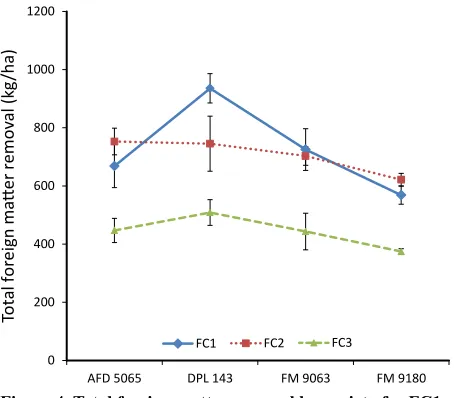
was also different by cultivar and a significant har -vest treatment by cultivar interaction was observed. As shown in Figure 4, the difference in total foreign
removed substantially more total foreign matter than FC2 or FC3. Due to the extractor-cleaner design of
the field cleaner, the cleaning efficiencies for bur and stick material were higher than fine trash (Table 4). FC1 and FC2 produced higher cleaning efficiencies
for bur and total foreign matter compared to FC3.
Stick removal efficiency for FC1 was about 17% higher than FC3, but stick removal efficiency for
FC2 was not different than that of FC1 or FC3. Fine
trash (i.e. leaf trash, pin trash, and motes) cleaning
efficiency was not different by harvest treatment or cultivar. Cleaning efficiency for bur, stick, and total
foreign material was different by cultivar. Although
stick removal efficiency was not different between
the FiberMax varieties or DPL 143B2F, total
for-eign matter cleaning efficiency was highest for FM 9180B2F because stick removal efficiency was ap -proximately 10% greater.
Table 3. Yield and seed cotton moisture content values by harvest treatment and cultivar for the field test conducted in 2008.
Harvest Treatment (HT) z Seed Cotton Yield
(kg/ha) Lint Yield(kg/ha) Seed Yield(kg/ha)
Harvest Moisture Content (% WB)
FC 1 2669 b 832 1340 5.4 c b
FC 2 2748 b 829 1348 5.8 b
FC 3 2883 b 791 1254 5.5 c b
NFC 3310 a 810 1263 6.6 a
Picked 2254 c 800 1240 5.1 c
p > F <0.0001 0.6322 0.0500 <0.0001
Cultivar
AFD 5065 B2F 3190 a 886 a 1506 a 5.8 a b
DPL 143 B2F 2673 b 712 c 1178 b 5.9 a
FM 9063 B2F 2791 b 848 a b 1279 b 5.4 b
FM 9180 B2F 2437 c 803 b 1194 b 5.6 a b
p > F <0.0001 <0.0001 <0.0001 0.0184
HT x Cultivar Interaction (p > F) 0.9590 0.3180 0.4700 0.1600
z Means by harvest treatment or cultivar within a column followed by the same letter are not different according to Tukey’s HSD test (a = 0.05).
Table 4. Seed cotton loss and total foreign matter removed by the field cleaner (kg/ha) and foreign matter cleaning efficiencies (%) by harvest treatment and cultivar.
Harvest Treatment (HT) z Seed Cotton Loss (kg/ha)
Total Foreign Matter (kg/ha)
Burs (%)
Sticks and Stems
(%)
Fine Trash
(%) Total FM(%)
FC 1 53.1 b 725 a 74.9 a 56.3 a 11.0 60.3 a
FC 2 76.9 a 706 a 77.6 a 47.5 ab 12.9 56.3 a
FC 3 17.7 c 443 b 42.5 b 39.0 b 13.4 35.1 b
p > F <0.0001 <0.0001 <0.0001 0.0009 0.2314 <0.0001
Cultivar
AFD 5065 B2F 46.7 a 623 b 55.2 a 40.0 b 13.5 45.2 a
DPL 143 B2F 82.7 b 730 a 62.5 b 47.8 ab 9.8 49.1 a
FM 9063 B2F 38.0 a 624 b 69.2 c 45.6 ab 13.0 49.2 a
FM 9180 B2F 29.6 a 522 c 73.2 c 57.0 a 13.4 58.7 b
p > F <0.0001 <0.0001 <0.0001 0.0090 0.1027 <0.0001
HT x Cultivar Interaction (p > F) 0.6612 0.0044 0.1034 0.0890 0.9670 0.2822
The same level of improvement in cleaning
ef-ficiency observed in the laboratory screening test
(Wanjura et al., 2011) was not observed between
the experimental field cleaner configurations (FC2 and FC3) and the conventional configuration (FC1).
The test conducted by Wanjura et al. (2011) used a
field cleaner from a John Deere model 7445 cotton stripper with five grid bars around the lower saw cylinder whereas the field cleaner used in this test
was on a newer John Deere model 7460 cotton strip-per which uses only four grid bars around the lower saw. The additional grid bar on the lower saw of the
model 7445 cotton stripper field cleaner was replaced with an additional brush on the model 7460 field
cleaner in an effort to help retain more seed cotton on the lower saw and reduce seed cotton loss. The
modified design between field cleaner models may have caused some of the differences in the findings
between this study and the one reported by Wanjura et al. (2011). Seed cotton feed rate, consistency of the feed rate, and distribution of material across the machine can also affect different levels of cleaning performance and seed cotton loss for extractor type cleaners. While the feed rate of seed cotton per unit
of machine width into the field cleaner in the current
study was about 20 kg/min-m (17.5 %) lower than that used by Wanjura et al. (2011), the consistency
of the feed rate into the field cleaner operating under field conditions was likely much less consistent than
that of the pneumatic feeding system used in the laboratory study. Inconsistency in feeding rate for a
field cleaner operating under field conditions can be
caused by any number of conditions including vari-able machine travel speed, areas of low yield, skips
or variability in plant populations along the length of the row, and weeds or foreign obstacles.
Fractionation results for seed cotton samples collected after harvest and prior to ginning (from the harvester basket) are presented in Table 5. Differences by harvest method and cultivar were observed for all foreign matter fractions. Total
foreign matter content was primarily influenced
by the combination of bur and stick material when evaluated by harvest method. High bur and stick
cleaning efficiencies observed for FC1 and FC2
resulted in lower bur, stick, and total foreign mat-ter contents compared to FC3 and NFC. Picked cotton contained the lowest amount of foreign matter compared to all other harvest treatments. FM 9180B2F contained the least and DPL 143B2F the greatest amounts of total foreign matter.
Sig-nificant harvest treatment by cultivar interactions
were observed for bur, stick, total foreign matter, and seed cotton content.
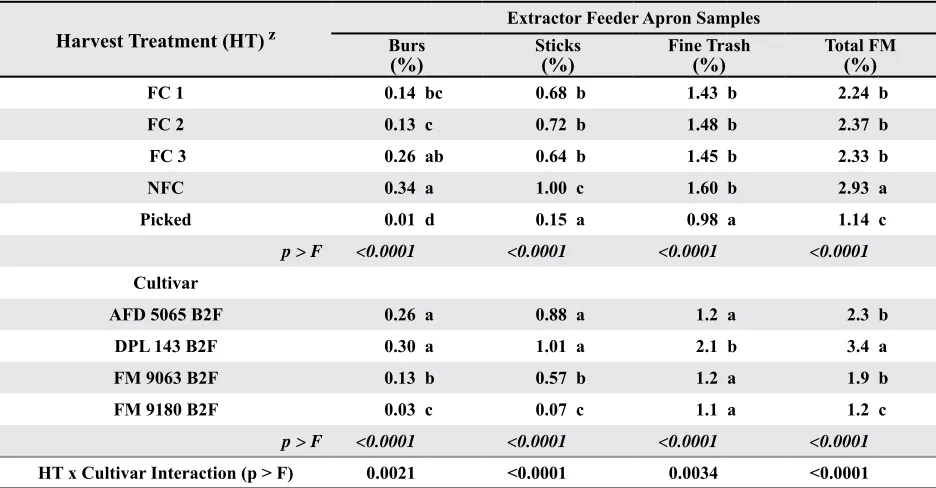
After seed cotton cleaning at the gin, total foreign matter content of seed cotton fractionation samples was not different among FC1, FC2, and FC3 (Table 6). The gin’s seed cotton cleaning system was able to compensate for differences in initial foreign matter
content resulting from varying levels of field cleaner cleaning efficiency. Total foreign matter content
remained highest for NFC and lowest for the picked harvest treatment. Differences in total foreign matter
by cultivar at the extractor feeder apron reflected the
same trends observed for the after harvest samples (Table 5). Cultivars with high initial trash content relative to the other cultivars contained high amounts of trash after seed cotton cleaning. Harvest
treat-ment by cultivar interactions were significant for all
foreign matter and seed cotton fractions measured at the extractor feeder apron.
The picked treatment had the highest and NFC had the lowest lint turnout values, after ginning and two stages of saw-type lint cleaning (Table 7). Among the stripper harvest treatments utilizing the
field cleaner, lint turnout for FC3 was about 3% lower
than FC1 and FC2, which were not different. Differ-ences by cultivar in lint turnout were observed and followed trends in initial total foreign matter content. Seed weight per bale was not different by harvest treatment but differences were observed by cultivar. Seed weight for the FiberMax cultivars were lower than AFD 5065B2F and DPL 143B2F which were not different. Total foreign matter removed by the ginning system followed the same trends observed in
0 200 400 600 800 1000 1200
AFD 5065 DPL 143 FM 9063 FM 9180
To
tal
fo
re
ign
ma
tt
er
re
m
ov
al
(k
g/
ha)
FC1 FC2 FC3
the lint turnout data by harvest treatment and cultivar.
Significant harvest treatment by cultivar interactions
were observed for lint turnout and total foreign mat-ter removed by the ginning system.
Analysis of seed cotton moisture content samples collected at the feeder apron (data not presented)
indicated no difference by harvest treatment but differences were observed by cultivar. The range in seed cotton moisture content at the extractor feeder apron was low (5.5 to 6.2% w.b.) and was not con-sidered adequate to affect differences in lint turnout
or fiber properties.
Table 5. Fractionation results for seed cotton samples collected after harvest and prior to ginning.
Harvest Treatment (HT) z Burs Post Harvest Samples
(%) Sticks(%) Fine Trash(%) Total FM(%)
FC 1 6.5 b 3.5 b 6.9 b 16.9 b
FC 2 5.2 b 3.9 b 7.3 b 16.5 b
FC 3 13.6 c 5.6 c 7.5 b 27.4 c
NFC 17.2 d 6.8 c 6.9 b 33.5 d
Picked 1.8 a 0.7 a 4.2 a 6.7 a
p > F <0.0001 <0.0001 <0.0001 <0.0001
Cultivar
AFD 5065 B2F 10.6 a 4.2 b 5.8 c 21.1 b
DPL 143 B2F 9.3 a 6.3 a 8.0 a 25.3 a
FM 9063 B2F 8.0 b 4.0 b 7.1 b 19.6 b
FM 9180 B2F 7.4 b 1.9 c 5.3 c 14.8 c
p > F <0.0001 <0.0001 <0.0001 <0.0001
HT x Cultivar Interaction (p > F) 0.0019 0.0004 0.1427 0.0015
z Means by harvest treatment or cultivar within a column followed by the same letter are not different according to Tukey’s HSD test (a = 0.05).
Table 6. Fractionation results for seed cotton samples collected at the extractor feeder apron prior to ginning.
Harvest Treatment (HT) z Extractor Feeder Apron Samples
Burs
(%) Sticks(%) Fine Trash(%) Total FM(%)
FC 1 0.14 bc 0.68 b 1.43 b 2.24 b
FC 2 0.13 c 0.72 b 1.48 b 2.37 b
FC 3 0.26 ab 0.64 b 1.45 b 2.33 b
NFC 0.34 a 1.00 c 1.60 b 2.93 a
Picked 0.01 d 0.15 a 0.98 a 1.14 c
p > F <0.0001 <0.0001 <0.0001 <0.0001
Cultivar
AFD 5065 B2F 0.26 a 0.88 a 1.2 a 2.3 b
DPL 143 B2F 0.30 a 1.01 a 2.1 b 3.4 a
FM 9063 B2F 0.13 b 0.57 b 1.2 a 1.9 b
FM 9180 B2F 0.03 c 0.07 c 1.1 a 1.2 c
p > F <0.0001 <0.0001 <0.0001 <0.0001
HT x Cultivar Interaction (p > F) 0.0021 <0.0001 0.0034 <0.0001
HVI fiber analysis results indicated differences
by harvest treatment for micronaire, length unifor-mity index, and leaf grade. Micronaire was 0.3 points higher for the picker-harvested treatment than for any of the stripper-harvested treatments, which were not different. The cotton picker is a selective harvester in that it can only harvest cotton from open bolls
that generally contain mature fiber unlike the cotton
stripper that harvests all seed cotton regardless of boll
condition and fiber maturity. Uniformity index was
0.8% higher for the picked treatment compared to the FC3 harvest treatment. Uniformity index for FC1, FC2, and NFC were not different than any of the other harvesting treatments. The improvement in uniformity index for the picker harvested cotton is attributable to the selective harvest mechanism; however, it was expected that the NFC uniformity index would be the lowest of all harvest treatments but variability in the uniformity index data resulted in no differences among the stripper harvested treatments. Leaf grade (based on classer’s leaf grade) after two stages of saw type lint cleaning was lowest for FC3 and highest for FC2. No clear trend by harvest treatment was apparent in the leaf grade data based on the harvest treatment
cleaning efficiencies shown in Table 4. Leaf grade
did not follow any of the seed cotton foreign matter content trends observed for seed cotton samples col-lected at the harvester basket (Table 5) or feeder apron (Table 6). No differences in loan value or lint value ($/ ha) were observed by harvest treatment. However, lint
value ranged from $952 to $1012 per ha between FC3 and FC1, respectively, due to the slight improvement in both lint yield and loan value for FC1.
Cultivar differences were observed for all HVI
fiber property measurements. Micronaire was high -est for FM 9180B2F and low-est for DPL 143B2F spanning a range of 1.16 units. Upper half mean length was longest for FM 9063B2F and shortest for AFD 5065B2F and DPL 143B2F. Length uniformity index was different for all four cultivars tested but was highest for FM 9180B2F and lowest for DPL 143B2F. Bundle strength was greatest for the Fiber-Max cultivars and weakest for AFD 5065B2F and DPL 143B2F. Loan value for DPL 143B2F was $0.18/kg lower than the other three cultivars, which were not different. Considering both lint yield and loan value, lint value was considerably lower for DPL 143B2F than the other three cultivars, which were not different.
Differences by harvest treatment were observed for all AFIS parameters shown in Table 9 except for visible foreign matter (VFM) and immature
fiber content (IFC). Nep count (number of fiber entanglements per gram of lint) and fineness were
not different among any of the stripper-harvested treatments but the picked treatment had the fewest
neps and highest fineness value (fineness indicates fiber cross sectional area). Mean length by number
(L(n)) was lower for FC3 compared to the FC2 and picked harvest treatments. Similarly, length by
number coefficient of variation (L(n) CV) and short
Table 7. Lint turnout (%), seed weight (kg/bale), and total foreign matter (kg/bale) removed by the ginning system by harvest treatment and cultivar (1 bale = 218 kg).
Harvest Treatment (HT) z Lint Turnout
(%) Seed Weight(kg/bale)
Total Foreign Matter Removed
(kg/bale)
FC 1 31.4 b 351 132 b
FC 2 30.3 b 356 151 b
FC 3 27.6 c 346 235 c
NFC 24.4 d 344 352 d
Picked 35.7 a 337 57 a
p > F <0.0001 0.2450 <0.0001
Cultivar
AFD 5065 B2F 28.1 c 370 b 198 b
DPL 143 B2F 27.2 c 363 b 256 a
FM 9063 B2F 30.8 b 329 a 170 b
FM 9180 B2F 33.4 a 326 a 118 c
p > F <0.0001 <0.0001 <0.0001
HT x Cultivar Interaction (p > F) 0.0212 0.5383 <0.0001
fiber content by number (SFC(n)) were higher for
FC3 compared to the FC2 and picked harvest treat-ments. As expected, total foreign material (Total) was highest for NFC and lowest for the picked harvest treatment. Maturity ratio (MR) was statisti-cally higher for the picked treatment compared to FC3, but the difference spanned a range of 0.02 and
was not of practical significance. Differences were
observed by cultivar for all AFIS parameters. Since the differences by cultivar for most HVI and AFIS
fiber parameters were spanned by DPL 143B2F and
FM 9180B2F, lint samples from these two varieties were spun into yarn to test for yarn quality differ-ences by harvest method.
Table 8. HVI fiber properties by harvest treatment and cultivar. Harvest
Treatment (HT)z MICy Length [mm] [%]UI [kN-m/kg]Strength [%]Rd Plus B [%] GradeLeaf [$/kg]Loan Lint Value [$/ha]
FC1 3.51 a 29.17 80.1 ab 283.1 82.7 7.2 1.9 bc 1.21 1012
FC2 3.52 a 29.42 80.4 ab 283.2 82.3 7.0 2.7 a 1.20 997
FC3 3.45 a 29.00 79.9 b 281.6 82.8 7.1 1.4 c 1.20 952
NFC 3.48 a 29.27 80.3 ab 282.8 82.0 6.9 2.2 ab 1.19 973
Picked 3.80 b 29.46 80.7 a 284.9 81.4 7.0 2.3 ab 1.25 982
p > F <0.0001 0.051 0.0179 0.675 0.107 0.3047 <0.0001 0.121 0.6659
Cultivar
AFD 5065 B2F 3.59 b 28.75 c 80.6 c 267.6 b 82.2 a 7.0 b 2.2 ab 1.24 a 1097 a
DPL 143 B2F 2.90 c 28.43 c 77.3 d 263.1 b 80.9 b 8.1 a 2.5 a 1.07 b 766b
FM 9063 B2F 3.64 b 30.26 a 81.3 b 300.4 a 83.1 a 6.6 bc 2.0 ab 1.25 a 1058 a
FM 9180 B2F 4.06 a 29.62 b 81.9 a 301.4 a 82.7 a 6.5 c 1.7 b 1.26 a 1012 a
p > F <0.0001 <0.0001 <0.0001 <0.0001 0.0004 <0.0001 0.002 <0.0001 <0.0001
HT x Cultivar Interaction
(p > F) 0.0928 0.699 0.1346 0.2362 0.565 0.2621 0.5606 0.223 0.3614
z Means by harvest treatment or cultivar within a column followed by the same letter are not different according to Tukey’s HSD test (a = 0.05).
y MIC = micronaire, Length = upper half mean length, LUI = length uniformity index, Strength = bundle strength, Rd =
reflectance, Plus B = yellowness, Loan = Commodity Credit Corporation 2008/09 Loan Value.
Table 9. AFIS fiber parameters by harvest treatment and cultivar. Harvest
Treatment (HT)z Nep Count [cnt/g] L(n)
y
[mm] L(n) CV [%] SFC (n) [%] [cnt/g]Total VFM [%] Fineness [mTex] IFC [%] MR
FC1 626 a 17.695 bc 59.12 ab 35.76 ab 185 ab 0.62 165.00 b 5.81 0.90 ab
FC2 609 a 18.182 ab 58.17 bc 33.91 bc 212 ab 0.65 163.08 b 5.76 0.90 ab
FC3 640a 17.251 c 60.67 a 37.26 a 180 ab 0.49 162.92 b 6.06 0.89 b
NFC 634 a 18.076 abc 58.50 abc 34.38 abc 239 a 0.77 161.75 b 5.93 0.89 ab
Picked 505 b 18.542 a 56.37 c 32.42 c 147 b 0.52 169.33 a 5.41 0.91 a
p > F 0.0002 0.0010 0.0004 0.0010 0.0311 0.1101 <0.0001 0.2850 0.0026
Cultivar
AFD 5065 B2F 528 b 18.085 b 56.55 bc 33.19 b 178 b 0.60 ab 170.40 a 5.18 b 0.90 b
DPL 143 B2F 973 a 15.968 c 64.17 a 42.39 a 274 a 0.79 a 150.40 c 7.01 a 0.85 c
FM 9063 B2F 505 b 18.728 ab 57.89 b 32.61 b 187 b 0.61 ab 164.27 b 5.50 b 0.91 a
FM 9180 B2F 405 c 19.016 a 55.65 c 30.79 b 132 b 0.45 b 172.60 a 5.49 b 0.93 a
p > F <0.0001 <0.0001 <0.0001 <0.0001 <0.0001 0.0126 <0.0001 <0.0001 <0.0001
HT x Cultivar Interaction
(p > F) 0.1205 0.6646 0.8894 0.7037 0.9716 0.7776 0.0087 0.8253 0.2915
z Means by harvest treatment or cultivar within a column followed by the same letter are not different according to Tukey’s HSD test (a = 0.05).
y L(n) = mean length by number, L(n) CV = mean length by number coefficient of variation, SFC(n) = short fiber content by
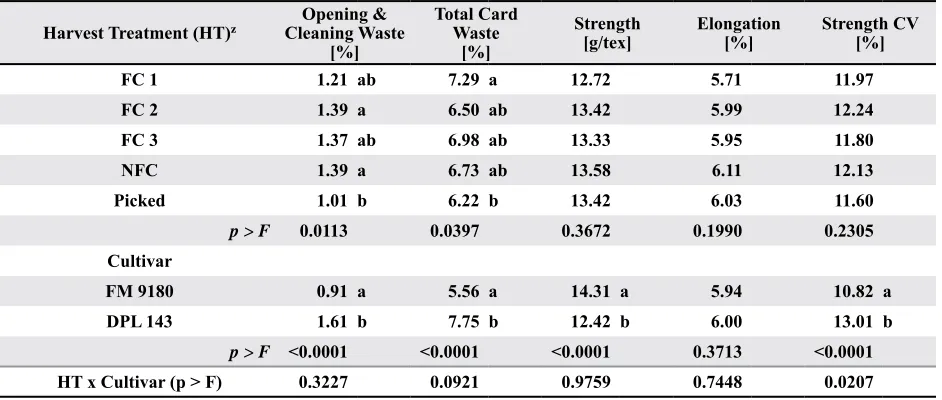
Opening and cleaning waste and total card waste were different by harvest treatment (Table 10). Waste during opening and cleaning was highest for the NFC and FC 2 treatments and lowest for picked. Waste at the card was again lowest for the picked harvest
treatment, which was only significantly lower than
FC1. Differences by cultivar were observed for open-ing and cleanopen-ing and total card waste. Yarn strength, elongation, and strength CV were not different among the harvest treatments tested. Yarn produced
from FM 9180B2F fiber was stronger and had lower
strength CV than DPL 143B2F yarn but elongation was not different by cultivar.
Table 10. Opening and cleaning waste, card waste, and yarn tensile properties by harvest treatment and cultivar.
Harvest Treatment (HT)z Cleaning WasteOpening & [%]
Total Card Waste
[%]
Strength
[g/tex] Elongation[%] Strength CV[%]
FC 1 1.21 ab 7.29 a 12.72 5.71 11.97
FC 2 1.39 a 6.50 ab 13.42 5.99 12.24
FC 3 1.37 ab 6.98 ab 13.33 5.95 11.80
NFC 1.39 a 6.73 ab 13.58 6.11 12.13
Picked 1.01 b 6.22 b 13.42 6.03 11.60
p > F 0.0113 0.0397 0.3672 0.1990 0.2305
Cultivar
FM 9180 0.91 a 5.56 a 14.31 a 5.94 10.82 a
DPL 143 1.61 b 7.75 b 12.42 b 6.00 13.01 b
p > F <0.0001 <0.0001 <0.0001 0.3713 <0.0001
HT x Cultivar (p > F) 0.3227 0.0921 0.9759 0.7448 0.0207
z Means by harvest treatment or cultivar within a column followed by the same letter are not different according to Tukey’s HSD test (a = 0.05).
Table 11. Sliver and yarn evenness results from UT5 analysis.
Harvest Treatment (HT)z Card Sliver Mass CV [%]
Finish Drawing Mass CV
[%]
Yarn Mass CV
[%] Nep Count[cnt/km] Thick Places[cnt/km] Thin Places[cnt/km]
FC 1 3.00 4.16 a 17.65 347 ab 489 73
FC 2 3.08 3.88 ab 17.46 330 ab 466 64
FC 3 3.22 4.09 ab 18.04 450 a 561 93
NFC 3.04 4.09 ab 17.65 347 ab 488 73
Picked 3.10 3.81 b 17.28 301 b 432 49
p > F 0.0638 0.0285 0.1274 0.0201 0.0946 0.0826
Cultivar
FM 9180 3.13 a 3.55 a 16.63 a 216 a 329 a 24 a
DPL 143 3.05 b 4.40 b 18.50 b 478 b 629 b 112 b
p > F 0.0329 <0.0001 <0.0001 <0.0001 <0.0001 <0.0001
HT x Cultivar (p > F) 0.3911 0.2060 0.5101 0.4506 0.4337 0.2015
z Means by harvest treatment or cultivar within a column followed by the same letter are not different according to Tukey’s HSD test (a = 0.05).
Evenness results on sliver and yarn samples with the UT5 are presented in Table 11. Mass CV after the card was not different by harvest treatment
but mass CV after finish drawing was lower for
the picked treatment compared to FC1. Yarn mass CV was not different by harvest treatment. Yarn nep count was only different between the picked and FC3 treatments with FC3 yarn containing about 150 more neps per km than yarn made from picked cotton. Thick and thin places as measured by the UT5 were not different by harvest treatment.
Cultivar had a significant influence on all UT5
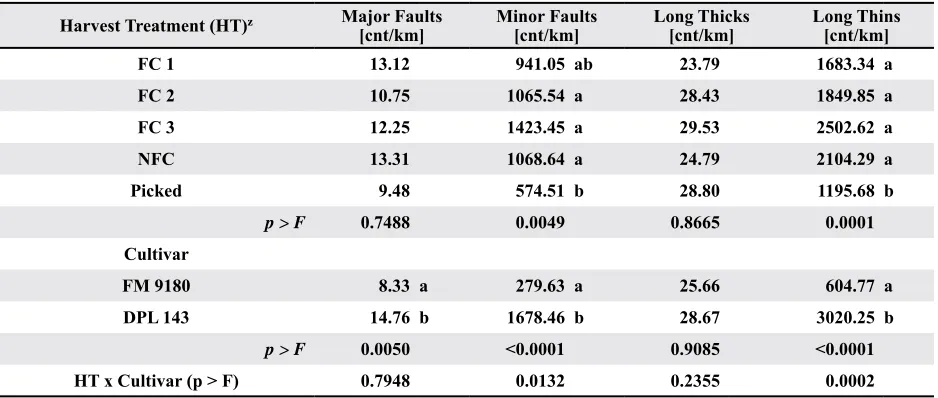
Classimat II analysis results on yarn samples are presented in Table 12. Yarn produced from picked
cotton contained significantly fewer minor faults
per km than FC2, FC3, or NFC yarn. Fewer long thin faults per km were observed for picked cotton compared to all stripper-harvested treatments. No differences in major faults or long thick places were observed by harvest method. Yarn produced from DPL 143B2F contained more major faults, minor faults, and long thin places than yarn produced from FM 9180B2F but long thick places were not differ-ent by cultivar.
Based on the results of this study, neither of the
field cleaner configurations utilizing experimental
grid bars provided superior performance over the
factory configuration in terms of cleaning efficiency, lint yield, lint value, fiber quality, or yarn quality.
CONCLUSIONS
The primary function of a cotton stripper
mount-ed field cleaner is to remove foreign matter from
harvested seed cotton with a minimal level of seed cotton loss. Favorable market conditions character-ized by high lint prices place an additional emphasis
on minimizing seed cotton losses. The findings of this work indicate that a field cleaner configured as specified for FC2 can have cleaning efficiencies
equal to FC1. Seed cotton loss was increased for
FC2 compared to FC1 but no lint yield, fiber quality,
or yarn quality differences were observed. Cleaning
efficiency for FC3 was substantially lower than that
of FC1 or FC2 but FC3 had lower seed cotton loss than FC1 or FC2.
Field cleaning had a minimal influence on fiber
quality. No differences were observed between FC1 and NFC for any of the HVI or AFIS parameters reported. With the exception of higher average leaf grade for FC2, no differences were observed between FC2 and FC1 for the HVI and AFIS parameters reported. FC3 reduced AFIS length parameters compared to FC2.
Spinning data indicated that the stripper harvest treatments had higher waste levels during opening and cleaning and at the card than the picked treat-ment. No differences in yarn strength, elongation, or strength CV were observed by harvest treatment. Yarn nep count was highest for FC3 and lowest for the picked treatment. Yarn evenness testing revealed no differences by harvest method. The number of yarn faults in terms of minor faults and long thins was lowest for the picked treatment compared to the stripper harvested treatments which were not different.
Based on the findings of this study, neither of the experimental field cleaner configurations improved cleaning efficiency, lint yield, lint value, fiber qual -ity, or yarn quality compared to the original factory
configuration.
This study demonstrates the potential influence of the cross sectional geometry of field cleaner grid
bars on cleaning performance, seed cotton loss,
and fiber and yarn quality. Additional work on this subject should focus on evaluating field cleaner per
-Table 12. Yarn fault results from Classimat II analysis.
Harvest Treatment (HT)z Major Faults
[cnt/km] Minor Faults[cnt/km] Long Thicks[cnt/km] Long Thins[cnt/km]
FC 1 13.12 941.05 ab 23.79 1683.34 a
FC 2 10.75 1065.54 a 28.43 1849.85 a
FC 3 12.25 1423.45 a 29.53 2502.62 a
NFC 13.31 1068.64 a 24.79 2104.29 a
Picked 9.48 574.51 b 28.80 1195.68 b
p > F 0.7488 0.0049 0.8665 0.0001
Cultivar
FM 9180 8.33 a 279.63 a 25.66 604.77 a
DPL 143 14.76 b 1678.46 b 28.67 3020.25 b
p > F 0.0050 <0.0001 0.9085 <0.0001
HT x Cultivar (p > F) 0.7948 0.0132 0.2355 0.0002
formance and seed cotton loss under crop conditions with higher yields, higher plant moisture content,
lower crop/fiber maturity, and conditions favoring
the generation of bark contamination. Further work could also investigate the potential for grid bar cross
section shape to influence the cleaning performance
and seed cotton loss for extractor type cleaners used in the ginning process.
DISCLAIMER
Mention of trade names or commercial prod-ucts in this manuscript is solely for the purpose of
providing specific information and does not imply
recommendation or endorsement by the U.S. Depart-ment of Agriculture. USDA is an equal opportunity provider and employer.
ACkNOWLEDGEMENT
The authors gratefully acknowledge Cotton
Incorporated for financial support and John Deere
for the equipment loan of the cotton picker used in this project.
REFERENCES
Armijo, C.B., D.P. Whitelock, S.E. Hughs, E.M. Barnes, and M.N. Gillum. 2011. Charting the collision between a seed coat fragment and newly designed lint cleaner grid bars. J. of Cotton Science 15: 33-42.
Baker, R.V., and A.D. Brashears. 2000. Combined effects of
field cleaning and lint cleaning on stripper harvested cot -ton. p. 1616-1621. In Proc. Beltwide Cotton Conf., San Antonio, TX. 4-8 Jan. 2000. Natl. Cotton Counc. Am.,
Memphis, TN.
Baker, R.V., W.S. Anthony, and R.M. Sutton. 1994. Seed cot-ton cleaning and extracting. p. 69-90. In W.S. Anthony
and W.D. Mayfield (eds.) Cotton Ginners Handbook.
Agricultural Handbook No. 503. U.S. Dept. of Agric. Washington D.C.
Barker, G.L, C.S. Shaw, and K.E. Luckett. 1969. A seed cotton cleaning attachment for mechanical pickers. Southeast Region Meeting, Mobile, AL. 3-5 Feb. 1969. Soc. Agric. Eng., St. Joseph, MI.
Bennett, B.K, S.K. Misra, A.D. Brashears, and T.L. Dowty. 1995. Effect of bur extractor on trash in seed cotton and
fiber quality for different harvest dates. p. 649-652. In
Proc. Beltwide Cotton Conf., San Antonio, TX. 4-7 Jan. 1995. Natl. Cotton Counc. Am., Memphis, TN.
Brashears, A.D. 1986. Reversing of grates to reduce extrac-tion loss. 1986 Annual Report. USDA ARS Project – 6208-20550-008. U.S. Dept. Agric. Agric. Res. Ser-vice - Cotton Production and Processing Research Unit, Lubbock, TX.
Brashears, A.D. 1991. Field cleaner efficiency as affected by
variety. ASAE paper no. 911078. ASAE International Summer Meeting, Albuquerque, NM. 23-26 June 1991. Am. Soc. Agric. Eng., St. Joseph, MI.
Kirk, I.W., T.E. Corley, and F.A. Kummer. 1970. Performance relations for a saw grid seed cotton cleaner. Trans. ASAE.
13(2): 171-176.
Kulkarni R., E. Segarra, M. Kelley, R.K. Boman, and A.D. Brashears. 2005. The economics of crop termination and
use of field cleaners. p. 304-309. In Proc. Beltwide Cot-ton Conf., New Orleans, LA. 4-7 Jan. 2005. Natl. CotCot-ton Counc. Am., Memphis, TN.
Lalor, W.F., M.H. Willcutt, and R.G. Curley. 1994. Seed cotton storage and handling. P. 16-25. In W.S. Anthony
and W.D. Mayfield (eds.) Cotton Ginners Handbook.
Agricultural Handbook No. 503. U.S. Dept. of Agric. Washington D.C.
Ray, S.J. 2006. Alternative configurations in a cylinder type
cleaner for seed cotton. Appl. Eng. Agric. 22(5): 643-649. Shepherd, J.V. 1972. Standard procedures for foreign matter
and moisture analytical tests used in cotton ginning research. Agricultural Handbook No. 422. U.S. Dept. of Agric., Washington D.C.
Smith, L.A., and W.T. Dumas. 1982. A cleaner for cotton strippers. Trans. ASAE. 25(2): 291-296.
Wanjura, J.D., G.A. Holt, M.G. Pelletier, and J.A. Carroll.
2011. Influence of grid bar shape on field cleaner perfor -mance – laboratory screening test. J. Cotton Science 15: 1-10.
Whitelock, D.P., and W.S. Anthony. 2003. Evaluation of
cylin-der cleaner grid bar configuration and cylincylin-der speed for
cleaning of seed cotton, lint, and lint cleaner waste. Appl. Eng. Agric. 19(1): 31-37.