Volume 2, Number 2, 2019 Iranian journal of educational Sociology |34
________________________________ ________________________________
__
Iranian journal of educational Sociology
(Interdisciplinary Journal of Education) Available online at: http://www.iase-idje.ir/
Volume 2, Number 2, July2019
The Effectiveness of Acceptance and Commitment Therapy on
Responsibility and its Components in Female Students
SaeedeDerogar1, Najaf Tahmasebi Pour2,Sadegh Nasri 3
1. Mَ. A. of Counseling, Department of Educational Sciences, Faculty of Humanities, Shahid Rajaei University of Education, Tehran, Iran.
2. Assistant Professor, Department of Educational Sciences, Faculty of Humanities, Shahid Rajaee University, Tehran, Iran. 3.Associate Professor of clinical psychology, Department of Educational Sciences, Faculty of Humanities, Shahid Rajaei University of Education, Tehran, Iran.
Article history:
Received date: 28 January 2019 Review date: 14 March 2019 Accepted date: 26 March 2019
Abstract
Purpose: The purpose of this study was to evaluate the effectiveness of acceptance and commitment therapy education on students' responsibility. Methodology: The research method was quasi-experimental with pre-test and post-test with control group. The statistical population of this study was all female students of Shahid Sadeghi Secondary School (District 6) in Tehran during the school year of 2018-2019. The sample consisted of 30 students (15 experimentalgroup, 15 control group) from those who had a lower than average deviation from the responsibility scale and were randomly selected and divided into two groups of 15 experimental and control groups. Were. The experimental group received 8 sessions of acceptance and commitment therapy training while the control group did not receive any intervention. To measure the variables, Kordlow Liability Questionnaire (2008) was administered to both groups and data obtained from pre-test and post-test using multivariate analysis of covariance. And univariate analysis was performed. Findings: The results of multivariate and univariate analysis of covariance showed that acceptance and commitment therapy education increased the students' responsibility in comparison with the control group in the post-test. (P <0.05). conclusion: Therefore, it can be concluded that acceptance and commitment based training can be used to promote accountability and its components. Acceptance and commitment based therapy can be part of intervention programs in counseling centers. Schools should be targeted to increase accountability of target groups.
Keywords:
Acceptance and Commitment Therapy, Responsibility, Internal Commitment, External Commitment, Security, Self-Esteem, female Students
Please cite this article: Derogar S, Tahmasebi Pour N, Nasri S. (2019). The Effectiveness of Acceptance and Commitment
Therapy on Responsibility and its Components in Female Students. Iranian journal of educational Sociology. 2(2):34-43.
Corresponding Email Author:test @ srttu.edu
1. Introduction
Developing a sense of responsibility as one of the important goals of education has long been considered by planners, teachers, educators, parents, and even the youth themselves. Having a sense of responsibility as a valuable life asset in human empathy, especially those who have less social skills and are the most important contributors to the growth and development of talents, abilities and creativity. They are considered as an important factor in academic achievement, socialization, social adjustment with peer group (Maleki, 2006). Acceptance of responsibility is both a sign of maturity and a means of achieving puberty and showing the extent of maturity. Responsibility is one of the most important aspects of adolescents and young people's development and they are able to communicate with others and adapt to their surroundings and community through acceptance of social responsibility and skills (Zarei, Mirshah, Liaghatdar, 2017).
Accountability is one of the most important social values that must be accepted and internalized by students. It is also an intrinsic obligation and commitment on the part of the individual to perform all of his activities optimally. This skill comes from within the individual and the person who assumes responsibility agrees to perform activities or tasks or to be supervised by others (Zand, 2013). Children learn a sense of responsibility from parents, school, friends, and the community, and by learning this valuable skill, it will preserve it for the rest of their lives, which will make them more successful in life (Kulm’s & Bean, 1986; quoted by Talebi tari, 2015). Students who have learned accountability at school learn how to think of or deal with ways to help each other in a bigger situation to solve problems, the education system needs students to connect with each other, to learn how to think and solve problems, and thus to become responsible in one's community (Glasser, 2012). Since evolving societies require responsible and self-sufficient people, so today's people must first accept responsibility for their lives and destiny, and precise effort and planning is required to achieve this goal. Accountability education helps children and adolescents to accept responsibility for their cognition, feelings, and behavior, as well as to accept that they are responsible for the health and success of communicating with others and the environment (Bahrami, Malekian, Abedi, 2006).
Responsibility is a valuable gem that human beings have outgrown all creatures in the world (Hosseini Qomi, 2012). Mid (1999) has considered responsibility to be the greatest stage of human perfection. In his opinion, diligent and responsible people always pay attention to their tasks and take the lead in helping others. Human beings cannot grow without accepting responsibility and must accept responsibility for success. He regards persistence in effort and commitment as one of the characteristics of a responsible person (Maleki, 2006). Kulm’s and Bean have considered responsibility literally, capable of responding, and in the general sense to the concept of appropriate and effective decision making. It means making the right choices within the framework of social norms and expectations that lead to positive human relationships, increased safety, success, and comfort. Responsibility is not hereditary and it is gained through experience (Kulm’s & Bean; Translated by Alipour, 2008). Accountability means having choices and having a responsible personality for oneself and responsible action in relation to others (Bahrami, Malekian, Abedi, 2006).
Accountability is broadly divided into two parts: individual responsibility and social responsibility. Individual accountability means that one is responsible for oneself and the situation in which they are placed, as well as the needs and well-being of others, but the basic idea of social responsibility for young people is to recognize that young people are part of society. And they must participate in social goals and objectives. Social responsibility also has many social and cultural implications, one of the most important of which is socialism (Soroush, 2012).
According to the research findings of the National Youth Organization, half of our youth are aged 18 to 29, with no strong job identity and many of them are in very low levels of responsibility (Hosseininejad, 2013). Responsibility is a social skill and encompasses a wide range of adolescent behaviors, including participatory activities, respect for others' rules and rights, courtesy, conscientiousness, trustworthiness, orderliness, informed decision making and commitment. Includes.
Volume 2, Number 2, 2019 Iranian journal of educational Sociology |36
________________________________ ________________________________
__
Today, training responsible and committed individuals is one of the most important and fundamental goals of any educational system. Because nurturing responsible and committed forces of intrinsic values and conscience is one of the most important factors in the development of any country. On the other hand, "nurturing a responsible spirit is one of the social goals of the Islamic Republic of Iran's education and training"(Safi, 2004). As a result, the education system needs to comprehensively and comprehensively focus on nurturing human capabilities and nurturing stable personalities that are less affected by situations and values, and with respect to values and values. Follow their own standards. And ignoring this will lead to people who are likely to have different specializations in various disciplines but have no obligation to their duties and to themselves, as well as to their fellow human beings in society. It is one of the priorities of any educational system. Therefore, achieving positive results in the area of accountability (by identifying the factors that affect accountability) can lead to the overall development of students and the community. Several factors can affect students' responsibility and its components and may promote or decrease them. One of the factors that seems to affect this construct is acceptance and commitment therapy. Citing the Effective Results of Research on Acceptance and Commitment-Based Interventions in Academic Areas, for example: Results of Shirvani, Mehdi Zadeh (2018), Haratmeh, Emami (2017), Hayes & Masuda (2014), Hayes & Lillis (2014).
Acceptance and commitment therapy is one of the third cognitive-behavioral therapies identified by Hayes (2007). And the purpose of this therapy is to help clients achieve a worthwhile and satisfying life through psychological flexibility and has six central processes that lead to psychological flexibility: acceptance, faulting. Cognitive, communicating with the present, as self-reliant contexts, values, and action (Roditi & Robinson, 2011). This treatment is a functional contextual intervention, based on relational framework theory (Rft), which considers human suffering from psychological-cognitive inflexibility that is reinforced by cognitive fusion and empirical avoidance (Izadi and Abedi, 2014). It also combines acceptance and attentional awareness strategies in a variety of ways with commitment and behavior change strategies with the aim of increasing psychological flexibility. Psychological flexibility is the ability to make practical choices between different options, which is more appropriate, as well as the ability to fully relate to the present and to change or maintain behavior in service of valuable and important life goals (Forman and Herbert, 2009). The goal of acceptance and commitment therapy is to help individuals lead a rich, meaningful and meaningful life, while still accepting the suffering that life inevitably has. This treatment derives its name from its original message. Accept the personalities and be committed to the action that enriches lives (Emami ezat, Hashemi Nasab & Nekonam, 2015). The core of ACT is the change in verbal behaviors (self-talk) and extrinsic (actions) ACT believes that fighting and fighting emotions makes them worse (Hayes, 2007). Finally, this treatment emphasizes the enhancement of valuable practice (Hayes & et all, 2010). These values can include improving interpersonal relationships, education, self-care, marital relationships, and so on. The therapist helps authorities to get involved by engaging in activities that are important to them but which they avoid. Important components of this goal include identifying and defining issues that are important to the client, bringing awareness to the moments occurring on the basis of these values, and acting on these values (Roemer & et all, 2005).
Since responsibility is one of the traits of personality that is as learned and acquired as any other skill, and training responsible and bound by internalized values and conscience is one of the important factors in the development of any country. On the other hand, "fostering a sense of responsibility is also one of the social goals of education in the Islamic Republic of Iran" (Safi, 2004). As a consequence, the education system needs to comprehensively and comprehensively focus on nurturing human capabilities and nurturing stable personalities that are less affected by situations and conditions and with respect to values and values. Follow their own standards. And ignoring it will lead to people who may have different specializations in various disciplines but have no obligation to their duties and to themselves, as well as to their fellow human beings in society. It is one of the priorities of any educational system. Therefore, achieving positive results in the
area of accountability (by identifying the factors that affect accountability) can lead to the overall development of students and the community.
Citing the Effective Results of Research on Acceptance and Commitment-Based Interventions in Academic Areas, for example: Results of Research Shirvani, Mehdi Zadeh (2018), entitled The Effectiveness of Acceptance-Based Therapy and commitment to responsibility in women with breast cancer, and post-test results showed that this treatment could significantly increase accountability compared to the control group. In another study in Haratmeh, Emami (2017) conducted a study entitled Effectiveness of Acceptance-Based Therapy and Commitment to Increasing the Level of Components (Trustee, Legislation, Self-Management) of Student Responsibility and Results The test showed that this treatment increased the level of components (trust, legality, self-management) of responsibility. And also Hayes and Lillis (2014) conducted a study on the effectiveness of acceptance and commitment therapy techniques and practices on adolescents' behavioral disorders and problems and concluded that acceptance-based interventions and exercises were used. And commitment can significantly enhance their level of responsibility and responsibility for their behaviors. The present study seeks to find an answer to the question whether acceptance and commitment training can increase responsibility and its components (internal commitment, external commitment, security, self-esteem, belonging).
2. Methodology
The present research is a quasi-experimental design with pre-test and post-test with control group. Statistical population, sampling and sampling method: The statistical population of this study was all the students of second tenth grade secondary school in Tehran who were studying in the academic year 2018-2019. The sampling method in this study is single-stage cluster sampling so that one school is randomly selected from girls' high schools in District 4 and then from this one school which meets the requirements of the study. There were 5 classes and about 184 students were given a responsibility questionnaire (Kordlow, 2008) and then 30 students were randomly selected from the students who volunteered to participate in the study (15). Patients in the experimental group and 15 in the control group). Inclusion criteria were in the age range of 16 to 17 years, having a standard deviation lower than the mean of the responsibility questionnaire and exclusion criterion for acceptance and commitment based therapy. The experimental group was then exposed to the independent variable for 8 sessions of 1 hour while the control group received no training. Then again, post-test was performed for both groups to evaluate the effect of training. All individuals received written information about the study and participated in the study if they so desired. People have been assured that all information is confidential and will be used for research purposes. Questionnaire was used for data collection and data were analyzed by multivariate and univariate analysis of covariance in SPSS software.
Responsibility Questionnaire: This questionnaire was developed by Kordlw in 2008 and has 78 items and 5 sub-scales: Responsibility (Internal Commitment), Responsibility (External Commitment), Security Feeling, Self-Esteem. And belongs. This researcher-made test was conducted on the statistical population of Tehran city in which 479 male and female high school students were tested. Responsibility of a multi-component concept and includes: 1- Security feeling: Designed to measure the level of subjective sense of security.2- Self-esteem: To measure the level of subjective self-esteem. Designed in school 3- Designed to measure the extent of the subject's feeling of belonging to the designed school. 4 - Sense of responsibility (External commitment): Indicates the extent of the subject's external commitment5. Acceptance (Internal Commitment): Increases the amount of internal commitment of the subjects. The sum of these scores indicates the individual's responsibility. The validity and reliability of this questionnaire was designed by Kordlow (2008) based on Maslow's hierarchy of needs theory, so that after reproducing the questionnaire in order to extract formal and content validity from the managers, Instructors, teachers and students, as well as some university professors, were asked to submit their corrections in writing. After reviewing and revising
Volume 2, Number 2, 2019 Iranian journal of educational Sociology |38
________________________________ ________________________________
__
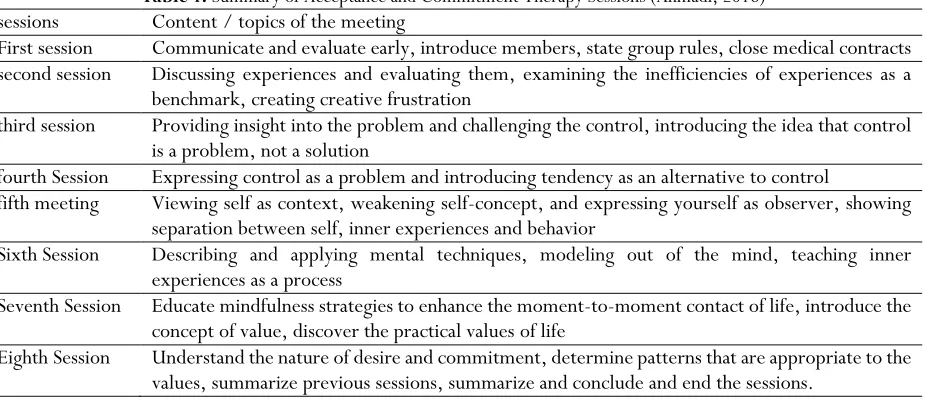
the questionnaire, the questionnaire was again reproduced and then a sample of 35 students was selected from the statistical population of the students. Then the test was validated by spss software. Required changes The questionnaire was administered to a sample of 104 people who were selected by random cluster sampling. The data obtained from 104 questionnaires were evaluated and for the third time 482 students from Tehran were given the questionnaire and the results showed the results. This test has a 90% validity which indicates the high validity of this test. The Acceptance and Commitment Therapy (independent variable) training used in this study was conducted in 8 one-hour sessions at Shahid Sadeghi High School.
Table 1. Summary of Acceptance and Commitment Therapy Sessions (Ahmadi, 2016)
sessions Content / topics of the meeting
First session Communicate and evaluate early, introduce members, state group rules, close medical contracts second session Discussing experiences and evaluating them, examining the inefficiencies of experiences as a
benchmark, creating creative frustration
third session Providing insight into the problem and challenging the control, introducing the idea that control is a problem, not a solution
fourth Session Expressing control as a problem and introducing tendency as an alternative to control
fifth meeting Viewing self as context, weakening self-concept, and expressing yourself as observer, showing separation between self, inner experiences and behavior
Sixth Session Describing and applying mental techniques, modeling out of the mind, teaching inner experiences as a process
Seventh Session Educate mindfulness strategies to enhance the moment-to-moment contact of life, introduce the concept of value, discover the practical values of life
Eighth Session Understand the nature of desire and commitment, determine patterns that are appropriate to the values, summarize previous sessions, summarize and conclude and end the sessions.
3. Findings
Table 2. Mean and standard deviation of responsibility and its components between control and experimental groups in pre-test and post-pre-test groups.
Variable pre-test post-test
Mean deviationStandard Mean deviationStandard
responsibility experiment 26/136 75/18 46/178 26/22
Control 26/149 85/18 93/149 26/20
Feeling of security experiment 23/24 96/5 66/31 54/6
Control 66/25 08/5 20/25 21/6
Self-esteem experiment 29 95/5 33/37 54/5
Control 66/32 19/7 53/32 39/6
A sense of belonging experiment 26/46 72/10 46/54 72/11
Control 66/49 80/10 60/49 76/12
External Commitment experiment 20/20 42/3 26/29 54/4
Control 40/22 23/4 21/29 21/4
Internal Commitment experiment 53/17 13/4 26/39 54/3
Control 26/19 34/4 11/29 39/4
Table 2 shows that there is no significant difference in the pre-test scores of responsibility and its components in the two groups. Also, it is observed that in the experimental group post-test the mean scores of responsibility and its components increased in comparison to the pre-test, whereas the mean scores of responsibility and its components in the control group in the pre-test. Test and post-test did not differ significantly.
Table 3. Levine test results to examine the default of the variance of accountability components Sig df2 df1 F Variable 35 / 0 28 1 96 / 0 Feeling of security
36 / 0 28 1 85 / 0 Self-esteem 08 / 0 28 1 21 / 33 A sense of belonging
68 / 0 28 1 17 / 0 External Commitment 82 / 0 28 1 82 / 0 Internal Commitment
Prior to using multivariate analysis of covariance analysis, Levon's test was used to observe its assumptions. As can be seen in Tables 3, the null hypothesis for equality of variance scores of the two groups in the post-responsibility components was considered. The test is approved. That is, the assumption of equality of variances of the scores in the experimental and control groups in the post-test was confirmed for the responsibility components.
Table 4. Regression slope homogeneity test for accountability components
Significance F
Mean of squares df
Sum of squares post-test 06 / 0 147 / 3 15 / 18 2 313 / 36 Feeling of security
38 / 0 01 / 1 25 / 10 2 515 / 20 Self-esteem 58 / 0 55 / 0 95 / 7 2 910 / 15 sense of belonging
40 / 0 95 / 0 14 / 6 2 286 / 12 External Commitment 26 / 0 42 / 1 37 / 6 2 752 / 12 Internal Commitment
As can be seen in Table 4, the interaction of pre-tests and post-tests of responsibility components in the group was not significant. Therefore, homogeneity of the regression slope was considered and also the Ambox test was used to test the assumption of homogeneity of variances. As a result, the assumption of equality of variance and covariance matrices is assumed. The assumption of normality was also confirmed by Kolmogorov-Smirnov test.
Table 5. Results of Multivariate Covariance Analysis to Investigate the Effect of Acceptance and Commitment-Based
Therapy on Responsibility Components
Eta square Sig Df Error df F Value Test 911 / 0 001 / 0 5 19 733 / 38 911 / 0 The effect of a banana
911 / 0 001 / 0 5 19 733 / 38 089 / 0 Wilks Lambda 911 / 0 001 / 0 5 19 733 / 38 193 / 10 Hotelling effect 911 / 0 001 / 0 5 19 733 / 38 193 / 10 Test the biggest root
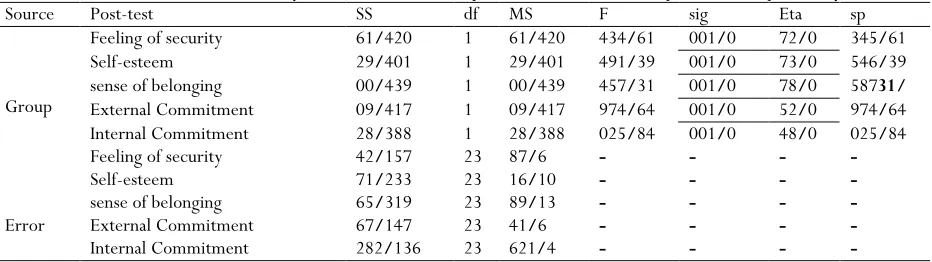
As in Table 5. As can be seen, the significant levels of all tests indicate that there is a significant difference between the experimental group and the control group, at least in one of the dependent variables (five components of responsibility). (P <0.01). Therefore, to determine which of the components of responsibility differ between the two groups, five univariate covariance analyzes were performed in the context of multivariate covariance analysis. The results are reported in Table 5.
Table 6. univariate analysis of covariance on the post-test scores of the components of responsibility
Source Post-test SS df MS F sig Eta sp
Group
Feeling of security 61/420 1 61/420 434/61 001/0 72/0 345/61 Self-esteem 29/401 1 29/401 491/39 001/0 73/0 546/39 sense of belonging 00/439 1 00/439 457/31 001/0 78/0 58731 /
External Commitment 09/417 1 09/417 974/64 001/0 52/0 974/64 Internal Commitment 28/388 1 28/388 025/84 001/0 48/0 025/84
Error
Feeling of security 42/157 23 87/6 - - - -
Self-esteem 71/233 23 16/10 - - - -
sense of belonging 65/319 23 89/13 - - - -
External Commitment 67/147 23 41/6 - - - -
Internal Commitment 282/136 23 621/4 - - - -
Volume 2, Number 2, 2019 Iranian journal of educational Sociology |40
________________________________ ________________________________
__
4. Discussion
Since the purpose of this study was to evaluate the effectiveness of acceptance and commitment based treatment on accountability and its components, therefore, identifying this effect on the basis that accountability is one of the important indicators of academic performance. The results of this study showed that acceptance and commitment based training significantly improved responsiveness scores and its components in the experimental group compared to the control group; in other words, students who participated in group learning related to knowledge Students who did not receive this training received better scores on responsibility in the post-test phase, and this result suggests that acceptance and commitment training has made the students more accountable. Results of this research on the positive effect of acceptance and commitment based group training on responsibility with the results of Shirvani, Mehdi Zadeh (2018), Haratmeh, Emami (2017), Hayes & Masudah (2014), Hayes and Lillis (2014).
In explaining the possible reasons for the above results, it can be clearly seen that committed action based on acceptance and commitment is closely related to commitment, and can also be taught to those who are always open and flexible in dealing with issues. And always be committed to dealing with their problems and behaviors. While accepting the present, they always think of growth and progress, fear the challenge, and use psychological faulting. These are common concepts in the Acceptance and Commitment and Accountability approach. Therefore, the results are predictable and logical. In addition, the major advantage of this approach over other approaches is the motivational as well as the cognitive aspects, in order to influence and further the effectiveness of education. Therefore, acceptance and commitment training can be used as a supportive and effective tool to promote internal and external commitment.
In explaining the effectiveness of acceptance-based and self-esteem-based therapy in students, it can be said that ACT therapy, through the six basic processes of psychological resilience, empowers individuals with the ability to grow and evolve. And it raises the hardships and overcomes them (Taheri, dortaj, delavar & Seadatee Shamir 2019). It also illuminates the goals and orientations of life for the individual, which is dominant in painful and life-threatening situations, and also enables the individual to be aware of himself / herself and his / her abilities and weaknesses. So he can better take positive action to fix his weaknesses and admit that if he can't, he won't be able to do anything. Acceptance means that one accepts that something can change and that it is incapable of change. If it is capable of change and improvement, it commits itself to following it. This treatment defines values as the selected qualities of purposeful actions to solve their problems, and teaches clients to examine what they want from life and to apply it in different areas (Zahmatkesh, Hosseini Nassab, Seadatee Shamir, 2016). Life such as: work life, intimate relationships, friendships, personal growth, health and spirituality, and processes of failure, acceptance, values, and commitment help clients take responsibility for behavioral change. Treatment challenges clients to pay attention to what is important to them in different areas of life, such as jobs, intimate relationships, personal growth, and so on. And working on values enhances client motivation to participate in therapy, a revision of values and goals of life, and ultimately commitment to goals can be considered as key factors in this treatment. Overall, this treatment helps people learn to act on their deeply held heart values and move on in a meaningful way, then lead a rich and meaningful life with a sense of life and joy, self-satisfaction and life. It is clear that these processes can increase self-esteem.
Also, in explaining the effectiveness of this treatment on feelings of security and belonging, it can be said that behavioral commitment exercises along with faulting and acceptance techniques as well as discussions of one's values and goals and the necessity of defining values lead to this treatment. It changes the person's view of himself or herself and also gives the person the opportunity to re-view, describe and describe their emotional states and abilities without a judgmental view, and more focus on the therapist. Authorities are fully conscious of accepting responsibility for themselves, to fully recognize and acknowledge themselves and their abilities. (Seadatee Shamir, Mazboohi, & marzi, 2019; Seadatee Shamir, Sanee’I Hamzanlouyi ,2017, Seadatee Shamir, Saniee, Zare,2019).
Morowatisharifabad, Khankolabi, Gerami, Fallahzade, Mozaffari-khosravi & Seadatee-Shamir ,2016). The therapist encourages individuals to fully experience thoughts, emotions, relationships, and behaviors without having to suppress them and make valuable judgments about them. This treatment is enhanced by mental flexibility, changes in one's perceptions, acceptance of negative thoughts and feelings, reduction of empirical avoidance, pervasive consciousness, and constant self-observation, one's deficits in roles and characteristics. Temporarily recreating the values and commitment to achieving them improves one's self-efficacy (Seadatee Shamir, Tahergholami & Jalai,sh, 2017 ). By improving self-self-efficacy through acceptance and commitment-based intervention, the automatic state of the chain of behavioral responses is slowed and the individual It can control his thoughts and behavior, which in turn increases his sense of security and belonging. Repeatedly working with the content of avoiding thoughts and tendencies will gradually change the public's view of negative thoughts and emotions, as well as developing a different perspective on thoughts and emotions. Emotions are the main factor influencing this approach and it is the ability to break free from the feeling of insecurity and low belonging
If we are to accept that society needs to grow and improve as much as possible, its members need to have a strong sense of responsibility and not to fall short of the duties they are required to cultivate. do. Teaching accountability is the most exquisite gift students can have. It enabled students to take better care of themselves and to take up their responsibilities as responsible adults in the future. One of the goals of the Iranian education system is to raise responsible and socially responsible people (Jafari Sani, Keshavarzi & Seadatee Shamir ,2017). Responsibility, contrary to personality traits, can be developed and developed. ACT treatment, through the six basic processes of mental flexibility, grants individuals the ability to grow and evolve and increase their capacity to cope with difficulties and difficulties. It also illuminates the goals and orientations of life for the person who is in control of the painful and life-threatening situations, thus increasing one's willingness to make contact with painful and unexpected internal events and being able to do so. Acceptance and mindfulness processes make the individual more aware of themselves and their abilities as well as their weaknesses, so they can better take positive action to address their weaknesses. Do it yourself and admit it can't do it if it's not possible. (Hassani, Dortaj, bagheri & seadatee Shamir ,2019).
Acceptance means that one accepts that something can change and that it is incapable of change. If it is capable of change and improvement, it commits itself to following it. This treatment defines values as the selected qualities of purposeful actions to solve their problems, and teaches clients to examine what they want from life and to apply it in different areas. Life such as: work life, intimate relationships, friendships, personal growth, health and spirituality, and processes of failure, acceptance, values, and commitment help clients take responsibility for behavioral change (Abbasi anabad, Seadatee Shamir ,2016). Treatment challenges clients to pay attention to what is important to them in different areas of life, such as jobs, intimate relationships, personal growth, and so on. And working on values enhances client motivation to participate in treatment. The major advantage of this treatment over other therapies, considering the motivational aspects along with the cognitive aspects, is the greater effectiveness and continuity of the treatment and in fact a balanced and effective confrontation with thoughts and feelings, avoidance, Changing the view of the self and the story in which the individual has imposed the role of the victim himself, a reassessment of the values and goals of life, and ultimately the commitment to the goals, can be considered as key contributors to this treatment(Marzi & Seadatee Shamir ,2019). Overall, this treatment helps people learn to act on their deeply held heart values and move on in a meaningful way, then lead a rich and meaningful life with a sense of life and joy, self-satisfaction and life. It is clear that these processes can increase accountability.
Overall, this study showed that acceptance and commitment therapy based on the components of sense of security, self-esteem, belonging, internal commitment and external commitment of secondary school students were significantly effective in enhancing and improving these components (lotfi & Seadatee Shamir,2016). Has been. Therefore, it can be concluded that acceptance and commitment therapy education can be used to increase student responsibility. The present study has some limitations such as students'
Volume 2, Number 2, 2019 Iranian journal of educational Sociology |42
________________________________ ________________________________
__
sample, so caution should be exercised in generalizing the results of this study to other segments of the population. Also, this study was conducted only on female students whose results are generalized to boys. Other limitations of the study It is important to be aware of other limitations of the study in spite of efforts to improve the fluidity and reliability of the questionnaires (Mahdian, Asadzadeh, Shabani, Ahghar, Ahadi & Seadatee Shamir ,2011). Finally, based on the results of this study, it is suggested that acceptance and commitment therapy intervention can be used as part of intervention programs in school counseling centers to increase the responsibility of target groups.
References
Abbasi anabad A, Seadatee Shamir A. (2016). The effect of meta cognitive strategies instruction on secondary school male students working memory capacity and verbal short term memory. Science and Education.12:452-456.
Bahrami F, Malekian H, Abedi M R. (2006). "A Comparative Study of Student Responsibility Strategies", Teaching Quarterly. 17:72-64. [in Persian].
Bidaki S, Seadatee Shamir A. (2014). Minnesota Multiphasic Personality Inventory Score in relapsed and non-relapsed addicted person. International journal of education and applied sciences. 1(3):141- 146.
Emami ezat A, Hashemi nasab M, Nekonam MS. (2015). The Effectiveness of ACT Acceptance and Commitment Therapy on the Treatment of Psychological Injuries in Iranian Society. First Scientific Research Conference on Psychology, Educational Sciences and Community Pathology. [in Persian].
Forman E M, Herbert D. (2009). New directions in cognitive behavior therapy: acceptance based therapies, chapter to appear. In: O'Donohue WT, Fisher, JE, editors. Cognitive behavior therapy: applying empirically supported techniques in your practice. 2nd ed. Hoboken, NJ: John Wiley & Sons.
Glasser w. (2012). Reality therapy: A new Approach to Psychotherapy. Newyork, Harper and Row-publishers.
Haratmeh S, Emami R. (2017). The Effectiveness of Acceptance and Commitment-Based Therapy on Increasing the Level of Components (Trustee, Legislation, Self-Management) of Student Responsibility. Psychology Journal 261615/16. [in Persian]. Hassani F, Fariborz F, bagheri F, seadatee Shamir. (2019). The Effectiveness of Teaching Academic Engagement on psychological
Capital Female Students Secondary School. Journal of Instruction and Evaluation. 12(46):123-140.
Hayes S C, Lillis M. (2014). Science: Examining the progress of a distinctive model of behavioral and Cognitive therapy. Behavior Therapy.
Hayes S C, Masuda K. (2014). Measuring experimental avoidance: A preliminary test of working model. The psychological Record. Hayes S C, Strosahl K, Wilson KG, Beset R T, Et all. (2010). Measuring experimental avoidance: A preliminary test of working
model. The psychological Record.
Hosseini Qomi T. (2012). "Student Responsibility", Journal: School Counselor Growth. [in Persian].
Hosseininejad M. (2013). Youth, Responsibility and the Role of Society, Journal of Culture and Society. Interview with Hossein Lotfabadi, Secretary of the National Youth Scientific Research Council. [in Persian].
Izadi R, Abedi M R. (2014). Acceptance and commitment therapy. Tehran: Jungle and Kavoshyar Publications. [in Persian]. Jafari Sani S, Keshavarzi Z, Seadatee Shamir A. (2017). The effects of train composition with brain learning approach based on the
Educational self-efficacy and written ability of students. Iranian journal of educational sociology.1(3):56-65.
Kordlow M. (2008). "Investigating Factors Affecting Adolescent Responsibility at Home and at School Three", Growth Journal: School Counselor. 4(1): 11-4.
Kulm’s H, Bean R. (2008). "Teaching Responsibility to Children", translation: Parvin Alipour, Mashhad: Astan Qods Razavi Publications, Seventh Edition.
lotfi N, Seadatee Shamir A. (2016).The relationship between personality characteristics and attachment styles and emotional breakdown. Research in clinical psychology and counseling. 6(1):98- 112.
Mahdian H, Asadzadeh H, Shabani H, Ahghar G, Ahadi H, Seadatee Shamir A. (2011) The Role of Invitational Education and Intelligence Beliefs in Academic Performance. Journal of Invitational Theory and Practice.17:3-10.
Maleki J. (2006). "The Unfolding of Suffering - Effort and Responsibility", Tehran: Jeyhun Publications.
Marzi S, Seadatee Shamir A. (2019). The Role of Self-efficacy and Happiness in Predicting Self-criticism/reassurance among Teachers. frooyesh. 8 (5) :153-162.
Marzi S, seadatee shamir A. (2017). A confirmatory factor analysis and validation of the forms of self-criticism/reassurance scale among teachers. Iranian journal of educational sociology. 1(3):26-34.
Morowatisharifabad MA, Khankolabi M, Gerami MH, Fallahzade H, Mozaffari-khosravi H, Seadatee-Shamir A. (2016) Psychometric Properties of the Persian Version of Parenting Style and Dimensions Questionnaire: Implication for Children`s Health-related Behaviors. Int J Pediatr; 4(9): 3373-80.
Najafi Pāzuki M, Darzi A, Dastjerdi M, Seadatee Shāmir A, Dānāye Tous M. (2013). Syntactic awareness, working memory & reading comprehension. Educational Innovations. 12(1):61-84.
Naseri M, Seadatee Shamir A. (2014). Self-directed skills enhancement through cognitive skills training. International journal of education and applied sciences. 1(5):235- 240.
Roditi D, Robinson M E. (2011). The role of psychological interventions in the management of patients with chronic pain. Psychology Research Behavior Management. 4: 41-49
Roemer L. (2005). Acceptance- and Mindfulness-Based Approaches to Anxiety: Conceptualization and Treatment. New York, NY: Springer. 13: 213-40.
Safi A. (2004). Department of Education and Central Organizations Survey of the Ministry of Education and Presenting Different Views on the Future Perspective (Research), Moderator: Ali Asghar Kakooyibari. [in Persian].
Seadatee Shamir A, Mazboohi S, MARZI S. (2019). A confirmatory factor analysis and validation of the forms of self-criticism/reassurance scale among teachers. Quarterly journal of Educational Measurement. 9(34):133-147.
Seadatee Shamir A, Sanee’I Hamzanlouyi R. (2017). Relationship between Intelligence Beliefs and Achievement Motivation with Self-Regulated Learning in Students with Veteran Parents Injured More than 40%. Iranian Journal of War & Public Health.; 9(4):205-210.
Seadatee Shamir A, Saniee M, Zare E. (2019). Effectiveness of Couple Therapy by Gottman Method on Family Function and Marital Adjustment in Divorce Applicant Couples. IJRN. 5 (2) :10-17
Seadatee Shamir A, Tahergholami R, Jalai sh. (2017). The Impact of Metacognitive Skills Training on the Reduction of Academic Procrastination and Test Anxiety. Quarterly journal of family & research. 14 (1) :89-102.
Seadatee Shamir A, Kiāmanesh A, Kadivar P, Ali Hamidi M. (2010). Working memory, reading performance and academic achievement in male monolingual and bilingual students. Educational Innovations. 9(3): 89-124.
Seadatee Shamir A. Mazbohi S. (2018) Predicting the Responsibility of Secondary School Girl Students Based on self-efficacy and spiritual intelligence. Educational Psychology.14(48):127-145.
Seadatee Shamir A, Najmi M, Rezaiee Haghshenas M. (2018). The Effectiveness of Reality Therapy Training on Responsibility and Encouragement. Marriage in married students of Azad University. Journal of research in educational systems 12:563-669. Shirvani I, Mehdizadeh A. (2018). The Effectiveness of Acceptance and Commitment-Based Therapy on Responsibility in Women
with Breast Cancer Referred to Kerman Oncology Medical Centers. Kerman Azad University. [in Persian].
Soroush M. (2012). "The Sense of Individual and Social Responsibility, Prostitution, and Social Confidence in Shiraz Adolescent Studies", Journal of Applied Sociology. 2: 211 - 193.
Taheri F, dortaj F, delavar A, Seadatee Shamir A. (2019). The Effectiveness of Mindfulness Program on Academic Engagement: The Mediating roles of Academic Stress and Academic Burnout. Journal of Psychological Studies.14(4):157-174.
Talebi Tari F. (2015). "The Predictive Role of Mothers' Personality Characteristics on Social Competence and Accountability of Elementary Sixth Grade Female Students. Master of Education in Allameh Tabataba'i University. [in Persian].
Tanhaye Reshvanloo F, keramati R, Seadatee Shamir A. (2016). Optimism and self-esteem in adolescent girls: The role of identity stylesJournal of Applied Psychology. 2(22): 73-90.
Tanhaye Reshvanloo F, Saadati Shamir A. (2016). Construct validity and reliability of Symptom Checklist-25 (SCL-25). Journal of Fundamentals of Mental Health. 18(1): 48-56.
Zahmatkesh Z, Hosseini Nassab S D, Seadatee Shamir A. (2016). Examining the Relationship between Working Memory and Intelligence with Female Students` Academic Achievement in Monolingual and Bilingual High School of Tehran. Journal of Instruction and Evaluation. 8(32): 111-134.
Zand M. (2013). Investigation of attention to responsibility teaching in elementary school textbooks from the viewpoint of teachers in Tehran, M.Sc., Islamic Azad University, Tehran center. [in Persian].
Zarei M H, Mirshah Jafari S E, Liaghtdar M J. (2017). (Explaining Appropriate Teaching-Learning Approaches and Evaluation for Preschool Teachers' Professional Development Curriculum. Journal: New Educational Approaches. 19:120-135. [in Persian].