Vol. 1, No. 1, Spring 2019 Print ISSN: 2588-6703 Pp. 27-34 Doi: 10.22034/ijsc.2019.86924
Effectiveness of Assessment and Education Phase of Schema
Therapy on Marital Satisfaction
Atefeh Jafari*1, Mohsen Khorshidzadeh2, Mohammad Hosein Salarifar2
1 Master Student, Educational Psychology, Faculty of Education and Psychology, University of Birjand, Birjand, Iran
2 Assistant Professor, Faculty of Psychology and Education, University of Birjand, Birjand, Iran
Abstract
Background: Marital satisfaction is a common concept to show the degree of happiness and solidarity in marital relationship.
Objectives: This paper aims to study the effectiveness of assessment and education phase of schema therapy on marital satisfaction of high school married students in Ghaen city, eastern Iran.
Methods: The study has a quasi-experimental design with pre-test, post-test, control group, and a follow-up phase. The sample consisted of 30 married students who were selected by convenience sampling method and randomly assigned into experimental and control groups (n=15 per group). Both groups were assessed using Young Schema Questionnaire - Short Form and ENRICH Marital Satisfaction Inventory in the pre-test, post-test and follow-up phases. The early maladaptive schemas were taught to the experimental group in 8 two-hour sessions held once a week.
Results: The obtained data were analyzed in SPSS software (V-22) using multivariate analysis of variance. While similar before intervention, the experimental and control groups were significantly different after intervention. In other words, education led to increased, long-lasting levels of marital satisfaction.
Conclusions: Therefore, it can be concluded that marital satisfaction can enhance by implementing assessment and education phase of schema therapy.
Keywords: Assessment and education phase, Schema therapy, Early maladaptive schemas, Marital satisfaction
Introduction
Marital satisfaction is an important aspect of married life and plays a highly significant role in ensuring solidarity and durability of the married life (Fazel, Haqhshenas and Keshavarz, 2001). Nicolas (2000; quoted in Taghavi Dinani et al., 2014) believes that marital satisfaction is one of the common concepts to show the degree of happiness and integrity in marital relations. Winch (2002; quoted in Taghavi Dinani et al., 2014) define marital satisfaction as the coordination and correspondence between the present situation and the expected situation. Accordingly, marital satisfaction represents the degree to which there is conformity between the current and the expected status of the marital relation.
Marital satisfaction is characterized by a state of cordial relations between the couple, coordination of marital roles, and achievement of a degree of empathy. Based on this definition, an air of misunderstanding (lack of mutual understanding of the partner’s state and mood) and dispute is an indication of dissatisfaction. Evidently, an atmosphere of marital dissatisfaction impedes the functioning and health of the family. The most manifest issue mentioned by women during the six month period prior to the onset of depression is marital discord and disharmony. Marital satisfaction, on the contrary, reduces risks of depression (Fazel, Haqhshenas and Keshavarz, 2001). Thus, by accepting that problems are part of the reality of life, couples can be helped to enjoy a healthy relationship by attracting their attention to influential contributors to marital satisfaction and effective ways to resolve disputes and problems (Mohammadkhani, 2010).
The increasing incidence of matrimonial disputes in the contemporary world and risks of divorce and its subsequent negative consequences on mental health of the couple and their child have motivated family counselors to think of ways to help strengthen this holy tie between the couple. One such way is schema therapy developed by Young. Schemas are perceived as an abstract cognitive map that guides how to interpret and solve problems. When a certain need is not fulfilled, a maladaptive schema arises (Young, Klosko and Weishaar, 2010). A theory that accounts for the underlying mechanisms for occurrence of antisocial behaviors is the early maladaptive schema. According to Young (2003), the early maladaptive schemas are long-standing cognitive components, beliefs and non-conditional feelings we hold of ourselves. The early maladaptive schemas are profound and embracing patterns and themes arisen from memories, emotions, cognitions and physical feelings from childhood or adolescence. They continue through life, concern with ourselves and others, and are highly inefficient (Young, 2003). They are the key concepts to schema therapy (Sempertegui, Karreman, Arntz and Bekker, 2013; cited in Sohrabi, 2015).
motivated and the patient is helped to establish an emotional relationship between the current problems and childhood experiences.
At the end of this stage, the therapist and the patients conceptualize the problem in the framework of a schema model. In the second phase, based on the patients’ needs, the therapist utilizes cognitive, empirical, behavioral and interpersonal strategies flexibly in every session (Young et al, 2010).
Yousefi, Abedin, Tirgari, and Fathabadi (2010) found that there are associations between early maladaptive schemas and marital dissatisfaction, where social isolation / alienation, dependence / incompetence, and other orientation schemas were most relevant to marital dissatisfaction. In addition, they found that schema therapy intervention is effective on marital satisfaction, personality issues, dispute resolution, and ideological orientation. Soleymani (2014) also found that emotional deprivation, emotional inhibition, and mistrust can predict marital satisfaction in a significant manner.
Shekari Ghand Pazi, Navabi Nezhad, and Ahghar (2015) showed that schema therapy-based peer group therapy is effective in increasing satisfaction of married women. Mokhtari (2012) also found that schema therapy increased marital satisfaction of married individuals suffering from obsessive-compulsive personality disorder.
Previous research points to the effects of schema therapy on marital satisfaction. Building on the theoretical insights, the current study aimed to answer whether or not implementation of the assessment and education phase of schema therapy is effective on marital satisfaction.
Method
The study has a quasi-experimental design with pre-test, post-test, control group, and a follow-up phase. The population consisted of all female married high-school students in the city of Ghaen, eastern Iran, during 2013-2014 academic year. The sample consisted of 30 students who were selected by convenience sampling method and randomly assigned into experimental and control groups (n=15 per group). Both groups were assessed using Young Schema Questionnaire - Short Form and ENRICH Marital Satisfaction Inventory in the pre-test, post-test and follow-up phases. The early maladaptive schemas were taught to the experimental group in 8 two-hour sessions held once a week. The controls did not receive a particular intervention during the same period. The obtained data were analyzed in SPSS software (V-22) using multivariate analysis of variance. P values <0.05 were considered significant.
Instruments
Young’s Schema Questionnaire - Short Form (SQ-SF) and ENRICH Marital Satisfaction Inventory were used in this study.
A. Young’s Schema Questionnaire - Short Form (SQ-SF)
deprivation, dependence / incompetence, vulnerability to harm or illness, enmeshment / undeveloped self, failure to achieve, entitlement / grandiosity, insufficient self-control / self-discipline, subjugation, self-sacrifice, emotional inhibition, and unrelenting standards / hypercriticalness. Each item is rated on a 6-point scale (1=completely incorrect; 6=completely correct). Each set of five items covers one schema where a schema is considered to be actively maladaptive for an individual in case s/he rates 5 or 6 out of 3 items in the set. The reliability and validity of the instrument have been confirmed in several studies (John J, Joshua D and Jacqueline M, 2004; Glenn W, Caroline M and Vartouhi O, 2001). Normalization of the instrument was performed by Sadoughi, Agilaroufayi, Rasoulzadeh Tabatabaei and Isfahanian (2008) who obtained its internal consistency using Cronbach’s alpha as ranging between 0.62 and 0.90. In the current study, Cronbach’s alpha of the instrument was 0.89.
B. ENRICH Marital Satisfaction Inventory
The inventory was developed by Fournier, Olson, and Druckman (1983, cited in Sanayi, 2000) to determine the domains and strengths of marital relations. The first sub-scale includes 5 items, while the other sub-scales consist of 10 items. The 12-category scales of the ENRICH Inventory are Idealistic Distortion, Marital Satisfaction, Personality Issues, Communication, Dispute Resolution, Financial Management, Leisure Activities, Sexual Relationship, Children and Parenting, Family and Friends, Equalitarian Roles, and Religious Orientation.
Correlation coefficient of the ENRICH inventory for family satisfaction ranges from 0.41 to 0.60 and for life satisfaction from 0.32 to 0.41, suggesting convergent validity of the construct. All the sub-scales of the ENRICH inventory can differentiate between satisfied and dissatisfied couples, which indicates good discriminatory power of the inventory (Mahdavian, 1997). The internal consistency of the inventory in the current study was calculated as 0.89 using Cronbach’s alpha.
Findings
One hypothesis in this study was that implementation of the assessment and education phase of schema therapy can enhance marital satisfaction. To test the hypothesis, univariate analysis of covariance was applied. Prior to this, the assumptions of the project were investigated. To test the homogeneity of variances between the two groups, Levene’s Test for Homogeneity of Variances was used. The calculated Levene’s test was not statistically significant. Thus, the assumption that the variables are homogeneous is accepted. The Kolmogorov-Smirnov test was used to check whether the data were normally distributed the result of which showed a p value >0.05, indicating normality of data distribution. The results of the univariate analysis of covariance are summarized in Table 1 and Table 2.
Table 1. Results of univariate analysis of covariance on marital satisfaction
Source of changes Df Sum of squares F Sig
Group 1 2123.91 88.06 0.001
Table 1 shows that the calculated F for marital satisfaction is significant at P <0.01, meaning that marital satisfaction is significantly different between experimental and control groups, where schema training increased martial satisfaction.
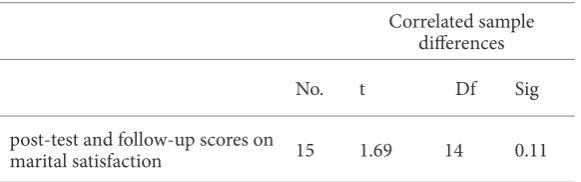
Cohen’s d indicator was 0.4 when used to determine efficacy of schema training on marital satisfaction. This efficacy is of a moderate level to increase marital satisfaction of the students (Sarmad, Bazzargan and Hejazi, 2008). Using T test, the continued efficacy of training on marital satisfaction was measured the results of which are displayed in Table 2.
Table 2. T-test results for post-test and follow-up scores on marital satisfaction
Correlated sample differences
No. t Df Sig
post-test and follow-up scores on
marital satisfaction 15 1.69 14 0.11
Results of Table 2 indicate that the calculated T is not significant at P <0.05, meaning that the mean marital satisfaction of the experimental group was not significantly different in the post-test and follow-up stages. Thus, it can be claimed that the training had continuous effects.
Discussion and Conclusion
Results of univariate analysis of covariance showed that assessment and education phase increased marital satisfaction in a significant manner. Tables 1 and 2 demonstrate the significant difference between experimental and control groups. This finding agrees with theoretical insights on effectiveness of schema education on marital satisfaction. Whenever marital satisfaction cannot be achieved in a simpler and shorter therapy, schema therapy proves a good alternative. In such cases, long-lasting and at times ambiguous marital and relational problems exist which seem difficult to diagnose and resolve. They root in early maladaptive schemas and destructive experiences of childhood and/or adolescence (Alaminia, 2014). Interpersonal schemas manifest in adulthood in selection of spouse and in marital relations, affecting the couple in destructive manners. Further, schemas can have an indirect effect on marital relations through their relations and effects on attachment style, personality disorder and mood disorders (Yousefi, 2011). Therefore, teaching schemas can enhance satisfaction with marital relations.
Active abandonment schema induces the perpetual perception in the person that s/he may lose or leave his/her spouse. These individuals are always in a sense of fear and worry. Abandonment schema is created at a time when the infant has not yet spoken and is in the pre-verbal stage. Involvement of either of the spouses in this schema can damage marital life. The patient avoids getting intimate with others, even with his/her spouse, and is always worried what the spouse is doing. A sense of exclusiveness and control plays an evident role in this schema (Young et al., 2010).
During the training sessions, characteristics of individuals suffering from abandonment / dependent and abandonment / volatility schemas and the factors contributing to these schemas were explained. The impact of this schema on intimate relationships and the early stages of love was also described. The participants were instructed to endure loneliness for a long time without getting depressed or anxious.
People with mistrust / abuse schema do not trust the honesty of their spouses. They suspect and avoid them. They feel that others are going to harm them, betray and abuse them. Instead of being a source of joy and confidence to them, their spouses manifest to them as unpredictable and dangerous. The dangers of this schema appear when the spouse is mistreating or interested in someone who is unreliable. The greater the involvement in this schema and the stronger the experiences of mistreatment in childhood, the more difficult and time-consuming the change and improvement in the person. The person alone will not be able to change it (Young and Klosko, 1993). During the training sessions, the participants were taught to avoid as far as they could those people who were mistreating to them, to defend themselves if they could, and to trust reliable people in their personal lives.
Emotional deprivation is a schema that inhibits the individual from expressing his/her emotional needs. A tendency on the part of this kind of people is to select someone as spouse who cannot or will not need to be satisfied by them. They often prefer to live with callous, self-centered, needy or lonely individuals. They avoid intimacy as they do not expect intimacy (Young et al, 2010). During the training sessions, the participants were helped to accept that emotional needs are natural rights of them. Any child or any adult needs affection, empathy, and support.
Individuals with dependence / incompetence schema present themselves as helpless and childlike. Since they cannot afford to handle their everyday responsibilities alone, their mere purpose is to find a spouse on whom they can depend. The spouse symbolizes the parents who would guide them step by step to do what they need to do. The main idea is that: I am incompetent, so I have to rely on others (Young and Kolsko, 2011). In the training sessions, the participants were taught to stop their reliability on others, especially their spouses, to fulfill their responsibilities by themselves, to accept their mistakes while learning how to do things, to have perseverance to succeed, and to prove to themselves that they can find solutions to their problems.
weak and helpless as they might believe and that the spouses still can manage their lives even if they paid lesser attention to them.
People with emotional inhibition refrain strongly from expressing and speaking about their emotions. They hide their feelings and appear emotionally cold and indifferent. They overemphasize rationality and ignore emotional needs which can result in serious problems in marital life (Young and Kolsko, 2011). The participants learned through the training sessions to discuss several of the emotions from which they had withdrawn, to express their anger in an appropriate manner, to manifest more emotions, and to speak about their feelings.
Presence of unrelenting standards / hypercriticalness manifests the individual as hard-working and perfectionist. A person’s health may be endangered because of everyday stress. S/He may lose the balance between work and leisure. Due to hard work and busy life, his/her relations would get damaged and s/he may have a disordered marital life (Young et al., 2010). In these sessions, the participants were helped to establish a better balance between work and pleasure, to spend time for emotional communication with their spouses, and to lessen their expectations.
Results of the present study agree with the study of Shekari Ghand Pazi, Navabi Nezhad, and Ahghar (2015) who examined effectiveness of group counseling based on schema therapy approach on marital satisfaction. The results showed that the schema therapy-based peer group therapy is effective in improving satisfaction of married women. Also, according to the findings of Yousefi et al (2010), schema-based educational intervention was effective on marital satisfaction, relationship, personality issues, dispute resolution, and religious orientation. Mokhtari et al (2009) found that schema therapy is effective in increasing marital satisfaction where the subjects’ satisfaction with their spouses significantly increased. This finding is in line with that of the current study.
Therefore, in light of the theoretical principles concerning early maladaptive schemas and marital satisfaction and findings from previous studies, it can be concluded that implementation of the assessment and education phase of schema therapy is effective on and enhances marital satisfaction. Thus, this type of education can be recommended to counseling centers, education departments, universities and welfare department in order to both confirm the efficacy of schema therapy and apply the approach for improvement of marital relations.
References
Alaminia, M. (2014). A critical review of researches in schema therapy area. Studies in Clinical Psychology, 18(5), 99-125.
Fazel, A., Haghshenas, H., & Keshavarz, Z. (2011). Predictability of marital satisfaction by personality traits and lifestyle in female nurses in Shiraz. Women Sociology, 2(3), 139-163.
Glenn, W., Caroline, M., & Vartouhi, O. (2001). Psychometric properties of the long and short versions of the Young Schema Questionnaire: Core beliefs among bulimic and comparison women. Journal of Cognitive Therapy and
Research, 25, 137-47.
Psychotherapy, 11, 344-52.
Mahdavian, F. (1997). Investigating the effects of educating communication on marital satisfaction and clinical
health. M.A. Thesis. Tehran Institute of Psychology.
Mohammadkhani, P. (2010). Turbulences in Marital Relations and Ways to Enhance Marital Satisfaction. Tehgran: Ghatreh.
Mokhtari, S. (2009). Investigating the efficacy of schema therapy on marital satisfaction of married individuals suffering
from Obsessive-compulsive personality disorder in Isfahan. M.A. Thesis. Al-Zahra University.
Sadooghi, Z., Aguilar-Vafaie, M., Rasoulzadeh Tabatabaie, K., & Esfahanian, N. (2008). Factor analysis of the Young Schema Questionnaire- Short Form in a nonclinical Iranian sample. Iranian Journal of Psychiatry and Clinical
Psychology, 14, 214-219.
Sanayi, B. (2000). Family and Marriage Assessment Scales. Tehran: Rosh.
Sarmad, Z., Bazargan, A., & Hejazi, E. (2008). Research Methods in Behavioral Sciences. Tehran: Agah Publications.
Shekari Ghand Pazi, F., Navabi Nezhad, S., & Ahghar, Gh. (2015). Effectiveness of group counseling based on schema therapy approach in marital satisfaction. International Journal of Psychology and Behavioral Research, 4(2), 171-177.
Sohrabi, F. (2015). Third-wave therapy: Origins, present and prospects, with particular emphasis on schema therapy. Studies in Clinical Psychology, 6(18), 1-14.
Soleymani, F. (2014). The Relationship of couple’s primary inconsistent schemas with marital satisfaction in bandar abbas. Academic Journal of Psychological Studies, 3(2), 148-153.
Taghavi Dinani, P., Zarbakhsh, M., Samkhaniyan, E., Hamidi, M., & Arkiyan, F. (2014). Study on the relationship between love attitudes and marital satisfaction among married women. European Online Journal of Natural
and Social Sciences, 3(3), 468-474.
Yoosefi, N. (2012). Comparison of the effectiveness of family therapy based on schema therapy and Bowen’s emotional system therapy on the early maladaptive schema among divorce applicant clients. Journal of
Fundamentals of Mental Health, 4(52), 356-373.
Young, J. (2003). Schema therapy. New York: Guilford.
Young, J., & Klosko, J. (1993). Reinventing your life. The breakthrough program to end negative behavior and feel great
again. [Translate into Persian]. New York: Penguin Group.
Young, J. E., Klosko, J. S., & Weishaar, M. E. (2003). Schema Therapy A Practitioner’s Guide. [Translate into Persian by Ahmad Hamidpour abd Zahra Andouz]. Guilford Publications: New York.