University of New Orleans University of New Orleans
ScholarWorks@UNO
ScholarWorks@UNO
University of New Orleans Theses and
Dissertations Dissertations and Theses
5-18-2007
Two essays on the predictability of asset prices: "Benchmarking
Two essays on the predictability of asset prices: "Benchmarking
problems and long horizon abnormal returns" and, "Low R square
problems and long horizon abnormal returns" and, "Low R square
in the cross section of expected returns"
in the cross section of expected returns"
Benito Sanchez
University of New Orleans
Follow this and additional works at: https://scholarworks.uno.edu/td
Recommended Citation Recommended Citation
Sanchez, Benito, "Two essays on the predictability of asset prices: "Benchmarking problems and long horizon abnormal returns" and, "Low R square in the cross section of expected returns"" (2007). University of New Orleans Theses and Dissertations. 1080.
https://scholarworks.uno.edu/td/1080
This Dissertation is protected by copyright and/or related rights. It has been brought to you by ScholarWorks@UNO with permission from the rights-holder(s). You are free to use this Dissertation in any way that is permitted by the copyright and related rights legislation that applies to your use. For other uses you need to obtain permission from the rights-holder(s) directly, unless additional rights are indicated by a Creative Commons license in the record and/ or on the work itself.
Two essays on the predictability of asset prices:
"Benchmarking problems and long horizon abnormal returns"
and,
"Low R square in the cross section of expected returns"
A Dissertation
Submitted to the Graduate Faculty of the University of New Orleans in partial fulfillment of the requirements for the degree of
Doctor of Philosophy in
Financial Economics
by
Benito A. Sanchez
B.S., University of Carabobo, 1993 M.B.A., IESA, 1995
M.A., Tulane University, 2001 M.S., University of New Orleans, 2005
Dedication
This dissertation would not exist without the support of my loved wife, Irma. She supported me not only during the intellectual demanding work that is to write a dissertation, but also during the whole Ph.D. program. For more than 12 years, she has literally lived my previous master degrees and my entire academic career. Irma, this is for you.
Dedicatoria
Acknowledgement
Table of
C
ontents
Abstract ... vi
Essay I: Benchmarking problems and long horizon abnormal returns...1
I. Introduction ...1
II. Literature review ...6
A. Benchmarks for Measuring Abnormal Returns ...6
A.1. Characteristics Based Models ...7
A.2. Factor Models ...9
A.3. Stochastic Discount Factor Models...11
B. Statistical corrections for current methods...13
B.1 Carefully constructed portfolios and skewness-adjusted t statistics ...13
B.2. Bootstrapping ...14
B.3 Calendar time portfolios...15
B.4. Bayesian approach...16
C Seasoned Equity Offerings performance...18
III. Methodology ...19
A. Asset Pricing Benchmarks ...20
A.1 The Stochastic Discount Factor ...20
A.2 Alternative Asset Pricing Benchmarks ...23
A.3 Restricted Asset Pricing Model...24
B Data Description...27
IV. Results...32
A CRSP Sample Distributions ...32
A.1 The Fundamental Benchmarking Problem ...38
A Seasoned Equity Offerings performance ...41
C Predictability of alphas...44
V. Conclusions...56
Appendix A: Derivation of the Restricted Asset Pricing Model (RAPM) ...62
Appendix B: Alternative CAR estimation ...65
Essay II. Low R square in the cross section of expected returns...74
I. Introduction ...74
II. An Empirical Model of the Cross-Section of Expected Returns ...76
A. Time Series and Cross-Sectional R2s ...77
B. Expected return and market return variance ...78
II.2 The error in variable problem...80
C. Data description and estimation procedure ...81
III. Empirical Results ...83
A. Explaining the cross-sectional R2 volatility ...89
B. Time series and cross-sectional R2 in portfolios ...92
List of Tables
Essay I’s Tables.
Table 1. Summary of abnormal returns tests ...17
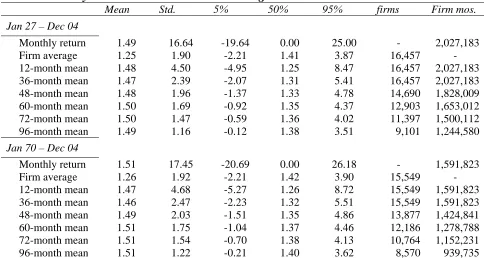
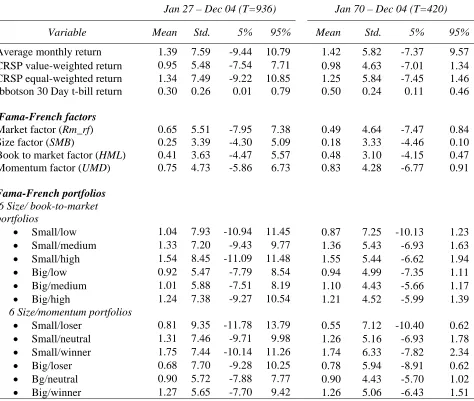
Table 2. Return Descriptive Statistics...30
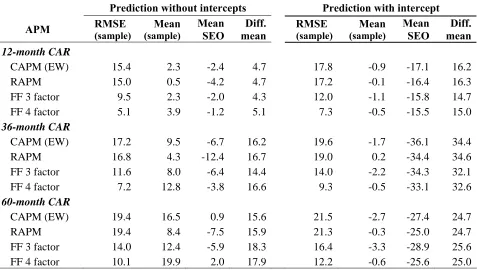
Table 3. Benchmark model performance...34
Table 4. Sample and SEO pricing with selected Benchmark models...42
Table 5. SEOs’ average CAR decomposition...44
Table 6. Alpha statistics...47
Table 7. Predictability of Jensen’s alphas...47
Table 8. Average Alpha by decile (period: Jan 1970 – Dec 2004)...50
Table 9. Predictability of Jensen’s alphas by decile ...52
Table 10. Alpha Predictability (Transition Table)...54
Table 11. Percentage of SEO events by decile ...55
Essay II's tables Table 1. Monthly statistics and Fama MacBeth cross-sectional regression results ...87
Table 2. Overall and firm level sample statistics with cross-sectional regression results ...88
Table 3. R squares comparison for individual firms...91
Table 4. R squares comparison for portfolios...94
Table 5. Monthly statistics and Fama MacBeth cross-sectional regression results ...97
Table 6. Overall and portfolio level sample statistics with cross-sectional regression results ....98
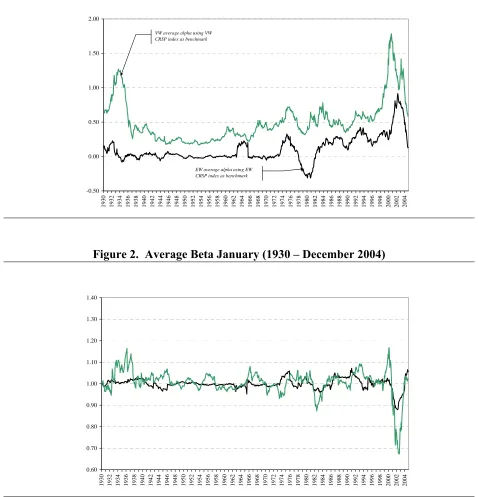
List of Figures Essay I’s figures Figure 1. Average alphas (%, January 1930 – December 2004) ...39
Figure 2. Average Beta January (1930 – December 2004)...39
Essay II’s figures Figure 1. Securities average time series R2 and cross sectional R2 ...84
Figure 2 Market and security average return volatility...85
Figure 3 Behavior of time series and cross-sectional R2 (securities) ...89
Abstract
This dissertation consists of two essays on predictability of asset prices. "Benchmarking
problems and long horizon abnormal returns" and, "Low R-square in the cross section of
expected returns". Long run abnormal returns following Initial Public Offerings (IPOs),
Seasoned Equity Offers (SEO) and other firm level events are well documented in the finance
literature. These findings are difficult to reconcile in an efficient markets world. I examine the
seriousness of potential benchmarking errors on the measurement of abnormal returns. I find
that the simpler, more parsimonious models perform better in practice and finds that excess
performance is not predictable regardless of the APM. Thus, the long run underperformance
following SEOs found in the literature is consistent with market efficiency because excess
performance itself is not predictable.
In the other essay, "Low R-square in the cross section of expected returns", I examine the
“low R-square” phenomenon observed in the literature. CAPM predicts exact linear relationship
between return and betas (SML). This means that estimated time series betas for firms should be
related with firms’ future returns. However, the estimated betas have almost no relationship with
future returns. The cross-sectional R2 are surprising low (3% average) while time series R2 are
higher (around 30 % average). He develops a simple asset pricing model that explains this
phenomenon. Even in a perfect world where there are no errors in the benchmark measurement
or estimation of the price of market risk the difference in R-squares can be quite large due to the
difference in variance between the “market” and average returns. I document that market
variance exceeds the variance of average returns, with few exceptions, for the last 74 years
Keywords: Asset pricing, predictability, cross sectional R square.
Essay I: Benchmarking problems and long horizon abnormal returns
I. Introduction
Most empirical tests of long-run abnormal returns demonstrate anomalous returns behavior.
Long-run is usually defined as a three to five year horizon following an event or set of events
impacting a firm. Abnormal returns are defined as deviations from either a benchmark asset
pricing model or a reference portfolio of matched firms. Negative cumulative abnormal returns
(CARs) indicate “underperformance” and positive cumulative abnormal returns show “superior
performance”.
The phenomenon of long-run underperformance of firm equity returns following a
variety of events such as mergers (Asquith, 1983; Agarawal, Jaffe and Mandelker, 1992),
dividend omissions (Michaely, Thaler, and Womack, 1995), Initial Public Offerings (IPOs) and
Seasoned Equity Offerings (SEOs) (Ritter, 1991; Loughran and Ritter, 1995), and more recently
bond ratings changes (Dichev and Piotroski, 2001) is well-documented in the literature.
Research also documents long-run superior performance following another set of events,
such as, dividend initiations (Michaely et al., 1995), earning announcements (Ball and Brown,
1968; Bernard and Thomas, 1990), open-market share repurchases (Ikenberry et al., 1995;
Mitchell and Stafford, 2001), tendered share repurchases (Lakonishok and Vermaelen, 1990;
Mitchell and Stafford, 2001), and stocks split (Dharan and Ikenberry, 1995; Ikenberry et al.,
1996).
The preponderance of long-run underperformance and superior performance of equity
returns has become a stylized fact in the literature, but these empirical findings challenge the
market efficiency paradigm and are difficult to reconcile with an equilibrium asset pricing
model. Market efficiency (ME) is essential to well-functioning financial markets and is a
fundamental tenant of standard finance models. In a well-functioning financial market,
mis-pricing should not exist for long periods of time. However, empirical findings seem to indicate
there are indeed long periods of misaligned prices. Long periods of mis-pricing violate any
concept of investor rationality.
Long-run abnormal returns studies are plagued with benchmarking errors that raise
doubts about the validity of their findings. Fama (1998) calls using the wrong benchmark asset
pricing model (APM) used to calculate abnormal returns. Under ME, the mean cumulative
abnormal return should be zero, but in the literature this depends on the APM under study.
While Kothari and Warner (1997) find a positive bias in mean cumulative abnormal returns from
the APMs they study, Barber and Lyon (1997) find a negative bias in mean cumulative abnormal
returns for the APM they study. The bias in mean cumulative abnormal returns biases t-tests if
the researcher assumes the asset pricing model is correct (i.e., a mean zero abnormal return).
I examine the seriousness of potential benchmarking errors on an exhaustive set of
benchmark APMs using an expansive collection of individual equity returns from the Center for
Research in Securities Prices (CRSP) from January 1927 through December 2004. The APM’s
performance is measured by computing out of sample mean cumulative abnormal returns over
12, 36, 60 month horizons. I also look at the performance of APMs out of sample under the asset
pricing restriction that intercepts (i.e, “alpha” a measure of ex post excess performance) are zero.
I judge the goodness of fit alternative APMs by looking at the variance of prediction errors
relative to a simple random walk model. The best APMs are selected based on mean and
goodness of fit and studied further. The selected APMs are used to assess SEO performance
reported by Securities Data Corporation (SDC) from January 1970 because SEOs have proven
the most difficult for APMs to price.
This research examines the long run performance of 13 asset pricing benchmarks. The
simplest APMs are the single index models including the Capital Asset Pricing Model (CAPM)
and Market Models (without a risk free rate) using equally weighted and value-weighted CRSP
market indices. The performance of ad-hoc Fama and French three (market, size,
book-to-market) and four (market, size, book-to-market and momentum) factor models that have become
common place in the finance literature are also examined.
In addition to the standard finance models, I study the long-run abnormal return
properties of a benchmark “free” model based on Hansen and Jagannathan (1991)’s stochastic
discount factor (SDF). The main advantage of the SDF is that it encompasses all rational asset
pricing models (e.g., it does not require a specific asset pricing model to estimate expected
returns). The SDF is the least subject to the bad model problem as it imposes the least
restrictions on the behavior of asset prices. Similar to Arbitrage Pricing Theory, the number of
believed to convey pricing information are used to form six different SDF benchmarks. The
underlying assets are the same assets used in forming Fama and French factors.
The last model I study is created as part of this research. This is a variant of the CAPM
which avoids what I call the “fundamental benchmarking problem.” This model imposes a
natural condition found in most principles of finance texts. This condition states that there is no
idiosyncratic risk in the aggregate. For a given set of assets defined as “the market” this is
tautological, where the average market beta must be one and average market excess performance
(alpha) must be zero. In other words, the market cannot outperform the market. However in
most studies a sub-set of assets are of interest and this condition does not hold by definition.
Using the large collection of assets in the study, I impose the restriction that guarantees there is
no market wide miss-pricing and examine its performance along with other APMs.
The simpler, more parsimonious models perform better in practice. The relative mean
square error indicates that models which use an equally weighted index perform better than those
that use a value-weight index. The CAPM (equally –weighted) marginally outperforms the other
single index models including the restricted CAPM I propose. The out of sample performance of
these models indicates that the CAPM-EW can reduce prediction variance relative to a naïve
random walk model by 15-20%. The more complicated SDF benchmarks perform miserably out
of sample. Even though the SDF benchmark uses the same information that is contained in
assets forming the Fama and French factors, the Fama and French three and four factor models
perform much better. The Fama French 3-factor model seems to outperform its four factor
counterpart.
For every APM tested, imposing the asset pricing restriction that APM predictions
exclude their intercepts results in better performance than assuming excess performance
continues into the future. This indicates that excess performance may not be predictable
regardless of the APM.
Excluding the SDF benchmarks, all of the common APMs suffer from the “bad model
problem” as the average excess performance in these models is positive. That is the average
security outperforms the market! I show this is because low performing firms (negative alpha)
do not survive in the dataset as long as higher performing firms.
Based in lowest absolute mean cumulative abnormal return predictions, the equally
cumulative abnormal returns using intercepts in prediction also perform better than those that do
not. If a researcher uses intercepts in their prediction then the population mean cumulative
abnormal return should be assumed to be slightly negative and if a researcher does not use
intercepts in their predictions then the population mean should be assumed positive.
Of all the APMs, the restricted APM I propose does best on balance considering mean
and variance of predictions.
Next I use the selected models, CAPM-EW the restricted CAPM, Fama French three and
Fama French four factor models to study the long run performance of SEOs. While the degree of
mis-pricing among models is very similar, the degree of mis-pricing with and without the asset
pricing restriction in benchmark predictions is striking. At 12 months after an SEO, using
intercepts in predictions reveals that SEOs under perform by 14% or more. With the asset
pricing condition in place, the degree of underperformance drops to about 5%. At 36 months
after an SEO, the mis-pricing under the asset pricing restriction is about 16% which is half as
much as with using intercepts in benchmark predictions. These results indicate SEOs are
initiated by firms with disproportionately high ex post excess performance (i.e., high alpha
firms). As SEOs demonstrate, investors expecting high excess performance to continue will be
badly mistaken.
The true degree of miss-pricing is not contained in the mean abnormal returns, but in the
measure of excess performance. As firms issue equity, leverage declines and firms’ betas also
decline. Thus some of the abnormal returns difference can be explained by changes in risk
sensitively over the horizon under examination. Indeed, I do find a decline in betas of SEO firms
after issuance, however underperformance still exists.
I examine the predictability of excess performance. The evidence presented thus far
would suggest that SEOs are overpriced, but if in the months after an SEO, a securities excess
performance is not predictable there would be no way to take advantage of any overpricing. I
find very weak predictability from relating measures of excess performance of selected APMs to
their past. The R2 from these regressions are under 2%. Given there has been an SEO, the future
excess performance is significantly lower, but it is extremely uncertain as demonstrated by the
2% R2. I also find that SEO firms are high alpha firms; however this is not a homogenous group.
Firms in the lowest deciles of performance also participate in the SEO process and have higher
the lowest decile 36 month later. Like the population of CRSP securities under study, SEO
excess performance appears independent of its past. The negative mean abnormal returns of
SEOs seem to be related to some extreme negative performing securities in months after
issuance, but not a characteristic of SEOs themselves.
The remainder of this study is divided as follow. Section II reviews the literature of
measuring long-run abnormal returns and summarizes the SEO literature. Section III describes
the data and presents the methodology used to compute cumulative abnormal return for the set of
II. Literature review
Measuring abnormal returns is difficult as they are defined as deviation from a “true” asset
pricing model. Market Efficiency (ME) rejections may be caused by a misspecified model and
have little to do with ME itself. Fama (1998) calls using the wrong benchmark asset pricing
model to assess ME the “bad model problem.” The bad model problem is especially severe in
long run abnormal returns because model errors are cumulative. Fama (1998) states that
consistent with the ME predictions, most long-term anomalies tend to disappear “with reasonable
changes in technique.”
Long run tests of ME are not only plagued with potentially severe benchmarking error, but also
with statistical difficulties. For example, standard inference using t-statistic depends on
normality and independence. Long abnormal return studies show abnormal returns are positively
skewed and suffer both contemporaneous correlation and time series dependence. Whether these
statistical properties are part of the nature of abnormal returns or arise from “bad” models is an
open question.
This section reviews the different approaches to test long-run abnormal performance.
Specifically, it reviews all benchmarks models used in the literature as well as the statistical
difficulties and proposed solutions to current tests of long-run abnormal return.
A. Benchmarks for Measuring Abnormal Returns
In the literature, abnormal returns are pricing errors or return deviations from a well defined
benchmark. The benchmark is either an asset pricing model or a reference portfolio of firms
with similar characteristics as the set under study. The abnormal return:
ARi = Ri – Bij (II.1)
is the difference between firm i’s return Ri and the return of the benchmark Bij (time subscript
suppressed for clarity), where j is either a reference portfolio (mp), a control firm (cf), or an asset
pricing model (APM). The benchmark for firm i, Bij =
{
Ri,mp,Ri,cf,E(
Ri APM)
}
are returns from a reference portfolio Ri,mp, control firm Ri,cf, or predictions of a asset pricing model E(Ri|APM).Define abnormal performance by cumulative abnormal returns (CAR):
∑
∑
= −=
τ τ
τ ( , )
, i i ij
i AR R B
or by differences in returns from buy and hold strategies:
∏
∏
+ − + =τ τ
τ (1 ) (1 )
, i ij
i R B
BHAR , (II.2.b)
over the performance period τ.
The significance of abnormal performance uses the t-statistic:
N S
CAR t
CAR
= , or
N S
BHAR t
BHAR
= . (II.3.a, II.3.b)
where CAR and BHAR are the cross-sectional means of N event firms, and, SCAR and SBHAR
are their respective standard deviations. Statistical inference based on this test requires that
abnormal returns are independently distributed normal variables.
A.1.Characteristics Based Models
Characteristics based models have a long tradition in long horizon studies. The main advantage
of the characteristics based approach is that it does not rely on a particular asset pricing model to
define benchmark returns. The benchmark for measuring abnormal returns for each event firm
uses returns from either a single or set of “like” firms. A “match” for each event firm is found
by selecting firm(s) based on similar “characteristics.”
Admittedly, characteristics based models are ad hoc and do not have to be risk based.
Characteristics are any set of criterion that produces separation in average returns.1 The most common approaches are “reference portfolio” and “control firm”.
a) Reference portfolios
Characteristics based portfolios are commonly used benchmarks that have evolved. The earliest
studies used equally or value weighted market indices as benchmark portfolios. After the
seminal works by Fama and French (1992, 1993), reference portfolios became more refined by
matching on size and book-to-market ratios. After Jegadeesh and Titman (1993), momentum
1
became an additional criterion. The benchmark return becomes the realized return of the
characteristics based portfolio for event firm i: Bij = Ri,mp.
However, Barber and Lyon (1997), and Kothari and Warner (1997) identify potential
biases of using reference portfolios. The new listing bias arises because the sample firms under
study usually have a long pre-event return record, whereas the benchmark portfolio may include
recent IPOs which are known to have abnormally low returns (Ritter, 1991; Loughran and Ritter,
1995). Second, the rebalancing bias arises because the compounded return on the benchmark
portfolio implicitly assumes periodic rebalancing of the portfolio weights, whereas it is not
possible to rebalance single event firm returns. Finally, the skewness bias arises because
abnormal returns are not normally distributed. The single event firm return cannot take
advantage of the Central Limit Theorem properties that apply to firms combined into the
reference portfolio. The consequence is that event firm returns are skewed to the right while
portfolio returns converge to normality. Those biases reduce the size of t-test of abnormal
returns resulting in more frequent rejections than expected under the conventional t-distribution.2
b) Control Firm
In the control firm approach, event firms are matched to a particular “control” firm based on
characteristics such as size, book-to-market ratio, and –more recently– momentum. The
benchmark return becomes the realized return of the control firm for event firm i: Bij = Ri,cf.
Barber and Lyon (1997) show the control firm approach alleviates reference portfolio
biases. The control firm benchmark eliminates the new listing bias because the control firm must
exist during the performance period. This approach also eliminates the need for rebalancing
because a single control firm return is the benchmark instead returns of a portfolio. Finally, this
approach mitigates the skewness bias because both the event firm and the control firm are
equally likely to experience large positive returns.
The control firm approach is not a panacea free of empirical difficulties. Lyon, Barber
and Tsai (1999) provides evidence that the control firm approach does not work well if event
firms appear multiple times in the same performance period, if event firms are large, if event
firms are from the same two (or three)-digit SIC industry, or if event firms have large pre-event
2
momentum. This is problematic because most firm events under study (i.e., IPOs, SEOs, Stock
Repurchases, and other corporate events) are likely to satisfy one or more conditions under
which the control firm approach suffers shortcomings. Additionally, the criteria to choose the
control firm are subjective resulting in potentially different results when choosing different firms
to study the same event.
Furthermore, most firm level events are neither cross-sectional nor time independent and
that causes statistical inference problems. Corporate events empirically tend to bunch together in
“hot” periods introducing cross-sectional correlation. Also, empirically firms have multiple
events in short periods; violating time-independence. Thus, the control firm approach is very
limited in its application: it is only appropriate if the arrival of firm events is random and firms
do not have multiple events in the same performance period, which is not the case on many
corporate events.
A.2.Factor Models
An alternative to using matched firms returns, as a benchmark for abnormal returns is to define
benchmark returns as predictions of an asset pricing model (APM). Matched firm returns are
“model free” in the sense that these benchmarks do not need the parameterization of particular
APM, but they do require the characteristics of matched firms to be specified. The advantage of
parameterizing a specific APM is that a consistent set of restrictions on asset pricing behavior
can be imposed (i.e., in the cross section of returns). An APM is attractive not only because of
its theoretical appeal, but also because of the universality of its application. Abnormal
performance in the context of a particular APM is defined intuitively as the difference between
an event firm returns and its predicted return given an event firm’s exposure to systematic risk.
Essential to the APM approach is the implicit assumption that the asset price model under
consideration correctly price assets (see for example, Davis, Fama and French, 2000, and Daniel,
Titman and Wei, 2001). In other words, the implied assumption is that factors and or
characteristics chosen by researchers do indeed describe the cross-section of expected returns.
Fama (1998) argues that most tests for long-run abnormal return suffer from the “bad” model
problem where the magnitude of abnormal returns is rarely robust to alternative methodologies.
Moreover, Fama emphasizes that APMs, by their nature, are necessarily incomplete descriptions
The Fama-French (FF, 1993) three factor model is the most widely used APM in the
literature where expected returns are generated by a market factor, a size factor, and a
book-to-market factor.3 The FF regression model as applied to post event monthly returns is,
( ) 1...
it ft i i mt ft i t i t it
R −R =α β+ R −R +s SMB +h HML +ε i= n, (II.4)
where Rit is the return of event firm i, Rft is the risk free rate, Rmt is the value-weighted market
index return, SMBt is the return of arbitrage portfolio that is long in valued-weighted small stocks
and short in a valued-weighted portfolio of big stocks, HMLt is the return of arbitrage portfolio
that is long in valued-weighted high book-to-market stocks and short in a valued-weighted
portfolio of low book-to-market stocks.4 The factor loading are βi, si, and hi. The error term is
εit. Regressions are run separately for a set of n event firms to obtain a set of αi’s which are
Jensen’s measures of abnormal performance.5
The cross-sectional average of alphas is calculated and a t statistic is used to test the null
hypothesis of no abnormal return. Thus,
1
/
N i i
N
α α
=
=
∑
and the t statistic isN S t
/ α
α
= , where
Sα is the cross-sectional standard error.
As Barber and Lyon (1997) emphasize, this method has two advantages. First, it does not
require book-to-market data for the sample firm, allowing firms without available data for size
and book-to-market ratio to enter the analysis. Second, because the model does not require an
explicit measure of size and book-to-market, it can capture patterns that would otherwise be
miss-categorized (e.g., large firms that behave like small firms).
More recently, a fourth “momentum factor” has been added to the FF specification.
Jegadeesh and Titman (1993) show that an arbitrage portfolio that is long on past winners and
short in past losers earns a positive return that is not captured by FF’s three factors. Thus, the
amended FF model includes an additional factor risk; the momentum effect. The regression
setup is the same as above,
3
Womack (1996) used this method to study long-run analyst recommendations, and Loughran and Ritter (1995) used it to study Initial Public Offerings and Seasoned Equity Offering.
4
Fama-French factors have become a standard in the finance literature. A detailed description of how this factor are constructed can be found in Fama and French (1993) and the K. French’s website:
http://mba.tuck.dartmouth.edu/pages/faculty/ken.french/ 5
( ) 1 1...
it ft i i mt ft i t i t i t it
R −R =α β+ R −R +s SMB +h HML + p PR YR +ε i= t (II.5)
with an additional regressor PR1YR that accounts for momentum. PR1YR is the Jegadeesh and
Titman (1993) arbitrage portfolio. Studies of long-run abnormal returns follow Carhart (1997) in
constructing the momentum factor. Carhart constructs this variable first by computing the
average return on all firms in the last eleven months. The arbitrage portfolio return is then
formed by taking the difference between equally weighted portfolios of firms with the highest
(top 30%) past returns and firms with the lowest (bottom 30%) past returns. The testing
procedure using cross-sectional alphas follows the same manner as in the three-factor case.
The FF three and four factor versions have disadvantages beyond the “bad” model
problem. These APMs assume parameter stability that could be a problem in studying long-run
horizons (5 years). Over longer horizons, there are more opportunities for a firm to change size,
book-to-market ratios and other characteristics. In addition, the time-dependence and/or
cross-sectional correlation of abnormal returns can bias the inferences.6
A.3.Stochastic Discount Factor Models
The stochastic discount factor (SDF) approach to benchmarking returns was first suggested by
Chen and Knez (1996) who built on the work of Hansen and Jagannathan (1991). The SDF is
model free in the sense that it requires only that the law of one price holds. Expected returns can
be computed with the first two moments of return data without assuming a specific utility
function, complete markets, normality of returns or that a particular benchmark portfolio is a
tangency portfolio. Therefore the SDF model is well suited to address the bad model problem as
it imposes the least restrictions on the behavior of asset prices.
Early theoretical development of the SDF is credited to Ross (1978), Rubinstein (1976),
and Harrison and Kreps (1979). The SDF is constructed on the principle that the law of one
price holds. The law of one price is the familiar present value relation,
[
+1 +1]
= t t t E m x
p (II.6)
where p is a vector of today’s prices on n assets and m is the discount factor that applies to
tomorrows payoffs, x. The law of one price simply states that if two assets have the same set of
6
payoffs they must sell for the same price. This implies there is only one discount factor at each
date.
Hansen and Jagannathan (1991) show that a valid discount factor, m, can be formed as a
linear combination of the returns, mt =b′Rt, where b is a vector of parameters and R is the
vector of gross returns on n assets. Divide (6) through by prices to get:
[
mt+1Rt+1]
=1E , (II.7)
and substituting the expression for m we obtain
[
b′Rt+1Rt+1]
=1E . (II.8)
It is straightforward to compute b. The resulting SDF m will exactly price the assets used
in its construction. Hansen and Jagannathan (1991) further prove that the resulting SDF has the
lowest variance of any candidate discount factor and shows there is a duality of the Hansen and
Jagannathan bounds that they develop and the mean variance frontier. The SDF approach
guarantees that resulting portfolios used as benchmark assets will in fact lie on the mean variance
frontier. There are other representations of the SDF that are equivalents. Specifically, discount
factors, betas representations and mean-variance efficient frontier are equivalents, as all of them
carry the same information (Cochran, 2001, p. 101).7 In the SDF context over and under pricing is defined by,
$
1−E mR( p)=α (II.9)
where Rp is the event firm portfolio and α$ is the parameter of interest. If alpha is greater than
zero there is over pricing and if alpha is negative there is underpricing. Ahn, Cliff, and
Shivdasani (2003) study the long-run performance of SEOs using the moment conditions:
, $
1 '
1 '
t t
p t t
R R b E
R R b α
−
⎡ ⎤
=
⎢ − − ⎥
⎣ ⎦ 0. (II.10)
The discount factor is formed from the set of basis assets. The second moment condition uses
this discount factor to price an event firm portfolio (i.e., α$ =0). The parameter of interest is
7
alpha, which is zero under the null hypothesis. Moreover, GMM can be used to estimate the
parameters.
The main disadvantages are that the approach as presented assumes parameter stability and that it
also is estimated in sample, forcing the pricing errors to be zero by construction.
B. Statistical corrections for current methods
Several approaches exist in the literature to deal with the biases in abnormal return estimation,
the cross-sectional/time series dependence of abnormal returns, and the non-normality of the
abnormal return distribution. These approaches include “carefully constructed portfolios”,
“adjusted test statistics”, “generated empirical distributions”, and “calendar time portfolios”.
B.1.Carefully constructed portfolios and skewness-adjusted t statistics
Lyon, Barber and Tsai (1999) advocate the use of “carefully constructed portfolios” (CCP)
where firms matched by characteristics (size and book-to-market, etc.) are purged of new listings
and portfolios are constructed to avoid rebalancing. The benchmark CCP return is computed by
averaging the compounded individual security returns over the performance period given by:
Bij=
,
1
[ (1 ) 1]
s
s
n i t
bh t s
i s R B n τ + = = + −
=
∑
∏
, (II.11)where ns is the number of stock trade at the beginning of month s. The return of this portfolio is
a passive equally weighted investment in the stocks that constitute the reference portfolio. There
is no investment in new listed stocks after s, nor is there a need to rebalance the portfolio. The
abnormal return in this context is the difference between the buy and hold return of an event firm
i and the CCP return Bij.
Skewness bias will remain even when using CCPs. A researcher may try to correct this
bias using the conventional skewness-adjusted t statistic (Johnson, 1978):
2
1 1
ˆ ˆ
3 6
sa
t n S S
n
γ γ
⎛ ⎞
= ⎜ + + ⎟
⎝ ⎠, (II.12)
where, ( ) AR S AR τ τ σ
= and
However, Lyon et al. (1999) find that, while better than the conventional t-statistic, the
adjusted t-statistic is negative biased, resulting in more rejection of the null hypothesis than
expected. Thus, using the skewness-adjusted t statistic with CCP will not yield well-specified
tests.
B.2.Bootstrapping
Most tests of abnormal performance are based on the normality and independence of abnormal
returns. Bootstrapping procedures can mitigate errors in statistical inference caused by
non-normality of abnormal returns. A researcher may bootstrap the skewness-adjusted t statistics or
the average cumulative abnormal return.
a) Bootstrapped skewness-adjusted t statistic
Lyon et al. (1999) advocate the use of bootstrapped adjusted t statistics to deal with the
skewness bias, regardless the reference portfolio used. They find that “only the bootstrapped
application of the skewness- adjusted t-statistic yields well-specified test statistics.”8
Specifically, take 1,000 bootstrapped re-samples from the original sample of size nb = n/4. In
each resample calculate the skewness-adjusted t statistic (equation II.12). Take the bootstrapped
distribution of tsa and estimate the critical values xl and xu for a significant level α by solving:
( ) ( )
2
b b
sa l sa u
P t ≤x =P t ≥x =α . (II.13)
This method alleviates the non-normality of abnormal return and yields well specified
test. However, as Lyon et al. (1999) recognize, this method fails when there are overlapping
events, which is the case in most long-run abnormal return studies.
b) Bootstrapped empirical distribution of abnormal return from pseudo portfolios
Some researchers have bootstrapped an empirical distribution of average long run abnormal
returns.9 The work of Ikenberry, Lakonishok, and Vermaelen (1995) and latter amended by Lyon et al. (1999), propose replacing every event firm in the original sample with a control firm
8
They mention that these results are consistent with Sutton’s (1993) recommendation. 9
drawn randomly from a set of non-event firms with the same size and book-to-market ratio.
Next, calculate the abnormal return on each control firm as the difference between its holding
period return and the buy and hold return of a CCP (equation II.11). Take the average of
abnormal returns across control firms and record this value. Finally, generate a distribution of
long run average runs by repeating this procedure 1000 times. The researcher compares the
average abnormal return with the percentiles from the empirical distribution.
Bootstrapping the empirical distribution of abnormal return results in more powerful tests
than using a conventional t-statistic. However, as emphasized by Brav (2000), this approach has
two shortcomings. If the two samples (sample of test assets and sample of control assets) have
different variance, the generated empirical distribution will be biased. Second, if the original
sample of event firm returns are cross-sectional correlated, which is most likely the case, the
replacement with random samples may lead to false inferences because the latter assumes
independence by construction. Mitchell and Stafford (2001) present simulation evidence that the
bootstrapped empirical distribution method fails in the presence of cross-sectional and time
series dependent abnormal returns. They find that bootstrapped estimated t statistics could be as
much as four times too large in the presence of zero abnormal return.
B.3.Calendar time portfolios
One shortcoming of using any of the above approaches to testing abnormal returns is the
potential for cross sectional dependence among event firms. Brav (2000) argues that due to
industry effects or other contemporaneous cross firm connections abnormal returns are
cross-correlated. However, most tests of abnormal returns assume independence. Fama (1998)
suggests the use of calendar time portfolios (CTP) to resolve the problem. Sample firms enter
the CTP in the month following the event of interest and are held in this portfolio CTP for five
years, depending on the definition of the long run. The concerns about cross-sectional
dependence are alleviated because this approach eliminates the need to compute and test average
abnormal returns. Instead, the researcher examines the properties of the CTP. Any APM or
characteristic model can serve to benchmark CTP returns.
The most commonly used benchmark for CTP returns is the FF three factor model
Brav and Gompers (1997), and Jegadeesh (2000)]. The CTP return, Rctp, is used to estimate the
three factor regression:10
(
m f)
p p pp p f
ctp R R R s SMB h HML
R − =α +β − + + +ε , (14)
where the parameter alpha, αp, is the measure of abnormal performance. Lyon, Barber and Tsai
(1999) show that the CTP work well when cross-sectional dependence is severe. However,
because the benchmark itself is subjects to its own problems miss-pricing can persist.
Loughran and Ritter (1999) criticize the use of calendar-time regressions. Through
simulations, Loughran and Ritter find the CTP approach has low power to detect abnormal return
because this approach does not treat “hot” and “cold” event periods differently. In contrast,
Mitchell and Stafford (2000) revisit Loughran and Ritter (1999), accounting for
heteroskedasticity caused by calendar clustering, and find the CTP approach is more powerful in
detecting abnormal return than using bootstrapped reference portfolios.
B.4.Bayesian approach
Brav (2000) proposes a methodology to test long run abnormal return that confronts both
non-normality and cross-sectional dependence of abnormal return. Using a Bayesian approach in a
seemingly unrelated regression (SUR) setting, an empirical testing distribution is generated.
Specifically, given an asset pricing model and a researcher’s prior belief regarding the
distribution of a firm residual, the asset pricing model’s parameters are estimated through Bayes’
theorem. Then, given the estimated parameters, long-run returns for all firms are simulated
taking into account the variance-covariance of the residuals. These steps are repeated a large
number of times, and the simulated averages are used to build the empirical distribution of the
sample mean. Finally, the observed abnormal return is compared with the null distribution.
This approach solves both the non-normality and independence assumption of earlier
approaches. Also, it is neither subject to the new listing bias nor the rebalancing bias because
Brav uses CCPs. However, as Brav (2000) recognizes, it still relies on an asset pricing model or
a particular set of characteristics.
Table 1 shows a summary of current approaches and their advantages and disadvantages.
10
Table 1. Summary of abnormal returns tests
Panel A. Early Approaches
Approach Advantages Shortcomings
Reference Portfolio and
t-statistics
Does not need an asset pricing model Subject to new listing bias, rebalancing bias, skewness bias.
Assume Normality and Independence of abnormal returns.
Control Firm and t-
statistic
Does not need an asset pricing model Works well in random sample
It does not work well when sample firms are large, are from the same set of 3 digit SIC, or have large-pre event momentum. The researcher chooses the reference firm making it depend on researcher
subjectivity.
Asset Pricing Models (regressions)
Neither factors nor characteristics of the test asset are needed to assess abnormal return. Only portfolios with the factors and/or characteristics are needed.
Assume factor loadings are constant over time.
Assume pricing errors are uncorrelated and independent.
An asset pricing model is needed.
Panel B. Improved approaches
Approach Advantages Shortcomings
Carefully constructed portfolios and adjusted t
statistic
Eliminates new listing bias and rebalancing bias.
The skewness bias remains.
Bootstrapped skewness- adjusted t statistic
Take into account the skewness bias Well- specified in random samples
Does not correct cross-sectional
dependence and neither does overlapping events
It is well specified for random events, but not for non-random events.
Bootstrapped empirical distribution of
abnormal return from pseudo portfolios
Well specified if carefully constructed portfolios are used and rebalancing is not allowed.
Underlying assumptions are that event firm and matched firm are similar in every dimension and there is no cross-sectional correlation in sample firms. Test misspecified because of the independency assumption.
Calendar time portfolios
Well specified when there is cross-sectional correlation
More statistical power after controlling for sample composition
Well specified for random sample, but not for non-random samples,
By averaging, it gives the same weights to high intensity events and low intensity events
An asset pricing model is required Bayesian approach Corrects non-normality of abnormal
returns, cross-sectional dependence and time-series dependence.
C Seasoned Equity Offerings performance
Studies of long-run performance following Seasoned Equity Offerings (SEO) have led to
intensive discussion in the literature whether the market efficiency holds or not. Ritter (1991),
Loughran and Ritter (1995), and Spiess Affleck-Graves (1995) find that Seasoned Equity
Offerings (SEOs) underperform market indexes after three and five years after the issuance.
(Loughran and Ritter, 1995). Loughran and Ritter (2000), and Jegadeesh (2000) confirm those
findings. This set of authors argues that the underperformance is due to the effect of investors’
sentiment on returns. Investors who purchase shares in IPOs and SEOs systematically over-value
the shares at the time of issuances.
In contrast, Brav and Gompers (1997), and Brav, Geczy and Gompers (2000) show that
stock returns after IPOs and SEOs follow a more pervasive return pattern for small stocks.
Specifically, Brav and Gompers (1997) find that documented “IPOs underperformance” is not an
IPOs effect, but a firm size effect. Non-issuing small firms tend to have the same
underperformance as issuing small firms (Brav and Gompers, 1997). Moreover, Brav et al (2000)
show that the SEO underperformance is primarily concentrated in small issuing firms with low
book-market ratios. This set of authors argues that the documented underperformance is not
evidence against the ME. Small firms’ issuances are more likely to be held by individual
investors (rather than institutional investors), who are more likely influenced by fads or are
victims of asymmetric information. Once size is taken into account by using valued weighted
returns in benchmark portfolios, the documented underperformance reduces substantially.
Brav et. al. (2000) and Mitchell and Stafford (2001) also show that the reported
underperformance is sensible to the benchmark model, agreeing with Fama (1998)’s bad model
problem. However, Loughran and Ritter (2000) argue that the benchmarks selected by Brav et
al. (2000) and Mitchell and Stafford (2000) incorporate miss-pricing proxies rather than true risk
factors and therefore those miss-pricing proxies bias the test statistics to find no abnormal return
III. Methodology
This dissertation examines the seriousness of potential benchmarking errors in the measurement
of abnormal returns in several methodologies that use a particular asset pricing model (APM),
(including the Stochastic Discount Factor (SDF), which does not assume a particular benchmark
asset-pricing model). The benchmarks use monthly-updated parameters versions of different
asset pricing models (APMs) out of sample. Cumulative abnormal returns (CARs) for all firm
months available from 1927 to 2004 are computed for each APMs. All firm months encompass
the CRSP’s available common stock with at least 37months of return.
Alternative APMs such as market models (MM), capital asset pricing model (CAPM),
Fama and French three factor model (FF3), the Fama and French four-factor (FF4) model, and
the restricted asset pricing model (RAPM), which is a method I propose to force the benchmark
to price itself, are examined herein to asses whether it is the nature of data that is driving
statistical complexities found in the literature. I also obtain CAR under the random walk (RW)
in order to compare the performance of the APMS and SDFs relative to the RW. The literature
has not yet examined the reliability of the RW, FF4, or SDF benchmarks in detecting long run
abnormal performance.11
This research contributes to the literature a study on the properties of the
monthly-updated parameters versions of APMs out of sample. A common critique of benchmark APMs is
that they are constant parameters. The literature has not yet examined the properties of the
monthly-updated parameters parameter versions of alternative APMs. In addition, most research
is conducted in sample with no verification of how alternative models actually perform out of
sample.12 Estimating parameters in sample has the potential problem of forcing pricing errors to be zero, whereas the average pricing error estimated out of the sample is not required to be zero.
I analyze long-run abnormal returns for a set of APMs from January 1930 to December
1999. Previous studies have used shorter periods13. There is no study –to my knowledge– that has investigated the properties of CAR statistics with data spanning this period. I estimate CAR
11
Some authors have used the four factor model as a benchmark to test abnormal return. For example, Brav, Geczy and Gompers (2000) use the Fama-French three factor model and the four factor model and find that the former can capture the joint covariation of IPO returns, whereas the latter is needed to capture the covariation of SEO returns. 12
With the exception of Kothari and Warner (1997) who studies the specification of the market model and FF three factor model with constant coefficients over the performance period. Kothari and Warner (1997) found these two models were severely misspecified.
13
for different sub-periods: 1930-1972, 1973-2004, and 1990-2004. The Center of Research in
Security Price started including NASDAQ common stocks, which are predominantly smaller
companies than the NYSE companies, at the beginning of 1973. Thus, I studied the CRSP
sample pre and post NASDAQ common stock inclusion in the database to see whether the results
are sensitive to this fact. I also calculate CAR statistics for the 1990s because it was
characterized by high volatility in the market.
I estimate CARs for 12, 36 and 60 months using return security data from all available
firms that have at least 37 month of consecutive return in the Center for Research in Securities
Prices (CRSP) database. Previous studies have calculated a random sample of CARS to infer the
CAR statistics. In contrast, I calculate CARs for every firm-month from securities’ returns
during the period January 1927 – December 2004 and report statistics. In other words, for every
firm, I calculate CARS for all valid returns in each firm. There is no study that has estimated
this large CRSP sample that certainly represents the population distribution of CARS. Knowing
the population distribution allows a researcher to use the population mean and standard deviation
to test abnormal return. I also, estimate CARs for under assuming fixed parameters and for
non-overlapping events.
The following sections explain the empirical implementation of SDFs and APMs
considered in this study as well as data sources.
A. Asset Pricing Benchmarks
A.1.The Stochastic Discount Factor
The SDF model is well suited to address the badmodel problem as it imposes the least
restrictions on the behavior of asset prices. This benchmark is considered a model “free” in the
sense that it requires only that the law of one price holds, and expected returns are generated
using the information contained in a set of basis assets rather than a model with pre-specified risk
factors. Furthermore, the SDF encompass all rational asset pricing models, while imposing
fewest restrictions on the ability of assets to price risk. Under the SDF benchmark, expected
returns are computed with the first two moments of the return data without assuming a specific
utility function, complete markets, normality of returns or any other typical assumptions found in
Ahn, Cliff, and Shivdasani (ACS, 2003) is the only other work that studies the long-run
abnormal return using an SDF methodology.14 They find a particular SDF using m=b R' where
m is a SDF, b is a vector of parameters and R is a matrix of basis assets. One shortcoming of
linking m to the data using m=b R' is the possibility that m becomes negative. A negative
discount factor would imply the existence of arbitrage opportunities. ACS impose a
non-negative condition on the discount factor (m>0) but this restriction decreases the robustness of
tests; especially as the number of assets increases. Additionally, they assume the vector b is
constant through time.
Instead of using m as linear combination of basis assets, I use the mean-variance frontier
to test abnormal return as it has the advantage of being intuitive and simple to use in estimation.
Hansen and Jagannathan (1991) prove that a discount factor SDF m=b R' has the lowest
variance of any candidate discount factor and show that there is a duality between the volatility
bounds that they develop and the mean variance frontier. Let Rp and Rop be the return series
from two distinct mean-variance efficient portfolios. The expected return on any event firm i is a
convex combination of any two efficient portfolios:
( )
Ri iE( )
Rp(
i)
E( )
RopE =β + 1−β . (III.1)
Based on this SDF benchmark, I compute long-run abnormal returns from a set of N
event firms over a horizon (T=1, 12, 36, or 60 months) in the following way:
i. Define time indices: Performance period for which abnormal returns is collected
is of length T. The event month is at time k. Define T estimation periods as 36
month windows [k-36, k-1] where k = {1, T} denotes both a particular estimation
period and a particular month when performance is measured.
ii. In each estimation period k, I obtain the vectors of portfolio weights (wp,k, wop,k) of
the efficient frontier assets, Rp, and Rop15
iii. For each estimation period k I obtain the weight βi,kby running the regression:16
14
ACS apply the methodology to a set SEOs, but they do not study the statistical properties of CARs conditional on the SDF benchmark.
15
Rop is the orthogonal portfolio to Rp when no risk-free asset is assumed and is the 30 day Treasury bill yield when risk-free asset is assumed.
16
(
pt opt)
t ki t op t
i R R R
R, − , =β, , − , +ε t={k-36, k-1} (III.2)
iv. The weights from the tangency portfolios (vectors wp,k and wop,k) and βi,k are used
to obtain a new portfolio that mimics event firm i’s returns for one period ahead
out of sample. The realized return on the benchmark mimicking portfolio, Bi,k, is,
(
pk opk)
opk ki k
i R R R
B, =β, , − , + , , k = {1, T} (III.3)
v. The abnormal return is,
k i k i k
i R B
AR, = , − , , k = {1, T}. (III.4)
vi. The cumulative abnormal return for event firm i at time k is,
∑
=
= T
k k i T
i AR
CAR
1 ,
, .
vii. I compute CARs for all firm-months (e.g. all firms i and all months k) available
in the Center for Research in Securities Prices (CRSP) database.17
The SDF benchmark requires the formation of a mean variance frontier for each
estimation period. The choice of assets to be included in the construction of the mean variance
frontier remains an open question. Cochrane (2001) argues that this set of basis assets must be
well motivated because all the pricing information is contained in the variance-covariance
matrix. The literature finds that the market, size, book-to-market (Fama and French, 1992,
1993), and past returns (Jegadeesh and Titman 1993, 2001) are important and nearly independent
characteristics that prices equities. I introduce these characteristics into the covariance matrix of
returns by using the following set of portfolios:
a) The 3 Fama-French factors (market, size, and book to market).
b) The 4 Fama-French factors (market, size, book to market, and momentum)
c) Six size/book to market portfolios and the market portfolio.
d) Augmenting the above set by using six size/momentum portfolios. This means total a
total of 13 portfolios (6 size/book to market portfolios, 6 size/momentum portfolios, and
the market portfolios) to estimate the covariance matrix.
17
I estimate the SDF assuming the existence of a risk-free asset and assuming a zero beta
portfolio for the cases “c” and “d”. Finally, I use the value weighted market index as the market
portfolio.
A.2.Alternative Asset Pricing Benchmarks
The abnormal returns from the RW model, MM, CAPM, FF3 factor model, and FF4 factors
model are computed in a similar way as the SDF benchmark. The RW benchmark is a 36-month
moving average of returns. The RW benchmark,BiRW,k , is define as,
36 , 36 1 ,
∑
− − = = k k t RW k i t RiB , k = {1, T},
and the abnormal prices are measured using,
RW k i k i k
i R B
AR, = , − , , k = {1, T}.
The MM benchmark, BiMM,k , uses the regression relation,
t t m k i k i t i R
R, =α, +β, , +ε , t={k-36, k-1},
to determine the benchmark return,
k m k i MM k i R
B, =β, , , k = {1, T}
where αi,k, and βi,k are parameter estimates and Rm is the market return. As in equation III.4,
abnormal returns are defined in excess of the MM benchmark.
The CAPM benchmark uses the regression:
t t f t m k i k i t f t
i R R R
R, − , =α , +β, ( , − ,)+ε t={k-36, k-1},
where Rit-Rf is the excess return on the event firm i, Rmt- Rf is the excess return on the market.
The benchmark BiCAPM,k uses the estimated beta and the realized Rm and Rf:18
t f k f k m k i CAPM k
i R R R
B, =β, ( , − , )+ , , k = {1, T}.
Abnormal returns are computed as in equation III.4, but in excess of the CAPM benchmark.
18
The FF3 factor benchmark uses the regression specification, t t k i t k i t f t m k i k i t f t
i R R R s SMB h HML
R, − , =α, +β, ( , − ,)+ , + , +ε , t={k-36, k-1},
where Rit-Rf is the excess return on the event firm i, Rmt- Rf is the excess return on the market,
SMB is a zero investment portfolio that is long in small size firms and short in large size firms,
HML is a zero investment portfolio that is long in high book-to-market ratio firms and short in
low book-to-market ratio firms. The parameter estimates βi,k, si,k,and hi,k are the factor loadings.
The , 3
FF k i
B benchmark is:
t f k k i k k i k f k m k i FF k
i R R s SMB h HML R
B, 3 =β, ( , − , )+ , + , + , , k = {1, T}.
Abnormal returns are computed as in equation III.4, but in excess of the FF3 benchmark.
The FF4 factor benchmark expands the FF3 factor version to include a momentum factor. The
expanded regression relation is,
t t k i t k i t k i t f t m k i k i t f t
i R R R s SMB h HML p PR YR
R, − , =α, +β, ( , − ,)+ , + , + , 1 +ε t={k-36, k-1},
where PR1YR is a zero investment portfolio of firms with the highest returns in the last eleven
months minus firms with the lowest returns in the last eleven months (Carhart, 1997). The
parameter, pi,k, is an additional factor loading. The FF4 benchmark returns, , 4
FF k i
B are given by,
k f k k i k k i k k i k f k m k i FF k
i R R s SMB h HML p PRYR R
B , , , , , , ,
4
, =β ( − )+ + + 1 + , k = {1, T}.
Abnormal returns are computed as in equation III.4, but using the FF4 benchmark.
A portfolio can be estimated using equally weighted return or value weighted return. All
benchmarks above use value weighted portfolios to minimize the rebalancing bias. However, I
also investigate the properties of the MM and the CAPM when the market portfolio is calculated
using equally weighted returns.
A.3.Restricted Asset Pricing Model
This dissertation provides evidence that classical asset pricing models used to test abnormal
returns do not price themselves. I call this fact “the fundamental benchmarking problem”.19 In order to alleviate this problem, I propose the restricted asset pricing model (RAPM), which
forces the benchmarking model to price itself.
19
Assume that MM (or CAPM) is an equilibrium model (and therefore market is an
equilibrium priced risk factor). This means that the market portfolio will contain both test assets
and control assets. If the market index is well constructed, the average alpha and beta will be
zero and one respectively. In other words, if firms in the estimation period are exactly the same
in the index (e.g., it is not allowed entering or delisting any firm), then the average alpha and the
average beta are zero and one, respectively.20 To see this let’s Ri be the i firm’s return. Then for each firm i, the market model states:
i m i i
i R
R =α +β +ε (III.5)
where
∑
= = n i i m R n R 1 1
is the market return, n is the number of firms, α and β coefficients, and ε
the error term. The beta coefficient is estimated in a regression as:
(
)
2 , cov m m i i R R σ β =Summing across i , we have
(
)
121 2 1 , cov , cov m m n i i n i m m i n i i R R R R σ σ β ⎟ ⎠ ⎞ ⎜ ⎝ ⎛ = ⎟⎟ ⎠ ⎞ ⎜⎜ ⎝ ⎛ =
∑
∑
∑
= = =dividing by n,
(
)
(
)
1 , cov , 1 cov , cov 1 2 2 2 2 1 1 21 = = =
⎟ ⎠ ⎞ ⎜ ⎝ ⎛ = ⎟⎟ ⎠ ⎞ ⎜⎜ ⎝ ⎛ =
∑
∑
∑
= = = m m m m m m m n i i n i m m i n i i R R R R n R R n n σ σ σ σ σ βTherefore, average beta is equal to one. Alpha can be found as:
m i i i R βR
α = −
Summing across i and dividing by n, we have:
(
)
1 1 01 1 1 1 1 1 = − = − = − =
∑
∑
∑
∑
= = = = m m m n i i n i i n i m i i n ii R R R
n R n R R n
n α β β
The results hold for value weighted market portfolio if the weights are fixed during the
estimation period. However, in practice, this will not be true because market value changes
through the estimation period.
20