in the population sciences published by the Max Planck Institute for Demographic Research Konrad-Zuse Str. 1, D-18057 Rostock · GERMANY www.demographic-research.org
DEMOGRAPHIC RESEARCH
VOLUME 21, ARTICLE 20, PAGES 599-626
PUBLISHED 27 OCTOBER 2009
http://www.demographic-research.org/Volumes/Vol21/20/ DOI: 10.4054/DemRes.2009.21.20
Research Article
Understanding low fertility in Poland:
Demographic consequences of gendered
discrimination in employment and
postsocialist neoliberal restructuring
Joanna Z. Mishtal
© 2009 Joanna Z. Mishtal.
This open-access work is published under the terms of the Creative Commons Attribution NonCommercial License 2.0 Germany, which permits use, reproduction & distribution in any medium for non-commercial purposes, provided the original author(s) and source are given credit.
1 Introduction: Eastern Europe and fertility decline 600
2 Postsocialist transformations and declining fertility in Poland 603
2.1 Before 1989 603
2.2 After 1989: Economic reforms and family planning restrictions 605
3 Fertility decline in Poland 606
4 Methods 609
5 Results 610
5.1 Sample characteristics (Table 1) 610
5.2 Quantitative and qualitative data results 612 5.3 Gendered discrimination in employment: employer practices
and job insecurity
613
5.4 Childcare and the babcia institution 616 5.5 The role of the State and family-friendly policies 617
6 Discussion 619
7 Acknowledgements 622
Understanding low fertility in Poland:
Demographic consequences of gendered discrimination in
employment and postsocialist neoliberal restructuring
Joanna Z. Mishtal1
Abstract
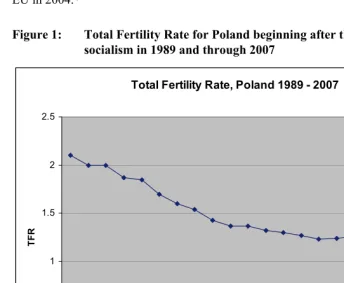
After the state socialist regime of Poland collapsed in 1989, the nation’s total fertility rate plummeted from 2.1 to 1.27 by 2007. Simultaneously, Poland severely reduced social service provisions and restricted access to family planning. A three-month mixed-methods research study was conducted in 2007 in Gdańsk to investigate Polish women’s reproductive intentions and decision making. These data reveal that discriminatory practices by employers against pregnant women and women with small children are decisive in women’s decisions to postpone or forego childbearing. The case of Poland demonstrates the urgent need to redress fundamental gendered discrimination in employment before work-family reconciliation policies can be effective.
1 Assistant Professor of Anthropology, University of Central Florida, Department of Anthropology, Howard
1. Introduction: Eastern Europe and fertility decline
In recent decades fertility has declined in most locations around the world, with the notable exception of sub-Saharan Africa. After the fall of state socialism in Eastern Europe in 1989, the region’s Total Fertility Rate (TFR) began to decline rapidly and recently fell to one of the lowest levels in the world. Eastern European nations currently constitute the majority of what are termed “very low fertility countries,” i.e., with TFR below 1.5. Eastern Europe is by no means politically, economically, or culturally heterogeneous and scholars have demonstrated the different permutations of socialism experienced in the region. Yet, the shared history of state socialism and similar global economic pressures to which these nations have been subjected result in many common post-1989 experiences that are significantly associated with fertility decline.
As a capital-poor system, state socialism relied heavily on labor and created an inflexible employment structure that provided a great deal of job security with virtually no threat of unemployment. This was especially significant for women who were for the first time able to easily enter the job market, interrupt their work for childbearing, and return to the safety of their jobs with minimal or no loss of wages. Simultaneously, and consistent with the socialist gender equity rhetoric, the state greatly expanded women’s access to education and reproductive rights (except in Romania), and established extensive state infant and childcare provisions. Food was relatively inexpensive and healthcare was free, although not always adequate. Consequently, gender relations were significantly reconfigured as women pursued careers, financial independence, and greater reproductive and sexual autonomy. The socialist state established itself as the “benevolent father” providing for the basic welfare of all (Verdery 1996:24). Women; however, were the major beneficiaries.
In the past high female unemployment and employment structures that deterred women from working have been associated with higher fertility. For example, the “new home economics” argument, proposed originally by Becker (1965) and Mincer (1963) posited that higher participation of women in employment resulted in lower fertility due to the disadvantages of child-rearing costs for women with higher wages. However, recent cross-national research demonstrates a reversal of this pattern, reflected by the Eastern European situation: a labor market that is not conducive to female labor participation is now associated with lower fertility (Castles 2003). To explain this phenomenon, some scholars have proposed the “tempo effect,” arguing optimistically that the very low fertility in Eastern Europe is driven by the postponement of childbearing, and that the system will eventually “catch up” (since it is assumed that women cannot postpone births indefinitely), following which fertility will at least partially recover, making the current situation just a temporary adjustment to new economic circumstances (Bongaarts 2002; Caldwell and Schindlmayr 2003; Sobotka 2004).
A recent and more convincing argument put forth by Reher (2007) and McDonald (2006) presents an opposing view. They assert that while the postponement of childbearing is an important factor in European fertility decline, “extremely low fertility has been around for too long for it to portend anything other than major long-term social change” (Reher 2007:194). Furthermore, in the Ukraine and Mongolia, postponement of childbearing is not pronounced, yet transformation-related hardships characterized by a decrease in economic activity and social services following the collapse of the Soviet Union are driving decisions to limit childbearing to 2.2 in Mongolia (from 4.8 in 1989) and to the extreme low of 1.24 in Ukraine (Aassve and Altankhuyang 2002; Perelli 2005). While a degree of recovery (perhaps reflecting a tempo effect) did materialize in the Nordic nations, states in Southern and Eastern Europe show no signs of improvement and in some locations fertility has continued to fall. Indeed, “[w]aiting for tempo is beginning to look like waiting for Godot” (McDonald 2006:487).
attainment and offer such provisions at an earlier point along a woman’s employment trajectory for such policies to have any real impact on the larger fertility decline.
Scholars have also observed major changes in educational, employment, and family size norms as well as in the desires of women, which contribute substantially to long term transformations in fertility patterns (Reher 2007). Women’s greater investment in education and careers and a desire for smaller families reflect both pragmatism and a shift in cultural norms as women balance their desires to achieve personal fulfillment with desires to ensure the best upbringing for their children. An analysis of normative changes regarding family size in Germany has shown that a lower fertility rate in one generation transmits notions of the desirability of the same or even lower fertility rate to the next generation, creating a self-perpetuating cycle of low fertility (Lutz and Skirbekk 2005:702-703). According to Lutz and Skirbekk (2005), when a population spirals to below a TFR of 1.5, it falls into a “low fertility trap” from which it is difficult to recover. In a mirror image argument, McDonald (2006) argues that a TFR of above 1.5 is a “safety zone” from which, with appropriate policies, a recovery is more feasible. Since Eastern European nations currently constitute the majority of countries with TFR below 1.5, this argument is particularly salient for this region.
But what are appropriate policies? Many scholars argue that family-friendly policies enable women to reconcile work and childbearing desires, indirectly redress some gender inequities within the family structure by turning away from the male breadwinner model, and offer women the confidence and security necessary to start families (Castles 2003; Dey 2006; McDonald 2000, 2006; Rosenbluth et al. 2004). Public policies which support maternal employment include state-subsidized childcare, generous parental leave with a portion of the leave “earmarked” for fathers, cash benefits for families, comprehensive healthcare benefits, and housing assistance. Issues of maternal employment support and gender equity are especially relevant for Eastern Europe, where the public sector has been shrinking since the fall of state socialism, employment insecurity had grown dramatically, and women have suffered disproportionately in the process. Outside of these commonalities, Eastern European fertility decline cannot be attributed to any single cause but rather must be explored as multi-factorial and context-specific.
family reconciliation laws can be initiated. I will now turn to the characteristics specific to the case of Poland.
2. Postsocialist transformations and declining fertility in Poland
2.1 Before 1989
Soviet controlled state socialism was established in Poland in 1948. Marxist egalitarian principles drove many new policies regarding expanded access to education, healthcare, and employment, especially for women, thereby creating substantial improvements in living standards of the population. Generous social service policies were established to relieve women of the burdens of caretaking and to facilitate their entry into paid employment. The state provided many households with basic appliances and opened a network of public childcare centers—from infant care facilities to library-like places for teens. Welfare benefits were expanded to include cash provisions to supplement families’ and single mothers’ wages, purchase school books and supplies, and support the care of disabled children. The state also subsidized a chain of cafeterias called Bar Mleczny (literally, Milk Bars) offering inexpensive home-style meals that could be picked up in stackable containers on the way home from work. As a result of these policies Polish women’s full-time employment rose to 78% during state socialism (Fodor et al. 2002:371-372). Although little changed within the family—women were still expected to manage the household and care for children, husbands, and elderly or sick relatives––state policies supported maternal employment with a great deal of job security and a considerable relief from caregiving.
Unlike elsewhere in Eastern Europe, Poland did not experience forced secularization because of the powerful position of the Polish Catholic church. Instead, church-state relations were characterized by “antagonistic interdependencies”—the state recognized that the continued visibility and importance of the church maintained a sense of stability among the populace who were faced with major political transformations and postwar chaos (Bax 1991; Swatos 1994). Conversely, the Polish church, witnessing systematic secularization elsewhere in the region, quickly recognized its dependence on the socialist state and the need to make concessions for survival in the new system.2
2 Indeed, most of the Soviet regimes repressed the churches since communist ideology associated religion
In 1952 the Polish state legalized abortion and introduced sex education in schools, although it did not reform the 1932 ban on voluntary sterilization, which remains in place to this day. The state heavily subsidized the development of a nationwide network of family planning clinics and educators—the Association for Conscious Motherhood (TSM).3 Beginning in 1959, TSM became a member of International Planned
Parenthood Federation (IPPF) and worked closely with IPPF to design family planning programs. TSM also worked directly with the Ministries of Health and Education. In principle, the church strongly opposed the legalization of abortion, and the increased access to contraception and sex education; however, the Episcopate rarely voiced these concerns. Instead, the Church’s negotiations with the state from the 1950s to the early 1980s centered on maintaining religious education in public schools, tax exemptions, and retaining real estate. In direct appeals to parishioners, the clergy spoke strongly against abortion, but they rarely attacked the policy itself (Swatos 1994).
During state socialism fertility declined at a gradual pace in Poland and elsewhere in Eastern Europe. Sociologist Elwood Carlson (1992) argues that fertility patterns in state socialist nations showed the reverse of the Easterlin hypothesis—a framework (conceived in the context of the United States) positing that free market forces drive women in-and-out of employment thereby producing cycles of alternating large generations with higher fertility and smaller generations with lower fertility (Easterlin 1961). Carlson found the opposite to apply to the pre-1989 Eastern Europe. The state socialist labor-driven economy operated on a “soft” budget (Kornai 1982) with minimal or no unemployment, and women’s workplace participation was consistently high. This economic system produced population cycles in which cohorts and fertility were directly proportional. In other words, in the context of state socialism, wage levels were not linked to reproductive decisions because women’s jobs and wages were always secure. Instead, the national-level shortages of goods associated with communist economic stagnation made women curtail their fertility during difficult times. Carlson observes; however, that population cycles in Poland and Slovakia elude the application of his “reverse Easterlin.” Nevertheless, he correctly notes that generous state’s subsidies for maternity leave and childcare minimized conflict between work and family in this region. In Poland, such provisions played an important role in making parenthood less burdensome, as evidenced by the consequences of the post-1989 cuts in these subsidies described in the following sections.
2.2 After 1989: Economic reforms and family planning restrictions
The end of state socialism in Poland came about as a result of a decade of mounting opposition waged by Solidarity—the Catholic-nationalist labor union—coupled with a failing economy. The collapse of the system in 1989 led to a series of political and economic transformations; the most detrimental for maternal employment was the shrinking of social services. Ironically, as the upper echelons of the Solidarity labor union took power after 1989, headed by the union’s leader Lech Wałęsa, the new government wholeheartedly embraced neoliberal economic principles that give market forces primacy in solving all sorts of economic and social problems to the detriment of organized labor and its principles. Comparative studies of welfare provisions in Eastern European nations show that Poland has had one of the harshest reductions in family and maternity benefits (Fodor et al. 2002:477-483). Maternity leave was cut from almost two years to less than four months. The post-socialist state closed or privatized most of the childcare facilities and reduced family cash benefits in almost every category. Many state subsidies for healthcare were eliminated, and as of 2005 Poland had the lowest public expenditure on health in the EU (World Health Organization 2006). For example, subsidies of medicines dwindled from 100% before 1989 to 35% in 2004, the lowest in the EU (Economist 9/16/2004). Even the Bar Mleczny cafeterias had their subsidies drastically reduced, and the handful that remain have raised prices considerably just to stay open.
According to the World Bank’s Development Research Group’s assessment of Eastern Europe, “the transition from planned to market economy has witnessed one of the biggest and fastest increases in inequality ever recorded” (Milanovic 1998). Indeed, economic changes are driving a new socioeconomic class stratification in Poland—the Polish Gini coefficient (a measure of the inequality of wealth distribution; a value of 1 indicates perfect inequality, while a value of 0 indicates perfect equality) went from 0.26 in the 1980s to 0.36 in 2005. Currently, Poland’s Gini coefficient is second highest after Russia in the post-Soviet region (World Bank 2007). Polish women are bearing the brunt of this stratification; they have twice the likelihood of falling below the poverty line as men and constitute the majority of the unemployed due to acute gendered discrimination in the workplace (Domanski 2002:393). In the face of growing female unemployment and disappearing state provisions, many of the women in rural areas are reverting to traditional strategies of relying on kin networks for resources, intensifying home production of clothing and food, and generally surviving on the informal economic exchanges so prevalent during state socialism. Ironically, these practices are returning as key coping mechanisms in the postsocialist neoliberal economy (Pine 2002).
after 1989. In an effort to repay the Church for supporting the Solidarity movement against the socialist regime, President Wałęsa immediately sought to eliminate access to abortion. In 1991 a nonlegislative policy known as the Conscience Clause allowed healthcare providers to withhold reproductive and sexual health services, in particular abortion (still legal at this time), prescription contraceptives, and information about family planning, by invoking conscience-based objections. In 1993 the government instituted a near-total ban on abortion. The law, which is still in place, criminalizes abortion under all but three circumstances: when the woman’s life or health is in danger; when a prenatal test shows a serious incurable deformity of the fetus which is threatening to its life; and when pregnancy is the result of rape or incest(and is less than 12 weeks, and has been reported to the police). Since 1956, when abortion first became legal in Poland, only 3% of all abortions had been performed for these three reasons (Johannisson and Kovács 1997; Nowakowska and Korzeniowska 2000). Within the EU nations, Poland’s law is second in severity only to Ireland’s.
The postsocialist state has also reduced access to contraceptives and family planning information. Shortly after 1989, the Ministry of Education eliminated publicly-funded sources of family planning information by abolishing sex education from schools and withdrawing funding for TSM, the sole national family planning organization discussed earlier. In 1999, it withdrew five types of birth control pills from the list of refunded prescription medications, and in 2002 it eliminated all health insurance coverage of hormonal contraceptives. As a result, such contraceptive methods became far less accessible because of their high cost relative to income. Given the considerable restrictions on access to family planning methods and information following 1989, the fertility decline experienced in Poland during the same period is remarkable.
3. Fertility decline in Poland
population growth compounded by significant emigration after Poland’s entry into the EU in 2004.4
Figure 1: Total Fertility Rate for Poland beginning after the fall of state socialism in 1989 and through 2007
Total Fertility Rate, Poland 1989 - 2007
0 0.5 1 1.5 2 2.5 19 89 19 90 19 91 19 92 19 93 19 94 19 95 19 96 19 97 19 98 19 99 20 00 20 01 20 02 20 03 20 04 20 05 20 06 20 07 TF R TFR
Data source: Statistical Yearbook of Poland, 1989 - 2007. Warsaw: Central Statistical Agency. TFR: Total Fertility Rate.
Historically, the traditional family model of early and long term marriage was pervasive in Poland, fueled by the dominance of the Catholic church. Traditionally, childbearing was expected to occur early and within marriage, and deviations from this model met with strong stigma directed toward single or relatively older (late 20s and above) mothers, and toward children born “out of wedlock.” As recently as the 1980s, the permanence of marriages was remarkable in Poland—80% of them ended only when one of the spouses, usually the husband, died (Frątczak 2004a:6).
4“Demographic Situation in Poland,” 2005-2006, Report No. 1. Warsaw: State Committee on Population.
These traditional norms are giving way to new patterns, many of which have been described by scholars in the past as signs of the second demographic transition (Cochran and O’Kane 1977; Lesthaeghe and Neels 2002). One of the most prominent trends is the postponement of childbearing: the mean age at first childbearing increased in Poland from 23.1 in 1989 to 25.7 in 2006. The mean age at second childbearing was 29.1 in 2006. The number of marriages systematically dropped since 1989 and the number of extramarital births rose (Kotowska et al. 2008). Divorces have increased although Poland’s divorce rate remains one of the lowest in the EU. Marriage is also being postponed, and more so by women than men. However, since an estimated 25 - 30% of marriages in Poland occur as a result of a pregnancy, the postponement of marriages by itself does not necessarily explain the postponement of childbearing. Also, since cohabitation has grown in Poland and is often viewed as a potential stepping stone for marriage (Mynarska and Bernardi 2007), it is likely that some women and couples simply continue to cohabitate or maintain single status in spite of an unplanned pregnancy. In fact, while only 5% of births were extramarital in 1989, by 2003 that number rose to 16% overall, and to 19% in urban areas. Voluntary childlessness has also increased, though there are no data on the extent of this phenomenon in Poland (Frątczak 2004a).
Scholars have argued that a traditional and religious family ethos is linked with greater gender inequity in the private sphere and constitutes a powerful force driving women’s preferences for fewer children (Castles 2003; Dey 2006; McDonald 2000). In particular, McDonald (2000) asserts that in locations where education and employment reached a relatively high level of gender equity but the institution of the family, often guided by a religious family model, did not, fertility will continue to fall. Thus far, demographic research in Poland has corroborated findings from the rest of Eastern Europe that fertility barriers include the rising cost of having children and the inability of women to reconcile work and family in the new labor market (Kotowska et al. 2008). Ideational changes in Poland regarding ideal family size, gender roles, and growing individualism weaken the traditional family model (Bühler and Frątczak 2005; Frątczak 2004a). Furthermore, applying the concept of the second demographic transition, Frątczak (2004a) argues that the transition has not yet been completed in Poland and that the state should look to other, especially Western European nations, for models of policies that support combining work and parenthood.
women negotiate their new circumstances, and must explore the origin of the preferences for the observed macro trends.
In light of the existing scholarship, my research in Poland focused on the factors that influence women’s choices to limit childbearing and the ways in which they achieve one of the lowest fertility levels in the EU under circumstances of severely limited family planning services.5 Specifically, this project explored the intentionality
and barriers regarding childbearing, including the role of the state and the church in fertility decisions.
4. Methods
I investigated these issues in a research study conducted from May until August 2007 in Poland. The project was a descriptive cross-sectional survey with qualitative and quantitative primary data collection in Gdańsk and the Tricity area. The Tricity (the contiguous towns of Gdańsk, Gdynia, and Sopot) is the second largest (after Warsaw) urban region in Poland with a population of over one million in the metro area, located on the Baltic coast in the north of the country. I carried out 55 qualitative interviews and 418 quantitative surveys with women ages 18-40 in four major healthcare facilities. The qualitative portion of the study involved in-depth interviews to examine the process behind reproductive decision-making. Interview questions probed the intentionality and barriers regarding the number of children, religious and cultural attitudes affecting childbearing decisions, the understandings of methods of fertility control, and knowledge about the abortion underground. The quantitative survey explored pregnancy prevention behaviors, contraceptive knowledge, birth desires and intentions, and the role of Catholicism in fertility decisions. Gdańsk and its vicinity were selected for because its median income falls closest to the average income of the 13 main urban centers in Poland and its economic base has been diverse, spanning chemical, electronic, and shipyard manufacturing.
Data were collected in face-to-face interviews with individuals using a 168-question quantitative interview instrument and 24-168-question qualitative interview instrument. No identifying data were collected and all interviewees were assured of anonymity. The study recruited women in four multi-specialty medical facilities that provide general and specialized medical services and serve as the portal of entry for medical care for the population at large. These clinics accept patients with national or private healthcare coverage, as well as patients paying “out of pocket.” The research sites were selected from a list of 19 regional clinics from the city of Gdańsk by
5 The portion of my research that deals with contraceptive use and clandestine abortion does not directly
selecting every fourth clinic on the list. Survey and interview procedures and instruments were the same across the four medical facilities.
Respondents were recruited from among patients who were waiting for an appointment in the main waiting room at each facility. After having been identified visually as age-eligible candidates, the women were handed a written description of the project which invited them to participate in the survey in a separate, private room within the facility, usually on the same day as their medical appointment. Women were eligible to participate if they were (1) age 18 to 40, (2) arrived at one of the four facilities for an appointment either for themselves or their child/ren, (3) had never been told by a doctor that they could not get pregnant for biological reasons, and (4) were able to provide informed consent. Interviews were conducted in Polish, and were transcribed and translated into English. Women received a small remuneration of 20 złotych (approx. 7.25 USD) after the interviews. A team of eight trained research assistants conducted most of the surveys and the principal investigator collected most of the qualitative data.
Quantitative data analysis was conducted using STATA 9.2 and SPSS (version 17) software programs, which were used to establish the demographic characteristics of the sample, calculate frequencies, and to conduct bivariate and regression analyses. The qualitative transcripts were analyzed using ATLAS ti software. Each respondent’s text was coded by assigning thematic coding categories that emerged from the research questions and from the respondents’ narratives. Coded text was then sorted to identify the predominant themes and subthemes.
This study has limitations. Although the clinics selected for this study are typical of urban health centers across Poland, they are not a random national sample; therefore, the generalizability of the results is limited. Furthermore, the birth rate is generally lower in urban as compared to rural areas. So there may be significant differences between women in this study and rural women with respect to their childbearing experiences.
5. Results
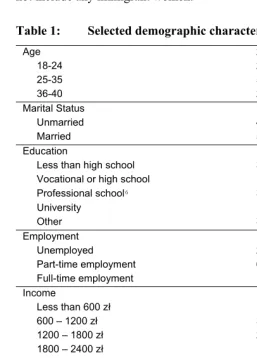
5.1 Sample characteristics (Table 1)
declared Roman Catholic affiliation (as compared to 89% nationally). The sample did not include any immigrant women.
Table 1: Selected demographic characteristics of the sample (N = 418). Age 18-24 25-35 36-40 29.3 (mean) 25.6% 51.1% 23.0% Marital Status Unmarried Married 45.4% 54.6% Education
Less than high school Vocational or high school
Professional school6
University Other 3.4% 10.6% 35.6% 14.9% 35.3% Employment Unemployed Part-time employment Full-time employment 24.3% 65.0% 10.8% Income
Less than 600 zł
600 – 1200 zł
1200 – 1800 zł
1800 – 2400 zł
More than 2400 zł
11.2% 37.2% 28.3% 13.6% 9.7% Parity 0 1 2
More than 2
0.92 (mean) 39.8% 36.7% 17.7% 5.7% Religious Affiliation Catholic Agnostic 94.2% 5.5%
5.2 Quantitative and qualitative data results
The data analysis shows that despite the policy restrictions on family planning, women use contraceptives and access illegal abortion to achieve the resulting very low fertility rate. Comparing UNDP data from 1991 (their most recent report on Poland) (UNPD 2003a) with results from my study demonstrates a significant increase in contraceptive use in Poland. Overall, modern contraceptive use—condoms, oral contraceptives (OC), IUDs, and barriers—increased from 19% in 1991 to 56% in 2007 (condoms: from 2% to 35%, OC: from 9% to 13%, IUD: from 6% to 8%, barriers: not used). Among traditional methods, periodic abstinence declined from 19% to 13%, and withdrawal remained stable at 11%. The use of no method declined dramatically from 51% to 11%. Although contraceptive use surged, 36% of respondents stated that at least one of their live births resulted from an unintended pregnancy. Since the 1993 ban on abortion, a robust abortion underground provided by doctors has developed. The number of illegal abortions performed annually in Poland is estimated by local NGOs to be between 80,000 and 200,000.
The mean ideal fertility desire—the number of children a woman would like to have in her lifetime if no childbearing barriers (financial, social, familial or others) existed—was 1.91. For the purposes of this paper, the most relevant outcome variable is fertility desire—the total number of children a woman would like to have in her lifetime under current circumstances—which was 1.77. There is a negative correlation between parity and fertility desire, suggesting that as women get closer to realizing their ideal fertility, their desire for additional children declines. Fertility desire was significantly higher among married, rather than single, women (p value < 0.5). There was no significant relationship between fertility desire and education, and none was found between fertility desire and the happiness with one’s housing situation. The degree of Catholic religiosity (using a four-level scale of very/moderately/slightly/not religious) revealed a correlation showing a significantly higher fertility desire among women with a greater degree of religiosity (p value < 0.5).
barriers such as unemployment, an unemployed partner, cramped or inadequate housing, unstable work, and too short a maternity leave, all showed significant results for both groups. Of these, unemployment, partner unemployment, cramped or inadequate housing, and unstable work were more likely to be reported as barriers by women with no children. The only barrier that was more likely to be cited by women with one child was too short a maternity leave, indicating that once women experience the realities of maternity leave with their first child, this barrier becomes a significantly more prominent deterrent to having a second child.
5.3 Gendered discrimination in employment: employer practices and job insecurity
Qualitative data analysis reveals that widespread fear of discrimination by employers against pregnant women, new mothers, and women with small children drives women’s decisions to postpone or refuse childbearing. The majority of respondents either directly experienced gendered discrimination in employment or knew of women who had. These narratives reported problematic employer practices which had an adverse influence on women’s fertility decisions, such as firing women who returned to work following maternity or child-rearing leave, and encouraging or requiring women to sign a contract pledging not to get pregnant for two to three years as a contingency for their employment. Women also reported illegal practices such as asking female job applicants if they have small children and hiring permanent employees to replace women on maternity leave. As one 33-year-old domestic worker said:
The main barrier to having another child would be financial because kids are very expensive and I was fired twice from my jobs, with each child, after I returned from maternity leave. As soon as the second kid got sick and I had to call in to say I had to take the day off, the boss fired me. With the first child it took a month before I got fired, but with the second it happened right away. Since then, I’ve had to do odd jobs that I pick up here and there, nothing steady. I wouldn’t be hired for a steady job because of my small kids.
A 32-year-old human resources officer echoed similar concerns:
pregnant and having to tell my boss about it. I’ve watched it over time. Women who work at my job and have gotten pregnant end up not advancing and they don’t get raises because they begin to be treated with less seriousness than other workers. They lose their position from which they could otherwise advance, if they didn’t get pregnant.
Many women reported that employers discriminated against applicants with small children, using the interview process to identify applicants who might miss work because of children. As this 27-year-old sales clerk, who was in the eighth month of her first pregnancy explained:
My sister-in-law has a one-year old child and nobody wants to hire her! She’s been looking and looking but employers keep asking her if she has any small kids, and she says she has one. Employers don’t want to bother with her if they can hire someone else. The newspapers say that there’s a shortage of labor because people are leaving Poland to get jobs abroad, but that’s not her experience, there are always other applicants that employers prefer over her. I’ve seen it in my own job: my boss never hires women with small children. He always says it’s better if the kids are preschool age, like at least six or so.
A 39-year-old physical therapist declared “I have one child and I’m done,” explaining that she would be afraid to have a second child:
With my son I took my three months of maternity and I added another 26 days of vacation time that I’ve accumulated from the previous year. I wouldn’t dare to take any more for fear of losing my job. Luckily, I had a permanent position as a physical therapist and was able to get my old job back. Currently, I only have a year-to-year contract, so now I would be afraid that they wouldn’t renew it if I went on maternity. Foreign companies that set up business in Poland don’t fire women like this. For example, Lufthansa. One of my cousins works for a Lufthansa affiliate and she went on maternity leave and returned to her own job. She said that other women are also fine when they get pregnant or have small kids. They don’t get fired. These jobs are few but it’s worth keeping your eyes open for them.
[F]inding work if you’re pregnant or have small kids is not realistic. Some of my friends and family have lost jobs even after years of work at the same job; they were told they either can’t return or that their contracts can’t be renewed.
A number of women described a new practice of harassment or “mobbing,” saying that some employers deliberately foster harassment of pregnant employees in order to make them quit their jobs voluntarily. As one woman, a 33-year-old doctor with two children elucidated:
Some women are vulnerable at work just by getting pregnant. Have you heard about “mobbing” against a worker? It’s when the boss and other managers gang up against her and make her job difficult and her life miserable at work until she quits voluntarily, because by law they can’t fire a pregnant woman. The worker has no protection from that.
A 27-year-old sales clerk, when asked about whether she would have a second child said:
[A]fter this pregnancy we’ll just have to wait and see. I’m not sure if I’ll even have my job when I go back. When I got pregnant my boss started to make things difficult for me, all of a sudden he made everything an uphill battle for me—every time I needed to go to the doctor he would make a fuss or with any other requests he always made it look like I was asking for too much; he wanted me out. It just wasn’t convenient for him to have any of the employees pregnant. My doctor took me off work when I was in my 4th month because it was time for me to get more rest. So I’m now off work with 100% pay and I’m still theoretically employed, but I have a feeling that my job will be gone by the time I return.
Frequently, women report that employers asked them during job interviews whether they had small children in order to assess whether they would be “not dyspozycyjna”—literally, being “indisposed”—and implying that the women would not be sufficiently committed to the job. As one woman, a 32-year-old manager with one child reported:
A 31-year-old bookkeeper with one child stated:
I was well aware, based on the example of my sister, that it’s extremely difficult to find a job with a small child because employers always look at the situation like this: Is she going to be not dyspozycyjna? Some of my girlfriends have had the same experiences—they found it very hard to find jobs because they were always asked at the interviews whether they had small kids. It [having children] is a huge negative.
Other women said that bosses look at a pregnancy or small children with an “evil eye” (złym okiem) or a “crooked eye” (krzywym okiem), indicating a negative attitude. This 18-year-old high school student with no children said:
Whether it’s a pregnancy or small kids, both are huge limitations in getting a job. The bosses look at it with a crooked eye.
Concerns over job security when women became pregnant were prominent throughout respondents’ narratives. Sometimes they provoke specific coping strategies, as the following 31-year-old respondent related:
I already have a 7 year old son but I’d like a second baby. I was so afraid that I would lose my job. I took the 3 months of the maternity leave and I had 6 weeks of vacation saved up, plus I took another year and 10 months of child-rearing leave, so together I think I had two and a half years. I was so afraid I’d lose my job in accounting that I decided to go to my workplace every three months, taking the baby with me, to talk with the director and to assure her that I’m coming back to work and to ask her not to hire anyone to replace me. This was my way of trying to make sure that I had a job to go back to.
This 26-year-old economist with one child added:
I’d like a second child but I just don’t want to lose my job [because of a pregnancy]. If I lose my job I’ll have nothing while the baby is still an infant. My salary is too small to begin with, so ideally I’d like a better paying job and a job that’s secure.
5.4 Childcare and the babcia institution
hold down a job is to have a babcia—literally, a grandmother—and referring to the tradition of having a mother or a mother-in-law who is available and willing to provide childcare for the grandchild. With the increased mobility after 1989 and the greater push to look for jobs in other cities, fewer relatives are on hand to provide childcare. Women who had babcias considered themselves lucky. Here are the responses of four respondents:
[T]here is the “babcia institution” that can provide childcare. I finished school without a problem and used my two babcias for childcare during that whole time.
I would like a third child but we would need childcare, first and foremost, and second, we’d need a larger apartment. We badly need a babcia! We had a couple of nannies, babysitters, but that didn’t go well - one of them burned my child with coffee! My husband helped with the childcare a little bit too.
When I was looking for a job one of the employers asked me if I’m planning to get pregnant, and if so, whether I had a babcia at home on hand to do my childcare; I said I didn’t. The main reason [that I don’t have kids]: no childcare! I have no kids but ideally I would like two. […] I’ve been married for 9 years and my mother-in-law lives nearby but I’d never let her do childcare because […] I wouldn’t trust her.
Women are also dealing with the major fear of losing work. This is especially terrible for women who are moving from the countryside to the cities—they have no babcias here locally so they have no childcare; they’re the most disadvantaged group.
5.5 The role of the State and family-friendly policies
Respondents asserted that the state could have an important role in childbearing decisions; most women conveyed that various forms of state support of motherhood would be necessary before they would decide to have a/nother child. The most frequently mentioned deficiencies were the lack of state-subsidized childcare, and severely inadequate social service provisions (especially cash benefits to parents), which had been cut after 1989. As a 34-year-old nurse with one child and a desire for a second one explained when prompted to consider whether any change in conditions would encourage her to have a second child:
they recently reduced maternity leave even more. In 2000 it was still 6 months, in 2002 it was reduced to 3 months. What they need to do is to extend maternity leave and to pay it at 100%. The child-rearing leave is not paid at all, but at least you can take that for up to 3 years. The answer is: we need better social service support and we need the child-rearing leave to be paid, not unpaid, because you can’t manage without the income.
When asked the same question, a 30-year-old information technician with one child stated:
We need more preschools and infant care centers. We need the guarantee of childcare by the government. The government needs to increase social service benefits for single mothers because they are having the worst difficulties. The 1000 zł bonus they offer doesn’t convince me to have a kid; it’s laughable.
A 32-year-old custodian with three children said:
The family benefits aren’t getting any larger but everything is getting more expensive […] The main change we need from the state is to increase family welfare benefits, increase help to mothers by increasing work opportunities. If a single mother can’t work because she has no childcare then why would she want more kids? We need free childcare, first and foremost, we need infant care centers and other childcare centers; I would use them and be able to work.
A 40-year-old information technician with an 18-year-old son responded:
I’d say we desperately need more state preschools. Right now there’s a one year waiting list to get in. We need inexpensive infant care centers. You see, the state is liquidating all these places, not adding more. They’re privatizing everything. I’m so mad at the government, I think it’s great that we’re having a demographic crisis because the state doesn’t give us any support—no support for women who are pregnant or women with kids. I had my son just before 1989 and it was no problem to have kids back then, even though I was a single mother. So I’m happy we’re having a demographic crisis, it’s what the government deserves.
“give women security that they can return to their jobs,” “protection of women at work,” “guarantees that women won’t be fired,” “stop the practice of firing women from their jobs,” “legal protection of women in employment,” and so on. The shortage of housing, cramped living conditions, and difficulties in qualifying for mortgages that would allow young couples to live independently were also cited as prominent barriers to childbearing. Difficult personal financial situations were usually framed in terms of job insecurity, low income, and the fear of insufficient income in the future. Some also spoke of concerns about stalling one’s career due to childbearing and loss of time from work. In general, women were highly aware of the “demographic crisis” and many worried about the future of their retirement pensions and the aging of society, but almost none of the respondents felt compelled by the state’s calls for increased fertility because of the ubiquitous perception that the state is not doing anything to facilitate motherhood and employment, and the widespread awareness that the government had dismantled the many social service programs that had been in place under socialism.
6. Discussion
These data highlight how gender inequities, in particular gendered discrimination in employment and the effects of neoliberal postsocialist restructuring on women, shape women’s fertility decisions in Poland. In this study the majority of women reported that they either directly experienced discriminatory practices by employers because of their pregnancy or small children, or knew of other women who did.7 Additional themes
included structural conditions which impact women’s ability to reconcile work and family, such as the lack of legal protection for pregnant women and mothers in the workplace, the low availability and access to state-subsidized childcare, and the inadequate levels of social service benefits for families and single mothers.
During state socialism the highly structured employment system provided a great deal of job security with virtually no threat of unemployment, guaranteeing that women could interrupt their careers for childbearing, enjoy a lengthy maternity leave of almost two years, and then return to the safety of their jobs with minimal or no loss of wages. Retirement pensions and benefits were unaffected by these lulls in employment activity. Although fertility was declining gradually, like elsewhere in Europe, the TFR never dropped below the replacement level during these decades in Poland. The first time it fell below 2.1 was immediately after 1989, coinciding with the immense economic changes being driven by the new embrace of neoliberalism. President Lech Wałęsa,
paradoxically the former leader of the Solidarity Labor Union, fully embraced deregulation and market driven solutions, both in practice and in rhetoric. Simultaneously, despite state limits on access to abortion and contraceptives, modern contraceptive use grew significantly in the 1990s, and the clandestine abortion underground has been thriving, serving as the means of achieving a low TFR.
Against the background of profound destabilization and cutbacks in the generous and protective social services of the pre-1989 era, women in this study speak of new sources of economic instability and concern. Employer practices that are especially threatening to pregnant women and mothers identified in this study are: questioning women during job interviews about their pregnancy plans, whether they have small children, and their childcare arrangements; the labeling of women as indisposed (not dyspozycyjna) which effectively marks them as undesirable employees; harassment (mobbing) in order to force women to quit, and firing women shortly after they return from maternity leave or discontinuing their contracts.
Katarzyna Kurkiewicz, a labor lawyer who specializes in gender discrimination and works closely with a feminist organization, The Network of East-West Women in Gdańsk, and with whom I conducted an in-depth interview, corroborated the experiences of the respondents saying that these practices are increasingly common in Poland. Kurkiewicz explained that even though it is unlawful for employers to ask women about their pregnancy status, whether they have children, or to request they sign an agreement pledging not to get pregnant for a period of time, these practices have become customary, leaving women with little choice but to answer the questions or sign the agreements. The employer cannot fire a woman who states that she is pregnant; hence harassment techniques are used to drive women out “voluntarily.”
Theoretically, once a woman declares that she is pregnant, the employer cannot fire her or decline her maternity leave, and she must be allowed to return to the same job at the same pay. In practice, employers get around these laws by “weeding out” job applicants who might get pregnant too soon, in their estimation, during the interview process, and by firing women a month or two after they return from their maternity leave, once the legally protected period ends. Legal recourse for victims has been practically nonexistent due to the extraordinary delays and expenses that accompany legal procedures in Poland. Respondents’ assessment that the state is not protecting women sufficiently from such practices points to a number of loopholes used by the employers and suggests that this area calls for policy-makers’ urgent attention.
Indeed, many women in this study rely on their babcias or other relatives for childcare when possible, but the majority nevertheless complained about the absence of state supported venues and stated that they would gladly use childcare centers if such were available. Kin networks, though desirable to many, cannot be viewed as an adequate replacement for state-subsidized childcare.
In a case study comparing France and Germany, Rosenbluth et al. (2004) show that the types of motherhood-conducive policies that women in this study call for are typically identified with strong left-leaning governments, like those in Sweden and France, and demonstrate that such policies result in higher fertility rates. Ironically, Eastern Europe enjoyed family-friendly policies during state socialism until 1989— before they were implemented elsewhere in Europe—but these benefits have been systematically dismantled since the 1989 neoliberal turn in economics, and they have simultaneously been discredited in the postsocialist discourse since all things communist have been clumped together as “failed.” This is especially evident in Poland where lustration—the “purification” of all public employment positions of former communist informants and secret police members—continues to occupy a central place on the state’s agenda, long after other Eastern European nations have moved on to addressing far more pressing problems. The necessary return to more generous social service provisions and family-supportive policies will undoubtedly be challenging for Poland and other Eastern European states, economically, politically, and symbolically, but is likely to be welcomed by the majority of the population.
7. Acknowledgements
References
Aassve, A. and Altankhuyang, G. (2002). Changing patterns of Mongolian fertility at a time of social and economic transition. Studies in Family Planning 33(2): 165-172. doi:10.1111/j.1728-4465.2002.00165.x.
Bax, M. (1991). Religious regimes and state-formation: Toward a research perspective. In: Wolf, E. (ed.). Religious Regimes and State-Formation. Albany: SUNY Press: 1-27.
Becker, G.S. (1965). A theory of the allocation of time. The Economic Journal 75(299): 493-517. doi:10.2307/2228949.
Bernardi, L. (2007). An introduction to anthropological demography. MPIDR Working Paper, Document No:WP-2007-031: 1-19.
Bongaarts, J. (2002). The end of the fertility transition in the developed world. Population and Development Review 28(3): 419-443. doi:10.1111/j.1728-4457.2002.00419.x.
Bühler, C. and Frątczak, E. (2007). Learning from others and receiving support: The impact of personal networks on fertility intentions in Poland. European Societies 9(3):359-382.
Caldwell, J. and Schindlmayr, T. (2003). Explanations of the fertility crisis in modern societies: A search for commonalities. Population Studies 57(3): 241-263.
doi:10.1080/0032472032000137790.
Carlson, E. (1992). Inverted Easterlin fertility cycles and Kornai’s “soft” budget constraint. Population and Development Review 18(4): 669-688.
doi:10.2307/1973759.
Castles, F. (2003). The world turned upside down: Below replacement fertility, changing preferences and family-friendly public policy in 21 OECD countries. Journal of European Social Policy 13(3): 209-227.
doi:10.1177/09589287030133001.
Chavkin, W. (2008). Biology and destiny: Women, work, birthrates, and assisted reproductive technologies. In: Elliott, C. (ed.). Global Empowerment of Women: Responses to Globalization and Politicized Religions. New York: Routledge Press: 45-56.
Dey, I. (2006). Wearing out the work ethic: Population ageing, fertility and work-life
balance. Journal of Social Policy 35(4): 671-688.
doi:10.1017/S0047279406000134.
Domanski, H. (2002). Is the East European ‘underclass’ feminized? Communist and Post-Communist Studies 35(4): 383-394. doi:10.1016/S0967-067X(02)00027-2. Easterlin, R. (1961). The American baby boom in historical perspective. American
Economic Review 51(5): 869-911.
Fodor, E., Glass, C., Kawachi, J., and Popescu, L. (2002). Family policies and gender in Hungary, Poland, and Romania. Communist and Post-Communist Studies 35(4): 475-490. doi:10.1016/S0967-067X(02)00030-2.
Frątczak, E. (2004a). Family and fertility in Poland – Changes during the transition period. Paper presented at the PIE International Workshop on Demographic Changes and Labor Markets in Transition Economies, Tokyo, February 2004. Frątczak, E. (2004b). Very low fertility: The patterns and their implications. European
Population Committee: The European Population Paper Series No. 21.
Gautier, M. (1997). Church attendance and religious belief in postcommunist societies. Journal for the Scientific Study of Religion 36(2): 289-296. doi:10.2307/1387559.
Johannisson, E, Kovács, L., Resch, B.A., and Bruyniks, N.P. (1997). Assessment of research and service needs in reproductive health in Eastern Europe - Concerns and Commitments. New York: The Parthenon Publishing Group.
Johnson, B. and Chavkin, W. (2006). Policy efforts to prevent ART-related preterm birth. Maternal and Child Health 11(3): 219-225. doi:10.1007/s10995-006-0160-5.
Kornai, J. (1982). Growth, Shortage and Efficiency. Berkeley: University of California Press.
Kotowska, I., Jóźwiak, J., Matysiak, A., and Baranowska, A. (2008). Poland: Fertility decline as a response to profound societal and labour market changes? Demographic Research 19(22): 795-854. doi:10.4054/DemRes.2008.19.22. Lesthaeghe, R. and Neels, K. (2002). From the first to the second demographic
Lutz, W. and Skirbekk, V. (2005). Policies addressing the tempo effect in low-fertility countries. Population and Development Review 31(4): 699-720.
doi:10.1111/j.1728-4457.2005.00094.x.
McDonald, P. (2000). Gender equity in theories of fertility transition. Population and Development Review 26(3): 427-439. doi:10.1111/j.1728-4457.2000.00427.x. McDonald, P. (2006). Low fertility and the state: The efficacy of policy. Population
and Development Review 32(3): 485-510.
doi:10.1111/j.1728-4457.2006.00134.x.
Milanovic, B. (1998). Explaining the increase in inequality during the transition. Policy Research Working Paper. [electronic resource]. Washington, DC: The World Bank. http://www.worldbank.org.pl/external/default/main?pagePK=51187349& piPK=51189435&theSitePK=304795&menuPK=64187510&searchMenuPK=30 4822&theSitePK=304795&entityID=000009265_3980901093351&searchMenu PK=304822&theSitePK=304795
Mincer, J. (1963). Market prices, opportunity costs, and income effects. In: Christ, C. (ed.). Measurement in Economics. Stanford: Stanford University Press: 67-82. Mynarska, M. and Bernardi, L. (2007). Meanings and attitudes attached to cohabitation
in Poland. Qualitative analyses of the slow diffusion of cohabitation among the young generation. Demographic Research 16(17): 519-554.
doi:10.4054/DemRes.2007.16.17.
Nowakowska, U. and Korzeniowska, M. (2000). Women’s reproductive rights. In: Nowakowska, U. (ed.). Polish Women in the 90s. Warsaw: Women’s Rights Center: 219-248.
Perelli, B. (2005). The path to lowest-low fertility in Ukraine. Population Studies 59(1): 55-70. doi:10.1080/0032472052000332700.
Pine, F. (2002). Retreat to the household? Gendered domains in postsocialist Poland. In: Hann, C.M. (ed.). Postsocialism: Ideals, Ideologies and Practices in Eurasia. New York: Routledge: 95-113.
Plessz, M. (2009). Life stages and transformations of the labor market: The case of Central Europe (Poland, the Czech Republic, Hungary). European Societies 11(1): 103-136. doi:10.1080/14616690802155353.
Rhein, W. (1998). The feminization of poverty: Unemployment in Russia. Journal of International Affairs 52(1): 351-367.
Rivkin-Fish, M. (2003). Anthropology, demography, and the search for a critical analysis of fertility: Insights from Russia. American Anthropologist 105(2): 289-301. doi:10.1525/aa.2003.105.2.289.
Rosenbluth, F., Light, M., and Schrag, C. (2004). The politics of gender equality: Explaining variation in fertility levels in rich democracies. Women & Politics 26(2): 1-25. doi:10.1300/J014v26n02_01.
Sobotka, T., Zeman, K., and Kantorová, V. (2003). Demographic shifts in the Czech Republic after 1989: A second demographic transition view. European Journal of Population 19(3): 249-277. doi:10.1023/A:1024913321935.
Sobotka, T. (2004). Is lowest-low fertility in Europe explained by the postponement of childbearing. Population and Development Review 30(2): 195-220. doi:10.1111/j.1728-4457.2004.010_1.x.
Stoilkova, M. (2005). A quest for belonging: The Bulgarian demographic crisis, emigration and the postsocialist generations. In: Douglass, C.B. (ed.). Barren States: The Population “Implosion” in Europe. New York: Berg Publishers: 115-136.
Swatos, W. (1994). Politics and Religion in Central and Eastern Europe. Westport: Praeger Publishers.
The Economist (9/16/2004). Screwing the Brand Names.
UNPD (2003). World contraceptive use 2003 [electronic resource] New York: United Nations Population Division. http://www.un.org/esa/population/publication contraceptive2003/WallChart_CP2003.pdf
Verdery, K. (1996). What was Socialism, and What Comes Next? Princeton: Princeton University Press.
World Bank (2007). Distribution of income or consumption. Table 2.7. [electronic resource]. Washington, DC: The World Bank. http://siteresources. worldbank.org/DATASTATISTICS/Resources/table2_7.pdf