AUT J. Model. Simul., 50(2) (2018) 129-140 DOI: 10.22060/miscj.2018.13848.5084
Optimization of an energy based bi-objective multi-skilled resource investment project
scheduling problem
Sh. Javanmard1, B. Afshar-Nadjafi1*, S. T. Akhavan-Niaki2
1 Faculty of Industrial and Mechanical Engineering, Qazvin Branch, Islamic Azad University, Qazvin, Iran
2 Department of Industrial Engineering, Sharif University of Technology, Tehran, Iran
ABSTRACT: Growing concern in management of energy due to the increasing energy costs, has forced managers to optimize the amount of energy required to provide products and services. This research integrates an energy-based resource investment project-scheduling problem (RIP) under a multi-skilled structure of the resources. The proposed energy-based multi-skilled resource investment problem (EB-MSRIP) consists of a single project with a set of tasks that require several skills to be competed. Each skill could be applied in several levels of efficiency, each including significant energy and implementation costs. Similar to RIPs, in the EB-MSRIP the required levels of skills are considered as decision variables and a bi-objective formulation is proposed for the problem. The first objective of the model minimizes total cost with regards to energy consumption cost and implementation cost of required multi-skilled resources, and the second one minimizes the project’s makespan. The epsilon constraint method has been used to validate the developed formulation on several small-size instances. For larger problem instances, as epsilon constraint method fails to obtain a solution, the multi-objective ant colony optimization (MOACO) algorithm has been implemented to tackle the problems. The key control parameters of the proposed MOACO are tuned by Taguchi method. Computational results in terms of several measures, including MID, DM, NPS and SNS, determine notable advantages of proposed MOACO.
Review History:
Received: 18 December 2017 Revised: 5 September 2018 Accepted: 22 September 2018 Available Online:30September 2018
Keywords:
Multi-skilled project scheduling resource investment problem Energy usage
Ant colony optimization
1- Introduction
Wise consumption of energy resources has gained increasing attention in many fields of engineering as a necessity for sustainable development. In addition, many researchers have found energy-oriented solutions to help decision makers with efficient management of their energy usage. Contriving energy-based frameworks within scheduling problems has been one of the most attractive ideas, which result in several real-life solutions for different applications. The reference [1] developed a mathematical formulation for the single machine scheduling problem with variable energy tariffs. The paper [2] presented a novel scheduling model which integrates the economic and ecological issues under a time-of-use energy tariff. In [3], a multi-objective framework for scheduling of a micro-grid was developed to minimize the total operation cost and the emission caused by generating utilities. [4] proposed an evolutionary algorithm for better consumption energy use in agriculture system. Recently, [5] developed a multi-objective particle swarm optimization algorithm for managing Energy and greenhouse gas (GHG) emissions for agricultural systems. Due to the growing attraction of energy optimization methods, in this research we aim to introduce an energy-based extension of resource investment problem (RIP) in project-scheduling problem under a multi-skilled structure of the resources.
The resource investment problem (RIP) which is sometimes called as resource availability cost problem (RAC) is an attractive version of resource constraint project scheduling problem (RCPSP) which was initially proposed by [6]. This reference introduced the RIP problem and proved its NP-hardness proof. Afterwards, many researchers studied
different extensions of RIPs. RIP has been recently focused to be implemented in different fields of optimization problems. Production design [7], software engineering [8], military capability planning [9], research and development project management [10], and project scheduling [11, 12] are just a few practical cases of RIP implementations. Looking at the literature available on resource availability cost problem (RAC), one could refer to [13] that implemented the path relinking and genetic algorithm for RACP. Their experimental results confirm the supremacy of the algorithm. [14] represented a time-dependent resource cost and tardiness penalty model to tackle the resource investment problem which aims to minimize the sum of resource cost and the tardiness cost. Besides RIP, the other concentration aspect of this research is on the multi-skilled project scheduling problem (MSPSP). Generally defined, in multi-skilled project scheduling problem (MSPSP), each of the project’s tasks is considered to require several skills to be accomplished wherein the candidate skills are represented in different levels of efficiency associated with significant implementation costs and completion time.
Likewise RIPs, the software development, research and development projects, chemical industry and maintenance projects are just a few potentials of this field of study. Many researchers have focused on multi-skill project scheduling problem within which we can refer to [15] that considered a model for MSPSP that is being solved by two complementary and efficient lower bounds, adapted from known lower bounds for the classic RCPSP. [16] studies the project scheduling problem considering multiple skills that cannot be mastered by all workforces involved. He proposes several methods to solve the problem that include heuristics, meta-heuristics and a branch-and-bound algorithm. [17, 18] consider
project version of multi-skilled project scheduling problem. [19] considered the MSPSP in emergency departments to optimize the scheduling of candidate medical staff system. Consider the two mentioned topics of project scheduling problems. To the best of our knowledge, although many researchers have focused on RIP and MSPSP separately, integration of the two mentioned problems have rarely been studied. In another words, considering the required levels of multi-skilled renewable resources of projects as a decision variable and focusing on the optimization of resource implementation costs introduces a new RIP-MSPSP oriented problem. Recently, [20] has considered the preemptive multi-skilled resource investment project scheduling problem for chemical processes where flexible workplace requiring multi-skilled workers is an undeniable fact.
According to the best of the authors’ knowledge, no research has ever been conducted on the integration of energy-efficiency within the MSPSP or RIP. This was the main motivation of this paper. We call this problem as energy-based multi-skilled resource investment problem, EB-MSRIP thereafter. In the EB-MSRIP, one faces the problem of finding the best availability for different levels of the multi-skilled resources which have time-dependent energy usage costs. Similar to RIPs, in the EB-MSRIP the required levels of the skills are considered as decision variables and the main objective is to minimize the total energy usage and implementation costs of multi-skilled resources of project. On the other hand, similar to MSPSPs, assignment of multi-skilled resources to the activities and the best start time of all the activities are to be determined in EB-MSRIP. Therefore, the main contribution of the current work includes proposing a new bi-objective model for the integrated multi-skilled project scheduling and resource investment project scheduling problem under time-dependent tariff for energy usage. Then the proposed mathematical formulation of EB-MSRIP is validated using the epsilon-constraint method applied by GAMS software in small-scale instances and implementation of a bi-objective ant colony optimization algorithm to solve large-scaled instances. Furthermore, the performance of the proposed bi-objective ant colony optimization (MOACO) will be evaluated by comparing it to the one achieved by the epsilon-constraint method.
The rest of the paper is structured as it follows. Section 2 describes the EB-MSRIP and its bi-objective mathematical model. Section 3 represents the solving approach including the bi-objective ant colony algorithm. Section 4 provides comprehensive experiments to validate the proposed approach. Finally, Section 5 concludes the paper and suggests some directions for future work.
2- Theoretical modeling
A bi-objective energy-based multi-skilled resource investment problem (EB-MSRIP) that is an integration of RCPSP and RIP considering energy consumption, is defined in this section. This problem consists of a single project with a set of activities, each requiring several skills for execution. Each skill can be applied in several levels of efficiency with different implementation costs. Each level of efficiency introduced for the skills includes significant energy cost. Inherited from its RIP features, the EB-MSRIP assumes that availability of all levels of multi-skilled resources are decision variables to be determined in order to minimize total cost of multi skilled implementation and energy consumption costs.
On the other hand, inherited from its MSPSP features, all the required skills are to be available at the start of any activity and the second objective is to determine the best schedule of the activities with minimum makespan. The following assumptions are considered throughout the paper.
• There is a single project represented as an activity on
node (AON) network.
• Precedence relations are ‘Finish to Start’ with zero
time-lags.
• Preemption of activities are not allowed.
• All resources are renewable and multi-skilled.
• All the required resources are available at the start of
each activity.
• Each skill can be applied in several levels with different rates of energy tariff.
• Each activity may require more than one skill to be
executed.
• A single level of each required skill would be assigned
to each activity.
• Higher levels of skills lead to lower execution time and
higher implementation cost.
• Higher levels of skills lead to lower or at least equal
energy consumption cost.
• Each multi-skilled resource has a time-dependent cost of
energy consumption.
The following notations are used to formulate the bi-objective energy-based multi-skilled resource investment problem (EB-MSRIP).
2- 1- Mathematical modeling
Based on the notations defined above, the mathematical formulation of EB-MSRIP is as it follows,
(1)
2
(
)
,
i
t t t
kl kl kl
t k S l
Min Z
IC
EC
R
∈
=
∑∑∑
+
×
(2)
1
,
nMin Z C
=
(3)
,
ikl ik ly
=
N
∑
∀
,
i k S
∈
i(4)
,
i i lf tikl ikl ikl t es
y
p
y
=
=
×
∑
,
i k S l
∈
i, ,
(5)
1,
t ikl k ly
≤
∑∑
∀ ∈
,
i t es lf
[
i, ,
i]
(6)
(
)
( )
1 1
max 1, 1
1,
i ikl t
t t u
ikl ikl ikl ikl
u es t p
p
y
y
+ −y
= + − +
−
−
∑
≤
[
]
, , ,
i k l t es
i1,
lf
i1 ,
∀
∈
+
−
(7) 1,
n t tikl ikl kl i
r
y
R
=
×
≤
(8)
(1
t)
t,
ik ikl ikl
l l
S
−
M
× −
∑
y
≤
∑
y
×
t
[
]
,
i,
i, ,
ii k S t es lf
∀
∈
∈
(9)
(1
)
,
t t
ikl ikl ik
l l
y
× −
t M
−
y
≤
C
∑
∑
[
]
,
i k S t es lf
i,
i, ,
i∀
∈
∈
(10)
,
ik ivS
=
S
∀
i k v S
,
≠ ∈
i,
(11)
,
i ikS S
=
∀
i k S
,
∈
i,
(12)
,
i j
C S
≤
∀
( )
i j
,
∈
E
,
(13)
,
n i
C
≥
C
∀
i
The first objective function in (1) aims to minimize the total cost of applying multi-skilled resources including the application cost of multi-skilled resources and the total energy consumption cost for the multi-skilled resources over the length of the project. Eq. (2) minimizes the project’s makespan. Eq. (3) assigns a single level of each required skill to the activities. Eq. (4) calculates the time within which any required skill is in process after its earliest start and before latest finish times. Eq. (5) declares that each level of a single skill can be assigned to at most one activity within a time frame. Eq. (6) guarantees that the activities must be in progress without preemption. Eq. (7) computes the required amount of candidate skill levels with regard to the resource assignments. Eqs. (8) and (9) compute the start and the completion times of applying skill k to perform activity i by satisfying the
logical relations between the variables t ,
ikl ik
y S and Cik. Eq.
(10) guarantees the necessity of concurrent application of all the required skills for any single task. Eq. (11) determines the start time of the activities. Eq. (12) satisfies the finish to start precedence relations between the activities. Eq. (13) calculates the project makespan.
2- 2- Implementation platforms
One of the potentials of the proposed model is in implementation of gas or oil transmission pipelines where different skills with multiple levels of proficiencies must stay together to perform the tasks. Various skills like, gas engineering, mechanical engineering, electrical engineering, project managing, computer engineering and many other skills shall be applied to perform these projects well. Besides, optimization of the energy consumption costs associated with the supplementary machinery required to apply the multi skilled resources is another challenging issue in this kind of projects. For instance, optimization of energy consumption to launch the suction pumps and the compressors in the gas transmission pipelines or the fuel needed to apply the diesel engines in the oil rigs that are mostly prepared by helicopters could be taken into consideration to optimize the project costs. Furthermore, special effects projects, many construction projects and setting up the telecommunications masts are just a few of existing real cases of the proposed model.
3- Solution methodology
The EB-MSRIP is an NP-hard optimization problem, as it is the integration of two NP-hard problems including the multi-skilled project scheduling problem and the resource investment one. To solve this problem, we have applied a meta-heuristic approach to provide acceptable solutions in a reasonable computational time. Since implementation of ant colony optimization (ACO) among meta-heuristic approaches has been successfully applied into project scheduling problems specially for MSPSPs [21, 22], the application of ACO has been considered to deal with the problem of this research.
3- 1- Construction of the solutions
A multi-objective ant colony optimization (MOACO) has been presented in the current paper that begins with generation of feasible solutions among the solution space. Each solution consists of two parts, i.e. determination of
tasks’ sequences and assignment of required levels of skills.
Each part consists of two matrices including matrix of heuristic function (
η
ih) and matrix of pheromone value (τ
ih).3- 1- 1- Heuristic function
The heuristic function matrix of the first part of solution, i.e.
tasks’ sequences, is a matrix of n rows and T columns where
n is the number of tasks and T represents the summation
of execution times while the tasks are accomplished by the slowest available levels of skills (to avoid infeasible
solutions). Heuristic function of first part of solution ( 1
ih
η )
is being calculated according to Eq. (14),
1 1 ih ih sub η = (14)
in which subih shows the number of subsequent activities
for task i located at position h. This allows tasks with more number of subsequent activities to be selected earlier.
For second part of solution, assignment of required levels of
skills, 2
ih
η , is calculated through Eq. (15),
2 1
ih
ih ih Nc Nt η =
+ (15)
whereNcih and Ntih represent the cost and the execution time associated with level of required skills. Eq. (16) guarantees that the candidate levels of skills with lower energy costs and lower execution times will have higher priority to be selected.
3- 1- 2- pheromone value matrix
The pheromone value matrix (
τ
ih) is a matrix of k rowsand l columns where k and l are number of required skills
and maximum efficiency levels of skills. In the proposed MOACO, the pheromone value matrix is updated through three updating pheromone rules, namely, local pheromone updating, global pheromone updating and pheromone evaporation procedures. In this paper, the initial value for
elements of pheromone matrix (τ0) are considered as 1 and
then updated by two pheromone updating rules.
local pheromone-updating rule:
The local pheromone is updated during the construction of solution and whenever a new task is sequenced and, subsequently, the required efficiency levels of skills are allocated. The local pheromone updating is done using Eq.
(16), through which, ξ∈
[ ]
0,1 corresponds to the controlparameter of pheromone as in Eq. (16). Eq. (17) guarantees
0
ih
(
)
( )
0 1 ih 0 ih, 16τ ≤ −ξ τ +ξτ ≤τ
(
)
(16)( )
0
1 . 17
ih ih
τ = −ξ τ +ξτ (17)
The global pheromone-updating rule:
This procedure provides pheromone updating at the end of each iteration by allowing participation of all ants. The procedure is designed to accelerate the exploration of new paths or solutions in the solution region. In our proposed approach for global pheromone updating, every ant can leave the pheromone procedure, however, the better the solution is, the more pheromone could be left by the ant [23]. In this stage, first, the dominant rank and crowding distance of each constructed solution is computed. Then, the value of pheromone is updated using Eq. (18) at the end of each iteration. . new old ih ih x Q D τ =τ + (18)
In Eq. (18), Q is the pheromone-updating factor considered
as a parameter and Dx is the non-dominant rank of the xth
solution.
Pheromone evaporation:
Pheromone evaporates iteratively which guaranties the exploration of new areas in the search space. Pheromone evaporation is done by decreasing the value of pheromone in every iteration (see Eq. (19)).
(
1)
.ih ih
τ
= −ρ τ
(19)
By determining the heuristic function and pheromone updating rules, the solutions are constructed according to Eq. (20). In order to avoid generating infeasible solutions, the following points are taken into consideration when the tasks and skills are selected: (1) precedence relations shall be met, (2) all the required skills shall be allocated to each associated task.
[ ] [ ]
[ ] [ ]
, , . j ih ih a ih h ih ih l Sp l i
α β α β
τ
η
ϑ
τ
η
= ∀ ∀ ∈∑
ò (20)In Eq. (20), a
ih
p denotes the probability of locating activity
i /skill k at position h by ant a. Position h denotes a part of sequence in which activity i is selected there and the efficiency level in which the required skill is applied. In addition, the pheromone value (
τ
ih) and heuristic function (η
ih) areembedded in a
ih
p with regards to the control parameters
α
andβ. It is noticeable that
ϑ
h is the set of activities that could be located at positionh.3- 1- 3- Decoding procedure
Having specified the tasks’ sequences and skill assignments, the next step is to schedule the tasks within the planning horizon according to the announced earliest and latest start times. With regard to the sequences defined in the previous section, the tasks are then scheduled at time t considering Eq. (21),
(
)
t max= Fpri+1, , esi (21) where Fpri and esi denote the completion time of preceding
activities of task i and the earliest start time of task I, respectively. This procedure ensures that activities do not start before their earliest start time. Besides by considering the precedence relations in the solution construction mechanism,
the value of Fpri will be automatically resulted less than latest start time
( )
lsi .3- 2- Comparison measures
Four measures are introduced in this section to evaluate the performance of the developed MOACO.
Mean ideal distance (MID): defines the distance between
the ideal solution (the best solution) and the Pareto solutions calculated by: n f f f f f f f f
MID total total
i best i total total i best i 2 min , 2 max , 2 2 2 2 min , 1 max , 1 1 1 ) ) ( ( ) ) ( ( − − + − − =
∑
∑
(22)where max
,total i
f min
,total i
f are the minimum and maximum values
of the objective functions via all the applied algorithms, and
) ,
(f1best f2best are the coordinates of the ideal point. Lower value
of this criterion is preferable.
Diversification Metric (DM): finds the spread of a Pareto
solution set. The higher the value of DM is, the more efficient the algorithm would be. DM is computed as below:
2 1
(min ) ,
I
i i
i
DM f maxf
=
=
∑
−(23) . where min fi and max fi are the minimum and the maximum
value of each fitness function among all non-dominated solutions achieved by the algorithms.
Number of Pareto solutions (NPS): exhibits the number of the
Pareto solutions that each algorithm have found. Although NPS does not include comprehensive information about the quality of the solutions, higher values of SNS is preferable.
Spread of non-dominance solution (SNS): This criterion
comtes the diversity of the Pareto archive solution. Higher values of SNS represent superiority of the algorithm. The value of this criterion is computed as:
(
)
21 ,
1
n
i
i MID D
SNS
n
= −
=
−
∑
(24)where
2 2
1 2
i
D
=
f
+
f
(25)3- 3- Parameter tuning
We adopt the Taguchi method to tune the 9 affecting parameters (factors) of the proposed MOACO. Herein, the signal to noise ratio, i.e. S
N, is used to evaluate the
performance of the algorithm as:
2
( ) 10 log s y , S
N= × nr (26)
where nr defines the number of orthogonal arrays and y
represents the response values. If a parameter’s level has the highest S
N, then it will become the most beneficial level of
the parameter. To do so, we have considered the MID factor
as the response value.
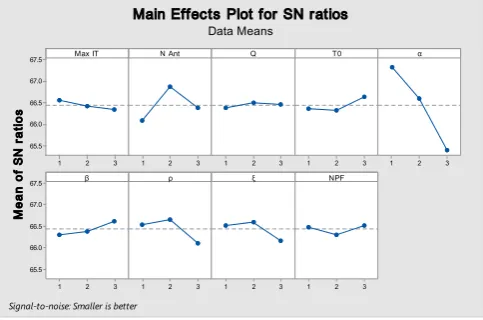
Table 1 demonstrates the nine affecting factors of the proposed MOACO and shows the three levels of the corresponding
factors. In Table 1, itermax denotes the maximum number of
iterations, nant represents the number of ants, Q and 0
τ stand
for the pheromone updating factor and initial pheromone,
exponential weight and the heuristic exponential weight, respectively. Besides, ρ and ξ represent the evaporation rate
and the control parameter of pheromone while NPF defines
the maximum number of Pareto members. It is notable that an instance including 25 activities, 4 skills and 3 levels is considered to set the parameters of proposed MOACO
through the L27 orthogonal array design, implemented on the
MINITAB software.
In Tables 2 and Fig. 1 the responses for signal to noise ratios of proposed MOACO are represented. Besides, the best value of signal to noise ratios associated with each parameter level is high-lighted in Table 2.
3- 4- Instance generation
With considering the number of activities (n), number of
candidate skills (K), and the maximum number of skill levels
(L), the problem instances are classified into two different
sizes of small and large. Moreover, it should be noted that the precedence relations are taken from the PSPLIB. The execution times of applying the candidate levels of the skills
to perform activities
( )
pikl follow a uniform distributionin the interval [15, 20] while the number of the resources required to perform activity i for each level of the skills
( )
riklare generated uniformly from the interval [1, 6]. For each task, the required number of skills is generated randomly between
1 and the maximum number of skills (K). It is considered
that the skill levels with higher indices will lead to lower executing times and less number of the required resources but
with higher implementation costs
( )
tkl
IC and lower energy
consumption cost ( t
kl
EC ). Finally, t
kl
IC and t kl
EC follow the
uniform distribution in the intervals [100, 500] and [6, 15], respectively.
4- Computational results
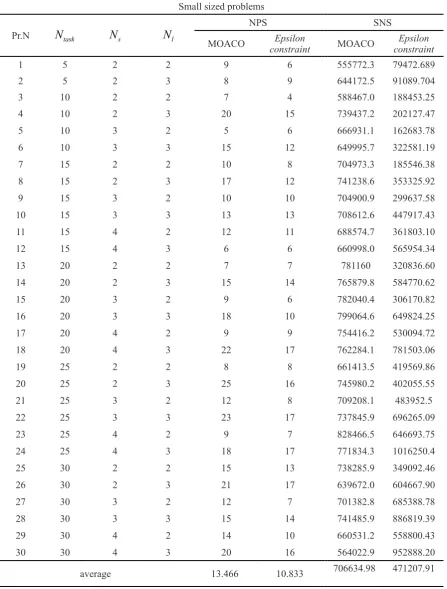
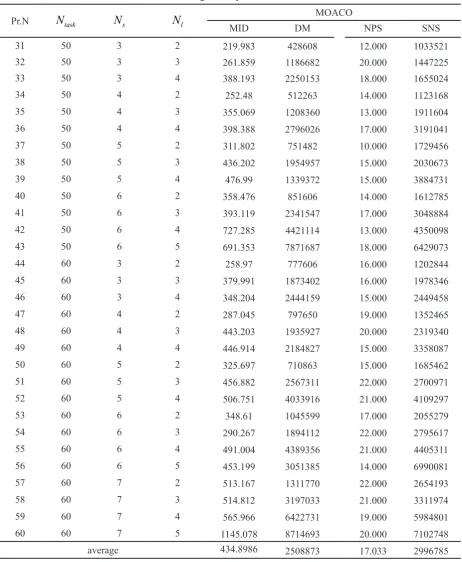
All the designed test problems were solved by the proposed MOACO coded in MATLAB R2013b, with a core i5 CPU and 4 GB memory. Each problem instance has been solved three times and the average results are considered to evaluate the algorithms. The quantitative results have been compared with the optimal solutions obtained by epsilon-constraint method on GAMS 22.9. It should be noted that as GAMS software is unable to solve problems with larger sizes than 30 activities, large-sized problems (problem number 31 and larger) are solved by the proposed MOACO. Computational results of the proposed MOACO and epsilon-constraint method based on four comparison criteria are demonstrated in Tables 3 and Table 4. The first four columns of Tables 3 and Table 4 reflect the characteristics of each problem instance according
to which PrN and Ntask represent the problem number and
the number of activities while Ns and Nl represent the
number of skills and the maximum number of the candidate levels of proficiency for each skill, respectively. As it is clear from Table 3, epsilon-constraint method achieved the best
MID in comparison with the proposed MOACO wherein on
the basis of DM criterion, MOACO with the average value
of 619368 outperforms epsilon-constraint method with the value of 216379. Computational results obtained by the
proposed MOACO in case of NPS determine the supremacy
of MOACO in comparison with epsilon-constraint method Table 1. Levels of key factors of MOACOs
Key parameters
Parameter levels
iter
maxn
antQ
τ
0α
β
ρ
ξ
NPF
Level 1
3 N
×
100.8
1
1
1
0.001 0.1 100
Level 2
4 N
×
150.9
1.2
1.5
1.2 0.005 0.15 150
Level 3
5 N
×
201
1.5
2
1.5
0.05 0.2 200
3 2 1 67.5
67.0
66.5
66.0
65.5
3 2
1 1 2 3 1 2 3 1 2 3
3 2 1 67.5
67.0
66.5
66.0
65.5
3 2
1 1 2 3 1 2 3
Max IT
M
ea
n
of
S
N
r
at
io
s
N Ant Q T0 α
β ρ ξ NPF
Main Effects Plot for SN ratios
Data Means
Signal-to-noise: Smaller is better
Fig. 1. Taguchi results for MOACO
Table 2. Response for S/N ratios of MOACO-ALL parameters Parameter
levels
iter
maxn
antQ
τ
0α
β
ρ
î
NPF
Level 1 66.56 66.09 66.38 66.35 67.32 66.31 66.55 66.54 66.49
Level 2 66.42 66.87 66.49 66.33 66.60 66.39 66.67 66.61 66.31
Level 3 66.34 66.37 66.45 66.64 65.40 66.62 66.11 66.18 66.52
Delta 0.22 0.78 0.11 0.31 1.92 0.30 0.56 0.43 0.21
Table3. Computational results obtained by the proposed MOACO and epsilon-constraint method for small-size problems based on MID and DM
Small sized problems
Pr.N
N
taskN
sN
lMID DM
MOACO Epsilon- constraint MOACO Epsilon- constraint
1 5 2 2 111.8525 105.852 367325 46077
2 5 2 3 113.1171 107.617 622669 52418
3 10 2 2 86.92738 80.927 530257 38514
4 10 2 3 186.1505 182.65 703388 42518
5 10 3 2 137.6298 121.13 511600 85517
6 10 3 3 206.2158 202.216 582870 27001
7 15 2 2 109.1855 102.686 556489 83986
8 15 2 3 206.3811 193.881 600110 99758
9 15 3 2 123.3991 119.399 503891 90176
10 15 3 3 195.1995 179.7 582515 82457
11 15 4 2 179.8422 160.842 553867 97059
12 15 4 3 261.056 251.556 507727 130259
13 20 2 2 128.8272 123.827 650942 130711
14 20 2 3 289.401 286.401 696739 170398
15 20 3 2 123.4329 145.433 321045 161282
16 20 3 3 269.3247 262.825 731107 287447
17 20 4 2 183.3332 183.833 663928 225327
18 20 4 3 258.0679 240.068 594514 383514
19 25 2 2 188.0846 191.085 567354 103449
20 25 2 3 224.542 214.042 602514 322528
21 25 3 2 173.4966 175.497 748824 239614
22 25 3 3 208.8058 191.806 687856 734345
23 25 4 2 184.9479 172.948 826017 303214
24 25 4 3 278.6913 258.191 857230 420058
25 30 2 2 160.3933 150.893 805875 240252
26 30 2 3 226.9243 211.424 535256 129874
27 30 3 2 237.9200 218.92 634696 303159
28 30 3 3 251.0515 251.551 896798 398745
29 30 4 2 198.0849 189.585 690568 264359
30 30 4 3 275.8161 272.316 447065 797348
Table 4. Computational results obtained by proposed MOACO and epsilon constraint method for small-size problems based on NPS and SNS.
Small sized problems
Pr.N
N
taskN
sN
l NPS SNSMOACO constraintEpsilon MOACO constraintEpsilon
1 5 2 2 9 6 555772.3 79472.689
2 5 2 3 8 9 644172.5 91089.704
3 10 2 2 7 4 588467.0 188453.25
4 10 2 3 20 15 739437.2 202127.47
5 10 3 2 5 6 666931.1 162683.78
6 10 3 3 15 12 649995.7 322581.19
7 15 2 2 10 8 704973.3 185546.38
8 15 2 3 17 12 741238.6 353325.92
9 15 3 2 10 10 704900.9 299637.58
10 15 3 3 13 13 708612.6 447917.43
11 15 4 2 12 11 688574.7 361803.10
12 15 4 3 6 6 660998.0 565954.34
13 20 2 2 7 7 781160 320836.60
14 20 2 3 15 14 765879.8 584770.62
15 20 3 2 9 6 782040.4 306170.82
16 20 3 3 18 10 799064.6 649824.25
17 20 4 2 9 9 754416.2 530094.72
18 20 4 3 22 17 762284.1 781503.06
19 25 2 2 8 8 661413.5 419569.86
20 25 2 3 25 16 745980.2 402055.55
21 25 3 2 12 8 709208.1 483952.5
22 25 3 3 23 17 737845.9 696265.09
23 25 4 2 9 7 828466.5 646693.75
24 25 4 3 18 17 771834.3 1016250.4
25 30 2 2 15 13 738285.9 349092.46
26 30 2 3 21 17 639672.0 604667.90
27 30 3 2 12 7 701382.8 685388.78
28 30 3 3 15 14 741485.9 886819.39
29 30 4 2 14 10 660531.2 558800.43
30 30 4 3 20 16 564022.9 952888.20
Table 5. Computational results obtained by the proposed MOACO for large-sized problems
Large-sized problems
Pr.N
N
taskN
sN
l MID DM MOACO NPS SNS31 50 3 2 219.983 428608 12.000 1033521
32 50 3 3 261.859 1186682 20.000 1447225
33 50 3 4 388.193 2250153 18.000 1655024
34 50 4 2 252.48 512263 14.000 1123168
35 50 4 3 355.069 1208360 13.000 1911604
36 50 4 4 398.388 2796026 17.000 3191041
37 50 5 2 311.802 751482 10.000 1729456
38 50 5 3 436.202 1954957 15.000 2030673
39 50 5 4 476.99 1339372 15.000 3884731
40 50 6 2 358.476 851606 14.000 1612785
41 50 6 3 393.119 2341547 17.000 3048884
42 50 6 4 727.285 4421114 13.000 4350098
43 50 6 5 691.353 7871687 18.000 6429073
44 60 3 2 258.97 777606 16.000 1202844
45 60 3 3 379.991 1873402 16.000 1978346
46 60 3 4 348.204 2444159 15.000 2449458
47 60 4 2 287.045 797650 19.000 1352465
48 60 4 3 443.203 1935927 20.000 2319340
49 60 4 4 446.914 2184827 15.000 3358087
50 60 5 2 325.697 710863 15.000 1685462
51 60 5 3 456.882 2567311 22.000 2700971
52 60 5 4 506.751 4033916 21.000 4109297
53 60 6 2 348.61 1045599 17.000 2055279
54 60 6 3 290.267 1894112 22.000 2795617
55 60 6 4 491.004 4389356 21.000 4405311
56 60 6 5 453.199 3051385 14.000 6990081
57 60 7 2 513.167 1311770 22.000 2654193
58 60 7 3 514.812 3197033 21.000 3311974
59 60 7 4 565.966 6422731 19.000 5984801
60 60 7 5 1145.078 8714693 20.000 7102748
by achieving 13.466 versus 10.833. Furthermore, in terms of
SNS, the proposed MOACO achieved better performance by
obtaining the value 706634.98 versus the value of 471207.91
gained by epsilon-constraint method for small problem sizes. As epsilon-constraint method was unable to solve the large-sized problems in a reasonable computational time, MOACO has been applied to tackle the problem of larger sizes.
According to Table 5, the average value of MID, DM, NPS
and SNS are achieved as 434.8986, 2508873, 20.333 and
2996785, respectively.
The Pareto fronts obtained by MOACO and epsilon constraint method on problem number 15 and the Pareto fronts obtained by MOACO on problem number of 52 are depicted in Fig. 2 and Fig. 3.
4- 1- Sensitivity analysis
In this section, a sensitivity analysis is done to investigate the effect of energy consumption cost on final scheduling
of activities. To this end, an illustration consisted of 4
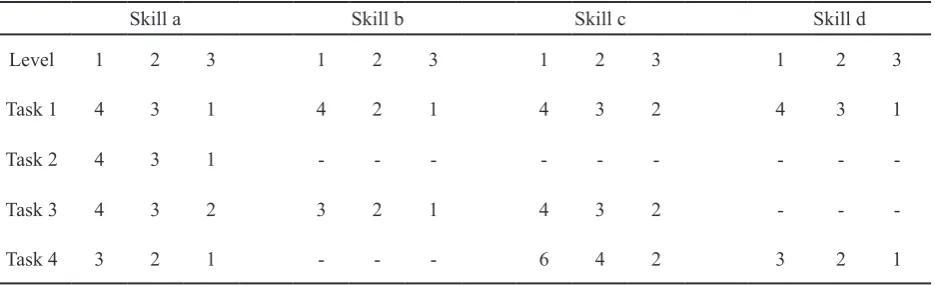
activities and 4 skills, each of which introduces three levels of efficiency, is taken into consideration. Execution times and implementation cost of efficiency levels of candidate
skills are represented in Tables 6 and 7. As an example, Task 1 requires concurrent application of skills a, b, c and d that could be implemented in 3 levels of efficiency, each of which resulted in a specific execution time and cost. Besides, time-based energy consumption cost regarding efficiency levels of candidate skills is represented in Table 8.
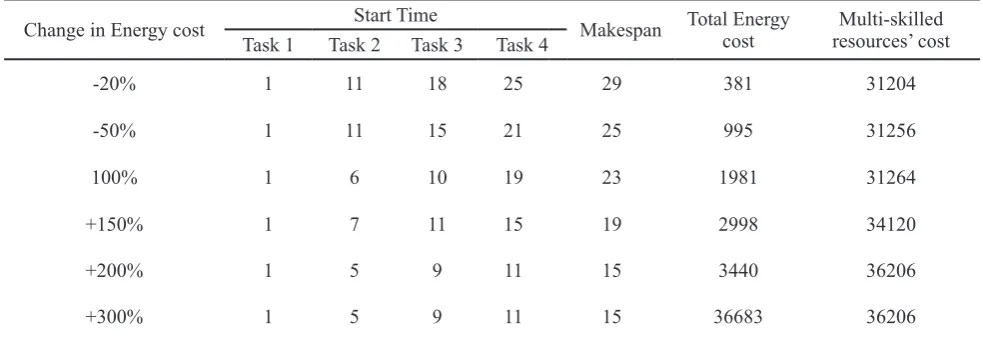
To accomplish the sensitivity analysis, energy consumption cost is shifted within -20% to +300% and the changes made to the scheduling of activities has been reported in Table 9. As can be seen, by increasing energy consumption cost, total energy cost and total application cost of multi-skilled resources are increased while makespan is decreased. In other words, by increasing the energy consumption cost, the activities will be scheduled as soon as possible.
5- Summary and conclusion
In this paper, a bi-objective energy-based integration of the multi-skilled project scheduling problem and resource investment problem, named EB-MSRIP, was formulated and solved. Indeed, this was the first work that considers minimizing the total cost including the implementation of multi-skilled resources as well as the energy consumption cost of multi-skilled resources as an objective in the project scheduling. The second objective minimizes project’s makespan. Application of the proposed model enables decision makers to obtain the best availability for efficiency levels of multi-skilled resources along with the best schedule of the activities while energy costs are considered. A mixed-integer programming formulation was proposed for EB-MSRIP, where its validity is established based on 30 small scales within application of epsilon-constraint method by GAMS software. Afterwards, the ant colony optimization (ACO) was developed to overcome the computational complexities of large-sized problems. The performance of the proposed ACO was evaluated by means of four performance measures within 60 test instances. Results achieved by epsilon-constraint method in terms of MID, DM, NPS and SNS were compared with MOACO. Therefore, regarding the advantages of proposed MOACO, the larger scales of problems were solved through the proposed MOACO and the computational results were depicted in terms of comparison
measures. As it was shown, the MOACO algorithm obtained
the best results in terms of DM, NPS and SNS but worst
results based on MID.
As this paper considers the cost of energy consumption in the field of multi-skilled project scheduling, several extensions could be noted for future researches. One can extend the Fig. 2. Obtained Pareto fronts of MOACO and
epsilon-constraint method on problem number 15
Fig. 3. Obtained Pareto fronts of ALL and MOACO-ELITE on problem number 52
Table 6. Execution times and resource requirements of tasks
Skill a Skill b Skill c Skill d
Level 1 2 3 1 2 3 1 2 3 1 2 3
Task 1 4 3 1 4 2 1 4 3 2 4 3 1
Task 2 4 3 1 - - -
-Task 3 4 3 2 3 2 1 4 3 2 - -
current work to develop a sustainable model when there is a dynamic policy for energy tariffs. Another extension can be consideration of bonus and penalty strategies for low and high energy consumptions as well as extending the problem to multiple project scheduling problems.
Parameters
E Set of prerequisite relations between activities
Si Set of required skills to execute activity i
ikl
p Execution time of activity i using the l th level
of skill k
ikl
r Number of workforces needed to perform
activity i using l th level of skill k
t kl
EC Energy consumption cost for the skill k at time t l th level of
t kl
IC Implementation cost of applying skill k at time t l th level of
[
es lsi, i]
Earliest and latest start times of activity i[
ef lfi, i]
Earliest and latest finish times of activity iik
N 1 , if activity i needs skill k ;0 , otherwise
n Number of activities
Decision variables:
ik
S
Start time of applying skill activity i k to performi
S
Start time of activity iik
C
Completion time of applying skill perform activity i k toi
C
Completion time of activity it kl
R
Availability of the l th level of skill k at time tikl
y
1 , if activity of skill k; i is performed by the l th level0 , otherwise
t ikl
y
1 , if activity skill k betweeni is in progress by the [t-1, t]; 0 , otherwisel th level ofReferences
[1] F. Shrouf, J. Ordieres-Meré, A. García-Sánchez, M. Ortega-Mier, Optimizing the production scheduling of a single machine to minimize total energy consumption costs, Journal of Cleaner Production, 67 (2014) 197-207. [2] A. Sharma, F. Zhao, J.W. Sutherland, Econological
scheduling of a manufacturing enterprise operating under a time-of-use electricity tariff, Journal of Cleaner Table 9. Sensitivity analysis of energy consumption cost on final scheduling of activities
Change in Energy cost Start Time Makespan Total Energy cost resources’ costMulti-skilled
Task 1 Task 2 Task 3 Task 4
-20% 1 11 18 25 29 381 31204
-50% 1 11 15 21 25 995 31256
100% 1 6 10 19 23 1981 31264
+150% 1 7 11 15 19 2998 34120
+200% 1 5 9 11 15 3440 36206
+300% 1 5 9 11 15 36683 36206
Table 7. Implementation cost of multi-skilled resources
Levels of efficiency 1 2 3
Skill a 128 299 322
Skill b 116 280 352
Skill c 137 284 390
Skill d 114 285 389
Table 8. Energy consumption cost according to time and efficiency levels of candidate skills
Time 1 to 5 6 to 9 10 to 24
Level 1 20 16 13
Level 2 15 13 12
Production, 108 (2015) 256-270.
[3] A. Rezvani, M. Gandomkar, M. Izadbakhsh, A. Ahmadi, Environmental/economic scheduling of a micro-grid with renewable energy resources, Journal of cleaner production, 87 (2015) 216-226.
[4] B. Khoshnevisan, E. Bolandnazar, S. Barak, S. Shamshirband, H. Maghsoudlou, T.A. Altameem, A. Gani, A clustering model based on an evolutionary algorithm for better energy use in crop production, Stochastic environmental research and risk assessment, 29(8) (2015) 1921-1935.
[5] S. Barak, M. Yousefi, H. Maghsoudlou, S. Jahangiri, Energy and GHG emissions management of agricultural systems using multi objective particle swarm optimization algorithm: a case study, Stochastic environmental research and risk assessment, 30(4) (2016) 1167-1187. [6] R.H. Möhring, Minimizing costs of resource requirements
in project networks subject to a fixed completion time, Operations Research, 32(1) (1984) 89-120.
[7] S.-H. Cho, S.D. Eppinger, A simulation-based process model for managing complex design projects, IEEE Transactions on engineering management, 52(3) (2005) 316-328.
[8] L.L. Minku, D. Sudholt, X. Yao, Evolutionary algorithms for the project scheduling problem: runtime analysis and improved design, in: Proceedings of the 14th annual conference on Genetic and evolutionary computation, ACM, 2012, pp. 1221-1228.
[9] L.T. Bui, M. Barlow, H.A. Abbass, A multi-objective risk-based framework for mission capability planning, New Mathematics and Natural Computation, 5(02) (2009) 459-485.
[10] B. De Reyck, R. Leus, R&D project scheduling when activities may fail, IIE transactions, 40(4) (2008) 367-384.
[11] M. Sabzehparvar, S. Seyed-Hosseini, S. Nouri, A mathematical model for the multi-mode resource investment problem, Journal of Industrial Engineering International, 4(7) (2008) 25-32.
[12] A.A. Najafi, F. Azimi, A priority rule-based heuristic for resource investment project scheduling problem with discounted cash flows and tardiness penalties, Mathematical Problems in Engineering, 2009 (2009). [13] M. Ranjbar, F. Kianfar, S. Shadrokh, Solving the resource
availability cost problem in project scheduling by path
relinking and genetic algorithm, Applied Mathematics and Computation, 196(2) (2008) 879-888.
[14] A. Hattab, M. Haouari, Robust resource investment problem with time-dependent resource cost and tardiness penalty, in: Industrial Engineering and Engineering Management (IEEM), 2016 IEEE International Conference on, IEEE, 2016, pp. 1693-1698.
[15] O. Bellenguez, E. Néron, Lower bounds for the multi-skill project scheduling problem with hierarchical levels of skills, in: International Conference on the Practice and Theory of Automated Timetabling, Springer, 2004, pp. 229-243.
[16] O. Bellenguez-Morineau, Methods to solve multi-skill project scheduling problem, 4OR: A Quarterly Journal of Operations Research, 6(1) (2008) 85-88.
[17] C. Heimerl, R. Kolisch, Work assignment to and qualification of multi-skilled human resources under knowledge depreciation and company skill level targets, International Journal of Production Research, 48(13) (2010) 3759-3781.
[18] M. Walter, J. Zimmermann, Minimizing average project team size given multi-skilled workers with heterogeneous skill levels, Computers & Operations Research, 70 (2016) 163-179.
19] S.B. Othman, S. Hammadi, A. Quilliot, Multi-objective evolutionary for multi-skill health care tasks scheduling, IFAC-PapersOnLine, 48(3) (2015) 704-709.
[20] S. Javanmard, B. Afshar-Nadjafi, S.T.A. Niaki, Preemptive multi-skilled resource investment project scheduling problem: Mathematical modelling and solution approaches, Computers & Chemical Engineering, 96 (2017) 55-68.
[21] J. Xiao, X.-T. Ao, Y. Tang, Solving software project scheduling problems with ant colony optimization, Computers & Operations Research, 40(1) (2013) 33-46. [22] G. Campos Ciro, F. Dugardin, F. Yalaoui, R. Kelly,
Open shop scheduling problem with a multi-skills resource constraint: a genetic algorithm and an ant colony optimisation approach, International Journal of Production Research, 54(16) (2016) 4854-4881.
[23] Y.-C. Liang, A. Chen, W.-C. Kao, C.-C. Chyu, An ant colony approach to resource-constrained project scheduling problems, in: Proceedings of the fifth Asia Pacific industrial engineering and management systems conference, 2004, pp. 31.35.
Pleasecitethisarticleusing:
Sh. Javanmard, B. Afshar-Nadjafi, S. T. Akhavan-Niaki, Optimization of an energy based bi-objective multi-skilled resource investment project scheduling problem, AUT J. Model. Simul., 50(2) (2018) 129-140.