RESEARCH ARTICLE
Acknowledging students’ concerns
about evolution: a proactive teaching strategy
Constance M. Bertka
1*, Briana Pobiner
2, Paul Beardsley
3and William A. Watson
4Abstract
Background: The religious or cultural objections by many people to the teaching of evolution in high school biology classrooms can impact both students’ willingness to explore a scientific understanding of evolutionary theory and teachers’ willingness to provide sound instruction on the topic. Pedagogical approaches designed to address this tension in the public or private US high school classroom during regular biology classroom instruction on evolution are needed. We developed a Cultural and Religious Sensitivity (CRS) Teaching Strategies Resource to aid teachers in acknowledging students’ religious and cultural concerns about evolution, introducing the variety of possible relation-ships between science and religion, and focusing on the nature of science. The resource provides both background information for the teacher and activities to engage students in two 50–75 min directed classroom discussions. The CRS resource is part of a designed-based study, the Teaching Evolution through Human Examples (TEtHE) project that created and field tested four curriculum units for advanced placement high school biology classes that use human examples to teach evolution (Pobiner et al. Evol Educ Outreach. 2018;11:3 2018). Here we describe the design of the CRS resource and qualitative results of student focus groups that explore the extent to which the CRS resource activi-ties helped to create a supportive classroom environment as well as more generally what benefits, if any, students derived from participating in these activities.
Results: Focus groups were conducted with students from five classes of four different teachers in both public and private US high schools. Focus group transcripts were analyzed to identify common themes expressed in relation to the students’ experience of one of the two CRS activities. Benefits of participating in these activities noted by students included reduced tension around the topic of evolution, a recognition that evolution is not necessarily in conflict with religious belief, and an increased understanding of the cultural context of modern and historical views about evolution.
Conclusions: The themes identified through qualitative analyses of focus group transcripts support the conclusion that acknowledging students’ concerns about evolution is a promising pedagogical approach to teaching evolu-tion in conjuncevolu-tion with lessons designed to teach the content of evoluevolu-tionary theory. The approach merits further research with general introductory high school biology classes.
Keywords: Evolution education, Evolution understanding, Acknowledging cultural controversy, Evolution and religion, High school biology students, Student focus groups
© The Author(s) 2019. This article is distributed under the terms of the Creative Commons Attribution 4.0 International License (http://creat iveco mmons .org/licen ses/by/4.0/), which permits unrestricted use, distribution, and reproduction in any medium, provided you give appropriate credit to the original author(s) and the source, provide a link to the Creative Commons license, and indicate if changes were made.
Open Access
*Correspondence: [email protected] 1 Science and Society Resources, LLC, 1108 Churchview Place, Potomac, MD 20854, USA
Background
Although there is constant debate, refinement, and even occasional controversy among scientists about the details of evolution, there is no scientific controversy over whether evolution occurred in the past and continues today. There are, however, cultural objections by many in the United States to the teaching of evolution. These objections are largely defined by perceived conflict with religious belief, an important component of an individu-al’s cultural identity. Religious objections, and the result-ing controversies surroundresult-ing them, can impact both students’ and high school teachers’ willingness to engage with the subject of evolution (e.g. Berkman and Plutzer 2012; Goldston and Kyzer 2009; Griffith and Brem 2004; Meadows et al. 2000; Rutledge and Warden 2000). This outcome is a considerable disservice to students’ under-standing of both the nature of science, because they are left with the impression that science negatively targets religious beliefs, and the understanding and acceptance of evolutionary theory.
In the US, where the cultural milieu favors free speech and democratic processes, even those accepting of evo-lution may raise issues of fairness and support a call to “teach the controversy”(Scott 2004; Berkman and Plutzer 2012). Furthermore, the negative emotional and social connotations perceived to be associated with evolution-ary theory, including increasing selfishness and racism (Brem et al. 2003), may be detrimental to the acceptance of evolution in some communities.
Cultural objections are not the only obstacles impact-ing the teachimpact-ing and learnimpact-ing of evolution. Others include common misconceptions, cognitive challenges, and ambiguous language (for reviews see Pobiner 2016 and Glaze and Goldston 2015). However, real or perceived conflict between evolutionary theory and a religious worldview is a well-documented barrier to accepting evolution among both teachers and students (Borgerd-ing et al. 2017; Glaze et al. 2015; Hermann 2011; Winslow et al. 2011; Smith 2010; Hokayem and BouJaoude 2008; Trani 2004; Rutledge and Mitchell 2002) and the public at large in the United States and globally (Heddy and Nadel-son 2012, 2013). Religiosity, as a measurable variable, is often defined as the extent to which people state that religion is very important in their lives, or the frequency with which they attend weekly religious services. Among First World countries, the US public is both one of the most religious and one of the most resistant to accept-ing evolution (Coyne 2012). The religiosity of US college students has been shown to be negatively correlated with their understanding of evolution (Hawley et al. 2011) and is a stronger predictor of evolution understanding than the evolution content of their high school biology course (Rissler et al. 2014; Moore et al. 2011). That students with
deeply held religious beliefs may fail to understand or accept evolutionary theory is reflective of a broader US cultural context.
The relationship between a students’ understanding of evolution and acceptance of evolution is nuanced, with some studies finding a positive correlation between the two (Lawson and Worsnop 1992; Scharmann et al. 2005; Shtulman and Calabi 2012; Hawley et al. 2011) and some finding no significant correlation (Sinatra et al. 2003; Ingram and Nelson 2006). While science educa-tion researchers and biology teachers may disagree on whether or not acceptance of evolutionary theory is an appropriate goal of biology instruction (Glaze 2017; Barnes and Brownell 2016; Reiss 2009; Meadows 2009; Ingram and Nelson 2006), the biology classroom should provide students with an opportunity to understand evo-lutionary theory as the scientific community does: the best scientific explanation for the diversity and interre-latedness of species. Students may choose not to accept evolution, but to be scientifically literate, they should understand how and why scientists consider it a core unifying theme of biology. To that end, at minimum, teachers must be willing to teach the topic and students willing to try and understand the material. That said, the reality for both teachers and students may be that they are being asked to engage a topic that conflicts with their worldview. Simply stated, a “worldview provides a per-son with presuppositions about what the world is really like and what constitutes valid and important knowledge about the world” (Cobern 1996). For many people their religious worldview is a significant component of their social identity. People are unlikely to embrace a topic that is seen as likely to threaten significant social connections and relationships (Kahan 2010).
for their students, evolution is not discussed at home and is “taboo” to mention at church (Hermann 2013). Bram-schreiber (2013) notes that in areas of fundamentalist evangelicalism, students are taught from an early age to reject evolution and be suspicious of anyone who tries to teach it. Glaze and Goldston (2015) also reported that if preservice teachers in the southeastern US had been exposed to negative perceptions of evolution by family members, members of the clergy, or at Sunday school, they were more likely to reject evolution. Long (2011), in his study of how students at one southern university interacted with the topic of evolution, highlighted the social costs for students learning about evolution and possibly reframing their religious worldview. He empha-sized that there is an important social dimension to the resistance to learn about evolution.
That students may be resistant to learning about evolu-tion because they feel it is in conflict with their religious worldview, and the religious worldview held by those in their social network, is frustrating not only for many scientists and science educators, but also for many reli-gious leaders and clergy whose traditions see no conflict between evolutionary theory and their religious world-view, and/or who are supportive of the teaching of evo-lution in high school science classrooms (Zimmerman 2010; Colburn and Henriques 2006). The most vocal opposition to the teaching of evolutionary theory in the United States has been from adherents of Christian reli-gious worldviews. Using publicly available statements by Christian organizations and denominations in the US about the relationship between their religious tradition and science, or evolution, Martin (2010) suggests that most US Christians should view evolution as compatible with their religious tradition. However he notes several caveats, including that not all groups have official state-ments and that many members may not be aware of, or agree with, the official statements. Christian clergy from largely mainline denominations may well be frustrated by the recognition that there is a gap between their scholarly interpretation of their religion’s tradition and the inter-pretation of the members of their congregations, some of whom mistakenly believe their religion does not accept evolution. The Pew Forum on Religion and Public Life (2013) reports that 26% of White and 31% of Hispanic Roman Catholics believe “humans and other living things have existed in their present form since the beginning of time.” While the conflict between religious worldview and acceptance of evolution may be a “perceived” conflict for some individuals, for those who adopt a fundamen-talist interpretation of Scripture, including many evan-gelical Protestants, the conflict between their religious worldview and evolutionary theory is very real. Evan-gelical Protestants, those who belong to churches in the
evangelical Protestant tradition, or nondenominational congregations, comprise about 25% of Americans (The Pew Forum on Religion and Public Life 2015). Of all the major religious groups in the US, evangelical Protestants are most likely to reject evolution at 64% (Pew Forum on Religion and Public Life 2013).
Pedagogical approaches that increase students’ willing-ness to engage in learning about evolution, particularly in cultural environments where opposition to evolutionary theory is prevalent, are needed. A survey of high school biology teachers in the US revealed that in order to avoid controversy in the classroom over the teaching of evolu-tion, 60% of teachers relied on techniques that do a dis-service to students’ understanding of evolutionary theory (Berkman and Plutzer 2012). These techniques include focusing solely on microevolution, communicating to students that they must learn the material only because a state mandated test requires it rather than helping stu-dents understand that evolution is central to biology, and introducing creation accounts alongside evolution-ary theory (implying that these accounts are alternative scientific theories and that students are free to choose between them). Berkman and Plutzer (2012) suggest that these approaches to avoiding the controversy, often taken by teachers who are not themselves opposed to evolu-tion, are nonetheless supportive of the tactics employed by those who question the legitimacy of evolution. These approaches do nothing to challenge the assumption that the science of evolution, and in particular human evolu-tion, is necessarily in conflict with religious and cultural beliefs. What is needed are alternative strategies for teachers that will help them both acknowledge the reli-gious and cultural controversy surrounding evolution in the classroom and create a classroom environment that encourages a greater understanding of evolution.
Increasingly, science educators are proposing that the most effective classroom environment for increasing stu-dents’ understanding of evolution, and at least laying the foundation for the possibility of increased acceptance, is not one in which anti-evolutionary views that stem from religious and cultural concerns are considered “miscon-ceptions to be corrected,” but instead are recognized as part of the students’ worldview that should be acknowl-edged in some way (Scharmann 1993; Smith 1994;
Dagher and BouJaoude 1997; Woods and Scharmann
environment which acknowledges the religious and cul-tural controversies, but focuses on an increased scientific understanding of evolution (specifically the recognition of processes and concepts central to the theory of evo-lution) rather than an acceptance of evolution (Mead-ows 2009; Reiss 2009; Scharmann 2005; Southerland and Scharmann 2013) and includes instruction that can reduce the perceived conflict between evolution and religion (Wiles and Alters 2011; Wiles 2014; Yasri and Mancy 2016; Manwaring et al. 2015; Barnes et al. 2017; Barnes and Brownell 2017; Troung et al. 2018).
At the level of high school instruction, there are few concrete examples in the literature of how a teacher might acknowledge the religious and cultural contro-versies while advancing an understanding of evolution-ary science, that also include quantitative or qualitative measures of the impact of this approach (Hermann 2008). Recent exceptions are the work of Wiles and Alters (2011) and Wiles (2014) with gifted high school students in an intensive summer program and Yasri and Mancy (2016) in a study with high school students at a Christian school in Thailand. Manwaring et al. (2015), Barnes et al. (2017) and Troung et al. (2018) have explored this approach and measured its impact with college undergraduates in the United States. However, many of the specific activities described in these studies would be inappropriate and possibly illegal in a public US high school classroom.
Previous research
Three recent studies with introductory biology students at the college level, all of which directly address reli-gious concerns about evolution and include quantita-tive or qualitaquantita-tive measures, are noteworthy. The first was undertaken with a highly religious population, stu-dents who are members of The Church of Jesus Christ of Latter-day Saints (LDS or Mormon) at Brigham Young University, and explored the impact of students’ knowl-edge of the neutral LDS doctrine on evolution on the stu-dents’ acceptance of evolution (Manwaring et al. 2015). In this study, in all but one control section, the instruc-tion on evoluinstruc-tion also included a 50 to 75 min class period devoted to a lecture and discussion about the official LDS church stance on human origins using mate-rials that introduce students to official LDS church state-ments on the topic and the history of the materials. This study also examined the relationships between concep-tual understanding of evolutionary theory and religios-ity with acceptance of evolution. As in previous studies, these researchers found that student religiosity impacts initial acceptance of evolution, with the two negatively correlated, but after instruction on evolutionary theory the study documented a positive relationship between conceptual understanding and acceptance regardless of
student religiosity. Acceptance rates, however, were sig-nificantly greater for those students who also received the one class period instruction on the LDS stance on evolution.
Another study with introductory biology students at the college level, in a public university in the southwest US, focused on challenging the idea that evolution and religion are necessarily in conflict by using several activi-ties to introduce students to the possibility of compatibil-ity between the two (Barnes et al. 2017). Over the course of a 2-week unit on evolution students participated in three activities; they (1) heard from a guest scientist who was both a biologist and religious and could speak to their own experience of reconciling their faith with evolution, (2) read the National Academy of Sciences handbook Science, Evolution, and Creationism (National Academy of Sciences 2008) which stresses the idea that evolution and religion can be compatible, and (3) partic-ipated in a lecture on the variety of creationists’ beliefs and the extent to which these beliefs are consistent with the theory of evolution with a focus on the different types of questions explored by science and religion. Students were surveyed both before and after the evolution unit on whether they thought evolution and religion could be compatible, and the number of both religious and nonre-ligious students who perceived a conflict between the two decreased by 50% after this instruction. The study did not document how this decrease in perceived conflict related to students’ conceptual understanding or acceptance of evolution, but assumes the importance of addressing the subject of conflict between science and religion for achieving positive learning goals.
evolution content. The first two aspects were cited as fre-quently as the latter. All three of the studies noted above used class time to explicitly acknowledge concerns about evolution conflicting with religious beliefs and concluded that this pedagogical approach is useful for engaging col-lege students in the study of evolution.
At the level of high school biology instruction, Wiles and Alters (2011) measured how students’ level of acceptance of evolution changed both immediately fol-lowing a 6 week summer program and 1 year later using the Measure of Acceptance of the Theory of Evolution (MATE) instrument. The program was designed for gifted students who had completed their junior year in high school and it explicitly addressed a number of fac-tors that may negatively impact students’ acceptance of evolution, including non-scientific factors such as a perceived conflict between religious faith and evolu-tion. This perceived conflict was not addressed as part of the course instruction on evolutionary science, but in an extracurricular seminar that presented the vari-ety of religious traditions’ views on evolution and faith, and in a forum with an invited theologian as a speaker who confirmed the compatibility of evolution with faith in the divine. Wiles and Alters (2011) note that despite the fact that religious factors have been shown to have an impact on high school students’ attitudes toward evolu-tion (Woods and Scharmann 2001), the extracurricular seminar and forum activities cited above are not appro-priate for a science course. Students who participated in the summer program however, did show a significant increase in acceptance of evolution, immediately after the program and 1 year later, though the study did not differ-entiate the impact of individual factors. In a subsequent study Wiles (2014) analyzed open-ended questionnaires and interviews with this same population of students, who were now either entering college as freshman or had completed one or 2 years of college, to determine which factors the students considered important to their change in acceptance of evolution. He reported that regardless of their level of acceptance of evolution, the students often cited their religion as a factor influencing their decision.
Another study with high school students at a Christian school in Thailand investigated changes in students’ posi-tions on the relaposi-tionship between evolution and creation and the reasons for changes in their position (Yasri and Mancy 2016). The class included both Christian and Bud-dhist students and their course on biological evolution lasted for 3 months. The course began with an introduc-tion to the differences between science and religion with a focus on the different ways of learning about the world that science and religion provide. Teachers also empha-sized, however, that they respected other views on the relationship between science and religion. The remainder
of the course focused on science instruction about evo-lution. After the evolution instruction, students were surveyed about their initial position on the relationship between evolution and creation, whether or not their position had changed, and if so their new position and the reason for the change. Though there were significant differences in the particular position on evolution and creation that Christian versus Buddhist students chose prior to and after instruction on evolution, a large per-centage of students (nearly 77%) underwent a change in position towards increasing acceptance of evolution. These students reported that the reason for their change was due to both changes in their understanding of the evidence for evolution and of ways of relating evolution and their religious beliefs.
or not the teacher shares their students’ worldview. The CRS places a focus on creating a classroom environment where individual worldviews are respected while encour-aging a sound scientific understanding of evolution.
The CRS resource is part of an exploratory design-based study, the Teaching Evolution through Human Examples (TEtHE) project, which created four curricu-lum units for advanced placement (AP) biology classes that use human evolution case studies to teach core evo-lutionary principles outlined in the AP Biology learn-ing objectives (Pobiner et al. 2018). While the focus of the overall project was AP biology classes, we think that the classroom activities described in the CRS are appro-priate for general biology classes as well and the results reported here have implications for all high school evo-lution instruction. As noted in Pobiner et al. (2018), AP biology classrooms provide a “best case” learning context for the formative evaluation of the TEtHE curriculum mini-units and CRS because AP students are generally more motivated to learn and are more sufficiently aware of the impact of teaching materials on their own learning. We are currently exploring the impact of these materials in an introductory high school biology population.
Purpose
The purpose of this paper is to describe the “Cultural and Religious Sensitivity (CRS) Teaching Strategies Resource” and to report on the students’ experience of this resource. Specifically, we describe the qualitative results of student focus groups that were designed to explore the extent to which the resource activities helped to create a sup-portive classroom environment that would encour-age students to engencour-age the topic of evolution, and more generally what benefits, if any, students derived from participating in these activities. For example, would par-ticipating in the activities alleviate any anxiety students might have about learning evolution? If so, this would indicate that the activities helped to create a supportive classroom environment. How would participation in the activities impact students’ understanding of cultural con-cerns about evolution? If the activities helped students recognize that cultural concerns about evolution vary and that these concerns cannot be addressed by the sci-entific study of evolution, then this would indicate that the activities helped with an understanding of the nature of science. How would students feel about a discussion of the cultural controversy surrounding the topic of evolu-tion taking place in a science classroom? The resource recommends activities that are different than those stu-dents expect to take place in a science classroom. For the resource to be judged successful to a large extent, it must address the likely variety in student and teacher comfort with this approach.
Quantitative measures of the success of the resource in terms of structure and function, from the perspec-tive of both teachers and students, and the impact of the resource activities on students’ understanding and acceptance of evolution are reported elsewhere (Pobiner et al. 2018). The qualitative data we provide here contrib-ute to one of the main questions guiding the research and evaluation of the TEtHE project:
“To what extent can the project team develop a set of Cultural And Religious Sensitivity (CRS) resources that provide teachers with strategies that create a supportive classroom environment for the teaching of evolution and support an understanding of the nature of science?”
While key points about the development and field-test-ing of the CRS resource, and quantitative measures of its impact on understanding and acceptance of evolution are summarized in this paper, readers are referred to Pobiner et al. (2018) for details about the design-based research approach of the TEtHE project including quantita-tive measures of the impact of the curriculum units and CRS resource on students’ understanding and accept-ance of evolution. Provided below are details about the CRS methodology, including a description of the CRS resource, field testing, focus groups and analysis of tran-scripts. Results from the analysis of audio transcripts of focus groups with students that experienced one of the CRS classroom activities, a summary of their teachers’ evaluation of the activity, and a discussion of the implica-tions for teaching evolution in public high school class-rooms are described.
Methods The CRS resource
Development process
This second draft was used in the National Field Test by seven teachers and was the version experienced by the students who participated in the focus groups. Teacher and student feedback were used to create a final version of the resource. The final resource is freely available from the Smithsonian Institution Human Origins Program’s website.1
Resource content
The result of the development process was a resource that includes a variety of strategies, providing both back-ground information for the teacher and activities to engage students in two 50–75 min directed classroom discussions. This approach recognizes that both the per-ceived need for these strategies, as well as the teacher’s willingness to acknowledge religious and cultural contro-versies in the classroom, will vary. To inspire confidence in teachers who may be called on to respond to questions about religious and cultural controversies, Part One of the resource provides concise background information on the nature of science as pertinent to managing a con-flict between science and religion; the range of creation-ists views; the variety of possible relationships between science and religion, including examples of how individu-als accommodate evolution and religion; and the histori-cal context and background on legal cases dealing with the teaching of evolution. For teachers seeking a proac-tive approach that acknowledges religious and cultural controversies and encourages a classroom exploration of their impact on the understanding of evolution, Part Two of the resource presents two classroom activities, each one consisting of three to four individual student
exercises to engage students in directed classroom dis-cussions. The two classroom activities use a procedural neutrality approach (Hermann 2008) in which informa-tion about the cultural controversy surrounding evolu-tion and different points of view about this controversy are elicited from students and from resource materials. The teacher does not make a value judgment about these views, but does help students come to a correct under-standing of the nature of science.
CRS Activity #1 CRS Activity #1, “Directed Discussions- Why study evolution?” is designed to be used at the start of the instruction on evolutionary theory, in communities where the teacher is aware that students may have rou-tinely encountered mostly negative or mistaken notions of evolutionary theory, especially as it applies to human evo-lution. The activity might also be useful at the first signs of unexpected negativity in any classroom. It is designed to help students recognize that they are not being asked to accept evolution or change their personal beliefs, but to understand evolution from a scientific perspective. Exer-cise 1 of the activity is a homework assignment “What Do You Know about Evolution?” In this exercise students are asked to provide short answers to three questions:
1. Summarize the theory of evolution in three sentences or less.
2. Are you aware of explanations for the variety of life (including animals, plants, microbes, and other forms of life found on Earth today) other than the theory of evolution, that are important to you or someone you know? If so, list one or two such explanations along with a one- or two-sentence description of each. 3. Some people are concerned about studying the
the-ory of evolution. List one or two concerns that you are aware of that others, or you, may have about studying evolution.
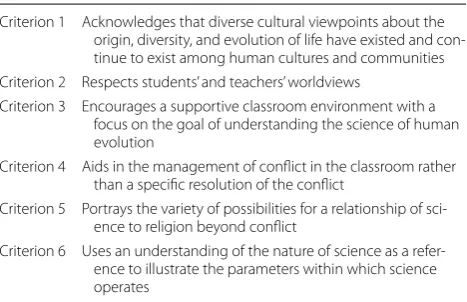
Students share their answers to the questions in this assignment with each other in small group discussions and directed class discussions that are aimed at identify-ing common responses to the last two of the three ques-tions. The questions are designed to provide the teacher with insight into what the students already know about evolution, including misconceptions, and to provide students with an opportunity to list concerns that they are aware of in regards to studying evolutionary theory. As the small groups record their common responses to these questions, and share them with the entire class, the teacher is encouraged to keep a public record of responses. However, the only responses that should be critiqued by the teacher are those that refer to the nature of science, and then preferably only after completing Table 1 CRS resource criteria
Criterion Description
Criterion 1 Acknowledges that diverse cultural viewpoints about the origin, diversity, and evolution of life have existed and con-tinue to exist among human cultures and communities Criterion 2 Respects students’ and teachers’ worldviews
Criterion 3 Encourages a supportive classroom environment with a focus on the goal of understanding the science of human evolution
Criterion 4 Aids in the management of conflict in the classroom rather than a specific resolution of the conflict
Criterion 5 Portrays the variety of possibilities for a relationship of sci-ence to religion beyond conflict
Criterion 6 Uses an understanding of the nature of science as a refer-ence to illustrate the parameters within which scirefer-ence operates
1 https ://human origi ns.si.edu/educa tion/teach ing-evolu tion-throu gh-human
Exercise 2 which explicitly explores this topic. Miscon-ceptions about the science of evolutionary theory that are recorded from these discussions may be addressed later, as appropriate, with references to the evolution content instruction. The goal of CRS Activity #1, and in particu-lar Exercise 1, is to allow students to begin their study of evolution with the recognition that their personal world-views are acknowledged and respected. The teacher is advised to be nonjudgmental about student responses but help students understand that in class they will be working together to understand the theory of evolution from a scientific perspective and that the next exercise will help make this clear.
In Exercise 2, “Ways of Knowing,” students are provided a figure that has three overlapping spheres representing three different “ways of knowing,” personal experience, tradition, and science- and they are instructed to answer the following question:
When people think about the world, they often draw on more than one kind of knowledge. The figure suggests three common ways of knowing. How does science as a way of knowing differ from the other ways of knowing listed in the figure?
Remaining in their small groups, students are asked to first write their own answer to the question, then to again share their answers with others in their group and identify common responses to report out to the entire class. The question is intended as a catalyst for a discus-sion about the nature of science. The teacher keeps a public record of key phrases from the groups’ responses and then provides students with a description of the nature of science provided in the background material found in Part One of the CRS resource (nature of science description summarized from NGSS Lead States 2013). Key points from this description emphasize that sci-ence, understood as both a process for learning about the natural world as well as the knowledge about the natural world gained through this process, is a “way of knowing” with a characteristic set of assumptions. These assump-tions include the idea that the natural world is under-standable, but absolute truth is unobtainable because new observations can lead to new ideas. That said, the process of science overall is more often an exercise in continually refining ideas than outright refuting them. One outcome of this process is a scientific theory: a comprehensive explanation of some aspect of nature that is supported by a vast body of observations and experimentation. Scien-tific explanations must be predictive of new observations and therefore testable. Science, by definition, is limited to explaining the natural world through natural causes. In this exercise the teacher guides the class in comparing the group responses to the provided description. The goal is to critique the students’ understanding of the nature
of science without elevating one way of knowing over another.
Exercise 3, “Relating Science to Other Ways of Know-ing,” explores possible relationships between science, or specifically evolution, and religious or cultural beliefs, providing students with an introduction to the vari-ety of ways individuals manage this intersection. In this exercise, students work in small groups to classify five statements by organizations (religious and secular) or individuals into three possible ways of relating science and religion: conflict, separation, or interaction. While these statements allow students to recognize the pos-sibility of a non-conflict relation between evolution and religious worldviews, no one religious worldview is pro-moted over another. Students are provided with exam-ples of both religious people who accept evolution and examples of those who reject evolution, and the reason-ing behind their position. Teachers are asked to summa-rize the main point of the activity, that more than one approach to relating science and religious beliefs exists, and that two of these approaches see a positive role for both science and religion to play in understanding the world.
At the end of class students leave with a homework assignment, Exercise 4, “Evolution as a Tool to Under-stand and Address Human Biological Challenges,” that introduces them to the idea that evolutionary theory is an explanatory tool that biologists use to solve problems and make testable hypotheses. In Exercise 4 students are pro-vided short summaries of research studies that address Tibetans’ adaption to altitude, the search for drugs to treat malaria, and the evolution of human skin color. The summaries identify for the students the research question scientists are trying to answer and the students are asked to list the type of data the scientists are collecting to answer the question. The exercise does not assume that students have any understanding of evolutionary theory, but is intended to introduce them to the idea of data col-lection as a precursor to scientific explanation using evo-lutionary theory. CRS Activity #1 is modeled in part after classroom exercises described by Scharmann (2005).
insights about the nature of science, and increase their understanding of the cultural controversy that surrounds the study of evolution. One of the main objectives is to help students recognize the differences between histori-cal concerns about evolutionary theory that were rooted in religious and cultural worldviews and those concerns that were rooted in a scientific understanding reasonable for that time period. Students use their knowledge of the nature of science and modern evolutionary theory to con-sider responses to these historical concerns. Teachers are reminded to review key points from the discussion of the nature of science provided in the CRS background mate-rial (noted above in reference to Activity #1) with their students if necessary. This activity is in part a revision of a classroom exercise previously designed by Solomon et al. (1993).
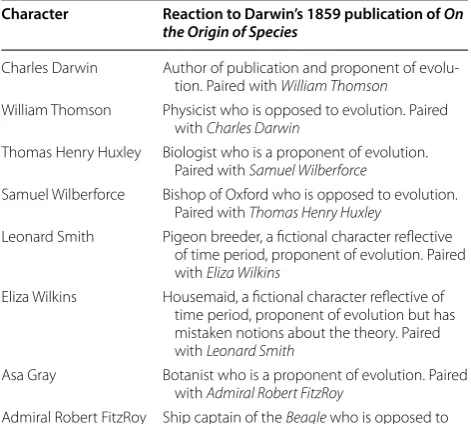
In Exercise 1, begun as a homework assignment and then discussed in groups in class, students are assigned one of eight historical characters (see Table 2) and given a brief biographical description of their character along with two or three questions about their character’s reac-tion to the 1859 publicareac-tion of Charles Darwin’s On the Origin of Species by Means of Natural Selection. When students return to class, they view a short video about Charles Darwin that provides insight into the cultural context of Darwin’s time. After the video, all students assigned the same character work together as a group to agree on how their character would reply to these ques-tions using information from the biographical sketch. For example, the students who were assigned Thomas Henry
Huxley, a biologist, draft answers in the character’s voice to two questions:
1. What evidence do you have to support the view that humans are related to animals?
2. Does Darwin’s theory disprove the existence of God?
Meanwhile, students assigned Samuel Wilberforce, the Bishop of Oxford, draft answers to the questions:
1. Why do you oppose the theory of evolution proposed by Darwin?
2. How do you explain the range of animals and plants that are alive today?
In Exercise 2 the character groups are paired so that each group contains one individual who was supportive of the theory of evolution in 1859 and one who either objected to the idea or had mistaken notions about the theory (see Table 2). The nuances of the characters’ sup-port of, or concern about, the theory of evolution are presented in the biographical character sketches the stu-dents are assigned. Not all of the characters chosen to represent proponents of evolution accepted all aspects of the theory as presented by Darwin. Most importantly, those characters chosen to represent opposition to the theory of evolution highlight both scientific and religious concerns about the theory at the time of its publication.
Students work together in their paired groups to con-sider how the proponent of evolution in each pair might have responded to his or her colleague or peer. They draft both a historical and modern-day response to concerns about evolution highlighted by one of their characters. All the paired groups are provided with a series of ques-tions to guide their responses:
1. Which character is a proponent of evolution? Or if both are proponents, which has an understanding of evolution closest to that of Darwin’s?
2. Given the opposing character’s specific objection(s) or misconception(s) about the theory, should the response include reference to the nature of science? For example, should the responses discuss the type of questions that science is able to explore? Why or why not?
3. If the opposing character’s objection(s) depend on a nineteenth-century understanding of nature, what type of new evidence would the proponent of evolution need to answer the objection(s) or misconception(s)?
4. What insights from a modern understanding of evolutionary theory or earth history would help the
Table 2 Historical Characters
Character Reaction to Darwin’s 1859 publication of On
the Origin of Species
Charles Darwin Author of publication and proponent of evolu-tion. Paired with William Thomson
William Thomson Physicist who is opposed to evolution. Paired with Charles Darwin
Thomas Henry Huxley Biologist who is a proponent of evolution. Paired with Samuel Wilberforce
Samuel Wilberforce Bishop of Oxford who is opposed to evolution. Paired with Thomas Henry Huxley
Leonard Smith Pigeon breeder, a fictional character reflective of time period, proponent of evolution. Paired with Eliza Wilkins
Eliza Wilkins Housemaid, a fictional character reflective of time period, proponent of evolution but has mistaken notions about the theory. Paired with Leonard Smith
Asa Gray Botanist who is a proponent of evolution. Paired with Admiral Robert FitzRoy
proponent of evolution respond to the character’s objection(s) or misconception(s)?
The paired groups then take turns introducing their characters to the entire class, describing the concern or misunderstanding one of their characters expressed, and outlining possible historical and modern day responses to those concerns. Students are asked to separate reli-gious and cultural concerns from scientific concerns. The teacher is encouraged to remind students that the goal is to be able to recognize and classify these different historical viewpoints but not to stage a debate between historical characters. The exercise should help students recognize that the theory of evolution meets one of the criteria of a robust scientific theory: it continues to be the best natural explanation of observations of nature even in light of new discoveries. Students should also recognize that cultural and religious responses to evolution var-ied in the past, just as they do today. Exercise 3, the final exercise for CRS Activity #2 is the “Relating Science to Other Ways of Knowing” exercise that explores possible relations between science, or specifically evolution, and religious or cultural beliefs. In contrast to CRS Activity #1 in which this exercise is completed in class, here it is assigned for homework.
CRS Activity #2 assumes that the students have previ-ously explored a scientific understanding of evolutionary theory as they are asked to draw upon that understand-ing to complete the exercises. This activity is designed to help students understand the cultural controversy surrounding evolution while demonstrating character-istics of a successful scientific theory, its ability to both predict future observations and withstand rigorous test-ing. If class time permits, students who had begun their instruction on evolution with Activity #1 would also benefit from completing their evolution instruction with Activity #2.
Field test
During the 2013–2014 school year, 218 students of seven different teachers field tested one of the two CRS activi-ties. These students were drawn from the larger pool of 304 students of 10 teachers who participated in the TEtHE project testing one of the four curriculum units for advanced placement (AP) biology classes. The recruit-ment strategies used to invite these teachers to partici-pate in the larger study are described elsewhere (Pobiner et al. 2018), but it is worth noting here that many of the teachers who responded to the recruitment were typically well-respected, experienced teachers, all of whom already taught AP Biology. The teachers who volunteered to test one of two CRS activities were free to choose which of the two activities they would use in their classroom.
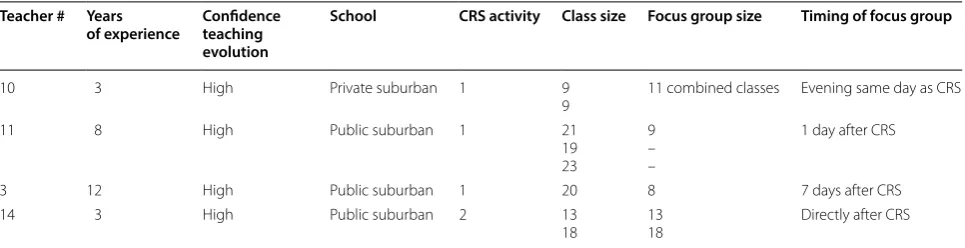
Five focus groups were conducted with students of four of these teachers. These four teachers were observed using the CRS activities in order to document their fidel-ity to the lesson exercises. Three of these teachers used the CRS activity with more than one class of students. Each of the four teachers described their confidence in teaching evolution as “high” before their participation in the TEtHE project, and all had faced sensitive issues with the topic of evolution in their classrooms in the past. The teachers all taught in suburban schools, three of which were public and one private (see Table 3). We include below a summary of these teachers’ responses to a sur-vey question about their experience using one of the CRS classroom activities.
The results of survey data collected from advisory board members, all seven teachers who field tested the CRS, and 120 returned student surveys in which they rated the degree to which the CRS learning materials aligned to the criteria/core strategies and the degree to which the materials were useable/feasible are reported elsewhere (Pobiner et al. 2018). Also reported in Pobiner et al. (2018) is the impact of the CRS activities on stu-dent understanding and acceptance of evolution from Table 3 Summary of teacher, school and focus group characteristics
Teacher # Years
of experience Confidence teaching evolution
School CRS activity Class size Focus group size Timing of focus group
10 3 High Private suburban 1 9
9 11 combined classes Evening same day as CRS
11 8 High Public suburban 1 21
19 23
9 – –
1 day after CRS
3 12 High Public suburban 1 20 8 7 days after CRS
14 3 High Public suburban 2 13
pre-curriculum to post-curriculum assessments. These results are referred to in the discussion section of this paper.
Focus groups
To gain insight into the students’ perspectives of the CRS activity; their experience of the activity, the extent to which the activity helped to create a supportive class-room environment and what benefits if any the students derived from participating in the activity; we chose to conduct focus groups. The choice of focus groups, rather than individual student interviews, was based on the advantage of focus groups for general topics where fos-tering talk among the participants through a structured interview is beneficial for revealing multiple perspectives (Bogdan and Biklen 1998, 2016). Participating in a group discussion can help the students both express and rec-ognize their own views (Bogdan and Biklen 1998, 2016). We felt this interaction between students would give us the most insight into the potential impact of the CRS resource and whether or not the approach it supports warrants further research. While focus group interviews may introduce the risk of losing data if a student is con-cerned about speaking in front of their peers, speaking individually to a researcher with whom the student has no familiarity may also be uncomfortable. Students in our group interviews were encouraged to express dissent-ing views if they held them and in general were reflective about how their views compared to others in the group. With the exception of one of the focus groups that con-tained too many students for an ideal experience and only half of the participants expressed an opinion, the other four groups had much higher participation rates with 64–88% of the students expressing an opinion.
Student participation in the focus group was volun-tary. Given the design-based research nature of this pro-ject, which involved a collaborative partnership between researchers and practitioners, we relied on the teachers to invite students to participate in the focus groups (Pobiner et al. 2018; Anderson and Shattuck 2012). Teachers were asked to recruit seven to ten students for the focus group and to allot 1 h of time for the group discussion. They were encouraged to assemble as diverse a group of stu-dents as possible in terms of cultural background, gender and academic performance. All of the focus groups were conducted by the lead author. See Table 3 for a summary of teacher, school and focus group characteristics.
In most cases teachers were able to schedule the focus group meeting the same day, or 1 day after, the stu-dents experienced the CRS activity, however one group meeting took place a week later. Two of the three focus groups conducted with students who had experienced CRS Activity #1 had a productive number of student
participants, 5 to 10 (Krueger and Casey, 2015), one group was slightly larger, 11 participants, and all three group sessions lasted 1 h. However due to scheduling dif-ficulties, the two focus groups conducted with students who had experienced CRS Activity #2 took place imme-diately after the activity as part of the regularly scheduled class time, and were therefore of a much shorter duration (25 min) and included the entire class as participants.
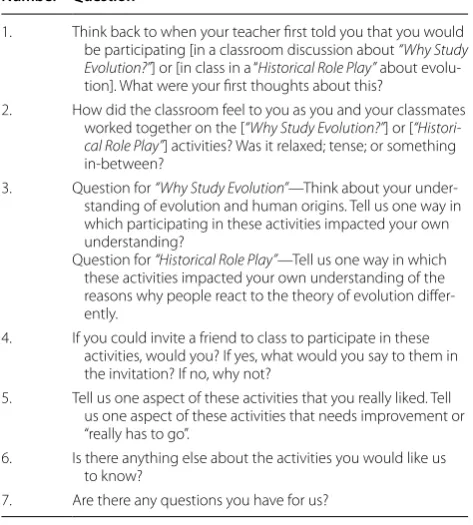
Both of the CRS activities highlight cultural con-cerns about evolution. The focus group questions were designed to elicit responses from the students that could be used to explore how the students experienced the CRS activities and to evaluate the structure and func-tion of the CRS activities to guide future revisions of the resource. The facilitator explained to the students that their thoughts and comments on the classroom activity would be very helpful to the CRS resource team as they considered future development of the activity. The stu-dents were assured that there were no wrong answers, that different points of view were welcome, and that par-ticipation was voluntary. All focus groups were audio recorded and transcribed verbatim with the students’ permission and understanding that their responses would remain anonymous. Following an ice-breaker question in which all students were invited to introduce themselves by first name and identify their favorite animal, the facili-tator briefly reviewed with the students an outline of the CRS activity they had experienced. Following this review, seven additional questions were posed to the students (see Table 4). The questions were open ended by design, encouraged the students to think back to their classroom experience with the activity and were sequenced from general to more specific as is standard for focus group questions (Krueger and Casey 2015). The students were assured that time would be reserved towards the end of the discussion for them to ask any questions they might have for the CRS resource team. Follow up questions to clarify students’ responses or to ask participants for spe-cific examples were also used as needed.
Analysis of transcripts
are presented below. However, the findings presented for the “Historical Role Play” activity are tentative due to the difficulty with the number (two classes of one teacher), size and timing of the focus groups. We present them here only to be seen as generally supportive of the goals of the CRS resource.
The coding process described by Bogdan and Biklen (1998, 2016) was followed. As a first step in the coding process, all transcripts for the focus groups associated with the same CRS activity were reviewed twice during a long single period. Then the transcripts of each of the focus groups were analyzed independently from other focus groups associated with the same activity to identify patterns in the data. An inductive approach was taken to coding, moving from specific codes to defining more general themes. This process began with initial cod-ing uscod-ing the constant comparative method to identify numerous codes for responses to each question (Krueger and Casey 2015). Focused coding was applied to these initial codes to combine, eliminate, or subdivide codes for each question of each of the individual focus groups. This process resulted in a total of 58 codes identified for focus group responses associated with the “Why Study Evolution?” activity, and 24 codes identified for the focus group responses associated with the “Historical Role Play” activity. For each code the number of instances of
students’ responses captured by the code, as well as the code assigned to each student respondent, was recorded.
The codes for each question were then analyzed across all focus groups who experienced the same CRS activity to identify repeating ideas for each focus group ques-tion for each activity. These repeating ideas may have been expressed by different students in the same focus group, or by different students across the focus groups. These repeating ideas were used to identify common themes for each CRS activity; that is, themes that con-nected repeating ideas across all questions for all of the focus groups associated with the activity. To check for consistency of coding the lead author coded the material twice with several weeks passing between coding efforts and achieved approximately the same results (Schreier 2012). In response to reviewers’ comments, coding was reviewed again a third time. In this review, rather than subdividing codes into repeating ideas, we recorded the overall instances of each theme, the focus group ques-tions from which the instances were derived, the number of instances per focus group and the percentage of stu-dents in a given focus group who expressed an instance of the theme (see Tables 5, 6). Theme descriptions were further refined in this process but overall interpretations remained the same.
Results
The intent of offering two different class activities in the CRS resource was to allow teachers to choose between activities based on their perception of whether or not the topic of evolution was a sensitive or troubling topic for the majority of students in their class. The final ver-sion of the CRS resource includes an acceptance of evo-lution survey that teachers can distribute to students before beginning their instruction on evolution to help teachers determine which activity might be most appro-priate for their classroom. However, the teachers who participated in this study volunteered to test one of the two CRS activities; they were free to choose which activ-ity they preferred to test and were not asked to justify their reasoning. Judging from the responses of students in the focus groups of the five classes who participated, all contained students who expressed finding the topic worrisome.
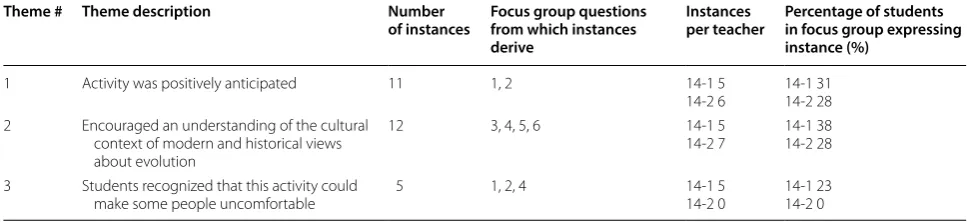
Listed below are the common themes identified for the focus groups conducted with students from the three classes who experienced CRS Activity #1, and focus groups conducted with students from the two classes who experienced CRS Activity #2. For each theme identi-fied, Tables 5, 6 detail the frequency of instances for the theme, the number of instances per teacher and the per-centage of students in each focus group that expressed an instance of the theme.
Table 4 Focus group questions Number Question
1. Think back to when your teacher first told you that you would be participating [in a classroom discussion about “Why Study Evolution?”] or [in class in a “Historical Role Play” about evolu-tion]. What were your first thoughts about this?
2. How did the classroom feel to you as you and your classmates worked together on the [“Why Study Evolution?”] or [“Histori-cal Role Play”] activities? Was it relaxed; tense; or something in-between?
3. Question for “Why Study Evolution”—Think about your under-standing of evolution and human origins. Tell us one way in which participating in these activities impacted your own understanding?
Question for “Historical Role Play”—Tell us one way in which these activities impacted your own understanding of the reasons why people react to the theory of evolution differ-ently.
4. If you could invite a friend to class to participate in these activities, would you? If yes, what would you say to them in the invitation? If no, why not?
5. Tell us one aspect of these activities that you really liked. Tell us one aspect of these activities that needs improvement or “really has to go”.
6. Is there anything else about the activities you would like us to know?
Common themes for CRS Activity #1
1. Encouraged respectful classroom discussion and reduced tension around the topic of evolution
Students of all three teachers referred to the positive rapport that already existed in their classroom among students and between students and their teacher. How-ever, in the focus group of teacher 11 and 3 there was also surprise expressed that this congenial atmosphere could remain when the topic of evolution was raised, especially as students recalled previous classroom experiences with the topic.
In classroom 11 one student remarked:
“It made like a good learning environment with no one fighting and everyone like ‘oh yeah, I hadn’t thought of that!’.” (11B5)
The student’s peers responded with an affirmation of this description of the classroom environment and a comparison to a previous classroom experience:
“Everyone was pretty respectful of other’s opinions and let them finish what they had to say before they went off about what they thought”. (11B6)
“It was definitely different because in certain classes like social studies classes there’s always like a debate about religion. There’s always like one person yell-ing at someone else about it. It definitely wasn’t like that.” (11B1)
A similar discussion emerged in the focus group of teacher 3, where students expressed surprise at the relaxed atmosphere in the classroom and appreciation of the discussions that took place:
“We were a lot more relaxed than I expected.” (3B3)
“Zero to very little yelling.” (3B2)
“I just value how we can really just sit down and talk about this openly without having to get into some kind of huge debate or argument.” (3A1)
Table 5 Frequency of instances for CRS Activity# 1 focus group themes, and their distribution among classes and students in focus groups
Theme # Theme description Number
of instances Focus group questions from which instances derive
Instances
per teacher Percentage of students in focus group expressing instance (%)
1 Encouraged respectful classroom discussion and reduced tension around the topic of evolution
32 2, 4,5, 6 (10) 3
(11) 10 (3) 19
(10) 18 (11) 56 (3) 63 2 Increased awareness of the possibility of
non-conflict between evolution and religious beliefs
19 3, 4, 5, 6 (10) 7
(11) 6 (3) 6
(10) 27 (11) 44 (3) 63 3 Encouraged reflection on own views and
interest in others’ views 29 1, 3, 4, 5, 6 (10) 10(11) 9 (3) 10
(10) 55 (11) 44 (3) 63 4 Students questioned the appropriateness of
the activity 7 1, 2, 5 (10) 2(11) 1
(3) 4
(10) 9 (11) 11 (3) 25
Table 6 Frequency of instances for CRS Activity# 2 group themes, and their distribution among classes and students in focus groups
Theme # Theme description Number
of instances Focus group questions from which instances derive
Instances
per teacher Percentage of students in focus group expressing instance (%)
1 Activity was positively anticipated 11 1, 2 14-1 5
14-2 6 14-1 3114-2 28 2 Encouraged an understanding of the cultural
context of modern and historical views about evolution
12 3, 4, 5, 6 14-1 5
14-2 7 14-1 3814-2 28
3 Students recognized that this activity could
This last student’s comment also inspired another stu-dent to recall a previous negative classroom experience:
“This is adding on to what she said. But in my last class, we had, it wasn’t supposed to start out on a debate on this, …it was about the ethics of testing for genetic disorders… and we probably got three min-utes in before it devolved into just a rampant debate between evolutionists and creationists…” (3B1).
Among the students of all three teachers who partici-pated in the focus groups, there was a general awareness that evolution is a controversial topic and could be an uncomfortable classroom discussion. Students suggested the CRS activity was useful for reducing tension and, if not a concern for them personally, might ease the con-cerns of religious friends or family.
Students of teacher 3 spoke about the usefulness of beginning instruction on evolution with the exercises in the CRS activity. Student 3B2 is an example:
“I really liked the first thing we did, the three ques-tions [exercise 1]. I thought it was like a good opener, like, it sort of eased the tension I think… I think it was like, let’s get this out of the way, yes there are other ideas, but we kind of have to learn this any-ways.” (3B2)
The first exercise is designed to provide an opportunity for students to note other cultural ideas about the diver-sity of life and specific concerns about studying evolu-tion. Nowhere in the focus group conversation does the student quoted above, 3B2, reveal their own cultural or religious concerns, but they are certainly aware that these exist for some people and applaud the value of acknowl-edging those concerns upfront. Following this student’s remark another student, who elsewhere in the conver-sation does identify themselves as religious, also spoke favorably about exercises 1 and 2 and was appreciative of the opportunity to share beliefs with their peers:
“I really enjoyed the first two, what do you know about evolution and ways of knowing diagram because I felt like those two are really nice opening things and it led to a lot of really interesting class discussions where we just shared things that we believed and we talked…” (3A3)
When students were asked a final time if there was any-thing else they would like us to know about the activity this same student spoke on a more personal level about the value of the activity’s approach, taking the time to introduce the topic of evolution with an acknowledge-ment of cultural concerns:
“I really liked how the lessons eased you into evolu-tion, the idea of it, because some people aren’t open to learning it, so it’s kind of helping you not to have to be bombarded…”(3A3)
Students were also reflective about who in their per-sonal sphere might benefit from participating in the activity and why. In the focus group of teacher 11 one student, who does not reveal whether or not they are gious themselves, notes the value of the activity for reli-gious friends:
“I think I would, personally, invite my friends because I have, not all of my friends, but some of my friends are more religious and I know that some of them have always struggled with the concept of evo-lution. And I would really want to invite them to the class so that they could see that there is the ability to coexist or to even be together with the two topics.” (11B2)
This student recognized the discomfort that the topic of evolution can raise for their religious friends and sug-gested the activity could help these friends see a possi-bility for the coexistence of evolution and their religious beliefs thereby alleviating their struggle with evolution. Following this student’s comment, a classmate, who else-where describes himself as “very religious”, remarked:
“Yeah, I mean I would invite someone [to class]. I can’t think of a reason why not. …it might clear some things up for anybody that might be in the same boat as [student 11B2] was talking about.” (11B5)
Students who openly identified as religious were included in the 56% of students in the focus group of teacher 11, and the 63% of students in the focus group of teacher 3, who expressed an instance of Theme 1. The percentage of students expressing this theme in the focus group of teacher 10 was less, 18%. Of the three teachers who used CRS Activity #1, the students of teacher 10 had the highest pre-curriculum acceptance of evolution as measured with the Generalized Acceptance of EvolutioN Evaluation instrument (GAENE, a 16 item Likert-scale instrument used to assess student acceptance of evolu-tion, Smith et al. 2016) (Pobiner et al. 2018). While not identifying as religious themselves, but previously noting that some of their family members are conflicted about evolution because of their religiosity, one student of teacher 10 noted the value of the activity’s approach for introducing the topic of evolution:
learn about evolution’. I’d say ‘we’re talking about evolution and how it relates to other ways of think-ing and how it relates to religion and how people deal with that, we’re going to talk about it, and come say what you think, we’re not going to try to convince you’.” (10A3)
This student highlighted the value of a respectful dis-cussion, one that avoids targeting any personal belief, as the starting point for a study of evolution.
2. Increased awareness of the possibility of non-conflict between evolution and religious beliefs
Students were curious about the relationship between evolution and religion and many commented on the pos-sibility of non-conflict between the two and the role the activity played in helping them recognize this possibility. All three teachers had students who expressed this senti-ment. A student of teacher 10 who introduced herself by noting her religious upbringing stated:
“…today when we were talking about the different ways of thinking, the conflict/separation/integra-tion, it made it more clear for me because it’s not like there’s one way…it’s not one or the other, there’s many grey areas in between, it’s not that you either believe in evolution or religion, and it kind of com-forted me to think that it’s okay to believe both…” (10A2)
Other students in this teacher’s class also noted with interest, rather than a personal connection, the possi-bility of believing both. For example in response to the above student, one classmate immediately replied:
“I think it’s kind of what you said, a mix between religion and science…I think it’s interesting that you can believe what you believe in and still believe in the science, it’s not one or the other” (10A1) As was the case for theme 1, the percentage of stu-dents in the focus group of teacher 10 who expressed an instance of theme 2 was only 27%, compared to 44% and 63% for the students in the focus groups of teachers 11 and 3. The classes of teachers 11 and 3 had pre-cur-riculum GAENE scores that were lower than the class of teacher 10. Student 10A2, and one other student of teacher 10, are the only students in this focus group who described themselves as religious. The other self-described religious student noted that they belonged to a very liberal tradition where a conflict between science and religion was not an issue and a topic they had pre-viously explored in religious education.
For students of teacher 11 the recognition of non-conflict between evolution and religion was described in more personal terms. One religious student explained:
“I’d say they [the exercises] made me a little more aware. Because I’m also very religious and it just made me more aware of my own beliefs and how they can coexist. So I guess, more interaction than conflict, or like one has to overcome or dominate the other one.” (COB5)
To which their peer replied:
“I’d just say that I’m pretty religious too…I was raised in a very narrow minded household about evolution…I was always raised to think that there was conflict, but really I’ve realized that there isn’t as much conflict as you’d think.” (COB4)
Students of teacher 3 had the lowest pre-curriculum GAENE scores of all three teachers. Students of this teacher who described themselves as religious also spoke about the recognition of options for relating evolution and religion beyond conflict in more personal terms as well. Student 3A2 is one example:
“I like the ways of knowing diagram and the relat-ing science to other ways of knowrelat-ing just because it showed me other ways of thinking. I didn’t have to just choose one or the other…” (3A2)
Student 3A4 also expressed appreciation that the state-ments in exercise three included examples that illustrated the possibility of a non-conflict relationship between evo-lution and religious belief, relieving them of the burden to choose one or the other.
“Coming into this, I’ve always thought creationism is over here and evolution is over there and you can’t bring them together, no way. …There’s part(s) of evo-lution that I do believe are true now… (3A4).
With the possibility of a non-conflict relation between evolution and religion realized, this student was able to reconsider the validity of evolution.
3. Encouraged reflection on own views and interest in others’ views