An IOT-based Multi-sensor Ecological Shared
Farmland Management System
https://doi.org/10.3991/ijoe.v14i03.8199
Guandong Gao!!"
The National Police University for Criminal Justice, Baoding, China
Yuchen Jia, Ke Xiao
Hebei Agricultural University, Baoding, China
Abstract—With the wide adoption of a shared economy, the term “share” has become closely linked with people’s daily life. To improve the economic output per unit area of farmland and allow urban residents to experience the fun of cultivating, an IOT-based multi-sensor ecological shared farmland manage-ment system is presented and designed in this paper. Furthermore, the system also presents an agricultural economy model that shares planting and gains by remote control. This system consists of multiple sensors for data collection, au-tomatically controlled equipment, a transport module (with a ZigBee module and a WiFi module), an app-based smart monitoring and control module and a WeChat public platform. Various monitoring data, including air temperature and humidity, soil humidity, illuminance, CO2 concentration, pH, real-time video and images, are collected for users to ensure an optimal crop growing en-vironment via remote control and by sharing agricultural products in harvesting seasons. Sharing functions such as picking, leasing and transferring are imple-mented via the WeChat public platform. Not only is detailed information on vegetables growing in rented farmland available remotely via RFID electronic tags and multiple sensors, but the real-time growing state of the planted crops is also available via camera. Control of functions such as irrigating, fertilizing and shading is also supported. The test shows that in this system, the data collected via multiple sensors are accurate; real-time information is transmitted and man-aged smoothly.
Keywords—share, multi-sensor, RFID, ZigBee, farmland
1
Introduction
saves agricultural resources significantly, reduces investment, protects the environ-ment and improves economic efficiency.
With the wide adoption of a shared economy, the term “share” has become a zeit-geist. In a shared economy that emphasizes the right of use, experience is another way of owning value. Bicycle share, automobile share, apartment share and office share emerge in cities and around us. Many idle resources are utilized [3-4]. In rural areas outside of cities, vast high-quality farmlands are idle and require labor for their maintenance. Most farmers are too occupied with agricultural work to become mi-grant workers and rely purely on income from farmland for a living. Simultaneously, the demand of urban families for ecological agricultural products cannot be fulfilled; urban families expect a “harvest paradise” but find it nowhere. Additionally, due to the pressures of life and work, urban families cannot spend a long time managing farmland. Therefore, a “shared kitchen garden” with smart control emerges. Precision agriculture is combined with a shared economy, and an IOT-based multi-sensor eco-logical shared farmland management system is formed.
The development of electronics and communication technology has been accom-panied by a new generation of information technologies, such as the 3S technologies (GIS, GPS and RS) [5-6], the Internet of Things [7], cloud computing [8] and big data [9], that are widely adopted in agriculture and catalyzed agricultural modernization. Farmland information collection, transmission, storage and processing are the founda-tion of modern agriculture. Chen et al. [10] developed a real-time agricultural infor-mation collection system based on the Android and iOS mobile platforms. Bailey et al. [11] deployed a mesh wireless network in a container nursery garden that provided a comprehensive monitoring and calculation of irrigation time and irrigation amount. Du et al. [12] designed a solution that integrated “point”-based monitoring data from the Internet of Things and “plane”-based space data from WebGIS and implemented an agricultural environmental monitoring system that integrated monitoring data from the Internet of Things (point) and space data from WebGIS (plane). Hirofumi [13] applied advanced information technology in crop cultivation and designed a real-time control system to supply solution for the hydroponic cultivation of tomato. Zhang et al. [14] developed a farmland information collection system consisting of a portable information collection device based on STM32 technology, a remote server and a mobile app. This system monitors such parameters as the crop leaf chlorophyll con-tent, air temperature and humidity, illuminance and geographical location. However, these researches focus on remote monitoring and control, which are short of data storage separately and labeling farmland renting information. It could be solved by combining radio frequency identification (RFID) technology in the system.
[19] designed a RFID-based farmland information collection system. In that system, a WSP430F5438, single-chip microcomputer is used as a master control unit to collect and process data that includes soil temperature and humidity, illuminance and CO2 concentration; a GPS module and CC1101 radio frequency transceiver chip provide functions that include electronic tag positioning, timing and communication with a read/write device. Guo et al. [20] implemented a ZigBee-protocol-based network system for farmland environmental monitoring that consisted of three major modules, including an ARM + Linux module, a ZigBee wireless sensor network and a remote information management system. However, fixed-point measurement has deficien-cies, such as low practicality, an excessive operational and maintenance load and low flexibility. Moreover, these studies only focus on the remote monitoring and planting management technology. The progress of improving practical application and agricul-tural economy model is rarely involved.
To improve the economic output per unit area of farmland and application in re-mote control system, an IOT-based, green shared farmland management system is designed to collect various parameters, including the air temperature and humidity, soil moisture, illuminance, CO2 concentration and pH value. Therefore, to address the aforementioned problems and further improve the economic income and output of each unit of land area, a model based on a shared economy is presented in this system. Additionally, RFID and ZigBee technologies are integrated to implement remote crop planting, management and sharing. Videos of farmland are transmitted and displayed in real-time via camera; information is provided to the user via WeChat or a mobile app-based sharing platform to support remote control and adjustment of the crop growing conditions by the user. Functions such as fruit picking and sharing, farm leasing and transferring are implemented via the sharing platform. The influence of a shared economy and the Internet of Things on the development of precision agricul-ture is introduced in the first section of this paper. Next, the architecagricul-ture and design of an RFID-based, multi-sensor, green shared farmland management system are elabo-rated in the second section. The third section covers related experiments and an analy-sis of the results.
2
Design of the shared farmland model and management
system
An IOT-based multi-sensor ecological shared farmland management system measures and records various parameters characterizing the farmland environment in real time. In this section, the architecture, design and implementation of the ecological shared farmland management system are elaborated.
2.1 Overview of the shared farmland model and management system
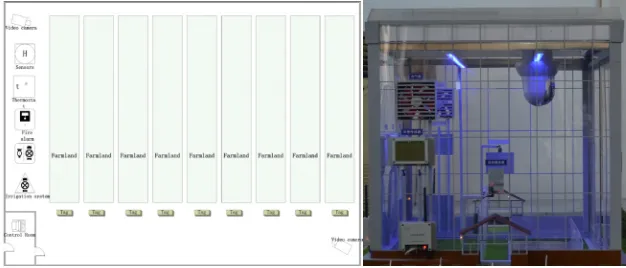
ultra-high-frequency RFID electronic tag is positioned. The tag is scanned to provide de-tailed information on the tenant(s) and planted vegetable(s) in that block: the name of the tenant(s), the lease date, the name of the planted vegetable(s), and the vegetable planting time and growth status. The system administrator can update the electronic tag information as required. This information facilitates the farmland management by the administrator and the information exchange between users. An IOT-based multi-sensor ecological shared farmland management system includes cameras and various sensors that provide comprehensive monitoring and recording from the initial moment of sowing or transplanting. This system also includes an irrigation scheme as well as a ventilator, roller shutter, lighting facility, thermostat and fire alarm. The control room monitors the operational states of all the devices on the farmland. The sensors are deployed at a specific position in the system (e.g., the soil moisture sensor is deployed in the soil, and the CO2, temperature and humidity sensors are deployed in the air) and are responsible for sensing the environmental status of the system. The measured data are transmitted to the single-chip microcomputer master control unit via the ZigBee module. The master control unit stores and analyses the received data so that the system environment is monitored efficiently in real time. Note that various sensors are deployed at different positions in the system to monitor multiple environmental variables. In this way, ubiquitous information collection and reading occur, and more comprehensive and effective data become available.
Fig. 1. Layout of the Shared farmland management system
Shared model: The farmland is divided into multiple blocks according to prede-fined criteria. Each farmland block is shared by multiple tenants who manage the farmland together and share its products when the crops mature. Additionally, tenants of different farmland areas can exchange products to maximize farmland resource utilization.
2.2 Overall design of the shared farmland management system
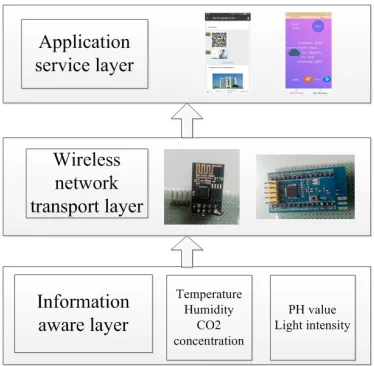
is responsible for monitoring the environmental parameters and for collecting data via the sensors. The wireless network transport layer consists of a WiFi module and the ZigBee module and is responsible for transmitting the data collected by the infor-mation-aware layer to the application service layer. The application service layer consists of a mobile terminal app and the WeChat public platform, which queries these data and makes decisions. These components complement each other and con-stitute an IOT-based multi-sensor ecological shared farmland management system. Figure 2 shows the architecture of this system.
Fig. 2. Architecture of the proposed system
2.3 Software platform design
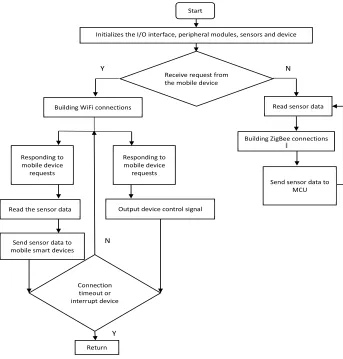
Fig. 3. Workflow diagram of the system
2.4 Sensor-based data collection module
Temperature and humidity are important factors that directly affect crop growth. The environmental temperature drives plant growth, and the proper temperature ac-celerates plant growth. Humidity refers to the water content in air. Improper humidity is unfavorable for plant growth because plants cannot satisfy their requirements for photosynthesis. Illuminance directly affects plant photosynthesis and subsequently affects plant growth. The CO2 concentration is an important factor for plant growth that directly affects plant photosynthesis. Low CO2 concentrations reduce the plant photosynthetic rate and affect plant growth. An excessively high CO2 concentration causes a partial or even complete closure of plant stomata, which affects plant photo-synthesis. Therefore, only a proper CO2 concentration is favorable for plant growth.
!
"#$%&'()'*!+&! ,&-).#!(#/)0#!
1#23#$+$!
4+51+!
6')+)5.)7#$!+8#!69:!)'+#1;50#<!%#1)%8#15.!,&(3.#$<!$#'$&1$!5'(!(#/)0#!
.! -. !
"#5(!$#'$&1!(5+5! =3).()'*!>)?)!0&''#0+)&'$!
"#0#)/#!1#23#$+!;1&,! ! +8#!,&-).#!(#/)0#!
"#$%&'()'*!+&! ,&-).#!(#/)0#!
1#23#$+$!
"#5(!+8#!$#'$&1!(5+5!
4#'(!$#'$&1!(5+5!+&! ,&-).#!$,51+!(#/)0#$!
:3+%3+!(#/)0#!0&'+1&.!$)*'5.!
@&''#0+)&'! +),#&3+!&1! )'+#113%+!(#/)0#!
"#+31'!
=3).()'*!A)*=##!0&''#0+)&'$!
B!
C!
C! B!
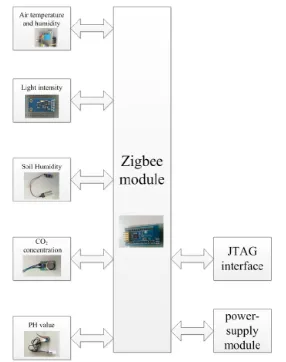
An IOT-based multi-sensor ecological shared farmland management system re-quires sensors for the real-time monitoring of various data. In this system, the sensors collect data such as the air temperature, air humidity, soil moisture, illuminance, CO2 concentration and pH value. The collections are based for the air temperature and humidity on a DHT22 module, for illuminance on a GY-30 module, for the soil mois-ture on a module that monitors soil moismois-ture, for the CO2 concentration on an MG-811 module and for pH on a pH detection module.
1. The air temperature and humidity DHT22 sensor module uses single-row, four-pin packaging and has an embedded, calibrated temperature and humidity composite collection component. Digital module collection technology and integrated tem-perature and humidity sensor technology ensure superior reliability and long-term stability. Additionally, the DHT22 module supports digital communication and in-cludes a temperature sensor that is based on a component that measures the nega-tive temperature coefficient (NTC) and a humidity sensor that is based on a capaci-tor humidity measurement component. An embedded, high-performance, eight-bit, single-chip microcomputer is responsible for data collection and transmission. Therefore, this module has advantages that include a low power consumption, quick response and superior anti-interference capability.
2.The illuminance data collection unit is based on a GY-30 module. The master con-trol chip (BH1750FVI) is a high-sensitivity, integrated circuit that is capable of de-tecting variations in illuminance over a wide range (1 to 65,535 lx). The sensor has five pins: an I2C serial data (SDA) pin as well as a serial clock (SCL) pin, refer-ence voltage (DVI), power supply port (VCC), common ground (GND) and ad-dress definition port (ADDR).
3.The soil moisture detection module is based on an LM393 chip, which has two de-tection poles that each has a special electrical coating. Two dede-tection poles planted under topsoil generate different electric potentials, which are processed by a volt-age comparator as an analogue voltvolt-age. In this design, the analogue voltvolt-age is col-lected by an application control terminal via an internal, integrated, analogue-digital (AD) convertor module and then quantified as the corresponding humidity. 4.The CO2 sensor is based on the MG-811 module from Zhengzhou Winsen
Elec-tronics Technology Co., Ltd. MG811 is a solid electrolytic sensor that is highly sensitive to CO2 and insensitive to temperature and humidity variation. This mod-ule has superior stability and repeatability and is suitable for air quality control sys-tems, the control of a fermentation process and the detection of greenhouse CO2 concentrations.
5.The pH detection module is a liquid electrolyte sensor consisting of an E-201-C pH composite electrode and transport module made by Rex. The electrode consists of a glass tube with a bulbous end and a pH-sensitive glass membrane. During opera-tion, the interior of the tube is filled with an aqueous electrolyte solution.
Fig. 4. Hardware structure diagram of the system
2.5 Remote control equipment in the system
In modern agriculture, constant ventilation is beneficial to crop growth because ventilation increases the oxygen concentration in the plant growth environment. A thermal insulating device (roller shutter) is installed in the system to maintain a warm environment for crop growth, especially at night or during the winter when the tem-perature drops. Additionally, a drip irrigation device is installed in the system to pro-vide functions such as automatic irrigation based on soil humidity data and manual irrigation by remote control. As these devices require automatic control, a means of controlling a terminal actuator via the network becomes a critical issue. In the present system, a relay is used for this control. Ventilation, drip irrigation and roller shutter control commands from a remote controller are received by the ZigBee communica-tion module. Then, the module sends an on/off signal to the relay to control the actua-tor on/off state. The relays used in this system include a high-level and a low-level triggering type. The high-level triggering type is based on the NPN triode J3Y; the low-level triggering type is based on the PNP triode 2TY. The relay that was designed based on this scheme can control a circuit with a 250-V voltage and a 7-A current under a bias of +5 V.
2.6 System transport module
This system includes two transport modes: one is the ZigBee-module-based less transport for sensors inside the system; the other is the WiFi-module-based wire-less transport between the system internal sensors and the external mobile apps. These two modules are described in the following sections.
the nodes can communicate with each other), a high transmission rate, low energy consumption and a simple network protocol, which fulfils the requirement of sys-tem internal wireless network communication. The ZigBee nodes in the syssys-tem are deployed in a collection area to gather farmland environmental data and effectively transmit data via internode routing. In this way, the gateway node acquires relevant data.
2.The WiFi module has the major advantage of wireless functionality. This module is not constrained by a wiring requirement and is suitable for both a mobile office user and a mobile user. In addition, the WiFi module has advantages that include the following: a wide range of radio wave coverage, an extremely fast transmission rate up to 11 mbps and a long operational range. WiFi is suitable for wireless communication between the system internal sensors and the external mobile app.
3
System test and experimental results
3.1 Test conditions
To test this farmland management system, a real scenario identical to an applica-tion system is deployed at an experimental farm on the west campus of the Agricul-tural University of Hebei (Baoding, China). In each test area, two real-time monitor-ing cameras are installed. Each farmland has been assigned an ultra-high-frequency RFID electronic tag to identify the surrounding sensors that detect and store the real-time environmental data. An active RFID read/write device is deployed in the control room and connected to a computer. A farmland tenant periodically communicates with the ultra-high-frequency RFID tag assigned to the rented farmland via wireless communication to obtain growth information on the planted crops.
3.2 Software platform test
This section mainly covers two management system components: an app smart monitoring/control unit and the WeChat public platform.
Fig. 5. Interface of mobile phone APP
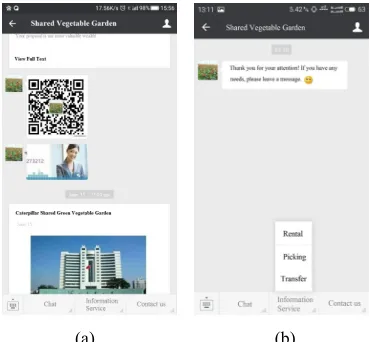
Figure 6 shows the WeChat public platform component. The WeChat platform fa-cilitates the communication between the tenant and system administrator and imple-ments functions such as lease and transfer. WeChat provides such basic functions as message reply and menu customization, which supports the system. The tenant only needs to follow “xxx” (subscription name) to receive a daily group message (includ-ing a pure text message, graphic message, voice message, video message and text and graphic message) or click the content in the customized menu to obtain the required information (such as transfer, fruit and vegetable ripening and harvesting). Tenants can also leave messages to the system administrator specifying suggestions and re-quirements so that the administrator is best able to try to satisfy the tenants.
(a) (b)
3.3 Sensor test and results
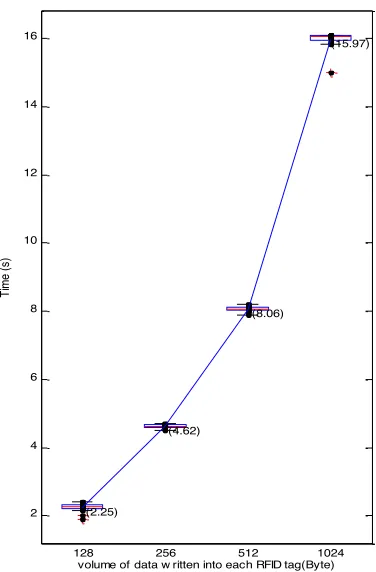
RFID electronic tag writing speed. Other automatic recognition technologies, such as those using a barcode, magnetic card, or an integrated circuit (IC) card, re-quire tags within a line of sight and a sequential reading order. By comparison, the ultra-high-frequency RFID cards have a reading distance of up to 10 m and permit multiple electronic tags to be identified simultaneously, which is more convenient and efficient compared with any other automatic recognition method. In this experiment, 60 electronic tags are used to record in detail the time required for different data vol-umes to be written to different ultra-high-frequency RFID tags (128, 256, 512 and 1,024 bytes). These times are shown in Figure 7, after selecting and displaying only 20 sets of data to facilitate diagram plotting.
Figure 7 is a box plot representing six data nodes. The data points in each data group are arranged in descending order from upper edge, upper quartile, median, and lower quartile to lower edge; and an abnormal value is calculated. Figure 7 shows that the writing time for the RFID electronic tag data is very short, ranging from 2.25 to 15.97 s, which is suitable for the multi-sensor, green shared farmland management system.
Fig. 7. The Time for writing different volumes of data 2
4 6 8 10 12 14 16
128 256 512 1024
volume of data w ritten into each RFID tag(Byte)
Tim
e (
s)
(2.25)
(4.62)
(8.06)
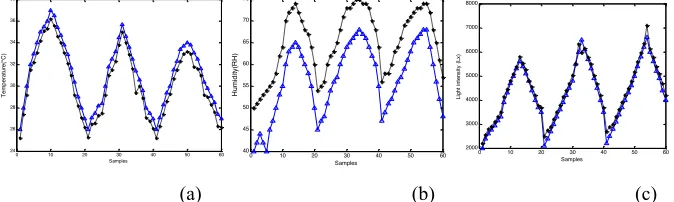
Test and evaluation of system accuracy. To demonstrate system accuracy, the sensors in this system are compared with similar sensors. In a laboratory environment, the system is operated continuously for more than 72 hours, the test result is measured and recorded every 30 minutes, and 60 groups of test results are selected and com-pared. These environmental temperature and humidity results are compared with the results from an AS817 handheld temperature and humidity metre (Smart Sensor, Hong Kong, China), whose temperature detection range is -10 to 50°C (measurement error ± 1.5°C) and humidity range is 5 to 98% RH (measurement error ± 4%). The system illuminance data are compared with the measurements obtained using an HT1300 digital handheld illuminometer (with a measurement range of 0 to 100,000 lx and a precision of ± 3%) manufactured by HCJYET (Guangzhou, Guangdong, Chi-na).
The test results are shown in Figs. 8(a), (b) and (c). In Figures 8(a) and (b), the temperature and humidity test data obtained via the DHT22 module are represented by the ! symbol and those obtained via the AS817 metre are represented by the * symbol. In Fig. 8(c), the illuminance test data obtained via the GY-30 module are represented by the ! symbol and those obtained via the HT1300 illuminometer are represented by the * symbol. The environmental temperature and humidity measure-ment results in the present test system are compared with the results from the AS817 handheld temperature and humidity metre. The absolute and relative temperature errors of this metre are 1.5°C, and 4.96%, respectively, and these values are mainly affected by air pressure and wind variation. The absolute and relative errors of this metre for humidity are 7.5% RH and 11.5%, respectively, and these values are mainly affected by air temperature, pressure and wind variation. The illuminance measure-ment result in the present test system is compared with the result from the HT1300 digital handheld illuminometer. The absolute error is 158.25 lx, and the relative error is 3.6%, values that essentially meet the design requirements. Future research to achieve increased measurement accuracy will improve the IOT-based multi-sensor ecological shared farmland management system
(a) (b) (c)
Fig. 8. Theexperimental results by the two instruments. (a) Temperature results; (b) Humidity results; (c) Light intensity(Lx) results.
0 10 20 30 40 50 60 24 26 28 30 32 34 36 38 Samples Tem per at ur e( °C )
0 10 20 30 40 50 60 40 45 50 55 60 65 70 75 Samples Hu m id ity (RH)
4
Conclusions
To improve the economic output per unit area of farmland and allow urban resi-dents to experience the fun of cultivating, an IOT-based multi-sensor ecological shared farmland management system records and collects various parameters of farm-land-planted crops in real time. This system provides integrated services, including data collection, smart control and information sharing, and replaces conventional kitchen garden planting. The system features are summarized as follows:
1.The concept of sharing is applied in this system, reasonably and effectively using idle farmland and fulfilling the demand of urban families for ecological and green agricultural products. To improve the economic return per unit area of farmland, farmland blocks are marked by ultra-high-frequency RFID electronic tags that have advantages such as a high data storage capacity and superior environmental adapt-ability. Various types of information, such as tenant name(s), lease date, the name(s) of planted vegetable(s), the date of vegetable planting and the vegetable growth status, are recorded in real time. This information facilitates farmland man-agement by tenants. When a tenant transfers farmland, the next tenant can obtain the real-time growth status of the farmland crops.
2.RFID and ZigBee technologies are applied in this system. The RFID read/write device not only shows a high read/write rate and a long reading distance but also effectively improves agricultural modernization. The test results show that ZigBee guarantees fast data transfer from each sensor. Compared with measurements made via handheld sensors, it shows that the relative errors in the temperature, humidity and illuminance data collected by multiple sensors in this system are only 4.96%, 11.5% and 3.6%, respectively. This means that the measurements are accurate. 3.A mobile app smart monitoring/control system and the WeChat public platform
system are developed. The monitoring and control supplied by the app are essential to the system, enabling the system, the administrator and the tenants to check the growth of planted crops in real time. Remote management is based on the collected information, and the farmland is monitored by a camera in real-time. In this way, green and ecological crop cultivation is guaranteed. The WeChat public platform facilitates communication between the tenants and the system administrator and provides functions such as harvesting, leasing, transferring and sharing.
5
Acknowledgments
6
References
[1]Liu, B., Shen, WJ., Yue, YM., et al. (2017). Combining spatial and spectral information to estimate chlorophyll contents of crop leaves with a field imaging spectroscopy system. Precision Agriculture, 18: 491-506 https://doi.org/10.1007/s11119-016-9466-5
[2]Van Hertem, T., Rooijakkers, L., Berckmans, D., et al. (2017). Appropriate data visualisa-tion is key to Precision Livestock Farming acceptance. Computers and Electronics in Agri-culture, 138: 1-10 https://doi.org/10.1016/j.compag.2017.04.003
[3]Yao, E., Zhang, Z.C., Zhang, J.L., et al. (2017). A Model and Algorithm for Optimization of the Utilization of Residential Shared Parking Slots. Journal of Transportation Systems Engineering and Information Technology , 17: 160-167
[4]Ju, P., Zhou, J., Xu, H.L. et al. (2017). Travelers' Choice Behavior of Car Sharing Based on Hybrid Choice Model. Journal of Transportation Systems Engineering and Information Technology, 17: 7-13
[5]Yolasigmaz, H.A., Keles, S. (2009). Data Base Design with GIS in Ecosystem Based Mul-tiple Use Forest Management in Artvin, Turkey: A Case Study in Balci Forest Manage-ment Planning Unit. Sensors, 9: 1644-1661 https://doi.org/10.3390/s90301644
[6]Calera, A., Campos, I., Osann, A., et al. (2017). Remote Sensing for Crop Water Manage-ment: From ET Modelling to Services for the End Users. Sensors, 17: 1104 https://doi.org/10.3390/s17051104
[7]Badia-Melis, R., Ruiz-Garcia, L., Garcia-Hierro, J., et al. (2015). Refrigerated Fruit Stor-age Monitoring Combining Two Different Wireless Sensing Technologies: RFID and WSN. Sensors, 15: 4781-4795 https://doi.org/10.3390/s150304781
[8]Chen, M.L., Wang, S.Y., Wang, M.W., et al. (2017). Entropy-Based Registration of Point Clouds Using Terrestrial Laser Scanning and Smartphone GPS. Sensors, 17: 197 https://doi.org/10.3390/s17010197
[9]Rahnemoonfar, M., Sheppard, C. (2017). Deep Count: Fruit Counting Based on Deep Simulated Learning. Sensors, 17: 905 https://doi.org/10.3390/s17040905
[10]Chen, X., Zhao, J.Y., Bi, J.F., et al. Research of real-time agriculture information collec-tion system based on mobile GIS. In Proceedings of the Internacollec-tional Conference on Agro-Geoinformatics(2012), August 2–4 2012, Shanghai China, pp. 1–4
[11]Bailey, D.R., Owen, J.S., Wagner, J., et al. (2013). In-situ performance and usability of a distributed, wireless sensor network via mesh connectivity at a production container nurse-ry. Applied Engineering in Agriculture, 5: 779–782
[12]Du, K.M., Chu, J.X., Sun, Z.F., et al. (2016). Design and implementation of monitoring system for agricultural environment based on Web-GIS with Internet of Things. Transac-tions of the Chinese Society of Agricultural Engineering, 4: 171–178
[13]Hirofumi, I., Yukimasa, K., Jungo, I., et al. (2016). A reliable wireless control system for tomato hydroponics. Sensors, 5: 644
[14]Zhang, J., Hu, J., Huang, L., et al. (2016). A Portable Farmland Information Collection System with Multiple Sensors. Sensors, 16: 1762 https://doi.org/10.3390/s16101762 [15]Want, R. (2006). An introduction to RFID technology. IEEE Pervasive Computing, 5: 25–
33 https://doi.org/10.1109/MPRV.2006.2
[16]Xiao, C.J., Chen, N.C., Li, D.D., et al. (2017). SCRMS: An RFID and Sensor Web-Enabled Smart Cultural Relics Management System. Sensors, 17 : 60 https://doi.org/10.3390/s17010060
[18]Tiago, M.F., Paula, F.L., Manuel, S.A., et al. (2017). Reverse Engineering and Security Evaluation of Commercial Tags for RFID-Based IoT Applications. Sensors, 17: 28 [19]Yao, D.W., Zhou, G.P. (2014). Design of an intelligent farmland information collection
system based on RFID_GPS. Water Saving Irrigation, 11: 80–83
[20]Guo, J., Ma, X.M., Guo, W., et al. (2013). Design of farmland environment remote moni-toring system based on ZigBee network. Journal of Agricultural Mechanization Research, 11: 65–70
7
Authors
Guandong Gao is a computer scientist, engineering educator. He works at de-partment of information management, The National Police University for Criminal Justice.
Yuchen Jia is a computer scientist, engineering educator. She works at college of information science and technology, Hebei Agricultural University.
Ke Xiao is a computer scientist, engineering educator. She works at college of in-formation science and technology, Hebei Agricultural University.