Comparative analysis of the effect of hermetic storage models on
some quality parameters of soybean seeds
Orhevba, Bosede Adelola
1*, Atteh, Bamidele
2(1. Department of Agricultural and Bioresources Engineering, Federal University of Technology, Minna. Niger State, Nigeria; 2. Department of Agricultural and Bioresources Engineering, Federal University of Technology, Minna. Niger State, Nigeria)
Abstract: The comparative analysis of the effect of hermetic storage models on some quality parameters of soybean seeds was studied. Freshly harvested soybean pods were depodded and the seeds were sundried at 33°C with an average relative humidity of 62% for three days. The seeds were then divided into three portions of 400 g and each portion was put into different storage models which were PVC bags of 400 g, jars of 1 L capacity and another jar (perforated) of 1 L capacity which served as the control. The initial quality parameters of the soybean seeds were determined, while the storage models and control were kept for eight weeks. Samples in each storage model and control were analyzed for proximate composition and other quality parameters at the end of every two weeks. The data obtained were analyzed statistically to determine the effect of hermetic storage models on the nutritional properties together with some quality parameter such as dry matter and hectolitre weight of the stored soybean seeds. Results for the nutritional properties showed that the raw soybean seeds consisted of 8.36% moisture, 15.23% fat, 6.12% ash, 5.18% fibre, 44.18% protein and 20.94% carbohydrate. The values for dry matter and hectolitre weight were 91.63% and 72.30 hl kg-1 respectively. The moisture content, carbohydrate and hectolitre weight of the soybean seeds increased significantly (P<0.05) in the control, while crude fat, crude fibre, ash content, crude protein and dry matter decreased. For that of the bag and jar, the carbohydrate, hectolitre weight and the dry matter of the soybean seeds increased significantly (P<0.05) while the crude fibre, fat, ash, crude protein and moisture content decreased. Thus, the hermetic storage models had effect on some of the nutritional parameters of the stored soya bean samples.
Keywords: soybean, hermetic, storage, hectoliter weight, proximate composition
Citation: Orhevba, B. A., B. Atteh. 2018. Comparative analysis of the effect of hermetic storage models on some quality parameters of soybean seeds. Agricultural Engineering International: CIGR Journal, 20(1): 137–142.
1 Introduction
Soybean (Glycine max) is a leguminous vegetable of
the pea family with high protein content (40%) and
high-quality oil (20%) (Osho, 2003).
It is believed that soybean has been part of the history
of China for about 5,000 years, but now the production of
soybean is circulating to different parts of the world
(Ugwu and Nwoke, 2011).
Soybean is one of the most valuable crops in the
world. It is not only as an oil seed grains and feed for
aquaculture and livestock, but also as a good source of
Received date: 2016-08-16 Accepted date: 2017-11-25
* Corresponding author: Orhevba, Bosede Adelola, Dr., Federal University of Technology, Minna, Niger State, Nigeria. Email: [email protected]. Tel: +2348061688880.
protein for the human food and as a bio-fuel feedstock
(Masuda and Goldsmith, 2009). It is an annual
herbaceous plant which is erect, bushy and with leafy
plant structure. The plant was categorized as an oil-seed
rather than a pulse by the Food and Agricultural
Organization (FAO, 2003). Soybean seeds were first
introduced into Nigeria in 1908, but were successfully
cultivated in 1973 using Malayan variety, which was
found to be suitable for industrial production in Benue
state (Fennel, 1966).
Storage is a vital stage of the postharvest system.
According to FAO (2002), during this stage, the soybeans
are kept in such a way as to guarantee soybean
availability other than during periods of its agricultural
production and conserve its potential quality as lengthy as
permit soybean use throughout the year, to guarantee seed
availability for the next planting season, to ensure
consistent and continuous supplies of raw soybeans for
processing industries and to balance the demand and
supply of soybean, thereby stabilizing its market value.
According to Monira et al. (2012), soybean seeds lose
viability within 3-4 months if the storage arrangement
and the condition of seed are improper. High temperature,
relative humidity and moisture in the storage environment
appear to be principle causes of deterioration of seed
quality. The type of container used in storage also has the
ability to regulate temperature, relative humidity and seed
moisture contents. Maintenance of seed quality during
storage period is important not only for crop production
in the following year but also for the maintenance
integrity of the seeds. Some of the storage methods
available do not provide the necessary atmospheric
condition required in sustaining the quality of the grain.
Many grains including soybeans are been preserved using
chemicals which are hazardous to human health and
environment. The need for storing grain in its natural
form without losing quality or with no significant lose
can only be achieved by atmospheric manipulation of the
environment where the grain will be stored, and this can
only be achieved from hermetic storage system.
Hermetic storage is an ancient technology used to
control insect infestation in grains and to preserve its
nutrient quality and caloric value. In ancient times,
agricultural communities stored their excess grains in
structures or containers that kept the grains safe from the
elements and limited the entrance of insects, birds and
rodents (Maier and Cook, 2014).
2 Materials and methods.
The soybean samples used for the study were
obtained at a farm in Kuta, Niger State. The soybean
samples were depodded manually with hand and dried to
a moisture content of 8.3% using sun-drying method at an
average temperature of 33°C and relative humidity of
62% for three days.
Hermetic storage bag of 50 kg capacity was obtained
from Strategic Grain Reserve Silo Complex, Minna,
Niger State and was resized into smaller units of 400 g
capacity. Storage jars of one litre capacity were procured
from Kure market, Minna, Niger State. The bags and jars
were filled with 400 g soybean seeds and sealed properly
to prevent the flow of air. A 1 L jar which was pierced on
every side was also filled with 400 g of soybean seeds,
this served as the control. The filled models were kept in the Departmental laboratory with the temperature and
relative humidity of the environment where the models were kept observed and noted four times daily at 6 am,
12 noon, 3 pm and 6 pm.
The grains inside each hermetic model and control
were stored for eight weeks and the quality of the stored
grain in each model was assessed at an interval of two
weeks. The quality parameters assessed were the
hectolitre weight, ash content, crude fibre, crude fat,
crude protein, carbohydrate, dry matter and moisture
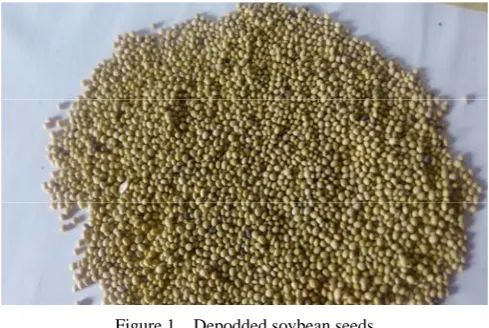
content of the grain. Figure 1 shows samples of the
depodded soybeans used for the experiment.
Figure 1 Depodded soybean seeds
2.1 Proximate analysis
The proximate compositions of the stored samples
were determined prior to storage and also during the
storage period. These were determined using standard
methods of Analysis of AOAC (2000). The following
parameters were determined: moisture content, ash
content, crude fibre, crude fat, crude protein and
carbohydrate.
2.2 Other quality parameters determined
Other quality parameters determined include dry
matter and hectolitre weight. The dry matter was
determined according to the method described by
Uchechukwu-Agua et al. (2015). Percentage of dry matter
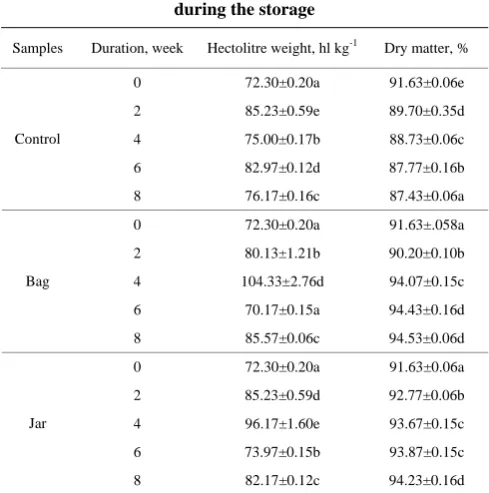
was estimated by using % dry matter = 100 - moisture
content. The hectolitre weight was determined according
3 Results and discussion
The results of the proximate composition and other
quality parameter of stored soybean seeds in the models
and the control are as presented in Tables 1 to 4. The
comparison of the results was carried out using Analysis
of Variance.
Table 1 Proximate composition of soybean seeds stored in the control
Duration, week Fat, % Ash, % Fibre, % Protein, % CHO, % Moisture content, %
0 15.23±0.00c 6.12±0.03b 5.18±0.00d 44.18±0.10c 20.94±0.06b 8.36±0.06a
2 13.74±0.01b 5.43±0.00ab 5.01±0.01c 43.84±0.44b 21.68±0.35a 10.30±0.34b
4 11.95±0.02a 3.19±0.02a 4.32±0.01b 42.54±0.35b 27.17±0.06c 11.27±0.06c
6 11.04±0.01a 2.74±0.02a 3.92±0.00a 37.43±0.51a 32.19±0.11c 12.23±0.12d
8 10.93±0.04b 2.10±0.03a 3.90±0.06a 38.12±0.22c 32.15±0.25b 12.50±0.06e
Note: * Values followed by same superscript alphabet are not significantly different at (P<0.05) along the columns. Values are Mean ± SEM of triplicate determination.
Table 2 Proximate composition of soybean seeds stored in the air-tight bag
Duration, week Fat, % Ash, % Fibre, % Protein, % CHO, % Moisture content, %
0 15.23±0.00d 6.12±0.00d 5.18±0.01a 44.18±0.51d 20.94±0.06a 8.36±0.0d
2 13.55±0.01b 2.41±0.01a 6.73±0.01d 44.16±0.28d 26.70±0.06b 7.80±0.06c
4 12.20±0.02c 3.47±0.00b 4.05±0.00a 41.26±0.13c 31.77±0.08b 5.93±0.09b
6 10.55±0.00a 6.22±0.02d 6.10±0.03c 38.40±0.32b 33.17±0.07d 5.57±0.07a
8 10.31±0.33d 4.75±0.01c 4.47±0.01b 37.78±0.16a 36.23±0.12c 5.46±0.05a
Note: * Values followed by same superscript alphabet are not significantly different at (P<0.05) along the columns. Values are Mean ± SEM of triplicate determination.
Table 3 Proximate composition of soybean seeds stored in the air-tight jar
Duration, week Fat, % Ash, % Fibre, % Protein, % CHO, % Moisture content, %
0 15.23±0.02b 6.12±0.01e 5.18±0.02c 44.18±0.20e 20.94±0.06a 8.36±0.06d
2 13.15±0.00c 4.69±0.00d 9.10±0.00e 43.52±0.47d 22.30±0.57b 7.23±0.06c
4 11.10±0.05a 1.22±0.01a 4.78±0.01a 40.32±0.30c 36.25±0.13d 6.33±0.15b
6 9.82±0.02d 4.60±0.00c 7.78±0.00d 39.03±0.58b 32.63±0.63c 6.13±0.15b
8 9.59±0.04e 3.86±0.03b 4.06±0.05b 38.18±0.32a 34.54±0.34d 5.77±0.12a
Note: *Values followed by same superscript alphabet are not significantly different at (P<0.05) along the columns. Values are Mean ± SEM of triplicate determination.
Table 4 Result of other quality parameters of soybean seed during the storage
Samples Duration, week Hectolitre weight, hl kg-1 Dry matter, %
0 72.30±0.20a 91.63±0.06e
2 85.23±0.59e 89.70±0.35d
4 75.00±0.17b 88.73±0.06c
6 82.97±0.12d 87.77±0.16b
Control
8 76.17±0.16c 87.43±0.06a
0 72.30±0.20a 91.63±.058a
2 80.13±1.21b 90.20±0.10b
4 104.33±2.76d 94.07±0.15c
6 70.17±0.15a 94.43±0.16d
Bag
8 85.57±0.06c 94.53±0.06d
0 72.30±0.20a 91.63±0.06a
2 85.23±0.59d 92.77±0.06b
4 96.17±1.60e 93.67±0.15c
6 73.97±0.15b 93.87±0.15c
Jar
8 82.17±0.12c 94.23±0.16d
Note: * Values followed by same superscript alphabet are not significantly different at (P<0.05) along the columns. Values are Mean ± SEM of triplicate determination.
3.1 Effect of the storage models on the moisture
content of soybean seeds
The result from Table 1 showed that the moisture
content of soybean seed in the control increased from
8.36% to 10.30%, 11.26%, 12.23% and 12.50% for two
weeks, four weeks, six weeks and eight weeks,
respectively. It was observed that the moisture level of
the seeds in the bag decreased from its initial level of
8.36% to 7.80%, 5.93%, 5.57% and 5.46% which was
similar to the seeds stored in the jar which also
experienced a decrease from 8.36% to 7.23%, 6.33%,
6.13% and 5.77% respectively after eight weeks of
storage. According to Ebubekir (2007), the moisture
content of grains affects their mechanical and physical
properties. It also affects the storability, processing and
handling of biomaterials.
Statistical analysis shows that moisture content of the
8.36% to 12.50% after eight weeks of storage. The
increase in the level of moisture in the control could be as
a result of the absorption of moisture from the
environment during storage. There was a decrease in
moisture content in the samples stored in the bag and jar
from 8.36% to 5.46% and 8.36% to 5.77%. The decrease
in moisture content in bag and jar may be as a result of
lack of absorption of moisture from the environment and
the prevalent low oxygen level which reduced the
survival of insects and weevils in the stored grains (Jayas
et al.,1993).
3.2 Effect of the storage models on the fibre content
of soybean seeds
The result showed that the fibre content of the
samples in the control decreased from 5.18% to 5.01%,
4.32%, 3.92% and 3.90% for two weeks, four weeks, six
weeks and eight weeks respectively (Table 1). This result
shows a significant decrease (P<0.05) from 5.18% to
3.90%. The crude fibre of the sample in bag increased
from 5.18% to 6.73% after two weeks, 4.05% at the end
of four weeks, 6.10% at the end of six weeks and 4.47%
at the end of the eight weeks (Table 2). That of jar also
increased from 5.18% to 9.10%, 4.78%, 7.78% and
4.06% respectively (Table 3). Dietary fibre is the edible
part of plant or analogous carbohydrates that are resistant
to digestion and absorption in the small intestine.
Statistical analysis shows that crude fibre significantly
decreased (P<0.05) in the control, bag and jar from
5.18% to 3.90%, 5.18% to 4.47% and 5.18% to 4.06%
respectively. This result is similar to the result achieved
by Fagbohun and Lawal (2014) who reported a depletion
from 0.48% in fresh cassava sample to 0.23% in sundried
sample stored for twenty weeks.
3.3 Effect of storage models on protein content of
soybean seeds
Tables 1-3 showed that there was a progressive
decrease in the protein content of the soybean seeds
stored in the control and the two models. It was observed
that the protein content of soybean seeds stored in the
control decreased from 44.18% to 43.84%, 42.54%,
37.43% and 38.12%, that of the bag was from 44.18% to
44.16%, 41.26%, 38.40% and 37.78% for two weeks,
four weeks, six weeks and eight weeks respectively.
While the soybean seed stored in the jar also decreased
from 44.18% to 43.52%, 40.32%, 39.03% and 38.18%.
Proteins are vital component of diet required for the
survival of human and animals and the basic function of
protein in nutrition is to provide adequate amount of
amino acids (Pugalenthi et al., 2004).
The statistical analysis showed that the storage model
had significant effect on the protein content of the
soybean seeds. The protein content of the soybean seeds
decreased significantly (P<0.05) in the three samples:
from 44.18% to 38.12% in the control, 44.18% to 37.78%
in bag, and 44.18% to 38.18% for the jar.
3.4 Effect of storage models on the fat content of
soybean seeds
Tables 1-3 showed a decrease in fat content in the
control and the two storage models. The fat content of
soybean seeds in the control decreased from 15.23% to
13.74%, 11.95%, 11.04% to 10.93% while that of bag
decreased from 15.23% to 13.55%, 12.20%, 10.55% to 10.
31%. In addition, the fat content of jar also decreased
from 15.23% to 13.15%, 11.10%, 9.82% to 9.59% for
two weeks, four weeks, six weeks and eight respectively.
Statistically, the storage model had significant effect
on the fat content of the stored soybean seeds. There was
a significant decrease (P<0.005) in the fat content of the
control and the two models. The control decreased from
15.23% to 10.93%, 15.23% to 10.31% for bag while that
of jar was 15.23% to 9.59%, which agrees with the
findings of Lawal and Fagbohun (2012) who reported a
decrease in fat content of millet seeds from 4.55% in
freshly harvested samples to 3.55% in sun-dried samples
stored for 6 months. The reduction could be as a result of
the decrease in protein content.
3.5 Effect of storage models on the carbohydrate
content of soybean seeds
The result showed a general increase in the
carbohydrate content of soybean seeds across the control
and the two storage models (Tables 1-3). The soybean
seeds in the control increased from 20.94%, to 21.68%,
27.17%, 32.19% and 32.15% (Table 1). While that of the
bags increased from 20.94% to 26.70%, 31.77%, 33.17%
and 36.23% for two weeks, four weeks and six weeks
20.94% to 22.30% at the end of two weeks, 36.25% at the
end of four weeks, 32.63% at the end of six weeks and
34.54% at the end of eight weeks (Table 3).
Statistical analysis shows that the storage models had
significant effect on the carbohydrate content of soybean
seeds. The carbohydrate content increased significantly
(P<0.05) in the two storage models which agreed with the
investigation of Fagbohun et al. (2011) who affirmed an
increase in the percentage of carbohydrate of freshly
shelled melon seeds (Citrullus vulgaris) from 0.56% to
1.56% in sundried sample after twenty weeks of storage.
3.6 Effect of storage models on the ash content of
soybean seeds
Table 1 showed that the ash content of the soybean
seeds stored in the control decreased from 6.12% to
5.43%, 3.19%, 2.74% and 2.10% for two weeks, four
weeks, six weeks and eight weeks respectively. It was
observed that there was also a decrease in ash content for
the samples stored in the bag from 6.12% to 2.41% at the
end of two weeks, 3.47% at the end of four weeks, 6.22%
at the end of six weeks and 4.75% at the end of eight
weeks (Table 2). The ash content of the samples in the jar
decreased from 6.12% to 4.69%, 1.22%, 4.60%, and
3.86% (Table 3).
Statistical analysis shows that ash content in the
control decreased progressively. The ash content
decreased significantly (P<0.05) in the control, bag and
jar from 6.12% to 2.10%, 6.12% to 4.75% and 6.12% to
3.86% respectively.
3.7 Effect of storage models on the dry matter
content of soybean seeds
The results in Table 4 indicated that there was a
significant decrease (P<0.05) in the dry matter of the
control sample. The dry matter content decreased from
91.63% to 89.70%, 88.73%, 87.77% and 87.43% for two
weeks, four weeks, six weeks and eight weeks
respectively. This is as a result of the increase in the
moisture content as seen in Table 1. It was observed that
the dry matter content of the bag and jar sample
increased significantly. That of the bag sample increased
from 91.63% to 90.20%, 94.07%, 94.43% and 94.53%;
while that of the jar increased from 91.63% to 92.77%,
93.67%, 93.87% and 94.23%. The increase in the bag
and jar sample is as a result of decrease in the moisture
content.
3.8 Effect of storage models on hectolitre weight of
soybean seeds
The results in Table 4 indicated that there was a
significant increase (P<0.05) in the hectolitre weight of
all the stored samples; these varied from the initial weight
of 72.30-76.17 hl kg-1 for the control; 72.30-85.57 hl kg-1
for bag and 72.30 to 82.17 hl kg-1 for jar. The increment
observed could be as a result of change in temperature
and relative humidity during storage.
4 Conclusion
From the results obtained from the comparative
analysis of the effect of hermetic storage models on the
quality parameters of soybean seeds carried out in this
study, the following conclusion can be deduced: the
moisture content increased significantly in the control but
reduced significantly in the bag and jar throughout the
period of storage. Crude fibre, fat, ash and protein
decreased significantly in all the models including the
control throughout the period of storage. However,
carbohydrate and hectolitre weight increased significantly
in all the models including the control throughout the
period of storage. Furthermore, dry matter decreased in
the control samples while it increased in the jar and bag
throughout the period of storage of eight weeks. Thus, it
can be concluded that the hermetic storage models had
effect on some of the quality parameters of the stored
soya samples.
References
AOAC. 2000. Association of official analytical chemists. Official methods of analysis (Vol. II 17th edition) of AOAC International. Washington, DC, USA. Official methods 925.09, 923.03, 979.09, 962.09, 4.5.01 and 923.05.
Ebubekir, A., and Y. Mehmet. 2007. Effect of moisture content on some physical and mechanical properties of faba bean (vicia faba l.) grains. Journal of Food Engineering, 78(1): 174–183. Fagbohun, E. D., and O. U Lawal. 2014. Mycoflora and nutrient
analysis of sundried cassava chips (Manihot esculenta) during storage. Journal of Applied Biosciences, 82(1): 7389–7402. Fagbohun, E. D., O. U. Lawal, and O. A. Hassan. 2011. The
Research Journal of Microbiology,2(8): 310–314.
Fennel, M. A. 1966. Present status of research on edible legumes in western nigeria. In the Fourth Nigerian Legume Conference, 99. Ibadan, Nigeria, August, 1966.
Food and Agricultural Organization of the United Nations. 2002. Available at: www.fao.org/3/a-ax444e.pdf. Accessed 30th June, 2016.
Food and Agricultural Organization of the United Nations. 2003. Available at: www.foa.org/news/archive. Accessed 30th June, 2016.
Frankel, E. N., A. M. Nash, and J. M. Snyder. 1987. A methodology study to evaluate quality of soybeans stored at different moisture levels. Journal of the American Oil Chemists’ Society, 64(7): 987–992.
Jayas, D. S., and V. D. G. White. 1993. Quality changes in grain under controlled atmosphere storage. In Proc. International Conference in Controlled Atmosphere and Fumigation in Grain Storage, 205–214. Winnipeg, Canada, June, 1992. Lawal, O. U., and E. D. Fabgohun. 2012. Nutritive composition
and mycoflora of sundried millet seeds (Panicum miliacieum) during storage. International Journal of Biosciences, 2(2): 11–18.
Maier, D. E., and S. Cook. 2014. Increasing global food security and reducing post-harvest loss with hermetic storage of grains. In 1st International Conference of Grain Storage in Silo Bag, 1-15. Mar del Plata/ Balcarce, Argentina, July, 2014.
Manley, M., and M. Geyer. 2006. Evaluation of hectoliter mass equipment in order to recommend a suitable method for determination of hectoliter mass of maize in South Africa. In Progress Report of Department of Food Science, Faculty of
Agricultural and Forestry Sciences Stellenbosch University, 1–13. Stellenbosch, November, 2006.
Monira, U. S., A. Aktar, M. Amin, and M. A. Mamun. 2012. Effect of containers on seed quality of storage soybean seed. Bangladesh Resource Publishing Journal, 7(4): 421–427. Osho, S. M. 2003. The Processing and Acceptability of a Fortified
Cassava-based Product (gari) with Soybean. Nutrition and Food Science. 33(6): 278–283
Pugalenthi, M., V. Vadival, P. Gurumoothi, and I. Janardhanan. 2004. Comparative nutritional evaluation of little known legumes tamarindus indica, erythrine indica and sesbania bispinosa. Tropical and Subtropical Agroecosystems, 4(3): 107–123.
Tiongson, R. L. 1992. Standardized methods for the assessment of losses due to insect pests in storage. In Towards Integrated Commodity and Pest Management in Grain Storage. A Training Manual for Application in Humid Tropical Storage Systems. Ed. R. L. Semple, P. A. Hicks, J. V. Lozare, and A. Castermans. 112–132. A Regnet (RAS /86/ 189) Publication in Collaboration with Naphire, May.
Uchechukwu-Agua, A. D., U. L. Opara, and O. J. Caleb. 2015. Effects of storage conditions and duration on physicochemical and microbial quality of the flour of two cassava cultivars (TME 419 and UMUCASS 36). CyTA -Journal of Food, 13(4): 635–645.