Design and Implementation of Wireless Sensor Cellular
Network Based on Android Platform
https://doi.org/10.3991/ijoe.v15i01.9774
Zhijun Luan(*), Hunli Fan Yantai Nanshan University, Shandong, China
Abstract—The fusion of cellular network and wireless sensor network is the key research problem of Internet of Things (IoT) technology at present. The design and implementation of wireless sensor cellular network based on Android platform is mainly studied. Firstly, wireless sensor network and cellular network, Android platform, cellular network and Wireless Sensor Network (WSN) fusion strategy, and Wireless Sensor Network (WSN) gateway platform are introduced. Then related functions are introduced, mainly including terminal registration management, connection management, authentication management, terminal fault management, and communication message design on the gateway and sensor network side. Finally, related functional tests are conducted. The results show that the designed application layer gateway system can connect the sensor network with the cellular network. Time Division-Synchronization Code Division Multiple Access (TD-SCDMA) and cellular network covers the whole world, while cellular network has been interconnected with the Internet through Access Network Technologies such as General Packet Radio Service (GPRS), The Fourth Generation of Mobile Phone Mobile Communication Technology Standards (4G) and Long Term Evolution (LTE), thus enabling the sensor network to access the Internet anytime and anywhere.
Key Words—Wireless sensor, cellular network, Android platform
1
Introduction
penetrated into all areas of human life and production and has attracted the attention of people in the industry.
Traditional sensor nodes transmit data and form networks with cables, which can’t be applied in many situations. Therefore, wireless data transmission of wireless sensor networks has great advantages. The wireless sensor network comprises a plurality of wireless sensor nodes, a plurality of routing nodes, and a coordinator node. A multi-hop self-organizing network system can be formed between these nodes through wireless communication. Through this network system, the wireless sensor node sends data to the routing node through the wireless data transmission after the sensor collects the data. The data is forwarded to the coordinator node.
Sensors with perceptual, computational, and wireless network communication capabilities since the 1990s and the Wireless Sensor Network (WSN), which is composed of them, have begun to attract worldwide attention.
Wireless sensor networks are generally composed of three parts. The first part is a large number of sensor nodes that are randomly distributed, energy-constrained and resource-constrained. These nodes have sensing capabilities and collect data through sensors and transmit data wirelessly to routing nodes or coordinating nodes. The second part is the routing node, which implements data forwarding. The third part is the coordinator. Its role is to build and maintain the wireless sensor network.
The convergence of wireless sensor networks and cellular networks is mainly discussed. The basic idea is to design a special module that can communicate with the wireless sensor network and communicate with the cellular network of the mobile communication at the same time, which acts as a bridge. This module can be either in the Sink node of the sensor network or as a separate gateway module. In addition, the integration of WSN and cellular networks, in addition to the basic communication capabilities, involves many other issues including terminal management control, business control management, etc., but these can be solved without technical problems. That is, the fusion between the two networks is technically feasible.
2
Literature Review
Wireless sensor networks have brought far-reaching impact on people's lives and production. All countries attach great importance to the development of wireless sensor networks. Various countries and regions are trying their best to promote the application and development of wireless sensor networks. Boston University founded the Sensor Association and hopes to promote the development of sensor networking technology. Wireless sensor networks are also listed among the top ten emerging technologies in "Technical Review" in the United States. The technical issues shared in the "China's Future Technology Forecast Research" are also directly related to sensor networks.
study, Khan et al. (2016) pointed out that the National Natural Science Foundation of the United States formulated a corresponding research plan in 2003 and invested $34 million to research and promote the popularity of wireless sensor networks. Many universities in the United States have conducted research on sensor networks, including the “Smart Dust” Laboratory jointly established by the University of California, Berkeley and Intel Corporation. The goal of the lab is to provide a device prototype that can automatically sense and communicate in a cubic millimeter volume [2]. López-Rodríguez et al. (2016) pointed out that the concept of “smart dust” includes sensors, power supplies, computing circuits, and two-way wireless communication technologies in each smart dust. These nodes can all collect data through sensors and send and receive data wirelessly [3]. Aguirre et al. (2017) pointed out in the study that the US City Sense project is a smart city project based on a wireless sensor network. City Sense is a wireless sensor network project funded by the National Science Foundation of the United States and developed jointly by Harvard University and BBN Corporation to report real-time monitoring data for the entire city. City Sense installed sensors on street lights in Cambridge, Mass., U.S., using the street light's power supply system as the sensor's running power source, and solved the limitations of battery life on the operation of wireless sensor networks, which is conducive to long-term environmental monitoring experiments [4]. Zakaria et al. (2017) pointed out in the study that Japan is one of the countries that initiated Internet of Things applications earlier. Since the 21st century, Japan is still actively promoting IT-based country strategy. On June 14, 2013, Japan passed the Cabinet Meeting Japan’s Future IT Strategy “Declaration of Building the World's Most Advanced IT Countries”. The declaration puts forward the goal of “detecting and repairing 20% of Japan’s important infrastructure and aging infrastructure by sensors before the end of 2020” [5]. Kafle et al. (2015) pointed out in the study that Spain has initiated the construction of the "Smart Santander" project, which has already deployed about 10,000 electronic monitoring devices. Each device includes two radio transceivers to communicate with other devices, GPS and sensors, and to monitor urban CO2 emissions, noise, temperature, ambient light and even parking spaces in a particular area [6].
sensor networks in China at present, but small businesses have shown a momentum of vigorous development [8].
In summary, the above research is mainly focused on the individual research of wireless sensor networks, and lack of research on integration with cellular networks. Therefore, based on the above research status, the design and implementation of a wireless sensor cellular network based on the Android platform has been mainly studied. The basic idea is to design a special module that can communicate with the wireless sensor network and communicate with the mobile communication cellular network at the same time, and finally realize the effective integration of the two.
3
Methodology
3.1 Android overview
Android is a Linux-based open source mobile device operating system that is mainly used for smartphones and tablets. Android is a completely open platform for third-party software, and developers have more freedom in developing programs for it. As a complete, open and free mobile platform, Android system has three characteristics of completeness, openness and freedom.
Due to its low cost and high openness, it attracts many terminal manufacturers. In 2009, Android's share in the mobile phone market was 3.5%. By March 2010, it had accounted for 25.5% of the mobile phone market share. In the first quarter of 2011, Android’s global market share surpassed that of Saipan for the first time, ranking first in the world. In the fourth quarter of 2013, the global market share of the Android platform mobile phone has reached 78.1%. On September 24, 2013, the number of devices using this system worldwide has reached 1 billion units. In the first quarter of 2014, the Android platform accounted for 42.8% of all mobile ad traffic sources, surpassing iOS for the first time. Given the large user base and popularity, Android is chosen as the mobile terminal system.
3.2 Wireless sensor network and cellular network
The most original definition of wireless sensor network WSN is composed of multiple sensor nodes and is completely independent of other communication means. It only relies on the "centerless" and "self-organizing" networks formed by sensor nodes through Ad Hoc interconnection. Early WSN is mainly used for military battlefield monitoring. The sensor node can measure the thermal, infrared, sonar, radar, seismic wave signals, etc. in the surrounding environment to detect substances phenomenon such as temperature, humidity, noise, light intensity, pressure, soil composition, size, speed, and direction of the moving object. WSN's perception of the physical environment is the key to the integration of the physical world and the information world. There are mainly four steps in the formation of WSN:
Step 2: The WSN node is woken up and automatically configured according to the preset settings
Step 3: WSN nodes automatically identify each other and understand their location records, automatically form the WSN
Step 4: Use Ad Hoc technology to automatically establish routes, collect environmental information and send the information out.
This kind of "self-configuring, self-identifying, ad hoc, self-routing" WSN is the initial design and is mainly used in special environments such as battlefields. In such a harsh environment, no other communication system can be borrowed and can’t be deployed by human intervention. Therefore, full “configuration, self-identification, ad hoc, and self-routing” becomes the only feasible networking method. It can be foreseen that the efficiency of this networking mode is relatively low. In most of the current non-special application scenarios, the WSN networking mode has been improved based on the previous initial networking mode: let some WSN nodes that are close to each other form a "cluster". Each cluster has a cluster head. The information of this cluster is clustered to the cluster head. Then the cluster head sends the aggregated information to another special node, that is, the sink node, and the sink node then sends out the aggregation information of all the WSNs through wired IP.
The service area of the mobile communication network is divided into sub-areas of regular hexagons. Each cell is provided with a base station and forms a structure resembling a "honeycomb". Therefore, the mobile communication network is also called a cellular network. With the rapid development of mobile communication technology in the past decade or two, cellular networks have become globally accessible and have reached ubiquitous access. In particular, with the development of technologies such as 4G and LTE, cellular networks have been greatly improved in terms of access bandwidth and so on, enabling them to provide support for more applications. Some innovative products on the market, such as netbooks and iPads, use cellular networks as their carrier for anytime, anywhere access. The Internet of Things emphasizes that any object can be connected anywhere at any time. In order to achieve ubiquitous access anytime and anywhere in the Internet of Things, it may also be possible to use a cellular network. In fact, in the research of the Internet of Things technology, it is the consensus of the industry that the cellular network is the first choice for the WSN to access the Internet.
3.3 The strategy of integrating cellular network and WSN
transforming the protocol stack; the wireless mesh network strategy is to make full use of the powerful mobile Internet support function of the protocol itself to provide a good way for WSN access.
Gateway policies can be divided into four types: application gateway policy, delay tolerance policy, virtual IP policy, and 6LowPAN policy. What they have in common is the need to add a WSN gateway between the cellular network and the WSN, and both require the WSN gateway to process the cellular network and WSN data in both directions. The application gateway strategy focuses on specific industry applications. The application gateway communicates with the cellular network on the one hand and communicates with the WSN on the one hand, ie the aforementioned dual-mode. Application gateway strategies can be roughly divided into two types. One is the WSN gateway, which acts as a forwarding node for information; the other is the WSN gateway, which is equivalent to a platform that not only forwards information but also has some operational management capabilities such as terminal management, task management, application management, and software management. This form is the main direction of research and is the subject of discussion. The delay tolerance policy DTN is an integration strategy of heterogeneous networks that is highly versatile. The initial research purpose of the DTN strategy is to be used in interplanetary communication. It is a strategy based on link recovery. The main idea is to modify the protocol stack so that unreliable and long-delay links have the characteristics of ordinary links.
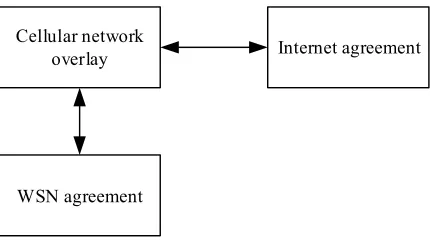
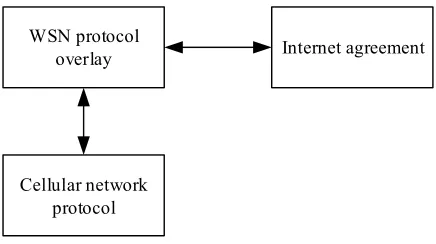
The biggest difference between the coverage policy and the aforementioned gateway policy is that the coverage policy does not have a clear gateway. The adaptation between protocols depends on the modification of the protocol stack. The integration of the cellular network and the WSN can be roughly divided into two modes. One way is to use a cellular network protocol to cover the WSN protocol, as shown in figure 1. In contrast, another way uses the WSN protocol to cover cellular network protocols, as shown in figure 2.
Fig. 1. Cellular network protocol covers WSN protocol Cellular network
overlay Internet agreement
Fig. 2. WSN protocol covers cellular network protocols
One problem here is that there are many existing WSN protocols and it is difficult to find a universal coverage model. However, with the development of the WSN protocol standardization and application model, the coverage model may be well applied.
Wireless mesh network strategy. From the perspective of the network structure, the wireless mesh network adopts a complete peer-to-peer approach to connect the access points and discards the network connection based on the hub-based star structure in the past, which greatly increases the scalability of the network. For residential communities in the suburbs and temporary high-density gathering places and even areas where there is no one-line network, wireless mesh networks can provide them with convenient and effective access. In addition, it can use WiFi, WiMAX and other communication methods, and has a good heterogeneous interconnectivity. Because of this, wireless mesh networks can be used as a new WSN access technology. Communication with the sensor nodes is performed by assembling IEEE802.I5.4 interfaces on these wireless routers. Multiple such structured WSN networks can be interconnected to improve network scalability and reliability while also increasing the network's data capabilities.
3.4 The introduction of WSN gateway platform
The WSN gateway is more like a platform. The benefits of WSN gateway platformization include: lowering the threshold for terminal development and reducing terminal costs; run different application software on this platform to adapt to different application environments and industries; intelligent pipelines make the terminal perceivable and controllable; optimize network usage; sharing capabilities components, reducing application development difficulty and cost. The schematic diagram of the WSN gateway platform architecture is shown in figure 3.
WSN protocol
overlay Internet agreement
Fig. 3. The architecture of WSN gateway platform
4
Result
4.1 Terminal registration management
The registration of the terminal to the gateway is the prerequisite for the whole system to start operation, which is also to facilitate the management of the gateway to the terminal. The main purpose of registration is to be able to obtain the unique terminal serial number assigned by the gateway. With reference to various practical terminal serial numbers in the current industry, the unique serial number of the terminal in this system is composed of three parts. The first part represents the information of the manufacturer and the related information of the product itself, and the second part is a time stamp. The third part is the unique terminal number assigned by the gateway. The terminal sequence diagram is shown in figure 4.
Fig. 4. Terminal sequence diagram
4.2 Connection management
Connection management mainly refers to the connection management of the WiFi communication between the sink node and the gateway in the sensor network. The main data transmission in this system is to periodically send temperature sensors, light sensors, and humidity sensors from the sensor network side to collect the data to the gateway, and then send the data to the servers on the Internet through the gateway. This is common in some wireless sensor network applications such as agricultural production or forest exploration. Therefore, this connection is not continuous. Only
WSN gateway function module
Embedded real-time OS
CPU(ARM) Wireless
sensor network
Cellular network RS232/485
Blue Tooth
Zigbee
...
GPRS
CDMA/HSPA
LTE
...
Terminal vendor information, terminal
model (4Bytes)
Time stamp
when the sink node in the wireless sensor network wants to send data to the gateway will it require connection establishment. In addition, because the terminal needs to report its own status information to the gateway for monitoring and management, the Sink node still needs to periodically send stimulus packets to the gateway. This process also needs to establish a connection. For the management of this non-persistent connection, the period of the stimulus packet to be sent at a fixed time is set. The connection process is better managed, as long as the data transfer is complete, the entire connection can be broken.
4.3 Authentication management
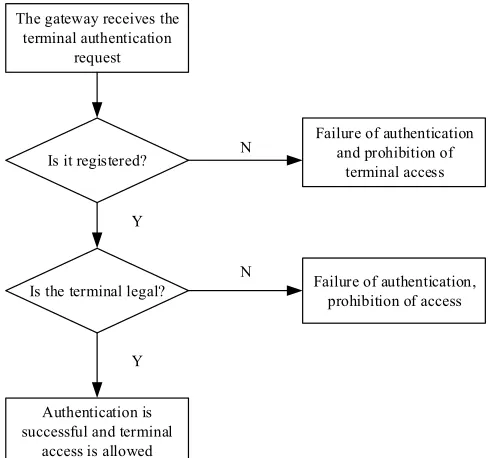
Since the exchange of data information between the gateway and the Sink node in the sensor network is through a shared wireless communication channel, there is no limitation. It may happen that some terminal nodes that do not belong to the present application access the application, resulting in information leakage and other phenomena. Therefore, by authenticating the node that wants to access the application, the non-application node is denied access to the application. The authentication mechanism in this system is relatively simple, as long as the terminal node has registered at the gateway and the gateway authentication passes; otherwise, the access of the terminal is prohibited. The flow of authentication processing is shown in figure 5.
Fig. 5. Authentication processing flow chart The gateway receives the
terminal authentication request
Failure of authentication and prohibition of
terminal access Is it registered?
Is the terminal legal? Failure of authentication, prohibition of access
Authentication is successful and terminal
access is allowed
N
N Y
4.4 Terminal fault management
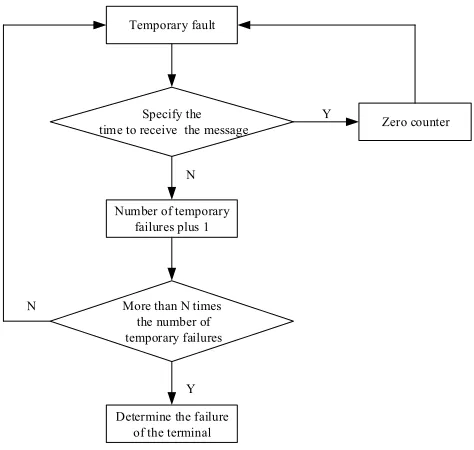
An important management function of the IOT gateway is the management of terminal failures. Terminal failure management means that the gateway manages failures that are likely to occur on the terminal. The gateway terminal fault management solution is given as follows: the gateway periodically checks the message information sent by the Sink node. If a terminal node has not sent data to the gateway within the time range predefined by the system, the gateway assumes that the terminal is in a state of temporary failure. The gateway will count the situation that the terminal is continuously in a temporary fault state. When the counted number reaches a certain threshold that is preset by the system, the gateway determines that the terminal is in a fault state and will process it. If the terminal starts sending data again at a certain moment before the number of successive temporary fault status counts reaches the critical value, then the gateway determines that the terminal is not faulty for the moment, clears the count of the number of critical statuses, and restarts such a process. The fault management process of the WSN gateway to the terminal is shown in figure 6.
Fig. 6. Terminal fault management flowchart
4.5 Terminal device activation and dormancy management
The system's gateway also has the ability to activate and hibernate terminal devices. In some cases, for example, when a sink node is active for a long period of time, taking into account the balance of the remaining energy of the nodes in the
Temporary fault
Number of temporary failures plus 1
Specify the time to receive the message
More than N times the number of temporary failures
Zero counter
Determine the failure of the terminal
N
N
Y
wireless sensor network, the Sink node is allowed to “break” while allowing other nodes in the vicinity to work. In this case, the gateway needs to perform a dormancy operation on the terminal and activate other nodes in the vicinity. When the network system is operating to a certain moment, it is required to perform an activation operation on the node and dormancy operations on one of the other nodes. Rest here refers to forcing the terminal to enter the dormant state from the active state. In the dormant state, the terminal node does not even send the stimulus packet. In a wireless sensor network, energy is an important indicator that directly affects the life of the entire network. The Sink node is the hub of data transmission in the entire sensor network, and its energy value is the most important. Therefore, it is very necessary to realize the management of the dormancy and activation of the Sink node in the wireless sensor network on the gateway. On the other hand, this also reflects the gateway's ability to manage and control terminal nodes. When the system is specifically implemented, these two operations are treated as two special commands of gateway.
4.6 The design of communication message between gateway and sensor network
Refer to TCPIIP, ICMP, and other message design methods. Table 1 shows the message types corresponding to various messages in this system.
Table 1. The message type corresponding to the message
Message name Message type
code Message name Message type code
LOGON 0x04 LOGON ACK 0x40
LOGOFF 0x05 LOGOFF ACK 0x50
STIMULATION 0x03 STIMULATION ACK 0x30
REGISTRATION 0x01 REGISTRATION ACK 0x10
STATUS GET 0x08 STATUS GET ACK 0x18
SLEEP 0x07 SLEEP ACK 0x70
ACTIVATION 0x02 ACTIVATION ACK 0x20
DATA 0x12 DATA ACK 0x11
4.7 Sensor data acquisition and point-to-point communication function test This test process includes a total of two devices, one as the sensor data acquisition and sensor data transmission end, and the other as the sensor data reception end. The collected sensor data is temperature data. The selected sensor is an analog temperature sensor LM35. The purpose of the test is to verify the sensor node's sensor data collection function and point-to-point communication function. The temperature data is used as an example to verify the communication data structure of the wireless sensor network node. The test tool is X-CTU. The parameters of the wireless communication module are set and read with X-CTU, and the X-CTU Terminals window is used as the serial monitor.
whose serial number is 13A20040BF8814. The serial number is the source device address. The serial number of the sensor node on the right side as the destination device is 13A20040BF88BD. The serial number is the destination device address. Both nodes are connected to the PC through the USB cable. The port occupied by the source device is COM6, and the port occupied by the destination device is COM8. The wireless data transmission adopts the API frame mode. After the source device collects the simulated temperature data and converts it to decimal Celsius temperature, it encapsulates the transmission request frame and then sends it out through the XBeeZB module; in API mode, the data format received by the destination device should be in the format of the data receiving frame.
Fig. 7. Physical map of point-to-point communication sensor data acquisition system
4.8 Test terminal authentication
The authentication of the terminal occurs when the terminal logs in to the gateway system. The gateway's authentication of the terminal is relatively simple. As long as the gateway determines that the terminal has been registered, the authentication succeeds, otherwise, the authentication fails. The terminal logs in to the gateway system by sending a LOGON message. The terminal number assigned by the terminal is already carried in the header of the LOGON message. When the gateway obtains the terminal number, a query is made in the list of saved terminal numbers. If yes, the authentication is successful. If not, the authentication fails. The result of the authentication is returned from the LOGONACK message to the terminal.
5
Conclusion
carrier of the gateway system, and it realize the main functions of the gateway system on the Android SDK platform. It is mainly to realize an application layer gateway system that can connect the sensor network and the cellular network. In TD-SCDMA, cellular networks are covered globally, and cellular networks have been connected to the Internet through access network technologies such as GPRS, 4G, and LTE, enabling sensor networks to access the Internet anytime and anywhere.
6
References
[1]Rawat, P., Singh, K. D., Chaouchi, H., Bonnin, J. M. (2014). Wireless sensor networks: a survey on recent developments and potential synergies. The Journal of supercomputing, 68(1), 1-48. https://doi.org/10.1007/s11227-013-1021-9
[2]Khan, I., Belqasmi, F., Glitho, R., Crespi, N., Morrow, M., Polakos, P. (2016). Wireless sensor network virtualization: A survey. IEEE Communications Surveys & Tutorials, 18(1), 553-576. https://doi.org/10.1109/COMST.2015.2412971
[3]López-Rodríguez, F. M., Cuesta, F. (2016). Andruino-A1: low-cost educational mobile robot based on android and arduino. Journal of Intelligent & Robotic Systems, 81(1), 63-76. https://doi.org/10.1007/s10846-015-0227-x
[4]Aguirre, E., Lopez-Iturri, P., Azpilicueta, L., Redondo, A., Astrain, J. J., Villadangos, J., Falcone, F. (2017). Design and implementation of context aware applications with wireless sensor network support in urban train transportation environments. IEEE Sensors Journal, 17(1), 169-178. https://doi.org/10.1109/JSEN.2016.2624739
[5]Zakaria, Y., Michael, K. (2017). An Integrated Cloud-Based Wireless Sensor Network for Monitoring Industrial Wastewater Discharged into Water Sources. Wireless Sensor Network, 9(08), 290. https://doi.org/10.4236/wsn.2017.98016
[6]Kafle, V. P., Fukushima, Y., Harai, H. (2015). Design and implementation of dynamic mobile sensor network platform. IEEE Communications Magazine, 53(3), 48-57.
https://doi.org/10.1109/MCOM.2015.7060518
[7]Chen, Y. (2017). Design and Implementation of Wireless Sensor Cellular Network Based on Android Platform. International Journal of Online Engineering (iJOE), 13(05), 56-66.
https://doi.org/10.3991/ijoe.v13i05.7048
[8]Pang, Z., Zheng, L., Tian, J., Kao-Walter, S., Dubrova, E., Chen, Q. (2015). Design of a terminal solution for integration of in-home health care devices and services towards the Internet-of-Things. Enterprise Information Systems, 9(1), 86-116.
https://doi.org/10.1080/17517575.2013.776118
7
Authors
Zhijun Luan and Hunli Fan are Researchers of Yantai Nanshan University, Shandong, China. Their research interests include Wireless Sensor Cellular Network.