Design, development and statistical optimization of
ginger peeling machine
Shiva Holker
1, Kshitiz Kumar
1, Lochan Singh
2, Vijay Singh Sharanagat
1* (1. Department of Food Engineering, NIFTEM, Kundli, Sonipat, Haryana, India-131028;2. Department of Agriculture and Environmental Sciences, NIFTEM, Kundli, Sonipat, Haryana, India-131028)
Abstract: The present research aims to develop a ginger peeling machine which can peel the outer skin of ginger with less mass
loss. Machine and product parameters for the developed ginger peeler were optimized. Fresh gingers with moisture content 87.47% and pre-treated at 1% NaOH solution exhibited highest peeling efficiency (70.20%), followed by hot water soaking and overnight soaking. At constant moisture content, reverse trend was observed for mass loss. The highest mass loss of about 4.13% was seen with hot water soaked samples, followed by overnight soaking and NaOH treatment. Gingers with 87.47% moisture content and pre-treatment at 1% NaOH solution exhibited maximum peeling efficiency. The optimimum peeling efficiency was 66.62% for the ginger having 79.28% moisture contant treated with NaOH (70oC, 10 min).
Keywords: ginger, peeling machine, peeling efficiency, pre-treatment
Citation: Holker, S., K. Kumar, L. Singh, V. S. Sharanagat. 2018. Design, development and statistical optimization of ginger peeling machine. Agricultural Engineering International: CIGR Journal, 20(1): 177–183.
1 Introduction
Ginger is a common ingredient in Asian and Indian cuisines. However, for centuries it has been illustrated for
its medicinal uses. The root or underground stem
(rhizome) of the ginger plant is mainly consumed in forms like fresh ginger, powdered root, dried spice, oil or juice (Semwal et al., 2015). Fresh ginger is used for curing asthma, coughs, colic, heart palpitations, swellings, dyspepsia, loss of appetite and rheumatism, while the dried root is used to “strengthen” the stomach, inhibit vomiting and treat diarrhoea. When consumed as a tea, it eases headaches and sore throats and also assists during cold or flu. It is believed to increase saliva and other digestive fluids, alleviating indigestion and associated problems such as flatulence. Its anti-inflammatory qualities relieve swelling and pain (Semwal et al., 2015). On average, the dry ginger contains 10.85% moisture, 1.8% volatile oil, 6.5% oleoresin (acetone extract), 19.6%
Received date: 2017-05-30 Accepted date: 2017-08-31 * Corresponding author: V. S. Sharanagat,Assistant Professor,
Department of Food Engineering, NIFTEM, HR. Email: [email protected].
water extract, 6.0% cold alcohol extract, 53% starch, 7.17% crude fiber, 12.4% crude protein, 6.64% total ash, 5.48% water soluble ash and 0.14% acid insoluble ash (Peter et al., 1999).
losses (Emadi et al., 2007; Emadi et al., 2008). On the other hand, chemical peeling utilizes a hot solution of caustic soda in which the product is immersed for a certain period of time. Despite a concern in the rise for chemical cost and the associated disposal problems, it is commonly used for peeling of some vegetables such as tomatoes and others (Das and Barringer, 2006; Garrote et al., 1993; Garrote et al., 1994; Barreiro et al., 1995; Barreiro et al., 2007). Steam peeling has emerged as one of the most popular methods due to its high automation, precise control of time, temperature and pressure by modern process control devices. Thus, it minimizes peeling losses and reduces environmental pollution in comparison to chemical peeling (Garrote et al., 2000; Garrote et al., 1997). Recently, enzymatic peeling, which is based on the treatment with corresponding glycohydrolase enzymes, has been suggested for fruits (Pretel et al., 1997) such as citrus fruits (Pretel et al.,
2007), stone fruits (Toker and Bayιndιrl, 2003; Kaur et
al., 2009) and vegetables (Suutarinen et al., 2003). This method involves no harsh treatment, hence, the number of broken segments and juice losses are much less than the conventional method and the peeled fruit have a better texture and appearance. The literature review on all these studies has shown that the peeling efficiency highly depends upon the peeling pre-treatment and machine operating parameter.
With respect to ginger peeling, limited research has been performed on its peeling mechanism. Different peeling machine such as vertical abrasive brush-type ginger peeling machine (Agrawal et al., 1987), low cost manual ginger peeling machine (Charan, 1995), hand operated mechanical ginger peeler (Jayashree and Visvanathan, 2012), concentric drum brush type ginger peeler (Jayashree and Visvanathan, 2014), etc. were developed with time. But in most of the industries, the outer peel is removed with special knives or in a barrel drum, prior to drying or further processing. Still the irregular shape of ginger makes the process very tedious, ineffective, time consuming and labor intensive. The objective of the present study was thus to develop and optimize abrasive belt peeling machine for high efficiency and less meat loss.
2 Material and method
2.1 Material
Ginger samples were procured from Azadpur Mandi, New Delhi, to test the efficiency of ginger peeling machine. Initial moisture content of sample was determined by hot air oven method. The moisture content of the ginger rhizomes was obtained according to ASAE Standard (ASAE Standard, 1983). The sample was dried in an electric oven at a temperature of 105°C for 24 hours and weighed using a weighing balance at every 6 hours interval to obtain four different levels of moisture content. The moisture content of the sample (in percent dry basis) was calculated using Equation:
100
i f
c
i
m m
M
m
−
⎛ ⎞
=⎜ ⎟×
⎝ ⎠ (1)
where, Mc is the moisture content of the ginger rhizome,
%; mi is the initial mass of the ginger, kg; mf is the final
weight of the ginger kg.
Drying was performed at 50°Cin hot air oven for 4 h,
8 h and 12 h to maintain different moisture. Dried sample were packed sealed and stored for further analysis.
2.2 Physical analysis
Physical properties including geometrical mean diameter, surface area, sphericity, mass and bulk density were calculated with the method used by Sharanagat and Goswami (2014).
2.3 Pre-treatment
To observe the effect of pre-treatment on peeling efficiency, three different pre-treatments namely overnight soaking, soaking in hot water and soaking in NaOH solution respectively, were performed. The fresh gingers were respectively soaked in water at ambient
temperature for a period of 12 h, in 70oC hot water for a
period of 1 h and in 1% NaOH solution for the time
period of 10 min at 70oC, respectively.
2.4 Performance evaluation of ginger peeling machine
Performance evaluation of peeling machine was performed with respect to the variation in the machine and product parameter. Two machine parameters were taken to estimate the efficiency of the ginger peeling machine. These are a) the orientation of the machine,
clearance of the brush belts, which varied from 1.5 to 2 cm.
2.5 Experimental design and statistical analysis
Response surface design was used to analyze and optimize the effect of machine parameters while factorial design was used for analyzing the effect of moisture
content and pre-treatmenton peeling efficiency and mass
loss. Central composite design was applied for experimental data using a commercial statistical package, Design-Expert version 9 (Statease Inc., Minneapolis, MN, USA) for the generation of response surface plots for machine parameters and optimal design was used for generation of plot for the effect of moisture content and pre-treatment. The independent variables considered were clearance between belts and orientation of the peeling surface for central composite design while moisture content and pre-treatment were chosen as independent
variables for factorial design.The dependent variables for
both the design were peeling efficiency and material loss. The individual effect of each variable and also the effects of the interaction terms were determined. The responses
were analyzed by a multiple linear regression method which describes the effects of variables in the models derived. Experimental data were fitted to the selected models and regression coefficients were obtained and machine peeling parameters were optimized by using a numerical method.
3 Result and discussion
3.1 Physical properties
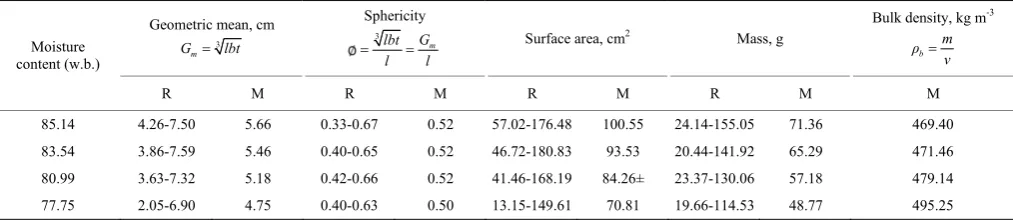
Physical properties of food material are the back bone of any design and moisture content of food having a major impact on physical properties. Physical properties such as geometrical mean diameter, surface area, sphericity, mass and bulk density were calculated at different moisture content (Table 1). It was observed that drying had a significant effect on physical properties. As moisture content declines from 85.14% to 77.75% (w.b), reductions in geometrical mean diameter, surface area, sphericity and mass were observed whereas bulk density increased with the drying. This may be due to removal of moisture during drying and shrinkage of capillaries in food.
Table 1 Effect of moisture content on physical properties of ginger
Geometric mean, cm
3
m
G = lbt
Sphericity
3
m
G lbt
l l
= = Surface area, cm
2 Mass, g
Bulk density, kg m‐3
b
m
ρ
v
=
Moisture content (w.b.)
R M R M R M R M M
85.14 4.26-7.50 5.66 0.33-0.67 0.52 57.02-176.48 100.55 24.14-155.05 71.36 469.40
83.54 3.86-7.59 5.46 0.40-0.65 0.52 46.72-180.83 93.53 20.44-141.92 65.29 471.46
80.99 3.63-7.32 5.18 0.42-0.66 0.52 41.46-168.19 84.26± 23.37-130.06 57.18 479.14
77.75 2.05-6.90 4.75 0.40-0.63 0.50 13.15-149.61 70.81 19.66-114.53 48.77 495.25
Note: * R-Range, M- Mean.
3.2 Designing and fabrication of ginger peeling
machine
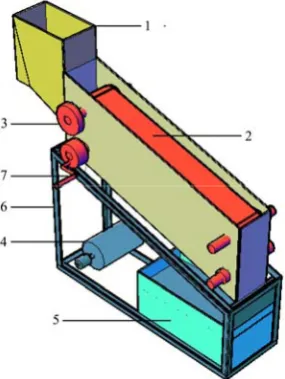
Trials were conducted to analyze the length of the belt based on peeling. The complete dimension of the machine is 152 cm × 35.6 cm × 125 cm (Figure 1). The base length of the machine is 117 cm, after including the hopper; the total length comes out to be 152 cm. The hopper dimensions are 35 cm × 20 cm, the height of the hopper is 35 cm at the far end and 45 cm at the feeding end. Inclination starts 12 cm from the far end to the feeding end to facilitate feeding of ginger between the abrasive brush belts.
Two abrasive brush belts are used for peeling purpose.
The belt is made up of canvas material of thickness 5 mm and width 15 cm. Brushes attached to the belt are of polypropylene of thickness 0.3 to 0.4 mm and are spaced at 1.5 cm × 1.5 cm in a v pattern. The alternate brush rows are of different height 2.5 cm and 3 cm to facilitate the peeling of depressions in the ginger rhizomes. The brush belt is mounted on mild steel rollers of diameter 114 mm, width 20 cm and shaft diameter of 20 mm. The effective length of the peeling belt was 95 cm.
sheet is 41cm and it is placed 20 cm apart. This metal sheet is placed on a MS L section frame of height 70 cm and 38 cm at the two ends so that the brush belts are at an angle of 15.25 degree when at natural rest position, this angle was varied during the course of experiments between 12.75 and 17.75 degree. MS L section angle was welded at the bottom of the sheets to support the sheets, a frame from the top side is also welded for support and a hinged panel was attached to it for safety purpose. MS L section angle is also welded along the length of the machine so as to support the machine and reduce vibration.
1. Feed Hopper 2. Abrasive belts with spray nozzle 3. Roller with gap adjustment 4. Electrical motor 5. Water storage tank with recirculation 6. Structure frame 7. Lever for hand operation
Figure 1 Auto CAD design of developed ginger peeling machine
The bottom two belt rollers are supported on four bearings from all the side. And the top two belt rollers are supported on bushes. The top belt is made adjustable by using screw mechanism attached to the bushes, so as to adjust the clearance between the two belts. The minimum and maximum clearances between the two are 15 and 60 mm. But for conducting experiments, clearance in the range of 15 to 20 mm was used.
Adjustments for water spray was provided from one side at a distance of 22.5 cm from the roller shafts and on the other side a water spray is provided in the center of the two shafts at a distance of 47.5 cm. The water was circulated in the system using a water tank of dimension 60 cm × 27.6 cm × 25 cm and a submersible pump. The top of the tank was covered with a combination of MS wire-mesh. This acts as a surface to retain both the
processed ginger and the removed peel. A water channel of length 69 cm and width 25 cm from the top to the water tank is provided so that water flows back to the water tank and also to protect the motor from water.
One HP motor was placed at the back side of the machine below the hopper to power the two brush belts. The shaft of the motor was of diameter 16 mm; a 1.5” v belt pulley was attached to it. The bottom roller shaft was mounted with a double v belt pulley of size 5” and the top roller shaft was mounted with a single v belt pulley of size 6”. The variation in the pulley size was made for easy introduction and forward movement of the ginger. The motor and the water tank were attached to the bottom frame of the machine.
Dimensions of hopper are 35 cm × 25 cm, and variable height of 35 cm and 45 cm with inclination starting 12 cm from the back side. So, the total volume of
the hopper is 0.032925 m3. The density of fresh ginger is
470 kg m-3. Thus the total capacity of hopper comes out
to be 15 kg. The dimensions of water tank are 60 cm × 27.6 cm × 25 cm. In this a metal sieve is placed to retain peeled ginger and peel, so the effective depth of the tank reduces to 19 cm. The volume of the tank is 30 L.
3.3 Performance evaluation of ginger peeling machine
3.3.1 Effect of machine parameters peeling efficiency The peeling efficiency of the machine by varying the machine parameters, clearance of brush belts and orientation of machine was found to be in the range of 43.54% to 68.68%. The minimum efficiency of 43.54% was found for the combination of 21.03 mm clearance
and 15.25o orientation. The maximum efficiency of
68.68% was found for the combination of 13.96 mm
clearance and 15.25o orientation. Increase in clearance
with constant orientation reduces the peeling efficiency this may due to reduction in optimum peeling force. The increased in orientation lead to decrease in peeling efficiency that may be due to accelerating movement of ginger between the belts. Lack of fit test suggested quadratic model for the peeling efficiency of the machine. Regression model fitted to experimental results of peeling
efficiency shows that Model F-value of 13.38 was
significant (P<0.01) whereas, lack-of-Fit F-value of 3.22
inversely proportional to the clearance and orientation. It can also seen from Figure 2 that the clearance and orientation has a very significant effect on peeling efficiency. As the clearance increases from 15 to 20 mm, the efficiency decreases sharply and as the orientation
increases from 12.75o to 17.75o the efficiency decreases
significantly.
Figure 2 Effect of machine parameter (clearance and orientation) on peeling efficiency of ginger peeling machine
3.3.2 Effect of machine parameters on mass loss
The mass loss for fresh ginger (moisture content 87.47%) was found to be in between 1.83% to 3.66%. The maximum mass loss was observed with the 17.5 mm
clearance and 15.25o orientation. The minimum mass loss
was observed with 20 mm clearance, and 17.75o
orientation. As clerence increases gap between the two belt increases and force required to peel the ginger reduction and as orientation increases faster moverment of ginger take place causes to reduction in mass loss. Lack of fit test suggested quardatic model for mass loss. Regression model fitted to experimental results of mass
loss shows that Model F-value of 18.69 was significant
(P<0.01) whereas; lack-of-Fit F-value of 1.13 was not
significant (P>0.05). The mass loss is inversely
proportional to the clearance and orientation and it can also visualize from Figure 3.
3.3.3 Effect of moisture content and pre-treatment on peeling efficency
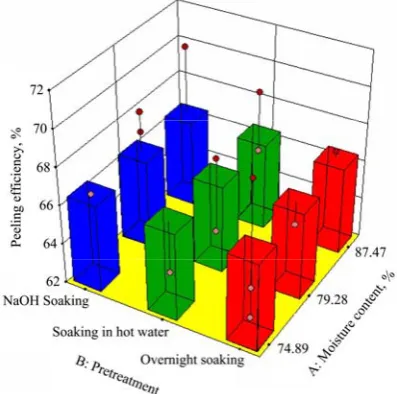
The peeling efficiency of machine by varying the moisture content and the pre-treatment given to the ginger sample was found to be in the range of 62.96% to 70.20%
Figure 3 Effect of machine parameter clearence and orientation on mass loss during ginger peeling
(Figure 4). The maximum value of peeling efficiency was achieved when fresh ginger (moisture content 87.47%)
was soaked in 1% NaOH solution at 70oC for 10 min. The
minimum peeling efficiency was attained when 12 h dried
ginger at 50oC (moisture content 74.89%) was soaked for
overnight in water. That may be due to hardening of sufrce during reduction of moisture content required a higher force to peel. Statistical analysis produced the following result. Lack of fit test suggested two factor interaction (2FI) model for the peeling efficiency of the machine. Regression model fitted to experimental results
of peeling efficiency shows that Model F-value of 8.54
was significant (P<0.001) whereas, lack-of-Fit F-value of
0.21 was not significant (P>0.05). At the same moisture
content, NaOH treatment had the maximum peeling
efficiency, which was better than the hot water treatment and the least was found in overnight soaking. As the moisture content of the ginger decreases, it becomes difficult to peel the ginger. There is a fall in the peeling efficiency of the machine with the decrease in moisture content.
3.4 Effect of moisture content and pre-treatment on
mass loss
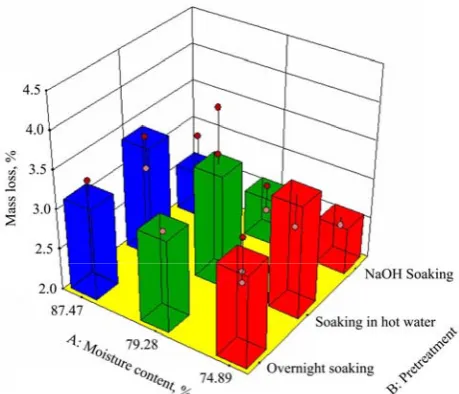
The mass loss of ginger sample by varying the moisture content and the pre-treatment was found to be in the range of 2.29% to 4.13%. The maximum value of
mass loss was observed when 6 h dried ginger at 50oC
(moisture content 79.28%) was soaked in hot water at
70oC. The minimum mass loss was attained when 6 h
dried ginger at 500C (moisture content 79.28%) was
soaked in 1% NaOH solution at 70oC for 10 min.
Statistical analysis produced the following result. Lack of fit test suggested two factor interaction (2FI) model for mass loss. Regression model fitted to experimental results
of mass loss shows that Model F- value of 6.69 was
significant (P<0.05) whereas; lack-of-Fit F-value of 0.34
was not significant (P>0.05). It was observed that
pre-treatment and moisture content have a significant effect on mass loss (Figure 5). Mass loss was minimum for ginger soaked in NaOH solution and maximum for in case of hot water soaking. The mass loss for the overnight soaked ginger was slightly lower than the hot water soaked ginger. As moisture content decreases, the mass loss of ginger also decreases.
Figure 5 Effect of product parameter moisture content and pre
treatment on mass loss
3.5 Optimization of ginger peeling machine
Optimization of moisture content and pre-treatment for maximizing the peeling efficiency and minimizing the mass loss was performed numerically. This resulted in optimum solution where the moisture content of the ginger was selected as 79.28%, and soaking in NaOH
solution at 70oC for 10 min. At these parameters
according to the model, the projected peeling efficiency was 66.62% and projected mass loss was 2.59%. This optimization solution has a desirability of 0.649. Optimization of machine parameters for maximizing the peeling efficiency and minimizing the mass loss was performed numerically. This resulted in optimum
machine parameters of 15 mm clearance and 12.75o
orientation for the machine. At these parameters according to the model, the projected peeling efficiency was 64.45% and projected mass loss was 2.94%. This optimization solution has a desirability of 0.569.
4 Conclusion
In this study, a ginger peeling machine was developed and its performance evaluation was carried out. Physical properties of ginger were determined and it was found that all physical properties were dependent on moisture content and with the fall in moisture content there is significant change in the physical properties. Peeling efficiency and mass loss were determined for performance evaluation of ginger peeling machine. It was observed that as the clearance of the brush belts increased the mass loss in ginger decreases significantly and as the angle of orientation of the machine increased the peeling efficiency of the machine also decreases. The optimum machine parameters for fresh ginger were obtained at
15 mm clearance of brush belts and 12.75o orientation of
the machine. The second phase of study determined the effect of moisture content and pre-treatment on machine performance at the optimum machine parameters. The optimum solution for the pretreatment was selected as moisture content of 79.28%, and soaking in NaOH
solution at 70oC for 10 min. Moisture content was
References
Agrawal, Y. C., A. Hiran, A. S. Galundia. 1987. Ginger peeling machine parameters. AMA in Asia, Africa and Latin America, 18(2): 59–62.
Arazuri, S., C. Jarén, P. C. Correa, I. Arana. 2010. Influence of the peeling process on pepper quality. Journal of Food, Agriculture & Environment, 8(1): 44–48.
ASAE Standard. 37th Ed. 1983. S358.2. Moisture measurement of grain and seeds. St. Joseph, Mich.: ASAE.
Barreiro, J. A., A. J. Sandoval, D. Rivas, and R. Rinaldi. 2007. Application of a mathematical model for chemical peeling of peaches (Prunuspersica l.) variety Amarillo Jarillo. LWT-Food Science and Technology, 40(4): 574–578.
Barreiro, J. A., V. Caraballo, and A. J. Sandoval.1995. Mathematical model for the chemical peeling of spherical foods. Journal of Food Engineering, 25(4): 483–496.
Charan, R. 1995. Developments in Ginger processing. AMA in Asia, Africa and Latin America, 26(4): 49–51.
Das, D. J., and S. A. Barringer. 2006. Potassium hydroxide replacement for lye (sodium hydroxide) in tomato peeling.
Journal of Food Processing and Preservation, 30(1): 15–19. Emadi, B., M. H. Abbaspour-Fard, and P. K. Yarlagadda. 2008.
Mechanical peeling of pumpkins. Part 1: Using an abrasive-cutter brush. Journal of Food Engineering, 89(4): 448–452.
Emadi, B., V. Kosse, and P. K. D. V. Yarlagadda. 2007. Abrasive peeling of pumpkin. Journal of Food Engineering, 79(2): 647–656.
Garrote, R. L., E. R. Silva, and R. A. Bertone. 2000. Effect of thermal treatment on steam peeled potatoes. Journal of Food Engineering, 45(6): 67–76.
Garrote, R. L., E. R. Silva, R. A. Bertone, and A. Avalle. 1997. Effect of time and number of cycles on yield and peeling quality of steam peeled potatoes and asparagus. LWT-Food Science and Technology, 30(5): 448–451.
Garrote, R. L., V. R. Coutaz, E. R. Silva, and R. A. Bertone. 1994. Determining process conditions for chemical peeling of asparagus. LWT-Food Science and Technology, 27(1): 19–22. Garrote, R. L., V. R. Coutaz, J. A. Luna, E. R. Silva, and R. A.
Bertone. 1993. Optimizing processing conditions for chemical peeling of potatoes using response surface methodology.
Journal of Food Science, 58(4): 821–826.
Jayashree, E., and R. Visvanathan. 2012. Development of hand-operated mechanical ginger peeler. Journal of Horticultural Science, 7(1): 75–80.
Jayashree, E., and R. Visvanathan. 2014. Studies on development of concentric drum, brush type ginger peeler. Agricultural Mechanization in Asia, Africa, and Latin America, 45(4): 82–87.
Kaur, S., B. C. Sarkar, H. K. Sharma, and C. Singh. 2009. Optimization of enzymatic hydrolysis pretreatment conditions for enhanced juice recovery from guava fruit using response surface methodology. Food and Bioprocess Technology, 2(1): 96–100.
Peter, K. V., and K. Kandiannan. 1999. Ginger. In Tropical Horticulture Calcutta, vol. 1, eds, T. K. Bose, S. K. Mitra, A. A. Farooqui, and M. K. Sadhu. pp 46–52. Naya Prokash, Calcutta, India.
Pretel, M. T., M. A. Botella, A. Amorós, P. J. Zapata, and M. Serrano. 2007. Optimization of vacuum infusion and incubation time for enzymatic peeling of ‘Thomson’ and ‘Mollar’ oranges. LWT-Food Science and Technology, 40(1): 12–20.
Pretel, M. T., P. Lozano, F. Riquelme, and F. Romojaro. 1997. Pectic enzymes in fresh fruit processing: optimization of enzymic peeling of oranges. Process Biochemistry, 32(1): 43–49.
Semwal, R. B., D. K. Semwal, S. Combrinck, and A. M. Viljoen. 2015. Gingerols and shogaols: Important nutraceutical principles from ginger.Phytochemistry, 117(9): 554–568 Sharanagat, V. S., and T. K. Goswami. 2014. Effect of moisture
content on physio-mechanical properties of coriander seeds (Coriandrum sativum). CIGR Journal, 16(3): 166–172. Somsen, D., A. Capelle, and J. Tramper. 2004. Manufacturing of
par-fried French-fries: Part 2: Modelling yield efficiency of peeling. Journal of Food Engineering, 61(2): 199–207. Suutarinen, M., A. Mustranta, K. Autio, M. Salmenkallio-Marttila,
R. Ahvenainen, and J. Buchert. 2003. The potential of enzymatic peeling of vegetables. Journal of the Science of Food and Agriculture, 83(15): 1556–1564.