course reader
School Safety framework
Published by the Centre for Justice and Crime Prevention
PO Box 44702, Claremont, 7735, Cape Town
© 2012 Centre for Justice and Crime Prevention and the Department of Basic Education, Pretoria
www.cjcp.org.za www.education.gov.za
First published August 2012 All rights reserved
This publication may be used and copied in part or as a whole, provided that the Centre for Justice and Crime Prevention and the Department of Basic Education are acknowledged as the source of information.
Table of contents
Introduction ...2
The purpose of this course reader ...2
Overview of the Course Reader ...3
What is bullying? ...4
Different kinds of bullying ...4
What is the difference between teasing and bullying? ...6
Who is most at risk? ...6
The role of bystanders...7
Why do children bully? ...9
The consequences of bullying ...9
Recognising the Warning Signs ...11
Addressing bullying – the big picture ...12
What works? ...13
What does not work? ...14
Steps to prevent and address bullying ...16
Roles and responsibilities ...18
Tips for educators ...20
Responding to bullying incidents ...21
Roles and responsibilities ...23
When does bullying become a criminal issue? ...24
Tips for parents/caregivers on responding to incidents ...26
Glossary ...27
Appendix 1: An example of an anti-bullying policy ...29
Appendix 2: An Example of an Acceptable ICT Use Policy...32
Appendix 3: Tips for Parents and Carers on Cyber Bullying ...40
Appendix 4: Guidelines on assessing and dealing with misconduct ...42
Introduction
South Africa’s post-Apartheid society is founded on respect for human rights. South Africa’s Bill of Rights states that everyone has the right to be free from all forms of violence, on the part of either the government or other sources; not to be tortured in any way; and not to be treated or punished in a cruel, inhuman or degrading way.
Laws specifically for the education sector also bind schools. The National Education Policy Act requires the Department of Education, schools and school authorities to create an enabling education system that supports the full personal development of each learner, and contributes to the moral, social, cultural, political and economic development of the nation at large. It emphasises the advancement of democracy, human rights and the peaceful resolution of disputes.
Bullying constitutes a significant challenge for school safety, and undermines directly the creation of an enabling school environment that supports personal growth and development. It is arguably one of the most underrated and enduring problems in schools today, and while adults are often unaware of bullying, research shows that it is a reality in the lives of most South African children, whether they are bullies, victims or witnesses. With rapid growth in the use of mobile phones and the Internet, new forms of bullying, such as cyber bullying, are also on the rise; telephone messages, short message service messages (SMS) and online bullying – often started at school – can follow young people home and be almost impossible to avoid.
Bullying can have devastating consequences. Victims of bullying often suffer from health issues, physical injury and severe emotional and psychological problems that can last a life-time, and even result in school drop-out, self-harm, suicide and murder. Bullying is also emotionally harmful for both bullies and those who witness it. It negatively affects the atmosphere of a school and disrupts the learning environment.
Bullying is not something educators should or have to accept. Bullying is not just a normal part of growing up. It goes against every child and young persons’ right to respect, safety and an education in a safe and nurturing environment, and given its possible consequences, must be addressed.
The purpose of this course reader
This Course Reader forms part of the School Safety Framework training modules on addressing Bullying and Positive Discipline. It deals specifically with bullying and provides detailed information on the topics covered in the training School Safety Framework Training Module on Addressing Bullying in Schools.
The Reader is designed to provide course facilitators with the information needed to deliver the content of the School Safety Framework training module on bullying to education officials, School Governing Bodies (SGBs), school principals and other school actors. It also can be used as a hand out resource for those participating in the course, as well as educators looking for information to incorporate into their teaching, or those who simply wish to learn more about bullying.
overview of the course reader
This Course Reader covers the primary content of the School Safety Framework
Addressing Bullying in Schools training module. The reader includes sections on primary messages, background information and definitions, as well as useful resources educators and trainers can use to access additional information.
The key objectives of the Course Reader are to:
• Define bullying and identify the types and nature of the bullying experienced in schools
• Explore who is most at risk of both bullying and being bullied
• Explore the consequences of bullying for the targets and perpetrators of bullying, as well as for the larger school community
• Explore appropriate responses to bullying in schools and what schools can do to prevent and respond to bullying
• Provide tips and useful resources to help schools and educators to create a school free from bullying
The Reader includes a Glossary that explains the meaning of key terms. These terms are coloured in blue in the text for easy reference.
Implementers
Book 1
School Safety Framework
Book 2
Book 3
Book 4
School Safety Framework
Training:
Module 1:
Addressing
Bullying in Schools
Module 2:
Positive Discipline
Course Trainers
Bullying Trainer’s Manual
Positive Discipline and
Classroom Management
Trainer’s Manual
Bullying Course
Reader
Positive Discipline and
Classroom Management
Course Reader
Bullying Workbook
What is bullying?
Bullying involves one or more people singling out and deliberately and repeatedly hurting or harming physically or mentally. Bullying has three components:
• It involves targeting one particular person or group repeatedly over a period of time
• It involves an imbalance of power. Bullies have more power than the person or people being bullied. This power may come from, amongst others, differences in age, physical strength, and status or popularity
• The goal is to harm the target by hurting them physically or mentally
People often think of bullying, conflict, violence or coercion as the same thing. They are different. Conflict involves some kind of disagreement or a clash of ideas. The people involved may each want to ‘win’, but the issue is not one of power and the goal is not to harm. Bullying is all about power. Bullies may use violence, or force someone to do something, but these are just tools; what they want to do is wield power over someone they consider worthless or inferior by harming them in some way.
different kinds of bullying
Bullying can take many different forms. While people associate bullying with hitting, pushing or some other kind of attack, there are many other types of bullying – and physical bullying can take different forms. The types of bullying include:
• Physical bullying: This includes hitting, pushing, slapping, tripping, or pulling someone’s hair. It can also involve forcibly taking something, like a person’s lunch, money or things
• Verbal bullying: This includes threats, insults, ridiculing, name-calling and making racist or sexual slurs
• Non-verbal bullying: Includes writing hurtful messages, letters or graffiti, or distributing pictures and videos that hurt someone or damage their reputation • Social bullying: Includes gossiping, spreading rumours, leaving people out on
purpose and breaking up friendships
• Sexual bullying: Includes passing inappropriate notes, jokes, pictures, taunts and starting rumours of a sexual nature. It can also involve uninvited touching and forced sexual behaviour
• Cyber bullying: Where people use the Internet, mobile phones or other electronic technologies to insult and harass, spread rumours, damage people’s reputations, and distribute videos and pictures that harm them
The different forms of bullying often overlap, and a person can experience several kinds of bullying at the same time.
spot-light on cyber bullying
With more and more South Africans having access to mobile telephones and the Internet, cyber bullying is rapidly becoming a key concern for educators and parents. Cyber bullying has several features that make it a particularly serious and damaging form of bullying. In addition to the anonymity provided by the Internet, in particular, these include:
•
Physical distance:
Cyber-bullies are often bolder as they do not have to face their victim. The lack of face-to face contact also means that just about anyone can cyber bully; while those involved in physical bullying often need to be bigger and stronger than their victim, anyone with access to a telephone or the Internet can bully someone.
•
A lack of supervision:
It is difficult to monitor and censor hurtful or offensive e-mails, phone calls, messages on Internet chats. Young people also often know more about computers and cellular telephones and their associated media than their parents and educators, making it easier to avoid potential monitoring. •
Accessibility:
Because young people tend to keep their cell phones, cyber bullying can follow young people wherever they go and can occur at any time of the day or night.
•
The fear of punishment:
While traditional bullying and violence often goes unreported, young people may be even more reluctant to report cyber bullying for fear that they will lose their access to computers or that their cell phone might be taken away.
Useful resources:
• Cyber-Training: Taking action on cyber bullying (www. cybertraining-project. org/book/page.php). • Digizen (http://old.
What is the difference between teasing
and bullying?
Teasing is different from bullying. People tease each other all the time. Young people tend to joke around with each other, call each other names, and often engage in physical horseplay. In most cases this is nothing to worry about. It becomes a concern when people are picked on over and over again in a one-sided way that causes emotional or physical pain. It is important to know the difference, as both learners and educators sometimes dismiss bullying as ‘only teasing’, when in fact the ‘teasing’ is causing physical and psychological harm.
The difference between teasing and bullying lies in the relationship of the bully and victim, and in the intent of the interaction. Teasing tends to be good-natured; the intention is not to harm or make the other person feel bad. Teasing becomes bullying when a person deliberately sets out to hurt someone. Bullying usually, although not always, occurs between individuals who are not friends. There is also usually a power difference between the bully and the victim. For instance, the bully may be bigger, tougher, or physically stronger. They may also be able to intimidate others or have the influence to exclude people from their social group.
The difference between teasing and bullying
Teasing Bullying
Being made fun of in a good-humoured way
Is deliberately hurtful
Usually by someone who cares
The bully’s goal is to show how powerful they are by hurting someone or damaging their reputation
Everyone gets a chance to tease
Is one-sided. One person is always the bully, the other always the victim
Stops if someone is upset or hurt
Doesn’t stop and often gets worse over time
Source: Vally, 2005
Who is most at risk?
There is no one single cause of bullying. Individual, family, peer, school and community factors all influence the likelihood that someone will experience bullying or bully others. At the same time, not everyone sharing particular risk factors will be involved in bullying. Cyber bullying can also involve just about anyone with access to the necessary technology, making it increasingly difficult to identify risk factors.
Local and international experience nevertheless suggests some characteristics to look out for. Young people who are bullied often:
• Do not get along well with others • Are less popular than others • Have few or no friends
• Do not conform to gender norms
• Are physically or ethnically different • Have low self esteem
Children with disabilities are often singled out, as are young people who are or are perceived to be homosexual. Race or ethnicity is also an issue, particularly in schools where most young people are from one ethnic group.
Bullies often share several of these characteristics. Although many are popular, well connected to their peer group and have social power, some are also depressed or anxious and have low self esteem. Most children learn to control their anger and fighting instincts as they grow older, but children who bully often find this difficult. Young people at risk of bullying others also often:
• Are very concerned about their popularity • Like to dominate or be in charge of others
• Do not identify with the emotions or feelings of others • Are aggressive and view violence in a positive way • Have difficulty in following rules
• Are hot-headed and easily frustrated • Think badly of others
Research also shows that young people who are bullied often become bullies. A study on cyber bullying amongst 1 726 youths between the age of 12 and 24 by the Centre for Justice and Crime Prevention (CJCP) on cyber bullying, for example, found that 7 out of every 10 of those who admitted to bullying others had themselves been bullied. 1
The role of bystanders
Bullies often have – and need – an audience. Bullying frequently takes place in the presence of bystanders, or people who witness or know about bullying. Although bystanders sometimes speak out to discourage the bullying, the most common response is to ignore what is going on. In some cases, bystanders laugh, take photos or videos and even cheer on the bully. This not only increases the status of the bully, it also encourages and prolongs the bullying. It also sends the message that bullying is acceptable, as young people tend to look to each other for cues on how to respond.
Bystanders are often reluctant to report bullying. Bullying usually happens when there are no educators around and they are often never told about it. This may be because learners do not see bullying as something that needs to be reported, or believe that the targets have done something to deserve it. They may also fear being labelled as sell-outs or snitches, or angering the bullies and risk being bullied themselves. In other cases they may simply not know what to do.
Why bystanders often do not intervene to stop the bullying?
Common myths and factors about bullying
MYTH: Bullying is only a problem in
‘bad’ schools. FACTcommunities. Even in the most disciplined : Bullies are found in most schools and or positive schools there may be isolated incidents of bullying.
Good schools prevent and address bullying, and deal with incidents of bullying quickly, firmly and fairly. Bad schools deny it, ignore it, justify it, sweep it under the carpet and blame the victim and their parents.
MYTH: Acknowledging that bullying is an issue will ruin a school’s reputation.
FACT: If bullying is happening it will come to light. Recognising the problem and proactively and vigorously working to address it will always reflect well on a school. It is hiding and ignoring the issue that ruins a school’s reputation.
MYTH: Bullying is only a problem
amongst older children. FACTsecondary schools. Bullying behaviour can : Bullying occurs in both primary and be identified as early as pre-school age, and some children who are bullies continue this behaviour into adulthood. While sexual bullying and cyber bullying is often more common amongst older learners, learners of all ages experience physical, non-verbal and social bullying.
MYTH: Only boys bully. FACT: People think that physical bullying by boys is the most common form of bullying. However, verbal, social, and physical bullying happens among both boys and girls, especially as they grow older.
MYTH: Bullying often goes away if you ignore it.
FACT: Bullying reflects an imbalance of power that happens again and again. Ignoring the bully sends the message that they can bully others without consequences. It also sends the message that bullying is acceptable. Adults and other learners need to stand up for children who are bullied, and to ensure they are protected and safe.
MYTH: Children will outgrow bullying.
FACT: For some, bullying continues as they become older. Unless someone intervenes, the bullying will likely continue and, in some cases, grow into violence and other serious problems. Children who consistently bully others often continue their aggressive behaviour through adolescence and into adulthood.
MYTH: Reporting bullying will make the situation worse.
FACT: Research shows that children who report bullying to an adult are less likely to experience bullying in the future. Adults should encourage children to help keep their school safe and to tell an adult when they see bullying.
MYTH: Parents are usually aware that their children are bullying others.
Why do children bully?
There is no one single cause of bullying among children; individual, family, peer, school, and community factors can all place a child or youth at risk for bullying. These factors can work individually, or together, to increase the likelihood that children will bully. Children may bully because:
• They learn to bully. Bullies often copy the behaviour they see or experience. Children who experience violence or aggression everyday often come to see violence as acceptable and normal. Children who bully are often bullied at home.
• Feel afraid or inadequate. Some bullies use bullying as a way of protecting themselves; they bully others to show they are strong or to cover up insecurities or negative emotions. Children who bully were often bullied themselves.
• They do not know how to deal with their feelings. Children who bully often have trouble dealing with their own feelings or the feelings of others. Some children bully as a way of dealing with negative emotions. They may be angry or frustrated and exert power over others as a way of making themselves feel better. Children who bully also often lack the skills needed to solve problems without resorting to violence.
• They want to be popular or feel important. By devaluing others they hope to show their own self worth in the eyes of their peers. Bullies often are popular children who believe that they have to maintain their status by lowering others.
• They want the attention. Some children become bullies because they want attention. They like the feeling of being in control and of having power over others. Some children do not even realise how much their behaviour is affecting others. They may see it as being “cool”. These children need to learn how to empathise with others.
Schools can support bullying without realising it. Schools that ignore bullying send the message that it is acceptable to bully. Schools can also encourage bullying by recognising and rewarding only certain groups of learners, such as athletes or children who do well academically, as this can reinforce the social power of some children over others. This approach also makes it harder to create an inclusive school environment where everyone feels valued included.
The consequences of bullying
For targets, the consequences of bullying can be severe, and often last a lifetime. Although some learners may only find bullying annoying, it can also cause significant physical and psychological harm. In addition to injuries, mental stress often results in physical symptoms, such as headaches, nausea and stomach pains. Victims also often become anxious, socially withdrawn and depressed, and in severe cases may even develop eating disorders, self-harm or commit suicide. The physical and psychological problems associated with bullying also make it hard for learners to concentrate and can negatively affect school performance. They may also skip classes or school and even dropout to avoid being bullied.
Why victims often do not report bullying?
Victims experience feelings of fear. Fear paralyses them and they do not know how to ask for help. Sometimes they do not realise that they are being bullied and they find it hard to discuss their feelings. In many cases victims blame themselves and believe that it is something that they do, or do not do, that creates the situation; they think it is their fault. This creates a feeling of powerlessness.
Source: Knott-Craig and Strathmann, 2011
Shaista’s story
Persistent bullying and threats of assault on a social networking website allegedly drove an Isipingo matric girl to end her life on Thursday.
Secondary school pupil Shaista was found hanged by her younger sister and a neighbour. Her school tie was around her neck and tied to a burglar-guard in her grandfather’s bedroom. The neighbour tried unsuccessfully to revive her.
Her mother said her daughter had been slapped and kicked outside the school gates in May by another female pupil, who said she did not “like the look of her face”. She said a doctor had treated Shaista for her injuries and they had opened a case of assault with the police. She said the matter was thrown out of court because a prosecutor had informed her that it was a “petty issue”.
“After the incident Shaista became very anxious and was afraid of going to school. The threats made by the girl who assaulted her, on Facebook, also intimidated Shaista. I have a printout of the girl’s Facebook page where she threatened to hit my daughter.
“On Thursday morning we had a cup of tea together and she appeared normal. There were no signs that she was going to end her life.”
Source: Facebook Threats Then Death for Matric Pupil,Independent Newspapers Online (IOL), 14 July, 2010.
Bullying also has consequences for the bullies. Bullying often masks low self-esteem and poor social skills, which if left unaddressed, can drive self-destructive behaviour and prevent people from forming healthy relationships with others. Research shows that those who bully others more often adopt self-destructive behaviour such as abusing alcohol and drugs, early and risky sex, and fighting. They are more likely to be abusive towards their partners and children. They are also more likely to break the law. One Canadian study, for example, showed that teens that bully were more than four times more likely than non-bullies to appear in court on delinquency-related charges.
Bullying itself can also have legal consequences. In many cases of bullying there are grounds to charge and prosecute bullies under our criminal and civil legal systems. For example, physical bullying, and in some cases verbal bullying, could be prosecuted as assault, while sexual bullying could be prosecuted under the Sexual Offences Act. Those responsible for verbal and some types of cyber bullying, for instance, could be charged with defamation or crimen iniuria - the intentional and serious violation of someone’s dignity or privacy. If perpetrators are found guilty, they would have criminal records and could face fines, jail-time or correctional supervision.
There are also implications for the school community as a whole. Bystanders often feel guilty and fearful, and have been shown to experience symptoms similar to those with post-traumatic stress disorder. Learners in schools where violence goes unaddressed often become more aggressive and less tolerant, creating a vicious cycle that grows the problem. In the absence of measures to deal constructively with bullying, targets may choose to fight back, creating not only the potential for injuries but also the escalation of violence, including the carrying and use of weapons.
recognising the Warning signs
There are many warning signs that could indicate that someone is involved in bullying, either by bullying others or by being bullied. However, these warning signs may indicate other issues or problems, as well. Individual children react to situations in different ways and may also show other signs not listed here. It is important to observe children’s behaviour on an on going basis; if they start acting differently it is important to talk to them to find out what is happening.
Signs that someone is being bullied:
• Comes home with damaged or missing clothing or other belongings • Reports losing items such as books, electronics, clothing, or jewellery • Has unexplained injuries
• Complains frequently of headaches, stomach aches, or feeling sick • Has trouble sleeping or has frequent bad dreams
• Has changes in eating habits • Hurts themselves
• Are very hungry after school from not eating their lunch • Runs away from home
• Loses interest in visiting or talking with friends
• Is afraid of going to school or other activities with peers • Loses interest in school work or begins to do poorly in school
• Appears sad, moody, angry, anxious or depressed when they come home • Talks about suicide
• Feels helpless
• Often feels like they are not good enough • Blames themselves for their problems • Suddenly has fewer friends
• Avoids certain places • Acts differently than usual
Signs that someone is bullying others:
• Becomes violent with others
• Gets into physical or verbal fights with others • Gets sent to the principal’s office or detention a lot • Has extra money or new belongings that cannot be
explained
• Is quick to blame others
• Will not accept responsibility for their actions • Has friends who bully others
• Needs to win or be best at everything
Resources:
• Stop Bullying campaign:
Information and resources for educators, learners and parents (www. stopbullying.gov) • Information and
resources for educators, learners and parents (www. teachsafeschools.org/ bully_introduction. html)
addressing bullying – the big picture
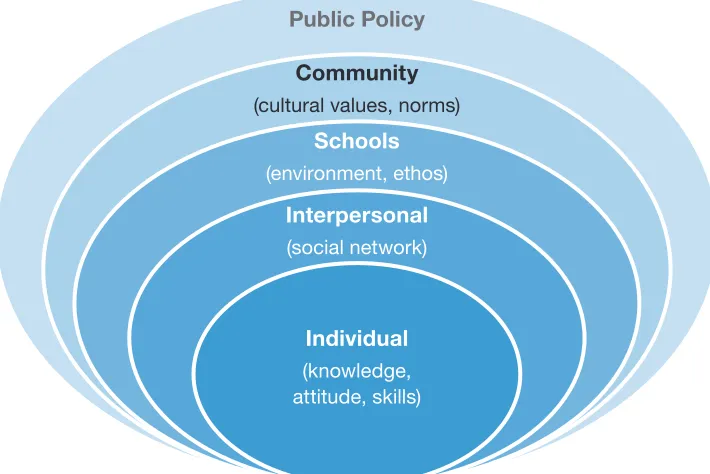
Bullying does not occur in a vacuum. As Figure 1 shows, both personal factors and what they see, hear and experience around them influence learners’ use of violence. Features of their environment in five different spheres influence children’s behaviour:
• At the individual level: children’s behaviour is influenced by their people skills, and whether they have the knowledge and skills needed to engage positively with others.
• At the interpersonal level: children’s behaviour is also influenced by the behaviour and attitudes of the people they interact with, including family members and friends. Children with social networks that encourage aggressive behaviour or view it as acceptable are more likely to use violence against others.
• At the school level: schools play a key role in socialising children. School policies, and the way schools respond to bullying and other types of violence, can discourage or encourage violent behaviour. Children in schools that ignore bullying or where educators use corporal punishment are more likely to bully, while children in schools that take a strong position on bullying are less likely to bully.
• At the community level: children also model the behaviour they see amongst other adults in their environment, including community leaders, neighbours and others in their communities. Children who see and experience violence in their communities are more likely to be violent and aggressive.
• At the policy level: The policy environment can play a key role in reducing violent behaviour by helping to protect children from violence and promote alternative models of behaviour in children’s life. South Africa has banned corporal punishment, for example, while the South African Schools Act aims to help create a school environment that encourages learning and protects the rights of educators and learners.
Figure 1: The factors influencing violent behaviour
Individual
(knowledge, attitude, skills)Interpersonal
(social network)Schools
(environment, ethos)Community
(cultural values, norms)
Public Policy
Schools can play a key role in changing young people’s attitudes on bullying and providing them with the skills they need. Many South African children experience high levels of crime and violence, but schools can help to break the cycle of violence. Even where children are exposed to violence in their homes and communities, the right interventions at school can both help to protect them from the effects of violence and assist them in choosing alternative behaviour. Schools that send a strong message that bullying and violence are unacceptable can help learners to see that violence is not an appropriate response to conflict. Educators can become positive role models by respecting the human dignity of each learner and using positive discipline techniques (see School Safety Framework Training Module on Positive Discipline in Schools).
What works?
While good practice on addressing bullying continues to evolve, experience internationally and locally points to the components of successful interventions. These include:
• A whole-school approach. Addressing the root causes, bullying requires a whole-school approach that focuses on creating a respectful and tolerant school environment. Rather than tackling bullying as a distinct agenda, interventions should form part of a larger strategy to encourage social and emotional development and learning. The emphasis should be on building trusting and mutually respectful relationships between learners and educators, respect between learners and a safe and supportive school climate where people feel they belong and bullying is not tolerated.
• Involvement of diverse actors. Bullying prevention and intervention is most effective where it addresses the many different influences on young people’s behaviour. Measures should target not only the individuals involved, but also educators, administrators, counsellors, other non-teaching staff (such as bus drivers, nurses, school resource officers, custodians, cafeteria workers, school librarians) and parents. To the extent possible, anti-bullying campaigns should
Corporal
punishment and bullying
also extend beyond schools, into the larger community – as identified by school role-players.
• Attention to both the targets and perpetrators. It is important to work with not only the target or bullying but also the bully. Research shows that bullying can be a sign of other serious antisocial or violent behaviour that needs to be addressed. More importantly, bullying can also indicate that there is something happening in a youngster’s life. As noted earlier, children who bully have often experienced bullying themselves, either by peers or at home. They may also be experiencing other problems outside of school. In these cases, bullying may be a way of trying to deal with negative feelings by hurting others. In other instances, perpetrators may lack social and emotional skills or empathy and require help in dealing with their emotions and engaging with others. • Accountability. At the same time, the bully must always be held accountable
for their actions. Regardless of the underlying reasons, bullying is wrong and perpetrators need to be held responsible. Schools’ Code of Conduct must send a clear message that bullying will not be tolerated and outline how bullying will be dealt with. Children must be helped to understand the impact of their actions and to make amends. Positive discipline methods can help to hold children accountable while also encouraging better behaviour in the future (see School Safety Framework Training Module on Positive Discipline in Schools). Bullies should be monitored, and those who continue to bully may be
subjected to increasingly serious sanctions, including suspensions, expulsions, and in very serious cases, through legal channels.
What does not work?
Experience to date also suggests less successful approaches. These have been tried and often promoted widely, but when evaluated alongside the methods above, have been shown to be less effective:
• Zero tolerance policies. Many schools have adopted “zero tolerance” or “three strikes and you’re out” policies towards bullying, in which young people who bully others are suspended or expelled from school. One problem with these approaches is that both minor and very serious bullying is treated in the same way. While suspension and expulsion of learners may be necessary to keep schools safe in a very small number of cases, more minor bullying is better addressed through more rehabilitative measures that address the underlying causes of bullying. A focus on punishment also usually fails to tackle associated antisocial behaviour. Another serious problem is that severe punishments, such as suspension or expulsion, may actually discourage children and adults from reporting bullying.
• Group treatment for young people who bully. Some schools have tried to address bullying through group activities for young people who bully, including anger management interventions, skill-building, empathy-building, and seeking ways to build bullies’ self-esteem. Such programmes are well intentioned, but are often counter-productive, as group members may become role models and reinforce each other’s bullying behaviour.
• Simple, short-term solutions. Schools often adopt a piecemeal approach to bullying prevention. They may, for example, run once-off, in-service training sessions for educators, hold an assembly or rely on individual educators to work bullying messages into their teaching. Although each of these efforts may represent important initial steps in adopting a comprehensive, long-term bullying prevention strategy, they are unlikely to reduce bullying problems. Meaningfully addressing bullying in the long-term requires changing the climate of the school and what is acceptable behaviour.
When schools fail: Paul’s story
“The bullying started at the end of my grade six year,” Paul says. “They [fellow learners] began calling me names and making nasty comments about me. I felt bad. They never hit or pushed me; they just said things that were mean. “It got worse when I was in grade seven. A group of boys in my class would always do these things where educators couldn’t see them. I would be walking from one class to another and they would make comments about my mother behind me in the line.
“They always seemed to pick on me. I tried to avoid them, to ignore them, but that didn’t seem to help. I eventually told my mother. She told the educators. They got all of the learners together and told them to stop. They made them write letters to apologise to me.
“The bullying stopped for about a month. But then they started again. I wasn’t scared but irritated. I had made new friends, but the bullies kept following me. I just tried to ignore them but I was losing self-confidence and was unhappy. One of the boys in the group phoned me at home and told me how sorry he was about the whole thing. But the others just kept coming after me.
The school suggested I move away from my group of friends and find somewhere else to “hang out” to lessen the chances of this student and me coming into contact with each other. I didn’t like the idea of leaving my friends and told the teacher; she just said that one of us had to make the move.
This boy doesn’t just contain his harassment to school either. My mum has witnessed him approaching me on a number of occasions in public harassing me. She wrote to the school the principal asking to meet with her, but nothing was done about it and the school never got back to us.
Eventually, I told my parents that I did not want to go to school. After many discussions, my parents took me out of school and I completed grade seven at home.”
steps to prevent and address bullying
Best practice on bullying suggests several tried and tested steps in preventing and addressing bullying in schools. In keeping with the whole school approach, these include:
• Define bullying.Bullying is not the same thing as ‘aggression’ or ‘violence’, although it may involve both. It is not just fighting or teasing. Bullying is about a specific desire to hurt and must be distinguished from other school problems. It is important that definitions recognise the many different forms of bullying.
• Establish and enforce school rules and policies related to bullying.
Developing simple, clear rules about bullying can help to ensure that learners know that bullying will not be tolerated. The school’s code of conduct should be revised to specifically discuss bullying, what is expected and how it is to be addressed and what the consequences are for those found bullying. Schools can also choose to develop a specific anti-bullying policy. It is important to make clear that the school not only expects learners not to bully, but that it also expects them to be good citizens, not passive bystanders.
As anti-bullying policies and codes of conducts affect all members of the school community, it is important that learners, educators, school administrators, non-teaching staff and parents all have an opportunity to contribute and provide feedback, and that they reflect the consensus of these actors. Without this buy-in, policies may be difficult to implement and apply, and may be opposed to those they affect. Policies should be well publicised and disseminated to all relevant actors.
• Assess what is happening. Schools should assess the extent and nature of bullying. Anonymous surveys amongst learners and staff can help to identify the types of bullying at the school, how common it is, where it occurs and how people react to it. Adults often know relatively little about the extent and nature of bullying in schools, and this information can help to raise awareness about bullying. It will also help the school to develop policies and strategies that respond to the environment in specific schools. It can also serve as a baseline from which administrators and other educators can measure their progress in reducing bullying (see Educator and Learner surveys).
• Establish or strengthen institutions to coordinate the school’s bullying prevention activities. Bullying prevention activities work best if a representative group from the school coordinates them. School Safety Committees should integrate bullying into their other activities, including the collection and interpretation of data on school safety. The safety committee or a dedicated committee should also help to coordinate the development of policies and guidelines. Coordinating structures should meet regularly to oversee and monitor interventions and ensure that they continue over time. They should draw on all members of the school community, including learners from different grades, educators from different grades, non-teaching staff, governing bodies and parents.
Forming a student advisory group is also useful in spotlighting bullying prevention and members can provide valuable suggestions and feedback to adults. It can also provide student input into the design of anti-bullying policies and interventions and help to raise awareness of them amongst other learners.
• Provide on going training on bullying prevention. School administrators, teaching and non-teaching staff and other school role-players should receive training in bullying prevention and intervention. This should aim to help them to better understand the nature of bullying and its effects, how to See Appendix 1 for
respond if they observe bullying, and how to work with others at the school to help prevent bullying. Training should not be available only for teaching staff. This should not be a once off; there should be on going training for new staff, as well as existing staff to ensure that bullying remains in the spot-light, and that interventions keep up with developments in anti-bullying practice. • Deal appropriately with bullying. Schools and staff must respond
consistently and appropriately in bullying situations. All staff should be able to intervene effectively on the spot to stop bullying. Appropriately trained staff should also meet separately with both the target of bullying and the bully to establish what happened and decide on the appropriate course of action. The parents of both learners should also be contacted and involved in the response. • Increase adult supervision in hot spots where bullying occurs. Bullying
tends to thrive in locations where adults are not present or are not vigilant. Once school personnel have identified hot spots for bullying from the student questionnaires, the school should look for creative ways to increase adults’ presence in these areas.
• Focus some class time on bullying prevention. It is important that bullying prevention programs include a classroom component. Educators should be encouraged and supported to include bullying-related content into their teaching on an on going basis. For example, educators (with the support of administrators) can set aside 20–30 minutes each week (or every other week) to discuss bullying and peer relations with learners. Anti-bullying themes and messages also should be incorporated throughout the school curriculum. The aim should be to change the social norms around bullying. It must become “uncool” to bully, “cool” to help out learners who are bullied, and normal for staff and learners to notice when a child is bullied or left out. Teaching and discussions should also provide tools for learners to address bullying problems.
Components of a school anti-bullying policy
A bullying policy, or a code of conduct should include: • A statement of the school’s stand against bullying
A succinct definition of bullying, with illustrations
• A declaration of the rights of individuals in the school community - learners, educators, other workers and parents - to be free of bullying
• A statement of the responsibilities of all those who see bullying going on to seek to stop it.
• A general description of what the school will do to deal with incidents of bullying
• An undertaking to evaluate the policy in the near and specified future
E-Safety in schools
Information Communication Technologies (ICTs) have a key role to play in education, both within and outside of schools. ICTs such as the Internet and cell phones are becoming more and more accessible and provide unprecedented scope to gather, share and manage knowledge. A focus on the negative aspects of ICTs, including cyber bullying, often overshadows the positive aspects, but the advantages of ICTs for education far outweigh the disadvantages. Rather than dismissing ICTs on the grounds of their risks, it is important to manage their use effectively to the benefit of educators and learners.
The Department of Basic Education has developed guidelines on e-Safety, or electronic safety, in schools. These identify the different ICTs used in schools, suggest strategies to manage their use and identify the different role-players that need to be involved, as well as their responsibilities. The guidelines highlight the need for a whole-school approach, within which schools, educators, learners and parents all have roles to play. Key strategies include:
• Developing a policy to guide the acceptable and appropriate use of ICTs in schools • Installing antivirus and monitoring software
• Improving document security and the appropriate backing-up of data
It is important to incorporate ICTs into bullying prevention. ICT educator should be involved in developing measures to prevent and address cyber bullying and should be included in the work of the School Safety Committee. Where there is no ICT teacher, the teams should include someone with a working knowledge of ICTs. Alternatively, the school safety officer MUST have a working knowledge of cell phones, computers and the Internet.
The Guidelines can be accessed at http://www.thutong.doe.gov.za/Default. aspx?alias=www.thutong.doe.gov.za/schoolsafety
See Appendix 2 for an example of an acceptable use policy
roles and responsibilities
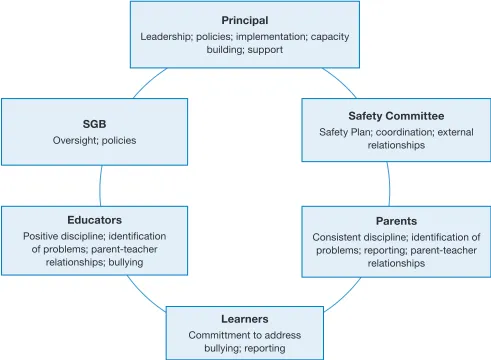
All actors in the school community have roles and responsibilities in creating a school environment free from bullying (Figure 2). Preventing and addressing bullying requires a collaborate effort. Teaching and non-teaching staff, school managers, the school safety committee, learners and caregivers all have a responsibility to watch out for bullying and intervene to address it. Principals, teaching staff, learners and parents also have specific responsibilities:
• Principals: Principals need to take the lead in addressing bullying. It is the principal’s responsibility to establish clearly the school’s position on bullying. It is also the principal’s responsibility to provide leadership on creating a safe school environment that protects and respects human rights. The principal and the school management team should work with the SGB to develop and disseminate policies and ensure that they are followed. It is also up to principals and other member of the school management team to ensure that educators and other role-players receive the support and training they need to prevent and address bullying.
• The school governing body: The SGB is responsible for developing and revising school policies regularly, including the school’s code of conduct, in cooperation with the school principal, the School Safety Team and other role-players. The SGB is also responsible for ensuring that policies are applied fairly and consistently.
• The school safety committee: The school safety committee is responsible for ensuring that the school’s safety plan includes and addresses bullying. Bullying should be included in the assessment and monitoring of school safety. Additionally, the committee can help to coordinate anti-bullying activities, as well as the contributions of the various stakeholders involved in creating Useful resources:
• The Olweus Anti-Bullying Programme: www.olweus.org/ public/index.page • Information and
reviews of anti-bullying interventions: www.campbell collaboration.org/ news/reduction_ bullying_schools.php • Reviews of
and revising policies. It also has a key role to play in identifying and building relationships with the external role-players, such as social workers
• Educators: It is up to educators to create a classroom environment that promotes learning and good behaviour (see School Safety Framework training module on Positive Discipline). It is the educator’s responsibility to get to know learners, to watch out for signs of bullying and to intervene to stop it. Educators are also responsible for engaging parents and caregivers, and working with them to promote and support a bully-free school.
• Parents or caregivers: It is up to caregivers to ensure they know what is happening in their child’s life. As with educators, caregivers need to look out for and report bullying. Caregivers also have a responsibility to familiarise themselves with school policies and ensure that their children adhere to school rules. They also need to get to know their children’s educators and work with them to prevent and address bullying, as well as other behavioural issues. • Learners: Along with class teachers, school prefects and other peer leaders are
the first line of response when it comes to bullying. Peer leaders must be on the lookout for and report bullying. It is also their responsibility to speak out against bullying and intervene to stop it where is occurs.
Principal
Leadership; policies; implementation; capacity building; support
SGB
Oversight; policies
Safety Committee
Safety Plan; coordination; external relationships
Educators
Positive discipline; identification of problems; parent-teacher
relationships; bullying
Parents
Consistent discipline; identification of problems; reporting; parent-teacher
relationships
Learners
Committment to address bullying; reporting
Tips
for educatorsEducators have their own ways of teaching and addressing the issues their learners’ experience, both inside and outside the classroom. The following strategies can help in both preventing bullying in the classroom and dealing with bullying outside of it. • Tip 1: Create a “Check It at the Door” Policy. Some call it a “safe space” or
“class rules”. Whatever the name, it is important for educators to create a positive environment for the learners in their class. A “Check It at the Door” policy is most effective when it’s posted on or outside the classroom door, in a place where learners see it every time they walk in the classroom. From time to time, it should be re-printed, painted or recreated so that it gets noticed.
• Tip 2: Write Everything Down. It can often be difficult to remember details as time goes by. Writing things down can not only help to record details but can also help to see patterns that might otherwise go unnoticed. Keeping a teacher’s journal can be very helpful in preventing bullying in your classroom, both to monitor what is happening and to document incidents so that the school can address them. • Tip 3: Share bullying experiences. Children need to know that they are not
alone. It can be helpful to provide young people with examples of people who have experienced and overcome bullying. Many celebrities, for example, have openly talked about being bullied. Such stories can give young people hope, and the confidence to tell an adult about bullying.
• Tip 4: Be accessible to learners. Most young people do not want to be thought of as a “snitch”, and don’t want to come forward publically to report bullying. It is often easier for kids to report when none of their peers is around to hear or see them. It is important for educators to make themselves available to learners. Educators can post open office hours, for example, where learners know they can come in and discuss issues. As suggested elsewhere in School Safety Framework, schools can also put up comment boxes where young people can anonymously alert staff to bullying. It is important that these boxes are in places that young people can easily access them, but also offer enough privacy for learners to drop in comments without being identified by other learners.
Useful resources:
• How to keep a teaching journal: www.ehow.com/ how_2160742_keep-teachers- journal.html • Talking and teaching
responding to bullying incidents
There is no set formula for the best way to intervene when one suspects or observes a bullying incident. It is important to consider a variety of issues, including the safety of the young people involved, the age and gender of the children involved, the circumstances surrounding the bullying, the form and type of bullying, and the role of bystanders. International experience nevertheless suggests some guidelines:
• Intervene immediately.
Separate the individuals involved. Do not ask what happened right away; rather wait until you speak with those involved and those who witnessed the incident. Try not to draw too much attention – this is the last thing the victim wants and making a spectacle of the incident provides the kind of attention bullies want.
• Get more information.
Get the facts. Speak to both the participants and those who witnessed it separately and ask what happened. Wait until all the facts are collected before making any judgements.
• Tell them you are aware of their behaviour.
Talk to the individuals involved separately. Tell them that you are looking into the matter. Link your actions to school policies and guidelines.
• Make it a teachable experience.
Help bystanders understand what has happened, reiterate school policies and principles and use the opportunity to discuss bullying, appropriate responses to bullying and what learners can do to prevent future incidents.
• Act.
Consider an appropriate intervention based on the severity and history of the incident and the individuals involved. Where ever possible try to link censure to rehabilitative measures. Gauge the impact of the incident; it may sometimes be necessary to refer those involved to external role-players such as counsellors or other health or social work professionals for specialised assistance. Inform the parents and invite them to be part of measures to resolve the issue. • Monitor the individuals involved.
Follow up with the individuals involved to ensure the bullying does not continue.
Actor-specific measures during and following a bullying incident
For the target of bullying y Check in regularly with the learner who was bullied
y Determine whether the bullying still continues
y Provide a supportive environment
y Review the school rules and policies with the student to ensure they are aware of their rights and protection
y Assess whether additional external assistance is required and make the appropriate referrals
For the bully y Identify and name the behaviour
y Review the school rules and policies with the student
y Ask for positive change in future behaviour
y Consider referring them for professional or other services as appropriate
y Consider appropriate graduated consequences
y Encourage the student to channel their influence and behaviour into positive leadership roles
y Monitor and check in frequently
For bystanders y Encourage them to talk about the incident
y Review the school rules and policies with the learners
y Discuss with bystanders how they might intervene and/or get help next time
y Acknowledge who took action to stop the bullying
For the parents y Describe the incident
y Review the school rules and policies with the parents
y Describe the intervention measures taken as appropriate
roles and responsibilities
The response to bullying incidents involves different actors, depending on the seriousness. Minor incidents can be dealt with in the classroom or on the playground, while more serious or repeat incidents, must involve school authorities and possibly external role-players (Figure 3). The various roles and responsibilities include:
• Educators: Educators are the first port of call when it comes to responding to bullying. Educators are responsible for dealing with minor or once-off incidents, as well as poor behaviour and relationships. They need to work with caregivers to address problematic behaviour.
• Principals: More serious and repeated incidents should be referred to the school principal. The principal should interview those involved, determine appropriate sanctions and work with caregivers to find solutions. The principal should also decide whether those involved need to be referred to school councillors or external sources of assistance such as social workers. All incidents reported to the principal should be formally recorded for monitoring and evidentiary purposes.
• The school governing body: Where the principal believes that the misconduct is serious enough, it should be referred to the SGB. The SGB is responsible for overseeing formal disciplinary processes. It should convene an independent tribunal to assess the case, and depending on its findings, determine appropriate sanctions (see School Safety Framework training module on Positive Discipline). The SGB is responsible for recommending to the Provincial Head of Department to consider expulsion of a learner. Criminal behaviour should also be referred to the South African Police Service (SAPS). • Parents or caregivers: Parents have a responsibility to report bullying
and work with educators and principals to address bullying incidents and behaviour.
Referral system
Police
SGB
Disciplinary procedures
Principal
More serious or repeat-incidents; recording
Educators
Minor or once-off incidents; problematic learner
behaviour
Parents/caregivers
Reporting; input and collaboration on
When does bullying become a criminal issue?
In some instances bullying crosses the line between a behavioural issue to be dealt with by school staff and parents to a criminal one that may involve the police. As shown in Figure 4, bullying incidents can usually be placed on a continuum from rude and disrespectful behaviour, to very serious occurrences that involve threatened or actual physical or sexual attacks, theft, damage to property and weapon use, all of which can justify the laying of criminal charges:• threatened or realised attacks constitute attempted or actual assault and sexual assault, and in the most serious cases attempted murder;
• damage to property, vandalism; and
• taking things, theft, or robbery if a weapon is used.
The threatened or actual use of a weapon is considered an aggravating
circumstance, and can lead to more serious charges for all of these crime-types.
Bullying should very seldom escalate to serious, potentially criminal behaviour. Bullying tends to be an escalating behaviour. It generally starts with minor incidents involving undesirable conduct, which left unchecked progresses to more serious behaviour. If schools and the school community take bullying seriously, and intervene decisively to address it early on, it should rarely reach the point where it becomes criminal behaviour. The School Code of Conduct should state clearly when bullying constitutes a criminal offence.
Figure 4: A continuum of bullying behaviour
Examples: • Ignoring
someone • Talking down to
someone • Making faces or
rolling eyes • Sneering • Mocking • Name-calling or
jokes • Laughing at
someone • Provoking
Examples: • Throwing
something Pushing, shoving or poking • Tripping or
causing them to fall
• Using derogatory names, remarks or profanity to publicly humiliate someone • Gossiping or
spreading lies or rumors
Examples:
• Writing graffiti or displaying drawings, pictures or materials
• Arranging public humiliation • Manipulating
others to remain silent about an incident
Examples: • Harassing,
including the use of written and electronic media
• Threatening using words, gestures or actions • Damaging,
destroying or stealing personal property • Hitting or
physically attacking • Touching of a
sexual nature or forced sex • Using a weapon
Continuum of bullying
Escalating behaviour
Rude or
It is important to take major incidents seriously, and to involve the police where necessary. At the severe end of the continuum, incidents can pose a serious threat to children’s life and health. They may also result in harm to the bully
where victims retaliate with weapons or force. Learners are prohibited from bringing dangerous items such as guns, knives, pangas, spears, knobkerries and other weapons to school. If a learner threatens other learners or school staff with any such weapons they are in contravention of Section 61 of the South African Schools Act. This states that: No person may –
(a) allow any dangerous object in the public school; (b) carry any dangerous object in the public school; (c) store any dangerous object in the public school except in officially designated places identified by the principal;
(d) carry illegal drugs on public schools If a learner stabs, shoots or seriously injures another student or member of staff, this constitutes assault with the intention to do serious bodily harm and needs to be reported to the police.
Sandile’s Story
The first person Sandile* saw after the weekend was Nkosana Mbhele. Mbhele
wanted R200.
Sandile had bunked school on Friday to avoid Mbhele. But on Monday October
9 2006 a furious Mbhele dragged Sandile behind a shed at the end of the school
grounds, where no one would see them. Mbhele slapped him. “Where’s the
money?” he demanded.
The bullying had started from the moment Sandile enrolled for Grade 8. The
19-year-old Mbhele was in Grade 10 - and had a bad reputation. His progress
reports in Grade 9 and 10 carried notes from educators who spoke of his
constant absenteeism.
Sandile was only 14 - an easy target for extortion for Mbhele. The amounts
varied. Sometimes it was R5, that day it was R200.
On occasion, Sandile had to buy a bottle of brandy for Mbhele and his friends.
Once, Sandile’s cell phone was taken away and kept until he paid to get it back.
That Monday it was just the two of them behind the shed.
When Sandile said he could not come up with the money, Mbhele pulled out a
knife and told Sandile he would be stabbed. Sandile grabbed the hand in which
Mbhele held the knife and a struggle ensued. The knife fell and Sandile picked it
up.
Sandile stabbed Mbhele several times, including in the neck. Mbhele staggered
backwards, and Sandile ran. He ran away, hid the knife and went home.
Mbhele died on the school’s premises.
That evening, the police arrested Sandile. Sandile helped them to find the knife.
Forensic reports determined the cause of death: a “penetrating incised wound of
the neck”.
Sandile was charged with murder. Last October, Sandile pleaded guilty. He
admitted it was his intention to kill.
* Not his real name
Tips
for parents/caregivers on responding to incidents
There are several things that parents/caregivers can do to help address bullying. • Familiarise yourself with the school’s policies. Read the school’s code of conduct
and its anti-bullying policy if there is one.
• Talk about bullying with your child. Help your child know what bullying looks like and feels like, and if they or classmates are being mistreated and bullied. Help your child understand that bullying involves more than physical aggression, and includes verbal and non-verbal, social, sexual and cyber bullying. Make sure they know they can talk to you about bullying.
• Teach them to report bullying to a trusted adult. Ensure that they understand the difference between tattling and telling. Tattlers are trying to get someone else in trouble for breaking a rule. Telling is when a child lets an adult know that something bad is happening, and that help is needed to stop it. Teach your child to be a positive bystander. If they see someone being bullied, they should not watch, laugh or join in. Instead, they should make it clear that they are on the side of the victim, not the bully— and they should tell an adult what they saw or heard.
• Model non-violent behaviour. Children learn by example. Model respectful behaviour at home and in your daily interactions with others. Avoid aggressive or violent behaviour. Learn about and apply positive as opposed to negative disciplinary methods (see School Safety Framework module on Positive Discipline).
If your child is bullied:
• Make sure that they know that bullying is wrong. Assure your child that bullying is not their fault and that everyone deserves respect. Let them know that you take their concerns seriously and will act to protect them. Often, children feel powerless when bullied, and presume no one can help them.
• Ask what happened. Ask them to describe exactly what happened. Remain calm; show concern but do not over-respond as this may cause them to close-up and stop talking. • Ask your child for their input on what steps can be taken to make them feel safe.
Work with them to find solutions. Do not encourage them to fight back; using fists or insults as protection against bullying is not a good solution—it could make things worse, get them hurt and get them into trouble.
• Talk to the school. Make an appointment to see your child’s teacher or the school principal. Encourage your child to come with you and describe what they experienced. Ask how you, the school staff, and your child can work together to ensure that the bullying does not happen again.
• Document bullying. Keep a journal of all bullying incidents. You and your child should write down what happened, where and when it occurred, how your child reacted, and how the bully and bystanders responded. Indicate what solutions were agreed upon and if they worked.
• Help your child develop strategies and skills in handling bullying. Help them to develop strategies for dealing with bullying. There are many different things they can do, including being more assertive, ignoring, using humour to diffuse tensions, and asking for help.
If your child is bullying others:
• Listen. Be objective and listen carefully to the account. Do not get defensive, nor take it personally.
• Talk to your child. Calmly ask for an explanation. Find out if your child was the instigator of the bullying or joined in.
• Explain that bullying is unacceptable. Ask your child if they know that bullying is unacceptable. Help them to understand how bullying hurts not only the victim, but also them and bystanders.
• Work to find solutions. Work with the school to determine what can be done to ensure that the bullying does not happen again. Work with the school to help address the bullying behaviour. Let your child know that you will work with the school personnel to monitor their progress. Ask to be kept informed.
Glossary
Censor Examine and edit information to remove
harmful or undesirable content. Conflict Refers to some kind of disagreement or
tension between people or a clash of ideas or goals.
Coercion Involves forcing someone to do something
they do not want to do. May involve threats or physical violence.
Delinquency Refers to wrongful, illegal or anti-social behaviour.
Eating disorder People with eating disorders eat, or refuses to eat, in order to satisfy a psychological need and not a physical need. While people normally eat when hungry and stop eating when the body doesn’t need more, people with eating disorder ignore these signals and either under or over-eat. Eating disorders include anorexia and binge eating, or bulimia.
Empathy Empathy involves identifying with
and understanding another person’s situation, feelings, and motives. It implies understanding and entering into another’s feelings. To empathise involves understanding another person’s feelings or position.
Gender Gender norms refer to the socially
prescribed attitudes and behaviour and roles given to men and women. Gender is not the same as sex; while ‘sex’ refers to the biological differences between males and females, ‘gender’ is about what society expects from males and females.
Hostile behaviour Refers to unfriendly, cold or aggressive behaviour.
Inclusive Refers to an environment where everyone is included and made to feel valued. Information Communication
Technologies
Refers to any communication device or application, including radio, television, cellular phones, and computer and network hardware and software and their uses, such as videoconferencing and distance learning.
Norms Refer to rules of behaviour in a society or group. They tend to reflect the values of the group and specify those behaviours and actions that are proper and those that are inappropriate, and how the group rewards or punishes adherence and non-adherence. Gender norms, for example, often expect men to be strong and masculine, while women are expected to be more submissive and feminine.
Peer Refers to people of the same age or status.
A peer group refers to members of a group that are roughly the same age and status. Peer mediation Refers to the use of fellow learners to
promote reconciliation, settlement, or compromise between conflicting parties.
Piecemeal Fragmented, piece-by-piece.
Post-traumatic stress Post-traumatic stress disorder (PTSD) is an anxiety disorder that develops after exposure to a terrifying event or ordeal, where a person experienced or was threatened with serious harm. Symptoms include anxiety, flashbacks, recurrent nightmares, and avoidance of reminders of the event. PTSD often occurs alongside depression and substance abuse.
Self-harm Self-harm behaviour involves any
deliberate attempt to harm or destroy the body. Self-harm is done without suicidal intent, but is severe enough to cause physical injury. Examples include cutting or burning oneself, head-banging, and severe scratching.
Slurs A slur refers to insinuations or allegations about someone that is likely to insult them or damage their reputation.
Socialisation Refers to the process of equipping children with the skills to interact with others. It involves children learning and adopting expected behaviour of their culture and community
Status Refers to a person’s social position
appendix 1:
an example of an anti-Bullying Policy
anti-Bullying Policy
statement of Intent
We are committed to providing a caring, friendly and safe environment for all of our learners so they can learn in a relaxed and secure atmosphere that fosters knowledge and promotes respect. Bullying of any kind is unacceptable at our school. It will not be tolerated.
objectives of this Policy
This policy outlines the school’s position on bullying and establishes the procedures and processes for responding to bullying incidents. The specific objectives of the policy include:
• Support other school rules, code of conduct, policies and programmes in ensuring a caring, friendly and safe environment for all learners
• Assist in creating a climate in which the school governing body (SGB), educators, non-teaching staff and learners are informed about bullying, understand the various types of bullying that can occur and are empowered to report it and act against it
• Assist in creating a climate in which parents and caregivers are informed about bullying, understand the various types of bullying that can occur and are empowered to report it and act against it
• Establish the framework and procedures for dealing consistently and effectively to all cases of bullying
What Is Bullying?
Bullying comprises repeatedly singling out and deliberately hurting or harming a child with the aim of hurting or harming them physically or psychologically. Bullying results in pain and distress to the victim.
Bullying takes many different forms. These include:
• Physical bullying: This includes hitting, pushing, slapping, tripping, or pulling someone’s hair, as well as forcibly taking another child’s lunch, money or things
• Verbal bullying: This includes threats, ins