Volume 3 • Issue 1 • January 2017
ISSN 2206-4451
www. ajbssit.net.au
An Assessment of the Impact of the use of New Technologies
on the Learning Quality: The Case of Tunisian National Post
Office (NPO) E-learning School
Chokri Elfidha
Department of Marketing, Universite Tunis El Manar, Labo Erma, Tunisia
1. Learning by E-learning
Learning is a concept increasingly studied in management science. In its most basic sense, learning is the acquisition of information, knowledge, and new ideas that change the way people perceive and understand the world in which they act. It is a process of continually drawing new lessons from our own experiences as those of others. It is also a cumulative process in the sense that the new lessons reinforce or complete old ones (Canadian Centre for Management, 2000). A distinction is made between individual and organizational learning. Accordingly, E-learning can be considered a new form of individual learning, which may be seen as a new individual learning tool likely to spread knowledge and thus promote organizational learning (Fillol, 2004a). Basing training on ICT is easily accessible, making the learner able to be trained at work or at any premises that have access to Internet. Thus, it
Abstract
Nowadays, new technologies and specially E-learning, offer an excellent opportunity to develop the educational systems in Arab universities. However, E-learning platforms are underdeveloped in these universities. Several factors were put to explain underdevelopment in the use of these new technologies in teaching and research in Arab universities. Indeed, E-learning was not completely a new thing to universities. Several teachers had created E-learning materials and courses in different Arab universities. However, studies that have attempted to assess and evaluate the impact of these tools on the quality of education in Arab universities are very rare. In this paper, we try to evaluate current E-learning practices by identifying the relationship between the use of new technologies and the quality of teaching in Tunisian universities. Our measurement protocol uses five key indicators: Goals, costs, student satisfaction, content, and training time. We constructed a research model that we tested on a sample of 110 students who took E-learning courses offered by the Virtual University of Tunis. In Tunisia, E-learning development was supported by the Virtual University of Tunis. This university has been developing E-learning courses, thus it gained expertise in methodology and distance technology and E-learning course development that meet quality standards. In the first section of this paper, we examine success factors of introducing new technologies in higher education, which is the essence of the E-learning process. We focus on the advantages of E-learning compared to traditional learning approaches. In the second section, we present the different dimensions of quality in higher education. These components are Goals of learning and the skills that students should have at the end of the course, costs, student satisfaction, content and training time. In the third section, we report the results of an empirical study of a sample of 110 Tunisian students. This paper aspires to be the first step of collaboration with other researchers from Arab universities with the aim of surveying students in their respective universities across the Arab world. This study can be classified under Category 2 (issues and trends in learning outcomes assessment: Methods of learning outcomes) of the 2nd ICA conference themes.
is more easily adapted to the specific needs of each learner thanks to the interactivity offered by ICT. Flexibility and customization put the learner at the heart of the training process. ICT-based materials used during training encourage or even force the learner to interact. This constant interaction with the tutor raises the attention of the learner and therefore promotes the acquisition of new knowledge. However, despite these advantages, the number of institutions that have opted for E-learning remains relatively small. In this study, we will try to identify factors that facilitate moving from a “traditional” training model to E-learning.
E-learning creates new forms of individual learning, promotes collective learning in virtual teams and allows for knowledge management through virtual interactions that reinforce collective and cooperative work (Roussel, 2001). These forms of learning seek different goals such as acquiring or updating knowledge (refresher training) and development of a particular know-how. This type of training can be organized synchronically (real-time) in a classroom with networked computers to a training platform, in virtual classrooms, video conferencing facilities, remote tutorials, Cd- ROMs, and online databases with phone meetings allowing for exchanging emails and scanned documents in a synchronic (chat rooms) and asynchronic modes (forum), with the presence of a trainer or on learners’ workstations. The process can be well organized in the form of “chat rooms” which are meetings organized on fixed dates on the organization’s intra- or extra-net (Bellier, 2001; Jones, 2001; El-Akrimi et al., 2003; Gil, 2003; Gilbert and Jones, 2001; Kalika, 2000).
E-learning integrates new learning methods reconciliating, on the one hand, the objectives of learning and development of skills required by any training process and, on the other hand, the services and opportunities offered by ICT (Guerrero, 2001). E-learning also offers a number of other benefits for organizations.
2. The Benefits of E-learning
2.1. E-learning as a tool for customized training
New educational technologies take individuals as the main focus. However, the possibility of establishing autonomous and distant training devices through networks does not necessarily break norms. Teleconferencing and video conferencing experiences and information exchange through emails, chats or forums testify to this fact (Dastous, 2003; Edmond, 1996; Gribin, 2011; Guerrero, 2001; Isaac, 2002).
While new technologies offer greater independence in how to manage training time, yet one cannot deny the relational potential of online technologies that inform training by giving it a social dimension through connected devices. The contribution of networks is to link remote people working on the same project, allowing them sharing in real or deferred time. This exchange potential facilitates coordination and cooperation. The concept of group, group cohesion, and group membership pushes individuals to adopt the values of the group as well as knowledge, methods and tools, facilitating thus adaptation and change.
E-learning allows other learners a large scale exchange using forums or chats and gives them the opportunity to value their achievements. To achieve a successful group training, again, conditions for exchange should be put in place bringing thus everyone to build and adjust their learning, using the group.
2.2. E-learning and reduced training costs
“Studies on the impact of training policies on financial performance confirm the positive returns of new technologies on profitability” (D’Arcimoles, 2003). In fact, E-learning is a solution that can significantly reduce costs compared to a face-to-face training by eliminating various fees that sometimes exceed half of the total cost. Companies “hope to achieve substantial savings on travel costs because they face constraints related to the geographical dispersion which needs rapid mastery of know-how to be competitive” (Baujard, 2005).
By 2000, Arthur Andersen’s study predicted 30% reduction in costs. The savings relate primarily to travel costs, hotel accommodation, animation costs, and administrative clearances, etc.
Furthermore, E-learning enables profitability of applications when shared by a greater number of learners. In addition, the new skills that learners have acquired foster their contribution to business results (Asensio et al., 2000). However, many experts agree that developing E-learning may be costly than a traditional face-to-face training (investment in machinery, equipment, purchase, or development of technological media). However, they stress that over time and to a sufficient number of learners, E-learning systems can be profitable from an economic point of view.
2.3. E-learning and its impact on training content
The transition from traditional training to E-learning brings about a change in training content. Change may affect content modularity as well as interactivity. Training content is created to measure, in respect of individuals’ will and prerequisites, their learning level and pace. Indeed, learning pace is proper to each, it can change the length of training by speeding up or rescheduling an activity. Learning content can be adapted to the needs of the learner, taking into account their level and learning pace. This content modularity, therefore, allows offering short modules that catch learners’ attention. The learner will be influenced by the form that should be enjoyable, attractive and readable eliminating thus dissatisfaction risk (Fillol, 2004b).
When focused on interactivity, E-learning content is an addition compared to traditional training. Distance learning is for a single person with specific and unique needs and focuses on the individual. Indeed, it favors the adequacy of the training content to learners’ request and does benefit only the learner. As networking grows, or when companies intensify their international presence, E-learning is an effective solution to train a large number of geographically dispersed employees at the same time and with the same training.
E-learning offers flexibility in dematerializing training location. This advantage is particularly interesting for companies present at the International level and whose employees are located worldwide. It ensures that training content and transmitted messages are identical. The company can develop training courses which will enable employees to exchange their “best practice,” to access a shared knowledge base and to develop their skills. The trainer can expand dynamically training content, changing teaching methods to foster the acquisition of knowledge.
2.4. E-learning and its impact on training time
The assumption that E-learning is a liberator of temporal and spatial constraints are unanimously accepted (Fillol, 2004a). The first specificity of online training devices is to reduce time, thus creating an opportunity to train faster. Indeed, personal learning time is reduced, since the learner focuses only on the aspects, he/she wishes to deepen.
In addition to the possibility of customizing training, modularity of this pedagogical device facilitates training and provides greater flexibility. The learner does not need to spend long hours or days to be trained. He/she can access to his/her training on the workplace or at home. E-learning allows to balance the time spent on training with the demands of job activities. In companies, staff replacement and interruption of customer service issues are handled more flexibly. It is less restrictive as E-learning significantly reduces learners’ unavailability.
immediate performance useful to the organization and does not allow for the development of their personal potential. Moreover, accessing to training where resources are cut and are available for very short periods may offset individuals’ capacity to deepen, analyze and synthesize a subject (Favier and Trahand, 1998).
3. Research Hypotheses
3.1. The strategic role of ICT and adoption of E-learning
A training strategy is crucial to the development of E-learning in view of developing skills and improving business efficiency (Chrétien et al, 2004; D’Arcimoles, 2003; Favier, 2003; Fillol, 2004a; Fillol, 2004b). The absence of a strategy slows the adoption of E-learning as this latter fosters efficiency.
The adoption process can be deliberate or anticipated. In both cases, “the perception of the tool is always an indicator of the adoption environment, an important factor of integration” (Baujard, 2004). Indeed, when companies and their affiliate’s services give an important role to ICT tools and consider them to be a strategic asset, this may facilitate its adoption by employees. The recognition of ICT as a source of competitive advantage or as a strategic asset improves its implementation. This presupposes availability of resources to the integration of ICT in business strategy and process, ensuring the continuity of investment in time (Catell, 1966).
More companies give importance to these technologies and they therefore opt for E-learning projects. Hence, we formulate the first hypothesis:
Hypothesis 1: Perception of the strategic role of ICT promotes the adoption of E-learning and positively influences its components.
3.2. Availability of ICT and adoption of E-learning
A company that seeks to establish an E-learning project among its learning practices for the purpose of developing human capital skills should acquire an appropriate technology platform that takes into account the specificities and the nature of the activity. “It’s essentially about computer tools including hardware and software, Internet, intranets, extranets, and other ICT (Anderson, 2004; Gilbert and Jones, 2001; Rich, 2001). This technological infrastructure has to contain computer and communication tools facilitating information exchange and encouraging the acquisition and sharing of knowledge to enable E-learning to achieve its development objectives in terms of individual knowledge and collective learning.
Hypothesis 2: Availability of technological resources favors the adoption of E-learning and positively influences its components.
3.3. Past experience with ICT-based projects and adoption of E-learning
Opportunities to use information technologies are developing rapidly and should increasingly condition the structure and functioning of organizations (Bellier, 2001; Benbasat et al, 1987, Carletto, 2003). Accordingly, companies have advanced their IT equipment, in particular by developing Intranets and opening their networks to external networks such as Internet. As networks, Internet and Intranet allow for connect distant people, improving their capacity to exchange in real and deferred time via e-mails, forums, video conferencing, etc. (Klein, 1995; Barthe, 2001; Baujard, 2004; Baujard, 2005).
The main advantage of ICT tools is the ease of cooperation between individuals or services whose objective is to achieve a common task or project (Carletto, 2003; LeBoterf, 2002).
Adoption decision depends not only on the constraints resulting from the organizational context but also the streamlining of work practices enabled by information technology. The enthusiasm of the company to adopt E-learning closely relates to the success or failure of technology previously adopted in other projects within the organization (Baujard, 2004; Bellier, 2001; Benbasat et al, 1987).
3.4. Mastering ICT and E-learning
E-learning allows to develop training and adapt it to individuals’ new working environment (Baujard, 2004; 2005). This is especially true in a changing context where how to do the job continues to evolve. However, current trends in business organization need everyone to know and understand these new practices, assume them and use them to interact with employees as well as customers. Thus, technological progress in the fields of information and communication affects the whole organization and processes. However, E-learning is a practice that is entirely based on ICTs which suggests that successful implementation depends heavily on the level of mastery of ICT tools. Capacity to use information technology is a key factor that determines the use of E-learning. Indeed, according to Venkatech and Davis (1996) and Barthe (2001), mastery of a technology refers to a person’s perception of his/her ability to use information technology and communication tools such as microcomputers, Internet, intranets, extranets, or e-mails. This perception, therefore, means the ability to deploy the skills acquired to use any technological tool.
Hypothesis 4: Mastery of ICT promotes the adoption of E-learning and positively influences its components.
As a summary to this theoretical analysis and the hypotheses on the links between our variables, we propose the following model:
To empirically validate our research hypotheses, we chose to conduct a survey of an innovative Tunisian institution in the use of new information technologies and communication, namely the National Post Office1. Indeed, in recent years, the Tunisian Post has implemented a strategy based on innovation, the development of technology-based applications and online solutions to make the most significant contributions out of information and communication technologies. In addition, as part of the interest shown by the Tunisian post toward its human capital, several training cycles were conducted based on the use of information and communication technology in collaboration with the Virtual School of the Tunisian Post Office. Indeed, nearly 1,100 workers or 12% of all staff use Internet from home and outside working hours to follow the courses of the virtual school.
4. Results and Discussions
To empirically test our model, we chose to conduct an explanatory study, which tries to explain a theoretical concept through a theoretical model that we seek to operationalize in the field. Surveying
employees of the Tunisian Post are part of a process seeking to validate the relationship between information technology and communication and training policy, operationalized mainly by the organization’s adoption of E-learning (Virtual School of the Tunisian Post Office).
In this study, we try also to determine the impact of ICT’s different dimensions, namely availability of technological resources, ICT skills, the strategic role given to ICT, past experience with technology in the company, on training policies, and the contribution of these dimensions to the adoption of E-learning in Tunisian companies.
We opted for the Tunisian Post Office because it is among the first Tunisian companies to integrate ICT in the learning process.
4.1. Data collection methodology
A questionnaire was administered to post office’s employees who followed training in the virtual school. The purpose of this questionnaire is to examine the device’s efficiency and learners’ satisfaction with such a device, on the one hand, and to identify perceived differences between face-to-face and online training, on the other hand. The opinions of the participants were measured on a 4-point Likert scale of 1 (strongly disagree strongly agree). Given the relatively small size of the sample (110 participants), only descriptive statistics were included in the analysis. Two open-ended were included in the questionnaire to enable learners to express qualitative opinions on the most positive and most negative aspect of this experience. These qualitative data are incorporated in the analysis of the quantitative results. The first part of the questionnaire seeks to assess participation in this virtual school by referring to the five dimensions of the use of ICT and to the acquisition of online dialogue mechanisms during the learning phase. Appropriation of the tool is assessed as well as the effectiveness of the educational device. The questions cover essentially availability of ICT, ICT skills, experience with ICT use, ease of use of ICT and the perception of the strategic role of ICT. The second part of the questionnaire deals specifically with learner satisfaction with the adoption of E-learning and with the experience of the Post Office with virtual training.
4.2. Factors explaining E-learning adoption
We notice from frequency distribution that most interviewees place a very high importance to training and to technological modernization.
The emphasis on technological modernization, on the one hand, and training, on the other hand, shows a strong interest in E-learning. What we need to know is the real motives for the adoption of this new form of training?
According to our model, we assumed that E-learning depends on factors related to ICT (Figure 1).
4.2.1. Availability of ICT
We found that all interviewees agreed that their organization has a website, 86.4% say they access Internet while 79.1% access the intranet from the Tunisian Post’s premises.
Adoption of E-learning needs installing the required technological infrastructure, which consists essentially of computers and network tools, including Internet and Intranet.
However, despite the fact that employees access Internet at the Tunisian post’s premises, access to the training platform is made only possible outside work hours, at home or in any other place that has an Internet access. We should, therefore, point out that the organization’s disposal of Internet and Intranet networks is not really a reason to adopt this new form of training. This latter assumption is indeed confirmed by 57.3% of respondents (Table 1), as only 47 people among the 110 respondents believe that availability of ICT promotes the adoption of E-learning. Our hypothesis H2 is rejected.
4.2.2. Mastery of ICT by learners
controlling the tool and have developed an expertise in this area as computerization of the post office’s tasks was made a long time ago. In addition, Internet-based technological tools are considered easy to use. 55.5% believe that they are competent and can easily manipulate computers and access Internet and 20.9% say they are more highly qualified in this area.
We can conclude that 76.4% of respondents have good or very good skills against 21.8% who have low skills and are not proficient in computer skills. Our hypothesis H4 is accepted because most employees who are part of our survey (101 people from 110) argue that ICT literacy is crucial to engage in an ICT-based training project. Then, we conclude that mastery of technological and ICT is a major determinant of the adoption of E-learning.
4.2.3. Perception of the strategic importance of ICT
Most respondents, 78.2% (Figure 2), think that the Tunisian post invested in ICT to improve the competitiveness of their organization. We can infer that ICTs are perceived by employees as a token of competitiveness and represent a competitive advantage for the organization which confirms our theoretical analysis.
The perception of the strategic importance of ICT integrates continuity of investment in technology over time (Powell and Dent Micaleff, 1997). This is confirmed by 83.6% of employees who state that the budget for ICT is growing continuously. We note in this context that according to employees the Tunisian post office gives importance to ICT. Indeed, most respondents (60.0% of total sample) believe that their organization made a strong investment in ICT and 33.6% consider rather that the investment made is very important (Table 2).
Although the investment in new technologies is very high and it is still growing, employees do not associate perception of the importance of ICT with adoption of E-learning. We can say that our hypothesis H1 is rejected (Figure 3).
4.2.4. Past experience with an ICT-based project
All of the respondents said they have experience with a technology project and that their organization has already launched ICT-based projects. One example is the project “e-management in the post,” which is launched to drive the change of organization’s management into a modern business administration. In addition, to support electronic transactions and develop a virtual economy, the Tunisian Post Office has put into place over the years a varied package of payment solutions via the Internet (e-payment). In addition, we can mention the instant electronic transfer of money (e-finance) and electronic processing solutions for individuals and businesses (e-post).
These electronic solutions have encouraged the adoption of electronic training which adds to the number of ICT-based projects, and particularly Internet-based. Employees are used with such projects and have sufficient experience and will not resist the adoption of E-learning. 58.2% of employees note
Table 1: Availability of ICT in the organization and adoption of E-learning
Valid Frequency Percent Valid percent Cumulative percent
0.00 63 57.3 57.3 57.3
1.00 47 42.7 42.7 100.0
Total 110 100.0 100.0
Table 2: Investment in ICT
Valid Frequency (%) Valid percent Cumulative percent
1.00 2 (1.8) 1.8 1.8
2.00 5 (4.5) 4.5 6.4
3.00 66 (60.0) 60.0 66.4
4.00 37 (33.06) 33.6 100.0
that past experience with a project based on ICT can motivate training through these technologies. Therefore, our H3 hypothesis is accepted. These results are consistent with those of Wheeler who found that no significant relationship between experience with an ICT-based educational device and performance (Reinig, 1997) .
4.3. E-learning and its impact on the performance of the company’s training module
4.3.1. The impact of ICT on learning objectives
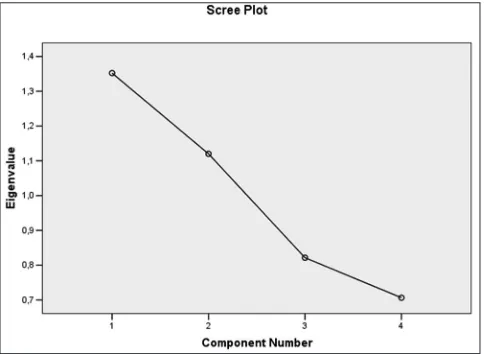
According to the table of variance explained, these are the two main components that have eigenvalues >1.0 and therefore they are retained in the analysis. Indeed according to Kaiser (1960), extraction of components should stop as soon as a proper value falls below 1.0. The two selected factors alone explain 63.325% of total variance (100%) (Figure 4).
Rotation factors redistribute explained variance, while the overall explained variance remains unchanged and only the first factor becomes smaller (Figures 5 and 6).
We can see that experience with an ICT-based project highly correlates with the first component. Availability of ICT and importance of these technologies rather correlate with the second component.
Figure 2: Importance of training and technological modernization
Figure 1: SPSS output,total variance explained
Figure 4: SPSS output, component matrix
Figure 6: Output SPSS, scree plot
4.3.2. The impact of ICT on training costs
A review of individual variables is greatly facilitated by calculating measures of sampling adequacy of Kaiser Meyer-Olkin. They can take values between 0.0 and 1.0. To be kept in a PCA, a variable should achieve a KMO measure exceeding 0.5 (Kaiser, 1960).
In the table of explained variance, we find that the first two components have eigenvalues >1.0. These two components alone explain 61.807% of total variance (100%).
This Table shows the factor solution before rotation. The higher loadings are the better they define a component.
In our case, we find that ICT skills, availability of ICT and the importance of these technologies rather correlated with the first component, while experience with an ICT-based project strongly correlates with the second component.
Ideally, a variable should correlate with one component and less with the others. However, we found that the first variable, namely (ICT skills), correlates with the two components.
In this case, the results cannot be optimally interpretable. To reach more relevant results, it seems necessary to run a preliminary Varimax rotation. This is an orthogonal rotation, which is made to simplify the structure of the factor solution, maximizing the variance of the components.
After rotation, the first three items heavily load on the first component. ICT skills best define the first component while the last item defines the second component.
4.3.3. The impact of ICT on training content
The variance accumulation test commonly known as scree test is a graphical method proposed by Catell (1966) and used to decide on the number of components to extract.
It is relevant to compare the different criteria for choosing the number of components that explain the most a factor rather than applying the only criterion or rule of Eigen value >1 Kaiser. We notice a sudden decrease invariance explained after the second component as observed on the scree plot. Then, we can extract the first two components, which also have eigenvalues >1.0 and explain 62.855% of total variance.
We notice that ICT skills and availability correlate more with the first component whereas importance of ICT strongly correlates with the second factor. However, we are not able to decide on the correlation of the variable “experience with an ITC-based project”.
To refine our results, we used a Varimax rotation. After running the rotation, we found that ICT mastery and availability correlate more with the first component whereas the importance of ICT and experience with an ITC-based project strongly correlate with the second component.
4.3.4. The impact of ICT on training time
The results indicate that the first two components, with eigenvalues >1.0, almost contribute equally to explain 56.918% of total variance. Even after rotation, loadings have not significantly changed.
Our principal component analysis shows that ICT skills and availability are strongly associated with the first component, i.e. importance of ICT. While experience with an ICT-based project rather correlates with the second component. These results were confirmed by the Varimax rotation. These obtained results are consistent with the first results before rotation but with different values.
4.3.5. Impact of ICT on learners’ satisfaction
The overall learner satisfaction was measured on a scale of 1-10. The mean score is 7.14. This confirms the high overall satisfaction of the participants with such a training device. However, satisfaction may likely be explained more by their mastery of a new communication tool, which they may find an effective new training tool.
5. Conclusion
did not negatively affect their participation. However, availability of ICT and experience with its use are factors that promote the adoption of E-learning. However, perception of the strategic importance of these technologies does not have a significant effect on the ease of adoption of these tools by the organization’s employees.
The lessons of this experience for the company are also very instructive. The main lesson is the critical importance of ICT in reducing training costs and especially in achieving training objectives. Far from eliminating the face-to-face training model, such tools will only improve learners’ satisfaction and organization’s profitability and competitiveness.
References
Anderson, T. (2004), Theory and Practice of Online Learning. Canada: Athabasca University Press.
Asensio, M., Hodgson, V., Trehan, K., McConnell, D., editors. (2000), Is There a Difference: Contrasting, Networked Learning 2000.
Barthe, S. (2001), The impact of ICT on human resource department: Emergence de l’e-RH, Note du LIRHE No. 343.
Baujard, C. (2004), e-learning strategies for large companies. Revue SIM Système d’information et Management (SIM), 9(4), 31-47.
Baujard, C. (2005), E-Learning Strategy and the Organizational Performance 10ème Colloque AIM, Toulouse, France.
Bellier, S. (2001), Le e-Learning, Editions Liaisons.
Benbasat, I., Goldstein, D., Mead, M. (1987), The case research strategy in studies of information systems. MIS Quarterly, 11(3), 369-386.
Canadian Centre for Management. (2000), Annual Report of Canadian Centre for Management, July 2000. Available from: http://www.publications.gc.ca/collections/Collection/SC91-2000E.pdf. [Last accessed on 2016 Jan 03]. Carletto, N. (2003), Concevoir Une Formation En Entreprise. Paris: DUNOD.
Catell, R.B. (1966), The screen test for the number of factors. Multivariate Behavioural Research, 1, 245-267. Chrétien, L., Martel, E., Forgues, J.F., Blais, R. (2004), ICT and HRM Professional Skills, 3ème Journée D’étude et
de Recherche du Groupe Thématique (GRH et TIC) de l’AGRH.
D’Arcimoles, C.H, (2003), Financial diagnosis, Human Resources and Value Creation. Paris: Vuibert. Dastous, A. (2003), The Research Project in Marketing. 2ème ed. Toronto: Montréal.
Edmond, M. (1996), Group training Extrait de la Revue Sciences Humaines, 12.
El-Akrimi, A., Ben Naoui, N., Gaha, C. (2003), The determinants for use of electronic training, Congrès de l’AGRH GRH ! Innovons, Grenoble, France.
Favier, M. (2003), Questions about e-learning. In: Présent et Futur Des Systèmes D’informations Grenoble: PUG. Favier, M., Trahand, J. (1998), Group work à L’age Des Réseaux, Paris: Economica.
Fillol, C. (2004a), E-learning in corporate training strategy de formation des entreprises Cahier de recherche du Crepa No. 85.
Fillol, C.(2004b), Apprentissage et systémique: Une perspective intégrée. Gil, P. (2003), E learing and professional training. Paris: Dunod.
Gilbert, S., Jones, S. (2001), E-learning is e-nourmous: Training over the Internet has become the fastest growing workplace performance improvement tool-and utilities are using it in several ways. Electric Perspective, 26(3), 66-82.
Gilbert, S.M., Jones, M.G. (2001), E-learning is enormous. Electric Perspectives, 26(3), 66-89. Gribin, A. (2011), A brief history of the internet. New Statesman, 140(5066), 30.
Guerrero, S. (2001), Contribution to the effectiveness of e-learning, Toulouse 30 et 31 Août.
Howell-Richardson, C., Mellar, H. (1996), A methodology for the analysis of patterns of participation within com-puter mediated communication courses. Instructional Science, 24(1), 47-69.
Isaac, H. (2002), Discussion de Cas en Ligne: Analyse D’une Expérience D’un Dispositif de Classe Virtuelle. Communication au 7ème Congrès de l’AIM.
Jones, M.G. (2001), Just in time training. Advances in Developing Human Resources, 3, 4.
Kaiser, H.F. (1960), The application of electronic computers to factor analysis. Educational and Psychological Measurement, 20, 141-151.
Kalika, M. (2000), L’émergence du e-management. Cahier de Recherche, 57.
Lauzon, A. (1992), Integrating computer instruction with computer conferencing: An evaluation of a model for designing online education. American Journal of Distance Education, 6(2), 32-46.
Louadi, M. (2005), Introduction to ict use TIC Centre de publication universitaire, Tunis.
Luc, P. (2004), ICT and competitive capabilities: Proposition d’un modèle de recherche empirique, 9ème colloque de
l’AIM à l’INT Evry.
Marchand, L., Lauzon, N. (2004), Training with ICT in the workplace, Document préparé pour le Réseau d’enseignement francophone à distance du Canada (REFAD). Available from: http://www.refad.ca/recherche/ formation_tic/pdf/formation_tic.pdf. [Last accssed on 2014 Jun].
Powell, T., Dent-Micallef, A. (1997), Information technology as competitive advantage: The role of human, business, and technology resources. Strategic Management Journal, 8(5), 375-405.
Reinig, B.A. (1997), Flaming in the electronic classroom. Journal of Management Information System, 14(3), 99-120.
Rich, D. (2001), E-learning: A new way to develop employee. Electronic Business, 27, 8.
Roussel, P. (2001), Pour un Développement de la E-formation dans le Prolongement du e-Management, Les Notes du LIRHE, Note No. 354.