Lesson
8
2.8.0 Introduction
It is common for water resources engineers to design a water system involving flow of water from one place to another, usually passing a variety of structures on the way some of them meant for controlling the flow quantity. Rivers and artificial channels, like canals, convey water with a free surface, that is, the surface of water being exposed to air as opposed to flow of water in pipes. It is easy to visualize that for any such open channel flow, as they are called; the presence or absence of a hydraulic structure controls the position of the free surface of water. Knowing the mathematical description of flowing water, it is possible to compute the water surface profile, which is important for example in designing the height of the channel walls of the water conveying system.
Another example, the case of river flow obstruction by the presence dam may be mentioned. The water level of the river increases on construction of the dam and it is essential to know the maximum possible rise, perhaps during the maximum flood, in order to know the degree of submergence of the land behind the dam. Barrages are low height structures, and hence, the rise of water will not be occurring uniformly across the river, again due to the difference of gate operation.
2.8.1 Flow in natural rivers
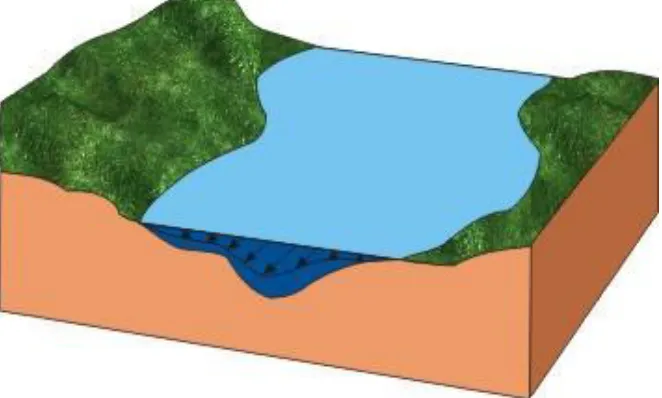
Figure1 shows a river carrying a low discharge.
When the water surface of the river just touches its banks, the discharge flowing
through the river at this stage is called the “bank full discharge”. It is also
sometimes called the “dominant discharge”. If the discharge in the river
increases, the water will overflow the banks and would spill over to the adjacent
Though the amount of discharge flowing through the river is of interest to the water resources engineer it cannot be measured directly by any instruments. Rather, an indirect method is used which requires knowledge of the velocity distribution in a river or an open channel.
Similarly the velocity profile of the river flowing in flood would be as shown in Figure 5, showing that the velocities over the flood plains is smaller compared to the main stream flow.
In order to measure the discharge being conveyed in a river, the velocity profile or the average velocity at a number of equally spaced sections are measured, as in Figure 6. The total discharge is then approximately taken equal to the sum of the discharges passing through each segment.
It has further been observed that an equivalent average velocity is almost equal to the actual velocity measured at 0.6 depth.
2.8.2 Variation of discharge with river stage
The water level in a river is sometimes called the “stage” and as this varies,
The general mathematical description for the stage-discharge relation is given as:
Q = k ( h − h 0)m (1)
Where h is the gauge corresponding to a discharge Q and h0 is the
corresponding to zero discharge k and m are constants. If the variables (Q and
H) are plotted on a log-log graph, then it generally plots in a straight line as:
log Q=m log (h−h ) +log k (2)
0
2.8.3 Flow variation along river length
obtained by dividing the total discharge by the cross sectional area. In a natural river, therefore, these flow velocities may vary from section to section (Figure 10).
If we now consider an axis along the length of the river, the total energy (H) is given as:
H = Z + h +V 2 (3)
2g
We may plot the total energy as shown in Figure 11, where the variables are as follows:
• Z:Height of riverbed above a datum
• h:Depth of water
•
V
2
g
: Kinetic energy head2In Figure 12, three slopes have been marked, which are:
• S0: Riverbed slope
• S: Water surface slope
• Sf: Energy surface slope
Since the total energy of flowing water reduces along the river length due to friction the “energy surface slope” is generally termed as the “friction slope”. The energy loss in a river or an open channel occurs mostly due to the resistance at the channel sides, as the turbulent characteristics of the flowing water implies a smaller loss internally within the water body itself.
It has been nearly 200 years when scientists first attempted to mathematically express (or “model”) the friction slope in terms of known variables like average velocity, cross section properties and riverbed slope. One of the earliest models
for friction slope Sf or, in effect, the channel resistance was derived from the
The variables represented in the figure are as follows
• W: Weight of water contained in the control volume
• V: Inflow velocity, which is the same as the outflow velocities
• θ: Angle of slope river bed, which is also equal to that water surface and
friction slopes
• τ0 : Shear stress due to friction acting on the control volume of fluid from
the river bed and all along the periphery, though in Figure 14 only the resistance due to the riverbed is shown.
Equating the forces and noting that the inflowing and out flowing momenta are equal as well as the pressure forces at either end of the control volume one obtains:
Where the remaining variables are:
• P: wetted perimeter
• A: Cross section of flow area
• L: Length of control volume
Assuming θ to be very small and nearly equal to bed slope, we have
τ0 =ρg R S0
(5)
Assuming a state of rough turbulent flow, as is the case for natural rivers and channels, one may write
τ0 α V2 or τ0 = kV2
(6)
Substituting into (4),
V =
ρ
g
R S0 (7)This may be written as k
V = C R S (8)
This is known as Chezy equation after the French hydraulic engineer. Antoine Chezy who first proposed the formula around 1768 while designing a canal for
Paris water supply. The constant C in equation (8) actually varies depending on
Reynolds number and boundary roughness.
In 1869, Swiss engineers, Ganguillet and Kutter proposed an elaborate formula
for Chezy’s C which they derived from actual discharge data from the river
Mississippi and a wide range of natural and artificial channels in Europe. The formula, in metric units, is given as
1.811 0.00281 41.6 + +
n S0
C =0.552
(9)
0.000281 n
1+ 41.65 +
S0
R
Where n is a coefficient known as Kutter’s n, and is dependent solely on the
boundary roughness.
C =R 16 (10)
n
From Equation (8), the Manning equation may be written as:
V =1
R
2 3S
0 12 (11)n
Where the Manning n is numerically equivalent to Kutter’s n.
Many research workers have experimentally found the value of n, and for natural
rivers, the following books may be consulted:
1. Chow, V T (1959) “Open Channel Hydraulics”, McGraw Hill.
2. Chaudhry, M H (1994) “Open Channel Flow”, Prentice Hall of India.
2.8.4 Uniform flow in channels of simple cross section
For problems concerning the steady uniform flow in rivers and open channels, the Manning’s equation is commonly used in India. The depth of water corresponding to a discharge in a channel or river under uniform flow conditions is called “normal depth”. By combining the continuity equation with that of Mannings, one obtains
Q =1
A R
2 3S
12 (12)n
Where the variables have been defined in the earlier sections.
One may also write equation (12) as follows
Q =K S (13)
2
Where K =
A R
n
3 , also called Conveyance, is often necessary to find out thenormal depth of flow corresponding to a discharge Q, flowing in a channel for
which equation (11) may be rearranged as
A R
2 3=
nQ (14)In equation (14), the right hand side terms are known where as those in left hand are unknown and are functions of water depth. For a few commonly encountered sections the parameters A and R are given in the table below.
Rectangle Trapezoid Circle
Flow Area, A b.h (b+my).y 1
8 (φ−sin φ)
Wetted Perimeter, P b +2h b +2h. 1+m 2 1
2 φ D
Hydraulic Radius, R bh (b + my).y 1 sin φ
b +2h b + 2h 1 +m 2
4
(1 −φ
)DFree surface width, B b b +2mh φ
(sin
2
)DIn the table, m stands for the side slope of a trapezoidal channel and stands for
the angle subtended at the centre by the water surface chord line.
As seen from the above table except for the very simple rectangular section it is
not possible directly to evaluate h, corresponding to Q as the left hand side of
equation 13 is nonlinear in terms of h. One way of solving is by Newton’s
method, where equation (14) is written as
f (h)= AR2 3
−
nQ = 0 (15)S 1 2
For using Newton’s method the derivative of the function is required
'
d A23 nQ
f (h) = A − = 0 (16)
dh P 2 3 S 1 2 f '
(h) =
5 − 2 2 dA 2 −5 5 dP
(17)
P 3 A 3
− P 3 A 3
3 dh 3 dh
f'(h) =5 BR23 −
2
R2 3
dP
(18)
3 3 dh
Where we have used
dA
dh
=B .Similarly the expressiondP
dh
may be evaluated forany section.
h i+1= h i - f (h i)
(19)
f '(hi)
Where h i+1 is the value of h at next iteration, which is an improvement of initial
guess hi. The iteration may be continued till a desired accuracy is achieved.
2.8.5 Uniform flow in channels of compound cross section
A compound section may be defined as a section in which various portions of the cross-section have different flow properties, like surface roughness or channel depth. (Figure 15)
However, it has been found that this method may lead to errors by as much as
± 20% or even more (Chadwick et al 2004). The error is largely due to the
neglecting of mass and momentum interchange between adjacent sub-areas. The current solution would however be more complex by using a two or even three-dimensional model.
In another method, the energy coefficient (α) and friction slope Sf are
evaluated in terms of conveyance K of the sub areas. With these expressions,
the flow in compound section may be computed without knowing the individual flows in each sub area. For a compound channel divided into N sections. (For
example N = 3 in Figure 15). The energy coefficient,α, is found out as:
∑
N V i3 Aiα = i =1
(20)
∑
NV m3
A
ii =1
Where Vm is the mean flow velocity in the entire section and is given as follows
Vm= ∑Vi Ai (21)
∑ Ai
Where Vi= Qi/Ai and Ai is the area of its ith sub-area. Equation (18) now can
(
∑ Ai)
3 /
A2 2
∑Qi i
α = (22)
(
∑ Qi)
3
Now, the flow in sub-areas i may be written as
Q
i=
K
iS
f i 12 (23)
S
f i 12
=
Qi --- (21)Ki
Here, an assumption has been made that Sf has the same value for all
sub-areas, which is not quite correct since the velocities of each of these areas being different, would not give equal velocity heads. Where as, the water surface is almost level over the entire cross section.
Q
1
=
Q2 = - - - = Qn = Constant = Sf 12 (24)
Kn
K1 K2
It follows from equation (23) that
Q1= K1
Qn
(25)
Kn
Q2= K2
Qn
Kn
-
-
-
Qn= K n
Qn
(26)
Kn
Adding all the above equation yields
Q =
∑
nQi=Qn
∑
nKi (27)
Kn
i =1 i =1
Q
nBy s ubstit uti ng this expr ession for Q i = Ki into eq uation (27) and simplif yi ng
n 2
∑
Ai n 3i=1 Ki
α = 3 , ∑ 2 (28)
n i =1 Ai
∑K
i
i=1
Elimination of
Q
n from equations (24) and (26) and squaring both sides giveKn ∑Q i 2 (29) S f =
∑Ki
S
f
= Q
2
(30)
∑Ki 2
Thus, expressions for α and Sf have been evaluated for any given stage without
explicitly determining the flow in each sub areas, Qi. In addition, equation (30)
2.8.6 Non uniform in channels
There are quite a few examples of non-uniform flow in rivers or open channels that may be encountered by a water resources engineer. Some of these have been illustrated in Figure 17.
2.8.7 Non-uniform gradually varied flow calculation
A representative non-uniform gradually varied flow is shown in Figure 18.
Over the incremental distance x, the depth and velocity are known to change
slowly. The slope of the energy grade line is designated as α in contrast to
uniform flow, the slopes of the energy grade line, water surface, and channel
bottom are no longer parallel. Since the changes in the water depth h and
velocity V are gradual, the energy lost over the incremental x can be represented
by manning equation. This means that equation 11, which is valid for uniform
flow can also be used to evaluate S for a gradual varied flow situation, and that
Additional assumption includes a regular cross section, small channel slope, hydrostatic pressure distribution and one-dimensional flow.
Applying the equivalence of energy between locations 1 and 2, and assuming the
loss term as hL given by S f ⋅ x one obtains
Z +h +αV 2=Z +h +α V 2+S x (31)
1 1 2 2 2 f 1
2g 2g
In the above equation, x is the distance between two consecutive sections x1 and
x2 such that x=x2- x1.
The energy coefficient α has been used along with the V
2
term, as it may be
2g
much different from 1.0 for natural sections. The term S f in equation (31) may be
evaluated by the expression for uniform flow, equation (11), where S0 may be
replaced by S f . Since equation (31) relates the energy between the sections, S f
may be taken either of the following:
____
1
(
Sf
1 +Sf
2)
Arithmetic mean: Sf =
2
(32)
____
Geometric mean: Sf =
S
f 1S
f 2 (33)____
2 Sf1S f 2
Harmonic mean: S f = (34)
S
f 1+
S
f 2
Where S f 1 and S f 2 are the friction slopes evaluated at section 1 and 2 by using
the Mannings formula equation (12).
Equation (29) may be used by starting from one end of the channel where the flow depth and velocity are known and working backward or forward in steps. Here, two, methods are used of which we shall discuss one, called the standard step method. Avery popular computer program called HEC-2 developed by hydrologic engineering center of the US Army Corps of Engineers is based on
this method. It may be freely downloaded from the website:
www.hec.usace.army.mil/software/ legacysoftware/hec2/hec2-download.htm.
The distance between the two successive sections (i and i+1) is taken as
constant, say x. It may be observed from the Figure 19a since the water is
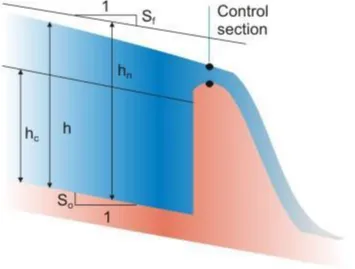
the dam is known. Similarly, in Figure 19b, since the water is flowing down from the reservoir into the steep channel critical depth corresponding to the given discharge would exist at the control section. Here two, the water level at the control section is then known.
Starting at the control section (i =1), the total energy of water is found out to be
H1= Z +h +α
V 2 (35) 1 1 1 2g
Next, consider the first reach, that is, between sections i =1 and i =2. A depth of
flow is assumed at section 2 and the energy there, that is,
H2 = Z2 +h2 +α
V 2
(36)
2 2g
____
is evaluated. Now, one of the equations for finding S f (the average friction
slope) in the reach is found out by, say equation 31.
As may be observed from Figure 18 the numerical value of H2 found from
equation (33) should be equal to that of h1 found from equation (33) + S f. If the
depth at the section 2 has been correctly assumed if the two don’t match, a new
depth h2 is assumed and the calculations are repeated till the two values match.
Once a correct depth is found at section 2, a similar procedure is used to find the depth at section 3, and so on.
These are the two other methods to find out water surface profiles of gradually varied flow situations, namely; method of direct integration and method of graphical integration. Interested reader may refer to standard textbooks on
Hydraulics of open channel flow, like the following for details about these methods.
1. Ranga Raju (2003) 2. Subramanya (2002)
2.8.8 Gradually varied flow profiles
analysis of water surface profile may be done by studying the governing equation, which can be derived from the sketch in Figure 20.
The total energy H at a channel section is given as
H = Z +h +α
V 2
(37)
2g
Where
• H: Elevation of energy line above the datum
• Z: Elevation of channel bottom above datum
• h: Flow depth
• V: Mean flow velocity
• α:Velocity head coefficient
Considering x as the space coordinate, taken positive in the direction of flow one
obtains by differentiating both sides of the equation (36) with respect to x and
dH
=dZ +dh+α Q
2
d 1
(38)
dx dx dx 2g dx A2
Again, we know by definition:
dH
= - Sf (39)
dx
And dZ = - So (40)
dx
In which
• Sf: Slope of the energy grade line
• So: Slope of the channel bottom.
The negative sign of Sf and So indicates that both H and Z decrease as x
increases. In equation (37) an expression for the derivative of A-2 may be found
out as follows:
d 1
= d 1 dA
dx
dx A2 dA A2
d 1 dA dh =
dA A2 dh dx
= −
2
A
B
3dh
dx
Since
dA
dh
=B(41)
(42)
(43)
By substituting equations (39), (40) and (43) into equation (38), and rearranging the resulting equation one obtains
dh
= S0 − Sf (44)
dx 1 − (αB Q2 ) / gA3
If the channel is not prismatic, then the cross sectional area A changes with distance, and may be expressed as:
dA
=∂A +∂A dh (45)
dx ∂x ∂y dx
We may express equation (43), which describes the variation of h with x, in
terms of the Froude Number (Fr) if we note the following:
α B Q2
=
(
Q/ A)
2
=Fr 2 (46)
g A3 (g A) / (αB)
Hence, equation (39) may be written as
dh
=S0 − Sf (47)
dx 1 −Fr2
Equation (47) can give a general idea about the nature of the curve if one knows
the relative inclinations of the channel bed slope and friction slope (Sf) and the
Froude Number (Fr). This may be done by observing the water flow depth (h)
with respect to normal depth (hn) and critical depth (hc) for a given discharge,
the following figures show the relative changes of hn and hc as channel bed
slope is increased gradually from horizontal. It may be observed that the for a
given discharge hc does not change but hn goes on decreasing starting from an
In water resources projects, one generally encounters slopes of channels that are either of the following:
• Mild, where hn >hc (Figure 22)
• Steep, where hn<hc (Figure 24)
• Critical, where hn = hc (Figure 23)
• Flat, where hn= ∞ (Figure 21)
• Adverse, where the slope is reversed (Figure 25)
For each of these slopes, the actual water surface would vary depending upon a control that exist either at the upstream or downstream end of the channel. Some examples of controls are given below
• Weir or spillway (Figures 26 and 27)
• Gate (Figure 28)
Apart from the above a normal depth may be assumed to exist within a very long channel, for which the conditions at the far end may be neglected (Figure 30).
of equation (42) and a known control section in determining flow profiles where for a mildly slope channel. Similar profiles may be qualitatively sketched for other channels too.
2.8.9 Downstream control raising the water level above
normal depth
This situation is common for spillways of large dams. The flow profile in a mildly
sloped channels where h > hn > hc as shown in Figure 31 is known as the M1
curve. Now, for uniform flow, Sf =S= So when h = hn. Hence it is clear from
Mannings formula (equation 11), that for a given discharge, Q,
Sf < Soif h > hn
Thus, in equation (47) i.e.,
S0 − Sf
dh
= (47)
The numerator is positive Fr<1 since h>hc. Therefore, the denominator of
equation (47) is positive as well. Hence, it follows from this eqn that
dh
dx
=S
1
0−
−
Fr
S
2f =+
+
=+This means that h increases with distance x.
Comparing with Figure 29 it may be inferred that quite some distance upstream
of the spillway the flow depth nearly equals normal depth. And, since dh/dx for
2.8.10 Downstream controlled raising water level above
critical depth but below normal depth
The flow profile in a mildly sloping channel where hn>h>hc, has been shown in
Figure 33 is known as the M2 curve. In this case Sf>So since h<hn (from
Mannings formula). Thus the numerator in equation (46) is negative. However,
the denominator is positive, since Fr<1 because h>hc hence it follows from
equation 46 that
dh
dx
=S
1
0−
−
Fr
S
2f =−
−
=−Thus h decreases as x increases for upstream of this spillway control section the
2.8.11 Upstream control causing water depth to be less than
both normal and critical depths
This situation is shown in Figure 34 for flow taking place below a sluice gate. The reader is advised to check the trend of water surface profile using equation (47) in this case.
2.8.12 Important terms, definitions and procedures
This lesson has used certain terms, which are discussed to some detail here.
Newton’s Method
This method is useful in finding a simple root of the function f(x) = 0, when the derivative of f(x) is easily obtainable. The iteration formula used in the method
can be derived by the Taylor’s series expansion of f(x) about x=x0 , the
f (x0 +h) = f(x0 ) +h f'(x0 ) +h 2
f ''(x0)+...
2!
Where h is the small correction to the root.
Now if h is relatively small, we may neglect terms containing n2 and higher powers of h. Then, we get
f (x0)+h f '(x0)= 0
This gives h =−
f
(
x
0)
f '(x0 )Thus, we can take the improved value of the root as
x1=x0 − f (x0)
f '(x0)
The Newton-Raphson iteration can thus be written as
xn+1= xn−
f (xn)
, n=0,1,2,...
f '(xn)
The sequence { xn }, if it converges, gives the root.
Froude Number
This measures the ratio of inertia to gravity forces. In problems where there is an interface between two immiscible fluids the gravity forces are of importance. Froude number is defined by the relation
Fr =
V
g D
Normal depth
For given values of channel roughness n, discharge Q, and the channel slope S,
there is only one depth possible at which uniform flow occurs. It is known as normal depth.
Critical depth
V 2
The depth of flow at which the specific energy E =y+ att ains a mini mum
2 g