Http://www.ijetmr.com©International Journal of Engineering Technologies and Management Research [63]
THE INVOLVEMENT OF MANAGERS IN THE CONTROL SYSTEM
FOR SMALL COMPANIES
ANDRIAMASIMANANA ORIGENE HarizoFinoana *1, ANDRIAMASIMANANA
ORIGENE Olivier 2
*1 Finances and Corporate governance, Antananarivo University, Madagascar 2 Management sciences, Antananarivo University, Madagascar
Abstract:
The manager plays a very important role in the management of a sma7ll company. The empirical analysis conducted for this article, using a hypothetical-deductive approach, demonstrated, once again, this situation. The hypothesis at the very beginning of this article that the manager's involvement in the control system varies according to the size of the VSE or SME has been verified according to a statistical study. For a very small company, the manager's intervention in the control system is done in an interpersonal way and covers all the management cycles of a company. When the size increases its intervention varies in the opposite direction. Thus, the manager acts as a one man show for a very small business and as an invigilator for an SME. The question of training, in this case, becomes an essential element for the effectiveness of the control system.
Keywords: Management; Control; VSE; SME; Manager.
Cite This Article: ANDRIAMASIMANANA ORIGENE HarizoFinoana, and
ANDRIAMASIMANANA ORIGENE Olivier (2019). “THE INVOLVEMENT OF MANAGERS
IN THE CONTROL SYSTEM FOR SMALL COMPANIES.” International Journal of
Engineering Technologies and Management Research, 6(6), 63-73. DOI:
https://doi.org/10.29121/ijetmr.v6.i6.2019.394.
1. Introduction
Today, small businesses play a very important role in the economic development of a country. These types of companies are generally managed in an archaic way due to a lack of sufficient resources and knowledge in management sciences so that their performance is sometimes compromised. Nevertheless, some of them have strong market potential both inside and outside the country and the profile of the leader plays an essential role in this respect. Among the various systems existing within an SME, the control system is the one most handicapped by the problems mentioned above. For this reason, it was decided to deal with the theme “The involvement of managers in the control system for small companies”.
Http://www.ijetmr.com©International Journal of Engineering Technologies and Management Research [64] the relationship between the size of the company and the involvement of the manager in the control system in VSEs and SMEs. The problem is therefore to know what are the particularities of small companies in terms of control? The objective is to trace the behavioural model of the small-scale entrepreneur in this area. A hypothetical deductive approach has been taken in this direction and the hypothesis is as follows: the smaller the size of the company, the greater the involvement of the manager in control.
Several authors of the theory of organizations have been interested in studying the behaviour of the manager or manager of a company because of the major role he or she played in traditional firms. In the 21st century, three figures referred to the entrepreneur: the entrepreneur, the administrator and the manager (A. Hatchuel& B. Segrestin, 2016). According to the reference authors, the patron-entrepreneur was the most common concept. Heir to the merchant and the master craftsman, he drew his power from the mastery of a trade. So he is not an academician; he is rather the "self-made man". The administrator's mission was to be concerned with the public good and the general interest. In carrying out this task, he had to be honest, honest and fair (Guerard de rouilly, 1815). Finally, the last figure is that of the manager developed with the appearance of the public limited company. He or she does not necessarily own the company and, if so, is accountable to shareholders.
On the other hand, other authors provide ample details on the personality of the manager of VSEs and SMEs that constitute small Malagasy companies. For BRUYAT (1993), the company is the entrepreneur's thing, he determines the size of the production and the way it is carried out. In most cases, the entrepreneur is the owner of the company and as such, he is looking for more income than profit, these incomes present an uncertainty at all times, beyond the daily efforts involved in the company (DEEKS, 1973). According to DEEKS (1973) or KOKOU DOKOU (2006), the leader of TPE comes above all from a technical culture from which he will benefit by creating a company, which reflects a certain social mobility and a status, a legitimacy inaccessible otherwise. The company becomes dependent on the entrepreneur in the sense of MAHE de BOISLANDELLE (1996), it is one of the components of this power.
FOLIARD (2010) focuses instead on the role of the small business owner. According to him, the entrepreneur is an essential element of decision-making that depends on several parameters. Good management is then based on good control, which depends on the typical behaviour of managers in small companies. These behaviours are intended to help the company achieve its objectives, and therefore the sustainability of its activities.
Http://www.ijetmr.com©International Journal of Engineering Technologies and Management Research [65] Control is often presented as a mechanism to support rational decision-making and an answer to the question: "what information should managers be given to make the "best" decisions? "i.e., the decisions that best correspond to the implementation of the strategy and the achievement of organizational objectives (SIMONS, 1947). On the other hand, it is considered to be the action taken to direct individual behaviours towards achieving the organization's objectives (OUCHI, 1979). Control affects all the functions of the company and the profile of the manager and the size of the company are decisive and the research has focused on these points.
It should also be noted that the assessment of the size of the company is generally carried out on the basis of two main quantitative variables, in particular the number of employees and turnover or the balance sheet total, but other authors such as FOLIARD (2010) and MINTZBERG (1982) introduce other rather qualitative variables to delimit SMEs and VSEs? The classification of companies by size differs from one country to another. In France, for example, microenterprises have fewer than 11 people in terms of number of employees.
SMEs differ from large companies in their small size. The most well-known typologies are based on quantitative methods that refer to quantitative data on jobs (number of employees and employees), assets or turnover. Small businesses are characterized by low task specialization. Specialization is generally accompanied by an increase in size as the firm grows, organizational levels increase and work becomes more specialized the control system goes hand in hand with this statement. JULIEN and MARCHESNAY (1988) then proposed a distinction between three categories: very small enterprises (VSEs) with between one and nine employees, small enterprises with between ten and forty-nine employees and medium-sized enterprises with between fifty and one hundred and ninety-nine employees. As a result, small businesses are considered to be small.
According to JULIEN (1997): We are beginning to distinguish between medium-sized companies that often operate close to large companies, small companies and, obviously, very small ones. Some medium-sized companies may then have to behave like smaller structures and be part of the very small companies. By carrying out comparative studies with other countries (Haiti, Cote d'Ivoire, Morocco, etc.), it is finally accepted that below a workforce of 101 employees, a company is qualified as a small size. In short, the study population includes VSEs (less than 10 employees) and SMEs employing between 10 and 51 employees, and those employing between 50 and 101 employees. Thus, the literature review on the theme is presented in this article, followed by the methodology of the approach, the results of the study and at the end by the discussions.
2. Materials and Methods
The purpose of this research is to show that size is a variable that influences the way in which the manager exercises control over his or her company. To do this, a survey of 25 Malagasy companies meeting the "small size" criterion, including 8 VSEs and 17 SMEs, was conducted. A variable parameterized in advance has been assigned to the above hypothesis in order to allow statistical tests, in particular that of Chi-square and to invalidate or confirm it. To do this, we had to go through certain stages before our descent into the field.
Http://www.ijetmr.com©International Journal of Engineering Technologies and Management Research [66] Small businesses" are therefore our statistical population. They include very small businesses that employ between 1 and 10 employees and SMEs with fewer than 100 employees. The only "effective" variable was chosen because some companies are reluctant to publish quantitative data on them. Within the time available and the research budget available, we were only able to conduct the survey on 25 companies. As the survey was anonymous, a detailed description of the respondents was not possible.
Most of the respondents are all located in the capital (Antananarivo) and the outskirts. They work in different sectors of activity existing in Madagascar. A brief description of all these companies is provided below where they are referred to as company number "n".
Http://www.ijetmr.com©International Journal of Engineering Technologies and Management Research [67] With regard to the sampling method, the stratification that consists in dividing the population into subgroups called "strata" was chosen. It improves the accuracy of estimates and reduces costs. The stratum survey is carried out more efficiently and the grouping of partial results makes it possible to obtain results close to those that would be obtained if the survey were carried out on all Malagasy companies with a workforce of 100 or fewer employees.
Once the survey population had been identified, the survey questionnaire was developed. It includes a total of 130 questions divided into 4 main parts. The first concerns general information about the company (the age of the company, the company name, the number of shareholders, the main activity, etc.). The other three parts include questions on prior controls, ongoing controls and post-controls. The next step was the administration of the survey questionnaire, which was probably the longest and most complex. Indeed, many of the companies pre-selected in the sample were not willing to give us time to complete the six pages of the questionnaire. This has profoundly changed the structure of our sample. Nevertheless, we have tried to fill the gaps by trying to find companies with similar activities to theirs. It took us about a month to complete our survey. This is the time allowed in the planning.
The study itself ended with an empirical analysis that confirmed or invalidated the initial hypothesis. The Pearson independence test or the "chi-square test" or the "χ²" test, which is used to assess the existence of a relationship between two qualitative variables or a qualitative variable and a quantitative variable, was applied. It is appropriate to our study and corresponds to the objectives of our research to prove whether the size of a company measured on the basis of its "T" workforce could influence the manager's behaviour towards "G" control.
The test was carried out in three stages. First, it was necessary to construct the actual establishment plan based on the analysis of the questionnaire. To do this, 10 multiple-choice questions where the "manager/leader" was a suggestion (checkbox) were chosen. Table 1 shows the number of companies that answered positively to each question. A cross tabulation could be established at the beginning of the analysis and then the theoretical numbers and Chi² were calculated. It was then necessary to carry out the comparison between the theoretical Chi² and the Chi² of the distribution table (by choosing a degree of freedom ddl and a risk α). The dependence between "T" and "G" exists if the chi² of the table is greater than the theoretical chi² and in this case, the starting hypothesis is confirmed, namely the degree of correlation between the two variables.
Http://www.ijetmr.com©International Journal of Engineering Technologies and Management Research [68]
3. Results and Discussions
This section first brings together the results of empirical research and the ensuing debates. Since our objective is to try to demonstrate using Pearson's independence test that the size of a company influences the control behaviour of the Leader, the preliminary counts were first conducted and the results were presented in the following Table 2, which outlines the positive responses of respondents to each question. We remind you that each question constitutes a control task in the company and the answer is validated only ticked the manager/leader box.
Table 1: Preliminary count
Variable "G" Size "T" x² calculated
Questions 1;10] (total
of 8 companies)
11;50] (total of 11 companies)
51;100] (total of 6 companies)
Who is placing the order? 5 8 0
Allocation of purchases 5 2 0
Payment of the supplier 6 3 1
Receipt of goods 3 0 2
Person in charge of sales 6 6 0
Sales allocation 5 6 0
Collection of revenue 7 6 0
Author of the treasury audit 6 10 1
Recruitment 8 10 1
Quality of information 6 9 1
Average 5,70 6,00 0,6
Estimate in % (in relation to the total number of companies surveyed)
71,25 54,55 10
8,14 Source: the author
Looking at the table, it can be said that the intervention of the manager/manager is quite marked in very small companies. Indeed, the corresponding positive response rate is quite high, estimated at around 71.25%. However, when the number of employees increases, this number gradually decreases (from 54.55% to 10% for the SME category). But does this mean that size influences the manager's behaviour in his role as controller? This assumption has been verified through the following cross-referenced analysis table 3 which attempts to frame the manager's intervention frequencies for each control task and for each tranche.
Table 2: Actual number of employees "nij". Observed staffing table
Intervention of the manager "G" Size of companies
"T" companies
Major intervention non-significant intervention
column totals (Cj)
[1 ;10] 6 2 8
Http://www.ijetmr.com©International Journal of Engineering Technologies and Management Research [69]
[51,100] 0 6 6
Line Totals (Li) 10 15 25
Source: the author
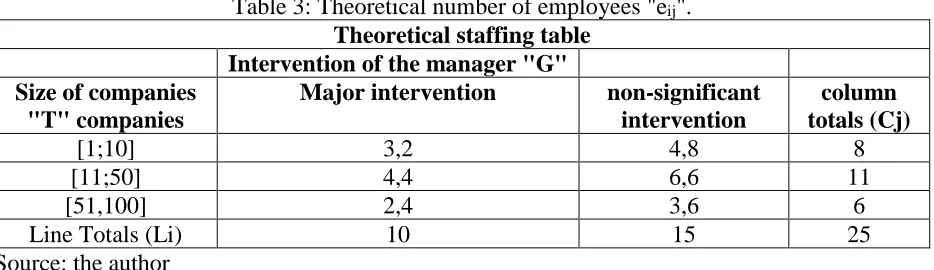
This statistical distribution makes it possible to assess the general trend, which is the same as in the previous Table 2. The theoretical numbers were subsequently calculated; the results are shown in Table 3 below.
Table 3: Theoretical number of employees "eij". Theoretical staffing table
Intervention of the manager "G" Size of companies
"T" companies
Major intervention non-significant intervention
column totals (Cj)
[1;10] 3,2 4,8 8
[11;50] 4,4 6,6 11
[51,100] 2,4 3,6 6
Line Totals (Li) 10 15 25
Source: the author
The theoretical headcount was obtained by multiplying the line total by the column total; all divided by the headcount "n". The calculation was programmed on an Excel spreadsheet. Then, from the two previous tables, the "x²" was calculated through Table 5 below.
Table 4: Calculation of the "x²".
Value nij eij nij - eij (nij - eij)² (nij - eij)²/eij
1 6 3,2 2,8 7,84 2,45
2 4 4,4 -0,4 0,16 0,036363636
3 0 2,4 -2,4 5,76 2,4
4 2 4,8 -2,8 7,84 1,633333333
5 7 6,6 0,4 0,16 0,024242424
6 6 3,6 2,4 5,76 1,6
Calculated χ² value 8,143939394
Source: the author
With a risk α= 5% and a ddl=2, the Chi² value was searched in the Chi-square distribution table. We have χ²= 5.99 (value provided by the distribution table of Chi-square law). Sinceχ² is lower than the calculatedχ², the variables are thus dependent, the variation of T influences G and vice versa. Finally, the V Cramer test was performed to determine the intensity of the relationship between the study variables. After calculation, V= 0.56, the intensity of the relationship is therefore average. The closer its value is to 1, the stronger the relationship between the two variables.
Http://www.ijetmr.com©International Journal of Engineering Technologies and Management Research [70] control system already in place. For example, he himself places orders (for goods or services) with suppliers to ensure that they are all brought to his attention and do not escape his vigilance to avoid the related risks. However, when the size increases, he organizes himself and delegates the same role to a manager or a specialized department and the manager who owns the company becomes less and less involved in the daily control tasks.
For SMEs with less than 51 employees, some managers still act as "One man show" the multi-tasking man but others are beginning to organise themselves and delegate their control responsibilities to other agents. However, above the above-mentioned threshold, the manager's intervention rate is very low and stabilises at 10% in terms of control. This type of manager is the "invigilator" the supervising man, because at this stage, he no longer intervenes directly in the affairs of his company. In this case, control mechanisms (internal or external) are put in place to prevent risks.
According to the Chi-square test, commonly represented by the symbol "x²", the place of the manager in the control system, taking into account the size of the company, is highlighted. In almost all VSEs and some SMEs, control at all levels is carried out by the manager in an intense way in all cycles (purchases, stocks, sales, cash flow, recruitment, etc.) existing within a small company.
In general, men who are part of the staff of a VSE do not have sufficient knowledge to control. When the questionnaire was being analysed, the respondents (where applicable, it was an VSE) did not enter anything in the "number of senior executives" box. And even if they did, the figures speak for themselves; these companies have no more than 2 senior managers.
The contractor performs several tasks at once: he is responsible for placing orders, accounting, cash and inventory management... The small number of employees and the cost issue also pushes him to do so.
However, this situation has certain advantages because it allows the manager to exercise self-control at all levels: relationships/suppliers, relationships/customers, accounting self-controls, cash flow control and close inventory control.The causes of these behavioural patterns can be categorized in two ways. On the one hand, there are the voluntary causes related to the personality of the leader himself. And on the other hand, there are unintentional causes that depend on certain external elements in relation to the personality of the leader.
The desired causes can be numerous. Two main factors are at the root of this behaviour: the manager's lack of trust in his employees and the desire to do things by himself. The business owner may be suspicious because employees can, for example, falsify accounts, collect revenues illegally or hide goods in stock... For all these reasons, he has little choice, he has to do things by himself. Moreover, this is confirmed by a common adage that says: "one is never well served except by oneself".
Http://www.ijetmr.com©International Journal of Engineering Technologies and Management Research [71] of entrepreneurs. This behaviour is quite understandable in the sense that if the company encounters any problem, it will be the first to be responsible but also the first victim.
The manager can only rely on himself this time to run his business properly for reasons that do not depend on his personality. Indeed, faced with the lack of knowledge and experience (involuntary cause) of his close collaborators, he is obliged to act as a "one-man show", especially during the start-up period of the company's activities, it is his responsibility to train his employees and follow in detail all the company's management cycles. This obligation also allows him to better understand how his business operates and the potential problems that arise, which he was unable to anticipate in advance, especially since the problems are interrelated.
The notion of cost is also an essential element that is one of the unintended causes that explain the control behaviour of managers in VSEs. Indeed, it avoids, at first, any form of external collaboration (specialized firm, external service provider...) in terms of control for several reasons including the question of costs. For the same reason, the VSE may also encounter a lack of staff and/or poor management, in which case, it is the manager himself who will carry out the various elementary tasks that are still outstanding, which logically leads him to adopt the "one-man show" behaviour.
According to FOLIARD (2010): Thresholds below four, five or eight employees correspond to the assumed limit of interpersonal business management, which is also referred to as "direct supervision" by STEINMETZ (1969). When the number of employees exceeds 10, the company manager can start organizing the work in such a way as to limit his intervention. It will be difficult for the manager to manage his business directly from this threshold. Beforehand, he must set up a control system to be able to both trace the attributions of each individual working on behalf of his company and control the details of the evolution of the activities as a whole.
When the size of the entity exceeds the 50 employee threshold, the manager no longer intervenes in a significant and systematic way. His involvement is reduced because of the volume of work that is growing logically and the complexity of it. Indeed, the company manager no longer has much time to devote to step-by-step control. It is obliged to delegate its powers and put in place certain control mechanisms to replace it. Especially since the company has, because of its size, a little more resources at its disposal to hire other individuals if necessary to fill the lack of knowledge and time previously noted. It can also call on the services of consulting and expertise firms to set up formal monitoring and control procedures adapted to its company.
At this stage, control is still one of its major concerns. But this time, he will act as a supervisor. This behaviour is similar to that of the "invigilator", the leader will no longer perform several tasks at once "multitasking" and will act as a "supervisor". On the other hand, in the range between 10 and 50, many companies are still managed in an interpersonal way (5/11 companies). But when the company's activity is too important, it is obliged to give up its power of control to someone else. If this is not done, the control system will be handicapped and the company will suffer the consequences.
Http://www.ijetmr.com©International Journal of Engineering Technologies and Management Research [72] optimize and control your activities. Indeed, as a "one-man show", all the risks and responsibilities fall to him. This recommendation is necessary because of the versatility required by the profile of a boss of a very small company. For cost reasons, the Manager can only rely on himself to ensure the proper management of his company. The more the manager is instructed, the more effective the control system will be. The question of training is therefore fundamental for managers, even if it will entail costs.
But training cannot be standardized, it depends on the profile of the manager and the sector of activity he operates. The curriculae approach, in this case, seems to be the most appropriate and very practical as it considers the variables listed earlier.
In addition, the manager should assume the role of trainer and instructor within a VSE, hence the importance for him to be trained in advance so that he can properly assume, in turn, the roles mentioned earlier. Indeed, since the number of staff is limited in VSEs, employees should be versatile. The temporary or permanent replacement of a person (resignation, leave, etc.) should be provided in advance in order to avoid blockages that would cause considerable losses to the company.
4. Conclusions and Recommendations
In the context of this article, it was highlighted that the SME control system varies according to several parameters, in particular the size of the company. The empirical study carried out on the case of 25 Malagasy VSEs and SMEs showed that there is a correlation between the size of a small company and the involvement of the manager in the control system. The larger the size of a company, the less the manager is involved in the control system. The initial hypothesis is therefore validated.
As the size increases, the Manager will no longer be able to manage the company in an interpersonal way. When the company has no more than 10 employees, the manager tends to carry out all controls at all levels in an invisible and informal manner. On the other hand, when the threshold of 10 employees is crossed, companies start to be better organized and the degree of involvement of the manager in the control system decreases. When the company reaches a high size (more than 50 employees) the control system is highly developed. In this case, the “one-man show” becomes the “invigilator”. At this stage, control procedures become more or less formalized and "supervision" alone is the main task of the company manager. At this level, the latter plays the role of “conductor” if in the first two cases, the entrepreneur was “a full-fledged musician”.
According to this study, the size of a company is therefore decisive for understanding the control behavior of an SME manager and training is one of the main solutions that could be suggested to improve the ability of these individuals to control and manage their company as effectively as possible.
Http://www.ijetmr.com©International Journal of Engineering Technologies and Management Research [73] References
[1] CHALLAGALLA G.N. et SHERVANI, T.N.” Dimensions and types of supervisory control: effects on salesperson performance and satisfaction”, Journal of Marketing, vol. 60, 105 pages. [2] CARVALHO DA SILVA Rosimeri, "les nouveaux mécanismes du contrôle organisationnel",
Cad.EBAPE.BR, Rio de Janeiro, 2003, 40 pages.
[3] FOLIARD Stéphane, "la gestion classique des TPE, entre territorialité et fidélité", 2010, Bordeaux, 18 pages.
[4] TORRES Olivier, Les "Petites et moyennes entreprises", Edition "Dominos", Québec, 2008, 51 pages.
[5] Guerard de Rouilly,A. (Baron), General Principles of Administration, Favre Paris 1815.
[6] Fells, M. J. 2000. Fayol stands the test of time. Journal of Management History, 6(2000): 345-360. [7] Hatchuel A., 2011, "Aux origines de la Gestion scientifique" in "Saussois J.M., "Les organisations"
Sciences Humaines 2011.
[8] Mintzberg, H. 1975. The manager's job: folklore and fact. Harvard Business Review, 53(July-August 1975): 49-61.
[9] Silverman Michael, “Managers as developers of others”, IES Research Networks, United Kingdom, 2004, 13 pages.
[10] Senge P, “The fifth discipline: the art and practice of learning organization”, Currency doubleday, New York, 1990, ISBN 0-385-26095-4, 414 pages
[11] Cohen, Y. 2003. Fayol, a teacher in the industrial order. Enterprises and History, 34(3): 29-67. [12] Chevenard, P. 1933. The installation and organization of a modern steel laboratory. Mémoires de
la société des ingénieurs civils de France, septembre- octobre : 3-52.
[13] Tamkin P, Hirsh W, Tyers C (2003), Chore to Champions: The Making of Better People Managers, IES Report 389.
[14] Abey C, Thomson A (2000), Achieving Management Excellence: A Survey of UK Management Development at the Millennium, the Institute of Management.
[15] Bianco-Mathis V, Nabors L, Roman C (2002), Leading from the Inside Out: A Coaching Model, Sage.
*Corresponding author.