ORIGINAL RESEARCH PAPER R
Magnetic Properties and Structural Study of Ni-Co/Cu Multilayers Prepared
by Electrodeposition Method
M. Jafari Fesharakia*, S. Manouchehrib, Z. Sadeghib, M. H. Yousefib, R. Jalajerdic
a
Department of Physics, Payame Noor University, P. O. Box 19395-3697, Tehran, Iran b
Department of Nano Physics, Malekashtar University of Technology, Shahinshahr, Esfahan, Iran c
Young Researchers and Elite Club, Arak Branch, Islamic Azad University, Arak, Iran
Abstract
Ni-Co/Cu multilayers have been grown by electrodeposition method from a single electrolyte (based on Ni(SO4).6H2O, Co(SO4).7H2O, Cu(SO4) and H3BO3) using galvanostatic control on titanium sublayers. The X-ray diffraction (XRD) patterns confirmed the multilayered structure with the nanometer thicknesses. Also, electron diffraction x-ray (EDX) analysis confirmed the purity of deposited samples. The morphology of the samples was estimated by scanning electron microscope (SEM). Magnetoresistance (MR) measurements were carried out at room temperature for the Ni-Co/Cu multilayers by measuring the resistivity in a magnetic fields varying between ±6kOe as a function of the Ni-Co and Cu layer thicknesses; (1 dCu(nm) 4 and 3 dNi-Cu(nm) 5). The Maximum value of giant magnetoresistance (GMR) was obtained when the Ni-Co and Cu thicknesses were 4.0nm and 4.0nm respectively. The hysteresis loop of the samples at room temperature was studied using an alternating gradient force magnetometer (AGFM). Finally, the temperature dependence of magnetization for Ni-Co/Cu multilayers; (dNi-Cu(4nm)/dCu(2nm) and dNi-Cu(3nm)/dCu(3nm)) measured by Faraday balance and decreasing the magnetization with increasing the temperature discussed according to electronscattering due to spin fluctuation.
Article history:
Received 27/07/2015 Accepted 08/08/2015 Published online 01/09/2015
Keywords:
Electrodeposition Magnetic properties Ni-Co/Cu multilayers Structural study
*Corresponding author: E-mail address:
[email protected] Phone: +98 9132197440 Fax: +98 3152238784
1.
INTRODUCTION
In the recent years, nanostructured materials such as thin multilayered structures have been
bulk materials. The primary interest is in magnetoresistance properties (GMR) effect [1], with the secondary goal of improving the deposit morphology and roughness of the surface. Many metallic multilayers have been produced using vacuum techniques (sputtering, MBE, evaporation) [2]. Although these techniques allow high-quality structures to be obtained, they are complex and expensive. Recent investigation showed that electrodeposition has long been shown to be a valuable technique for obtaining metallic multilayers since it offers a simple, flexible and cheap process for their fabrication [3]. In spite of some limitations (like conducting substrates, not all metals can be deposited using aqueous baths) the electrochemical methods has been successfully used for preparation of many multilayer superlattice systems. Electrodeposited (ED) magnetic/non-magnetic multilayers with GMR can be conveniently obtained with the help of two-pulse plating from a single bath where the deposition potential or current density is varied rapidly. Various two-pulse combinations (G/G, P/P and G/P) have been applied for producing ED multilayers with GMR where G and P denotes galvanostatic and potentiostatic control, respectively, and the combination A/B refers to the sequence magnetic layer/non-magnetic layer. Whereas the ED process can be controlled to produce a pure non-magnetic layer by the single-bath technique, the magnetic layer in ED multilayers contains typically a few atomic percent of the non-magnetic element.
Several papers described the observation of GMR in the electrodeposited Ni-Co/Cu systems [4]. In this paper, we report the results of magnetoresistance characterization of Ni-Co/Cu multilayers (paying attention to variation of
nonmagnetic and magnetic layer thickness) and structural studies of multilayers.
2.
Experimental section
Multilayered Ni-Co/Cu deposits were produced from a single bath containing the following components: NiSO4.6H2O (604.63g/l),
CoSO4.7H2O (114.48g/l), CuSO4 (8.8g/l) and
H3BO3 (30g/l). The electrolyte was not stirred
during deposition and its temperature was kept constant at 34±1°C. The electrolyte pH was adjusted to 2.5 by adding H2SO4 to the solution.
The choice of this pH value was based on some literatures reporting to get appropriate deposition conditions [5]. All electrochemical experiments and the deposition processes were carried out in a standard three electrode. The working electrode was either Cu sheet or titanium layer, the counter electrode was a Pt ribbon and KCl as a reference electrode.
A series of multilayer was prepared. The number of bilayers was chosen to give the total thickness of about 0.5μm for each multilayer sample.
The multilayered samples were produced under potentiostatic control by using a SAMA500 potentiostat device, which also served as a power source for both direct-current (D.C.) deposition and pulse-plating experiments. The structure of the multilayered samples were studied using an X-ray diffractometer (X,Pert Pro MDP) with CuK
radiation (Cu =1.54056 ºA). The elemental
analysis of themultilayers was performedusing an electron diffraction X-ray (EDX). The morphology of the multilayered samples was shown by a scanning electron microscope (SEM).
probe in the multilayer film plane. The MR ratio was defined as [6]
H R (R R )
R R
(1)
Where R R(H) in the absence of magnetic
field, while RH R(H) is the resistance in the
presence of magnetic field H. Both the longitudinal (LMR) and transverse magnetoresistance (TMR) were measured using a magnetic field parallel and perpendicular to the current flow direction respectively. The hysteresis (M-H) loops and Curie temperature of the samples were measured by an alternating gradient force magnetometer (AGFM) and Faraday balance equipped with a permanent magnet (0.02 T) and, respectively.
3.
Results and discussion
3.1. Structural study
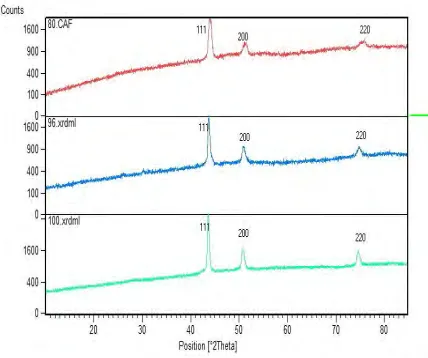
The XRD patterns measured in the vicinity of the 111, 200 and 220 peaks are shown in Fig.1 for the Ni-Cu(3nm)/Cu(1nm), Ni-Cu(3nm)/Cu(2nm) and Ni-Cu(3nm)/Cu(3nm) multilayers. The diffraction patterns confirmed all samples are single phase and the cubic structure is formed in all samples.
Fig. 1. XRD patterns of the Cu(3nm)/Cu(1nm), Ni-Cu(3nm)/Cu(2nm) and Ni-Cu(3nm)/Cu(3nm) multilayers
Local composition analysis was carried out by EDX for Ni-Cu (3nm)/Cu(2nm) multilayer. The center of the broad peaks is in a good agreement with the composition of the deposits as measured by the EDX. As the EDX spectra shown in Fig.2, indicate the intensity ratio of the Ni, Co and Cu. There is not any unknown peaks.
Fig. 2. EDX analysis of Ni-Co (3nm)/Cu(2nm) multilayer.
If a multilayer has superlattice structure i.e., if the bilayers are well defined and periodic, two kinds of peak will appear in their X-ray diffraction patterns. Firstly, the main Bragg peak corresponds to the periodicity of the atomic planes and gives their spacing. Secondly, the satellite peaks appearing around the main peak correspond to the periodicity of the superlattice structure and give the modulation wavelength. The positions of the satellite peaks have been calculated using different models [7].
d = /(sini+1 - sini-1) (3)
where is the wavelength of the X-ray beams, i is the position of the main diffraction peak, i-1 and
i+1 are the angles at which the satellite peaks are observed and d is the modulation wavelength. XRD pattern of electrodeposited Ni-Cu(3nm)/Cu(1nm) multilayer is given in Fig. 3.
40 42 44 46 48 50 52 54
0 100 200 300 400 500 600
a)
?
Position (°2Theta)
C
o
u
n
ts
(1 1 1) peak
satellites
Fig. 3. XRD pattern of the Ni-Co(3nm)/Cu(1nm) .
Two superlattice reflection peaks appear around the (111) Bragg peak of the XRD pattern. A reasonable good agreement is found between the bilayer nominal and real (measured) thicknesses. The positions of the superlattice satellites give a superlattice period of dXRD=4.7nm, which has to be
compared with the nominal thickness of dnom=4nm.
The difference between nominal and measured thickness in the electrodeposited films can be attributed to the hydrogen evolution during the metal reduction [7].
3.2. Magnetization study
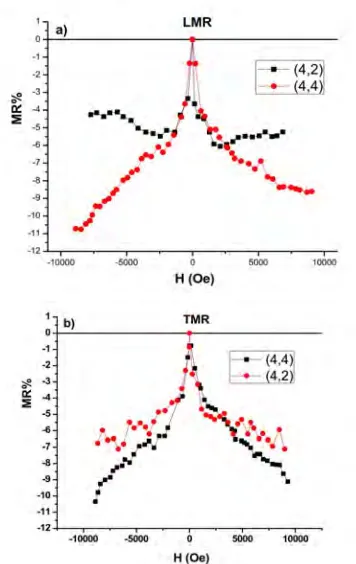
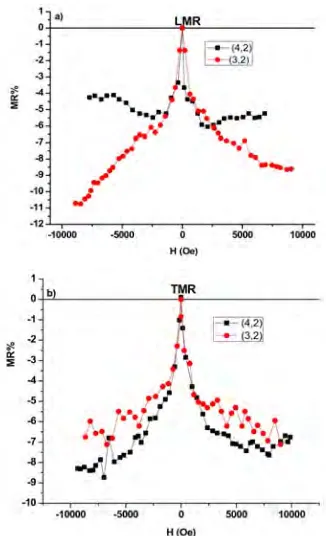
Fig. 4 and 5 show the MR(H) (LMR and TMR) curves of Ni-Co/Cu multilayers for different magnetic and nonmagnetic layer thicknesses. As shown in Fig. 4 and 5, the magnetoresistance curves shows a clear GMR effect since in the whole range of magnetic fields, both the LMR
and TMR are negative (LMR<0, TMR<0) [8]. This is because the bulk contribution to the magnetoresistance due to electron scattering events entirely within the magnetic layer diminishes with decreasing Ni-Co layer thickness and the GMR effect due to the nanoscale magnetic/nonmagnetic multilayer structure becomes dominate [9]. The Fig. 4 and 5, also indicate that the LMR and TMR curves are practically the same and there is not much difference in the curves, the same behavior as reported for Ni-Co/Cu multilayer [10]. The field dependence of the isotropic MR contribution is calculated from the following formula [4]:
MR(H)=(1/3)LMR (H)+(2/3)TMR(H) (2) The LMR and TMR values increase up to 8.4%, 8.61% and consequently the magnitude of the maximum GMR in our Ni-Co/Cu multilayers increases up to 8.54% as demonstrated in Fig. 4 and 5, relate to Ni-Cu(4nm)/Cu(4nm).
Fig. 5. LMR and TMR curves of Ni-Co/Cu multilayers in different Ni-Co layer thicknesses.
In order to investigate the magnetic properties of Ni-Co/Cu multilayers in a accurate manner, the variation of magnetization as a function of applied magnetic field at room temperature is studied using a AGFM magnetometer. The result is presented in Fig. 6.
Fig. 6. Magnetic hysteresis loop for Ni-Co/Cu multilayer samples; A) Co(3nm)/Cu(3nm), B) Ni-Co(3nm)/Cu(2nm), C) Ni-Co(3nm)/Cu(1nm).
As demonstrated in Fig. 6, the saturation magnetization (MS) for all samples indicating the
decrease of MS with increasing Cu layer thickness.
This behavior is explained by the magnetic dilution of the multilayer system with nonmagnetic (Cu) layer thickness.
A typical series of SEM images is shown in Fig. 7. It was observed in morphology of the deposits, as the Ni layer thickness decreased, consequently, the continuous coating became decorated and the extra grains decreased.
Fig. 7. Scanning electron micrographs for Ni-Co/Cu
multilayer samples; A)Co(5nm)/Cu(2nm), B) Ni-Co(4nm)/Cu(2nm), C) Ni-Co(3nm)/Cu(2nm).
B
C
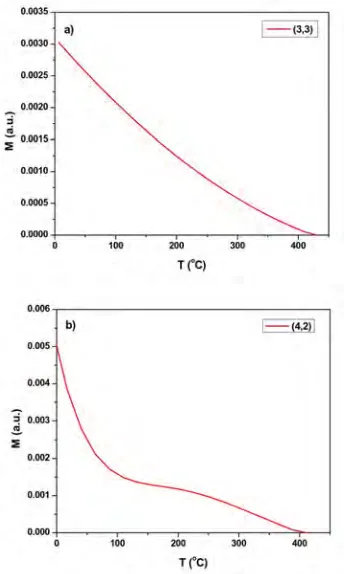
The temperature dependent magnetic measurements (Fig.8 ) revealed that the Curie temperature (TC) of the as prepared Ni-Co/Cu
multilayers shifts towards lower temperature for both Ni-Co(3nm)/Cu(3nm) and Ni-Co(4nm)/Cu(2nm) multilayers. Decreasing the magnetization with increasing the temperature discussed according to electron scattering due to spin fluctuation [11].
Fig. 8. The temperature dependent magnetization for Ni-Co/Cu multilayer samples; A) Ni-Co(3nm)/Cu(3nm), B) Ni-Co(4nm)/Cu(2nm).
4. Conclusion
We have studied dependence of magnetoresistance on the Ni-Co and Cu layer thickness for electrodeposited Ni-Co/Cu multilayers. XRD studies revealed the superlattice and nano scaled characteristic of electrodeposited Ni-Cu/Cu multilayers. A relatively good agreement between nominal and
real (measured) bilayer thicknesses was achievedA GMR behavior was obtained for all multilayers with; 1dCu(nm)4 and 3 dNi-Cu(nm)5. Maximum GMR was obtained at around Ni-Co (4nm)/Cu (4nm). The
magnetization studies also showed that with increasing the Cu layer thickness, the saturation magnetization and Curie temperature decreasing respectively. It can be discussed according to electron scattering due to spin fluctuation.
Acknowledgment
The authors would like to thank the “Payame Noor University, Zarinshahr” for electrodeposition experiments, “Malekashtar University of Technology, Shahinshahr” for magnetization measurements.
References
[1] M. N. Baibich, J. M. Broto, A. Fert, F. Petroff, P. Eitenne, G. Creuzet, A. Freiderich and J. Chazelas. Phys. Rev. Lett 61 (1988) 2472-2480.
[2] M. Angelakeris, E. T. Papaioannou, P. Poulopoulos, O. Valassiades and N. K. Flevaris. Sens. Acta. A 106 (2003) 91-97.
[3] C. A. Ross, Ann. Rev. Mater. Sci 24 (1994) 159-165.
[4] I. Bakonyi and L. Peter. Progr. Mater. Sci 55 (2010) 107-112.
[5] M. Jafari Fesharaki, L. Peter T. Schuchknecht, D. Rafaja, J. Degi, L. Pogany, K. Neurohur, E. Szeles, G. Nabiyouni and I. Bakonyi. J. Electrochem. Soc 159 (2012) D162-D171. [6] E. Hiroto, H. Sakakima and K. Inomato, “Giant Magnetoresistance Devices” 2001, Springer.
Elsevier, Amesterdam (1987).
[8] B. Deiny, U. S. Sperious, S. S. P. Parkin and B. A. Gurney, Phys. Rev. B, 43 (1991) 1297-1303.
[9] B. G. Toth, L. Peter , J. Degi, A. Revesz, D. Oszetzky, G. Molnar and I. Bakonyi. Electrochim. Acta 49 (2013) 122-129.
[10] N. Rajasekaran, S. Mohan, J. Arout Chelvane and R. Jagannathan, J. Magn. Magn. Mater 324 (2012) 2983-2988.