DOI: 10.22075/JRCE.2017.12150.1206
Journal homepage: http://civiljournal.semnan.ac.ir/
Effect of Pile Scouring on the Structural Behavior of a
Fixed Jacket Platform with Consideration of
Non-linear Pile Seabed Interaction
A. Taheri1 and Gh. Emamverdizadeh beyg2
1. Faculty Member, Assistant Professor, Marine Engineering Department, Petroleum University of Technology, Mahmoudabad, Iran.
2. M.Sc. Student, Marine Engineering Department, Petroleum University of Technology
Corresponding author:[email protected]
ARTICLE INFO ABSTRACT
Article history:
Received: 03 August 2017 Accepted: 05 September 2017
In offshore structures, most of failures are caused by the lack of sufficient piles strength. Scour phenomena affects the load transition and the pile strength. The necessity of the consideration of scouring phenomena amplifies when the scour depth becomes remarkable, which can endanger the jacket stability. In this paper, a new method is used to consider the pile scouring using nonlinear pushover analysis with SACS software. A recently-built existing jacket platform namely SPD 19C is selected as a case study. Results show that Reserve Strength Ratio (RSR) of the jacket platform decreases when scour depth increased in the both aged and recently-built cases. RSR decreasing becomes more sensible as scour depth increases. According to API RP2A collapse will be occurred in the range of RSR< 1.6. It is shown at RSR=1.6, collapse will be occurred in the scouring depth of 13.5m and 11m for recently-built and aged platform respectively, which both have approximately 27% lower RSR than their original state. So scour protection methods should be addressed in vulnerable areas as preventive alternatives.
Keywords: Jacket Platform, SACS,
Pushover Analysis, Scouring,
Aging Effect, Persian Gulf.
1. Introduction
Offshore oil and gas industry began the use of pile hammering and undiscovered fields and exploitation of oil wells about 1891. Piles are the main structural members that are used and designed in order to transfer the
most cases there is a combination of lateral resistance and end resistance, unless the pile crossed of loose soil and positioned on hard layer in which only the end pile resistance (tip) is involved in load transmission. With respect to the importance of offshore facilities and vital role of piles in strength, stability, load endurance and structures life time, the rules of the design and modeling of piles are very important. Offshore jacket platforms are usually designed for 25 years of life service. During life service of the platform, due to acquisition for new demands or more functionalities of the platform, platform modification should be based on regulations.
According to reliability assessments of aged platforms, Petronas Carigali Sdn Bhd (PCSB) has found that safety factor for pile foundation capacity is so low [1]. Aged platform defines as a platform having at least 25 years old and partially lost wall thickness in its members due to corrosion. One of the important parameters on platform stability and the pile capacity is pile scouring. When a structure is located in sea, its presence changes the flow pattern in its vicinity results to occurrence of following phenomena:
The contraction of flow
The formation of a vortex in front of the structure
The formation of lee-wake vortices behind the structure
The generation of turbulence
The occurrence of reflection and diffraction of waves
The occurrence of wave breaking The pressure differentials in the soil that may produce “quick” condition/liquefaction allowing material to be carried off by currents.
These changes lead to increment in the local sediment transport capacity and souring occurrence finally [2]. The term scour is used instead of the more general term erosion to distinguish the process caused by structure presence [3]. Because of the complexity of piles scouring in offshore jacket platforms and lack of an appropriate equation to cover all kinds of conditions are already a concerning subject and comes interesting to researchers and engineers. The importance of investigation on scouring will be outstanding when scouring depth reaches to specified levels leads to endanger the platform stability. So it is needed to execute more evaluation of the scouring impact.
(1976) indicated that scour depth highly decreases with geometric standard deviation [9];
𝜎𝑔 = 𝑑84⁄𝑑50 (1)
All the Ettema’s experiments were clear-water. As well as the Ettema’s tests confirmation, live-bed tests which were done by Baker (1986) shows that the decrease is not so remarkable. The boundary layer depth to pile size ratio is an influencing factor on scour depth [10]. Melville and Sutherland (1988) manifested that scour depth increases with L/D increasing [11]. Where L is boundary layer thickness and D is pile diameter. Cross section is also important. Sumer et al. (1993) indicated that the more cross section is simple; the little scour depth will be [12]. These results are also approved in the term of pile height as it does have direct relationship with vortex size and scour depth. Another interesting subject is scour in supported piles in cohesive sediments such as clay. Briaud et al. (1999) have established a method namely SRICOS (scour rate in cohesive soils) to predict scour depth as time passing and estimated scour depth changes with a hyperbola equation [13].
Stahlmann (2013) has performed a numerical investigation within the framework of Open FOAM software code, which was extended by an appropriate scour model [14]. Also, Fen Li et al. (2013) have carried out a numerical study on the effect of scour on the behavior of laterally loaded single piles in marine clay. Their study results show that the scour depth has an important effect on the pile lateral capacity than the scour width. Moreover, the pile with a free head was more sensitive to scour than the pile with a fixed head [15]. Harris (2016) has provided information on seabed scouring at some types of structures [16]. Haitao Zhang et al.
(2016) have proposed a theoretical model for Offshore Wind Turbine Foundation (OWTF) to foresee the scour assessment with time, especially for inclined pile group foundation [17]. Recently, Stevens et al. (2017) have addressed the importance of scour for marine renewable energy facilities and have done comprehensive research on the contributing factors related to scour [18].
The main purpose of this study is to investigate the scour effect on the Reserve Strength Ratio (RSR) of the 19C jacket platform which is located in Persian Gulf The generic method to perform analysis regarding scouring effect is push-over analysis which is done by software SACS [19].
2. Pushover Analysis
SACS is the commercial structural analysis software which is used in this study. In SACS, the pile soil modelling is done in a module known as Pile Structure Interaction (PSI). In PSI, the soil is defined in terms of soil curves namely side shear curve (t-z), end bearing curve (Q-z) and lateral strength curve
(p-y) .
To decrease the pile capacity, soil curves should be modified because of the effect of pile scouring. The coefficients Q and t in the
Q-z and the t-z curves should be stepped up in each same axial displacement to modify the axial capacity of piles. To this aim, the coefficients t and Q in each axial displacement should be manually equaled to zero to simulate the scouring effect and removal of the pile-surrounding soil which is placed in that particular axial displacement.
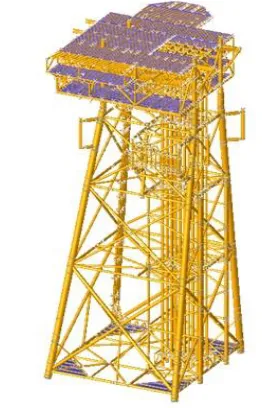
in Persian Gulf (South Pars gas field Development, phase 19) and it is a four-legged platform, as shown in the Fig. 1. The self-weight of the jacket platform, buoyancy, installed equipment and live load were applied on the platform in the first phase of the pushover analysis with load factor of 1.0. The second phase of the pushover analysis is performed by the environmental load on the platform with increasing the load factor until the platform collapsed. Pushover analysis is carried out separately for eight selected loading directions namely; North (N (0º)), North-East (NE (45º)), East (E (90º)), East (SE (135º)), South (S (180º)), South-West (SW (225º)), South-West (W (270º)), and North-West (NW (315º)). The worst loading condition which causes the minimum RSR is the storm condition in S (180º) direction. So this direction is selected to investigate the scouring effect on the jacket platform.
RSR is a measure of structure’s ability to withstand loads in excess of those determined from platform design and this can be obtained using the ultimate strength of the platform through pushover analysis. This reserve strength can be used to maintain the platform in service beyond their intended service life. Knowledge from this analysis can be used to determine the criticality of components within the structural system for prioritizing the inspection and repair schemes [20].
𝑅𝑆𝑅 = 𝐵𝑆𝑐𝑜𝑙𝑙𝑎𝑝𝑠𝑒
𝐵𝑆𝑑𝑒𝑠𝑖𝑔𝑛 (2)
The design base shear can be identified when the environmental load factor = 1.0, while collapse base shear is the maximum base shear prior to collapse.
3. Structural Modeling
3.1 Platform Data
The jacket platform is four-legged drilling jacket with grouted steel piles for the purpose of supporting 2700 tones maximum operation weight located in the South Pars gas field which is approximately located 210km south east of port of Bushehr in a water depth of around 65.25m. The total height of the jacket is 93.85m and the jacket footprint at sea floor is 32.16m×23.04m and leg spacing at working point is 24m × 13.716m. A perspective plot of the model is shown in Fig. 1.
Fig. 1. A Perspective Plot of the SACS.
Three main components of the model are:
3.1.1. Substructure
3.1.1.1. Jacket
a) Jacket legs
b) Horizontal framings
c) Elevation bracings and diagonals
3.1.1.2. Appurtenances
a) One conductors 22” outer diameter (55.88cm)
b) One riser 18” outer diameter (45.72cm) c) One riser 6” outer diameter (15.24cm) d) Two fire water pump caisson 18” outer diameter (45.72cm)
e) One fire water pump caisson 26” outer diameter (66.04cm)
f) Two J-tubes 8” outer diameter (20.32cm)
3.1.1.3. Material
As per API RP 2SIM, material specifications and properties of an existing structure are defined based on data from original design.
Table 1.Material Properties [21]. Density, ρ (kg/m3
) )
7850
Young’s modulus, E (Pa) 2.1e11
Poisson’s ratio, ν 0.3
yield strength, Fy (MPa)
𝑡ℎ𝑖𝑐𝑘𝑛𝑒𝑠𝑠 ≤ 16 235 16 < 𝑡ℎ𝑖𝑐𝑘𝑛𝑒𝑠𝑠 ≤ 40 225
3.1.2. Deck
The topside has three deck levels and includes accommodations and different equipment. The model includes all the deck primary and secondary beams, truss chords, bracing and columns. Deck plates have been included as quadrilateral isotropic plate element for the in-plane stiffness of the deck.
3.1.3. Foundation
The foundation is modelled using uncoupled non-linear soil springs acting along the piles length. The load-displacement characteristics of these springs are defined by p-y, q-z and t-z curves based on geotechnical report. Based on pile makeup drawing the piles are modelled to penetration of 88.47m and 94.48m below mud-line. Pile outer diameter is 1524mm. The scour readings by survey report ranged from 400mm to 900mm, so the final scour for modelling the platform was assumed equal to 1m on all pile locations.
3.2. Environmental Data
3.2.1. Water Depth
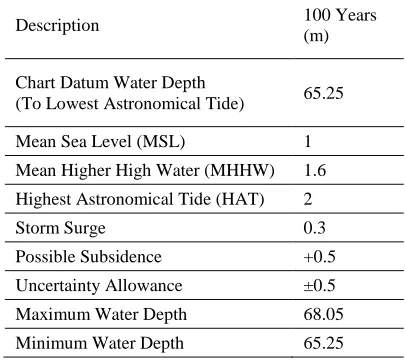
The platform is located in 65.25m water depth. The design water levels and tidal range with 100 years return periods are summarized in Table 2.
Table 2. Water Depth and Surface Fluctuations.
Description 100 Years
(m)
Chart Datum Water Depth
(To Lowest Astronomical Tide) 65.25
Mean Sea Level (MSL) 1
Mean Higher High Water (MHHW) 1.6 Highest Astronomical Tide (HAT) 2
Storm Surge 0.3
Possible Subsidence +0.5
Uncertainty Allowance ±0.5
Maximum Water Depth 68.05
Minimum Water Depth 65.25
The maximum water depth considered in the analysis is 68.05m and the minimum water depth is 65.25m. Max. Water Depth = Water Depth + HAT + Storm Surge + Subsidence.
3.2.2. Wind
The wind loads are calculated based on the API RP 2A-WSD, using following directional wind speeds for extreme storm conditions [22].
Table 3. 100-Year Return Period Wind Speed. Directio
n
N W
W SW S SE E NE N
wind speed (m/s)
36 34.9 35.6 36.7 35.6 33 33.4 35.2
3.2.3.Wave and Current
Directional waves are used for the pushover analysis. Wave height with associated period for extreme storm conditions are as follows:
Table 4. 100-Years Wave Heights and Associated Wave Periods.
Direction NW W SW S SE E NE N
Wave Height (m)
10.8 8.8 9.7 12.2 10.8 8.8 10.2 11.6
Wave Period (sec)
10.4 9.6 10 11 10.4 9.5 10.2 10.8
The following currents are considered for the design of the platform.
Table 5. 100-Years Return Period Current Profile.
Elevation NW W SW Direction S SE E NE N Surface
(m/s) 1.28 1.28 1.28 1.28 1.28 1.28 1.28 1.28 50%
Water Depth (m/s)
1.28 1.28 1.28 1.28 1.28 1.28 1.28 1.28
1.0m above Seabed
(m/s)
0.78 0.78 0.78 0.78 0.78 0.78 0.78 0.78
0.5m above Seabed
(m/s)
0.71 0.71 0.71 0.71 0.71 0.71 0.71 0.71
3.2.4.Hydrodynamic Coefficients
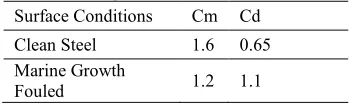
Basic drag and inertia coefficients used to evaluate wave forces on cylindrical members are as follows:
Table 6. Hydrodynamic Coefficients for Calculating the Storm Wave Loads. Surface Conditions Cm Cd
Clean Steel 1.6 0.65
Marine Growth
Fouled 1.2 1.1
The wave kinematics factor should be taken as 0.9. The current blockage factors for the 4 legged structures are as API RP 2A-WSD (2014); End-on: 0.70, Diagonal: 0.85, Broadside: 0.80.
3.2.5. Marine Growth Profile
Marine growth can lead to the rise in the increase of the weight, hydrodynamic added mass and hydrodynamic actions, and may influence hydrodynamic instability. For typical design situations, global hydrodynamic action on a structure can be calculated using Morison’s equation, with the values of the hydrodynamic coefficients for unshielded circular cylinder [22]. Table 7 presents the marine growth thickness measured by underwater survey. The specific weight of marine growth in air considered equal to 1.4 kN/m3.
Table 7. Marine Growth Thickness. Elevation
(m) 0.00-8.1 8.1-18.1 18.1-28.1 28.1-38.1 38.1-48.1 48.1-58.1 58.1-66.1 Thick.
(mm) 5.0 5.5 6.0 6.5 7.0 7.5 7.5
4. Results and Discussion
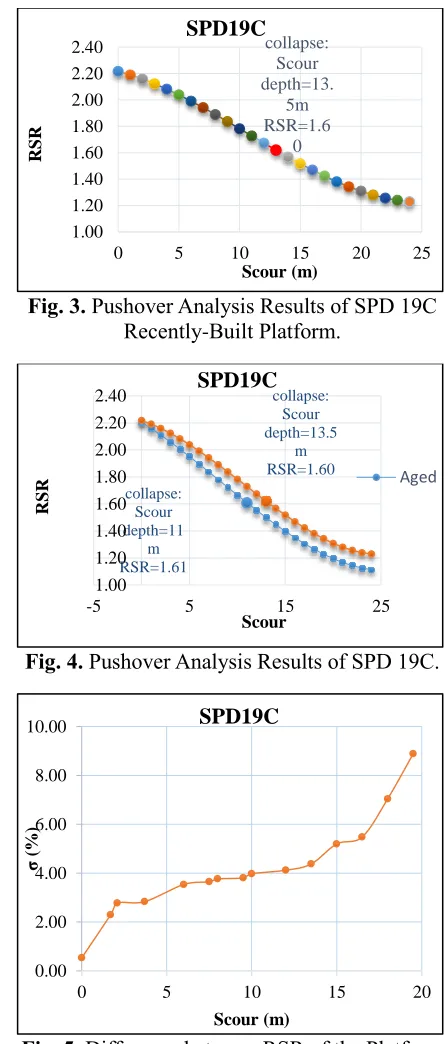
(2014) collapse will be occurred in the range of RSR< 1.6. results show that at RSR=1.6, collapse will be occurred in the scouring depth of 13.5m and 11m for recently-built and aged platform respectively, which both had roughly 27% lower than their original RSR, which is shown in Figs. 2,3 and 4.
Finally, the existing jacket platform RSR in the forms of aged and recently-built one in Persian Gulf was obtained in the form of a polynomial function having the order of 3 as follows:
𝑅𝑆𝑅 = 6.5 𝐸 − 0.5 𝑆3− 0.0016 𝑆2
− 0.0445 𝑆 + 2.2046
(3)
𝑅𝑆𝑅 = 9 𝐸 − 0.5 𝑆3− 0.0029 𝑆2 − 0.0234 𝑆 + 2.2164
(4)
Where Eqs. (3) and (4) belong to aged platform and recently-built one respectively.
Fig. 2. Pushover Analysis Results of SPD19C Aged Platform.
Fig. 3. Pushover Analysis Results of SPD 19C Recently-Built Platform.
Fig. 4. Pushover Analysis Results of SPD 19C.
Fig. 5. Difference between RSR of the Platform in the Forms of Aged and Recently-Built.
5. Conclusion
Due to importance of offshore structures such as jacket platforms, if scour depth exceeds a specified limit, the structural stability will be affected. Decreasing trend in RSR shows that
collapse: Scour depth=11
m RSR=[Y VALUE]
1.00 1.20 1.40 1.60 1.80 2.00 2.20 2.40
-5 5 15 25
RSR
Scour (m)
SPD19C
collapse: Scour depth=13.
5m RSR=1.6
0
1.00 1.20 1.40 1.60 1.80 2.00 2.20 2.40
0 5 10 15 20 25
R
SR
Scour (m)
SPD19C
collapse: Scour depth=11
m RSR=1.61
collapse: Scour depth=13.5
m RSR=1.60
1.00 1.20 1.40 1.60 1.80 2.00 2.20 2.40
-5 5 15 25
RSR
Scour
SPD19C
Aged
0.00 2.00 4.00 6.00 8.00 10.00
0 5 10 15 20
σ
(%
)
Scour (m)
the capacity of jacket platform in the both aged and recently-built cases decrease with increasing the scour depth. As the scour depth increases, especially in the aged case, the more sensible RSR decreasing will be resulted. So that the aged platform at 11 meters will reach the critical value set by the API RP 2A-WSD (2014), while the newly built platform will reach this critical value at 13.5 meters, which both had approximately 27% lower than their original RSR. This may endanger the jacket stability or leads to the collapse the whole platform in the worst case. Therefore, scouring occurrence should be banned in susceptible areas by utilizing so-called “Scour Protection” methods, in which the bed area around the pile is covered by protection layer in the forms of stone protection layer or in the form of protective provisions.
6. Notation
𝐵𝑆𝑐𝑜𝑙𝑙𝑎𝑝𝑠𝑒: The ultimate base shear capacity of the jacket prior to Collapse
𝑄: end bearing Capacity
𝐵𝑆𝑑𝑒𝑠𝑖𝑔𝑛: The design base shear loading on the jacket
𝑞𝑙𝑖𝑚: Limit unit end bearing pressure
𝐶𝑑: Drag coefficient 𝑆: Scour depth
𝐶𝑚: Inertia coefficient 𝑇 − 1: Clay
𝐶𝑢: Undrained shear
strength
𝑇 − 2: Calcarenite
𝐷: Pile diameter 𝑡: Shear stress
𝑑50: Median soil diameter 𝑦: Lateral displacement 𝑑84: Soil size for which
84% of bed material is finer
𝑧: Axial
displacement
𝐸: Young’s modulus 𝜌: Density
𝑓𝑙𝑖𝑚: Limit unit skin
friction 𝜎𝑔:
Geometric standard deviation
𝐿: Boundary layer
thickness 𝜈: Poisson’s ratio
𝑁𝑞: Bearing capacity
factor 𝛿: Soil-pile friction angle
REFERENCE
[1] Nichols, N. W., Goh, T. K., and Bahar, H. (2006). “Managing Structural Integrity for Aging Platform,” in SPE Asia Pacific Oil and Gas Conference and Exhibition, Adelaide,Australia, DOI: 10.2118/101000-MS.
[2] Sumer, B. M., and Fredsøe, J., (2002). “The Mechanics of Scour in the Marine Environment.” Denmark: world scientific Publishing Co. Pte. Ltd, vol. 17, ISBN: 981-02-4930-6.
[3] Coastal Engineering Manual (2001). Scour and Scour Protection. Chapter VI—5-6, Engineer Manual EM 1110-2-1100, Headquarters, U.S. Army Corps 01 Engineers, Washington, D. C.
[4] Breusers, H.N.C. and Raudkivi, A.J. (1991).” Scouring.” A.A. Balkema, Rotterdam, viii + 143 p, Bib ID: 1890407, ISBN 10: 9061919835,
ISBN 13: 9789061919834.
[5] Melville, B.W. and Coleman, S.E. (2001). “New Zealand Bridge Scour Experiences”.
JOURNAL OF HYDRAULIC
ENGINEERING, DOI: 10.1061/ (ASCE) 07339429(2001)127:7(535).
[6] Herbich, J.B. (1981). “Scour around pipelines and other objects.” Offshore Pipeline Design Elements. Marcell Dekker Inc., New York, 43-96.
[7] Herbich, J.B., Schiller, R.E., Jr., Watanabe, R.K. and Dunlap, W.A. (1984). “Seafloor Scour.” Design Guidelines for Ocean-Founded Structures, Marcell Dekker Inc., New York, ISBN-10: 0824770951.
[8] Mao, Y. (1986). “The interaction between a pipeline and an erodible bed.” PhD Thesis fulfillment article, Series Paper 39, Tech. Univ. of Denmark, ISVA, DOI: 10.1061/ (ASCE) 0733-950X (1988)114:1(81). [9] Ettema, R. (1976). “Influence of bed material
gradation on local scour”. Report No. 124, University of Auckland, Department of Civil Engineering.
Auckland, New Zealand, ISSN: 0111-0136.
[11] Melville, B.W. and Sutherland, A.J. (1988). “Design methods for local scour at bridge piers.” Hydraulic Engineering, ASCE, vol. 1114, No. 10, pp 1210-1226, DOI:
10.1061/ (ASCE)
0733-9429(1988)114:10(1210).
[12] Sumer, B.M., Christiansen, N. and Fredsøe, J. (1993). “Influence of cross section on wave scour around piles.” Waterway, Port, Coastal and Ocean Engineering, ASCE, vol. 119, No. 5, pp 477-495, DOI: 10.1061/ (ASCE) 0733-950X (1993)119:5(477).
[13] Briaud J.-L., Ting, F.C.K., Chen, H.C., Gudavalli, R. perugu, S. and Wei, G. (1999). “Prediction of Scour Rate in cohesive Soils at bridge piers.” Geotechnical and Geoenviromental Engineering, ASCE, vol. 125, No. 4, pp 237-246, ISSN: 1090-0241.
[14] Stahlmann, A., (2013). “Numerical and Experimental Modeling of Scour at Foundation Structures for Offshore Wind Turbines “International Offshore and Polar Engineering (ISOPE), Document ID: ISOPE-I-13-031, ISBN 978-1-880653-99– 9 and ISSN 1098-6189.
[15] Fen Li, Jie Han, Cheng Lin (2013). “Effect of Scour on the Behavior of Laterally Loaded Single Piles in Marine Clay”, Marine Georesources & Geotechnology, Volume 31, 2013- Issue 3. DOI: 10.1080/1064119X.2012.676157. [16] Harris, J., Whitehouse, R., Todd, D., Gunn,
L., Lewis, R., (2016). “Analyzing Scour Interaction between Submarine Pipelines, Valve Station and Mechanical Protection Structures”, Offshore Technology Conference, Document ID: OTC-27289-MS, DOI: 10.4043/27289-MS.
[17] Haitao Zhang, Xianqi Luo, Jinfeng Bi, Hui Shen (2016). “Seabed Scour around Inclined-pile Group Foundation of Offshore Wind Turbine”, International Ocean and Polar Engineering Conference (ISOPE), Document ID: ISOPE-I-16-213, ISBN: 978-1-880653-88-3, ISSN 1098-6189.
[18] Robert F. Stevens, Kevin Smith, Lawrence Soosainathan, and James Fisher, Mohamed M. Mekkawy, Amir Rahim, Daniel P. O'Connell, (2017). “Seabed Scour Considerations for Marine Renewable Energy Facilities”, Offshore Technology Conference, Document ID: OTC-27863-MS, DOI: 10.4043/27863-MS.
[19] George, J. M., Wahab, M. M. A. and Kurian, V. J., (2016). "Changes in the Pushover Analysis of Offshore Jacket Platforms Due to the Incorporation of the Aging Effect of Piles," ARPN Journal of Engineering and Applied Science, VOL. 11, NO. 4, ISSN 1819-6608.
[20] Narayanan, S. P. and Kabir, M., (2009). “Structural Integrity Management for Fixed Offshore Platform in Malaysia”, World Academy of Science, Engineering and Technology, Malaysia, vol. 3, No. 10. DOI: 1999.3/6666.
[21] API, (2013). Structural Integrity Management of Fixed Offshore Structures, American Petroleum Institute, DOI: 10.4043/20675-MS.