Evaluation of the Heading Confinement Pressure Effect on
Ground Settlement for EPBTBM Using Full 3D Numerical
Analysis
Amir Hossein Haghi
1*, Mohammad Reza Asef
2, Ali Taheri
3and Mohsen Mohkam
41
National Iranian South Oilfields Company, Ahvaz, Iran
2
Geology Department, Kharazmi University, Tehran, Iran
3
Zaminfanavaran Geotechnical Consulting Engineers (ZAFA), Esfahan, Iran,
4
Ecole National des Travaux Publics de L’Etat (ENTPE), Laboratoire Geomateriaux, France
Received 24 March 2013; Received in revised form 3 May 2013; accepted 20 May 2013
Abstract
Ground settlement is often the most serious concern when tunneling under an old city with numerous historic monuments. A successful engineering design under these conditions would require getting the most out of the ground strength parameters and avoiding any weakening maneuver throughout the operation. Knowing that surface settlement is highly affected by tunneling parameters in EPB shield tunneling lead us to estimate the optimum values for the machine heading pressure with the lower amount of the ground settlement in fragile structure of the old city for the Esfahan Subway Project. Tunnels were dug underneath some of the most prominent historical sites along the path of the project. To improve precision and efficiency in tunneling operation, at the first step, tunnel heading confinement pressure is calculated by using an advanced 3D mathematical approach based on the limit equilibrium theory. Then, a promoted 3D finite element model is developed, taking into account the tunneling procedures and the designed heading confinement pressure from the first step. Settlements were pre-calculated and the surface displacement was checked at all sensitive locations. At the third step, settlement is estimated by exerting executed face supporting pressure to the tunnel face and the concluded amounts for displacement are compared with the outputs of extensometers. This comparison leads us to check the reliability of calculated settlements and the accuracy of the designed tunnel heading confinement pressure. Furthermore, evaluating the relation between extensometer outputs and executed tunnel face pressure at the points of extensometers stations validates the assumption that the safe face supporting pressure causes least surface displacement. Although the minimum pressure occurred in short term fluctuations, this approach confirms the sensibility of settlement with the least executed face supporting pressure.. It is also found that higher executed face supporting pressures could reduce the tunnel face stability. Therefore, documentation of appropriate software facilitates design procedures. Yet a further achievement of this study concerns effective decision implementations under strictly limited.
Keywords:
EPB shield tunneling machine, extensometer, heading confinement pressure, numerical modeling settlements.1. Introduction
Recently, Mechanized tunneling in urban area has become one of the most interesting and challenging issues in civil and geotechnical studies. In these projects, a successful operation is desired while absolutely the most strict limitation for engineering design is set. The working atmosphere becomes even more complicated if it is known that the tunnel will pass under monuments inscribed by UNESCO and observed by media. Therefore, adequate attention is required in designing and executing tunneling parameters in order to minimize the project impacts on adjacent buildings and structures. The most destructive tunneling
14 Int J Min & Geo-Eng (IJMGE), Vol. 47, No. 1, Jun. 2013, pp.1 -32
during and after the construction of the tunnels. Several approaches, including empirical methods, analytical methods and numerical methods are commonly used to predict ground movements and settlements associated with tunneling operations. In engineering practices, empirical methods are generally used to predict tunneling-induced ground movements. Peck [1] stated that the transverse settlement caused by a tunnel could be described by Gaussian error function. This mathematical description has been widely accepted [2, 3] but yet it has no theoretical basis. Attewell and Woodman [2, 3] developed a semi-empirical methodology for the simplified condition of the ground. However, as pointed out by Loganathan and Poulos [4], empirical methods are subjected to some important limitations in their applicability to different ground conditions and construction techniques, and in the limited information they provide data about the horizontal movements and subsurface settlements.
A few attempts [4,5] have been made to develop closed form analytical solutions that incorporate all of the factors that may contribute to ground deformations. Recently, Chiriotti et al. [6] suggested the so-called “Matrix Approach” to estimate settlement when tunneling with TBMs in soft material.
However, empirical and analytical methods are restricted and cannot deal with problems involving the interaction between soil and structures and the relation between the surface movements and the heading confinement pressure. To analyze the interaction problem between a new tunnel and an existing one, numerical methods may provide a flexible tool. Tunneling is often modeled two-dimensionally (2D), though it is a three-dimensional (3D) problem since a full 3D numerical analysis often requires excessive computation resources (both storage and time). Yamaguchi et al. [7] performed a series of 2D linear elastic finite element analyses to analyze ground behavior during shield tunnel constructions, the changes of earth pressures acting on parallel shield tunnels, and the influences of a shield thrusting on the preceding shield tunnel. These analyses were then compared with the monitored results during the construction of four extremely close parallel shield tunnels in Kyoto, Japan.
Over the past few years, with the rapid development of computing power, interactive computer graphics, topological data structures and storage capacities, there has been some research [8, 9, 10, 11] carried out on the 3D
modeling of tunnel constructions. Franzius [12] investigated the tunnel- induced subsidence using a 3D Imperial College Finite Element Program (ICFEP). The 3D excavation process was modeled by a step-by-step approach, i.e. successive removal of elements in front of the tunnel face while successively installing lining elements behind the tunnel face. However, 3D numerical model is preferred for shield tunneling because it provides the most reliable solution for settlement analysis by considering all parameters: tunnel face pressure, tunnel geometry, geotechnical parameters and etc.
On the other hand, many researchers verified advisable relationships between ground settlement and the heading confinement pressure in tunneling with EPB machines [12, 13, 14]. A proper design and execution of the tunnel face supporting pressure will guarantee a safe tunnel construction with minimum displacement on the neighboring old structures. The face support pressure design for shield tunneling must employ a sequential analysis, firstly, to verify the equilibrium conditions of the excavation face and, secondly, to identify the consequent stabilizing measures for a complete control of the development of deformations [15, 16]. There are several analytical and numerical methods for analyzing tunnel face supporting pressure. These analyses could be operated for 2D or 3D models as well. Regarding the circular shape of the tunnels and the specific definition of face supporting pressure for EPB tunnels, the 2D methods of analyses present major deficiencies.
The analytical method is based on the Limit Equilibrium Method (LEM) and the earth pressure theory. The limit equilibrium methods generally factor in the iterative definition of the critical failure surface and the assumption of stress distribution along the failure surface. The shape of this critical failure surface should be adequately matched with the natural behavior of the soil material at the tunnel face. Different 3D methods have been introduced for analyzing the face supporting pressure for closed shield tunneling machines including, Method of Leca and Dormieux [17], Jancsecz and Steiner [18], Anagnostou and Kovari [19], Broere [16], Carranza and Torres [20] and so on.
3D finite element analysis represents the more sophisticated instrument for construction’s simulation and verification of the face-stability conditions and settlement. Even though, 3D numerical models showed slight weaknesses in reproducing the high values of the surface settlements in mixed face conditions with sharply
different mechanical behavior [21], still these methods appeared to provide the best potential for the required simulations. Chen et al. [22] investigated successfully the failure mechanism and the limit support pressure of a tunnel face in dry sandy ground using a numerical discrete element method (DEM). They claim that comprehensive numerical analysis of tunnel face failure may help guarantee safe construction during tunneling.
To sum up, most of the research on shield tunneling to date has focused on the assessment of the ground surface settlement, regardless of noticeable effects of shield tunneling parameters through it, though some research has just started to target the interaction between tunnel and subsurface structures, such as adjacent tunnels [23]. Relatively few studies can be found in the literature on the interaction between structures-soil together with the sensibility of the surface settlement with the heading confinement pressure variations and the significant impacts of small fluctuation of the minimum face supporting pressure in twin tunneling operations. Moreover, most numerical analyses are 2D simulations, a small portion of which involves full 3D modeling.
In this paper, initially, the heading confinement pressure calculation is performed on the basis of a kinematical calculation method implementing a variation analysis to define the "3D Logarithmic-Spirals" failure surface and the state of stress acting at every point of this model. In comparison to other analytical models mentioned earlier, this method presents more reliable results by considering the phenomenon of arching effect, soil’s mechanical parameters (based on Mohr-Coulomb Law) and physical characteristics, pressure gradient in the working chamber as well as a relevant 3D failure surface with the geometry of the circular tunnels and natural behavior of the ground. Furthermore, variation analysis is used to solve extracted differential equations from limiting equilibrium analysis. This method has been broadly used in several tunneling projects in France, Italy, Iran, and elsewhere.
Then, calculated heading confinement pressure for safety factors 1 and 1.5 from the first step probes by a 3D finite element software and settlement predicts settlements at the tunnel alignment. On the other hand, changing the reference pressure at the tunnel face in the 3D numerical model, we approached the result of two methods and then used this model for settlement forecasting with the calculated
heading confinement pressure.
At the third step, the promoted numerical model from the second step employs for settlement determination at the location of instrumentation stations and the results were compared with the real values of the settlement gained from extensometers. This comparison could be helpful in predicting the ground settlements for different applied face stability pressures and geotechnical characteristics for future sensitive locations.
The Combination Analysis Method (CAM) was utilized for the Esfahan Subway Project to predict and analyze settlement at breakable locations of the city.
2. Tunnel Face Stability and Earth Pressure Design
In this study, a stability analysis of the bored face was performed with the model introduced by Mohkam and Wong [24], based on limiting equilibrium state combined with variation method and considering a 3D failure mechanism.
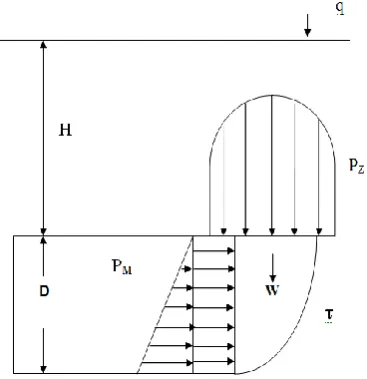
Generally in this method, tunnel face is assimilated to a vertical slope and its stability is analyzed considering the equilibrium of a wedge of soil bounded between this vertical surface, a horizontal surface at crown and a potential slip surface. On this wedge, different loads are acting, such as overburden pressure PZ, muck pressure applied in working chamber Pm, weight of the wedge w, surface loads q, Shear resistance
of the soil along the potential slip surface based on the Mohr-Coulomb shear theory and the overburden pressure Pz (Figure 1).
The overburden pressure is calculated based on the concept of arching effect and height, determined by Terzaghi’s method, [25] modified and adapted for immersed soils.
16 Int J Min & Geo-Eng (IJMGE), Vol. 47, No. 1, Jun. 2013, pp.1 -32
In the analyses, soil density (), Mohr-Coulomb shear strength parameters (c & ), rheological characteristics of muck and the mobilized pressure gradient (for hyperbaric intervention which is neglected in this study), as well as hydrostatic pressure, permeability, and as mentioned above, overburden loads and the arching effect in the ground were taken into consideration.
The heading confinement pressure is determined as a function of safety factor. F ( m/ p) is defined as the ratio of mobilized shearing resistance to the potential shearing resistance. For instance, a safety factor of 1 corresponds to the confinement pressure at equilibrium state without any safety margin. Moreover, a safety factor of 1.5 corresponds to the confinement pressure with a normally applied safety margin.
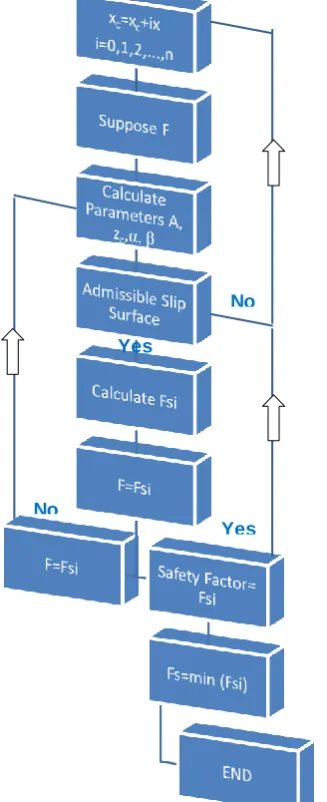
Based on the flow chart in Figure 2, a program is prepared in order to solve equations of slip surface and safety factor by means of
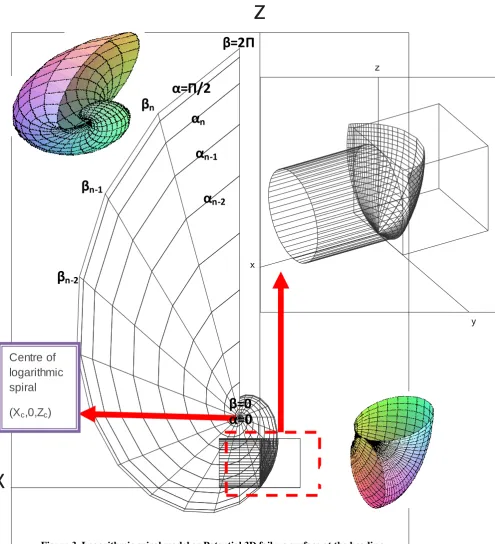
iteration to find admissible slip surface and the minimum safety factor. Matching one point of the logarithmic-spiral slip surface (Figure 3) with the bottom of the tunnel (defining slip angle at toe, α and β), for a given support pressure as input (F), the minimum safety factor (min Fs) is obtained by iteration using the variation method, corresponding to one position of the center (xc, 0 , zc) of the logarithmic spiral. Then, again by iteration, the position of the center is varied and relative safety factors are determined. At the end, the minimum safety factor is defined for the given pressure for the safety factor 1. In turn, iteration is performed over different pressures, F, in order to obtain the required safety factors. More details about the strategy, program flow chart and equations can be found in the reference paper by Mohkam and Wong [24].
Based on the hydrostatic pressure, the rheological characteristics of the muck in the working chamber and the type of the mud cake
Figure 2. Programming flow chart for calculating Heading Confinement Pressure for EPBTBM
3
No
No
Yes
(in Hyperbaric Mode), the permeability and the pressure gradient, for the same pressure applied and the safety factor varies. It can be increased or decreased with pressure, yet it will not be necessarily increased with increased support pressure. In fact, the pressure applied could induce excess pore water pressure [26] and diminish the effective stress and thus the resistance of the soil in the failure zone. Hence, under certain conditions, higher pressure will not improve the stability; it may rather reduce it.
The heading confinement pressure is also performed using a complete 3D mathematical solution based on Finite Elements Method in some cases.
This method will be discussed in the next section. The outgrowth of these two methods of calculation successfully matched in 90% of calculations and the deviation obtained less than 10%. However, deformability parameters are neglected in the LE method.
Figure 3. Logarithmic spiral model as Potential 3D failure surface at the headin g Centre of
logarithmic spiral
(Xc,0,Zc)
β=2Π
β
nβ=0
β
n-1α
nα=Π/2
α
n-1α=0
α
n-218 Int J Min & Geo-Eng (IJMGE), Vol. 47, No. 1, Jun. 2013, pp. -32
3. Numerical method for settlement analysis
A rigorous analysis of the EPBTBM tunneling problem in this study is a difficult task because of:
1. The presence of the twin tunnel and single tunnel analysis;
2. The presence of several materials (divers soil and steel) with very different stiffness and mechanical behavior;
3. The presence of several types of contacts, such as the interaction between the machine shield plate and surrounding material, and the interaction between the paste material pressure within the machine chamber (heading confinement pressure) and the soil material at the tunnel face; and
4. The three-dimensional nature of the problem. Therefore, to reproduce correctly the deformational mechanism, the analysis cannot be treated as 2D with plane strain or axisymmetry, but requires the use of full three-dimensional modeling accounting for the presence of the twin tunnel, its existing machine shield system, the circular tunneling process, the several types of materials and their heading confinement pressure.
In this approach, analyses related to the tunnel overburden movements were performed by carrying out numerical simulations using
the finite element program "PLAXIS 3D Tunnel" [27] to determine anticipated ground deformation at different loads and approximate the ground settlement [28].
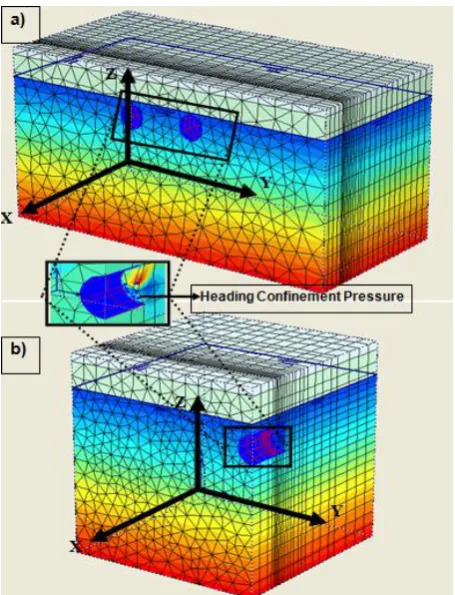
To this end, firstly the “primary model” was prepared based on tunnel geometry, complete geological and geotechnical parameters, hydrological condition, etc. The finite element models developed for this analysis are shown in Figure 4
.
A fine grid model, 50m long in the direction of the tunnel axis, 100 m wide and 50 m deep ((x,y,z)→(100,50,50)) is used to model twin tunnels for extensometer stations no. 0 to 5 (Figure 4a) while a smaller grid box ((x,y,z)→(50,50,50)) is used for modeling single tunnel models for extensometer stations no. 6 to 8 with single tunnel (Figure 4b) for the Esfahan Subway Project. The geometrical boundaries considered here was found to be far enough from the tunnels’ axis in order to minimize the influence of boundaries on the tunneling model. The tunnels had a circular cross-section with diameter D=6.9 m. The distance between the centers of the twin tunnels was Ldis≈3D and the cover depth varied between 8 to 13m in different instrumentation stations. The finite element meshes for twin tunnels includes 17472 fifteen-node wedge elements with 48683 fifteen-nodes
Figure 4. Finite element 3D numerical model for extensometer stations. a) Twin tunnel numerical model for extensometer station number 5. b) Single tunnel numerical model for extensometer station no. 7.
and 240 eight-node plate elements with 1920 nodes to model the behavior of soil material and machine shield, respectively. The single tunnel model includes 16075 fifteen-node wedge elements with 44540 nodes for soil material and 45 eight-node plate elements with 360 nodes to model the machine shield. However the number of fifteen-wedge elements for soil materials changed slightly in different location for different extensometer stations. The machine shield length (8m) and its material characteristics were inserted into models. The water table is assumed to produce the hydrostatic initial pore water pressure. An elastic-plastic soil model using the Mohr-coulomb failure criterion is adapted in this study.
In general, the process of tunnel construction was modeled in two steps (for more information for simulation of tunneling, see [29,30]). First, the initial conditions were set up for the "primary model" before the excavation of the tunnels. It was achieved by specifying the distribution of effective vertical and horizontal stress (using the coefficient of earth pressure at rest, K0≈0.5) and pore water pressure. At this stage, the surface loads were calculated and applied to the model. After establishing the initial conditions, the analyses continued with modeling excavation of the first tunnel in "staged constriction" phases.
The tunneling process is modeled using a step-by-step approach in the X direction of the model in 8 phases (Figure 4). In each phase, the excavation process consists of:
i) Successive removal of excavation elements in front of the tunnel face by a distance L= 1m, ii) Application of pore water pressure,
iii) Applying the calculated heading confinement pressure to the tunnel head as the reference pressure and introducing the mud paste density to support the tunnel face, iv) Successively supporting the material with
the machine shield plate elements behind the tunnel face, and
v) Activating the surface loads. Moreover, strength properties in the interaction zone between soil and machine shield are lower than the adjacent soil.
Hence using 0.7≤Rinterface≤1 gives a reduced interface friction and adhesion compared to the friction angle and the cohesion in the adjacent soil. After the last phase (phase 8) the gap between the soil and the newly installed lining
t=0.3m at the end of the machine shield is filled with grout material. The second tunnel excavation for the twin tunnel was modeled after the completion of the first tunnel in which the same manner of step-by-step method is applied.
Accordingly several "Staged Construction" phases were used in order to simulate settlements corresponding to different applied face pressures through "Prediction" and "Comparison" scenarios.
"Prediction scenarios" are executed by applying designed heading confinement pressure to the tunnel face of the 3D model. For this purpose, the reference support pressure at the tunnel face of the 3D numerical model altered to fit with the designed heading confinement pressure and so, the "primary model" revised to the "promoted model". The promoted model was used for settlement predictions.
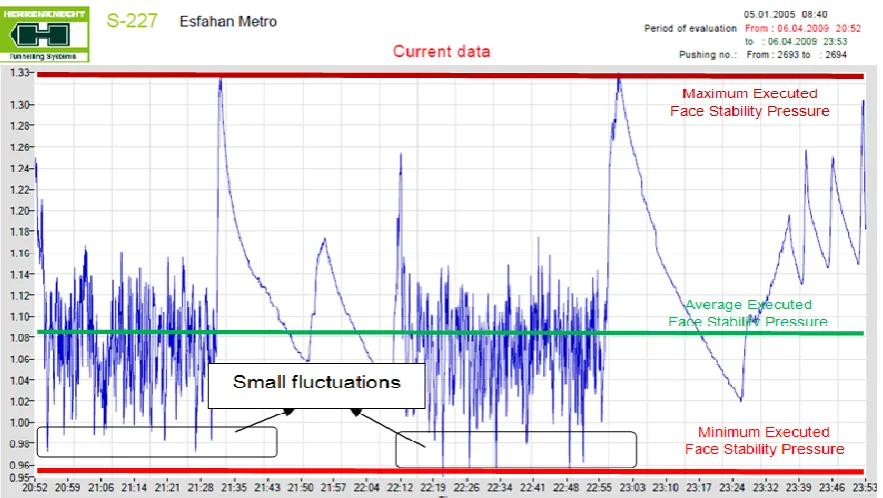
In the "Comparison scenarios", promoted models from the previous section were used for settlement analysis at the extensometers stations by applying the executed tunnel face supporting pressure to the tunnel head of the 3D promoted numerical model. Evidently, executed tunnel face pressure changes dramatically as the machine progresses over time (Figure 5). Hence three maximum, minimum and average limits are considered for executed pressures while the machine passes through the extensometer tools and these pressures are applied to the tunnel face of the 3D numerical model. As it is illustrated in Figure 5, almost minimum executed face supporting pressure is noticed commonly in small fluctuations. For each instrumentation station three values for settlement calculated as maximum, minimum and average calculated settlements corresponding to minimum, maximum and average values of executed face supporting pressure, respectively. These results were compared with the real values of settlements gained from extensometers in "Comparison Scenarios".
20 Int J Min & Geo-Eng (IJMGE), Vol. 47, No. 1, Jun. 2013, pp. -32
Figure 5. Executing face pressure variation with time for EPBTBM
(by multiplying the forces with a number, 1>M>0) to exceed acceptable minimum pressure for the tunnel heading confinement pressure.
4. Esfahan Subway Project
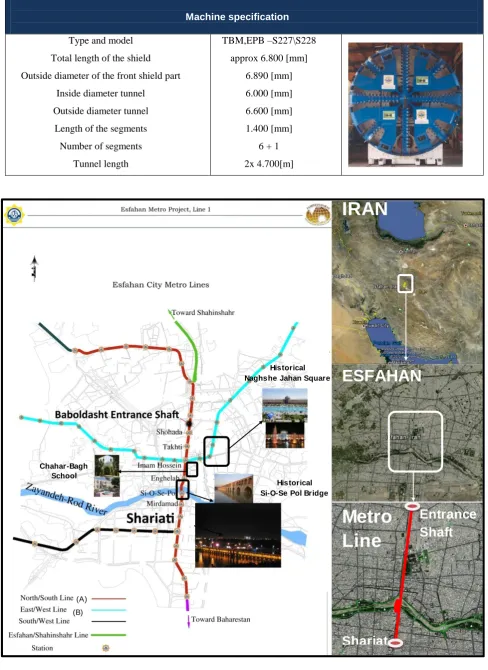
Esfahan is the center of communications for region and a chief center of attraction in central Iran. The corridors studied for the Esfahan Subway Project pass the world's most significant and ancient heritages like Chahar-bagh Boulevard and Chahar-Bagh School, Si-O-Se-Pol Bridge upon the Zayandeh-Rud River with a high degree of tourist attractions in central Iran (Figure 6). Regarding the geotechnical and hydro-geological conditions of the middle section of the proposed line, two EPB shields were employed to excavate twin tunnels with the length equal to 5 kilometers [31]. During and after the construction of the western and eastern tunnels, the ground settlement has been monitored in 9 sensitive points by extensometer tools equipped with real time data acquisition systems.
The intercity network of the Esfahan Subway Project consists of north to south (Line A) and east to west (Line B) lines. Line A is separated into five sections and the most prominent section is the middle section. This section starts at Baboldasht entrance shaft and ends in Shariaty station and covers 7 stations (Figure 6). Based to the geological and geotechnical aspects of the middle section, an EPB tunneling machine with the given specification in Table 1 was used for construction of the Esfahan Subway Project.
4.1. Geological characterizations
The subsurface stratigraphy of the project area of the proposed subway line and section is as follows [32]:
FILLS: The natural deposits are covered by fills with variable thicknesses in the City area. These materials are comprised mostly of the local soils with different percentages of building wastes.
RIVER DEPOSITS: The river deposits consist of coarse-grained fluvial and/or fine grained flood-plain sediments, which overlie the alluvial fan deposits at the southern part of the river.
a)Coarse Grained Fluvial Deposits
These deposits comprise dominantly of clean, well graded or poorly graded (gap graded) sandy gravel and/or gravelly sand layers, where the soil grains are mostly rounded with a maximum size of 60 mm.
b)Fine Grained Flood Plain Deposits
The Flood-Plain deposits comprise of silt and clay with some sand particles (up to 20%). These deposits are mostly homogeneous and firm in place. Among the fine-grained Flood-Plain sediments there are some lenses of coarse grained Fluvial Deposits.
ALLUVIAL FAN DEPOSITS: These deposits which overlie the bedrock at the southern parts of the city consist mainly of very silty/clayey, sandy gravel, with sub-angular particles. These deposits are mostly heterogeneous and slightly cemented in place.
Table 1. Machine specification
Machine specification
Type and model Total length of the shield
Outside diameter of the front shield part Inside diameter tunnel
Outside diameter tunnel Length of the segments
Number of segments Tunnel length
TBM,EPB –S227\S228 approx 6.800 [mm]
6.890 [mm] 6.000 [mm]
6.600 [mm] 1.400 [mm]
6 + 1 2x 4.700[m]
Figure 6. The sensitive middle section plan of intercity network of Esfahan Metro project, Esfahan, Iran
Historical Si-O-Se Pol Bridge Chahar-Bagh
School
Historical Naghshe Jahan Square
IRAN
ESFAHAN
Metro
Line
Entrance
Shaft
Shariat
i
22 Int J Min & Geo-Eng (IJMGE), Vol. 47, No. 1, Jun. 2013, pp. -32
Soil Strata
Mean Deformability Parameters
Mean Mohr-Coulomb Shear Strength
Parameters
Modulus of Total Deformation, Et (MPa)
Coefficient of relative lateral deformation,
r
In terms of effective stress
c′ (kPa) ′ (deg.)
Fills 8 0.35 10 20
River Deposits
Fine Grained
20 0.35 30 25
Coarse
Grained 40 0.27 0.5 35
Alluvial Fan Deposits 50 0.30 40 35
4.2. Geotechnical characterizations
The proposed line and stations are intersecting the river deposits at the central parts of the city where the heritage sites and the Old City structures are located. According to the performed in-situ and laboratory tests results, the mean values of the Mohr-Coulomb shear strength and deformability parameters of the soil strata is as given in Table 2. The coefficient of in-situ permeability of the river deposits lies in the ranges given in Table 3.
5. Instrumentation layout and monitoring system
The most destructive tunneling impact on the environment is the ground settlement which could create serious problems for the existing buildings and structures along the alignment. However, one of the main objectives of the EPB tunneling process is to provide adequate support to minimize deformation during and after the construction.
Investigation on settlement at key points along the proposed line was accomplished in two stages as follows:
During the tunneling design process by settlement analysis.
During and after the tunnel construction by instrumentation and monitoring.
For the subsidence monitoring system, borehole extensometers are used to monitor changes in the distance between four down-hole anchors and a reference head at the borehole collar. A change in the current measurement compared to the initial readings would indicate ground movement. Movement may be referenced to a borehole anchor that is installed in stable ground or to the reference head, which can be surveyed [33].
In order to take more precise readings of the ground subsidence, electrical heads were mounted on the extensometers in order to convert ground settlement (mm) to electrical voltage (V). These heads were then connected to an electrical Read-out Unit.
As the settlement measurements could not be taken simultaneously in all of the installed extensometers, a powerful Geotechnical Data Acquisition System (Datataker model DT515) with the relevant software (Delogger) is used. This system is connected to a powerful computer by a RS232 comms port [31].
The recording time is firstly set on 2 hours. Then, by approaching the TBM to the instrumentation station, the recording time intervals are reduced gradually to a few seconds. After passing the TBM about 10 m below the instrumentation section, the recording time is gradually increased again to 2 hours.
Table 3. Coefficient of permeability of the river deposits [32]
Soil Strata
Coefficient of Permeability (m/s)
Vertical, kv Horizontal, kh
Fine Grained 10-8×10⁻⁸ _ 4.0×1.6 10-7×10⁻⁸ _ 2.0×8
Coarse
Grained 10 ×1.2
-4 _ 2.0 ×
10-4 10-3×10⁻³ _ 2.0×1.2
13
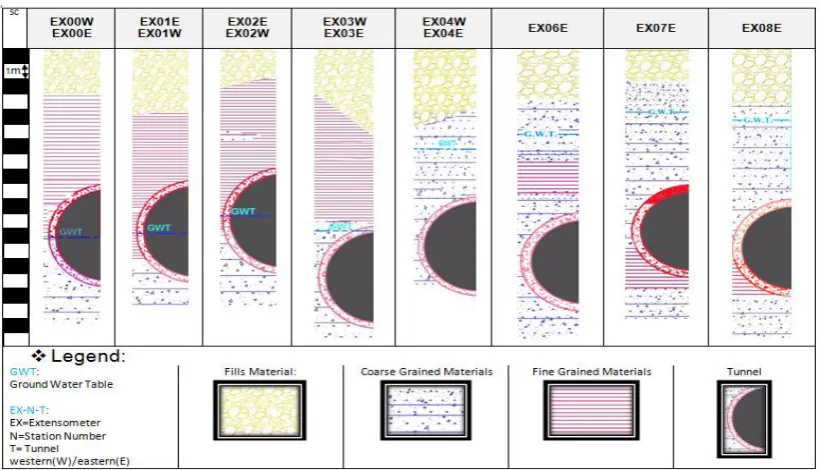
The instrumentation was carried out at 9 selected sections (stations no. 0 to 8) with multi-position borehole extensometers in a row for each station which were installed at proper points and depths, in order to monitor the ground settlement on a profile intersecting the tunnel alignment. Figure 7 illustrates the geological profile of the extensometer station number 5. Other station’s geological profile information is summarized in Figure 8.
Extensometer locations were selected in accordance with tunnel stations to record all the movements around and above the tunnel lines. According to the amount of the settlement, commonly the maximum movement recorded by instruments located exactly above the tunnel axes and this amount of displacement decreased laterally. A sample curve related to extensometer code EX03WA0, station no. 3 western tunnel with four anchors is illustrated in Figure 9 [34].
Figure 7. Geological cross section of extensometer station number 5
24 Int J Min & Geo-Eng (IJMGE), Vol. 47, No. 1, Jun. 2013, pp. -32
Figure 9. Displacement versus TBM distance from Extensometers Station no. 3
6. Heading confinement pressure calculation
According to the presented methods in section 2 and 3, the designed Heading confinement pressure for the safety factor 1 and 1.5, for the instrumentation stations no. 0 to 8 are given in Table 4 [35, 36]. Recently, several researches confirm significant impacts of machine tunneling parameters (thrust force, cutting wheel torques, grout injection pressure, etc) and process controlling on settlements [37, 38].
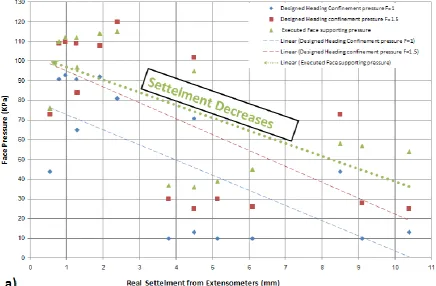
Nevertheless, considering the results of Table 4, executed face supporting pressure and real settlement values obtained from extensometer stations demonstrate the key role of face stability pressure on the surface displacement. As it is shown in Figure 10a, by approximating the executed face supporting pressure to the designed heading confinement pressure for safety factor 1.5, the amount of settlement decrease dramatically.
This result first validates the accuracy of the
designed heading confinement pressure and then proves the vital importance of face supporting pressure parameters in ground settlement for closed shield tunneling. Moreover, the graph in Figure 10b as well suggests the designed value of heading confinement pressure for the safety factor 1.5 as the best face supporting pressure for tunneling in sensitive locations in the city. Lowering the difference between the amount of executed face supporting pressure and the designed heading confinement pressure for the safety factor 1.5, yields a lower amount of settlement.
Furthermore, Figure 10b represents a significant conclusion by obtaining sizeable value for θ2. This confirms that a higher executed face supporting pressure than the designed heading confinement pressure for the safety factor 1.5 intensifies the face instability based on real settlement values from extensometers.
Table 4. Designed tunnel face supporting pressure for extensometer stations no.0 to 8 [35], [36]
Instrumentation
Station number Tunnel
Designed confinement pressure (F=1)(kPa)
Designed confinement pressure (F=1.5)(kPa)
0 Western-Eastern 10 26
1 Western-Eastern 10 30
2 Western-Eastern 13 25
3 Western-Eastern 44 73
4 Western-Eastern 93 110
5 Western-Eastern 91 109
6 Eastern Tunnel 71 102
7 Eastern Tunnel 65 84
8 Eastern Tunnel 95 120
Figure 10. Investigation of the relation between the executed face pressures, designed heading confinement pressure and settlement for Esfahan Metro project. a) This graph demonstrates that approximating the values of executed
face pressure to the designed heading confinement pressure for F=1.5 from right to left, ground settlement from Extensometers stations decrease. b) This graph confirms the result by illustrating the relation between ground settlement and deviation of executed average face pressure parameter from designed heading confinement pressure
26 Int J Min & Geo-Eng (IJMGE), Vol. 47, No. 1, Jun. 2013, pp. -32
This result is seen in the right hand side of Figure 10a as well. When applying higher pressure to the tunnel face than the designed heading confinement pressure for the safety factor 1.5, the pore pressure at the tunnel face increases significantly. The excess pore water pressure effect during EPB tunneling at the tunnel face has been investigated through case studies [22]. As we know,
Effective stress= Principal Insitu stress - pore pressure (1)
Hence, excess pore water pressure diminishes the effective stress [39]. Lower effective stress helps the soil grains to be dismissed and this function weakens material and reduces internal friction angle dramatically. Changing mechanical characteristics of soil may intensively reduce the tunnel face stability. As we know the executed face supporting pressure in EPBTBM’s is a function of several parameters like screw conveyer rotations speed, foam or bentonite injection rate, screw conveyer gate opening etc. Accordingly, face supporting pressure values with time do not move on a straight line. It means lower effective stress provides the condition for face instability and
the pressure variations shocked the soil and helped in face failures.
In addition to the analysis of monitoring stations’ results, which clearly shows the negative impact of higher executed pressure on face stability and settlement (Figure 10). Herein, a record of a face failure in the middle section of the Esfahan Subway Project is provided. After a period for tools inspection under hyperbaric condition, the machine advancement restarted with the previous designed heading confinement pressure. Unfortunately, during inspection period an equipment failure (Samsun Valves) caused the executed face supporting pressure to get much higher than the designed heading confinement pressure for the safety factor 1.5 (Figure 11). With the new advancement, higher values of soil excavation weight were recorded (over-excavation, ton). This uncontrollable situation continued for few meters and it intensified even with higher executed pressure and caused a big hole at the surface road (Figure 12). Fortunately, this incident took place at night and did not have casualties but gave us an important alarm for the rest of the project. “Higher executed face pressure than the designed heading confinement pressure for the safety factor 1.5 could even reduce the face stability”.
13
7 . Settlement analysis
The numerical procedure is performed by means of Combination Analysis Method (CAM), which presents facilities to settlement analysis in the EPBTBM tunneling process, as shown in Figure 13. As it is provided in Figure. 13, in this study settlement are analyzed in two different scenarios: prediction scenario and comparison scenario.
7.1 .Prediction scenarios
To predict settlement for this project, we
prepared promoted models by revising the primary model, as it was discussed in section 3. The promoted 3D numerical models used for settlement prediction by applying minimum designed heading confinement pressure to the tunnel face for sensitive locations in the city (Table 5). As it is provided in Table 5, controlling pressure within the designed limits, settlements at the tunnel axes for all locations is well acceptable and confirms the safe operation at distance close to these locations [40].
Table 5. Predicted settlements for some sensitive location through Esfahan Metro Project line employing Promoted 3D numerical model in Prediction scenarios. For these calculations designed heading confinement pressure for
safety factor 1 is applied to the tunnel face of the 3D numerical model [40]
Sensitive Locations Predicted Settlement (mm)
North of Chaharbagh Bolivard 4.5
Chahar-bagh School (historical structure) 2.3 North of Siosepol Bridge (historical bridge) 1.4 South of Si o se pol Bridge (historical bridge) 1.3
Suit Hotel 3.1
Baran Complex 2.2
Figure 12. Surface failure at middle section of Esfahan Metro Project
E
x
e
c
u
te
d
F
a
c
e
S
u
p
p
o
rt
in
g
P
re
s
s
u
re
(B
lu
e
L
in
e
)
Q
u
a
n
tit
y
o
f E
x
c
a
v
a
te
d
M
a
te
ria
l (
to
n
)
Higher Executed face supporting Pressure
Increasing excavated material (ton)-Failure Sensor
Noises
SF 1.5
28 Int J Min & Geo-Eng (IJMGE), Vol. 47, No. 1, Jun. 2013, pp. -32
Figure 13. Flowchart of CAM showing the tunnel analysis procedure
7.2. Comparison scenarios
These scenarios were performed after the tunnel passed through extensometers station. Promoted 3D numerical models from previous scenarios were used for settlement calculations. This time executed maximum, minimum and average face supporting pressure are applied to the tunnel face of the 3D promoted model. The maximum, minimum and average calculated settlements corresponding to the minimum, maximum and average executed face pressure respectively at the point of the stations were considered. A comparison between extensometers output and
calculated displacement is illustrated respectively in Figures 14a, b, c for max., min. and average settlement. As it is shown in Figures 14a to c, there is a great adjustment between the real displacement and the calculated maximum displacement which refers to the minimum executed face supporting pressure applied to the tunnel face of the 3D numerical model. This logical result proves the sensibility of the ground displacement to the small fluctuations of minimum executed face supporting pressure. On the other hand, as the minimum executed face supporting pressure
Geometry, Loads, Material, Mesh,
Initial Condition, Stress
Primary
Model FEM
analysis
Prediction
Scenario
Compariso
n Scenario
HeadingConfinement pressure (LM)
Heading Confinement pressure (FEM)
Total Multiply Phase
Executed face supporting
pressure Activate support element in the i th step
Remove excavation elements in the i th step
Interface effect in the i th step
Surface loads in the i th step
Grouting in the 9th step
Extensometers Output Fig.2
Settlement
analysis
END
START
Pore water pressure in the i th step
applied to the tunnel facedecreases, the settlement value increases and this could be dangerous when this minimum executed pressure approximates to the minimum designed heading confinement pressure for the safety factor 1 and causes failures.
This study also presents a good coordination between the presented Combination Analysis Method (CAM) in this study and the real settlement. According to this study, to predict settlements in all sensitive locations, minimum executed face supporting pressure must be used in CAM analyses and this conclusion adapts well with other similar experiences in different case studies in Iran like Tabriz and Shiraz subway projects.
8. Conclusions
This study provides the following conclusions for tunneling with EPBTBM in soft materials like the situation presented for the Esfahan Subway Project:
While predicting the settlements for EPB shield tunneling, appropriate heading confinement pressure must be considered for all calculations. On the other hand, these two parameters have a close relationship.
As it is proved the ground settlement is highly affected by the small fluctuations of minimum executed pressure. Thus even though the average and maximum executed face supporting pressure is still above the designed heading confinement pressure for the safety factor 1, changing the minimum pressure (in small fluctuations) lower than the designed pressure for the safety factor 1, would increases the settlement and yields to soil failures.
Lowering the disparity between the executed face supporting pressure and the designed heading confinement pressure for the safety factor 1.5 would decrease the settlement. On the other hand higher executed face supporting pressure than designed heading confinement pressure for the safety factor 1.5 reduces the tunnel face stability severely. Therefore, the designed heading confinement pressure for the safety factor 1.5 with the given method is the best value during excavation with EPB machines while interacting with fragile constructions.
30 Int J Min & Geo-Eng (IJMGE), Vol. 47, No. 1, Jun. 2013, pp. -32
Figure 14. Comparison between real values of settlement from extensometers stations no. 0 to 8 for both western and eastern tunnels and the calculated values of settlement with 3D numerical method. a) This graph evaluates maximum calculated settlement with extensometers output. This graph shows the great adjustment between the real and calculated amounts. b) This graph compares average calculated settlement with extensometers output. c) This graph compares minimum calculated settlement with extensometers
output.
References
[1] Peck, R.B., (1969). Deep excavations and tunnelling in soft ground. In: Proceedings of the 7th International Conference on Soil Mechanics and Foundation Engineering, State of the Art Volume, vol. 3. Mexican Society of Soil Mechanics, Mexico, pp. 225–290
[2] Attewell, P.B., Woodman. (1982). Predicting the Dynamics of Ground Settlement and its Derivatives Caused by Tunneling in Soil. Ground Eng. 15(8), pp.13-22
[3] Attewell, P.B. Taylor, R. K. (1984). Ground Movements and their Effects on Structures, Chapman and Hall, New York, U.S.A., pp. 132-140
[4] Loganathan, N., Poulos, H.G., (1998). Analytical prediction for tunneling induced ground movements in clays. Journal of Geotechnical and Geoenvironmental Engineering 124 (9), 846–856.
[5] Chen, L.T., Poulos, H.G., Loganathan, N., (1999). Pile responses caused by tunnelling. Journal of Geotechnical and Geoenvironmental Engineering 125 (3), 207– 215.
[6] Chiriotti, E., Grasso, P., Gaj, F. and Giacomin, G., (2004). Risk Control for Mechanized Tunneling in Urban Areas. Proc. IX National Geotechnical Congress, Aveiro, Portugal. [7] Yamaguchi, I., Yamazaki, I., Kiritani, Y.,
(1998). Study of ground-tunnel interactions of four shield tunnels driven in close proximity, in relation to design and construction of parallel shield tunnels.Tunnelling and Underground Space Technology 13 (3), 289– 304
[8] Augarde, C.E., Burd, H.J., (2001). Three-dimensional finite element analysis of lined tunnels. International Journal for Numerical and Analytical Methods in Geomechanics 25, 243–262
[9] Mroueh, H., Shahrour, I., (2003). A full 3-D finite element analysis of tunnelling-adjacent structures interaction. Computers and Geotechnics 30, 245–253
[10] Franzius, J.N. (2003). Behaviour of buildings due to tunnel induced subsidence. PhD Thesis.Imperial College of Science, Technology and Medicine, London, UK. [11] Galli, G., Grimaldi, A., Leonardi, A., (2004).
Three-dimensional modelling of tunnel excavation and lining.Computers and Geotechnics 31, 171– 183.
[12]Finno, R.J., Clough, G.W., (1985). Evaluation of soil response to EPB shields tunneling.
J. of Geotechnical Engineering 111 (2), 155– 173.
[13] Chiorboli, M.A., Marcheselli, P.P., (1996). Analysis and control of subsidence due to earth pressure shield tunneling in Passante Ferroviario of Milano. In: Proceedings, International Conference on North American Tunneling_96. Balkema, Rotterdam, pp. 97– 106.
[14] Suwansawat, S., Einstein, H.H., (2005). Artificial neural networks for predicting the maximum surface settlement caused by EPB shield tunneling. J. Tunneling and underground spaces technology 21 133–150 [15] Maidl, B., Herrenknecht, M. & Anheuser, L.
(1996) .Mechanized Shield Tunneling, Ernst &sohn, Berlin.
[16] Broere, W, (2001). Tunnel Face Stubility and New CPT Applications. PhD Thesis-Technical University of Delf.
[17] Leca, E., Dormieux, L., (1990). Upper and Lower Bound Solutions for the Face Stability of Shallow Circular Tunnel in Frictional Material. Geotechnique 40(4), pp.581-606
[18] Jancsecz, S., and Steiner, W., (1994). Face Support for a Large Mix-Shield in Heterogeneous Ground Conditions. Tunneling 94, London,
[19] Anagnostou, G., Kovari, K., (1994). The Face stability of Slurry-Shield-Driven Tunnels.Tunneling and Underground Spaces Technology. 9(2), pp.165-174
[20] Carrenza-Torres, C., (2004). Computation of Factor of Safty for Shallow Tunnels using Caquots Lower Bound Solution. Technical Report for Geodata, Turin,
[21] Lambrughi, A., Medina Rodriguez, L., Castellanz, R., (2012). Development and Validation of a 3D numerical model for TBM-EPB mechanized excavation. Computer and Geotechnics, 97-113
[22] Chen, R.P., Tang, L.J., Ling, D.S., Chen, Y.M., (2011). Face stability analysis of shallow shield tunnels in dry sandy ground using the discrete element method, Computer and Geotechnics, 187-195
[23] Liu, H.Y., Small, J.C., Carter, J.P., (2008). Full 3D modeling for effects of tunneling on existing support systems in the Sydney region. J. of tunneling and underground spaces technology, 23, 399-420
32 Int J Min & Geo-Eng (IJMGE), Vol. 47, No. 1, Jun. 2013, pp.12-32
Methods in Geomechanics, (Innsbruck 1988), Balkema, Rotterdam, ISBN 906191 809X.
[25]Terzaghi, K. (1943). Theoretical soil mechanics. New York: Wiley
[26] Chen, R.P., Zhu, J., Liu, W., Tang, X.W., (2011). Ground movement induced by parallel EPB tunnels in silty soils, Tunneling and Underground Space Technology, 163-171.
[27] Brinkgreve, R. B. J., Broere, W., (2004). PLAXIS 3D Tunnel manuals, Version 2.Online manual.
[28] Taheri, A., Haghi, A.H., (2010), Comparison between real and calculated values of ground settlement corresponding to EPBM tunneling for Esfahan Subway Project, 4th International conference of soil mechanic and Geotechnical engineering, Tehran, Iran [29] Potts, D.M., Zdravkovic, L. (2001). Finite
element analysis in geotechnical engineering: application. Thomas Telford, London, UK [30] Namazi, E., Mohamad, H., Jorat, M.E.,
Hhajihassani, M., (2011). Investigation on the effects of twin tunnel excavation bebeath a road underpass. Electronic J. of geotechnical engineering. Vol. 16
[31] Taheri, A., (2009). Report on Environmental Measures Taken for Protection of Chahar-Bagh Historical Boulevard Properties reported by Zaminfanavaran Consulting Engineer (ZAFA), Esfahan, Iran,
[32] Taheri. A., (1999) and (2001) to (2005). Geotechnical Investigations Reported by Zaminfanavaran Consulting Engineer (ZAFA), Esfahan, Iran
[33] Lioa, J. S., Pan, K. L., Haimson, B. C., (1991). The Monitoring and Investigation of Ground Subsidence in Southwestern Taiwan, Proceedings of the Fourth International Symposium on Land Subsidence, IAHS, Publ. No. 200.
[34] Haghi, A.H., Afsharipour, B., Rasa, Tahmasebi, O., (2006) to (2011). Settlement Determination from Extensometer Stations No.0 to 8 Reportedby Zaminfanavaran Consulting Engineer (ZAFA), Esfahan, Iran, [35] Mohkam, M., (2005) to (2011). Tunneling
Parameters Designing Report no. 1 to 10 from Zaminfanavaran Consulting Engineer (ZAFA), Iran, Esfahan
[36] Haghi, A.H., (2011). Tunneling Parameters Designing Report no. 11 and 12 from Zaminfanavaran Consulting Engineer(ZAFA), Esfahan, Iran.
[37] Taheri, A., Haghi, A.H., (2011). Process Controlling of TBM of Esfahan Metro for Safety of Heritage Structures, 14th Asian Regional Conference for ISSMGE, ATC19 special session, Hong Kong [38] QianweiXu, Hehua Zhu, Wenqi Ding, XiurunGe, (2011). Laboratory model tests and field investigations of EPB shiled machine tunneling in soft ground in Shanghai”, J. Tunneling and Underground Spaces Technology, Volume 26, Issue 1, Pages 1-14 [38] QianweiXu, Hehua Zhu, Wenqi Ding,
XiurunGe, (2011). Laboratory model tests and field investigations of EPB shiled machine tunneling in soft ground in Shanghai”, J. Tunneling and Underground Spaces Technology, Volume 26, Issue 1, Pages 1-14
[39] Hudson, J.A., Harrison, J.P., (1997). Engineer Rock Mechanics: an introduction to the principles and Applications. Elsevier Science Ltd
![Table 2. Deformability and Mohr-Coulomb shear strength parameters of the soil strata [32]](https://thumb-us.123doks.com/thumbv2/123dok_us/8957509.1866877/10.595.98.499.666.778/table-deformability-mohr-coulomb-shear-strength-parameters-strata.webp)