T E C H N I C A L A D V A N C E
Open Access
Privacy-preserving record linkage in large
databases using secure multiparty
computation
Peeter Laud
1*and Alisa Pankova
1,2FromiDASH Privacy and Security Workshop 2017
Orlando, FL, USA.14 October 2017
Abstract
Background: Practical applications for data analysis may require combining multiple databases belonging to different owners, such as health centers. The analysis should be performed without violating privacy of neither the centers themselves, nor the patients whose records these centers store. To avoid biased analysis results, it may be important to remove duplicate records among the centers, so that each patient’s data would be taken into account only once. This task is very closely related to privacy-preserving record linkage.
Methods: This paper presents a solution to privacy-preserving deduplication among records of several databases using secure multiparty computation. It is build upon one of the fastest practical secure multiparty computation platforms, called Sharemind.
Results: The tests on ca 10 million records of simulated databases with 1000 health centers of 10000 records each show that the computation is feasible in practice. The expected running time of the experiment is ca. 30 min for computing servers connected over 100 Mbit/s WAN, the expected error of the results is 2−40, and no errors have been detected for the particular test set that we used for our benchmarks.
Conclusions: The solution is ready for practical use. It has well-defined security properties, implied by the properties of Sharemind platform. The solution assumes that exact matching of records is required, and a possible future research would be extending it to approximate matching.
Keywords: Secure multiparty computation, Privacy-preserving record linkage, Deduplication, Privacy
Background
In this paper, we present a solution to the first track of iDASH 2017 competition [1], titled De-duplication for Global Alliance for Genomics and Health (GA4GH). The goal is to develop privacy-preserving record linkage (PPRL) technique on top of existing European ENCCA Unified Patient Identifier (EUPID) framework to facilitate the deduplication task in GA4GH [2].
There is a large number of data providers, called health-care centers. They all have lists of patients. They want to know whether anyone else has the same patient in
*Correspondence:[email protected]
1Cybernetica AS, Ülikooli 2, 51003 Tartu, Estonia
Full list of author information is available at the end of the article
the list. This knowledge would allow them to exclude the duplicates from further data analysis, making it more efficient and less biased. Since each center uses its own local identities for its patients, they need to use so-called quasi-identifierssuch as patient name and his date of birth to link the records, and this information may be sensi-tive. The centers could potentially agree on some kind of anonymization, replacing the quasi-identifiers with some random numbers. However, this is in general not suf-ficient, as e.g. seeing that some patient is present in exactly the centers A, B, C could already potentially leak more information about the patient. For example, if the observer already knew the patient records of A, he would in addition learn that these patients have also visited the
centers B and C. Mechanisms stronger than anonymiza-tion are needed to overcome this problem.
Technical details of the task
In the competition setting, the patient list of a health center is presented as a table, the columns of which are correspond to the patient’s sensitive data, such as “first name”, “last name”, “date of birth”, “sex”, etc. Two records are considered the same if a certain combination of their attributes matches, e.g. concatenation of the name and the date of birth. For simplicity, it is assumed that the records are already pre-formatted, and possible typos should not be taken into account (we will discuss exact and approx-imate matching in the “Discussion” section). For each record, the centers compute the required combination of the attributes, and hash it. They then upload all hashes to the ideal computing machine, implemented with the help of Secure Multiparty Computation (SMC). The machine tells to each center, which of its records are also present in someone else’s dataset, but it does not tell to whom exactly these records belong. The machine itself should be real-ized by k ≥ 3 specially assigned servers, and no server should learn the values of uploaded hashes, since hashing is used only for shortness of representation and does not provide privacy by itself.
The targeted size of the computation is ca. 1000 centers, with ca. 10000 records each. The competition organiz-ers have made available a test set with 1000 tables, each containing around 10000 records.
There are certain details about the data input and out-put, which make this task more specific:
• The data is not uploaded instantaneously by all centers. It is uploaded over time, so the ideal computing machine may have significant resources left over, while waiting for the next inputs.
• The first uploader of each record does not get it indicated as a duplicate, even if more copies of the same record are uploaded later. The record is indicated as a duplicate only to the next uploaders.
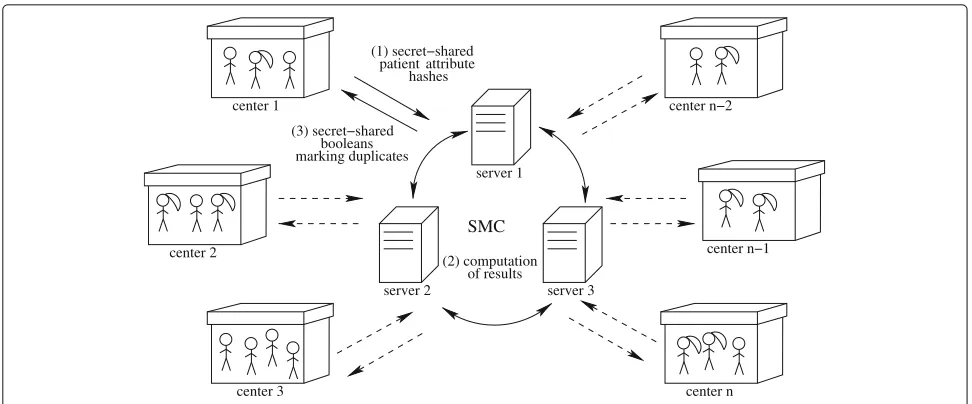
The system diagram is depicted in Fig. 1. There aren healthcare centers, indexed in the order they provide data. The data is uploaded to the servers in form of secret-shared hashes of records (1). After SMC servers compute the results on this data (2), they report to each center a list of booleans marking the duplicates (3), i.e. the records that have already occured in the centers with smaller indices. The results are returned to the centers in a secret-shared manner, so that no server will learn them, but the receiver center is able to reconstruct his answer from shares. In the end, each center knows which records it should dis-card to avoid repetitions with the other centers, and the remaining records may now be used for any other task, e.g. data analysis using other SMC protocols.
There can be two ways in which the final outputs should actually be delivered to the centers. These are different tasks with different challenges and solution possibilities. We will consider them both.
1. In our first solution, the results are sent out to the centers only after all uploads have finished. It is fine as far as all 1000 centers will agree to contribute their data more or less simultaneously, so that the first uploader will not have to wait for too long. We provide a faster and a more secure algorithm for this setting.
2. In our second solution, each upload of a bunch of records by a center is immediately followed by a response from the servers. This algorithm has to be used in the case when some centers may need more time to contribute their data, but the faster uploaders already want to get the results. It is more difficult to preserve privacy in this case.
Related work
There are numerous papers about PPRL, including (but not limited to) solutions based on Bloom filters for string approximate matching [3,4], extensions of Bloom filters to matching of numerical data [5], as well as provably secure multiparty protocols [6]. Some practical implementations of PPRL include [7], describing a protocol where the link-ing is delegated to the patient himself, and [8], based on matching seeded hashes, which describes in details which preprocessing steps should be applied to the data to make it better linkable. An extensive state-of-the art overview of this topic in the beginning of 2017 has been given in [9].
Similarly to other privacy-preserving computation tasks, the two main approaches to PPRL are Secure Multi-party Computation (SMC) techniques and data perturba-tion techniques. The SMC approach is in general less effi-cient, but it provides clear security guarantees, while data perturbation methods can be severely broken due to infor-mal security definitions that they provide [10]. For exam-ple, some cryptanalysis of Bloom filter based solutions has been performed in [11,12]. They show some inter-esting attacks, including patient name frequency analysis. The iDASH 2017 competition has been focused on SMC methods.
server 1
server 3 patient attribute
hashes
SMC
booleans marking duplicates center 1
center 2
center 3
center n−2
center n−1
center n (2) computation
of results (3) secret−shared
(1) secret−shared
server 2
Fig. 1System diagram. The setting to which the solutions proposed in this paper are applied
parties are specially assigned servers, whose number does not depend on the total number of health centers partic-ipating. The centers themselves are both input and result parties, each of them receiving a different subset of the outcomes.
In our solution, we assume three computation parties, since this is the setting for which the fastest SMC proto-cols are known, and mature computation platforms exist. The solution makes use of the following assumptions, allowed by the competition:
1. Honest majority: at most 1 of 3 servers can be corrupted.
2. Honest-but-curious (passive) adversaries: the corrupted server follows the protocol, but the attacker may get access to all messages received by this server.
As far as these assumptions are satisfied, the only things that may be inferred by the servers from the computation are the following. The first type of leakage is the “duplica-tion pattern”:for each n∈N, how many records are there, that occur in the lists of all data providers exactly n times? In the context of our task, this leaks how many patients have been registered in exactlynhospitals, but this num-ber is not correlated with particular records or hospitals in any way. The second type of leakage is:how many dupli-cates have been reported to the health center?It does not allow to correlate the duplicates of different centers in any way, and it only leaks that somenpatients of this center have visited some other center. We note that, in our solu-tions, either the first or the second type of leakage takes place, but never both at once.
Some points for evaluating a PPRL algorithm have been mentioned in [9]. According to their framework, our solu-tion could be assessed as follows:
• Scalability:The network communication
complexity of the first algorithm isO(n), wheren is the total number of records that all the clients hold. e.g. if there arem clients holding k records each, then n=mk. The complexity of the second algorithm is formallyO(n2), but we keep the constant small by using an elaborated filtering technique, which allow to reduce the number of comparisons up to 10 times compared to straightforward pairwise comparison, while slightly sacrificing the answer precision. We note that the running time of the second solution is actually more affected by heavy local computation than by network communication.
• Linkage quality:Our solution aims to achieve exact matching, as it was required by the test dataset. The loss in correctness is limited by2−40in our
application. It happens mainly due to the initial application of a hash function to the inputs, which was a competition’s requirement anyway, and also due to dropping some bits in order to match data types that Sharemind supports. In the second solution, some more correctness is sacrificed to gain better efficiency.
• Privacy:It is guaranteed that we leak no more than the total number of patients that have been registered in exactlyn hospitals (the first solution), or the number of duplicated records in one client’s data (the second solution).
Methods
The Sharemind platform
the description of a privacy-preserving application (in our case, the deduplication), where the cryptographic details are abstracted away. From the application developer’s point of view, different pieces of data are merely labeled as “public” or “private”. The private data will never be learned by any of the servers, unless it is deliberatelydeclassified (i.e. opened to all servers) by the application. While the public values are stored at each server in plain, the private values are stored in a secret-shared manner, preventing a single server from learning its value. Underneath, the vir-tual machine executes cryptographic protocols to perform operations on private secret-shared data, which in general requires interaction between the servers. The underlying cryptographic protocols have been proven to be compos-able [15], meaning that the applications do not need to undergo any additional security proofs. Only deliberate declassification of values needs to be justified. This also concerns the deduplication that we present in this paper.
The main protocol set of Sharemind [16], denoted
shared3p, is based on additive sharing among three par-ties. The private representation of a valueu ∈ Rfrom a finitering R is denoted byu, and is defined as u = (u1,u2,u3), where theshareui ∈ Ris held by the i-th server. The shares are random elements ofR, with the constraint that the sum up tou. Hence, if anyone man-ages to get only one or two shares ofu, he cannot infer any information aboutu. In [16], the authors have presented protocols for a number of basic arithmetic, relational and logical operations, such as addition, multiplication, comparisons, etc., transforming shares of the inputs into shares of the output. The supported rings areZ2nandZn2,
and several different rings may be in used simultaneously in the same application. There are special protocols for converting shares between different rings. This basic set of operations has been extended in numerous follow-up papers [17–22].
The protocols ofshared3pare secure against one pas-sively corrupted party. Our deduplication application is built on top of them. In the rest of this section, we present all algorithms that we used in our application. In the loops, we use foreach and while to denote parallelizable loops, whilst for loops are sequential. Parallelization is important due to the latency of all non-linear operations with private values, due to the need to exchange mes-sages between computation servers. We denote vectors as
x= x1,. . .,xn.
The first solution: output all results once in the end
In out first solution, the results of computation are only available at the end, after all clients (the health centers) have uploaded the hashes of their records. The outline of the process is the following. In the first phase, the SMC servers are collecting input data from the clients, with-out performing any deduplication detection on it. When
the uploads have ceased (e.g. the deadline or some other trigger event has happened), the servers stop collecting the data. They run the deduplication algorithm on all data they managed to collect so far, and give to each client its personal output. If a record is duplicated, then the client that first uploaded it will not be notified that it is a dupli-cate. All other clients that have uploaded the same record will receive a notification about it.
Cryptographic building blocks
We fix two cryptographic functions: the hash function H:{0, 1}∗→ {0, 1}η, and a block cipherE:{0, 1}η×K→
{0, 1}η, where K is the set of possible keys for E. The block size of E should be the same as the output length of H, so that we could applyE directly to the output of H. The challenge is that we will applyEto secret-shared values, and hence the block cipher E has to be easily computable under SMC. We have picked AES-128 asE, and the privacy-preserving implementation of AES-128 is already available in Sharemind [19]. There exist newer, possibly more efficient implementations of AES [23], as well as proposals for SMC-optimized block ciphers [24], which have not been implemented on Sharemind yet, and could potentially speed the computation up.
In our solution, we have takenη=128. We letHbe the composition of SHA-256 cryptographic hash function and a universal one-way hash function family (UOWHF) [25].
Computation on the client side
The behaviour of a client is described in Algorithm 1. At start-up, each client queries the Sharemind servers for the random parameters of the UOWHFH, which the servers generate in the beginning. Each client takes the
Algorithm 1:Client computation
Data: Patient recordsp1,. . .,pn
Result: Booleansb1,. . .,bn, wherebi=1 iffpiis a
duplicate
beginclient(p1,. . .,pn
Receive parametersa,rfrom the servers. η←128
foreachi=0 ton−1 do
Letsibe concatenation of key attributes ofpi. x←SHA256(si)
hi←(a·x+r)mod 2η
Sendhito the servers.
end
foreachi=0 ton−1 do
Receive a boolean valuebifrom the servers.
Ifbi=1, then thei-th record is a duplicate.
end
returnb1,. . .,bn
input records as soon as they become available, picks the necessary attributes from each record, appliesHto them, and uploads the hashes to Sharemind servers in secret-shared manner. The Sharemind API readily supports that. At this point, no server learns the exact values of the hashes, since they are all secret-shared.
In the end, when the servers have finished the compu-tation, the client queries them for its personal result. The servers respond with the shares of the output, which is a vector of booleans of the same length as the number of records from this client, indicating whether a record is a duplicate one. The client reconstructs the result vector. Again, the Sharemind API already has support for that.
Computation on the server side
We describe the work of the servers in phases.
Start-up. This short phase is given in Algorithm 2. The servers privately generate the following random values:
• parameters of the hash functionH ; • a keyKfor the block cipherE.
All these values are generated in such a way that they remain secret-shared among the servers, and no server actually learns them. Sharemind API supports such shared randomness generation, and we denote the corresponding functionality asrandom.
The servers initialize a public variablecnt ← 0. It will be used for indexation of clients.
Algorithm 2:Start-up
beginserverStartup()
K←random(2128)
a←declassify(random(2128)) r←declassify(random(2128)) cnt←0
whilemore clients are connectingdo
Senda,rto the client.
end end
Upload During the upload phase, two different activity threads are essentially taking place in parallel.
One thread is the actual acceptance of data from the clients, described in Algorithm 3. The hashes of clients are stored into an private arrayv, and the correspond-ing client identities into a public arraysunder the same indices. In principle, this algorithm could be invoked sev-eral times for the same client, if it intends to split up the upload of its data. Several clients may want to connect to the servers at the same time, so we need to make use of Sharemind’s database support to avoid race condition oncnt.
Algorithm 3:Uploading data to servers
beginserverReceiveUploads()
whilemore data comingdo
Let the client upload the hashhof a record Letidbe the identity of the client
vcnt←h scnt ←id cnt←cnt+1
end end
The other thread of activity is encrypting the elements
vi. For eachi, the servers evaluateEonviin a
privacy-preserving way, using the same keyKfor each encryp-tion, and take the first 64 bits of the result, as described in Algorithm 4. The only reason why we take only 64 of 128 bits is that the largest ring that Sharemind currently supports isZ264. There are no problems with taking only
64 bits, as long as there are no collisions. With the envi-sioned amounts of data (around 107 = 223.5 records in total), collisions are unlikely; the birthday paradox puts their probability at around 2−64+2·23.5 = 2−17. We note that the communication complexity also reduces with the number of bits of the data types.
Algorithm 4:Computing encryptions of hashes
Data: Private valuesv0,. . .,vcnt−1
Result: Private valuesc0,. . .,ccnt−1, whereciis an
encryption ofvifor alli∈ {0,. . .,cnt−1}
beginencrypt(v0,. . .,vcnt−1)
foreachi=0 tocnt−1 do
ei←E(K,vi)
ci←leftbits64(ei)
end
returnc0,. . .,ccnt
end
In our implementation, evaluation ofE can take place either immediately after the data upload, or it can be run in a separate thread, waiting until more data comes to pro-cess it all in parallel. In any case, the application ofE is done in parallelized manner, batching up the hashes that are waiting for being processed so far.
secret-shared, it only reveals the “duplication pattern”, i.e. how many values occur there exactlyntimes. The private shuf-fle [26] in theshared3pprotocol set is highly efficient: the amount of communication is linear in the size of the shuf-fled vector, and the number of communication rounds is constant. It also allows to easily apply the shuffle inverse, which is as efficient as the shuffle itself.
Algorithm 5:Finding the duplicates
Data: Private encryptionsc0,. . .,ccnt−1
Data: Public client identitiess0,. . .,scnt−1, where the
recordcibelongs tosifor alli∈ {0,. . .,cnt−1}.
beginserverMain(c0,. . .,ccnt−1,s0,. . .,scnt−1)
Generate a random permutationσforcnt elements.
w←shuffle(σ,c)
t←shuffle(σ,0, 1,. . .,cnt−1)
w←declassify(w)
foreachi∈ {0,. . .,cnt−1}, such that wiunique in
wdo
ri←false
end
foreachvalue ct occurring inw several times do
{i1,. . .,ik} ← positions, wherectoccurs inw
ri1,. . .,rik ←findmin(ti1,. . .,tik)//Alg. 6
end
b←inverse_shuffle(σ,r)
fori=0 tocnt−1 do
outputbito the data providersi
end end
At this point, the servers could already mark the dupli-cates with boolean values 1 and the remaining values with 0. After the obtained vector is privately shuffled back, the servers can return the secret shared bits to the clients, so that thei-th clients learns the bits indicating the duplicity of its own records. The problem is that the servers need to notify all clients except the first one, but because of shuf-fling they do not know which entry belongs to the first client. They cannot declassify the client indicessieither
since it would partially undo the shuffling.
In order to determine which value belongs to the first client, the servers run Algorithm 6. This algorithm is applied to each set of shuffled entries that have identi-cal values, to determine the minimum amongst them. The minimum should be labeled falsesince it is not consid-ered a duplicate, and all other elements should be labeled true. The idea behind this recursive algorithm is the fol-lowing. The inputs are split into pairs, and a comparison performed within each pair. The element that is larger is definitely not the minimum of the entire set, so we can
immediately writebi := true. The indices of all elements
that turned out to be smaller are stored intomi, and the
whole algorithm is now applied again to the elements indexed bymi. The procedure is repeated until there are
is only one element left, which is the minimum, so the algorithm returnsfalsein one-element case.
Although Algorithm 6 works with private values, it reveals the ordering between certain elements of t. Because of the random shuffle, the ordering of this vector is completely random, so it does not disclose any informa-tion. No server learns from the output more than it would from a random permutation.
Algorithm 6:Finding the minimum of private values with public ordering
Data: Private numbersx1,. . .,xk, all different
Result: Public booleansb1,. . .,bkwherebi=falseiff xiis the smallest amongx1,. . .,xk
beginfindmin(x1,. . .,xk)
ifk=1 then returnfalse← k/2
foreachi∈ {1,. . .,}do
ifdeclassify(xi<xi+)then
mi←i bi+←true
else
mi←i+ bi←true
end end
ifk is oddthen
←+1 m←k
end
bm1,. . .,bm ←findmin(xm1,. . .,xm)
//Alg. 6 returnb1,. . .,bk
end
The second solution: output results immediately
Our second solution considers the case where the client is immediately notified, which of its hashes of records have already been uploaded by some previous client. This task is more difficult than the previous one. We cannot simply declassify the encrypted hashes when they arrive, since it would leak which pairs of centers have intersecting sets of records.
The second solution has the same componentsE and H as the first solution, constructed in the same manner. Again, the computation servers agree on the key Kin the beginning, as well as the parameters ofH.
Computation on the client side
immediately, so the client most likely does not interrupt the session with the servers, and stays connected until it receives the result.
Computation on the server side
Assume that the servers already storeTencrypted hashes (zero or more), provided by the previous clients. These T hashes have been stored as public values z1,. . .,zT,
whereziis equal to the first 64 bits ofE(K,vi). Duplicates
have already been removed amongz1,. . .,zT. Assuming
that duplicates never end up amongz1,. . .,zT, sinceK
remains private, z1,. . .,zT are computationally
indistin-guishable fromTuniformly randomly distributed values, so it is safe to make them public.
The 64-bit valuesz1,. . .,zTare kept in 2Bbuckets,
num-bered from 0 to 2B−1. In our implementation,B = 16.
Each bucket is just a vector of values. Eachziis assigned
to the bucket Bj, wherejis equal to the first 16 bits ofzi.
Now suppose that a center has uploaded the hashes
v1,. . .,vt. The servers need to check whether these
hashes has occurred before. The computation starts by encrypting each vi. Let z1,. . .,zt be the results of
encryption, computed byzi = leftbits64(E(K,vi)).
We cannot immediately declassify them since it would leak which pairs of centers have intersecting sets of records. Instead, we should use privacy-preserving com-parison.
We do not want to simply invoke the private compar-ison protocol for each zi andzj, because we consider
their number to be too large. Indeed, as we are aiming to handle ca. 10 million records, this method would cause us to compare each pair of records, leading to ca. 5·1013 invocations of the comparison protocol. An-bit compar-ison requires slightly more network communication than a-bit multiplication [16], with the latter requiring each computation server to send and receive two-bit values [17]. If=64 and there are 5·1013operations, then each server has to send out and receive at least 6·1015 bits, which on a 100 Mb/s network (specified in the conditions of the competition task) would take almost two years.
We reduce the number of comparisons in the following manner. Letzbe one of the private valuesz1,. . .,zt; all t values are handled in parallel. The comparison of
z with z1,. . .,zT is described in Algorithm 7. In this
algorithm, we let N be the maximum size of a bucket. We denote thej-th element of thei-th bucket by Bi,j. We
assume that each bucket has exactlyN elements, adding special dummy elements if necessary.
The characteristic vector of an element x ∈ ZM is
a vector b0,. . .,bM−1 ∈ ZM2, where bx = 1 and all
other elements are equal to 0. Theshared3pprotocol set has a simple and efficient protocol for computing char-acteristic vectors, described in [27]. The protocol turns a private value into a private characteristic vector. The
characteristic vector of leftbits16(z) marks the index of the bucket to which z belongs, and the expres-sion 2i=0B−1bi·Bi,j returns exactly thej-th element of
that bucket, which we denote yj. This way, the
val-ues y1,. . .,yN are the privately represented content
of the bucket, into which z would belong. The private comparisonz =? yjis performed for allj, thus
com-paringzagainst each element that belongs to thei-th bucket. Finally, b = nj=1cj is the private OR of all
comparisons, which tells whether there had been at least one match. The private bitsb1,. . .,btresulting from
applying Algorithm 7 to allz1,. . .,ztare returned to the client.
Algorithm 7:Comparingzagainstz1,. . .,zT
Data: Public numbersz1,. . .,zT, all different
Data: A private numberz
Result: Private booleanbwhereb=trueiffz=zjfor
somej∈ {1,. . .,T}
begincompare(z,z1,. . .,zT)
Letzibe partitioned to 2Bbuckets Bjby firstBbits.
Compute the characteristic vector
b0,. . .,b2B−1ofleftbitsB(z).
foreachj∈ {1,. . .,N}do
yj←2
B−1
i=0 bi·Bi,j
cj←z=? yj
end
returnb=nj=1cj
end
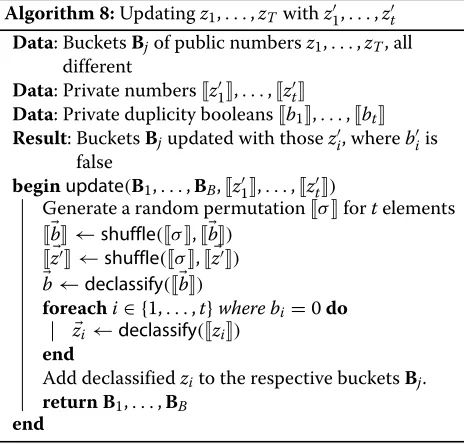
After returning the answer to the client, the buckets have to be updated withz1,. . .,zt. It is safe to declassify
zi if bi = 0, since in this case zi cannot be
corre-lated to any ofzi and is indistinguishable from a random
value. However, we cannot immediately declassify the vec-torb, because the positions of duplicated elements may give away information about the input data. Since we are allowed to leak the total number of duplicated entries per client, we can do as described in Algorithm 8:
1. randomly shuffleb1,. . .,btandz1,. . .,zt, using the same permutation;
2. declassifyb;
3. declassify thosezi, wherebi=0, and add thesezi to the respective buckets.
Algorithm 8:Updatingz1,. . .,zTwithz1,. . .,zt
Data: Buckets Bjof public numbersz1,. . .,zT, all
different
Data: Private numbersz1,. . .,zt
Data: Private duplicity booleansb1,. . .,bt
Result: Buckets Bjupdated with thosezi, wherebiis
false
beginupdate(B1,. . ., BB,z1,. . .,zt)
Generate a random permutationσfortelements
b←shuffle(σ,b)
z←shuffle(σ,z)
b←declassify(b)
foreachi∈ {1,. . .,t}where bi=0 do
zi←declassify(zi)
end
Add declassifiedzito the respective buckets Bj.
return B1,. . ., BB
end
length 2B. The computation of the characteristic vector
requires communication of two elements of ZB2 and one element ofZ22B (intotal, not per party).
The computation ofyjin Algorithm 7 is again a local
operation. The computations ofcjand their disjunction
are straightforward using the protocols available in the
shared3pset of Sharemind.
Speeding up local computations
In Alg. 7, the computation ofyj is local. Nevertheless,
in practice it takes a major part of the entire effort of the protocol, taking up most of the time in it. If we knew something about the size ofz, we could computenot over all buckets, but only over a subset of them, covering only the range into whichzis guaranteed to fall, with a negligible error.
A bucket is defined by the most significant bits of ele-ments that it contains. If we take any two buckets, then all elements in one of them will be strictly smaller than all elements in the other one. If we sortz1,. . .,ztin ascending order (Sharemind has efficient protocols for sorting private values [28]), we know that the first ele-ments more likely belong to the buckets with “smaller” bits, and the last elements more likely belong to buck-ets with “larger” bits. We can estimate these probabilities more precisely.
As the keyKis secret, and the hashesv1,. . .,vt
are all different, the values z1,. . .,zt can be treated as mutually independent, uniformly random elements of Z64
2 . After sorting them, their likely ranges can be derived from the order statistics as follows.
LetP be a discrete probability distribution over values x1,x2,. . ., such that the probability mass ofxi ispi. Let
X1,. . .,Xnbe random variables sampled fromP, and let X1,. . .,Xn be obtained after sortingX1,. . .,Xnin
ascend-ing order. We have Pr[Xj≤xi]=nk=j
n
k
Pik·(1−Pi)n−k,
wherePi =Pr[Xi≤xi]=ik=1pk. This quantity comes
from summing up probabilities of all possible combina-tions, where at leastjofnvariables are smaller thanxi. For
a fixedj, this expression is actually the cumulative density function of a binomial distributionB(n,Pj).
In our case,P is the distribution over AES ciphertexts, i.e pi = 2−128 for all i. The sorted ciphertexts zi are
instances of random variablesXi. We want to findmiand Mi, such that Pr[zi < mi]≤ ε and Pr[zi > Mi]≤ ε,
whereεis the desired error probability. Since we are deal-ing with binomial distribution, we can use e.g. Höffddeal-ing’s inequality
Pr[zi≤mi]≤exp
−2(n·Pi−mi) 2
n
and Chernoff ’s inequality
Pr[zi≤mi]≤exp
− 1
2Pi ·
(n·Pi−mi)2 n
,
where exp(x) = ex for Euler’s number e. We can solve the equation = exp(−2(n·Pi−mi)2
n )if Pi ≤ 14, and = exp(−21P
i
(n·Pi−mi)2
n )ifPi≥ 14, getting the value formi. The value forMi can be obtained analogously, since Pr[zi ≥ xi]=Pr[−zi≤ −xi].
By default, we useε = 2−40as the probability of error. As the total number of hashes is expected to be around 1000·10000 ≈ 223.5 and we have two bounds to try for each hash, the probability of making a bounds check error during the whole run is not more than 2·2−40+23.5 = 2−15.5, which we consider acceptable, and which is also similar to errors due to the collisions in the first 64 bits of AES output.
The usefulness of these bounds increases together with t. Ift = 100 (andε = 2−40), then we gain little, as the ranges [mi,Mi] still cover around half of the whole range.
Ift = 10000, then the sorted values can be much more tightly positioned — the ranges [mi,Mi] are less than 1/10
of the whole range.
Table 1First solution
Encrypting the hashes 29 m
Shuffling the encrypted hashes 60 s
Find the first element in each duplicated set 30 s
Unshuffling the boolean results 12 s
Public sort, housekeeping 18 s
Fig. 2Second solution (w/o polynomials). Efficiency graph of the second solution without polynomial optimization. The number of CPU threads is limited to 2
Alternative comparison
The communication costs of Algorithm 7 may be further reduced, ultimately turning them into a constant (assum-ing thatBis constant), albeit with a further increase in the costs of local computation.
Consider the bucket Biwith elements Bi,1,. . ., Bi,N. The
valuezis an element Biiff it is a root of the polynomial
Pi(x)= Nj=1(x−Bi,j). The polynomial is considered over
the fieldF264. The elements of this field are 64-bit strings
and their addition is bitwise exclusive or. Hence, an addi-tive sharing overF264is at the same time also sharing over
Z64
2 and vice versa.
Let Pi,0,. . ., Pi,N be the coefficients of the polynomial
Pi. It does not make sense to compute Pi(z) in a
straightforward way, because this would involveN−1 pri-vate multiplications for each bucket. A better way is given in Algorithm 9.
Algorithm 9: Comparing z against z1,. . .,zT by
polynomial evaluation
Data: Public numbersz1,. . .,zT, all different
Data: A private numberz
Data: Coefficients Pi,0,. . ., Pi,Nof the polynomial
Pi(x)= Nj=1(x−Bi,j)
Result: Private booleanbwhereb=trueiffz=zj
for somej∈ {1,. . .,T}
begincompare_poly(z,z1,. . .,zT)
Privately compute powers ofz:z2,. . .,zN
foreachi∈ {0,. . ., 2B−1}do
di←
1,z,z2,. . .,zN · Pi,0,. . ., Pi,N
ci←di=? 0
end
Returnb=2i=0B−1ci
end
In Algorithm 9, di is computed as a scalar product
of the private vector of the powers ofz with the public vector of the coefficients of Pi. The powers ofzhave
to be computed only once for all buckets. These powers are computed with the help of the usual multiplication protocol of Sharemind, but working overF264. The local
operations in this protocol are multiplications in F264,
which are relatively more expensive than ordinary bit-wise operations. In our implementation we use the NTL library [29] for binary field operations. The computation of alldiinvolves many multiplications in this field, so
even though the computation does not require any com-munication between the parties, it is quite heavy on the local side.
As the computation of z2,. . .,zN is done over a field, we can push its heaviest part to the precompu-tation phase, leaving just a single private multiplication to be done during runtime. The method is described in ([30], Algorithm 1). The precomputation consists of gen-erating a random invertible elementr ∈ F∗264 together
with its inverser−1and computingr2,. . .,rN. Dur-ing the runtime, one computesz·r−1and declassifies it. For an exponentk, the private valuezkis then found aszk=z·r−1k·rk, which can be computed locally,
without interaction.
Table 2Second solution (w/o polynomials)
Housekeeping (avg per client) 0.28 s
Encrypting the hashes (avg per client) 6.3s
Shuffling the encrypted hashes (avg per client) 0.51 s
Detecting duplicates (min of 1000 clients) 20s
Detecting duplicates (max of 1000 clients) 46s
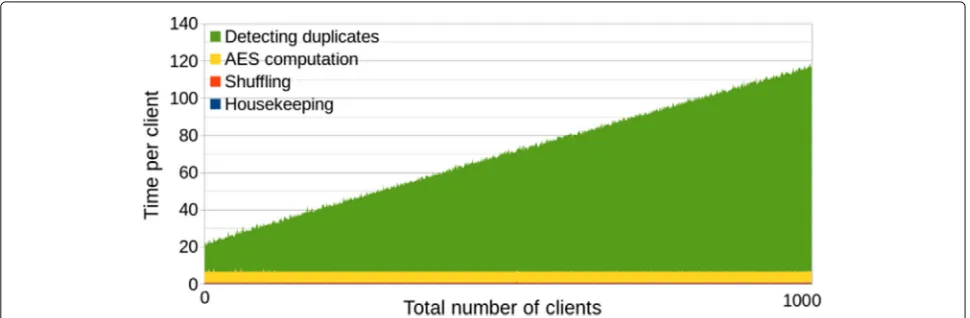
Fig. 3Second solution (w/ polynomials). Efficiency graph of the second solution with polynomial optimization. The number of CPU threads is limited to 2
In binary fields, including F264, squaring of additively
shared values does not require communication between the servers. This can be used to speed up precomputa-tions. In ([30], Algorithm 4) it is shown how to reduce the communicationcost of computingr2,. . .,rNto that of approximately√Nmultiplications.
The polynomial-based comparison method is also amenable to the order statistic related speedup described in the previous section. Both comparison methods have been implemented in our second solution.
Results
We have evaluated our solution on the test data provided by iDASH 2017 competition organizers. The data consists of 1000 CSV formatted files, ca. 10000 rows each. The evaluation has been performed on a local cluster of three 2 x Intel Xeon E5-2640 v3 2.6 GHz/8GT/20M servers, where one server has also played the role of all clients. The network bandwidth has been throttled to 100 Mb/s, and latency changed to 40 ms. The number of computation threads was limited to 2, as required by the competition rules. The data upload times have not been measured since they depend on the network connection between the server and the centers, and are not related to the particular SMC algorithms.
The number of incorrect answers in our benchmarks was 0, and it turns out that the error 2−40was fine for 1000 clients with 10000 records each.
First solution
The benchmarks of our first solution are given in Table1. The entire computation takes ca. 32 min, after which all centers receive back the list of entries that are duplicates. This is quite fast for privacy-preserving computation with such large inputs, and in practice setting up the servers and collecting the data may even take more time than the computation itself.
Second solution
If the centers do not provide their data simultaneously, and the time span between the first and the last contri-bution is long, then the first uploaders may probably not want to wait for the remaining ones. The 32 min of the actual computation may become insignificant compared to the time waiting for the other centers, so even a slower algorithm may give advantage if it returns the results immediately. The benchmarks of our second solution (withoutpolynomial optimization) are given in Fig.2and summarized in Table 2, and they show that the waiting time for each server is between 20 and 45 s. The later the center joins, the longer will be his computation time. For all 1000 centers altogether, the second solution would give 12 h 45 min compared to the 32 min of the first solu-tion. However, if the time span between the first and the last contributions exceeds at least 12 h 15 min, then the second method already gives advantage also in the total time.
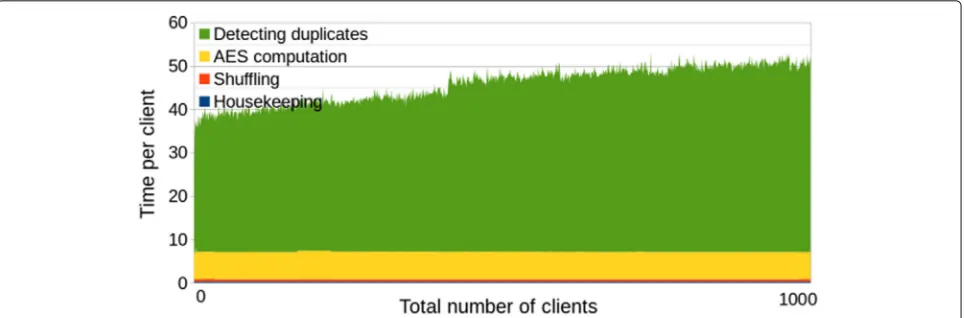
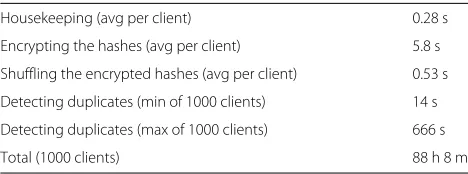
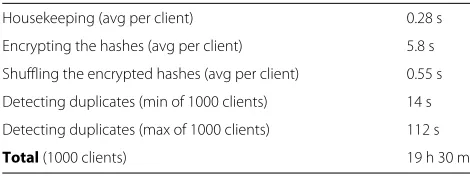
The benchmarks of the second solution with polyno-mial optimization are given in Fig. 3 (the limit on Y-axis values is set to 140 to make it comparable to the other graphs) and summarized in Table 3. We see that, although the communication between parties decreases, the computation is slower. The time cost per client vis-ibly grows linearly with the number of clients, so the total time is quadratic in the number of clients. This
Table 3Second solution (w/ polynomials)
Housekeeping (avg per client) 0.28 s
Encrypting the hashes (avg per client) 5.8 s
Shuffling the encrypted hashes (avg per client) 0.53 s
Detecting duplicates (min of 1000 clients) 14 s
Detecting duplicates (max of 1000 clients) 666 s
Fig. 4Second solution (w/o polynomials, no thread limit). Efficiency graph of the second solution without polynomial optimization. The number of CPU threads is 32
means that the multiplication inF264 is too heavy, and
even limiting network connection to 100Mbps and adding 40ms latency did not make its complexity less signifi-cant. The total time of processing 1000 clients was almost seven times slower than the solution without polynomi-als. Nevertheless, for small number of clients, this solu-tion is actually more efficient, and total time is smaller for the first 55 clients. The time per client has started getting worse after the 30-th client, so it is reasonable to switch between comparison algorithms at this point. Since the alternative comparison has less network com-munication, it should be theoretically better in settings with very slow network connection and fast hardware. We decided to conduct one more experiment to verify this claim.
During the competition, the solutions were evaluated using only 2 parallel processor threads, but we have also tried to run the same algorithm without limiting their number (using all 32 cores), to see if we get any advan-tage. The results of the benchmarks with and without
polynomials can be found in Figs.4 and5, summarized in Tables4 and 5 respectively. We see that the polyno-mial solution was still slower, although all 32 processors on all three servers worked with 100% load during the main computation. However, while the time improvement of the solution without polynomials is not too significant (although 1.5 extra hours still make a difference), we see that the performance of polynomial solution is much bet-ter than it was with 2 threads, and the 1000 clients have been processed in 19 h 30 m instead of 88 h 8 m. This time, the polynomial solution was more efficient that the non-polynomial solution with up to 300 clients. The timeper clienthas started getting worse after the 160-th client. We see that the alternative comparison indeed scales better w.r.t. parallelization.
Discussion
We think that the results are good enough and can be applied to real data. Depending on the requirements, either the first or the second solution can be used.
Table 4Second solution (w/o polynomials, no thread limit)
Housekeeping (avg per client) 0.28 s
Encrypting the hashes (avg per client) 6.3 s
Shuffling the encrypted hashes (avg per client) 0.50 s
Detecting duplicates (min of 1000 clients) 20 s
Detecting duplicates (max of 1000 clients) 40 s
Total(1000 clients) 11 h 20 m
The data that was provided by iDASH 2017 competition organizers was idealized, i.e. it was already preprocessed and assumed that e.g. the gender is labeled exactly “M” and “F” and there are no other possible encodings. In a practical application, we should think how much prepro-cessing we agree to delegate to the data owner, and how much we perform using secure multiparty computation.
We note that revealing “duplication pattern” is safe as far as there are sufficiently many clients, so that leaking how many patients have been present in exactlyncenters would be safe. This leakage would be bad in some extreme cases, e.g with two medical centers with one patient, since then the server will know whether that particular patient has been in both centers or only one of them. However, if the data is small, then slower and more secure algorithms could be used for that anyway, such as finding privacy-preserving set intersection between each pair of medical centers to determine the duplicates.
One possible problem of Sharemind deployment is that its protocols work under assumptions of the honest major-ity and an honest-but-curious adversary. This means that one needs to find three hosts who agree to set up an SMC server, and who are trustworthy enough not to deliber-ately break the computation, and clean the server from all intermediate data after the computation has finished (some challenges of real-world application deployment are described e.g. in [31]). Sacrificing in efficiency, we could use protocol sets like SPDZ [32] or MASCOT [33], which are actively secure against a dishonest major-ity. In any case, as far as we use secret sharing, we need to assume that at least one server should remain uncorrupted, or otherwise the computation parties will collaborate to reconstruct the clients’ secrets, regardless of the privacy-preserving algorithms used.
Table 5Second solution (w/ polynomials, no thread limit)
Housekeeping (avg per client) 0.28 s
Encrypting the hashes (avg per client) 5.8 s
Shuffling the encrypted hashes (avg per client) 0.55 s
Detecting duplicates (min of 1000 clients) 14 s
Detecting duplicates (max of 1000 clients) 112 s
Total(1000 clients) 19 h 30 m
Possible future work
As discussed e.g. in [9], the quasi-identifiers are often inconsistent in real applications, so exact comparison of values is not sufficient to achieve accurate linkage results, and some approximated string matching can be preferred. Our algorithms cannot be extended to this setting directly, since AES encryption maps similar strings to completely different values. We could take some ideas from some pre-vious works, and hash alln-grams of a string instead of the entire string. Differentn-grams should be encrypted with different AES keys to avoid leaking similarities in the string patterns. Nevertheless, this would already leak more information, and a corrupted server would be able to perform e.g. analysis of bigram frequencies, and there could possibly be more attacks inspired by [12], even though the attacks are adapted to Bloom filters that we do not use in our solution. We conclude that the extension to approximate matching would require a more careful design and security analysis.
Conclusion
In this paper, we have proposed two methods for finding duplicates between several databases. The implementa-tion has been benchmarked on data of 1000 medical cen-ters with 10000 records each, giving quite positive results, which would be acceptable in real-world scenarios.
Abbreviations
AES: Advanced encryption standard; CSV: Comma separated values; PPRL: Privacy-preserving record linkage; SMC: Secure multiparty computation; SHA: Secure hash algorithm; UOWHF: Universal one-way hash function; VM: Virtual machine; WAN: Wide area network
Acknowledgements
The authors want to thank Marju Ignatjeva who helped to set up the Sharemind virtual machine for iDASH competition.
Funding
The research and the publication cost were funded by Estonian Research Council, grant no. IUT27-1.
Availability of data and materials
The test data itself is not available anymore on the competition site. The virtual machine of the implementation is not available due to Sharemind group’s commercial interests.
About this Supplement
This article has been published as part of?BMC Medical Genomics?Volume 11 Supplement 4, 2018: Proceedings of the 6th iDASH Privacy and Security Workshop 2017. The full contents of the supplement are available online at?https://bmcmedgenomics.biomedcentral.com/articles/supplements/ volume-11-supplement-4.
Authors’ contributions
PL has developed the theory part and the corresponding algorithms. AP has implemented these algorithms on Sharemind platform, and performed the experiments. Both authors have read and approved the final manuscripct.
Ethics approval and consent to participate
Not relevant.
Consent for publication
Competing interests
The authors declare that they have no competing interests.
Publisher’s Note
Springer Nature remains neutral with regard to jurisdictional claims in published maps and institutional affiliations.
Author details
1Cybernetica AS, Ülikooli 2, 51003 Tartu, Estonia.2STACC, Ülikooli 2, 51003 Tartu, Estonia.
Published: 11 October 2018
References
1. iDASH 2017 competition .http://www.humangenomeprivacy.org/2017/. Accessed 7 July 2018.
2. Ebner H, Hayn D, Falgenhauer M, Nitzlnader M, Schleiermacher G, Haupt R, Erminio G, Defferrari R, Mazzocco K, Kohler J, Tonini G, Ladenstein R, Schreier G. Piloting the european unified patient identity management (eupid) concept to facilitate secondary use of
neuroblastoma data from clinical trials and biobanking, vol. 223. In: Health Informatics Meets eHealth: Predictive Modeling in Healthcare -From Prediction to Prevention, Proceedings of the 10th eHealth 2016 Conference, Studies in Health Technology and Informatics. Vienna: IOS Press; 2016. p. 31–38.https://doi.org/10.3233/978-1-61499-645-3-31. 3. Schnell R, Bachteler T, Reiher J. Privacy-preserving record linkage using
bloom filters. BMC Med Inform Decis Making. 2009;9(1):41.https://doi. org/10.1186/1472-6947-9-41.
4. Karapiperis D, Verykios VS. A fast and efficient hamming lsh-based scheme for accurate linkage. Knowl Inf Syst. 2016;49(3):861–84.https:// doi.org/10.1007/s10115-016-0919-y.
5. Vatsalan D, Christen P. Privacy-preserving matching of similar patients. J Biomed Inform. 2016;59:285–98.https://doi.org/10.1016/j.jbi.2015.12.004. 6. Du W, Atallah MJ. Protocols for secure remote database access with
approximate matching, vol. 2. In: Ghosh AK, editor. E-Commerce Security and Privacy. Advances in Information Security. Boston: Springer; 2001. p. 87–111.https://doi.org/10.1007/978-1-4615-1467-1.
7. Alhaqbani B, Fidge C. Privacy-preserving electronic health record linkage using pseudonym identifiers. In: HealthCom 2008 - 10th International Conference on E-health Networking, Applications and Services. Singapore: IEEE; 2008. p. 108–17.https://doi.org/10.1109/HEALTH.2008. 4600120.
8. Kho AN, Cashy JP, Jackson KL, Pah AR, Goel S, Boehnke J, Humphries JE, Kominers SD, Hota BN, Sims SA, Malin B, French DD, Walunas TL, Meltzer DO, Kaleba EO, Jones RC, Galanter WL. Design and
implementation of a privacy preserving electronic health record linkage tool in chicago. J Am Med Inform Assoc. 2015;22(5):1072–80.https://doi. org/10.1093/jamia/ocv038.
9. Vatsalan D, Sehili Z, Christen P, Rahm E. Privacy-preserving record linkage for big data: Current approaches and research challenges. In: Zomaya AY, Sakr S, editors. Handbook of Big Data Technologies. Cham: Springer; 2017. p. 851–95.https://doi.org/10.1007/978-3-319-49340-4. 10. Kargupta H, Datta S, Wang Q, Sivakumar K. Random-data perturbation techniques and privacy-preserving data mining. Knowl Inf Syst. 2005;7(4): 387–414.https://doi.org/10.1007/s10115-004-0173-6.
11. Kuzu M, Kantarcioglu M, Durham EA, Toth C, Malin B. A practical approach to achieve private medical record linkage in light of public resources. J Am Med Inform Assoc. 2013;20(2):285–92.https://doi.org/10. 1136/amiajnl-2012-000917.
12. Niedermeyer F, Steinmetzer S, Kroll M, Schnell R. Cryptanalysis of Basic Bloom Filters Used for Privacy Preserving Record Linkage. J Priv Confidentiality. 2014;6(2):59–79.
13. Kamm L. Privacy-preserving statistical analysis using secure multi-party computation. 2015. PhD thesis, University of Tartu.
14. Sharmeind secure multiparty computation platform.https://sharemind. cyber.ee. Accessed 7 July 2018.
15. Bogdanov D, Laud P, Laur S, Pullonen P. From Input Private to Universally Composable Secure Multi-party Computation Primitives. In: Datta A, Fournet C, editors. IEEE 27th Computer Security Foundations Symposium, CSF 2014, Vienna, Austria, 19-22 July, 2014. Computer Society Press: IEEE; 2014. p. 184–98.https://doi.org/10.1109/CSF.2014.21.
16. Bogdanov D, Niitsoo M, Toft T, Willemson J. High-performance secure multi-party computation for data mining applications. Int J Inf Sec. 2012;11(6):403–18.
17. Randmets J. Programming languages for secure multi-party computation application development. 2017. PhD thesis, University of Tartu.http://hdl. handle.net/10062/56298.
18. Dimitrov V, Kerik L, Krips T, Randmets J, Willemson J. Alternative implementations of secure real numbers. In: Proceedings of the 2016 ACM SIGSAC Conference on Computer and Communications Security. CCS ’16. New York: ACM; 2016. p. 553–64.https://doi.org/10.1145/ 2976749.2978348.
19. Laur S, Talviste R, Willemson J. From Oblivious AES to Efficient and Secure Database Join in the Multiparty Setting, vol. 7954. In: Applied Cryptography and Network Security. LNCS. Berlin: Springer; 2013. p. 84–101.
20. Krips T, Willemson J. Hybrid model of fixed and floating point numbers in secure multiparty computations, vol. 8783. In: Proceedings of the 17th International Information Security Conference, ISC 2014. LNCS. Cham: Springer; 2014. p. 179–97.
21. Kamm L, Willemson J. Secure floating-point arithmetic and private satellite collision analysis. Int J Inf Secur. 2015;14:531–48.
22. Krips T, Willemson J. Point-counting method for embarrassingly parallel evaluation in secure computation, vol. 9482. In: Garcia-Alfaro J, Kranakis E, Bonfante G, editors. Foundations and Practice of Security: 8th International Symposium, FPS 2015, Clermont-Ferrand, France, October 26-28, 2015, Revised Selected Papers. LNCS. Cham: Springer; 2016. p. 66–82. 23. Araki T, Furukawa J, Lindell Y, Nof A, Ohara K. High-throughput
semi-honest secure three-party computation with an honest majority. In: Proceedings of the 2016 ACM SIGSAC Conference on Computer and Communications Security. CCS ’16. New York: ACM; 2016. p. 805–17.
https://doi.org/10.1145/2976749.2978331.
24. Albrecht MR, Grassi L, Rechberger C, Roy A, Tiessen T. Mimc: Efficient encryption and cryptographic hashing with minimal multiplicative complexity, vol. 10031. In: Cheon JH, Takagi T, editors. Advances in Cryptology - ASIACRYPT 2016 - 22nd International Conference on the Theory and Application of Cryptology and Information Security, Hanoi, Vietnam, December 4-8, 2016, Proceedings, Part I. Lecture Notes in Computer Science; 2016. p. 191–219. https://doi.org/10.1007/978-3-662-53887-6.
25. Naor M, Yung M. Universal one-way hash functions and their cryptographic applications. In: Johnson DS, editor. Proceedings of the 21st Annual ACM Symposium on Theory of Computing, May 14-17, 1989, Seattle, Washigton, USA. New York: ACM; 1989. p. 33–43.https://doi.org/ 10.1145/73007.73011.
26. Laur S, Willemson J, Zhang B. Round-Efficient Oblivious Database Manipulation. In: Proceedings of the 14th International Conference on Information Security. ISC’11, vol. 7001. Lecture Notes in Computer Science. Xi’an: Springer; 2011. p. 262–77.
27. Laud P, Randmets J. A domain-specific language for low-level secure multiparty computation protocols. In: Ray I, Li N, Kruegel C, editors. Proceedings of the 22nd ACM SIGSAC Conference on Computer and Communications Security, Denver, CO, USA, October 12-6, 2015. New York: ACM; 2015. p. 1492–503.https://doi.org/10.1145/2810103.2813664. 28. Bogdanov D, Laur S, Talviste R. A practical analysis of oblivious sorting
algorithms for secure multi-party computation, vol. 8788. In: Bernsmed K, Fischer-Hübner S, editors. Secure IT Systems - 19th Nordic Conference, NordSec 2014, Tromsø, Norway, October 15-17, 2014, Proceedings. Lecture Notes in Computer Science. Cham: Springer; 2014. p. 59–74.
https://doi.org/10.1007/978-3-319-11599-3.
29. NTL. A Library for doing Number Theory.http://www.shoup.net/ntl/. Accessed 7 July 2018.
30. Laud P. A private lookup protocol with low online complexity for secure multiparty computation, vol. 8958. In: Hui LCK, Qing SH, Shi E, Yiu SM, editors. Information and Communications Security - 16th International Conference, ICICS 2014, Revised Selected Papers. Lecture Notes in Computer Science. Cham: Springer; 2014. p. 143–57.https://doi.org/10. 1007/978-3-319-21966-0.
32. Damgård I, Pastro V, Smart NP, Zakarias S. Multiparty computation from somewhat homomorphic encryption, vol. 7417. In: Safavi-Naini R, Canetti R, editors. CRYPTO. Lecture Notes in Computer Science. Berlin: Springer; 2012. p. 643–62.