R
EGULARA
RTICLECritical review of CIELO evaluations of
n
+
235
U,
238
U using
differential experiments
Roberto Capote*and Andrej Trkov
NAPC–Nuclear Data Section, International Atomic Energy Agency, Vienna 1400, Austria
Received: 18 December 2017 / Received infinal form: 28 February 2018 / Accepted: 14 May 2018
Abstract.Key reactions have been selected to compare JEFF-3.3 (CIELO 2) and IAEA CIELO (CIELO 1) evaluated nuclear datafiles for neutron induced reactions on235U and238U targets. IAEA CIELO evaluation uses reaction models to construct the evaluation prior, but strongly relied on differential data including all reaction cross sectionsfitted within the IAEA Neutron Standards project. The JEFF-3.3 evaluation relied on a mix of differential and integral data with strong contribution from nuclear reaction modelling. Differences in evaluations are discussed; a better reproduction of differential data for the IAEA CIELO evaluation is shown for key reaction channels.
1 Introduction
An international collaboration called CIELO (Collabora-tive International Evaluated Library Organisation) was initiated by the Nuclear Energy Agency of the OECD with the main goal to improve our understanding of neutron reactions on key isotopes that are important in nuclear applications [1–4]. A central role of this project is taken by 235
U and 238U, which are the major components of the reactor fuel in energy applications.
Existing evaluations ENDF/B-VII.1 [5] and JEFF-3.2 [6] perform very well for many applications. However, discrepancies have been pointed out between integral performance and differential data (e.g., for promptfission neutron spectra of thermal235U (n,f) [7–9]), or between evaluated data from different libraries (e.g., between235U inelastic cross sections [10]). Those challenges led to new evaluations for235U and238U targets, in particular by the JEFF (JEFF-3.3) and by the IAEA CIELO [11,3] collaborations. Note that both evaluations have been released. The IAEA CIELO evaluation was adopted by the ENDF/B-VIII.0 library [12]) that was released in February 2018. Authors were the lead authors of the IAEA CIELO evaluation. A brief comparison between the mean values of important differential quantities evaluat-ed in these libraries is the subject of this short contribution. The integral performance of these libraries will be compared elsewhere.
2 Comparison of JEFF-3.3 and IAEA CIELO
evaluations
Let’s review some of relevant reaction channels.
2.1 Total cross sections
Neutron total cross sections from 20 keV to 30 MeV on235U and 238U targets agree within experimental uncertainty (about 2%–3% including 1% systematic) for both JEFF-3.3 and IAEA CIELO evaluations. The agreement ofn+235U cross section is shown in Figure 1. Note the uncertainty band (thin blue lines) shown around the JEFF-3.3 cross sections (bold blue line). The IAEA CIELO evaluation is shown in bold green line. Total cross sections in evaluated files are derived directly from the employed optical model, which are documented in reference [13] for the JEFF-3.3 evaluation and in references [14–16] for the IAEA CIELO evaluation on235U and238U targets, respectively.
2.2 Fission cross sections
Evaluated235U (n,f) and238U (n,f) cross sections in JEFF-3.3 correspond to the IAEA Neutron Standards 2006 [17,18], and are within 0.5% of the latest IAEA Standards 2017 [19] used in the IAEA CIELOfile.
Despite this close agreement it should be noted that the evaluation methods differ significantly. The JEFF-3.3 evaluation team replaced their own calculatedfission cross sections for both U isotopes (e.g., Ref. [13]) by the IAEA Standard 2006. It is expected that cross-section differences between calculated fission cross sections and Standards * e-mail:[email protected]
©R. Capote and A. Trkov, published byEDP Sciences, 2018
https://doi.org/10.1051/epjn/2018029 & Technologies
Available online at: https://www.epj-n.org
(e.g., as shown in JEFF-3.2 [6]) were dumped into the elastic cross sections. However, those differences will also be shown in other calculated cross sections including inelastic scattering and capture due to the constrain to reproduce the well-known total cross section.
Meanwhile, the IAEA CIELO evaluation employed the optical model for fission [21–23] to describe Neutron Standardsfission cross sections for both uranium targets within 3% as shown in references [11,24–26]. Such description allows minimizing the impact of fission modelling on competing neutron capture and neutron scattering channels (Fig. 2).
2.3 Inelastic cross sections
Inelastic scattering is the only reaction that changes the neutron energy without losing the neutrons below 5 MeV in the energy range where the fission neutron flux is the largest. As such the inelastic cross sections is extremely important for neutron transport in reactors.
Both evaluations for inelastic scattering cross sections are based on model calculations, and the observed agreement is generally good, in fact much better than differences discussed at 2011 IAEA meeting [10]. The largest difference between238U (n,n0) cross sections reaches 4% at 3 MeV; the corresponding difference between235U (n, n0) cross sections is larger reaching 13% at 4.4 MeV. However, evaluations agree within quoted uncertainties, even if the IAEA CIELO uncertainties are smaller (around 5% at the maximum) than those in the JEFF-3.3. library. It should be noted that IAEA CIELO evaluated inelastic cross sections were found in references [21,25] to be in good agreement with JENDL-4 evaluation [27].
2.4 (n,2n) and (n,3n) cross sections
(n,2n) reaction is the main competition tofission in both uranium targets above 7–8 MeV of neutron incident energy. The agreement of evaluated 238U (n,2n) cross
sections is reasonable as discussed in reference [11]. However, larger differences are observed for evaluated 235
U (n,2n) and 235U (n,3n) cross sections as shown in Figure 3, even if the shape of cross sections is similar. Evaluated uncertainties for the JEFF-3.3 library are also shown and differences between evaluations are larger than quoted uncertainties at the maximum of evaluated excitation functions both for the 2n and 3n emissions. Significant differences are also observed near threshold which imply large differences in the derived235U (n,2n) and 235U (n,3n) spectrum averaged cross section (SACS) in 252Cf(sf) reference neutron spectrum. If we exclude Mather
1972 data, which are discrepant, then the IAEA CIELO evaluation is in significant better agreement with differen-tial data than the JEFF-3.3 evaluation, especially for the 235U (n,3n) cross section.
Fig. 1. Evaluated cross sections from IAEA CIELO and JEFF-3.3 libraries for235U (n,tot) compared to selected experimental data from EXFOR [20].
Fig. 2. Evaluated238U (n,n’) and235U (n,n’) cross sections from IAEA CIELO and JEFF-3.3 libraries compared to selected experimental data from EXFOR [20].
2.5 Capture cross sections
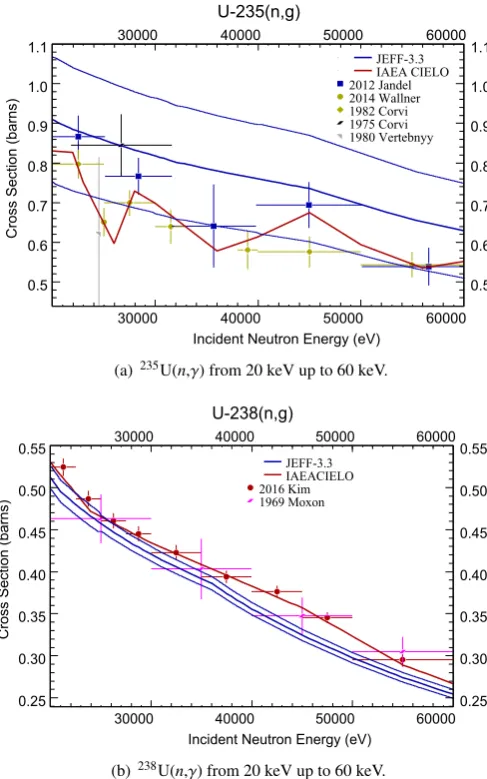
IAEA CIELO 235U (n,g) cross sections were modified to follow fluctuations observed in Jandel’s Los Alamos experiment [31], and are compared to the JEFF-3.3 cross section inFigure 4a. The JEFF-3.3 evaluation seems to be about 20% larger than the IAEA CIELO evaluation in the whole energy range shown in the picture. Note that the IAEA CIELO follow experimentalfluctuations which can not be reproduced by statistical model calculations.
IAEA CIELO 238U (n,g) cross sections were adopted from Neutron Standardsfit [19] and are shown inFigure 4b compared to evaluated JEFF-3.3 cross section. Evaluated reference 238U (n,g) cross sections within the Neutron Standards are in excellent agreement with newest high-accuracy measurement at JRC Geel [32,33], while the evaluated JEFF-3.3 cross sections are lower in the whole energy range. The difference between both evaluations reaches about 7% around 45 keV.
Note that the overestimation in JEFF-3.3 evaluation of the235U (n,g) measured data from 20 keV to 60 keV and the underestimation of the238U (n,g) measured data led to a very strong underestimation of the measured Maxwellian Averaged Cross Sections (MACS) of the ratio 238U (n,g)/235U (n,g) near 25–30 keV by Wallner and collab-orators [34]; the measured ratio is 0.60 ± 0.03 (5% uncertainty) while the derived ratio from the JEFF-3.3 evaluation is 0.49 which is 22% lower than the measured value! Such difference is outside the quoted uncertainties of IAEA CIELO evaluation, but it is within the much larger uncertainties given in the JEFF-3.3file.
2.6 Thermal-neutron induced promptfission neutron spectra
The235U thermal prompt neutronfission spectrum (PFNS) is one of the most important quantities for reactor applications as it represents the main source of reactor neutrons. A new evaluation of this spectrum was undertaken using a least-square code GMAP within the IAEA project, using shape data measured relative to the 252Cf(sf) PFNS standard spectrum. The average energy of
the 235U thermal PFNS was determined to be 2.00 ± 0.01 MeV [7–9]. Such average energy was also adopted by the JEFF-3.3 in Figure 5 the results of the un-smoothed GMAP evaluation (black dashed line) are compared with the experimental input data [35–41] and with the ENDF/B-VII.1 evaluation, which is very similar to the JEFF-3.2 evaluation. The ENDF/B-VII.1 evalua-tion (bold green line, which was based on Madland–Nix model [42]) is lower than the GMAPfit below≈1.2 MeV of outgoing neutron energy, but it is higher than the GMAP fit from 1.2 MeV to 9 MeV. The JEFF-3.3 evaluation shape is different from 1 to 9 MeV, but it is similar to the ENDF/ B-VII.1 evaluation below 500 keV and above 10 MeV.
On the other side, the IAEA CIELO PFNS evaluation for E>9 MeV was based on the evaluated SACS for the 90Zr(n,2n) dosimetry reaction [43] and on the linear
Fig. 4. Evaluated capture cross sections on235U and238U targets
in the region relevant to the calculation of the MACS at (30 keV) are compared to experimental data retrieved from EXFOR [20]. (a)235U(n,g) from 20 keV to 60 keV, (b)238U(n,g) from 20 keV to 60 keV.
Fig. 5. 235
dependence of the SACS onEas tested in references [7–9]. The PFNS uncertainty from 9 to 14 MeV was estimated to be 7% from the uncertainty of the SACS for the90Zr(n,2n). The suggested PFNS energy dependence above 9 MeV significantly improves the agreement with measured SACS for (n, 2n) dosimetry reactions when IRDFF cross-section evaluations [44,45] are used to calculate the corresponding SACS. However, the extrapolated PFNS above 10 MeV is significantly larger than JEFF-3.2 and JEFF-3.3 evalua-tions based on Madland–Nix model [42].
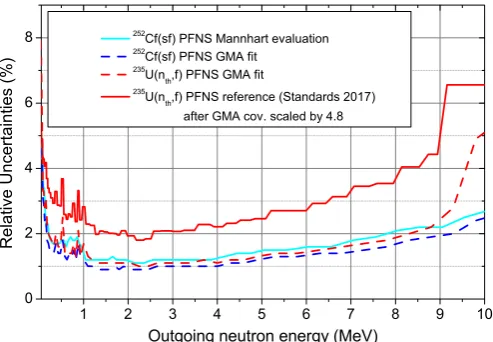
The GMAP derived uncertainties for both252Cf(sf) and 235U(n
th,f) PFNS are represented by dashed lines in
Figure 6; the GMAP 235U(nth,f) PFNS uncertainty is
always larger than the GMA252Cf(sf) PFNS uncertainty as expected. The later is close, but slightly smaller than the uncertainty of252Cf(sf) Mannhart evaluation (cyan line); thefitted252Cf(sf) PFNS shape was practically unchanged. Therefore, Mannhart evaluation [46] as listed in reference [18] was kept as the252Cf(sf) PFNS standard.
However, the GMAP derived uncertainty of the 235U (nth,f) PFNS average energy was 5 keV, which was
considered underestimated. An estimated 10 keV uncer-tainty was quoted based on expert assessment in references [7–9]. That uncertainty assessment is confirmed by the observed spread in measured PFNS as shown inFigure 5; the additional 5 keV uncertainty could be assigned to the unrecognized shape uncertainty in the existing experimen-tal data1. By scaling the PFNS covariance matrix the minimum PFNS uncertainty in the region of 2–3 MeV was increased approximately by factor of 2 to reach about 2%; the scaled uncertainty reached 4.5% at 9 MeV.
Final235U(nth,f) PFNS uncertainty is shown inFigure 6
by a bold red line, and corresponds to the red uncertainty band shown inFigure 5.
3 Conclusions
Significant differences between the IAEA CIELO and JEFF-3.3 (CIELO 2) evaluations are shown for neutron capture on 235U and 238U targets, 235U (n,2n) and 235U (n,3n) cross sections and the235U thermal-neutron induced prompt fission neutron spectrum. Differences in evalua-tions are tracked to differences in evaluation methods, but also to differences between measured differential data and model-based JEFF-3.3 evaluation; the IAEA CIELO evaluation reproduces the differential cross section and PFNS data.
Authors acknowledge an important contribution made by contributors to the IAEA CIELO collaboration, by the IAEA Neutron Standard committee, and by all contributors to the IAEA Prompt Fission Neutron Spectra project. Special thanks to V.G. Pronyaev, D.L. Smith and D. Neudecker for many inspiring discussions on uncertainties related to this work.
References
1. OECD, Nuclear Energy Agency, Collaborative International Evaluated Library Organisation (CIELO) Pilot Project, WPEC Subgroup 40 (SG40), https://www.oecd-nea.org/ science/wpec/sg40-cielo/
2. M.B. Chadwick, E. Dupont, E. Bauge et al., The CIELO collaboration: neutron reactions on 1H,16O,56Fe, 235,238U, and239Pu, Nucl. Data Sheets118, 1 (2014)
3. R. Capote, A. Trkov (coordinators), IAEA CIELO Data Development Project within the International Pilot Project of the OECD/NEA [1],235U and238Ufiles released December
1st, 2017,https://www-nds.iaea.org/CIELO/
4. M.B. Chadwick, R. Capote, A. Trkov et al., CIELO collaboration summary results: international evaluations of neutron reactions on Uranium, Plutonium, Iron, Oxygen and Hydrogen, Nucl. Data Sheets148, 189 (2018)
5. M.B. Chadwick, M.W. Herman, P. Oblozinsky et al., ENDF/ B-VII.1 nuclear data for science and technology: cross sections, covariances,fission product yields and decay data, Nucl. Data Sheets112, 2887 (2012)
6. JEFF Scientific Working group, Nuclear Energy Agency Data Bank, Joint Evaluated Fission and Fusion File (JEFF) release 3.2, OECD, March 5 (2014)
7. R. Capote, A. Trkov, V.G. Pronyaev, Current issues in nuclear data evaluation methodology: 235U prompt fission neutron spectra and multiplicity for thermal neutrons, Nucl. Data Sheets123, 8 (2015)
8. R. Capote, Y.-J. Chen, F.-J. Hambsch et al., Promptfission neutron spectra of actinides, Nucl. Data Sheets131, 1 (2016) 9. A. Trkov, R. Capote, Evaluation of the prompt fission neutron spectrum of thermal-neutron inducedfission in U-235, Phys. Procedia64, 48 (2015)
10. A.J. Plompen, T. Kawano, R. Capote Noy, Inelastic scattering and capture cross-section data of major actinides in the fast neutron region, report INDC(NDS)-0597 (Inter-national Atomic Energy Agency, Vienna, 2012), https:// www-nds.iaea.org/publications/indc/indc-nds-0597.pdf
11. R. Capote, A. Trkov, M. Sin et al., IAEA CIELO evaluation of neutron-induced reactions on235U and238U targets, Nucl. Data Sheets148, 254 (2018)
Fig. 6. Uncertainties of the235U(nth,f) (bold red) and252Cf(sf) (cyan) PFNS evaluations are compared with the corresponding ones obtained in the GMAfit (dashed lines).
1
12. D.A. Brown, M.B. Chadwick, R. Capote et al., ENDF/B-VIII.0: the 8th major release of the nuclear reaction data library with CIELO-project cross sections, new standards and thermal scattering data, Nucl. Data Sheets148, 1 (2018) 13. P. Romain, B. Morillon, H. Duarte, Bruyères-le-Châtel neutron evaluations of actinides with the TALYS code: the
fission channel, Nucl. Data Sheets131, 222 (2016)
14. R. Capote, E. Sh. Soukhovitski, J.M. Quesada, S. Chiba, Is a global coupled-channel dispersive optical model potential for actinides feasible?, Phys. Rev. C72, 064610 (2005) 15. R. Capote, S. Chiba, E.Sh. Soukhovitski, J.M. Quesada, E.
Bauge, A global dispersive coupled-channel optical model potential for actinides, J. Nucl. Sci. Tech.45, 333 (2008) 16. E. Sh. Soukhovitski, R. Capote, J.M. Quesada, S. Chiba, D.S.
Martyanov, Nucleon scattering on actinides using a disper-sive optical model with extended couplings, Phys. Rev. C94, 064605 (2016)
17. S. Badikov et al.,International Evaluation of Neutron Cross-Section Standards, report STI/PUB/1291 (International Atomic Energy Agency, Vienna, 2008)
18. A.D. Carlson, V.G. Pronyaev, D.L. Smith et al., Interna-tional evaluation of neutron cross section standards, Nucl. Data Sheets110, 3215 (2009)
19. A.D. Carlson, V.G. Pronyaev, R. Capote et al., Evaluation of neutron data standards, Nucl. Data Sheets148, 143 (2018) 20. N. Otuka, E. Dupont, V. Semkova, B. Pritychenko et al., Towards a more complete and accurate experimental nuclear reaction data library (EXFOR): international collaboration between nuclear reaction data centres (NRDC), Nucl. Data Sheets120, 272 (2014)
21. M. Sin, R. Capote, M. Herman, A. Trkov, Modelling neutron-induced reactions on 232–237U from 10 keV–30 MeV, Nucl. Data Sheets139, 138 (2017)
22. M. Sin, R. Capote, M. Herman, A. Trkov, Extended optical model forfission, Phys. Rev. C93, 034605 (2016)
23. M. Sin, R. Capote, Transmission through multi-humped
fission barriers with absorption: a recursive approach, Phys. Rev. C77, 054601 (2008)
24. R. Capote, A. Trkov, M.T. Pigni et al., Evaluation of the neutron induced reactions on 235U from 2.25 keV–30 MeV, EPJ Web Conf.146, 02029 (2017)
25. R. Capote, A. Trkov, M. Sin, M. Herman, A. Daskalakis, Y. Danon, Physics of neutron interactions with 238U: new developments and challenges, Nucl. Data Sheets118, 26 (2014) 26. R. Capote, M. Sin, A. Trkov, M.W. Herman, D. Bernard, G. Noguere, A. Daskalakis, Y. Danon, in Proc. NEMEA-7 Workshop NEA/NSC/DOC(2014)13(NEA, OECD, 2014) 27. K. Shibata et al., JENDL-4.0: a new library for nuclear
science and engineering, J. Nucl. Sci. Technol.48, 1 (2011) 28. J. Frehaut, A. Bertin, R. Bois, Measurement of the 235U (n,2n) cross section between threshold and 13 MeV, Nucl. Sci. Eng.74, 29 (1980)
29. D.S. Mather, P.F. Bampton, R.E. Coles, G. James, P.J. Nind, Measurement of (n, 2n) cross sections for incident energies between 6 and 14 MeV, report AWRE-O-47/69, (A.W.R.E. Aldermaston Reports, UK, 1969)
30. L.R. Veeser, E.D. Arthur, inInt. Conf. on neutron physics and nucl. data for reactors and other applied purposes, Sept. 1978(Harwell, UK, 1978), p.1054
31. M. Jandel, T.A. Bredeweg, E.M. Bond, M.B. Chadwick, A. Couture, J.M. O’Donnell, M. Fowler, R.C. Haight, T. Kawano, R. Reifarth, R.S. Rundberg, J.L. Ullmann, D.J. Vieira, J.M. Wouters, J.B. Wilhelmy, C.Y. Wu, J.A. Becker, New precision measurements of the235U (n,g) cross section, Phys. Rev. Lett.109, 202506 (2012)
32. H.I. Kim, C. Paradela, I. Sirakov et al., Neutron capture cross section measurements for 238U in the resonance region at GELINA, Eur. Phys. J. A52, 170 (2016)
33. I. Sirakov, R. Capote, O. Gritzay, H.I. Kim, S. Kopecky, B. Kos, C. Paradela, V.G. Pronyaev, P. Schillebeeckx, A. Trkov, Evaluation of cross sections for neutron interactions with238U in the energy region between 5 keV and 150 keV, Eur. Phys. J. A53, 199 (2017)
34. A. Wallner, T. Belgya, M. Bichler, K. Buczak, I. Dillmann, F. Kaeppeler, C. Lederer, A. Mengoni, F. Quinto, P. Steier, L. Szentmiklosi, Novel method to study neutron capture of235U
and238U simultaneously at keV energies, Phys. Rev. Lett.
112, 192501 (2014)
35. N. Kornilov, F.-J. Hambsch et al., The 235U(n,f) prompt
fission neutron spectrum at 100K input neutron energy, Nucl. Sci. Eng.165, 117 (2010)
36. A.S. Vorobyev, O.A. Shcherbakov, A.M. Gagarski et al., Investigation of the prompt neutron emission mechanism in low energyfission of235,233U(nth,f) and252Cf(sf), EPJ Web Conf.8, 03004 (2010)
37. Y. Wang, X. Bai, A. Li et al., Experimental study of the prompt neutron spectrum of U-235 fission induced by thermal neutrons, Chin. J. Nucl. Phys. (Beijing) II,47(1989) 38. A. Lajtai, J. Kecskemeti, J. Safar et al., inProc. Nucl. Data for Basic and Applied Sc. (Gordon and Breach Publishers, Santa Fe, NM, 1985), p. 613
39. A.A. Boytsov, A.F. Semenov, B.I. Starostov, inProc. 6-th All- Union Conf. on Neutron Physics, Kiev, 1983, in Russian, report INDC(CCP)-0459 (IAEA, Vienna, 2014), Vol. 2, pp. 294–297
40. V.N. Nefedov, B.I. Starostov, A.A. Boytsov, in Proc. 6-th All- Union Conf. on Neutron Physics, Kiev, 1983, in Russian, report INDC(CCP)-0457 (IAEA, Vienna, 2014), Vol. 2, pp. 285–289
41. B.I. Starostov, V.N. Nefedov, A.A. Boytsov, in Proc. 6-th All- Union Conf. on Neutron Physics, Kiev, 1983, in Russian, report INDC(CCP)-0458 (IAEA, Vienna, 2014), Vol. 2, pp. 290–293
42. D.G. Madland, J.R. Nix, Nucl. Sci. Eng.81, 213 (1982) 43. W. Mannhart, Status of the Evaluation of the Neutron
Spectrum of235U +nth, Report INDC(NDS)-0540, presenta-tion link in Appendix C (IAEA, Vienna, 2008)
44. E.M. Zsolnay, R. Capote, H. Nolthenius, A. Trkov, Summary description of the new international reactor dosimetry and fusion file (IRDFF release 1.0), report INDC(NDS)-0616 (IAEA, Vienna, 2012)
45. R. Capote, K.I. Zolotarev, V.G. Pronyaev, A. Trkov, Updating and extending the IRDF-2002 Dosimetry library, J. ASTM Int.9, JAI104119 (2012)
46. W. Mannhart, in Proc. Consult. Meeting on Physics of Neutron Emission in Fission, Mito City, Japan, 1988, edited by H.D. Lemmel, Report INDC(NDS)-220 (IAEA, Vienna, 1989), pp. 305–336
![Fig. 2. EvaluatedIAEA CIELO and JEFF-3.3 libraries compared to selectedexperimental data from EXFOR [ 238U (n,n’) and 235U (n,n’) cross sections from20].](https://thumb-us.123doks.com/thumbv2/123dok_us/8818747.1782141/2.595.305.552.325.489/evaluatediaea-cielo-libraries-compared-selectedexperimental-exfor-cross-sections.webp)