Journal of Experimental Biology and Agricultural Sciences
http://www.jebas.org
ISSN No. 2320 – 8694 Journal of Experimental Biology and Agricultural Sciences, February - 2018; Volume – 6(1) page 150 – 158
WEED DYNAMICS AND YIELD OF RABI MAIZE (Zea mays L.) AS INFLUENCED
BY WEED MANAGEMENT PRACTICES
Chaitan Soren
1*, Korla Aditya Chowdary
1, Gokenapally Sathish
2and Bikas Chandra Patra
11Department of Agronomy, Bidhan Chandra KrishiViswavidyalaya, Mohanpur, Nadia, West Bengal, India, Pin – 741252 2Department of Agricultural Statistics, Bidhan Chandra KrishiViswavidyalaya, Mohanpur, Nadia, West Bengal, India, Pin – 741252
Received – August 30, 2017; Revision – October 26, 2017; Accepted – January 14, 2018 Available Online – February 20, 2018
DOI: http://dx.doi.org/10.18006/2018.6(1).150.158
ABSTRACT
A field experiment was conducted during the rabi season of 2015-16 and 2016-17 at Regional Research Sub-station, Raghunathpur, Bidhan Chandra Krishi Viswavidyalaya, Purulia, West Bengal to evaluate the post emergence herbicides application for effective weed control and influence on crop yield in maize. The treatments were arranged in a Randomized Block Design with four replications. Results of this study revealed that hand weeding recorded superiority over remaining treatments with respect to reduced weed density and increased weed control efficiency. But, it required lot of man force which was not economic to the farmer’s point of view. Among the herbicidal treatments 2, 4 D Ethyl Ester 38% EC
@ 1.0 kg ha-1 was proved to be better in controlling weeds, increasing crop yield and microbial
population in the rhizosphere. 2,4 D Ethyl Ester 38% EC @ 1.0 kg ha-1 was recommended as a
post-emergence herbicide in rabi maize for effective and eco-friendlycontrol of weeds and getting higher
grain yield.
* Corresponding author KEYWORDS
Hand weeding
Herbicide
Weed control efficiency
Weed density
Grain yield
E-mail: [email protected] (Chaitan Soren)
Peer review under responsibility of Journal of Experimental Biology and Agricultural Sciences.
All the article published by Journal of Experimental Biology and Agricultural Sciences is licensed under a
Creative Commons Attribution-NonCommercial 4.0
International License Based on a work at www.jebas.org.
Production and Hosting by Horizon Publisher India [HPI] (http://www.horizonpublisherindia.in/).
Journal of Experimental Biology and Agriculture Science http://www.jebas.org
Weed dynamics and yield of rabi maize influenced by weed management practices 151
1 Introduction
Maize (Zea mays L.) is the world’s widely grown highland cereal and primary staple food crop in many developing countries (Ram et al., 2017). It is considered as the third most important food crop among the cereals in India and contributes to the nearly 9% of the national food basket (Jeet et al., 2017). It is also known as the queen of cereals. It is a productive food plant and has highest potential for carbohydrate per unit area per day (Aldrich et al., 1975). Maize is an important crop for food, feed and fodder for livestock, raw materials for industries and nutritional security for the many sectors in the country (Kumar et al., 2016). Strong market demand and resilience to the climate changes have increased area and production of maize in the country over the past decade (Kumar et al., 2015). It is known as miracle crop as it was used as human food and animal feed. It has cosmopolitan application in wide range of fields. In India, it occupies 8.69 m ha
of the area with a production of 21.81 mt and 2509 kg ha-1
productivity in 2015-16 (Anonymous, 2016a). It occupies 0.16 m ha of the area with a production of 0.72 m t and 4615 kg ha-1 productivity in West Bengal during 2015-16 (Anonymous,
2016b). Now a days rabi maize (4414 kg ha-1) getting more
importance in farmer community as it has higher productivity than
Kharif maize (2249 kg ha-1). There are so many factors like weeds, pest and diseases affect the maize yield. One of the major problems in the area is posed by the weeds, which have shown to reduce the yields from 25 - 50% (Riaz et al., 2007). Patel et al. (2006) reported that weeds accounts for 28-100% yield loss in
kharif maize. A broad spectrum of grasses andbroad-leaved weeds
infests maize fields viz., Cyperus sp., Amaranthus, Euphorbia,
Trianthema, Cynodon and Dactyloctenium. These weeds can cause substantial yield reduction if not satisfactorily controlled. Weed management techniques like manual and herbicidal methods are found to be effective in controlling different groups of weeds in cropped fields (Subbulakshmi et al., 2009). Due to high cost and non-availability of labour at proper time, manual weeding was difficult during some times (Singh et al., 2013). Herbicides are major integral part in weed management practices which resulted in high yields (Baghestani et al., 2005). Herbicides are truely essential to a good yield of maize crop by suppressing different types of weeds. Chemical control is cheaper, faster, and gives better control of weeds over manual weeding. Keeping all these in view, the present study was carried out to determine how well selected post emergence herbicides worked when applied at normal use rates for weed control instead of Atrazine towards environmental sustainability and increased crop yield in maize.
2 Materials and methods
2.1 Experimental site
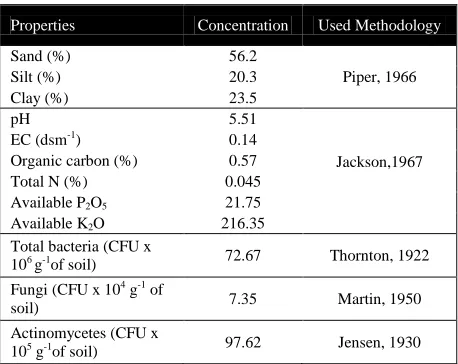
The experiment was conducted at Regional Research Sub-station, Raghunathpur, Bidhan Chandra Krishi Viswavidyalaya, Purulia, West Bengal in two consecutive years of 2015-16 and 2016-17. The study area belongs to humid and tropical climate characterised by a wet monsoon season (June to September) and a dry post monsoon season. The experimental site was situated at 23.55°N latitude and 86.67°E longitude with the altitude of 155 meters above the mean sea level (MSL). The soil characteristics were given in Table1.
2.2 Experimental design and treatments:
The experiment was laid out in Randomized Block Design. There were 6 treatment combinations with four replications. The treatments are comprising of 2,4 D Ethyl Ester 38% EC @ 0.9kg
ha-1, 2,4 D Ethyl Ester 38% EC @ 1.0 kg ha-1, 2,4 D Ethyl Ester
38% EC @ 1.1 kg ha-1, Diuron 80% WP@ 1.0 kg ha-1, hand
weeding at 20 and 40 DAS and Control. The individual plot size was 5m × 4m.
2.3 Crop management
The maize variety Disha 3502 was sown on 03-11-2015 and 06-11-2016 and harvested on 20-02-2016 and 24-02-2016 respectively taking a total duration of 107 and 108 days. The seed rate was 20 kg ha-1 and the row to row spacing was 45cm and plant to plant spacing was 15cm. The recommended fertiliser dose of 120:60:60 kg N, P2O5 and K2O ha
-1
was used for the crop. 50% Table 1.Basic physical,chemical and microbiological properties of the
soil in the study area
Properties Concentration Used Methodology
Sand (%) 56.2
Piper, 1966
Silt (%) 20.3
Clay (%) 23.5
pH 5.51
Jackson,1967
EC (dsm-1) 0.14
Organic carbon (%) 0.57
Total N (%) 0.045
Available P2O5 21.75
Available K2O 216.35
Total bacteria (CFU x
106 g-1of soil) 72.67 Thornton, 1922
Fungi (CFU x 104 g-1 of
soil) 7.35 Martin, 1950
Actinomycetes (CFU x
Journal of Experimental Biology and Agriculture Science http://www.jebas.org
152 Soren et al.
N along with a full dose of P2O5 and K2O were applied as basal at
the time of final land preparation and the rest amount of nitrogen was applied at 30 days after sowing (DAS).The herbicide 2, 4 D Ethyl Ester 38% EC was sprayed as post-emergence treatments
(i.e. 20 DAS) and Diuron was sprayed as pre-emergence
treatments (i.e. 2 DAS) using a water volume of 500 litres ha-1 with knapsack sprayer fitted with flat fan deflector nozzle.
2.4 Plant and weed sampling
The population of different types of weeds (Grasses, Broadleaf & sedge) and were recorded at 30, 45 and 60 DAA (Days after herbicide Application). A quadrate with a dimension of 1 m × 1 m was placed randomly at three places in each plot and the weeds from that area were counted and expressed as number per square meter. Weeds belonging to three categories obtained in the population at 30, 45 & 60 DAA were labelled properly. The labelled samples were sun dried for 24 hours and then oven dried
at 70oC for 72 hours. The dry weight of weeds was then taken and
recorded separately. For measuring the grain yield of maize, the entire produce from the net plot area (from demarcated portion, leaving the border area) was harvested and weighed after proper drying under the sun. Grain yield from that area was converted to yield unit-1 area (kg ha-1). Weed control efficiency is expressed as the percentage of control of weeds over unweeded control. It denotes the efficiency of the applied herbicide for comparison purpose. WCE of different treatments was computed on the basis
of weed dry weight by using the following formula,
WCE =DWC − DWT
DWC 100
Where,
DWC = Dry weight of weeds in untreated control plot
DWT = Dry weight of weeds in treated plot
2.5 Soil sampling
After the harvest of maize crop, soil samples were collected from three different places in each plot at a depth of 30 cm and microbial population was counted as per the standard procedures.
2.6 Statistical analysis
Data were analysed using analysis of variance (ANOVA) following randomised block design (Gomez & Gomez, 1984). Differences were considered significant at 5% level of probability.
3 Results
The important weed flora observed in the experimental plot were
Trianthema monogyna, Portulaca oleracea, Euphorbia hirta, Physalis minima, Digera arvensis, Cyperus rotundus, Cyperus iria, Echinochloa colona, Digitaria sanguinalis, Eleusine indica, Brachiaria mutica, Amaranthus viridis, Alternanthera philoxeroides, Chenopodium album, Fumaria parviflora, Boerhaavia diffusa, Phyllanthus niruri and Eclipta alba.
3.1 Weed density and dry weight
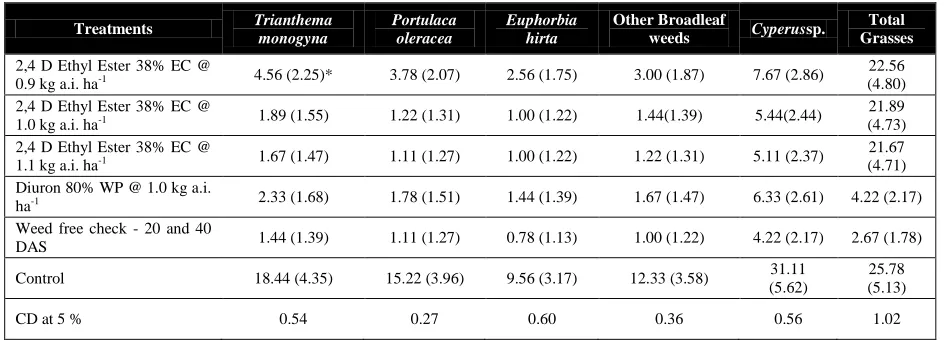
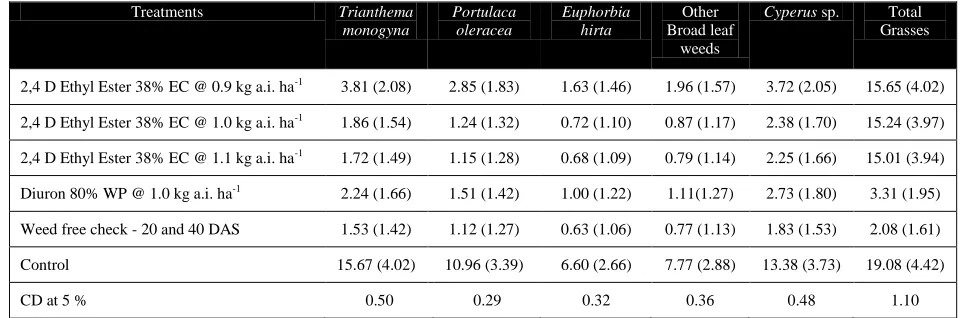
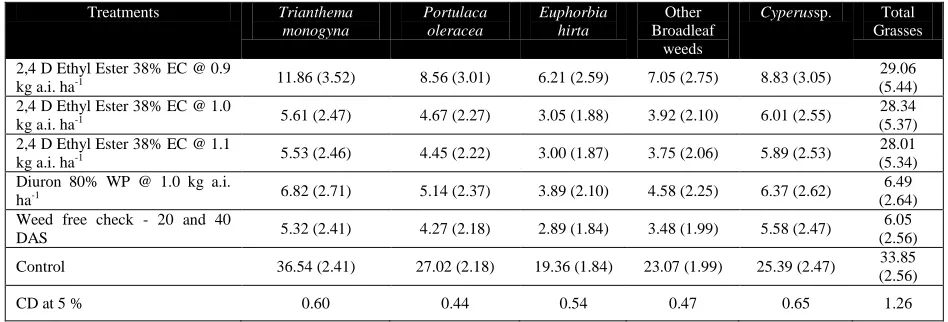
Weeds type and severity of weed infestation in field crops are considered the precursor of yield loss in a crop. Therefore, timely control of weeds is very necessary for realizing an optimum yield of any crop. The pooled data of two years pertaining to weed density and dry weight were given in table 2, 3, 4, 5, 6 and 7. Weed count and dry weight was significantly reduced in all treatments except weedy at check at 30, 45 and 60DAA. Lowest weed density and dry weight were recorded by 2,4 D Ethyl Ester
38% EC @ 1.1 kg ha-1
followed by 2,4 D Ethyl Ester 38% EC @
Table 2 Weed density (m-2) at 30 DAA of herbicides
Treatments Trianthema
monogyna
Portulaca oleracea
Euphorbia hirta
Other Broadleaf
weeds Cyperussp.
Total Grasses
2,4 D Ethyl Ester 38% EC @
0.9 kg a.i. ha-1 4.56 (2.25)* 3.78 (2.07) 2.56 (1.75) 3.00 (1.87) 7.67 (2.86)
22.56 (4.80) 2,4 D Ethyl Ester 38% EC @
1.0 kg a.i. ha-1 1.89 (1.55) 1.22 (1.31) 1.00 (1.22) 1.44(1.39) 5.44(2.44)
21.89 (4.73) 2,4 D Ethyl Ester 38% EC @
1.1 kg a.i. ha-1 1.67 (1.47) 1.11 (1.27) 1.00 (1.22) 1.22 (1.31) 5.11 (2.37)
21.67 (4.71) Diuron 80% WP @ 1.0 kg a.i.
ha-1 2.33 (1.68) 1.78 (1.51) 1.44 (1.39) 1.67 (1.47) 6.33 (2.61) 4.22 (2.17)
Weed free check - 20 and 40
DAS 1.44 (1.39) 1.11 (1.27) 0.78 (1.13) 1.00 (1.22) 4.22 (2.17) 2.67 (1.78)
Control 18.44 (4.35) 15.22 (3.96) 9.56 (3.17) 12.33 (3.58) 31.11
(5.62)
25.78 (5.13)
CD at 5 % 0.54 0.27 0.60 0.36 0.56 1.02
Journal of Experimental Biology and Agriculture Science http://www.jebas.org
Weed dynamics and yield of rabi maize influenced by weed management practices 153
Table 3 Weed density (m-2) at 45DAA of herbicides
Treatments Trianthema monogyna
Portulaca oleracea
Euphorbia hirta
Other Broadleaf weeds
Cyperussp. Total Grasses
2,4 D Ethyl Ester 38% EC @
0.9 kg a.i. ha-1 5.44 (2.44) 4.33 (2.20) 3.11(1.90) 4.89 (2.32) 9.44 (3.15) 25.67 (5.12)
2,4 D Ethyl Ester 38% EC @
1.0 kg a.i. ha-1 2.67 (1.78) 2.11 (1.62) 1.56 (1.44) 2.22 (1.65) 6.44 (2.63) 25.11 (5.06)
2,4 D Ethyl Ester 38% EC @
1.1 kg a.i. ha-1 2.44 (1.71) 2.11 (1.62) 1.44 (1.39) 2.11 (1.62) 6.11 (2.57) 25.00 (5.05)
Diuron 80% WP @ 1.0 kg a.i.
ha-1 3.11 (1.90) 2.33 (1.68) 1.78 (1.51) 2.78 (1.81) 7.89 (2.90) 5.44 (2.44)
Weed free check - 20 and 40
DAS 2.33 (1.68) 1.89 (1.55) 1.33 (1.35) 2.00 (1.58) 5.67 (2.48) 3.44 (1.98)
Control 22.78 (4.82) 17.89 (4.29) 12.56 (3.61) 19.56 (4.48) 37.56
(6.17) 28.78(5.41)
CD at 5 % 0.60 0.36 0.41 0.54 0.77 1.39
*Data in the parenthesis are transformed value; Square root transformed value of (X+0.5) was used for statistical analysis
Table 4 Weed density (m-2) at 60 DAA of herbicides
Treatments Trianthema monogyna
Portulaca oleracea
Euphorbia hirta
Other Broadleaf weeds
Cyperussp. Total Grasses
2,4 D Ethyl Ester 38% EC @
0.9 kg a.i. ha-1 8.56 (3.01) 7.33 (2.80) 6.22 (2.59) 6.67 (2.68)
13.33 (3.72)
27.00 (5.24)
2,4 D Ethyl Ester 38% EC @
1.0 kg a.i. ha-1 3.67 (2.04) 3.11 (1.90) 2.44 (1.71) 2.56 (1.75) 8.56 (3.01) (5.20) 26.56
2,4 D Ethyl Ester 38% EC @
1.1 kg a.i. ha-1 3.56 (2.01) 3.00 (1.87) 2.22 (1.65) 2.33 (1.68) 8.22 (2.95) (5.18) 26.33
Diuron 80% WP @ 1.0 kg a.i.
ha-1 4.33 (2.20) 3.44 (1.98) 2.78 (1.81) 3.00 (1.87)
10.44
(3.31) 8.22 (2.95)
Weed free check - 20 and 40
DAS 3.22 (1.93) 2.78 (1.81) 2.00 (1.58) 2.33 (1.68) 7.89 (2.90) 6.11 (2.57)
Control 26.67 (5.21) 22.33 (4.78) 18.44 (4.35) 19.89 (4.52) 39.67
(6.34)
30.22 (5.54)
CD at 5 % 0.68 0.43 0.49 0.56 0.86 1.44
*Data in the parenthesis are transformed value; Square root transformed value of (X+0.5) was used for statistical analysis
Table 5 Weed dry weight (g m-2) at 30 DAA of herbicides
Treatments Trianthema monogyna
Portulaca oleracea
Euphorbia hirta
Other Broad leaf
weeds
Cyperus sp. Total Grasses
2,4 D Ethyl Ester 38% EC @ 0.9 kg a.i. ha-1 3.81 (2.08) 2.85 (1.83) 1.63 (1.46) 1.96 (1.57) 3.72 (2.05) 15.65 (4.02)
2,4 D Ethyl Ester 38% EC @ 1.0 kg a.i. ha-1 1.86 (1.54) 1.24 (1.32) 0.72 (1.10) 0.87 (1.17) 2.38 (1.70) 15.24 (3.97)
2,4 D Ethyl Ester 38% EC @ 1.1 kg a.i. ha-1 1.72 (1.49) 1.15 (1.28) 0.68 (1.09) 0.79 (1.14) 2.25 (1.66) 15.01 (3.94)
Diuron 80% WP @ 1.0 kg a.i. ha-1 2.24 (1.66) 1.51 (1.42) 1.00 (1.22) 1.11(1.27) 2.73 (1.80) 3.31 (1.95)
Weed free check - 20 and 40 DAS 1.53 (1.42) 1.12 (1.27) 0.63 (1.06) 0.77 (1.13) 1.83 (1.53) 2.08 (1.61)
Control 15.67 (4.02) 10.96 (3.39) 6.60 (2.66) 7.77 (2.88) 13.38 (3.73) 19.08 (4.42)
CD at 5 % 0.50 0.29 0.32 0.36 0.48 1.10
Journal of Experimental Biology and Agriculture Science http://www.jebas.org
154 Soren et al.
1.0 kg ha-1 in all the stages of sampling. Hand weeding twice at 20
and 40 DAS significantly recorded the lowest weed density and dry weight at 30, 45 and 60 DAA compared to other management practices.
3.2 Weed control efficiency
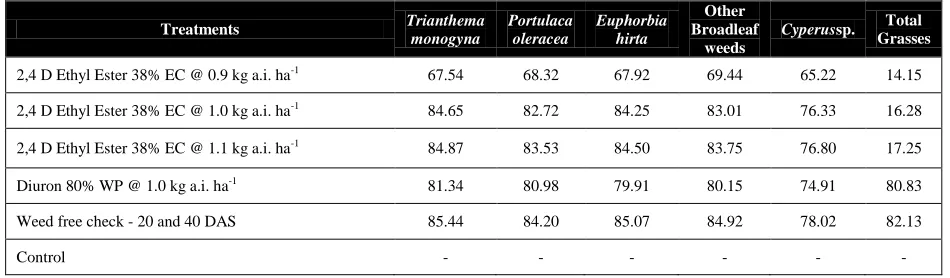
Data regarding weed control efficacy (Table 8, 9 and 10), revealed highest weed control efficiency was recorded in hand weeding twice at 20 and 40 DAS at 30, 45 and 60 DAA. Among the
herbicides2,4 D Ethyl Ester 38% EC @ 1.1 kg ha-1 recorded
highest weed control efficiency followed by 2,4 D Ethyl Ester
38% EC @ 1.0kg ha-1.
3.3 Crop Yield
The pooled data of maize stover and grain yield was given in Table 11 revealed that hand weeding gives significantly higher
stover (15.02 t ha-1) and grain yield (4.64 t ha-1) which was followed by 2,4 D Ethyl Ester 38% EC @ 1.1 kg ha-1 (4.49 and
14.86 t ha-1) and this was atpar with 2,4 D Ethyl Ester 38% EC @
1.0kg ha-1 (4.41 and 14.51 t ha-1). Lowest straw (10.93 t ha-1) and
grain yield (3.18 t ha-1) was observed in weedy check.
3.4 Microbial population
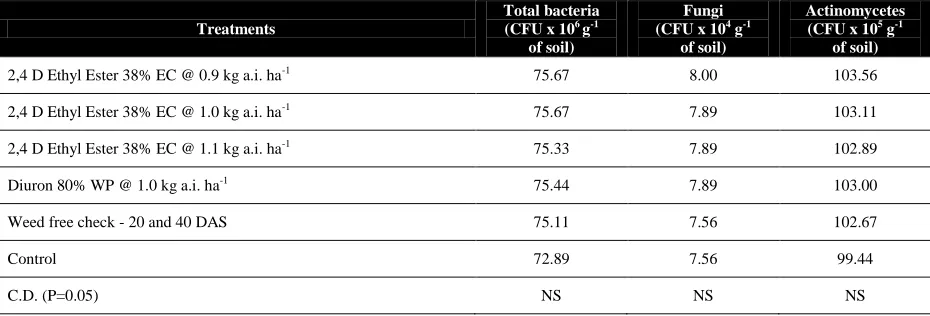
Data given in Table 12 reveals that total bacteria populationin 2,4 D Ethyl Ester 38% EC applied plots did not show any significant influence on the population of total bacteria in Rhizosphere soil at the initial stage. But at harvesting the recorded population slightly higher than the initial observation. There was the adverse effect on the population of fungi in Rhizosphere region at harvest, the data showed slightly higher than the initial population of the fungi.Like the bacteria and fungi, similar kind of trend was found in the case of Actinomycetes population. There was no significant difference among the herbicide treatments with respect
Table 6 Weed dry weight (g m-2) at 45 DAA of herbicides
Treatments Trianthema monogyna
Portulaca oleracea
Euphorbia hirta
Other Broadleaf weeds
Cyperus
sp.
Total Grasses
2,4 D Ethyl Ester 38% EC @ 0.9
kg a.i. ha-1 7.18 (2.77) 5.25 (2.40) 3.05 (1.88) 4.63 (2.26) 6.02 (2.55) 19.73 (4.50)
2,4 D Ethyl Ester 38% EC @ 1.0
kg a.i. ha-1 3.38 (1.97) 2.71 (1.79) 1.70 (1.48) 2.31 (1.68) 3.91 (2.10) 19.21 (4.44)
2,4 D Ethyl Ester 38% EC @ 1.1
kg a.i. ha-1 3.27 (1.94) 2.64 (1.77) 1.56 (1.44) 2.18 (1.64) 3.78 (2.07) 18.96 (4.41)
Diuron 80% WP @ 1.0 kg a.i. ha-1 4.17 (2.16) 3.03 (1.88) 1.97 (1.57) 2.68 (1.78) 4.55 (2.25) 4.00 (2.12)
Weed free check - 20 and 40 DAS 3.06 (1.89) 2.43 (1.71) 1.41 (1.38) 2.07 (1.60) 3.57 (2.02) 3.08 (1.89)
Control 27.11 (5.25) 19.50 (4.47) 11.93 (3.53) 17.02 (4.19) 21.03
(4.64) 23.60 (4.91)
CD at 5 % 0.66 0.39 0.42 0.53 0.60 1.23
*Data in the parenthesis are transformed value; Square root transformed value of (X+0.5) was used for statistical analysis
Table 7 Weed dry weight (g m-2) at 60DAA of herbicides
Treatments Trianthema monogyna
Portulaca oleracea
Euphorbia hirta
Other Broadleaf
weeds
Cyperussp. Total Grasses
2,4 D Ethyl Ester 38% EC @ 0.9
kg a.i. ha-1 11.86 (3.52) 8.56 (3.01) 6.21 (2.59) 7.05 (2.75) 8.83 (3.05)
29.06 (5.44) 2,4 D Ethyl Ester 38% EC @ 1.0
kg a.i. ha-1 5.61 (2.47) 4.67 (2.27) 3.05 (1.88) 3.92 (2.10) 6.01 (2.55)
28.34 (5.37) 2,4 D Ethyl Ester 38% EC @ 1.1
kg a.i. ha-1 5.53 (2.46) 4.45 (2.22) 3.00 (1.87) 3.75 (2.06) 5.89 (2.53)
28.01 (5.34) Diuron 80% WP @ 1.0 kg a.i.
ha-1 6.82 (2.71) 5.14 (2.37) 3.89 (2.10) 4.58 (2.25) 6.37 (2.62)
6.49 (2.64) Weed free check - 20 and 40
DAS 5.32 (2.41) 4.27 (2.18) 2.89 (1.84) 3.48 (1.99) 5.58 (2.47)
6.05 (2.56)
Control 36.54 (2.41) 27.02 (2.18) 19.36 (1.84) 23.07 (1.99) 25.39 (2.47) 33.85 (2.56)
CD at 5 % 0.60 0.44 0.54 0.47 0.65 1.26
Journal of Experimental Biology and Agriculture Science http://www.jebas.org
Weed dynamics and yield of rabi maize influenced by weed management practices 155
to microbial population. Since the effect of herbicide treatments on the beneficial soil microbes may be considered as safer to the soil beneficial microbes.
4 Discussion
4.1 Weed density and dry weight
The better performance of these herbicides might be due to longer persistence effect. The reduced crop weed competition in hand
wedding is due to regular removal of weeds in the initial and later stages of crop growth (Subbulakshmi et al., 2009; Hawaldar & Agasimani, 2012; Shankar et al., 2015). More over in the later stages of crop growth, the crop suppresses the weeds by shade and limited the availability of sunlight to reduce the biomass and density of weeds. Due to limited care and management, weedy check recorded significantly highest weed density and bio mass (Mathukia et al., 2014; Barad et al., 2016; Kumar et al., 2017). Selective post emergent herbicides reduced the weed dry weight Table 8 Weed control efficiency (%) at 30 DAA of herbicides
Treatments Trianthema
monogyna
Portulaca oleracea
Euphorbia hirta
Other Broadleaf
weeds
Cyperus
sp.
Total Grasses
2,4 D Ethyl Ester 38% EC @ 0.9 kg a.i. ha-1 75.69 74.00 75.30 74.77 72.20 17.98
2,4 D Ethyl Ester 38% EC @ 1.0 kg a.i. ha-1 88.13 88.69 89.09 88.80 82.21 20.13
2,4 D Ethyl Ester 38% EC @ 1.1 kg a.i. ha-1 89.02 89.51 89.70 89.83 83.18 21.33
Diuron 80% WP @ 1.0 kg a.i. ha-1 85.71 86.22 84.85 85.71 79.60 82.65
Weed free check - 20 and 40 DAS 90.24 89.78 90.45 90.09 86.32 89.10
Control - - - -
Table 9 Weed control efficiency (%) at 45 DAA of herbicides
Treatments Trianthemamonogyna Portulaca
oleracea
Euphorbia hirta
Other Broadleaf
weeds
Cyperussp. Grasses Total
2,4 D Ethyl Ester 38% EC @ 0.9 kg a.i. ha-1 73.52 73.08 74.43 72.80 71.37 16.40
2,4 D Ethyl Ester 38% EC @ 1.0 kg a.i. ha-1 87.53 86.10 85.75 86.43 81.41 18.60
2,4 D Ethyl Ester 38% EC @ 1.1 kg a.i. ha-1 87.94 86.46 86.92 87.19 82.03 19.66
Diuron 80% WP @ 1.0 kg a.i. ha-1 84.62 84.46 83.49 84.25 78.36 83.05
Weed free check - 20 and 40 DAS 88.71 87.54 88.18 87.84 83.02 86.95
Control - - - -
Table 10 Weed control efficiency (%) at 60 DAA of herbicides
Treatments Trianthema
monogyna
Portulaca oleracea
Euphorbia hirta
Other Broadleaf
weeds
Cyperussp. Total Grasses
2,4 D Ethyl Ester 38% EC @ 0.9 kg a.i. ha-1 67.54 68.32 67.92 69.44 65.22 14.15
2,4 D Ethyl Ester 38% EC @ 1.0 kg a.i. ha-1 84.65 82.72 84.25 83.01 76.33 16.28
2,4 D Ethyl Ester 38% EC @ 1.1 kg a.i. ha-1 84.87 83.53 84.50 83.75 76.80 17.25
Diuron 80% WP @ 1.0 kg a.i. ha-1 81.34 80.98 79.91 80.15 74.91 80.83
Weed free check - 20 and 40 DAS 85.44 84.20 85.07 84.92 78.02 82.13
Journal of Experimental Biology and Agriculture Science http://www.jebas.org
156 Soren et al.
by controlling wide range of weeds in the maize crop (Amare et al., 2015; Baniasadi, 2016; Kumar et al., 2017).
4.2 Weed control efficiency
After hand weeding all herbicides are effective in reducing weed density and dry weights (Tesfay et al., 2014). Better weed control efficiency of herbicides along with weed free condition might be due to effective weed control obtained under hand weeding, application of herbicides mixture at initial and early growth stage, which resulted in the lowest weed counts and finally reduced the total dry weight of weeds at harvest (Ehsas et al., 2016).
4.3 Crop Yield
The improved growth and yield under these treatments might be due to the periodical removal of weeds by hand weeding or herbicide application as evidenced by less weed density, weed dry weight and weed control efficiency compared other weed
management practices. The limited competition for light, moisture and nutrients in these treatments helps to gain higher yields than the weedy check (Mathukia et al., 2014; Dobariya et al., 2015; Shankar et al., 2015; Barad et al., 2016). A significant difference in grain and straw yields of maize was observed might be due to minimum weed seed bank and eradication of weeds providing a healthy environment for crop plant growth (Riaz et al., 2007). Totally, the results showed that application of herbicide led to a reduction of damages caused by weeds, also, it was determined that using of 2,4 D Ethyl Ester 38% EC had the highest effect on weed control in comparison to control resulted in increased straw and grain yield (Baniasadi, 2016).
4.4 Microbial population
The toxic effects of herbicides are normally most severe immediately after application. Few days after application of herbicides or at the time of harvest, the microbial population was increased, this was might be due to the reason that Table 11 Effect of Weed treatment on Maize Yield (t ha-1)
Treatments
Yield t/ha
Grain Straw
2,4 D Ethyl Ester 38% EC @ 0.9 kg a.i. ha-1 3.63 11.82
2,4 D Ethyl Ester 38% EC @ 1.0 kg a.i. ha-1 4.41 14.51
2,4 D Ethyl Ester 38% EC @ 1.1 kg a.i. ha-1 4.49 14.86
Diuron 80% WP @ 1.0 kg a.i. ha-1 4.06 13.67
Weed free check - 20 and 40 DAS 4.64 15.02
Control 3.18 10.93
CD at 5 % 0.81 1.71
Table 12 Influence of herbicides on soil microflora
Treatments
Total bacteria (CFU x 106 g-1
of soil)
Fungi (CFU x 104 g-1
of soil)
Actinomycetes (CFU x 105 g-1
of soil)
2,4 D Ethyl Ester 38% EC @ 0.9 kg a.i. ha-1 75.67 8.00 103.56
2,4 D Ethyl Ester 38% EC @ 1.0 kg a.i. ha-1 75.67 7.89 103.11
2,4 D Ethyl Ester 38% EC @ 1.1 kg a.i. ha-1 75.33 7.89 102.89
Diuron 80% WP @ 1.0 kg a.i. ha-1 75.44 7.89 103.00
Weed free check - 20 and 40 DAS 75.11 7.56 102.67
Control 72.89 7.56 99.44
Journal of Experimental Biology and Agriculture Science http://www.jebas.org
Weed dynamics and yield of rabi maize influenced by weed management practices 157
microorganisms initiate degradation process, and then the
degraded herbicides release carbon rich substrates which in terms maximize the microbial population in the root zone (Adhikary et al., 2014). 2,4-D decomposes rapidly because of its hormonal properties. There is no direct effect of herbicides on the population of soil microflora. Herbicides act as a source of nutrition for microbes, under such condition they significantly affect microbial growth and multiplication (Milosevic & Govedarika, 2002). Hand weeding rendered a significant increase in the population of microorganisms in soil is might be due to the influence of available nutrients stimulatory to the soil micro flora (Khuntia et al., 2013).
Conclusion
According to the results of this study, hand weeding shown superiority in controlling weed density, weed dry matter and higher control efficiency and grain yield when compared to the remaining treatments. But, it requires a lot of man force which was not economic to the farmer point of view. Among the
herbicidal treatments 2,4 D Ethyl Ester 38% EC @ 1.1 kg ha-1
shown better performance followed by 2,4 D Ethyl Ester 38% EC @ 1.0kg ha-1in terms of controlling weeds and increasing crop yield and microbial population in the rhizosphere. As there is no
much difference between 2,4 D Ethyl Ester 38% EC @ 1.1 kg ha
-1
and 2,4 D Ethyl Ester 38% EC @ 1.0kg ha-1 response to yield and
microbial population and controlling weeds, 2,4 D Ethyl Ester
38% EC @ 1.0kg ha-1was recommended as a post emergent
herbicide in rabi maize for effective controlling of weeds and getting higher grain yield.
Conflict of Interest
The author(s) declared no potential conflicts of interest with respectto the research or publication of this article.
References
Adhikary P, Shil S, Patra PS (2014) Effect of herbicides on soil microorganisms in transplanted chilli. Global Journal of Biology, Agriculture and Health Sciences 3: 236–238.
Aldrich SR, Scott WO, Leng ER (1975) Modern Crop Production, 2nd
Edn., A & L Publication, Champaign, IL, USA.
Amare T, Mohammed A, Negeri M, Sileshi F (2015) Effect of
weed control methods on weed density and maize (Zea mays L.)
yield in west Shewa Orimia, Ethiopia. African Journal of Plant Science 9: 8–12.
Anonymous (2016a) Estimates of area and production of maize in India-2015-16. Ministry of Agriculture and farmer welfare, Government of India.
Anonymous (2016b) Estimates of area and production of maize in West Bengal-2015-16. Ministry of Agriculture and farmer welfare, Government of India.
Baghestani MA, Zand E, Rahimian MH, Soufizadeh S (2005) Morphological and physiological characteristics which enhance
competitiveness of winter wheat (Triticum aestivum) against
Goldbachia laevigata. Iranian Journal of Weed Science 1: 111–126.
Baniasadi MH (2016) Effect of pre and post emergence herbicides to weeds control in corn field. International Journal of Environment, Agriculture and Biotechnology 3: 502–504.
Barad B, Mathukia RK, Gohil BS, Chhodavadia SK (2016)
Integrated weed management in rabi popcorn (Zea mays var.
everta). Journal of Crop and Weed 12: 150–153.
Dobariya VK, Mathukia RK, Gohil BS, Shivran A (2015).
Integrated weed management in rabi sweet corn (Zea mays var.
saccharata). Journal of Eco-friendly Agriculture 10: 70–73.
Ehsas J, Desai LJ, Ahir NB, Joshi JR (2016) Effect of integrated weed management on growth, yield, yield attributes and weed
parameters on summer maize (Zea mays L.) under south Gujarat.
International Journal of Science, Environment 5: 2050–2056.
Gomez KA, Gomez AA (1984) Statistical procedures in
agricultural research, 2nd edition. A. Wiley–Interscience
Publication, New York, 122-123.
Hawaldar S, Agasimani CA (2012) Effect of herbicides on weed
control and productivity of maize (Zea mays L.). Karnataka
Journal of Agricultural Sciences 25: 137-139.
Jackson ML (1967) Soil chemical analysis. Prentice Hall of India Private Limited, New Delhi, Pp. 498.
Jeet S, Singh JP, Kumar R (2017) Production potential and nutrient uptake of QPM hybrids as influenced by nitrogen and sulphur fertilization. Journal of Agriculture Search 4: 27-30.
Jensen HL (1930) The genus Micromonospora Orskov, a little known group of soil microorganisms. Proceedings of The Linnean Society of New South Wales 55: 231-248.
Khuntia A, Pradhan MR, Jena S, Lenka PC (2013) Effect of herbicides soil microbial population and productivity of rice in north eastern coastal plain zone of Odisha. International Journal of Advanced Chemical Science and Applications 1: 51–53.
Journal of Experimental Biology and Agriculture Science http://www.jebas.org
158 Soren et al.
International Journal of Current Microbiology and Applied Science 6: 1431–1440.
Kumar R, Bohra JS, Kumawat N, Kumar A, Kumari A, Singh AK (2016) Root growth, productivity and profitability of baby corn (Zea mays L.) as influenced by nutrition levels under irrigated ecosystem. Research on Crops 17: 41-46.
Kumar R, Bohra JS, Singh AK, Kumawat N (2015) Productivity, profitability and nutrient-use efficiency of baby corn (Zea mays) as influenced of varying fertility levels. Indian Journal of Agronomy 60: 285-290.
Martin JP (1950) Use of acid, rose bengal and streptomycin in the plate method for estimating soil fungi. Soil Science 69: 215-232.
Mathukia RK, Dobariya VK, Gohil BS, Chhodavadia SK (2014)
Integrated weed management in rabi sweet corn (Zea mays L.
var.Saccharata). Advances in Crop Science and Technology 2: 139-141.
Milosevic NA, Govedarica MM (2002) Effect of herbicides on microbiological properties of soil, Proceedings for Natural Sciences, Matica Srpska Novi Sad 102:5–21.
Patel VJ, Upadhyay PN, Patel JB, Meisuriya MI (2006) Effect of herbicide mixture on weeds in kharif maize (Zea mays L.) under middle Gujarat conditions. Indian Journal of Weed science 38: 54-57.
Piper CS (1966) Soil and Plant Analysis. Hans Publication, Bombay, India, Pp. 137-153.
Ram P, Sreenivas G, Leela Rani P (2017) Impact of sustainable weed management practices on growth, phenology and yield of rabi grain maize (Zea mays L.). International Journal of Current Microbiology and Applied Sciences 6: 701-710.
Riaz M, Jamil M, Mahmood TZ (2007) Yield and yield components of maize as affected by various weed control methods under rain-fed conditions of Pakistan. International Journal of Agriculture and Biology 9: 152–155.
Shankar KA, Yogeesh LN, Prashanth SM, Channabasavanna AS, Channagoudar RF (2015) Effect of weed management practices on weed growth and yield of maize. International Journal of Science, Environment and Technology 4: 1540–1545.
Singh P, Rana NS, Shukla UN, Singh S, Kumar R, Kumar K (2013). Effectof genotypes and nitrogen levels on production
potential of maize (Zea mays L.) under Indo-Gangetic plain zone
of western U.P. The Bioscan 8: 777-781.
Subbulakshmi S, Subbian P, Prabhakaran NK (2009) Effect of tillage and weed management practices on performance of maize- sunflower. International Journal of Agricultural Sciences 5: 35–39.
Tesfay A, Amin M, Mulugeta N (2014) Management of weeds in
maize (Zea mays L.) through various pre and post emergency
herbicides. Advances in Crop Science and Technology 2: 151-155.
Thornton HG (1922) On the development of a standardised agar medium for counting soil bacteria, with especial regard to the