Paper: CH
VISUALISING ELECTRONIC DATA INTERCHANGE (EDI) AND
VIRTUAL INFORMATION SYSTEM (VIS) FOR MANIPAL
INSTITUTIONS
Padma V Upadhya, Librarian, Manipal Institute of Technology, Manipal 576 119 & Harish B, Manipal Centre for Information Science, MAHE, Manipal 576 119
Paper discuses a case study on a virtual information system for a group of institutions in Manipal. A demonstration model, which has been developed, is discussed.
1. INTRODUCTION
Manipal, a small village now an International centre for professional studies is the dreamland of Dr. T M A Pai. His vision is the present Manipal where one can find all the facilities for both academic and professional activities. Visualizing the need for Information exchange between the organizations at Manipal is found necessary to develop Virtual Information System (VIS) and Electronic Data Exchange (EDI). For this purpose Manipal Institute of Technology (MIT), Kasturba Medical College (KMC), Manipal Centre for Information Science (MCIS) and T A Pai Management Institute (TAPMI) are taken. KMC and MCIS are the units of Manipal Academy of Higher Education, (A Deemed University), Manipal. All these institutions are self-financing institutions.
All these institutions have in-house developed databases of Information resources and Local Area Network (LAN) facility. The Institutional LAN links the other information systems like Alumni Information System (AIS), Student Information System (SIS), Employee Information System (EIS) and University Information System (UIS) of the organization. Emphasis is also given to promote virtual classroom since there are various interdisciplinary course being taught at undergraduate and post graduate level. The Distance Education Cell in collaboration with APTECH Centre and Manipal Institute of Computer Education (MICE) conducts IT Course leading to PG degrees at national level.
2. WHY ELECTRONIC DATA INTERCHANGE (EDI) AND VIRTUAL INFORMATION SYSTEM (VIS)
Several features are driving us to opt for the technique of electronic Data Interchange (EDI) through Virtual Information System (VIS). They are change, subsidization and global competition, time, speed, cost & integration. The major reason is the change. Change is an activity or process, which no body can deny or escape. We accept change consciously or unconsciously, willingly or unwillingly. We come across many changes in and around and where we work and live. Computerization of finance sector once made the employee to fear for loss of job opportunities. In the process of library development the terminology itself is changed. Now the library is known as knowledge centre where the knowledge manager manages knowledge.
In the context of information system environment the changes can be grouped as
a. change in the data storage/preservation b. change in the data acquisition process c. change in the data communication media d. Change in the data distribution media e. change in the data presentation media
With the above changes taking place we have walked a long distance and we now live in the networked society. The challenges before the IS manager is to apply their craft and develop their system in a way that will best perpetuate and facilitate the use of the information resources which we find before us. In the present situation it is the prime issue to go for the VIS and EDI. Keeping informed and keeping open communication lines and being receptive to feedback is the key to overcome the fear of change.
3. ELECTRONIC DATA INTERCHANGE (EDI)
EDI is the electronic exchange of documents in a standard, computer processable, universally accepted form between the provider and user of the information system. The difference between e-mail, sharing file through a network or bulletin board and EDI is that ‘the computer application of both the sender and receiver is referred to as ‘Trading Partners (TP) i.e., EDI consists of standard electronic message formats for communication. This can be referred as below Fig. 1.
Electronic Data Exchange and E-mail or FAX
EDI is often termed as paperless communication. EDI means communication without human intervention. More formally described as the interchange of structured data according to agreed message standards between the computer systems by electronic means. EDI enables to transfer the document irrespective of the applications of the computer in organizations. For E.g., one library may use LIBSYS package for database management and other may us CDS/ISIS etc. EDI enables one to overcome the problem of
a. increase time b. low accuracy c. high labor charge
The direct benefit include
a. Retyping of data not required since the transfer of information is done automatically b. Cost of processing EDI documents is cheaper than paper documents
c. Customer relation is improved and one is able to communicate faster. d. Efficient management of information
Person
FAX
E-Mail User
Computer
Purchase order.
Post office
Purchase order
Order process
e. More job satisfaction among the workers since they may be redeployed in creative activities.
f. EDI helps the information officer to fulfil the laws of Library Science.
In general the benefits of EDI are grouped into
Strategic benefits Operational benefits Opportunity benefits
The benefits will vary depending on why and how EDI has been implemented.
3.1 Process in EDI
EDI involves five main processes
1. Extracting data from a computer system 2. Translating the data into a transmittable format 3. Transmitting the message
4. Receiving/interpreting the message at the receiving end 5. Downloading the data in the receiving computer application
3.2 Components of EDI
1. EDI standards 2. EDI software
3. Network for communication
The method of correct interpretation of the information by the computer system is defined by EDI standards. EDI standard define the techniques for structuring the data into electronic message equivalent of paper based documents. EDI standard is independent of computer hardware and software. ISO is responsible for developing syntax rules and the data dictionary.
What do we mean by standards, what do they comprise, who makes them and how do you choose which one to use? In this article Chris Nelson of EDI Initiative takes a brief look at these issues. The first thing to know about EDI standards is that there is more than one or, more accurately more than one syntax upon which the EDI messages are built. The syntax comprises the rules that define how a message is assembled for exchange.
The three syntax that dominate in the world of EDI are
1. ANSI ASCX.121 (often called ANSI X.12) 2. UNTDI2 and
ANSI X.12 is the dominant standard in North America and is also widely used in Australia and New Zealand. UNTDI2 is used in Western Europe, and messages using this syntax are still widely used in the UK as a part of the TRADACOMS message set. However, the only international syntax standard is EDIFACT. EDIFACT was born in 1985 as a merge between the best features of UNTDI and ANSI X.12 and out of recognition that in the world of commerce, transportation and administration there could no longer be national or regional syntax standards. In fact, no new messages will be developed using ANSI X.12.
After 1995 in many industry sectors, such as insurance, travel and leisure, statistics, health and social administration, the only syntax standard used is EDIFACT. CEN4 will start to adopt chosen EDIFACT messages as the European standard from this year. An EDI standard comprises the syntax, the message design rules (i.e. the technical rules which must be followed when designing a message) and the directories (i.e. the messages themselves and the building blocks of the messages segments, data elements and codes).
Technical experts in conjunction design the messages and directories messages with the users. This is done in national or international committees set up for this purpose by the relevant maintenance authority for the directories. New business functions will require changes to the directories: e.g. new messages; changes to segments; new data elements; new codes. These changes must be agreed by the maintenance organization for the directories. Depending on the type of maintenance organization this can take a long time (two or three years in the case of international EDIFACT directories because the directory changes must be agreed at the international level).
When the new directory has been formally approved then the new message or new version of an existing message is available for use. The international body responsible for the maintenance of the EDIFACT directories is the UN/ECE trade procedures committee - Working Party 4 (WP.4). Although many user communities often prefer to wait for formal approval of a message before it is used, this is not always the case. For instance, the message used for the INTRASTAT declaration for trading within the E.U. was not formally approved until many months after the live date of the INTRASTAT regulation (1st January 1993) and the live use of the message.
EDI software i.e., the translating softwares are designed to translate the message as they move from standard to internal formats and vice versa. EDI is nothing but the computer instructions that translate the information from unstructured format to structured EDI format. EDI also need communication networks.
To perform EDI we need a computer
a. communication interface i.e., network b. appropriate software
analogous to the pipe work of the processes that which enables message to flow between the trading partners.
EDI is implemented either through EDI service Bureau or as Integrated EDI which will be done on the network server along with the Front End Processor (FEP). The FEP takes care of translation and communication. The FEP could be connected over a LAN to the computer system on which the information system is running. Information can be downloaded or uploaded between the FEP and the computer.
Different options are available which earlier included exchange of discs, tapes and now the data exchange through the private networks. In UK and USA most of the organizations now engage the services of third party network operators known as Value Added Network (VAN). TRADENET has become the most widely used VAN in UK. Now the General Electric Information Service (GEIS) is the largest community of EDI users.
The major benefit with the VAN is that one is only concerned about his/her link to the network whether it be from a PC to a mainframe computer and need not bother about what the user or customer use to connect to the network. This aspect will be completely the concern of VAN. This VAN is essentially described as Electronic Post Office.
4. VIRTUAL INFORMATION SYSTEM (VIS)
Virtual Information System is a system that provides access control and network configuration changes using software control The virtual system or library are designed on the basis of networking concept which offers all the activities on the network. The VIS can be defined as
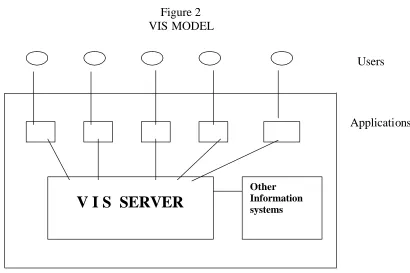
“A network of different library systems that come together to exploit or transit the information available in their premise or they can also be defined as Information System Partners “ The VIS environment can be picturized as in the Fig 2.
The VIS will enable us to
a. Reduce the flow of paper between the organizations. b. Improves the communication and productivity
c. Allows efficient and speedy distribution of information d. Improves accuracy of information
e. Allows reduction in the personnel
f. Enable to improve the user and customer relation g. Improves industry institute interaction
Figure 2 VIS MODEL
With this brief introduction to EDI and VIS the case study of development of VIS for Manipal institutions is outlined in the following paragraphs.
The data base of all the institutions is converted into a standard data format under the oracle based MS Access System. The data bases are provided with Front End User facility. The main aspect which are to be considered here are outsourcing of
a. Cost and time involved in data conversion b. Cost involved in cabling.
The whole project is being carried out in different stages.
1. Justifying the need for EDI and VIS 2. Study the available infrastructure 3. Study the process to be carried out 4. Requirements
5. Implementation 6. Future Strategy
i) Justification
Justification for the EDI and VIS is already discussed in the section Why EDI and VIS.
V I S SERVER
Other Information systems
ii) Infrastructure available
Present Infrastructure available in different institutions:
a. Infrastructure LAN, Internet, e mail and client server setup
b. Applications LIS, SIS, Payroll, EIS, UIS etc.,
M I T Information centre has 127 electronic journals for which the updations are made monthl y. Both M I T and K M C have bibliographic databases of related field.
c. Managerial Accounts, Auditing, Hospital IS, Medical Record IS
d. IT Centralized computer centre in all the institutions
e. User Institutional members and non-institutional members. In case of M I T the users are also from industry, software company etc.
f. Personnel Adequate number of IS people. Experts in technical fields like computing and communication technology. Adequate number of skilled people.
iii) Process being carried
The major need is linking the different institutions and for which cabling work is already started.
Data conversion of the applications into standard format is also under progress. Measures are being taken to see that:
a. the user is given different options for search b. to enable both guided and expert search c. well maintained data dictionary
d. data updating process e. user clarification
f. access control to the non members of the institution
g. downloading facility of electronic journals and search results from the applications and bibliographic databases
iv) Requirements
Network system with high-end servers for the future and CD Network station and more number of user work stations.
v) Implementation
Since the above process is under progress the implementation may take few more days. However a demonstration model is developed.
vi) Future Strategy
Once the implementation is made the future strategy is to
a. Develop multimedia sources b. Develop HTML based sources
c. Digitization of rare and old documents d. Develop audio and video presentations etc
e. Develop database of slide based presentations for classroom instructions. f. Develop high speed bandwidth network with parallel processing server g. Online evaluation etc.
The above features will be useful for distance learning and also develop ‘Virtual classroom’ for the learners.
Virtual classroom or electronic classroom is an exciting medium for delivering lectures. It enables both students and lecture to communicate even in dispersed place conveniently. It also enables the student to make query and get answers from the source in the absence of the lecturer.
In this lessons and assignments are communicated via a central computer system network which stores the instructions. As and when the students logs onto the system the instructions are given and on request the same may be downloaded with the telecommunication software and modem. The queries from students are again transferred to the central system and at any time or immediately the student gets the clarification. This will help to:
a. Increase speed, flexibility in training and education a. reduce the cost associated with the classroom teaching
b. leverage instructors expertise across a broader population of participants c. Increase team performance, team learning and team productivity.
5. CONCLUSION
6. REFERENCES
1. Bajaj, K K and Nag, Debjani. E Commerce The cutting edge of business. Delhi: Tata Mc Graw Hill, 1999.
2. Robert E. Hand Book of IS management. Umbaugh,. Florida: CRC press, 1999.