March, 2003 DRTC, Bangalore
Paper: B
Digital Library Architecture
Richa Pandey
Documentation and Research Training Centre Indian Statistical Institute
Bangalore-560 059 email: [email protected]
Abstract
A digital library is an integrated set of services for capturing, cataloging, storing, searching, protecting, and retrieving information, which provide coherent organization and convenient access to typically large amounts of digital information. Digital libraries are realizations of architecture in a specific hardware, networking, and software situation, which emphasize organization, acquisition, preservation, and utilization of information.
2.
CRITERIA FOR DIGITAL LIBRARY
To develop a digital library system, the following criteria can be considered: 1. Low cost, including all hardware and software components; 2. Technically simple to install and manage;
3. Robust 4. Scalable
5. Open and inter-operable 6. Modular
7. User Friendly;
8. Multi-user (including both searching and maintenance); 9. Multimedia digital object enabled; and
10. Platform independent (including both client and server components).
3. PRINCIPLES FOR DIGITAL LIBRARY DESIGN
The following principles guide the development of the architecture. a. Service driven
The architecture for the DLs must be driven by the services it provides and tools required for delivering the service
b. Open architecture
The architecture must be open, extensible and support interoperability among heterogeneous, distributed systems
c. Scalability
The architecture must be robust, scalable and reliable in a high transaction rate production setting thousands of patrons with a wide variety of backgrounds and information needs
d. Preservation
The architecture must ensure persistent access to collection of the DL, addressing such issues as naming, digital archiving and digital preservation.
e. Privacy
The architecture must be sensitive to privacy issues and support both anonymous and customized access to resources
f. Practicality
The architecture should represent a flexible and practical approach to standards, recognizing the need to balance the level of information collection with economic constraints
g. Modularity
The architecture should represent a mix of new technology and legacy pieces, all of which must inter operate while involving at different rates.
h. Time frame
i. Client support
The architecture should support a base line level of services, which can be accessed with common desktop configuration and software. Certain higher level services may require proprietary clients but the support of these clients should be determined by DL tool and services group.
4.
COMPONENTS OF DIGITAL LIBRARY
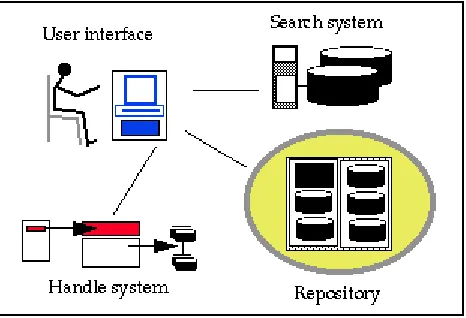
Digital library framework permits many different computer systems to coexist. The key components are shown in the figure below. They run on a variety of computer systems connected by a computer network, such as the Internet. (1)(See figure 1)
Fig. 1: Major system components
4.1. User Interfaces
We have to use two user interfaces: one for the end-users of the digital library, the other for digital librarians and system administrators who manage the collections. Each user interface is in two parts. A standard Internet browser is used for the actual interactions with the user. This can be Netscape Navigator, Microsoft's Internet Explorer. The browser connects to client services, which provide intermediary functions between the browser and the other parts of the system. The client services allow the user to decide where to search and what to retrieve; they interpret information structured as digital objects; they negotiate terms and conditions, manage relationships between digital obje cts, remember the state of the interaction, and convert among the protocols used by the various parts of the system.
4.2. Repository
Repositories store and manage digital objects and other information. A large digital library may have many repositories of various types, including modern repositories, legacy databases, and Web servers. The interface to this repository is called the repository access protocol (RAP). Features of RAP are explicit recognition of rights and permissions that need to be satisfie d before a client can access a digital object, support for a very general range of dissemination of digital objects, and an open architecture with well defined interfaces.
4.3. Handle System
Handles are general-purpose identifiers that can be used to identify Internet resources, such as digital objects, over long periods of time and to manage materials stored in any repository or database. When used with the repository, the handle system receives as input a handle for a digital object and returns the identifier of the repository where the object is stored.
4.4. Search System
5.
DIGITAL LIBRARY ARCHITECTURE
An architectural approach to the digital library can be discussed under following points. (2)
5.1 Notional Architecture
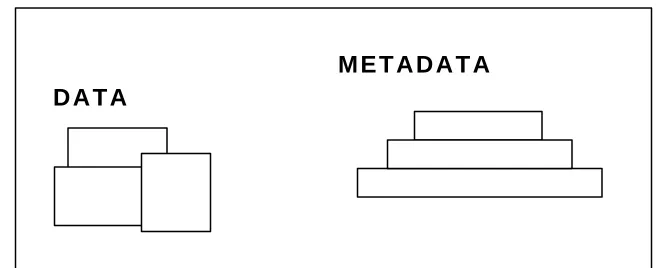
At notional level, data and metadata and meta-object are considered. Data are library materials in the traditional libraries where as digital library deals with digital information or data and metadata is data about object in the digital library. The traditional card record is an example of metadata for traditional library. A meta-object is an object that provides references to a set of digital objects. In its simplest form, a meta-object is a list of handles of other digital objects. For example, a meta-object for an anthology is a digital object that lists all the poems. An important example of a meta-object is a digital object that lists all converted versions of a specific physical item. Digital objects are kept for defining the metadata (Data about data). The designing of metadata is important for searching and retrieval of information. Most of the integrated library automation software takes care of the process of defining metadata. The metadata are entered in fields. This software indexes all the fields according to the requirement of users and the system administrators (See Figure 2)
D A T A
M E T A D A T A
Fig. 2: Notional level
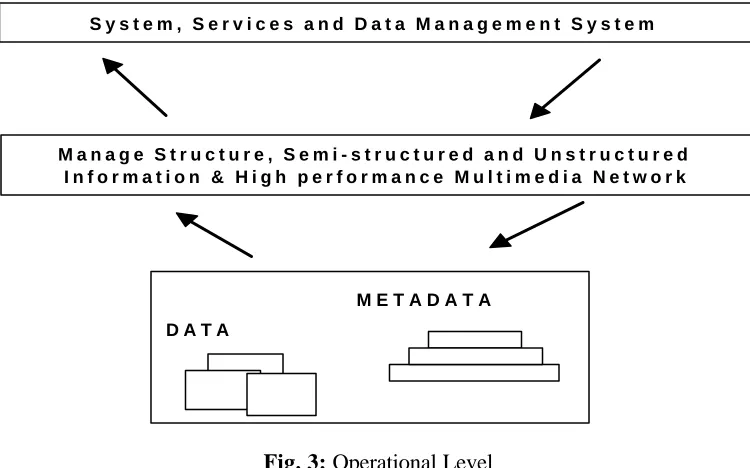
5.2 Operational System
S y s t e m , S e r v i c e s a n d D a t a M a n a g e m e n t S y s t e m
M a n a g e S t r u c t u r e , S e m i - s t r u c t u r e d a n d U n s t r u c t u r e d I n f o r m a t i o n & H i g h p e r f o r m a n c e M u l t i m e d i a N e t w o r k
D A T A
M E T A D A T A
Fig. 3: Operational Level
5.3. Technical System
At technical level we have to think about the functional component. The metadata is for content and is added to the digital library. It provides information about the content. So, Metadata and data must be bound together logically, and there must be a robust underlying technology to manage the logical connection through time, across platforms, and over geographical separations, all on a networked, distributed system. It describes major functional areas that taken together provide necessary components to build robust, scalable and interoperable digital library applications and services with the resulting digital objects. (See Fig. 4)
Functional Components:
Ø Hardware (Servers, PCs(Clients),Modems, Storage devices, Book Scanner, CD/DVD Writers and digital camera, Video digitizer, UPS backup etc)
Ø Software (OCR, Linux/Solaris, MS Windows (Windows NT, Windows 95, Windows 98 etc), ORACLE, publishing Software, Search Engines etc.)
Ø Digital Resources (CDs, E-journals, Scientific & Technical journals like, IEEE, ACM, ACS etc)
Ø Conversion of Materials to digital format with proper licensing agreements
Ø High Speed Internet connectivity to broadband backbone
Search, Retrieval And Catalogue management will
utilize Metadata
Capture Catalogue & Index and Store
Functions will Create Metadata Metadata Production and Utilization Manager
Applets & APIs
Common Catalogues and Repository Access API
Catalogues &
Indexes
Hierarchical Storage
Access
Fig. 4: Technical Architecture
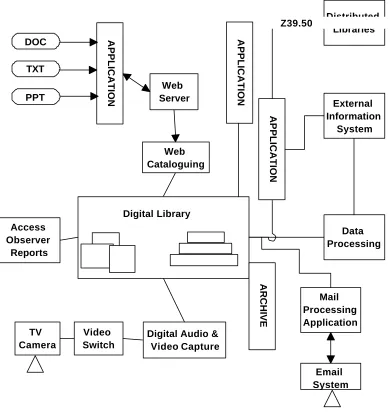
5.4. System Architecture
Distributed Libraries
APPLICATION APPLICATION
APPLICATION Information External
System Data Processing Web Server Web Cataloguing DOC PPT TXT Digital Library Mail Processing Application Email System ARCHIVE Video Switch Access Observer Reports
Digital Audio & Video Capture TV
Camera
Z39.50
Fig. 6: System Architecture
7. GENERIC DIGITAL LIBRARY MODEL
This basic digital library architecture is derived from a traditional library's four major components:
• The catalog of holdings; the storage area, organized into collections
• The user interface, for access to library services
• The ingest facilities (which a digital library uses to add documents and information about document cataloging and access),
Fig. 7: Generic Digital Library Model
8.
ARCHITECTURE OF DIFFERENT LIBRARIES
8.1. Architecture Of Alexandria Digital Library (ADL)
Alexandria Digital Library Project. The name Alexandria comes from the library of Alexandria, Egypt, which was considered the center of all knowledge/learning. The project began in 1995 with the development of the Alexandria Digital Library, a working digital library with collections of geographically referenced materials and services for accessing those collections. The Alexandria Digital Library Project is headquartered on the campus of the University of California at Santa Barbara. The Davidson Library hosted the Alexandria Digital Library. (4)
ADL follows three tiered structures (See Fig. 8)
• Client
• Middle ware
• Server
8.2. Architecture of California Digital Library (CDL)
The California Digital Library was founded in 1997 by University of California President Richard Atkinson, who called it "a library without walls."
Major components of CDL are as follows:(5) (See Figure 9)
• Client Desktop
• Server Tools
• Object Metadata
• Digital Objects
• Storage
• Integrating Components
• Protocols
• Persistent identifier
Fig. 9: Architecture of California Digital Library (CDL)
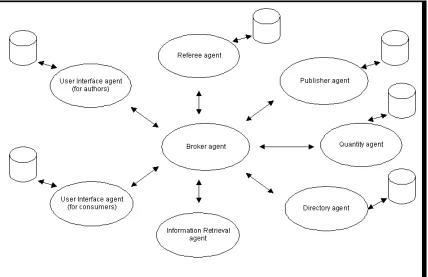
8.3. An Agent Architecture for a Virtual Research Digital Library
Agents: (7)
• Helps in bridging the gap between information producer, information consumer and publisher
• Interacting software agents cooperate to provide digital library services
Different Types of Agents (See Figure 10)
• User interface agents (for consumer)
• User interface agents(for authors)
• Publisher agents
• Broker agents
• Directory agents
• Quantity agents
• Referee agents
Fig. 10: Architecture of Virtual Digital Library
8.4. Architecture of NCSTRL (Networked Computer Science Report Library)
NCSTRL is
• largest distributed digital library on the internet
• A collaborative effort by a number of universities
• Focuses on distribution of computer science technical reports
• A network of interoperability digital library server
• Underlying technology as foundation- DIENST
8.4.1. Services offered by NCSTRL • User interface service
• Repository service
• Index service
• Collection service
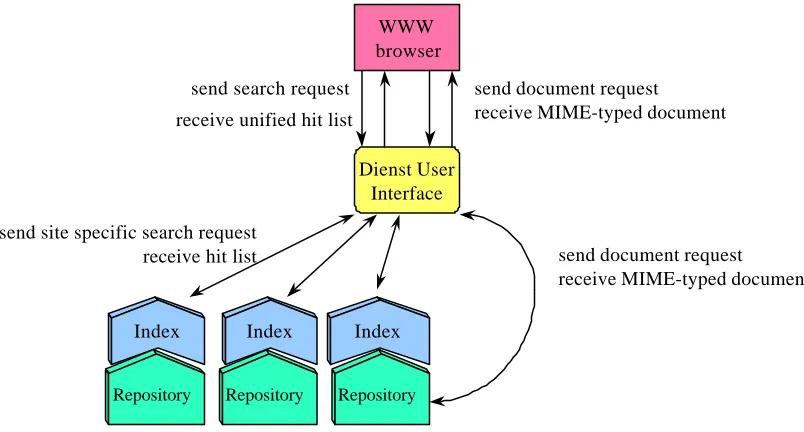
8.4.2. Dienst
This is “a system for configuring a set of individual services running on distributed servers to cooperate in providing services of a digital library”.
8.4.2.1 Features
• A conceptual architecture for distributed digital libraries
• A protocol for service communication in digital library architecture
•
• Has structured document model
• Open, extensible protocol for communicating with digital library services and accessing these documents
• Provides a mechanism for definition and administration of distributed collection
send search request
WWW browser Dienst User Interface Repository Index Index Index Repository Repository
send document request
receive MIME-typed document
send document request
receive MIME-typed document send site specific search request
receive hit list
receive unified hit list
Fig. 11: Interaction of Dienst Services
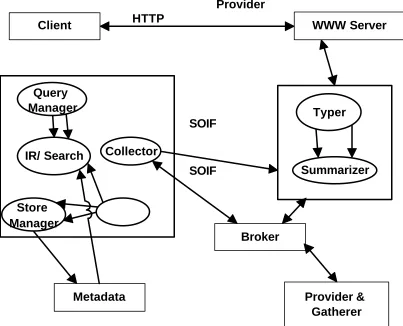
8.5. Harvest
Client
HTTP
Provider
WWW Server
Broker
Metadata
Provider &
Gatherer
Query
Manager
Typer
Summarizer
Store
Manager
IR/ Search
Collector
SOIF
SOIF
Fig. 12: Architecture of Harvest
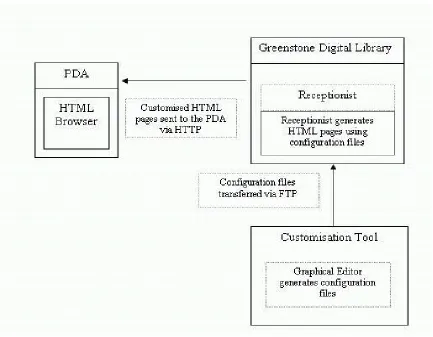
8.6. Architecture of Green Stone Digital Library (GSDL) (12)
The GSDL was developed by the University of Waikato in collaboration with UNESCO and the Human Libraries Project to provide information to the developing world. Greenstone digital library retrieves requested information and generates HTML pages that contain the information. The prototype system contains following parts
• PDA(Portable Digital Assistant): A thin client that runs an HTML browser that displays the generated HTML pages. The browser is capable of sending HTTP requests and receiving HTTP responses. This is possible because we make use of the wireless TCP technology that allows HTTP to run over mobile networks without the need to translate to other protocols.
• Customization Tool: The tool can be used by users to customize Greenstone for small screen devices. It generates configuration files that are used by Greenstone to generate HTML pages that match user preferences and that are suited to small screen devices. The customization tool provides a complete abstraction from Greenstones low-level details such as macro or CGI arguments, and allows users to visualize what the generated HTML page would look like, while they customize. The major component of the system is the customization tool. The customization tool allows users to customize all four components of Greenstones interface.(See Figure 13)
• Home Page: Allows users to specify the structure of the home page and gives them the option to place a search for a single collection on the home page.
• Document Structure: The layout or structure of documents within each collection
• Search Preferences: Allows users to customize the search facility (e.g. they can choose to have a normal search or date search)
Fig. 13: Architecture of Green Stone Library
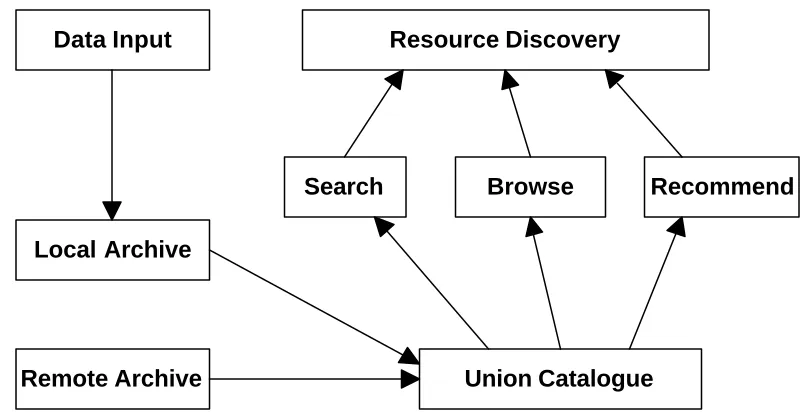
8.7. Open Digital Library Architecture
Data Input
Resource Discovery
Browse
Union Catalogue
Search
Recommend
Remote Archive
Local Archive
Fig. 14: Network Architecture of an Open Digital Library
9.
CONCLUSION
Digital libraries are very important sources of structured well-organized and well-stored information. In fact, it is a collection of disparate systems and resources connected through a network, and integrated within one interface and are responsible for developing and providing access to shared collections. An ideal digital library has distributed structure as the distributed architecture promotes modularity, flexibility, and incremental development, and accommodates diversity in current and future library environments. At the same time, distribution presents difficult problems in interoperability, coordination, search, and resource allocation. So digital libraries must follow architecture guidelines and standards to ensure interoperability between system and consistent level of system performance and coherent searching and access methods.
10. REFERENCES
1. Arms, W. Y., Blanchi, C., & Overly, E. A. (1997). An Architecture for Information in Digital Libraries. D-Lib Magazine, 2(1). from
http://www.dlib.org/dlib/february97/cnri/02arms1.html 2. Chapter 4:Digital Library Architecture. from
http://www.wtec.org/loyola/digilibs/04_03.htm
3. Smith, T. R. (1996). A Digital Library for Geographically Referenced Materials, from http://www.computer.org/computer/dli/r50054/r50054.htm
4. Alexandria Digital Library. from http://www.alexandria.ucsb.edu/ 5. California Digital Library. from http://www.cdlib.org/
6. California Digital Library Technical Architecture and Standard 2002. from http://www.gseis.ucla.edu/~howard/Classes/208-s00/CDL/CDL-Arch-031000.pdf 7. Isaias, P. T. A Virtual Research Digital Library: Architecture and Validation, from
http://www9.org/final-posters/65/poster65.html
8. Networked Computer Science Technical Reference Library. from http://www.ncstrl.org/
9. Preservation and Transition of NCSTRL Using an OAI-Based Architecture. from http://128.82.7.99/ncstrl/p183-anan.doc
Small Screen Devices, from
http://www.cs.uct.ac.za/courses/CS400W/projects/project2002/libpda/paper/paper.htm 13. Architecture of harvest. from