1 Department of Chemical Engineering, Faculty of Engineering and Engineering Technology
Abubakar Tafawa Balawe University, Bauchi. Nigeria Email: [email protected] Abstract The growing interests in the use of lignocellulosic agricultural fibers as reinforcement in composite led to minimize the environmental problem associated with disposal of non-biodegradable composites. This research aims to evaluate and optimize a ceiling board composite from piliostigma thonningii particulate reinforced with styrofoam adhesive. Minitab 17 statistical software was used. The process was successfully modeled and optimized using a Box–Behnken design method with response surface methodology (RSM). The effects of three independent process variables (fibre/binder mixing ratio, pressure and temperature) were investigated, the coefficients of determination(R2
= 97.49 and 99.02%) is enough, which explained adequately for the model to be considered. Furthermore, the optimal conditions for the piliostigma thonningii
boardwere found to befibre/binder mixing ratio of 1:1w:w, pressure of 500kg/m2 and temperature of 91.73 o
C which yielded response values of 9.0466 % water absorption and 0.106810 W/mK thermal conductivity. The optimum results gave a minimal error difference when validated. Hence the board has greater insulating properties and shows good potential to be used as ceiling board 1. Introduction The growth of population and global warning problem have leads to an increase in energy consumption in many countries worldwide, due to increase in both building and comfort inside buildings for living (Lombard et al., 2008; Radhi, 2008). The increased demands for raw materials in wood composite industries led researchers to investigate lignocellulosic fibre materials from locally available agricultural resource. The shift towards the use of locally available lignocellulosic agro fibres is because they are in great abundance in Nigeria from variety of sources especially plant origins which are environmental friendly, light weight, renewable, cheap and their ability in enhancing quality of composite (Abdullahi and Umar, 2010). This is supported by La mantia and Morreala (2011) who opined that the rising concern towards the environmental issues on one hand and the need for more versatile polymer-based materials on the other hand has led to increasing interest in polymers filled with natural lignocellulosic agro fibre. Lignocellulosic fibers are low cost raw material, abundant in nature and renewable. Besides that, the less abrasive nature of the lignocellulose fibers offered a friendlier processing environment and offered good thermal and insulating properties, easily recyclable and biodegradable especially when used as reinforcement in a biopolymer. Natural reinforcements have advantages over reinforcements as a result of natural alignment of carbon-carbon bonds and also significant strength, stiffness (Justiz-smith et al., 2008), low density, low cost and biodegradability they offer.
Piliostigma thonningii is a woody plant found grows in savannah regions that are moist and wooded grass land in low to medium altitudes. It is widely distributed in Africa. The English name is monkey bread, camel's foot. It is a plant which content lignocellulose fibre, which is growing abundantly as a wild uncultivated tree in many parts of Nigeria. The basic chemical component of lignocellulose fibres in piliostigma thonningii
are cellulose, hemicellulose, lignin (Lange, 2013). The cellulose consists of high molecular weight polymers accounts for 40 wt% of the lignocellulose. Hemicellulose consists of shorter polymers usually accounts 25 wt% of the lignocellulose, while lignin accounts 20 wt% of the lignocellulose (Lange, 2013).
International Journal of Research Publications
Volume-11, Issue-1,August 2018
Accepted and Published Manuscript
Statistical Evaluation and Optimization of Pilliostigma Thonningii Ceiling Board Composite
Ibrahim Shuaibu Muhammad
PII : Ibrahim Shuaibu Muhammad.10011182018335
DOI: 10011182018335
Web: http://ijrp.org/paper-detail/336
To appear in: International Journal of Research Publication (IJRP.ORG)
Received date: 20 Aug 2018
Accepted date: 08 Sep 2018
Published date: 08 Sep 2018
Please cite this article as: Ibrahim Shuaibu Muhammad , Statistical Evaluation and Optimization of
Pilliostigma Thonningii Ceiling Board Composite , International Journal of Research Publication (Volume:
11, Issue: 1), http://ijrp.org/paper-detail/336
This is a PDF file of an unedited manuscript that has been accepted for publication. As a service to our
customers we are providing this final version of the manuscript.
1
Statistical Evaluation and Optimization of
Pilliostigma
Thonningii
Ceiling Board Composite
Ibrahim Shuaibu Muhammad
,
Prof. U. A. El–Nafaty, Dr. S. Abdulsalam
Department of Chemical Engineering, Faculty of Engineering and Engineering Technology
Abubakar Tafawa Balawe University, Bauchi. Nigeria
Email:
[email protected]Abstract
The growing interests in the use of lignocellulosic agricultural fibers as reinforcement in composite led to minimize the environmental problem associated with disposal of non-biodegradable composites. This research aims to evaluate and optimize a ceiling board composite from piliostigma thonningii particulate reinforced with styrofoam adhesive. Minitab 17 statistical software was used. The process was successfully modeled and optimized using a Box–Behnken design method with response surface methodology (RSM). The effects of three independent process variables (fibre/binder mixing ratio, pressure and temperature) were investigated, the coefficients of determination(R2 = 97.49 and 99.02%) is enough, which explained adequately for the model to be considered. Furthermore, the optimal conditions for the piliostigma thonningii
board were found to befibre/binder mixing ratio of 1:1w:w, pressure of 500kg/m2 and temperature of 91.73 oC which yielded response values of 9.0466 % water absorption and 0.106810 W/mK thermal conductivity. The optimum results gave a minimal error difference when validated. Hence the board has greater insulating properties and shows good potential to be used as ceiling board
1.Introduction
The growth of population and global warning problem have leads to an increase in energy consumption in many countries worldwide, due to increase in both building and comfort inside buildings for living (Lombard et al., 2008; Radhi, 2008). The increased demands for raw materials in wood composite industries led researchers to investigate lignocellulosic fibre materials from locally available agricultural resource. The shift towards the use of locally available lignocellulosic agro fibres is because they are in great abundance in Nigeria from variety of sources especially plant origins which are environmental friendly, light weight, renewable, cheap and their ability in enhancing quality of composite (Abdullahi and Umar, 2010). This is supported by La mantia and Morreala (2011) who opined that the rising concern towards the environmental issues on one hand and the need for more versatile polymer-based materials on the other hand has led to increasing interest in polymers filled with natural lignocellulosic agro fibre. Lignocellulosic fibers are low cost raw material, abundant in nature and renewable. Besides that, the less abrasive nature of the lignocellulose fibers offered a friendlier processing environment and offered good thermal and insulating properties, easily recyclable and biodegradable especially when used as reinforcement in a biopolymer. Natural reinforcements have advantages over reinforcements as a result of natural alignment of carbon-carbon bonds and also significant strength, stiffness (Justiz-smith et al., 2008), low density, low cost and biodegradability they offer.
Piliostigma thonningii is a woody plant found grows in savannah regions that are moist and wooded grass land in low to medium altitudes. It is widely distributed in Africa. The English name is monkey bread, camel's foot. It is a plant which content lignocellulose fibre, which is growing abundantly as a wild uncultivated tree in many parts of Nigeria. The basic chemical component of lignocellulose fibres in piliostigma thonningii
are cellulose, hemicellulose, lignin (Lange, 2013). The cellulose consists of high molecular weight polymers accounts for 40 wt% of the lignocellulose. Hemicellulose consists of shorter polymers usually accounts 25 wt% of the lignocellulose, while lignin accounts 20 wt% of the lignocellulose (Lange, 2013).
2
The increased environmental awareness leads to the usage of lignocellulose fibers as a potential replacement for synthetic fibers such as carbon, aramid and glass fibers in composite materials. Lignocellulose fibers have the potential to be an effective reinforcement in thermoplastics and thermosetting materials (Bledzki and Gassan, 1999). The styrofoam is an environmental unfriendly solid waste styrene; non-biodegradable and normally thrown away after been used during ceremonies, occasions or after other materials been packaged were removed.
Styrofoam is a very lightweight, plastic material. However, it is formed when air (or other “blowing agents”) blown through molten polystyrene as it is extruded to foam up and produces the light foamy material known as “Styrofoam”. They are non-biodegradable and readily soluble in acetone but insoluble in water (Aroke et al.,
2012).
Composite are combination of two materials in which one of the materials, called the reinforcing phase, is in the form of fibers, sheets or particles, and is embedded in the other material called the matrix phase (Shaffer et al., 1995).
Ceiling board is a composite product manufactured from particles of wood or other cellulosic fibre materials using adhesive as binder.
Important role of ceiling board:- Creates perfect ambience that have ability to improve the acoustical system, use as insulators and reduces heat transfer into the building. adds value to the existing architecture of buildings and use in holding up building materials etc.
The authors of this research focused on the production of ceiling board composite that can have a potential application of good acoustic and low thermal conductivity and reduce the operation cost and also help to preserve the environment by reducing the indiscriminate littering of styrofoam to be converted into wealth
2. MATERIALS AND METHODS
2.1 Materials and Equipments
Raw materials:- The major raw materials for this work are the stem fibres of piliostigma thonningii,
other materials include styrofoam, unsaturated polyester resin, sodium hydroxide (NaOH), gasoline, distilled water.
Equipments:- Compatible linear heat conduction accessory, Grander(Gradplex M12), Digital Electrical weighing balance(Mettler P160N), Storage bowl 5000 ml, Stirrer (magnetic and glass rod), Electric drying oven(MC21438BPPLG), Press (94030626 Cat C 43/2), Sieve and aperture, Measuring cylinders, steel mould,
2.2 Sample Preparation
2.2.1 Preparation of stryofoam adhesive
The styrofoam were cleaned and made free of dirt. Forty grams (40g) of styrofoam was dissolved in 120ml of gasoline and stirred to enhance the dissolution of the styrofoam. In this research the 60% unsaturated polyester resin was mixed with 40% dissolved styrofoam adhesive. The formulated solution were stirred twice daily for a period of a week, until the formulated adhesive reaches homogeneity and stabilization.
2.2.2 Preparation of Piliostigma thonningii into wood particles
The piliostigma thonningii stems were collected and washed thoroughly with clean water to remove any unwanted particles. The cleaned piliostigma thonningii (stem) were reduced into chips, then mercerized using 5%w/v sodium hydroxide (NaOH) solution at room temperature for 24 hours. The piliostigma thonningii
(chips) were thoroughly washed in a fresh tap water and air dried. The dried chips were ground into small particle sizes. The sieve analysis of particles was carried out in accordance with BS2377:1990.
2.2.3 Sample Preparation
Three (3) numbers of moulds of 0.15 m by 0.15 m were constructed with thickness of 0.10 m. The required quantity of piliostigma thonningii particle sizes were mixed with prepared styrofoam adhesive ratios and compounded into the mould. Pressure and heat were applied for crosslinking and hardening the boards. The
3
boards sample were cut and prepared for characterization tests subjected into:- Water absorption and Thermal conductivity.
2.3 Experimental Design
Equation 1 was used in determining the number of experimental runs for the design. In this design the number of factors is three (3) and the number of replications is also three (3)
(1) Where is the number of factors and is the number of replication
A box–Behnken design was adopted using Minitab 17 software Design Expert. 15 experimental runs were designed. The Design Expert was also used for the process to model and optimized the effects of the
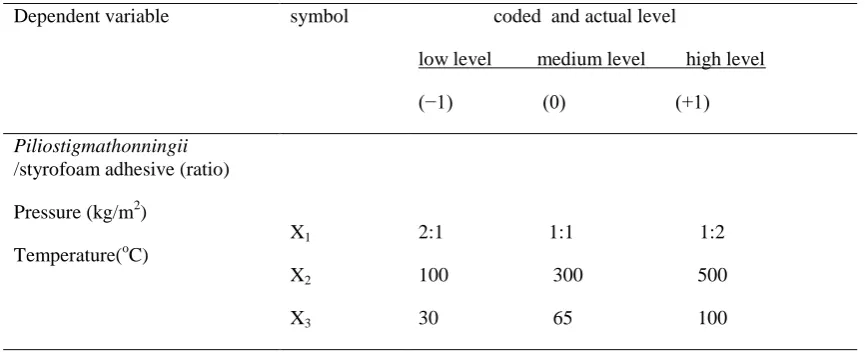
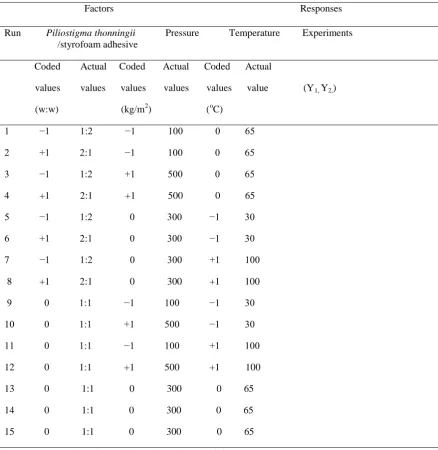
piliostigma thonningii particle and styrofoam adhesive mixed ratio (2:1, 1:1, 1:2 weight ratios), Pressure (100, 300, 500 kg/m2) and heat (30, 65, 100 oC) respectively as shown in Tables 2 and 3.
The Analysis of variance (ANOVA) was also used to check the goodness of fit of the models, develop the regression model and the adequacy of the model for the experimental outputs (or responses) at nearly all conditions in the experimentation. All the results of the experiment were subjected to Response Surface Regression for analysis using the Statistical package Minitab 17. The independent variables are w:w, pressure, and temperature. The results presented for the various responses for water absorption and thermal conductivit
Table 1: Experimental range and the levels of the variables
Dependent variable symbol coded and actual level
low level medium level high level
(−1) (0) (+1)
Piliostigmathonningii
/styrofoam adhesive (ratio)
Pressure (kg/m2)
Temperature(oC)
X1
X2
X3
2:1 1:1 1:2
100 300 500
30 65 100
4
Table 2: The Box-Behnken design for the coded and actual values
Factors Responses
Run Piliostigma thonningii Pressure Temperature Experiments /styrofoam adhesive
Coded Actual Coded Actual Coded Actual
values values values values values value (Y1, Y2,)
(w:w) (kg/m2) (oC)
1 −1 1:2 −1 100 0 65
2 +1 2:1 −1 100 0 65
3 −1 1:2 +1 500 0 65
4 +1 2:1 +1 500 0 65
5 −1 1:2 0 300 −1 30
6 +1 2:1 0 300 −1 30
7 −1 1:2 0 300 +1 100
8 +1 2:1 0 300 +1 100
9 0 1:1 −1 100 −1 30
10 0 1:1 +1 500 −1 30
11 0 1:1 −1 100 +1 100
12 0 1:1 +1 500 +1 100
13 0 1:1 0 300 0 65
14 0 1:1 0 300 0 65
15 0 1:1 0 300 0 65
Where; Y1 = water absorption and Y2 = thermal conductivity
2.3.1 Determination of water absorption
The water absorption test was conducted according to ASTM D1037, 2004. The specimens of dimension 0.14m x 0.14m x 0.1m used in the determination of the density were used since their masses and volume were recorded. Each specimen was immersed in water at ambient temperature of 24 hours until equilibrium. The specimens were removed and patted dry with a towel (lint free) and then weighed using a digital weighing balance. The dry weight before immersion (W1) and the weight after immersion (W2) were
noted. The water absorption was expressed as the percentage increase in volume based on the volume before immersion. Equation (4) was applied to determine the percentage water absorption in accordance with ASTM D570 (Klyosov, 2007).
5
x 100 % (2)
Where: is the weight of the sample before immersion in water and the weight of the sample after immersion in water.
2.3.2 Determination of thermal conductivity
The thermal conductivity of the boards was determined in accordance with ASTM 2004. The equipment used for the test was Armfield HT10XC Heat Transfer Service Unit and HT11C Computer Compatible Linear Heat Conduction Accessory. From each of the boards, four (4) specimens were cut in form of a disc of diameter (d) 25 1mm and the thickness (x) was measured and recorded. A specimen was clamped tightly in between two faces of heated and cooled brass sections, the heater voltage (V) was set to 10 volts and the heater current (1) was read from the console and recorded. After HT11C was stabilized, the temperatures T1,
T2, T3, T7, and T8 were also read and recorded from the console display. Where T1, T2 and T8 are the
thermocouples connected to the heating section of the instrument and T6, T7 and T8 are those connected to the
cold section of the instrument. The thermal conductivity (k) of a material was determined from equation (3) (4) and (5).
The temperature difference across the specimen
(4)
Where
and
Apply Fourier rate equation to determine the thermal conductivity (k) of a specimen
3.0 RESULTS AND ANALYSIS
Various experiments were determined; the results of the experiment obtained were subjected into Response Surface Regression analysis using the statistical package minitab 17. The independent variables are
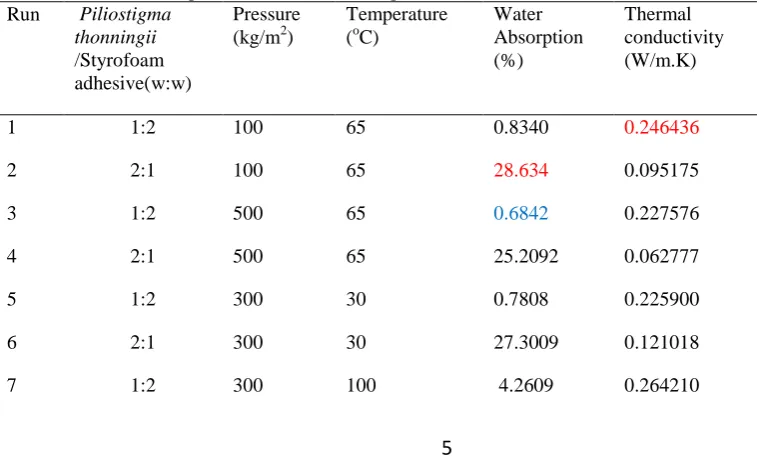
piliostigma thonningii fibre/styrofoam adhesive ratio, pressure, and temperature. The water absorption and thermal conductivity test results measured as output parameters (responses) for the 15 runs are given in Table 3.
Table 3: Shows the independent variables and responses Run Piliostigma
thonningii
/Styrofoam adhesive(w:w)
Pressure
(kg/m2)
Temperature (oC)
Water Absorption (%)
Thermal conductivity (W/m.K)
1 1:2 100 65 0.8340 0.246436
2 2:1 100 65 28.634 0.095175
3 1:2 500 65 0.6842 0.227576
4 2:1 500 65 25.2092 0.062777
5 1:2 300 30 0.7808 0.225900
6 2:1 300 30 27.3009 0.121018
7 1:2 300 100 4.2609 0.264210
6
8 2:1 300 100 15.8848 0.058807
9 1:1 100 30 15.6729 0.141422
10 1:1 500 30 13.7473 0.128858
11 1:1 100 30 15.5419 0.094793
12 1:1 500 65 10.5541 0.081098
13 1:1 300 65 10.9541 0.080806
14 1:1 300 65 10.9515 0.080845
15 1:1 300 65 10.9546 0.080835
3.1 Analysis of Results
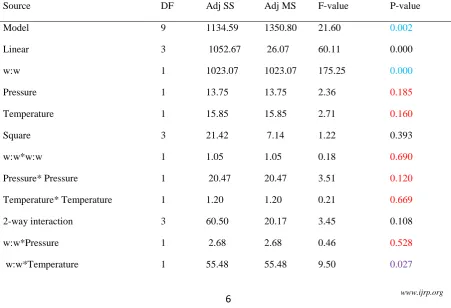
The analysis of variance (ANOVA) technique was used to check the adequacy of the developed models at 95% confidence level for the model to satisfy the adequacy conditions in non-linear form.
3.1.2 Water Absorption
Table 3; show the percentage water absorption of the produced piliostigma thonningii fibre ceiling boards, ranged from 0.68424% to 28.6336%. The results in Table 4 shows that, the model is significant at 1% level with a p-value of 0.002. The lack of fits test shows significance at 1% level, which suggest that higher order terms can still be incorporated into the model. The Main terms show that, w:w is significant with a p-value of 0.000, while pressure and temperature are not significant. For the Square terms show that all the square factors for the three variables are not significant at 5% level. For the interactions, it is only the interactions between w:w and temperature that shows significance at 5% level with a p-value of 0.027. The other interactions are not significant. The R-squared value of the model is 97.49%; this implies that R-squared is enough, which explained adequately for the model to be considered.
Table 4: ANOVA result for water absorption
Source DF Adj SS Adj MS F-value P-value
Model 9 1134.59 1350.80 21.60 0.002
Linear 3 1052.67 26.07 60.11 0.000
w:w 1 1023.07 1023.07 175.25 0.000
Pressure 1 13.75 13.75 2.36 0.185
Temperature 1 15.85 15.85 2.71 0.160
Square 3 21.42 7.14 1.22 0.393
w:w*w:w 1 1.05 1.05 0.18 0.690
Pressure* Pressure 1 20.47 20.47 3.51 0.120
Temperature* Temperature 1 1.20 1.20 0.21 0.669
2-way interaction 3 60.50 20.17 3.45 0.108
w:w*Pressure 1 2.68 2.68 0.46 0.528
w:w*Temperature 1 55.48 55.48 9.50 0.027
7
Pressure*Temperature 1 2.34 2.34 0.40 0.554
Residual 5 29.19 5.84
Lack of fit
Pure error 3 2 29.19 0.00 9.73 0.00
3450531.44 0.000
Total 14 1163.78
Model summary
S R-sq R-sq(adj) R-sq(pred)
2.41614 97.49% 92.98% 59.87%
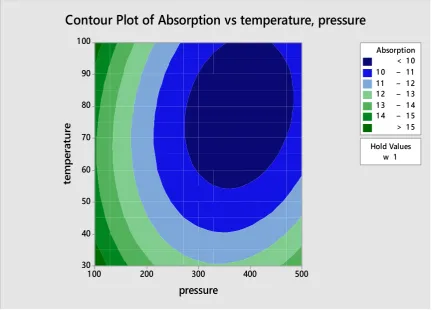
Figure 1 shows the contour plot for the water absorption versus temperature and pressure shows that less than 10% of water absorption falls between around 290 to 475kg/m2 of pressure, and 55 to 100 oC of temperature.
Figure1: Contour plot of water absorption
3.1.2 Thermal Conductivity
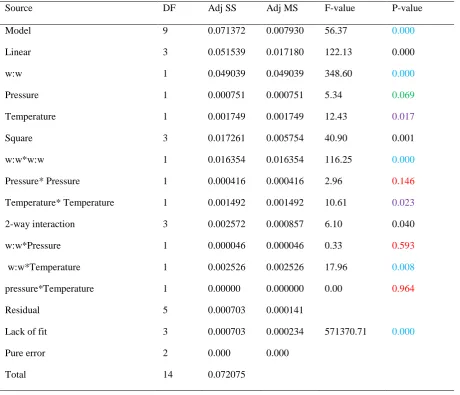
From the result in Table 3 indicates that the thermal conductivity values from 0.058807 W/m.K to 0.246436W/m.K. The results in Table 5 shows that, the model is significant at 1% level with a p-value of 0.000. The lack of fits test shows significance at 1% level, which suggests that higher order terms can still be incorporated into the model and the main term:- w:w is significant with a p-value of 0.000, while pressure is relatively significant at 10% level with a value of 0.069 and temperature is significant at 5% level with a p-value of 0.017 while the square term show that; w:w* w:w is significant at 1% level, temperature is significant at 5% level, pressure is not significant and the interactions indicated that only the interactions between w:w and
w 1 Hold Values
pressure
te m pe ra tu re 500 400 300 200 1 00 1 00 90 80 70 60 50 40 30 > – – – – – < 1 0 1 0 1 1 1 1 1 2 1 2 1 3 1 3 1 4 1 4 1 5 1 5 AbsorptionContour Plot of Absorption vs temperature, pressure
8
temperature is significance at 1% level with a p-value of 0.008. The other interactions are not significant. However, the R-squared of 99.02% has explained enough variations for the model to be considered.
Table 5: ANOVA result for model representing Thermal Conductivity
Source DF Adj SS Adj MS F-value P-value
Model 9 0.071372 0.007930 56.37 0.000
Linear 3 0.051539 0.017180 122.13 0.000
w:w 1 0.049039 0.049039 348.60 0.000
Pressure 1 0.000751 0.000751 5.34 0.069
Temperature 1 0.001749 0.001749 12.43 0.017
Square 3 0.017261 0.005754 40.90 0.001
w:w*w:w 1 0.016354 0.016354 116.25 0.000
Pressure* Pressure 1 0.000416 0.000416 2.96 0.146
Temperature* Temperature 1 0.001492 0.001492 10.61 0.023
2-way interaction 3 0.002572 0.000857 6.10 0.040
w:w*Pressure 1 0.000046 0.000046 0.33 0.593
w:w*Temperature 1 0.002526 0.002526 17.96 0.008
pressure*Temperature 1 0.00000 0.000000 0.00 0.964
Residual 5 0.000703 0.000141
Lack of fit 3 0.000703 0.000234 571370.71 0.000
Pure error 2 0.000 0.000
Total 14 0.072075
Model summary
S R-sq R-sq(adj) R-sq(pred)
0.01186 99.02% 97.27% 84.39%
9
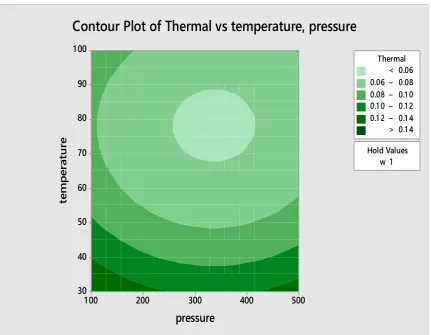
The contour plot for the thermal conductivity vs. temperature and pressure shows that around 285 to 410 kg/m2 of pressure and and 68 and 85 oC of temperature with a hold value w:w of 1
Figure 2: Contour plot for thermal conductivity
3.2 Optimization of Independent Variables and Responses
The multi objective criteria for each response were selected. Table 6 show the best responses optimal results solution obtained. The experimental parameters that produce maximum or minimum values of responses depend on optimization criteria.
Table 6: Independent Variables and Responses Optimal Results
Fibre/binder Ratio (w:w)
Pressure
(kg/m2)
Temperature (oC)
Water Absorption (%) Thermal conductivity (W/m.K) Desirability
1:1 500 91.7250 9.0466 0.106810 0.622050
1:2 100 30 4.7376 0.205665 0.604886
1:1 500 30 13.6615 0.121616 0.577581
1:1 500 30 16.5793 0.086680 0.570231
w 1 Hold Values
pressure
te m p er at u re 500 400 300 200 100 100 90 80 70 60 50 40 30 > – – – – < 0.06 0.06 0.08 0.08 0.1 0 0.1 0 0.1 2 0.1 2 0.1 4 0.1 4 ThermalContour Plot of Thermal vs temperature, pressure
10
3.3 Validation of the Independent Variables and Responses Optimum Results
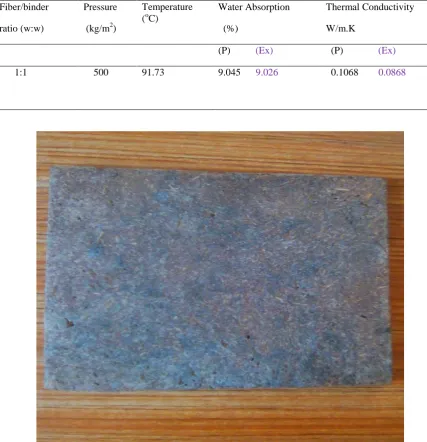
Number one(1) was selected from the optimal results set of parameters given in Table 6; those parameters in number one(1) were used to reproduce the piliostigma thonningii ceiling board composite and subjected into various experimental tests. The experimental test results (responses) obtained was compared with the optimum results for validation. Details of the experimental results obtained and predicted results of the responses variables are given in Table 7. The predicted results for the experiment gave a minimal error difference for the validation data.
Table 7: Validated optimum results
Fiber/binder
ratio (w:w)
Pressure
(kg/m2)
Temperature (oC)
Water Absorption
(%)
Thermal Conductivity
W/m.K
(P) (Ex) (P) (Ex)
1:1 500 91.73 9.045 9.026 0.1068 0.0868
Plate I: Reproduced pilliostigma thonningii ceiling board experimental sample
4.0 Conclusion
The process was successfully modeled and optimized using a Box–Behnken design with response surface methodology (RSM).Full resolution model was adopted and the R-squared value explained adequately, which is enough for the model to be considered. The following conclusions were drawn from experimental runs results for the study.
11
1. The board’s percentage water absorption, some results fall within the conventional standard board values made from organic materials.
2. The piliostigma thonningii fibre boards have potentials for use as thermal insulation, the values fall within the requirement.
3. The optimum results gave a minimal error difference when validated. Hence the board has greater insulating properties and shows good potential to be used as ceiling board
5.0 Recommendations
The following suggestions are made for further work:
1. The mechanical and thermal properties such as creep test, compressive strength, modulus of rupture, modulus of elasticity and thermal resistivity of the piliostigma thonningii fibre boards should be investigated.
2. The boards should be produced by the application of catalysts (initiator and accelerator) and evaluate its properties.
3. Since the boards were produced from organic materials, there is need to examine the effect of insect attack which are mostly associated with organic products.
References
Abdullahi, I. and Umar A. A. (2010) Potentials of unsaturated polyester ground nut shell as material in building industry. Journal of engineering and technology, 5, 78-84.
ASTM (2004) Standard methods for evaluating properties of wood-based fiber and particle Panel materials. American Society for Testing and Material International handbook.
Aroke U. O., Osha O. A., Ibrahim M. and Kabir G. (2012) Analysis of Particle Board from Rice Husk and Sawdust using Developed Styrofoam Adhesive Binder, International Journal of Engineering Science,
3(4)81-86
Bledzki, A. K. and Gassan J. (1999) Composites reinforced with cellulose based fibers.
Progress Polymer Science,24(221) retrieved online on 22ndAPRIL, 2016. From (http//books.goggle.com.ng).
Dagwa, I.M., Builders, P.F and Achebo, J. (2012). Characterization of Palm Kernel Shell Powder for use in Polymer Matrix Composites. International Journal of Mechanical and Mechatronics Engineering,
12(4), 88-93
Ekpunobi U. E., Ohaekenyem E. C., Ogbuagu A. S.andOrjiako E. N. (2014). The Mechanical Properties of Ceiling Board Produced from Waste Paper. Elements of materials science and engineering,3rd edition. Addision Wesley Publishing Company Inc, United State.
Gary W. Oehlert, 2010. A First Course in Design and Analysis of Experiments text book. University of Minnesota, USA.
Hill, T. and Lewicki, P. (2007). Statistics: Methods and Applications Textbook. retrieved online on 22nd May, 2014 http://www.statsoft.com/textbook
Justiz Smith, N.G., Virgo, G.J., Buchanan, V.E., 2008. Potential of Jamaican banana, coconut coir and bagasse fibre as composite materials. Mater Charact. 59, 1273-1278
Klyosov, A. A. (2007). Wood Plastic Composite. John Wiley and Son Inc, New Jersey, USA.
Lange. J.M.C (2013). Piliostigma thonningii (Schumach) Milne-Redhead, JSTOR global Plant, www.plants.jstor.org
La mantia, F. P. and Morreale, M. (2011). Green composite: A brief review, Elsevier journal of materials science, 579-588
12
Nemli, G. and Aydin A. (2007). Evaluation of the physical and mechanical properties of Particle board made from the needle litter of Pinuspinaster Ait’. Industrial Crops and Products 26(3): 252–258
Panyakaew, S. AND Fatios, S. (2011). New thermal insulation boards made from coconut husk and bagasse,
Energy and Buildings 43(7), PP. 1732-1739. Available at: http//dx.doi.org/10.1016.j.enbuild
Rekesh, K., Sangeeta, O. and Aparna, S. (2011). Chemical Modifications of Natural fibre for Composite Materials. Pelagia research library, der chemical sinica, 2(4), 219-228.