University of New Orleans University of New Orleans
ScholarWorks@UNO
ScholarWorks@UNO
University of New Orleans Theses and
Dissertations Dissertations and Theses
Fall 12-16-2016
The relationship between perceived multicultural disability
The relationship between perceived multicultural disability
competence, multicultural counseling coursework, and
competence, multicultural counseling coursework, and
disability-related life experience
related life experience
Melissa D. Deroche
University of New Orleans, [email protected]
Follow this and additional works at: https://scholarworks.uno.edu/td
Recommended Citation Recommended Citation
Deroche, Melissa D., "The relationship between perceived multicultural disability competence, multicultural counseling coursework, and disability-related life experience" (2016). University of New Orleans Theses and Dissertations. 2252.
https://scholarworks.uno.edu/td/2252
This Dissertation is protected by copyright and/or related rights. It has been brought to you by ScholarWorks@UNO with permission from the rights-holder(s). You are free to use this Dissertation in any way that is permitted by the copyright and related rights legislation that applies to your use. For other uses you need to obtain permission from the rights-holder(s) directly, unless additional rights are indicated by a Creative Commons license in the record and/ or on the work itself.
The relationship between perceived multicultural disability competence, multicultural counseling coursework, and disability-related life experience
A Dissertation
Submitted to the Graduate Faculty of the University of New Orleans in partial fulfillment of the requirements for the degree of
Doctor of Philosophy in
Counselor Education
By
Melissa D. Deroche
B.A. University of New Orleans M.Ed. University of New Orleans
Dedication
I dedicate my dissertation to my parents, Earl and Cindy. To my Mom (in memoriam), I am
grateful for your warm and giving spirit; your constant support and encouragement; and your
belief in my abilities – all of which has given me the confidence to pursue my dreams. To my
Acknowledgements
To Dr. Herlihy, without your support and encouragement early in my graduate
studies, I would not have had the confidence to pursue such a lofty goal of earning my doctoral
degree. I truly value your wealth of knowledge, mentorship, patience, and constant
professionalism. Your keen ability to know when I just needed your support and when I needed
to be challenged have resulted in my doctoral journey ending with a “done dissertation.”
To Dr. Lyons, I sincerely appreciate your professionalism - always maintaining a pleasant
and calm demeanor even when I was frantic, stressed, and unsure of myself. Your reassurance,
confidence in my abilities, and insights helped me make it through the dissertation process.
To Dr. Bonis, there are no words that can fully and accurately describe my gratitude for
the time and attention you gave to me throughout my dissertation process. No matter how long
my list of questions, you always greeted me with kindness and patience. Your ability to present
and explain complex statistical concepts in a digestible form is truly a gift you possess and that I
appreciate.
To Dr. Angelocci, your friendship, mentorship, and expertise have been invaluable to me
throughout this dissertation process. Thank you for always being available with a listening ear.
To Edina and Jenn, my friends and mentors, I am indebted to you for your wisdom,
unwavering support, and encouragement. Thank you for always knowing when I needed a
sounding board and knowing when I just needed you to be my cheerleader. I treasure you both.
To Anabel, Christine, Joan Ellen, Angie, and Adan, I am overwhelmed by your kindness
and generosity. Thank you for helping make this a “done dissertation.”
To countless other family members and friends, thank you for always being there for me,
Table of Contents
List of Tables ... viii
Abstract ... ix
Chapter 1 Introduction ...1
Background ...1
Significance of the Study ...7
Purpose of the Study ...8
Conceptual Framework ...9
Research Questions...10
Overview of Methods ...11
Limitations and Delimitations...11
Assumptions of the Study ...12
Definition of Terms...12
Chapter 2 Literature Review...14
Multicultural Counseling and Disability...14
Tenants of multicultural counseling...15
Evolution of multicultural counseling ...15
Disability as an aspect of multicultural counseling ...17
Landscape of Disability ...17
Defining disability ...17
Frameworks...18
Moral model...19
Biomedical model ...19
Functional and environmental models ...20
Sociopolitical or minority group model...21
Demographics of disability ...22
The Disability Experience...23
Sociopolitical history of persons with disabilities ...23
Response to disability ...24
Everyday experiences of persons with disabilities ...26
Disability identity...27
Multiple minority statuses for persons with disabilities ...30
Multicultural Counselor Training, Preparation, and Competence ...31
Multicultural counselor competencies and standards ...31
Multicultural counselor training and preparation ...34
Pedagogical and instructional strategies ...38
Intergroup contact and exposure...41
Ethical and legal implications ...42
Multicultural Counselor Training, Competence, and Disability...43
Multicultural training and disability ...43
Multicultural disability competence ...43
Self-awareness/beliefs/attitudes towards persons with disabilities ...44
Level of knowledge regarding persons with disabilities...46
Level of skills regarding persons with disabilities...47
Summary of findings...50
Chapter 3 Methodology ...51
Purpose of the Study ...51
Survey Method...51
Variables ...52
Research Questions...53
Participants...53
Instruments...54
Counseling Clients with Disabilities Survey ...54
Biographical questionnaire ...56
Data Collection Procedures...57
Data Analysis Plan ...60
Research question 1 ...60
Hypothesis 1...60
Data analysis ...60
Research question 2 ...60
Hypothesis 2...60
Data analysis ...61
Research question 3 ...61
Hypothesis 3a...61
Hypothesis 3b...61
Data analysis ...62
Research question 4 ...62
Hypothesis 4...62
Data analysis ...62
Research question 5 ...62
Hypothesis 5...62
Data analysis ...63
Chapter 4 Results ...64
Descriptive Statistics...64
Reliability Statistics ...67
Analysis of the Research Questions...68
Research question 1 ...69
Research question 2 ...69
Research question 3 ...70
Research question 4 ...74
Research question 5 ...77
Responses to the Qualitative Item...78
Summary of Findings...80
Chapter 5 Discussion ...83
Overview of the Study ...83
Discussion of the Findings...85
CCDS and its subscales ...85
Perceived multicultural disability competence ...86
Self-awareness, knowledge, and skills...89
Qualitative responses ...91
Summary of findings...92
Limitations ...93
Implications and Recommendations ...95
Counselor educators...96
Counselor training programs...97
Recommendations for Future Research ...97
Conclusions...99
References...102
Appendices...129
Appendix A: Agreement for the Procedural Use of the Counseling Clients with Disabilities Survey ...129
Appendix B: Biographical Questionnaire...132
Appendix C: Approval Letter from IRB ...134
Appendix D: Request to CACREP Liaisons...136
Appendix E: Request for Participation to AMCD Graduate Student Facebook Group and AMCD Community List ...139
Appendix F: Request for Participation to CESNET-L Listserv...140
Appendix G: Request for Participation to COUNSGRAD Listserv ...142
Appendix H: Request for Participation ACA Flyer...144
Appendix I: Informed Consent ...145
List of Tables
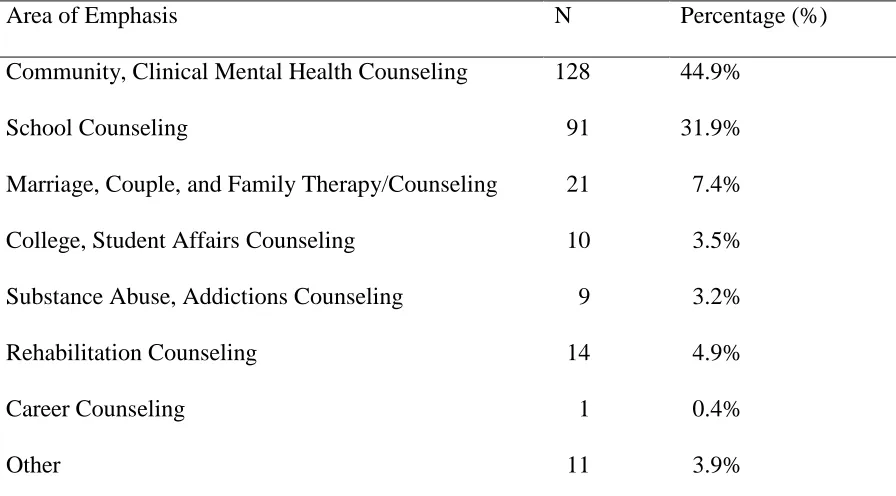
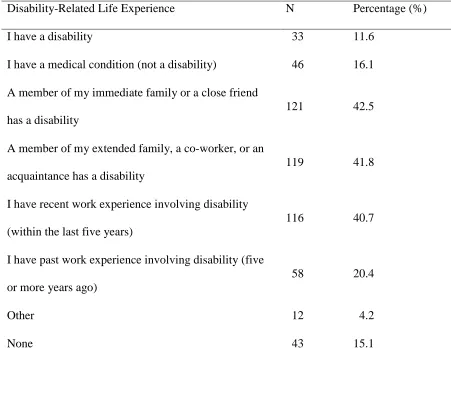
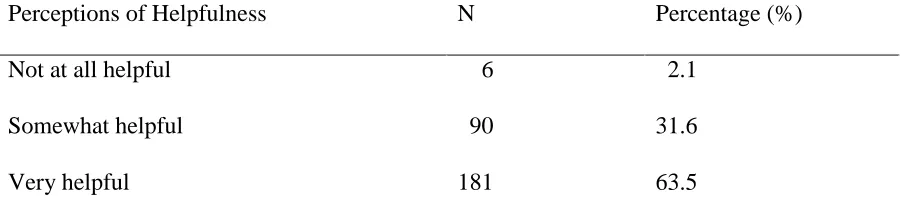
Table 1 Participants’ Counseling Area of Emphasis by Frequency ...65 Table 2 Participants’ Disability-Related Life Experience by Frequency ...66 Table 3 Participants’ Perceptions of Helpfulness of Disability Life Experiences
by Frequencies ...67 Table 4 Internal Consistency of the Counseling Clients with Disabilities Survey
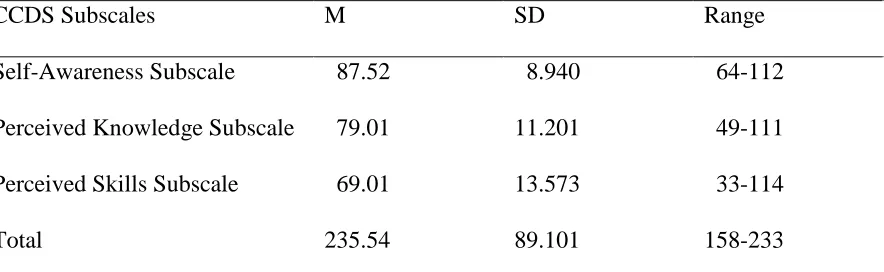
(CCDS) and its Subscales ...68 Table 5 CCDS Subscale Scores by Means, Standard Deviations, and Ranges ...68 Table 6 Spearman Correlation Matrix for Variables – Perceived Multicultural
Disability Competence, Disability-Related Life Experience, and Completion
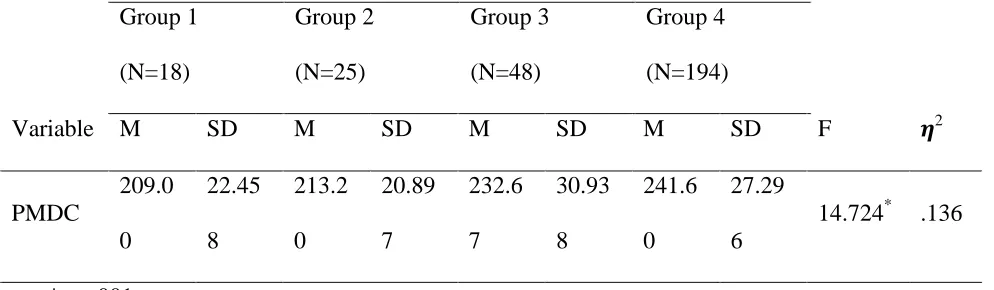
Of Multicultural Counseling Course...70 Table 7 One-Way, Between Groups ANOVA for Perceived Multicultural Disability
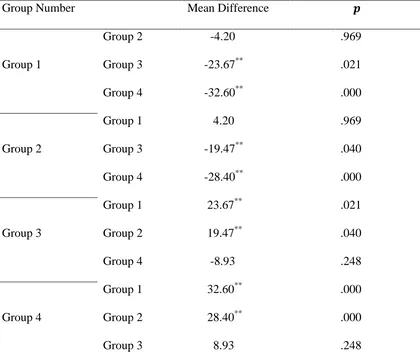
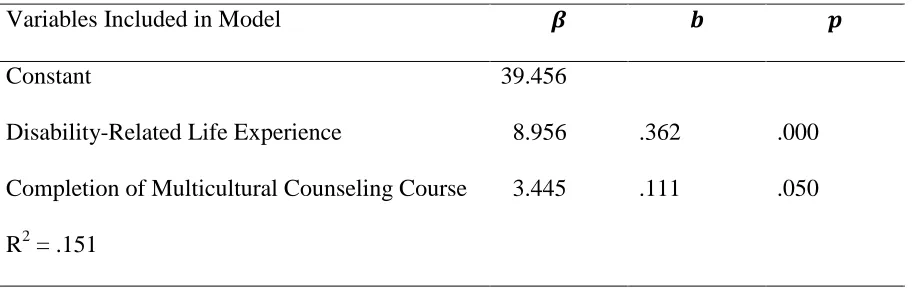
Competence with Group Means and Standard Deviations ...72 Table 8 Scheffe Post Hoc Tests for Group Comparisons ...73 Table 9 Multiple Linear Regression Model for Self-Awareness Using the Enter
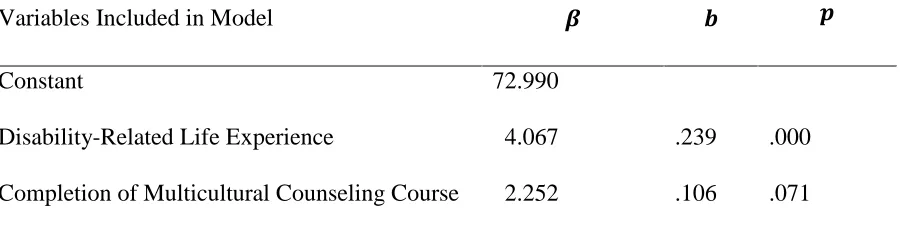
Model ...75 Table 10 Multiple Linear Regression Model for Perceived Knowledge Using the
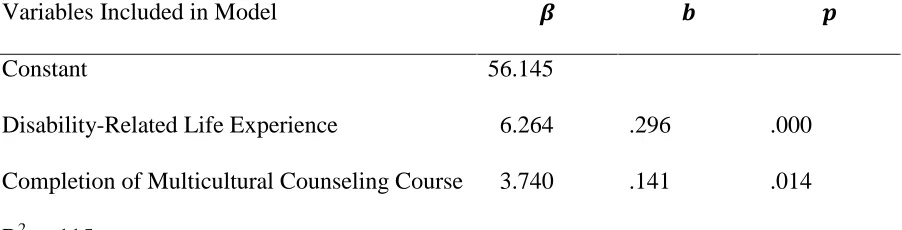
Enter Model ...76 Table 11 Multiple Linear Regression Model for Perceived Skills Using the Enter
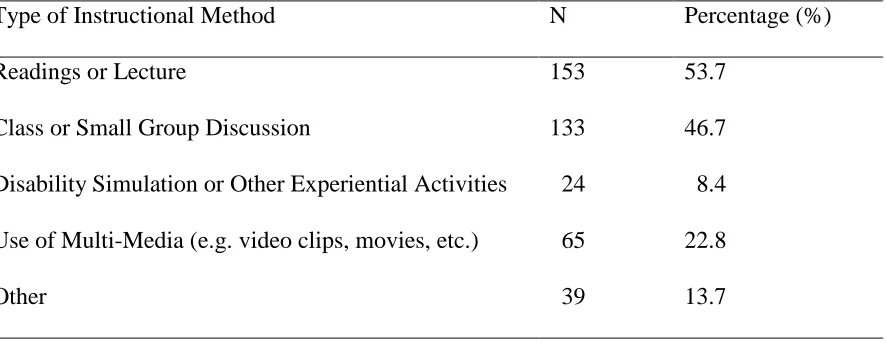
Model Following Removal of Extreme Cases ...77 Table 12 Participants’ Reported Instructional Methods of How the Subject of
Abstract
The aim of this study was to explore the perceived multicultural disability competence of
master’s-level counseling students in CACREP-accredited programs given their disability-related
life experience(s) and multicultural counseling course completion and to assess the extent to
which the topic of ability/disability is addressed in multicultural counseling coursework.
Participants (n = 285) were electronically surveyed using theCounseling Clients with
Disabilities Survey(CCDS; Strike, 2001) and a researcher developed biographical questionnaire.
Collectively, study results indicated that both disability-related life experience(s) and
multicultural counseling course completion positively impacted participant perceived
multicultural disability competence. However, disability-related life experience(s) seemed to
have a greater level of impact and significantly predicted self-awareness, perceived knowledge,
and perceived skills. Results of this study indicated that the topic of ability/disability or persons
with disabilities is given less attention than other topics covered in multicultural counseling
courses within CACREP-accredited programs.
Keywords: multicultural disability competence, multicultural training, cross-cultural
Chapter 1 Introduction
In this chapter, an overview of the study is presented. The foundations of multicultural
counseling, disability as a component of multiculturalism, and multicultural disability
competence related to training and cross-cultural contact are discussed. The purpose and
significance of the study are presented, along with the research questions, limitations and
delimitations and assumptions of the study. The chapter concludes with a list of defined terms
pertinent to the study.
Background
Multicultural counseling leaders have been critical of the deficiencies in traditional
counseling theories and the inequities of the mental health services delivery system for those
who are culturally different from the dominant culture (Arredondo, Tovar, & Parham, 2008; Sue,
1978; Sue & Sue, 1977). These criticisms prompted a shift in the discourse of the counseling
profession from a focus on the individual to the cultural, environmental, and systemic
experiences of diverse populations (Crethar, Rivera, & Nash, 2008; Ratts, 2009; Sue, 1978; Sue
& Sue, 1977). The foundation of multicultural counseling, therefore, is based on the premise
that individuals who do not possess certain demographic, ethnographic, or status-relevant
personal characteristics associated with the dominant culture are not afforded the same
opportunities and privileges as those who do possess such characteristics (Petersen, 1990;
Reynolds & Pope, 1991; Robinson, 1999).
The term multiculturalism has been viewed from multiple perspectives. Some authors
have posited that all counseling is multicultural and that culture should be more broadly defined
and inclusive of identities other than race/ethnicity (Speight, Myers, Cox, & Highlen, 1991;
cultural identity and cultural worldview (Pedersen, 1990; Speight et al., 1991) and its relevance
to counselor multicultural competence. Other writers have made a distinction between the
concepts of multiculturalism and diversity. Proponents of this distinction assert that
multiculturalism focuses on race, ethnicity, and culture, whereas diversity refers to other
personal identity differences such as ability or disability, age, gender, and sexual orientation
(Arredondo et al., 1996).
Regardless of the position taken, proponents of both perspectives acknowledge that
individuals possess multiple identities which can cut across demographic, ethnographic, or
status-related personal characteristics (Reynolds & Pope, 1991; Robinson, 1999). These
personal characteristics or multiple identities are social constructs that set the stage for a
hierarchical and dichotomous society. The consequence is that individuals who possess valued
traits are afforded unearned privileges whereas others experience oppression and marginalization
based solely on their status in society (Black & Stone, 2005; Robinson, 1999).
Individuals with disabilities, like other minorities, are subject to the dominant discourses
of the majority culture (Olkin, 2002; Reynolds & Pope, 1991; Robinson, 1999). The discourse
often reduces persons with disabilities to a single dimension and view disability as a devalued,
inferior, and undesirable trait, which contributes to disablement (Johnson, 2006; Masala &
Petretto, 2008; Robinson, 1999). Disablement is not the result of impairment; rather, it is the
product of negative attitudes and barriers to access (Masala & Petretto, 2008; Olkin, 1999;
Smart, 2009a). For individuals with disabilities, disablement is represented in unemployment
and underemployment, underrepresentation in professional fields and politics, inappropriate use
and interpretations of tests, and even subtle and overt forms of discrimination in the workplace
2010). Consequently, the prejudice, stigma, discrimination, and oppression experienced by
individuals with disabilities are social and civil issues (Bampi, Neves, & Alvis, 2010; Hughes,
2010; Middleton, Rollins, & Harley, 1999; Smart, 2009a) that deserve greater attention in
multicultural counselor training and research (D’Andrea, Skouge, & Daniels, 2006; Lofaro,
1982; Rawlings & Longhurst, 2011).
Whether disability is characterized as a component of multiculturalism or as an aspect of
diversity in counseling, both training program standards (CACREP, 2009) and professional
codes of ethics (ACA, 2014) clearly state that cultural competence is central to ethical practice.
The multicultural competencies developed by Sue, Arredondo, and McDavis (1992) provide a
framework for defining what it means to be a culturally competent counselor and describe these
competencies from training and practice standpoints along three domains (self-awareness,
knowledge, and skills). Most recently, the framework has been revised to include both
multicultural and social justice counselor competencies. These revisions include the recognition
of the impact of intersecting identities and the dynamics of power, privilege, and oppression
within the counseling relationship and incorporate four developmental domains, including
counselor self-awareness, client worldview, counseling relationship, and counseling and
advocacy interventions (Ratts, Singh, Nassar-McMillan, Butler, & McCullough, 2015). The
preamble of theAmerican Counseling Association Code of Ethics(ACA, 2014) delineates as
one of the core values of the counseling profession that counselors honor diversity and embrace a
multicultural approach in support of the worth, dignity, potential, and uniqueness of people
within their social and cultural contexts.
Although the multicultural counseling literature provides a basis for the inclusion of
the multicultural counseling literature to the detriment of a focus on non-racial aspects of
multiculturalism (Arredondo, Rosen, Rice, Perez, & Tovar-Gamero, 2005; Pope-Davis, Ligiero,
Liang, & Codrington, 2001). The minimal consideration given to the topic of disability in
multicultural counselor training and research is disproportionate to the fact that individuals with
disabilities comprise the largest minority group in the United States (Disability Funders
Network, 2012). Multiple content analyses of counseling journals and multicultural counseling
course syllabi have indicated that the topic of disability is underrepresented compared to the
focus on racial/ethnic minorities (Foley-Nicpon & Lee, 2012; Lee, Roser, & Bums, 2013;
Pope-Davis et al., 2001; Priester et al., 2008),. Additionally, a content analysis of commonly used
human behavior textbooks indicated that the topic of disability is underrepresented in
comparison to other developmental concerns (Reed-Cunningham & Fleming, 2009).
Similarly, training programs have subscribed to a narrow definition of diversity and typically
have relegated the topic of disability to rehabilitation specialty programs (Green, Callands,
Radcliffe, Luebbe, & Klonoff, 2009; Olkin, 2002). The inadequate attention given to the topic of
disability in counselor training programs and the research literature is antithetical to the
importance placed on a multicultural perspective (Arredondo et al., 1996; D’ Andrea et al., 2006;
Olkin, 2002; Reynolds & Pope, 1991; Robinson, 1999). Consequently, some researchers have
argued that disability competence should be integrated into the multicultural and social justice
frameworks (D ‘Andrea et al., 2006) and included within the three domains of multicultural
competence (Foley-Nicpon & Lee, 2012; Strike, Skofholt, & Hummel, 2004).
Much of the existing research concerning domains of disability competence has focused
on rehabilitation students’ and rehabilitation professionals’ attitudes toward individuals with
Thomas, Curtis, & Shippen, 2011). Due to multiple demographic, contextual, and
contact-related variables, these attitudinal studies have yielded mixed results (Pruett & Fong, 2006;
Rosenthal et al., 2006; Strohmer, Grand, & Purcell, 1984; Yuker, 1988). However, Carney and
Cobia (1994), examined counseling students’ attitudes across different specialty programs and
found that rehabilitation counselor trainees had the most positive attitudes toward individuals
with disabilities, followed by school counselor trainees and community counseling trainees.
They suggested that counseling area of emphasis may account, in part, for these differences in
attitudes.
Rehabilitation specialists are no longer considered the only professionals who will
encounter individuals with disabilities (Mcdougall, 2008; Olkin & Pledger, 2003). This is due,
in part, to legislation such as the Americans with Disabilities Act (ADA) of 1990 and its
amendments that has prompted greater inclusion of individuals with disabilities into mainstream
society. Therefore, it is necessary for all counselors to be competent in working with individuals
with disabilities. The recent merger between CACREP and the Council on Rehabilitation
Education (CORE), recommendations for the inclusion of disability across the counseling
curriculum, and a future unifying body of accreditation for all counseling programs further
substantiate the need for greater inclusion of the topic of disability into multicultural counseling
course curricula.
One method of examining counselors’ competence to work with clients with disabilities
is to measure their perceived multicultural disability competence using the domains of
self-awareness, knowledge, and skills. Some researchers have identified disability-related life
experience, exposure, and/or contact as important variables relevant to perceived multicultural
(Hollimon, 2007; McDougall, 2008; McLennon, 2012; Strike et al., 2004). Disability-related life
experience has been defined in terms of type (Hollimon, 2007; McLennon, 2012; Strike et al.,
2004) and extent of exposure/contact (Diaz-Lazaro & Cohen, 2001; McDougall, 2008).
Regardless of the definitions used in these studies (e.g., type or extent of exposure/contact),
accumulated disability-related life experience resulted in higher levels of overall perceived
multicultural disability competence (Diaz-Lazaro & Cohen, 2001; Hollimon, 2007; McDougall,
2008; McLennon, 2012; Strike et al., 2004).
Strike (2001) identified four main types of exposure/contact relevant to perceived
multicultural disability competence. These categories included personal/interpersonal, work,
training, and other-related disability experiences. Researchers have demonstrated that the
operationalization of type of exposure/contact variables is relevant when investigating perceived
multicultural disability competence (Hollimon, 2007; McLennon, 2012; Strike et al., 2004).
For example, Strike et al. (2004) found that level of experience based on participants’ cumulative
personal/interpersonal, work, and training-related experiences yielded higher levels of perceived
multicultural disability competence than their less experienced counterparts. Hollimon (2007),
however, found that level of closeness based on participants’ personal/interpersonal -related
experiences resulted in higher levels of reported perceived multicultural disability competence
than participants’ who reported no contact or only training-related experience.
Diaz-Lazaro and Cohen (2001) built their study on the assertion that prior accumulated
cross-cultural contact through life experience(s), completion of a multicultural counseling
course, and the implementation of cross-cultural contact experiences within a multicultural
course are relevant factors in promoting counselor multicultural competence. They found that a
self-reported awareness and skills but not knowledge. However, completion of a multicultural
counseling course significantly increased overall knowledge and skills but not awareness as
measured by the Multicultural Awareness, Knowledge, and Skills Survey (MAKSS). Using
qualitative data, the researchers also suggested that a multicultural counseling course with a
strong cross-cultural contact component is effective in augmenting trainees’ overall multicultural
competence.
Existing research lends support to the idea that completion of a multicultural counseling
course and prior accumulated cross-cultural contact are important variables to consider when
examining multicultural counselor competence (D’Andrea, Daniels, & Heck, 1991; Diaz-Lazaro
& Cohen, 2001; Malott, 2010). More specifically, disability-related life experience, whether
defined in terms of personal/interpersonal, work, or training-related experience, has
demonstrated relevance to perceived multicultural disability competence (Diaz-Lazaro & Cohen,
2001; Hollimon, 2007; McDougall, 2008; McLennon, 2012; Strike et al., 2004). The
significance of multicultural counseling coursework and cross-cultural contact on counselor
multicultural competence, combined with the limited amount of research regarding counselor
multicultural disability competence, gives credence to further investigation. Therefore, an
examination of multicultural disability training and personal/interpersonal and work-related
experience with persons with disabilities warrants attention.
Significance of the Study
The topic of disability traditionally has been viewed as a subspecialty in the fields of
counseling and psychology. However, due to the increased participation in mainstream society
of people with disabilities (Olkin & Pledger, 2003), it is critical for all counselors, regardless of
multicultural counseling and diversity courses provide a potential context for training to develop
this competence, as persons with disabilities are the largest minority group in the United States
(Disability Funders Network, 2012). The results of this study provide information about the
current state of integrating ability/disability into multicultural counselor instruction and the
impact that disability-related life experience and instruction have on perceived multicultural
disability competence. This study fills a gap in the research by informing counselor training
programs and counselor educators about the need to more clearly address ability/disability as a
distinct topic in multicultural counseling coursework and to consider using
exposure/contact-related instructional strategies to help increase master’s-level counseling students’ multicultural
disability competence.
Purpose of the Study
The intent of this study was to expand upon the existing research literature that
demonstrates the efficacy of multicultural counselor training and cross-cultural contact
experiences on multicultural counselor competence by applying these conditions to counselor
multicultural disability competence. The main objective of this study was to examine
relationships between master’s-level counseling students’ perceived multicultural disability
competence and their disability-related life experience(s) and completion of a multicultural
counseling course. A second objective was to determine whether there are significant group
differences in perceived multicultural disability competence based on master’s-level counseling
students’ multicultural counseling course completion and reported disability-related life
experience(s). A third objective of this study was to determine how well completion of a
perceived knowledge, and perceived skills. A fourth objective was to identify to what extent the
topic of disability is being integrated into multicultural course curricula.
This study was based on the rationale that disability is a relevant component of
multicultural training and that completion of a multicultural counseling course and cross-cultural
contact experiences have demonstrated efficacy with regard to multicultural counselor
competence generally and to multicultural disability competence specifically (D’Andrea et al.,
1991; Diaz-Lazaro & Cohen, 2001; McDougall, 2008; Strike et al., 2004). This researcher,
however, examined these variables using a national sample of master’s-level counselor trainees
in CACREP-accredited programs. Additionally, disability-related life experience was
operationalized differently from previous studies and multicultural counseling course completion
(i.e., training) was considered a separate variable.
Conceptual Framework
A multicultural counseling model is based on the premise that the worldviews of both the
counselor and client are shaped by the historical and sociopolitical climates in which they live
and their cultural experiences and perspectives (Robinson, 1999; Sue, 1978; Sue et al., 1982; Sue
et al., 1992). Consequently, their worldviews are vital components to the counseling process and
therapeutic relationship (Katz, 1985; Sue et al., 1992). The multicultural and social justice
counseling competencies (MSJCC) are described as a revised version of the original
multicultural counseling competencies developed by Sue et al. (1992). The MSJCC framework
is said to offer counselors a set of guidelines and standards for implementing multicultural and
social justice counseling competencies into counseling theories, practices, and research (Ratts et
The MSJCC framework includes several constructs that form the backbone of the
competencies. First, the importance of intersecting identities and the impact of power, privilege,
and oppression on the counseling relationship are recognized and integrated throughout the
competencies. Second, there are four developmental domains that reflect the different layers that
provide a path to multicultural and social justice competency, including counselor
self-awareness, client worldview, the counseling relationship, and counseling and advocacy
interventions. The first three developmental domains are described in terms of aspirational
competencies that include attitudes and beliefs, knowledge, skills, and actions. The fourth
developmental domain, counseling and advocacy interventions, is explained using a
socioecological model in which counselors advocate on behalf of clients on intrapersonal,
interpersonal, institutional, community, public policy, and international/global levels (Ratts et al.,
2015). The integration of intersecting identities and the constructs of power, privilege, and
oppression throughout the competencies; the developmental domains; aspirational competencies;
and the socioecological model described within this framework are all components that help
provide an understanding of counselor multicultural disability competence.
Research Questions
The following research questions were investigated in this study:
1. What is the relationship between perceived multicultural disability competence and prior
disability-related life experiences among master’s-level students in CACREP-accredited
counseling programs?
2. What is the relationship between perceived multicultural disability competence and
completion of a multicultural counseling course among master’s-level students in
3. Are there significant group differences in perceived multicultural disability competence
between students who have neither disability-related life experience(s) nor have completed a
multicultural counseling course, students who have disability-related life experience(s) but have
not completed a multicultural counseling course, students who have completed a multicultural
counseling course but have no disability-related life experience(s), and students who have
disability-related life experience(s) and have completed a multicultural counseling course?
4. What amount of variance do the two independent variable sets, disability-related life
experience and completion of a multicultural counseling course, contribute to the prediction of
the outcome domains of self-awareness, knowledge, and skills?
5. To what extent do master’s-level students in CACREP-accredited counseling programs report
that the topic of disability or persons with disabilities was covered as a distinct aspect of
multiculturalism/diversity in their multicultural counseling courses?
Overview of Methods
A quantitative research design was most appropriate for examining the identified research
questions in this study. The Counseling Clients with Disabilities Survey (CCDS; Strike, 2001)
and a researcher-developed questionnaire were used for the purposes of data collection. The five
research questions were analyzed using descriptive statistics and correlational and multivariate
methods.
Limitations and Delimitations
This study was delimited to masters’-level counseling students enrolled in
generalized to trainees enrolled in non-CACREP-accredited programs. A second limitation was
the use of self-report measures. The use of self-report measures has been criticized for the
subjective nature of participant responses and the propensity of participants to respond in
socially desirable ways (Fleming, 2012). Third, an online data collection program was used to
gather data. These data collection procedures might introduce selection bias and a reduced
response rate due to lack of access or lack of comfort using computer technology (Granello,
2007). Finally, the correlational nature of this study did not allow the researcher to make causal
inferences.
Assumptions of the Study
The researcher assumed that participants met the criteria for the study and responded
honestly to survey questions. Second, the researcher assumed that the participants in this study
were representative of master’s-level students in CACREP-accredited counseling programs.
Definition of Terms
Disability-related life experience(s): Direct interpersonal or work-related interactions
between master’s-level counseling students and persons with disabilities or someone who has a
disability.
Diversity: Individual differences that refer to personal characteristics by which someone
may choose to self-define. These characteristics may include age, gender, sexual orientation,
religion, and physical or mental ability (Arredondo et al., 1996).
Multicultural disability competence: A construct that is represented by the connection
between the tripartite framework of the self-awareness/knowledge/skills structure of the
multicultural competencies and standards and the minority model of disability and as measured
Multicultural competencies: A set of guidelines used to describe culturally skilled
counselors along three domains, including self-awareness, knowledge, and skills (Sue et al.,
1992).
Multicultural counseling: The working alliance between a counselor and client that
considers the personal dynamics of the counselor and client, alongside the cultural dynamics of
both of these individuals (Lee & Park, 2013)
Person with a disability: A physical or mental impairment that substantially limits one or
more major life activities, a person who has a history or record of such an impairment, or a
person who is perceived by others as having such an impairment (American’s with Disabilities
Chapter 2 Literature Review
The literature review provides an understanding of multicultural counseling and its
relevance to persons with disabilities. The chapter contains five main sections. In the first
section, the researcher discusses the tenets and evolution of multicultural counseling. In the
second section, the ways in which disability is defined and conceptualized, and the demographic
variables associated with persons with disabilities are presented. In the third section of this
chapter, the researcher covers the experience of persons with disabilities, including the
sociopolitical history, response to disability, disability identity, everyday experiences, and
multiple minority status of persons with disabilities. In the fourth section, the researcher
describes multicultural training counselor competencies, multicultural training and preparation,
and pedagogical instructional strategies, intergroup contact and exposure, and ethical and legal
issues. In the final section, the researcher provides information about multicultural disability
competence that includes the self-awareness/beliefs/attitudes, knowledge, and skills of
counselors to work with clients with disabilities.
Multicultural Counseling and Disability
Over the past 60 years, a paradigm shift has occurred in the fields of counseling and
psychology. This paradigm shift has coincided with the historical and sociopolitical climate of
the United States in which culturally diverse minorities have demanded access, equality, and
social inclusion (Lee et al., 2009; Middleton et al., 1999). The consequence has been the
emergence of a theory of multiculturalism that exists alongside psychodynamic, cognitive
behavioral and existential-humanistic theories and has been coined the “fourth force in
Tenets of multicultural counseling. The multicultural counseling movement has
resulted in the recognition that the underlying assumptions, theories, and values held by the
profession were rooted in Eurocentric, middle class and male values that are representative of the
dominant culture. These views failed to account for cultural differences and were insufficient in
addressing the needs of culturally diverse clients (Katz, 1985; Sue & Sue, 1977; Vontress, 1969).
A multicultural perspective, therefore, acknowledges the inherent complexities of human nature
and human development and values the relevance of culturally diverse perspectives in counseling
(Pedersen, 1990).
These culturally diverse perspectives take into consideration the intersecting identities of
an individual, such as ability/disability, age, gender, racial or ethnic background, sexual
orientation, socioeconomic status, religious affiliation, spiritual beliefs, and education, and how
these cultural variables are affected by the dominant discourses in society (Reynolds & Pope,
1991; Robinson, 1999). The dominant discourses determine the level of status or value
associated with a particular identity which, in turn, results in the attainment of unearned
privileges or the experience of social exclusion and marginalization (Reynolds & Pope, 1991).
In essence, multicultural counseling takes into consideration the impact of the personal dynamics
and cultural experiences of both the client and counselor and the interplay of these contextual
factors within a therapeutic relationship (Lee & Park, 2013).
Evolution of multicultural counseling. The 1960s and 70s were turning points during
which the importance of culture and cultural differences was acknowledged as important to
counseling and the counseling relationship (Sue, 1978; Sue & Sue, 1977; Vontress, 1969, 1970).
The recognition and appreciation of cultural differences, specifically race and ethnicity, became
as social exclusion and racial tension, are integral to the lives of those who are culturally
different from the dominant culture (Smith, 1977; Sue, 1978; Sue & Sue, 1977).
Over time, scholars began to define multiculturalism more broadly to include aspects of
human diversity which acknowledged the significance of multiple or intersecting identities
(Constantine, 2002; Robinson, 1993). These differing views have created controversy over
whether multiculturalism should be narrowly defined in terms of race, ethnicity, and culture or
viewed more broadly to include other aspects of human diversity such as ability/disability,
gender, sexual orientation, and social class (Daas, 1995; Patterson, 1996; Spate et al., 1991).
Although there has been debate regarding the definition of multiculturalism, the counseling
profession has endorsed the relevance of multiculturalism and human diversity in codes of ethics,
program standards, and counselor competencies (ACA, 2005, 2014; CACREP, 2009; Sue et al.,
1992).
More recently, greater consideration has been given to the idea that identities are socially
constructed in society by way of discourses (Robinson, 1999). The dominant discourses of
society create a system in which certain identities are valued, while others are not. This new
approach to discussing aspects of multiculturalism has allowed scholars to explore the ways in
which power and privilege contribute to the experience of marginalization and oppression in
society (Black & Stone, 2005; Reynolds & Pope, 1991; Robinson, 1999). Robinson (1999)
asserted that it is not the identities themselves that lead to oppression; rather, it is the socially
constructed practices that result in prejudice and discrimination (e.g., racism, sexism,
heterosexism, classism, and able-body-ism). Therefore, it is essential that counselors are aware
Disability as an aspect of multicultural counseling. The historical and sociopolitical
underpinnings of the civil rights movement for persons with disabilities run parallel to the
experiences of other minority groups. Persons with disabilities are subject to the prevailing
dominant discourses of society. These discourses, determined by the majority culture, view
disability as an undesired or devalued trait (Olkin, 1999; Robinson, 1999), placing persons with
disabilities in a position that holds little power or privilege based on their associated status in
society. Therefore, these discourses contribute to the stigma, prejudice, and discrimination
experienced by persons with disabilities and are seen throughout society. For example, the
negative images of disability depicted in the media, pressure to assimilate into the majority
culture, underrepresentation in professions and politics, and comparatively higher rates of
unemployment and underemployment are forms of oppression and marginalization (Erickson,
Lee, & Von Schrader, 2014; Olkin, 2002). These realities are similar to those experienced by
other cultural minorities; therefore, persons with disabilities fit within the framework used to
describe multiculturalism.
Landscape of Disability
Defining disability. Defining disability is a complex task as its meaning is based on a
myriad of factors which are often socially constructed (Bampi et al., 2010; Hughes, 2010; Smart,
2009a) but can also be a result of self-definition (Gill, 1997; Olkin, 1999). Socially constructed
definitions, however, are based on the dominant cultures perception of normalcy (Smart, 2009b;
Smart, 2013) and are further complicated by the blurry distinction between the concepts of
health/illness and disability (Olkin, 1999). Defining disability may be impossible without
can lead to secondary health conditions, and some serious health conditions can result in loss of
functioning (i.e., disability) (Olkin, 1999).
Several classification systems and categorical labels have been used to define and
describe disability. For example, the International Classification of Functioning (ICF) and the
Diagnostic and Statistical Manual of Mental Disorders (DSM) are classification systems used to
define disability. These systems, along with disability laws, describe disability in terms of a
diagnosis, system affected, onset, severity, and function loss (Olkin, 1999; Smart, 2009b).
Additionally, disabilities can be categorized as congenital or acquired, or visible or hidden, and
be considered as physical, cognitive, or psychiatric. These perspectives are not exhaustive;
however, they do illustrate the complexities in and contextual nature of defining and describing
disability.
Frameworks. The above perspectives on defining disability also can be seen within
more developed frameworks. The four broad models of disability discussed in the following
sections include the moral, biomedical, functional/environmental, and sociopolitical models.
These models are frameworks used to define, describe, and discuss disability. Each of these
models provides a different definition of disability, describes the source of the problem of
disability (i.e., causal attribution), and identifies who is responsible for the solution (i.e.,
responsibility attribution) (Olkin, 1999; Smart, 2009a). Therefore, models of disability
contribute to the understanding of the disability experience, impact the language used to discuss
disability, guide treatment and intervention strategies, and help shape the self-identities of
persons with disabilities (Bampi et al., 2010; Smart, 2009a). Each of these models has its
strengths and limitations, and no model provides a comprehensive understanding of the disability
training and education, and professional practice and research (Smart 2009a; Smart, 2009b). The
reality is that models are “powerful tools” that can greatly impact the lives of persons with
disabilities (Smart, 2009a).
Moral model. The moral model of disability is the oldest model of disability. It contends
that disability is a defect that results from moral lapse or sin, is a failure or test of faith, or is
punishment for wrong doings (Olkin, 1999). From this standpoint, people are morally
responsible for their own disability and bring shame to both themselves and their families. There
is also the myth that as disability impairs one sense, it heightens another, and the solution is to
adjust to or transcend the disability or impairment (Olkin, 1999).
Biomedical model. Although the biomedical model removes moral lapse or sin as the
cause of disability, it replaces it with the premise that disability is a medical problem or
condition that requires medical rehabilitation, amelioration, or cure. From the perspective of the
biomedical model, disability is viewed as a pathology, abnormality, or defect that is located
within an individual. This medicalization of disability has resulted in a standardized diagnostic
system that classifies the severity of a disability, the level of impairment, and the treatment
protocol or interventions used for rehabilitation (Olkin, 1999; Smart, 2009b). Persons with
disabilities are, therefore, expected to avail themselves to the expertise of medical professionals.
Even when medical stabilization is reached, the solution to the problem of disability is for
persons with disabilities to adjust to their disabilities and the environment (Olkin, 1999).
The biomedical model has received much criticism because it pathologizes disability,
places people in categories, and gives them diagnostic labels based on presumed objective
criteria (Olkin, 1999; Smart & Smart, 2006). This medicalization of disability results in the use
contributing to disablement; fails to recognize the differences in individuals’ needs, resources,
assets, cultural values and experiences; and subscribes to the notion that medical practitioners are
the experts on disability (Smart, 2009b; Smart & Smart, 2006). The risk in using this
classification system is that persons with disabilities can be viewed as groups or categories (e.g.,
“the blind” or “the mentally ill”), thereby ignoring their unique multiple identities (Allston &
Bell, 1996; Drummond & Brodman, 2014; Harley, Nowak, Gassaway, & Savage, 2002).
Although the biomedical model has received considerable criticism, it has made some
important contributions to understanding the experience of disability and improving the lives of
people with disabilities. Most notably, the diagnostic/definitional system of the biomedical
model has been formalized into law (e.g., ADA) and applied to the acquisition of services (e.g.,
educational and work-related accommodations and eligibility for governmental programs and
benefits). Additionally, the biomedical model recognizes the biological realities of disability, is
informed by medical and technological advancements, and provides an organized system for the
general public to understand disability (Smart, 2009b).
Functional and environmental models. The functional and environmental models of
disability are both interactional models that warrant a side-by-side discussion. These models
describe disability as a complex phenomenon that takes into account the individual, his/her
disability, the role or function needing to be performed, and the environment. Disablement,
therefore, varies depending upon the function or role expected of the individual, the physical
accessibility or inaccessibility of an environment, and negative societal attitudes about persons
with disabilities (Smart, 2013; Smart & Smart, 2006). Because the problem of disability is
conceptualized as residing external to the person with a disability, the solution to disablement is,
adaptations (e.g., assistive technology, hearing aids, and wheelchairs) and making physical,
social, and environmental changes that reduce prejudice and discrimination (Smart, 2013).
Adherence to this model allows the opportunity for persons with a disability to be seen as more
than their disability and as whole persons who have multiple identities and a range of skills,
talents, and abilities (Robinson, 1993; Smart & Smart, 2006).
Nevertheless, there are two primary limitations of the functional and environmental
models. First, the general public has difficulty conceptualizing the idea that lack of
accommodations contributes to disablement. Second, the functional model is often referred to as
the “economic model,” placing an emphasis on the value of persons with disabilities based on
their ability to work or contribute to the economy (Smart, 2009a).
Sociopolitical or minority group model. The sociopolitical model is the newest model of
disability described in the literature; it has also been referred to as the minority group model
(Olkin, 1999, 2002; Wertlieb, 1985). It represents a paradigmatic shift in the understanding of
the disability experience and is said to have greater explanatory power in describing the
day-to-day lives of persons with disabilities (Smart, 2009a). What sets the sociopolitical model apart
from the moral, biomedical, and functional/environmental models is that it acknowledges the
importance of self-identification and self-determination for persons with disabilities (Saleeby,
2012; Smart & Smart, 2006).
The greatest contribution of the sociopolitical model is that it shifts the focus away from
disability as a medical diagnosis or biological inferiority and contends that disability is a natural
and common part of the human experience (Smart, 2009b). As a result, disability is no longer
identified as the “problem,” and neither individuals nor their disabilities are the focus of
negative societal attitudes, architectural barriers, lack of accommodations, and the failure of
government protection; therefore, disability is both a social and civil concern that requires
collective actions (Bampi et al., 2010; Hughes, 2010; Olkin, 2002; Smart, 2009a; Smart, 2009b).
Demographics of disability. Disability has been described as a universal phenomenon
and an equal opportunity condition (Smart, 2009b). In other words, no one is immune to the
possibility of acquiring a disability or being born with a congenital disability. However,
demographic factors increase one’s likelihood of having a disability. Of the estimated 53 million
persons with disabilities in the United States, older adults (65+) and racial/ethnic minorities (e.g.,
African Americans and Native Americans) tend to have higher rates of disabilities than
individuals of traditional working age or Whites (Erickson et al., 2014). However, overall rates
of disability seem to be relatively similar for both males and females regardless of other
demographic variables (Erickson et al., 2014).
Individuals who have personal characteristics that place them within a minority group are
often compared to the majority culture. For persons with disabilities, the American Community
Survey (ACS) provides a basis for tracking any differences in the lives of persons with
disabilities compared to individuals who are non-disabled. In general, there have been some
improvements in employment rates, education attainment, and political participation for persons
with disabilities, yet significant gaps remain between persons with and without disabilities in a
number of areas (National Organization on Disability, 2010). What is most disappointing is that
since the passage of the Americans with Disabilities Act (ADA), there has been limited to no
progress in the following areas: household income, access to transportation, health care,
(National Organization on Disability, 2010). These data suggest that persons with disabilities
continue to experience barriers to access and equal opportunities.
The Disability Experience
Sociopolitical history of persons with disabilities. Historically, persons with
disabilities have been subjected to forced institutionalization, sterilization, and eugenic practices
(Mackelprang & Salsgiver, 2009). Over the past 50 years, however, significant progress has
been made regarding the civil rights for persons with disabilities. The disability rights
movement began with the collective actions of persons with disabilities. These activists were
members of the disability community who believed that the challenges they encountered were
not medical but were political, economic, and social (Olkin, 1999).
These leaders paved the way for the independent living movement in which Independent
Living Centers (ILCs) provided services that helped increase the number of persons with
disabilities living independently within their communities. The independent living movement,
along with the Civil Rights Act of 1964, provided the foundation for enhancing the civil rights,
independence, education, and employment for persons with disabilities (Middleton et al., 1999).
Several landmark legislative acts have helped shaped the civil rights of persons with
disabilities; to date, the most comprehensive is the Americans with Disabilities Act (ADA)
which was signed into law on July 26, 1990. The ADA was modeled after the Civil Rights Act
of 1964 and Section 504 of the Rehabilitation Act of 1973 and created the language, policies, and
practices that have promoted greater inclusion of persons with disabilities into mainstream
society (Middleton et al., 1999). The ADA has been called the “equal opportunity” law for
rights, including employment, public services, public accommodations, telecommunications, and
miscellaneous (U.S. Department of Justice, n.d.).
Response to disability. A person’s response to disability often has been described using
the terms adjustment, adaptation, and/or acceptance of the disability and has been applied to a
series of psychological stages or crises through which one has to progress before reaching
psychological adjustment (Livneh, 1980; Livneh & Antonak, 2005; Smart, 2009b). This stage
model approach described adjustment, adaptation, and/or acceptance as a linear process with a
beginning and an end and has been equated with the stages of loss (Smart, 2009b). These same
stage models have also been viewed as flexible with persons recycling, repeating, or skipping
stages (Kendall & Buys, 1998; Smart, 2009b). According to Kendall and Buys (1998),
adjustment to an acquired disability is a “unique process characterized by continual peaks and
troughs as individuals seek to redefine themselves in the face of new challenges and unfamiliar
circumstances” (p. 18). These fluctuations may occur within any or all of the following phases:
(1) shock, (2) anxiety/fear, (3) bargaining, (4) denial, (5) mourning or grief, (6) depression, (7)
withdrawal, (8) anger, (9) hostility/aggression, (10) acknowledgement, (11) acceptance, and (12)
adjustment (Livneh, 1980).
These stage models provide guidelines for understanding and predicting the course and
outcome of the response process, have been experienced and expressed by persons with
disabilities, and have been viewed as normative (see Crisp, 1993; Smart, 2009b). However,
scholars have also criticized stage models, stating that they are inadequate in explaining the
disability experience (Parker, Schaller, & Hansmann, 2003). Stage models are silent on the
impact of prejudice and discrimination; ignore the ongoing continuous nature of response to
the time of onset, coping strategies, and environmental resources; and do not account for the
impact of cultural/linguistic/ethnic variables and identity (Graf, Marini, & Blankenship, 2009;
Livneh & Antonak, 2005; Smart, 2009b). Another criticism is that outsiders, persons without
disabilities, have primarily been the ones to describe the response process (Olkin, 1999).
The term response to disability, rather than adjustment, adaptation, or acceptance, has
been cited as a more preferable term to describe one aspect of the disability experience (Smart,
2009b). A person’s response to disability is a complex, multifactorial process that entails
behavioral, cognitive, and affective reactions (Smart, 2009b). This response is influenced by
multiple factors, including prognosis, age of onset, reactions from family and friends, societal
attitudes, degree of prejudice and discrimination experienced, sense of personal responsibility,
encounters with barriers to access, level of integration, access to role models, and coping
strategies (Crisp, 1993; Livneh & Antonak, 2005; Olkin, 1999; Phillips, 1990; Smart, 2009b).
This list, though not exhaustive, demonstrates the complex nature of the response process.
Smart (2009b) alluded to a different response process for children with congenital
disabilities, pointing out that they might not recognize stigma until they enter school.
Additionally, the response process is not applicable only to the individual with a disability; there
are also meaning and ramifications for the entire family, whether the disability is congenital or
acquired (Alston & Turner, 1994; Olkin, 1999). It is this personal meaning ascribed to the
disability that has been viewed as part of the response process and been equated with the idea of
transcendence (Smart, 2009b). Disability, therefore, is not a single event; rather, it is a process
that is influenced by personal, interpersonal, and societal variables (Graf et al., 2009; Olkin,
Everyday experiences of persons with disabilities. The daily lives of persons with
disabilities have been equated with the minority group experience (Bell, 2013; Olkin, 1999;
Phillips, 1990). This minority group experience has been described as an interlocking
relationship among stigma, stereotypes, prejudice, and discrimination (Corrigan & Lam, 2007;
Overton & Medina, 2008). Stigma is the product of stereotypes, prejudice, and discrimination
(Corrigan & Lam, 2007). Negative stereotypes lead to prejudice, and prejudice is the result of
cognitive and affective responses to stereotypes. Prejudice, then, leads to discrimination, and
discrimination is a behavioral response to emotions and beliefs resulting from prejudice (Overton
& Medina, 2008). Although these are all common experiences among persons with a range of
disabilities, a stigma hierarchy associated with different categories of disabilities has been
described in the literature. In general, there is greater acceptance of persons with physical
disabilities than persons with sensory disabilities, and persons with sensory disabilities generally
experience less stigma than persons with emotional/psychological or cognitive disabilities
(Goodyear, 1983; Overton & Medina, 2008; Smart, 2009b).
Despite these differences, the dominant discourse regarding persons with disabilities is
that disability is a tragedy (Hevey, 1993; Olkin, 1999). It is this discourse that has contributed to
the misconceptions, negative attitudes, and stereotypes about disability and persons with
disabilities (Smart, 2009b). These negative perceptions or individual forms of prejudice and
discrimination are experienced by persons with disabilities in the following ways: (1) treated as
perpetual children; (2) viewed as an object of pity; (3) assumed to have additional impairments
or to be unintelligent or incompetent (disability spread); (4) experienced feeling invisible or
ignored or felt an invasion of privacy; and (5) seen as brave, courageous or superhuman (Olkin,
misconceptions and the negative attitudes of others as more disabling than the impairment itself,
and these experiences have been characterized as microaggressions (Bell, 2013; Graf et al., 2009;
Olkin, 1999).
Structural forms of prejudice and discrimination are felt by persons with disabilities on
organizational, institutional, and systems levels (Corrigan & Lam, 2007). These structural forms
of prejudice and discrimination are encountered through environmental and architectural barriers
and by rules, policies, and procedures that limit the opportunities of persons with disabilities and
have been described as unintentional or intentional forms of prejudice and discrimination
(Corrigan & Lam, 2007). Unintentional structural forms of prejudice and discrimination result
from environmental and architectural barriers. For example, barriers exist when buildings are
not equipped with wheelchair entrances and have only stairs, when elevators are not labeled with
Braille, when the housing environment impedes independent living, and when the lack of
reasonable accommodations inhibits academic and occupational goals and productivity (Dunn,
1990; Friedman, 1993; Milsom, 2006; Olkin, 1999). Intentional structural forms of prejudice
and discrimination, on the other hand, are represented in state laws that limit the marriage and
custody rights of people with mental health disorders (see Corrigan & Lam, 2007). Whether
subtle or overt, negative attitudes, stereotypes, prejudice, and discrimination affect the lives of
persons with disabilities.
Disability identity. Disability identity is a multifaceted construct that has been
conceptualized as encompassing both personal and social identities (Beart, Hardy, & Buchan,
2005; Olkin, 1999). Arguably, one of the most tenuous aspects of discussing disability identity
is the question: “who defines a person as having a disability?” This question can be answered in
culture) labels a person as disabled. Personal disability identity requires self-definition, whereas
social disability identity is a social construct in which the majority group defines who has a
disability (Beart et al., 2005; Olkin, 1999). In her Ted Talk, Amy Mullins (2010), who is an
athlete, actress, and activist clearly communicated the distinction between personal and social
disability identity when she stated:
There is an important difference and distinction between the objective medical fact of
my being an amputee and the subjective societal opinion of whether or not I’m disabled.
And, truthfully, the only real and consistent disability I’ve had to confront is the world
ever thinking that I could be described by those definitions [referring to dictionary
definitions of disability].
It seems that Amy chooses to self-identify as an amputee, while rejecting the notion that she is
disabled as defined by societal standards. This distinction between personal and social disability
identity has been challenged. The opposing view is that personal and social identities are
inseparable because individuals derive their identities from social interactions and by the salience
of the identity at a particular time (see Beart et al., 2005; Olkin, 1999; Smart, 2009b).
Scholars have conceptualized disability identity as a process of minority identity
development that exists along a continuum, and that has been associated with political activism
(Gill, 1997; Olkin, 1999; Putnam, 2005). Gill (1997) likened disability identity development to
other minority identity development models, asserting that disability identity development
follows a similar trajectory but does so based on four different types of integration. It is unclear
whether Gill (1997) viewed disability identity development as a fluid process since she refers to
presents her framework as a discussion of how persons with disabilities describe who they are
(i.e., identification) and where they belong.
The first type is described as integrating or assimilating into the majority culture
(“coming to feel we belong”). The second type includes those who choose to integrate with a
disability community (“coming home”). The third type describes those who experience internal
conflict in which they must contend with valuing the part of the self that is not valued by the
majority culture (“coming together”). The fourth type describes those who experience a sense of
freedom in being oneself without internal conflict or social discomfort (“coming out”). “Coming
out” means that there is congruency between the private and public selves (Gill, 1997).
Accepting or rejecting a disability identity is represented in Olkin’s (1999)
conceptualization of disability identity as occurring along a continuum and including three main
groups of people that range from non-disabled to disability activist. Persons who reject having a
disability identity may do so for a number of reasons, including but not limited to the use of
denial as a defense mechanism (Beart et al., 2005; Smart, 2008b). Some individuals may have a
hidden impairment or disability, so they can “pass” as non-disabled (e.g., learning or mental
disabilities), while others may refuse to accept the socially constructed definition of disability
(Dunn & Burcaw, 2013; Olkin, 1999).
Another interpretation is that disability identity may be activated based only on
contextual factors (e.g., activation based on an inaccessible building versus collaborating on a
presentation with a colleague) (Dunn & Burcaw, 2013). Each of these scenarios presents
different personal narratives, meanings, and subjective realities of disability identity (Dunn &
Regardless of the conceptualization used to describe disability identity, the literature
suggests several variables associated with positive disability identity development. Disability
self-concept, disability identity, and self-efficacy have all been identified as important variables
associated with life satisfaction (Bogart, 2014). Affirmation of disability identity has resulted in
lower levels of depression and anxiety, has been associated with age of onset, has predicted
refusal of treatment, and has been presented as one dimension of a political disability identity
(Bogart, 2014; Darling & Heckert, 2010; Hahn & Belt, 2004). Moreover, disability identity may
be influenced by the response process, the visibility of the disability, and most significantly,
societal perceptions or judgments (Smart, 2009b).
Multiple minority statuses for persons with disabilities. The idea of multiple
identities among persons with disabilities is a relatively new aspect of the discourse within
disability studies and the multicultural literature. In general, persons with disabilities have been
viewed as unidimensional beings, defined solely by one aspect of their identity. Although a
singular disability identity may be useful in some contexts (e.g., for political and definitional
purposes), this perspective fails to acknowledge the multiple identities of persons with
disabilities, including gender, gender expression, class, race/ethnicity, and sexual orientation
(Harley et al., 2002; Henry, Fuerth, & Figliozzi, 2010; Ostrander, 2008). Consequently, some
scholars have challenged the segmented and categorical identity perspective and have asserted
that identities need to be conceptualized as “intersections” and “overlaps” (Erevells & Minear,
2010; Higgens, 2010; Reynolds & Pope, 1991; Robinson, 1993, 1999).
The complexity and salience of multiple identities for persons with disabilities is
impacted by contextual, situational, and environmental factors, as well as social roles and
2006; Whitney, 2006). Many identity development models focus on only one aspect of identity
and are not sufficient to explain or understand multiple minority statuses (Allston & Bell, 1996;
Henry et al., 2010; Huang & Brittain, 2006; Whitney, 2006).
For instance, inattention to the sexuality of persons with disabilities portrays individuals
with disabilities as asexual, and thereby immune to the prejudice and discrimination experienced
by sexual minorities (Schulz, 2009). However, persons with disabilities who identify as queer,
lesbian, gay, bisexual, or transgender must negotiate these identities in a society that values
able-bodiedness and heterosexism. The narratives of sexual minorities with disabilities illustrate that
the nature, onset, and visibility of the disability, as well as the level of acceptance within the
majority culture and non-heterogemonic community impact the integration of these identities
into the overall self-concept (Henry et al., 2010; Whitney, 2006).
A similar scenario holds true for persons with disabilities and the gender role
expectations held by society (Huang & Brittain, 2006; Ostrander 2008). Meekosha (2002)
communicated the inherent complexities of negotiating multiple minority identities when she
stated, “our identities are constantly in tension, as we are defined by others and redefined by
ourselves” (p. 67). Morris (1992) contended that inclusion of feminist theory and methodology
into disability research may allow persons with disabilities to take ownership of the definition of
oppression, provide a translation of their subjective realities, and empower and liberate persons
from all social groups.
Multicultural Counselor Training, Preparation, and Competence
Multicultural counselor competencies and standards. The multicultural counselor
competencies are drawn from almost 30 years of proactive leadership and advocacy,