Patron: Her Majesty The Queen Rothamsted Research Harpenden, Herts, AL5 2JQ
Telephone: +44 (0)1582 763133 Web: http://www.rothamsted.ac.uk/
Rothamsted Research is a Company Limited by Guarantee Registered Office: as above. Registered in England No. 2393175. Registered Charity No. 802038. VAT No. 197 4201 51. Founded in 1843 by John Bennet Lawes.
Rothamsted Repository Download
A - Papers appearing in refereed journals
Pickett, J. A., Birkett, M. A., Blassioli Moraes, M. C., Bruce, T. J. A.,
Chamberlain, K., Gordon-Weeks, R., Matthes, M. C., Napier, J. A.,
Smart, L. E., Wadhams, L. J. and Woodcock, C. M. 2007. cis -Jasmone
as allelopathic agent in inducing plant defence. Allelopathy Journal. 19
(1), pp. 109-118.
The output can be accessed at:
https://repository.rothamsted.ac.uk/item/89v8x/cis-jasmone-as-allelopathic-agent-in-inducing-plant-defence
.
© 1 January 2007, Allelopathy Journal.
Allelopathl' Jountal 19( I ): 109- I 1 8 (2007)
Table: -. Fiss : 2
0971-4693/94 US $ 5.00 iO I n t e m at i o n a I A I I e I o n a t ltv F ou ttd a t i on 2007
cis-Jasmone
as allelopathic
agent in inducing plant defence
J.A. PICKETTX, M.A. BIRKETT, M.C. BLASSIOLI MORAES, T.J.A. BRUCE, K. CHAMBERLAN, R. GORDON-WEEKS, M.C. MATTHES, J.A. NAPIER, L.E. SMART,
L.J. WADHAMS and C.M. WOODCOCK
Rothamsted Research,
Harpenden, Herts., AL5 2JQ, United Kingdom
E. Mail: [email protected]; [email protected]
(Received in revised form: November 29,2006)
CONTENTS
INTRODUCTION S E M I O C H E M I C A L S
2 . 1 . S t r e s s r e l a t e d s e m i o c h e m i c a l s
2 . 2 . P l a n t s e m i o c h e m i c a l r n d u c t i o n o f d e f , e n c e C1S-JASMONE
3 . 1 . m o l e c u l a r b i o l o g i c a l s t L r d i e s 3.2. practical use of czs-jasmone
3.3. cis-jasmone upregulates antibiotic effects T H E " P U S H - P U L L ' ' S T R A T E G Y
R E F E R E N C E S
ABSTRACT
The study of plant/insect interactions, particularly in multitrophic systems. it is possible to identify the insect semiochemicals that nray induce de{bnce responses in plants. From such work, crs-jasmone was identifled as having highly specific and persistent effects in regulating the explession of genes associated rvith plant det-ence. The molecular genetic mechanisms involved are being investigated in Arabidopsi.s tholiano by microarray analyses, the use of knockout lines and by functional gene expression studies inA. tholiana and other systems. In cereals, there are major varietal diflerences in the level of defence induced by cis--jasmone. With some elite cultivars. long term protection against aphids has been established in the llelcl. Chemical studies and investigations rvith insects using electrophysiological and behavioural assays have shorvn that 6-methyl-5-hepten-2-one. the production of rvhich is induced by cis-jasnrone. is highly active in reducing aphid colonisation and increasing tbraging by parasitoids. Differential induction between cultivars nray provide a useful nreans to elucidate the associated genetics. In both rvheat and barley, there is additionally an induction rvith cls-jasmone of antibiotic eft'ects against aphids. In rvheat, this appears to be due to enhanced production of hydroxamic acicls. For these secondary metabolites. the associated genes are known and RT-PC-R is used to determine the induction of expression. MS". after derivatisation and chronratography, provides analyical tool to estin.rate these and unknown antibiotic agents in barley.
Key words: Allelopathy, Arahidopsis, c'is-jasmone, delbnce, induction, insect
1
-).
I
2 .
4 . 5 .
l l 0 Pickett et al
1. INTRODUCTION
We now know that the attraction of insects to plants and other organisms involves detection of specific semiochemicals (naftrral signal chemicals mediating changes in behaviour and development) or specific ratios of semiochemicals (6). We also know that the avoidance of unsuitable hosts involves the detection of specific semiochemicals associated with non-host taxa. During host alternation by many pest aphids, there can be repulsion away from a host that is not suitable for use at that developmental stage. For example, the winter, or primary, hosts of aphids can act as repellents in the spring to aphids on their migration back to their summer, or secondary, hosts. Similar phenomena can be observed during colonisation by a herbivorous insect, because the plant releases signals indicating that it is already infested and therefore unsuitable as a host (7). These signals can repel other incoming insects, but can also increase foraging by predators and parasitic wasps. The first interaction with the semiochemicals involved in these types of non-host recognition is usually on the insect antenna (6). Therefore, by using electroantennography (EAG) or single cell recording (SCR) from individual olfactory neurons, coupled to high resolution gas chromatography (GC), we can identify the compounds involved (23).
2. SEMIOCHEMICALS
2.1. Stress related semiochemicals
Using plants upon which herbivores are feeding, and investigating, by GC-EAG or GC-SCR, the volatile compounds released, it is possible to identify a range of compounds that are electrophysiologically active and which may subsequently prove to be active in behavioural assays as repellents of insect pests. These compounds can also be active in increasing foraging by predators and parasitoids which attack the pests. The compounds involved come from a wide range of biosynthetic pathways, but promrnent in these are the isoprenoid and lipoxygenase pathways (19). For example, monoterpenes such as (f)-ocimene, and sesquiterpenes such as (-)-germacrene D, can be produced by plants and cause repellency to herbivores. However, it is difficult to deploy these chemicals in the field as there is no long-lasting effect, and the chemicals themselves are highly volatile and unstable. Heterologous expression of the genes associated with the biosynthesis of these compounds has been atten'rpted, but it is often very difficult to obtain useful expression rates, or a\ \tasr t\press\o\\ r\r-rr \er\: \o \:tl\\ Fo\\i\t\ trt $t:t itrtrloun(s ( \\. However. recently. we have found that the heterologous expression of an (E)-B-farnesene
synthase in Arabirlopsis thttliutu can be acconrp\rshed so t\rat \arge atl\0uNs s[ (E)-ll-farnesene are produced, which can affect aphids and their parasitoids (2).
Al lelopathic agent cis-Jasnnne
the crop (20). Methyl salicylate is biosynthetically related to salicylic acid, a signal of systemic acquired resistance (14) and salicylic acid and jasmonic acid pathways interact in induced defence (28). This may indicate that the plant is upregulating defence pathways associated with hormonal activity of salicylate and could thereby present difficulties for colonisation by aphids. However, the effect was not long-lived and the formulation needed to continue to release to provide ongoing field activity.
2.2. Plant semiochemical ind uction of del'ence
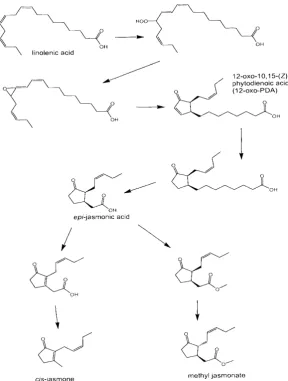
Methyl salicylate has been shown, when applied aerially to plants, to induce defence against fungal pathogens (27). However, a great deal of attention has been attached to the jasmonate pathway (Figure 1) (13), which is part of the lipoxygenase pathway referred to above. Again, jasmonic acid can act internally as a plant hormone associated with a damage/stress response but, when methylated (i.e. methyl jasmonate, Figure 1), can be released by the plant and, whether naturally or not, will certainly have an effect on intact plants by upregulating defence related and other genes. Unfortunately, a great number of genes are influenced and this can have a deleterious effect on plant development and yield for agricultural crops (3). When we were studying the host alternation semiochemistry of the lettuce aphid, Nosortovia ribis-nigri, we found, as predicted from the above hypothesis, that the spring migrants were repelled by their winter hosts (members of the Saxifragiaceae, e.g. the blackcurrant, Ribes nigr"unt) and that these semiochemicals could act as repellents for such migrants searching for the summer host, lettuce, Lactuca sativa (Asteraceae). However, the nrixture of semiochemicals contained cls'-jasmone, which is also involved in the jasmonate pathway (Figure l). Previously it hadbeen suggested that cru-jasmone is a metabolic product of jasmonate and represents a sink for this pathway (12). The response with N. ribis-nigri was very pronounced with this compound alone. A specific olfactory neuron was identified which responded exclusively to cls'-jasmone. with virtually no response from methyl jasmonate at orders of magnitude greater stimulus concentrations, even though cl.r-jasmone and methyl jasmonate have a close structural resernblance (see Figure 1) (3) crs-Jasmone was also found to be a repellent for the damson-hop aphid Phorodon humuli, taxonomically very different in terms of having a Pntnus species (Rosaceae) as its primary host and, as a secondary host, the hop Hunulus lupulus (Cannabiaceae). It was also found that cru-jasmone would increase attraction and searching by an aphid predator, the seven-spot ladybird, Coccinella septentpunctata. Therefore, because of cls-jasmone's relationship with the jasmonate pathway, we decided to see if aerial application of cis-jasmone could influence the defence of intact plants. This was achieved by placing low levels of crs-jasmone over bean plants contained in bell jars. The plants were tested for residual cls-jasmone, which was found to be completely absent after 48 h, and these and control plants were then placed in a wind tunnel and the effect on an aphid parasitoid, Aphidius ervi, was investigated. In both dual and single choice experiments, there was, respectively, three-fold and two-fold increases in oriented flight to the crs-jasmone treated plant, with both results being highly significant statistically (3). One of the compounds showing induced release as a consequence of the cls-jasmone treatment was (E)-ocimene, which is known to be partly responsible for the response by A. ervi. Although this compound was also induced by methyl jasmonate, the effect was short-lived and had disappeared 48 h after the initial treatment. However, the effect with cls-jasmone remained for 8 days (3).
n 2
Pickett el al1 2 o x o 1 O , 1 5 ( Z ) -p h y t o d i e n o i c a c i d ( 1 2 - o x o - P D A )
--->
I
(v
n 4v
">-a-2
P
N
"
/="-
#on
Vou
^ 4V
\ r l )"-/ ( / P
Yo-I
V
" \ l
^..'..,$
( t o \ 1 i l
Yo-m e t h y l j a s Yo-m o n a t e
/
/
I
" 4 v
\ ll Y o
\_-{ il
O H
\
\
I
,a' o l
\/.>
\ i l
cls-jasmone
--l:\-(-
-\
noo_{
\
(vL-v:"
- \l i n o l e n i c a c i d
u n
\
epr-jasmonic acid
Figure l. Biosynthesis of methyljasmonate and putative route to cis-jasmone
3. CIS-JASMONE
3.1. Molecular biological studies
A I Ielopat h ic agen I cis-J rts rtton e
shown that crs-jasmone affected the acceptability to aphids and the foraging behaviour of l. erui on A. thalionrz, a model plant for molecular genetics. Information was first acquired
fromA. thaliano gene expression by means of a linited microamay, involving genes already known to be associated with plant stress (EE Farmer, personal communication). This demonsh'ated that the gene responsible for reduction of the oxophytodienoic acid (Figure 1) in the biosynthetic pathway to jasmonic acid, and the putative pathway to crs-jasmone, was upregulated by cis-jasmone. However, in this plant, there was no upregulation of the gene for (fl -ocimene synthase.
It was decided to investigate the effects of crs'-jasmone on gene expression in l. thuliana by using the Stanford Arabidopsis microarray facility, in which the effects of crs-jasmone would be tested against a control, comprising plants treated in a similar way with methyl jasmonate. Thus, intact eight-week-old A. thaliana, ecotype Columbia, were exposed for 24 h in sealed boxes (3.7 litres) to methyl j asmonate or cis-j asmone as a vapour from 1 pl (ca I mg) of undiluted material. The extracted messenger RNA rvas hybridised to the Stanfordarcay, giving the following comparisons: control against cis-jasmone, control against methyl jasmonate, cis-jasmone against methyl jasmonate. There were about 30 genes upregulated by exposure to cls-jasmone. Confirmation of this upregulation was obtained for a subset of the initially recognised -qenes by differential expression to cls-jasmone using Northern blots, and included genes annotated as cytochromes P450, a 4-nrethyl-5(2-hydroxyethyl)thiazole monophosphate biosynthase and an oxophytodienoic acid reductase gene, OPRI. It would be expected that products from genes upregulated by plant activators would be enzymes involved in the generation of herbivore repellents and foraging stimulants for predators and parasitoids. The cytochromes P450 may fulfil such a role, but this has not yet been determined. Alternatively, the cytochromes P450 could be involved in the selective discrimination of cis-jasmone as the activating signal. It is now known that OPR3, rather than OPRI/2, rs involved in the reduction step in the specific biosynthesis of jasmonic acid from oxophytodienoic acid (25,26). OPRI and OPR2 are considered likely to be involved in the removal of isomers different from the 95,135- isomer of the oxophytodienoic acid, which has the appropriate stereochemistry to be the precursor of epr-jasmonic acid (Figure 1). It may be that, since methyl jasmonate was also observed to upregulate OPR3 and only crs'-jasmone upregulated OPR1, this latter gene might be involved in the direct biosynthesis of crs-jasmone as part of a feedback loop (Figure 1). This might account for the persistent effect of crs-jasmone and the mode of action is under investigation.
In addition to progress towards uncovering the mechanism by which cn'-jasmone is detected and gives a persistent response, the molecular biological studies have also demonstrated another principle of potential practical value. The promoter sequence for one of the genes upregulated by cls-jasmone has been cloned and linked to a marker gene encoding a luciferase and then expressed transgenically in A. thaliana. Thus, when this transgenic plant is exposed to aerial cru-jasmone. the luciferase gene is expressed and the plant emits light when treated with the substrate luciferin, whereas without cis-jasmone, the gene remains inactivated. This demonstrates the principle of using crs-jasmone with cls-jasmone responsive promoters to switch on other genes, not merely acting as markers but of potential value (21). Such genes could relate to other aspects of plant protection; for example, the activator promoter sequence could be linked to insect defence genes or genes associated with valuable agronomic traits. There would also be the possibility of using
ll4 Pickett et al
czs-jasmone responsive promoters associated with light sensitive markers that could act in sentinel plants as indicators of the onset of insect attack or disease development.
3.2. Practical use of cl's-jasmone
While we continue to investigate the molecular basis of cls-jasmone plant activation as a means of eventually providing transgenic delivery of these types of crop protection approaches, we have been looking at elite cereal cultivars for high levels of activation with cis-jasmone. One of the compounds that is our target for increased expression is 6-methyl-5-hepten-2-one. We have found this to be one of a number of compounds Q$ that is produced when R. padi attacks cereals and which causes repulsion of this aphid from normally attractive wheat seedlings. We also know that 6-methyl-5-hepten-2-one is an important foraging cue for the aphid parasitoid A. ervi (10). The biosynthesis for 6-methyl-5-hepten-2-one has been reported (9) as an oxidation product of isoprenoids by microbes. However, we have found that, in certain elite wheat cultivars, there is upregulation of the production of this compound with cls-jasmone. We also find that, as a consequence of this and other effects, there is repellency to the cereal aphid S. ovenee when the wheat cultivar is treated with cis-jasmone (a). This has been followed through in the field where, in three seasons out of four, we have had reduced levels of cereal aphids on winter wheat, one month after cls-jasmone was applied (at a low field dose in an emulsifiable concentrate) (4). Although we have not been able to do simrlar field work on aphid parasitoids, we have shown, in simulated field trials on wheat seedlings treated with crs-jasmone, that there is a statistically significant increase in foragingby A. en,i (5).
3.3. cis-jasmone upregulates antibiotic effects
In addition to the behavioural effects induced in cereals, it was observed that there \\ere red\\etions in aghicl devetopment. These involved statistically significant reductions in
Al lelopathic agent cis-Jasntone
O
Repellents (non-host volatiles, pheromones, antifeedants)
OAttractants
(aggregation / sex pheromones; visual stimuti)
tMor.
attractive cultivars / related hosts
oSelective
control agents
Figure 2. The general principles of a "push-pull" crop protection system.
4. THE "PUSH-PULL'' STRATE,GY
Although delivery of semiochemicals by plants, whether induced or not, provides a neans of economically viable delivery, particularly for unstable or highly volatile compounds, the effects may not be sufficient to reduce the pest problem below the economic tlueshold (22). Also, in an attempt to avoid rapid development of resistance to semiochemical control strategies, we and other grollps put together a number of semiochemically based control methods into a stimulo-deterrent, or "push-pull" strategy. This involves creating a "push" effect from the main crop, by using less attractive crop cultivars and by using repellents such as non-host volatiles, or oviposition deterrent pheromones and plant derived antifeedants (see Figure 2). The system also requires a trap crop ("pull") to which the pests are attracted by aggregation or sex pheromones, visual stimuli and more attractive cultivars/related hosts. On the trap crop can also be deployed a highly selective control agent. Economics do not usually allow the use of biological control agents in broad-acre crops, but application to a limited area of trap crop, particularly one in which the best conditions for infectivity with the biological agent can be established, will make the process economically feasible. Into this system also comes the potential to exploit beneficial organisms such as predators and parasitoids of the pests and so, as part of the
i l 5
Main crop
tL.rt;
attractive crop cultivars
l l 6 Pickelt et al
"push" strategy, there is also an involvement of foraging cues to ensure that the main crop is visited by predators and parasitoids before the pest population builds up. We have attempted to do this in the UK on the oilseed rape crop, initially using a trap crop comprising turnip rape, which produces both visual cues and volatile semiochemical atfi'actants. Eventually, we hope to "switch on" the effects of "push" and "pull" by means of the kind of plant activators, such as cis-jasmone, described above.
ACKNOWLEDGEMENTS
Rothamsted Research receives grant-aided supporl from the Biotechnology and Biological Sciences Research Council (BBSRC), UK, with additional funding provided under the Biological Interactions in the Root Environment (BIRE) rritiative. This work was in part
suppor-ted by the Depafiment for Environnrent, Food and Rural Affairs (Defra), UK.
REFERENCES
l . A h a r o n i , A . , G i r i , A . P . , D e u e r l e i n , S . , G r i e p i n k , F . , d e , K o g e l , W - . f . , V e r s t a p p e n , F . W . A . , V e r h o e v e t r , H . A . , Jongsma, M.A., Schwab. W. and Bouwmeester, H..1. (2003). Terpenoid metabolisnr in rvild-type and transgenic Arabidopsis plants. Plnnt Cell l5; 2866-2884.
2 . B e a l e , M . t l . , B i r k e t t . M . A . , B r u c e , T . J . A . , C h a m b e r l a i n , K . , F i c l d , L . M . , F l u t t l y , A . K . , P h i l l i p s , A . L . , P i c k e t t , J . A . , P r o s s e r , 1 . M . , S h e w r y , P . R . , S n r a r t , L . 8 . , W a d h a m s , L . . 1 . , W o o d c o c k , C . M . a n d Z h a n g , Y . (2006). Aphid alarm pheronrone f}om transgenic plants at-lects aphids and their parasitoids. Proceedings ofthe Notional Acndentl, ofSciences 103: 10509-13.
3 . B i r k e t t , M . A . . C a m p b e l l , C . A . M . , C h a m b e r l a i n , K . , G u e n ' i e r i , E . , H i c k , A . J . , M a r t i n , J . L . , M a t t h e s , M . , N a p i e r , J . A . , P e t t e r s s o n , J . , P i c k e t t , J . A . , P o p p y , G . M . , P o w . E . M . , P y e , 8 . J . , S m a r t , t - . E . , W a d h a m s , G . H . , Wadhams, L..1. and Woodcock, C.M. (2000). New roles tbr crs-jasmone as an insect semiochemical and in plarrt def'enc e. Proceedings of tlre National Acadenry oJ' Scicnces 91: 9329-9334.
4 B n r c e , T . J . A . , M a r t i n , . 1 . L . , P i c k e t t , J . A . , P y e , 8 . J . . S m a r t , L . E . a n d W a d h a m s , I - . . 1 . ( 2 0 0 3 a ) . c i s - J a s m o n e treatmeltt induces resistarrce in wlreat plarrts against tlre grairr aphid, Sitobion oven(Ie (FabriciLts) (l{omoptera: Aphididae). Pest ll(ouogernent Science 59: I031-I016.
5 . B r u c e , T . . 1 . , P i c k e t t , J . A . a n d S n t a r t , L . E . ( 2 0 0 3 b ) . C r . s - j a s m o n e s r v i t c h e s t - r n p l a n t c J e l - e n c e a g a i n s t in s e c t s . Pe.sticide Outlook 14: 96-98.
6 . B r u c e , T . . 1 . , W a d h a n r s , L . . f . a n d W o o d c o c k , C . M . ( 2 0 0 5 ) . l n s e c t h o s t lo c a t i o n : a v o l a t i l e s i t u a t i o n . T r e n d s it t P lant Sciettce l0'. 269-27 4.
1 . C h a m b e r l a i n , K . , P i c k e t t , J . A . a n d W o o d c o c k , C . M . ( 2 0 0 0 ) . P l a n t s i g n a l l i n g a n d i n d L r c e d d e l b n c e i n i n s e c t attack. ll(oleatlor Plont Potlrclogl, l: 67 -72.
8 . C h a m b e r l a i n , K . , G u e r r i e r i , E . , P e n n a c h i o , F . , P e t t e r s s o n , J . , P i c k e t t , J . A . , P o p p y , G . M . , P o w e l l , W . , W a d h a m s , L . J . a n d W o o d c o c k , C . M . ( 2 0 0 1 ) . C a n a p h i d - i n d u c e d p l a n t s i g n a l s b e t r a n s n - r i t t e d a e r i a l l y a n d through the rhizosphere'.! Biochenticol Sl,stenotics and Ecologs'29: 1063-1074.
9. Demyttenaere, .l.C.R. and DePooter, FI.L. (1996). Biotrarrslbrnration of gerarriol and nerol by spores of Penicillium itolicum. Phl'tochemislry 41. i079-1082.
1 0 . D u , Y . , P o p p y , G . M . , P o w e l l , W . , P i c k e t t , . l . A . , W a d h a m s , L . . l . a n d W o o d c o c k , ( 1 . M . ( 1 9 9 8 ) . l d e n t i f l c a t i o n o f semiochemicals released during aphid f'eeding tlrat attract parasrtoid Aphidius en'i. Journol of Chenticol Ecologl, 24: I 355-1 368.
1 1 . F r e y , M . , C ' l r o m e t , P . , G l a w i s c l r n i g , E . , S t e t t n e r , C . , G r r - i n , S . , W i n k l m a i r , A . , E , i s e n r e i c h , W . , B a c h e r , A . , M e e l e y , R . 8 . , B r i g g s , S . P . , S i m c o x , K . a n d G i e r l , A . ( 1 9 9 7 ) . A n a l y s i s o f a c h e m i c a l p l a r r t d e t ' e n c e mechanism in grasses. Scienc'e 277:696-699.
I 2. Koch, T., Bandemer, K. and Boland, W. ( I 997). Biosynthesis of cis-jasmone: pathway tbr the inactivation and the disposal of the plant stress hormone jasmonic acid to the gas phase? Helvetico Chinicn Acto 80'. 8 3 8 - 8 5 0 .
A | | el opallti c ugertl ci s-J a smort e
1 5 . M a t t h e s , M . , N a p i e r , J . A . , P i c k e t t , . l . A . a n d W o o d c o c k , C . M . ( 2 0 0 3 ) . N e w c h e m i c a l s i g n a l s i n p l a n t p r o t e c t i o n against lrerbivores and weeds. ln: Proceedings BCPC Internotional Congress - Crop Sciertce and Tec'hnolog1,. pp.1227 -1236. Glasgow, 10- I 2 November 2003.
1 6 . N o m u r a , T . , I s h i h a r a , A . , I m a i s h i , H . , E n d o , l ' . , O h k a w a , H . a n d l w a m u r a , H . ( 2 0 0 2 ) . M o l e c u l a r charactelization and chromosomal localization of cytochrome P450 genes involved in the biosynthesis of cyclic hydroxamic acids in hexaploid Wheat. Molec'ular Genetics and Genomics 267 210-217 .
1 7 . N o m u r a , T . , I s h i h a r a , A . , l m a i s h i , H . , O h k a w a , H . , E n d o , T . R . a n d Iw a m u r a , H . ( 2 0 0 3 ) . R e a r l a n g e m e n t o f t h e genes tbr tlre biosynthesis of benzooxazinones in the evolution of Triticeae species. Plonto 217' 7 7 6 - 7 8 2 .
18. Osbourn, A. (2004). Unravellirrg triterpene glycoside biosyrthesis in grasses: Integrated approaches fbr the dissection of complex secondary metabolite pathways. In: Proceedings Botanikertagung. B r a u n s c h w e i g , 5 - 1 0 S e p t e m b e r 2 0 0 3 , E V l 3 - 0 1 , T e c h n i s c h e L J n i v e r s i t a t B r a r . r n s c h r v e i g . 1 9 . P a r e , P . W . a n d T u m l i n s o n , J . H . ( 1 9 9 6 ) . P l a n t v o l a t i l e s i g n a l s in r e s p o n s e t o h e r b i v o r e f- e e d i n g . F l o r i d a
Entomo logi s t 79 : 93 -1 03.
2 0 . P e t t e r s s o n , J . , P i c k e t t , J . A . , P y e , 8 . J . , Quiroz, A., Snraft, L . 8 . , W a d h a m s , L . J . a n d W o o d c o c k , C . M . ( 1 9 9 4 ) . Winter host cc-rmponent reduces colonizatiort by bird-cheny-oat aphid, Rltopolosiphum parli (1,.) (Honroptera, Aphididae), and other aphids in cereal tields. Journsl o.[ Chunicnl Ecologl, lg. 2565-2514.
2 1 . P i c k e t t . J . A . a n d P o p p y . G . M . (2 0 0 1 ) . S w i t c h i n g o n p l a n t g e n e s b y e x t e m a l c h e m i c a l s i g n a l s . T ' r e n d s i n P l a n r S c i e n c e 6 : 1 3 7 - 1 3 9 .
2 2 . P i c k e t t , J . A . , R a s m u s s e n , H . B . , W o o d c o c k , C . M . , M a t t h e s , M . a r r d N a p i e r , . l . A . ( 2 0 0 3 ) . P l a n t s t r e s s s i g n a l l i n g : understanding arrd exploiting plant-plant interactions. Biochenticol Societl,Trortsoclions 3l' 1 2 3 - t 2 1 .
2 - 1 . P i c k e t t , J . A . , W a d h a m s , L . . 1 . , W o o d c o c k , C . M . a n d H a r d i c , . 1 . ( 1 9 9 2 ) . T h e c h e m i c a l c c o l o g y o f a p h i d s " A n n u o l Review of Entontologl' 37: 67 -90.
2 - 1 , Q L r i r o z . A . , P e t t e r s s o n , J . , P i c k e t t , . l . A . , W a d h a m s , I- . J . a n d N i e m e y e r , H . M . ( 1 9 9 7 ) . S e n r i o c h e n r i c a l s rnediating spacirrg behavior of bird chen'y-oat aphid, Rlopalosiplrum pcrlr f'eedirrg on cereals. Journol of ('hemicol Ecologl, 23 2599-2601 .
2 5 S c h a l l e r , F . ( 2 0 0 1 ) . E n z y m e s o l t h e b i o s y n t h e s i s o f o c t a d e c a n o i d - d e r i v e d s i g n a l l i n g m o l e c u l e s . J o u r n a l o f Experimentol Bot any 52: 1 1 -23.
2 6 S c h a l l e r , F . , B i e s g e n , C . , M r i s s i g , C . , A l t m a n n , T . a n d W c i l e r , E . W . ( 2 0 0 0 ) . l2 - O x o p h y t o d i e n o a t c r e d u c t a s e 3 (OPR3) is the isoenzyme involved in jasmonate biosynthesis. Plonta 210:919-984.
2 7 . S h u l a e v , V . , S i l v e r m a n , P . a n d R a s k i n , I . ( 1 9 9 7 ) . A i r b o m e s i g n a l l i n g b y m e t h y l s a l i c y l a t e i n p l a n t p a t h o g e n resistance. Nature 385: 71 8-121 .
2 8 . S t o u t , M . J . , T h a l e r ' , . 1 . S . a r r c i T h o m m a , B . P . H . i . ( 2 0 0 6 ) . P l a n t - m e d i a t e d i n t e r a c t i o n s b e t w e e n p a t h o g e n i c microorganisnrs and herbivorous arthropods. Artnuol Review of Entonolog), 5l: 663-689.