R E V I E W
Open Access
The human microbiome in evolution
Emily R. Davenport
1†, Jon G. Sanders
2†, Se Jin Song
2, Katherine R. Amato
3, Andrew G. Clark
1and Rob Knight
2,4,5*Abstract
The trillions of microbes living in the gut
—
the gut
microbiota
—
play an important role in human biology
and disease. While much has been done to explore its
diversity, a full understanding of our microbiomes
demands an evolutionary perspective. In this review, we
compare microbiomes from human populations, placing
them in the context of microbes from humanity
’
s near
and distant animal relatives. We discuss potential
mechanisms to generate host-specific microbiome
configurations and the consequences of disrupting
those configurations. Finally, we propose that this
broader phylogenetic perspective is useful for
understanding the mechanisms underlying
human
–
microbiome interactions.
Keywords:
Microbiome, Evolution, Codiversification,
Habitat filtering, Transmission
The microbiome in the context of evolution
We are in the midst of a revolution in our
understand-ing of the human
microbiome
(Box 1). A decade ago,
very little was known of the inventory of microbes that
inhabit different parts of the human body, how they
as-semble into communities of varying levels of complexity,
and how they relate to microbiomes in other species.
Recent improvements in technology for collecting and
analyzing DNA sequence data make these questions
ac-cessible for the first time. Various aspects of the
micro-biome have been correlated to a surprising number of
human diseases [1], and some microbiome-centric
inter-ventions have shown extraordinary efficacy in treatment
of specific disorders like recurrent
Clostridium difficile
infection [2]. More broadly, this wealth of additional
data has drawn attention to the connections between
* Correspondence:[email protected] †Equal contributors
2
Department of Pediatrics, University of California San Diego, La Jolla, CA, USA
4Department of Computer Science & Engineering, University of California San
Diego, La Jolla, CA, USA
Full list of author information is available at the end of the article
microbes and foundational elements of organismal
biol-ogy and ecolbiol-ogy [3]. Given the rush to apply knowledge
of the human microbiome in fields ranging from
medi-cine to forensics, there has been a heavy emphasis on
practical applications of microbiome sequencing, largely
from North American and European populations.
How-ever, as in many other areas of biology, a true
under-standing of these patterns and processes requires an
evolutionary perspective.
In this review, we focus on the gut microbiome, as
sur-prisingly little comparative data are available for other
body sites across human populations or other species.
We place the human gut microbiome into its
evolution-ary context across different modern populations with
varying diets, lifestyles, and environmental exposures,
and relate evolutionary patterns in the gut microbiome
across the mammals to address several key questions.
How do human microbiomes compare with our
evolu-tionary ancestors? Are those patterns consistent with a
common assumption that the microbiome evolves with
the host? If so, what exactly is evolving in a microbiome
and how? Does evolutionary history in the microbiome
matter to human health and fitness? If so, how can we
use evolutionary history to better understand the
assem-bly and effects of the microbiome to the benefit of
human health?
To address these questions, we first describe the
hu-man gut microbiome and its contents. We then place
this information in the context of our closest relatives,
the primates, and more distant relatives, mammals. Then
we discuss the consequences of modifying
species-specific microbiomes, and some of the mechanisms
underlying this process. Finally, we point the way to
microbiome studies that can better take into account the
evolutionary properties of hosts, microbes, and their
symbioses to improve our knowledge both of the
under-lying biology and for practical applications in human
and animal health.
Global diversity of the human microbiome
Although the 6.5 meter human digestive tract consists of
three organs
—
the stomach, small intestine, and large
intestine
—
most human microbiome research focuses on
the microbial community (the
microbiota
) of the large
intestine as read out through the stool. This community
harbors by far the greatest microbial biomass of any
organ or surface of the human body. Each milliliter of
the large intestine holds approximately 10
11microbial
cells compared to 10
8cells in the small intestine [4].
Typically, researchers turn to non-invasive fecal samples
as proxies for the distal colon microbiome. These
sam-ples contain a mixture of microbes and human
colono-cytes from along the length of the digestive tract and
have a similar, albeit distinct, composition to intestinal
biopsies [5, 6].
Zooming in to the microbiome of a single individual,
an estimated 150 to 400 species reside in each person
’
s
gut based on culture-dependent and -independent
tech-niques [7]. Typically, most of these species belong to the
Bacteroidetes
,
Firmicutes
,
Actinobacteria
, and
Proteobac-teria
phyla. The relative proportions of each of these
taxa vary dramatically [7] between individuals [8] and
even within an individual over the course of their lives
[9
–
11]. Although each person
’
s microbiome is unique,
several trends emerge when we examine microbiomes of
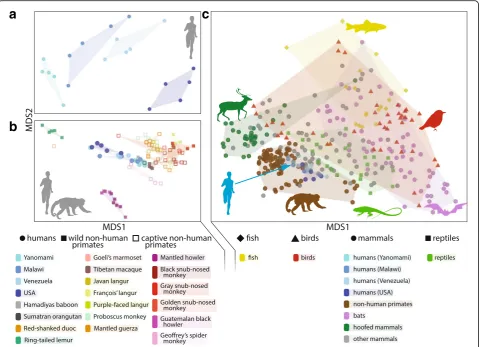
populations around the globe (Fig. 1a). Most of what we
know of the microbiome comes from studies that
exam-ine individuals from highly industrialized and developed
(
“
westernized
”
) nations, including both medical
micro-biome research and major micromicro-biome surveys, like the
Box 1 Definitions
Microbiome:the biotic and abiotic habitat comprising the community of microorganisms associated with a particularenvironment or host. Sometimes synonymized with “microbiota”, though it has been argued the latter should be reserved for marker-gene-based descriptions of the biotic component of the microbiome [109]
Metagenome:the collective genomes, or genomic components, of the microbiome. Empirically, metagenomes are investigated by random shotgun sequencing of the mixed community, rather than targeted sequencing of marker genessuch as 16S rRNA.
Hologenome:the genome of a host animal and its metagenome [110–112]. Conceived in light of a growing awareness of the importance of microorganisms to hostorganism biology, the“hologenome concept of evolution” considers the host and its microbes as an ecosystem, arguing that changes in phenotype due to exchange of symbiotic partners can be usefully analogized to changes in phenotype
due to changes in genotype within an evolutionary
framework [113,114]. This concept is controversial [115], in part because imperfect vertical transmission of symbiotic components of the“hologenome”precludes analysis under
standard models of evolution by natural selection.
Holobiont:a host animal and its microbial associates. Two animals with identical genotypes but different microbial associates could express different“holobiont”phenotypes. Co-evolution:causally related, reciprocal changes in allele frequencies within populations of different organisms. This term has been used with conflicting or imprecise meanings for decades [116]; we prefer the usage outlined by Janzen[117], which is defined by a population-geneticprocess. Other previous uses have describedpatterns, which can be more usefully described with specific and discrete terms (e.g.,“codiversification”or“phylosymbiosis”).
Cospeciation:one particulareventin evolutionary history, in which the speciation of one organism itself causes the contemporaneous speciation of another organism. Cospeciation events over time can produce a pattern ofcodiversification; horizontal transmission can make this harder to detect, and other processes of adaptation and transfer can also produce tightly codiversified phylogenies in the absence of cospeciation [118,119].
Codiversification:a cophylogeneticpatternin which biologically associated organisms display predicted evolutionary histories more similar to one another thanexpected by chance. We advocate the special use of the term “codiversification”, distinct from coevolution or cospeciation, as a precise way to refer to a particularly interesting and
frequently observed pattern. Codiversification might arise from a history of cospeciation, but could also result, for example, from the shared experience of population vicariance across a landscape inhabited by both organisms.
Phylosymbiosis:a pheneticpatternof congruence between the phylogeny of a clade of host organisms and the similarities of their symbiotic microbial communities [55]. Phylosymbiosis does not necessarily require the sharedevolutionary history of microbiota and host, but can arise via structuring of microbial communities in ways correlated with host phylogeny [59,99].
Vertical transmission:acquisition of microbes directly from an organism’s parents. This conceivably happens either via transmission through the germline, as is frequently observed in insects, or subsequent interactions.United States focused Human Microbiome Project [8]
and the European MetaHIT [12]. However, Western
microbiomes differ in several ways from the
non-Western microbiomes profiled to date [13
–
22].
First, Western microbiomes consist of 15 to 30% fewer
species than non-Western microbiomes [14, 18, 19].
One proposal, the disappearing microbiome hypothesis,
puts forth that technological and cultural changes
ac-companying industrialization lead to a
“
disappearing
microbiome
”
[23]. In lieu of building a time machine,
the one way to evaluate this hypothesis is to turn to
an-cient DNA (Box 2).
Second, Western microbiomes lack certain species that
consistently occur in non-Western microbiomes. The
most striking example is the spiral bacteria in the genus
Treponema
, which appears in the stool of numerous
non-Western populations who utilize different
subsist-ence strategies, including hunting and gathering and
agriculture [13, 15, 19].
Finally, the relative abundances of common phyla shift
between Western and non-Western microbiomes.
West-ern microbiomes generally bear a greater amount of
Bac-teroides
,
while
non-Western
microbiomes
generally
contain greater amounts of Firmicutes and Proteobacteria
a
c
b
[15, 17], although exceptions to this trend exist [13].
Taken together, these studies point to the fact that there is
no single
“
human microbiome
”
, but rather a wide range of
configurations that our commensal microbiomes assume.
Given this observation, two key questions arise. First,
why do these differences exist between populations? One
explanation points to cultural and environmental factors.
Diets in particular vary dramatically between cultures and
continents. In general, the increased fiber and decreased
sugar, fat, and meat in non-Western diets is thought to
promote bacterial richness in the gut [13, 24
–
26].
Additionally, differences in hygiene and medicine likely
contribute, including exposure to animals and other
septic environments, overuse of antibiotics early in life
[23, 27, 28], and differences in enteric parasite carriage
in Western populations [20, 29, 30]. Alternatively,
por-tions of the microbiome may simply have diverged
along with human populations as they expanded
around the globe. For example, the modern day
distri-bution of
Helicobacter pylori
strains aligns with known
human migrations [9, 31].
The
second
question
that
arises
is:
Do
these
differences between populations matter? Are they larger
than expected for a species that eats diets and lives in
environments as variable as our own? To answer this, it
is useful to compare human microbiomes to our close
evolutionary relatives, the non-human primates.
The human gut microbiome in the context of our
closest evolutionary ancestors: non-human primates
Despite the evolutionary relevance, surprisingly few
studies systematically compare human and non-human
primate gut microbiomes. Directly comparing primate
and human microbiomes offers insights into what
factors shaped our microbiome throughout our
evolu-tionary past. The data that exist demonstrate that, in
contrast to our most recent common ancestors, African
apes, humans have lower gut microbiota diversity,
increased relative abundances of
Bacteroides
, and
reduced relative abundances of
Methanobrevibacter
and
Fibrobacter
[32, 33]. Many of these traits are associated
with carnivory in other mammals, suggesting that a
hu-man dietary shift toward meat-eating over evolutionary
timescales may have been accompanied by associated
gut microbial shifts [34, 35]. Comparing primate and
hu-man microbiomes also provides an indication of how
quickly the human microbiome is changing. The human
gut microbiome composition appears to have diverged
from the ancestral state at an accelerated pace compared
to that of the great apes [33]. Some of the hallmarks of
human evolution and history potentially responsible
in-clude cooked food, the advent of agriculture, population
size and density increases, and physiological changes
such as the human-specific loss of N-glycolylneuraminic
acid (Neu5Gc).
A meta-analysis of non-human primate and human
gut microbiome datasets currently available in the Qiita
public repository provides some additional insight (see
Fig. 1). Human inter-population differences appear
simi-lar to the inter-species differences in non-human
pri-mates (Fig. 1b). Human inter-population differences are
commonly attributed to diet [14, 15]. Similarly,
non-human primate gut microbiomes change in response to
host habitat and season [36
–
43], effects which appear to
be most strongly linked to spatial and temporal variation
in diet. However, differences in gut microbiome
com-position among non-human primates mirrors host
Box 2 A glimpse into human microbiome evolution
through ancient DNA
How can we know what our microbiomes looked like in the
past? Were the microbiomes of our ancestors more diverse than our own, as predicted by the disappearing microbiome hypothesis [23]?
Although comparing non-Western to Western microbiomes offers insights into how modern diets and medicine shape microbiome composition, no living population today carries an “ancestral”microbiome. Rather, turning to ancient samples such as coprolites [120–122], dental calculus [123–125], tissue retrieved from permafrost [126, 127], and mummified remains [128, 129] offers us a glimpse into what our microbiomes looked
like throughout the course of hominin evolution [130].
Although coprolites or mummified intestinal contents give us
the best snapshots of ancient gut microbiomes, typically these samples preserve poorly and not all profiled samples contain what we think of as gut microbes [121].
Dental calculus, on the other hand, preserves quite well. Diversity of oral microbiomes decreased with the advent of agriculture, as observed from a series of samples dated between
7000 years ago to modern day [123]. Additionally, ancient oral microbiome samples carry both known opportunistic pathogens and, interestingly, putative antibiotic resistance genes [124].
Recently, sequencing of Neanderthal dental calculus samples from two caves revealed oral microbiomes that differed according to inferred meat eating behavior at each site. The microbiota of
putatively meat-eating specimens closely resemble hunter-gatherer populations, while non-meat eating specimens resemble forager-gathering chimpanzees [125]. Given the explosion in ancient DNA research, it is likely we will know much more about
phylogenetic relationships, a pattern known as
phylo-symbiosis
, and this signal of host phylogeny persists
across a range of timescales, regardless of diet [43]. The
human microbiome also exhibits signs of
phylosymbio-sis. Across primates, human microbiome composition is
most similar to Old World monkeys and apes, and
dis-tinct from the gut microbiome of New World primates
and lemurs (Fig. 1b). Nevertheless, more extensive
sam-pling of non-human primate populations would help
de-termine if the range of variation in human microbiomes
is similar to that of non-human primates and if patterns
of phylosymbiosis are truly differentially resistant to host
environmental context. These data would offer insight
into whether unique and/or divergently evolved aspects
of human physiology and environments resulted in
human-specific gut microbiome traits and whether
non-human primates represent a model for understanding
dietary transitions and their impact on the microbiome
over human evolutionary history.
In this sense, studies of captive primates with
artificially manipulated diets provide helpful context
for understanding human dietary transitions. Several
studies including our own find that captive primates
consume less diverse, lower-fiber diets compared to
their wild counterparts [42, 44, 45], mirroring the
gradual transition to low-fiber diets over the course of
human evolution and the stark contrast of modern
Western and non-Western diets. One study reports
that the low-fiber captive diet provided to howler
monkeys and douc langurs results in a
“
humanization
”
of the gut microbiome, as characterized by the loss of
microbial diversity [41, 44]. However, even with the
low-fiber diet, the howler and douc microbiomes were
more similar to non-Western than Western human
microbiomes, indicating that the relationship between
host diet and the gut microbiota differs between
hu-man and non-huhu-man primates when considering
spe-cific microbial taxa. Our own study comparing the gut
microbiomes of vervets and humans consuming both
high- and low-fiber diets reports similar results [41].
In contrast to observations of Western versus
non-Western human populations [14],
Bacteroides
relative
abundances are lower in captive animals with
low-fiber diets [44], while
Prevotella
relative abundances
are higher. These data indicate that closely related
mi-crobial taxa may have evolved to encode different
metabolic functions in humans and non-human
pri-mate
microbiomes.
Given
the
overall
similarities
among primate microbiomes, targeting these related
but contrasting lineages for more detailed genomic
and functional characterization offers unique
oppor-tunities for understanding both the overall function of
the human microbiome as well as how evolution of
its constituents impacts human health.
The human gut microbiome in the context of
more distant ancestors: mammals
The association between diet and phylogeny among
pri-mate microbiomes echoes the larger patterns of diversity
among vertebrate gut communities, as evidenced by
looking at convergence of dietary transitions and
micro-biomes across mammals (Fig. 1c) [34, 35]. Transitions to
herbivory seem to have especially large effects on the
microbiome. Mammals with independently evolved
herbivorous diets host similar microbiota. Additionally,
some of the same genes and pathways that differ in
abundance between herbivorous and carnivorous
micro-biomes also rapidly shift in corresponding directions in
humans who change from vegetarian to omnivorous
diets [26]. Interestingly, insectivory has also been
associ-ated with some degree of convergence in mammalian
microbiomes [46].
Major dietary transitions inevitably correlate with
nu-merous other physiological changes, both related to and
independent of diet itself, simply as a result of
phylogen-etic non-independence [47]. As a consequence,
inter-preting these changes as evidence of diet per se
structuring the microbiome is likely an
oversimplifica-tion. Numerous mammals host gut communities
con-trary to the general pattern of convergence by diet.
Panda bears, despite being strict herbivores, host gut
microbiomes comparatively similar to their carnivorous
and omnivorous confamilials [35] and that differ
sub-stantially in functional gene complement and ecological
dynamics from other herbivores [48, 49]. Work from our
group shows that baleen whales, despite an entirely
animal-based diet, host microbiomes that share
similar-ities in both taxonomy and functional gene complement
with the foregut-fermenting herbivores, to which they
are distantly related [50]. Among bats, which have
evolved numerous dietary specializations including
nec-tivory, carnivory, sanguivory, frugivory, and insecnec-tivory,
surveys revealed conflicting patterns with respect to diet
and microbiomes (Fig. 2c) [51, 52]. Within species,
diet-ary effects on the microbiome can be assessed
independ-ently of other factors. In comparative analyses, these
effects must be understood in context with changes to
things like gut morphology. Notably, both whales and
pandas retain gut morphological similarities to their
closest relatives that mirror the similarities in their
microbiomes. Therefore, the relationship between diet,
phylogeny, and the microbiome is not always a
straight-forward one.
Consequences of altering species-specific
microbiomes
microbial lineages. What are the consequences of these
relationships? When does perturbation result in health
consequences, and when are these consequences relevant
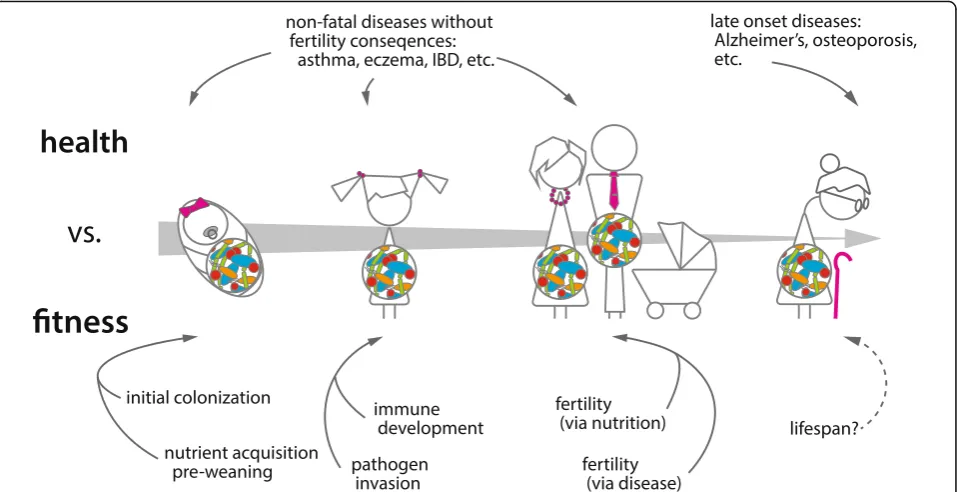
to evolutionary fitness (Fig. 2)? Can the
“
microbiome
”
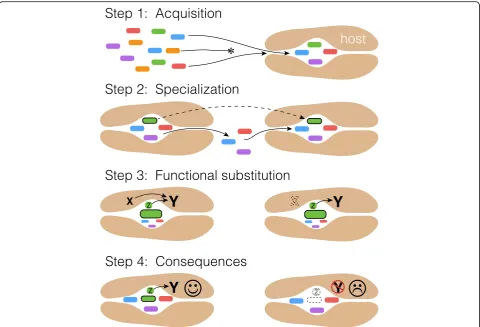
even be considered a thing that evolves (Box 3, Fig. 3)?
Growing evidence suggests shared evolutionary history
matters to both hosts and microbiota. Although
germ-free mice can be colonized by some bacteria from a wide
range of environments, microbes from more closely
re-lated donor species often colonize more effectively [53].
Moreover, host-specificity per se affects the host: mice
colonized with gut microbiota from humans, or even
rats, fail to develop fully mature intestinal immunity,
and are less protected from infection compared to mice
with native microbiota [54]. Gut microbiota transplanted
among multiple related species of mice show
physio-logical effects that correlate with the evolutionary
dis-tance between the host and donor [55]. Host specificity
affects colonization dynamics for some specific microbial
lineages in the vertebrate gut, including
Lactobacillus
[56] and
Candidatus
Savagella, also known as segmented
filamentous bacteria, which have potent
immunomodu-latory activity [57].
Correlations between shared evolutionary history and
impact on mammalian hosts are also beginning to
ap-pear in broad comparative surveys across populations
and species, although methods to formally examine
cophylogenetic patterns in such datasets are still in their
infancy.
H. pylori
, which has long been known to
codiversify
with human mitochondrial lineages [31],
induces variable gastric disease symptom severity in
dif-ferent host genotypes in a manner consistent with either
coevolutionary processes or lineage-specific adaptation
[58]. In a recent paper seeking to tease apart signals of
dietary and phylogenetic correlation in mammalian gut
microbiota, many of the most tightly codiversifying
mi-crobial lineages also associated with inflammatory bowel
disease in human datasets, suggesting that the pattern of
codiversification itself may be an especially useful tool
for finding microbes relevant to human health [59].
These codiversified lineages make clear candidates for
investigating the underlying basis for recent
formula-tions of the
“
hygiene hypothesis
”
, which posit that
im-mune stimulation by microbes has a causal relationship
with a number of chronic disease states, and that
differ-ences in transmission efficiency, coupled with the
Fig. 2.Host–microbiome interactions can affect both health and fitness. Dysbiosis is associated with a number of negativehealthoutcomes, including obesity, asthma, and certain cancers. Negative health outcomes are not sufficient evidence for coevolution of the microbiome and host, however. Not all of these diseases result in negativefitnessconsequences by limiting reproductive success. Microbiomes potentially impact host
increased use of antibiotics, are a risk factor in some
so-cieties [23, 60].
Mechanisms underlying species-specific
microbiomes
As we have shown, perturbing species-specific
micro-biomes results in negative health and fitness
conse-quences. Characterizing the mechanisms that determine
these microbiome configurations is thus a key
prerequis-ite to exploiting the microbiome therapeutically. Two
broad categories of mechanisms underlie microbiome
assembly: transmission and filtering.
Species specificity of individual microbial lineages
arises via the restricted transmission of microbes within
host species. Certain bacterial lineages in primates and
across mammals more broadly show these patterns [59,
61]. Two types of transmission are possible, with
differ-ent evolutionary implications:
vertical transmission
,
where microbes pass directly from parents to offspring
[62], and
horizontal transmission
, where microbes
ex-change non-filially. Strict vertical transmission leads to
cospeciation
of symbionts when host populations
di-verge, resulting in high fidelity of host-microbe
relation-ships over long evolutionary time scales. This effect is
notable in obligate intracellular microbes, which arose
repeatedly in insects [63
–
65]. These intimate
interac-tions can lead to
coevolution
between symbiont and
Box 3 Do microbiomes evolve?
Microbiomes clearly impact host performance, and have changed along the branches of the animal evolutionary tree. Individual microbes, and their hosts, are clearly subject to evolutionary forces.
But can a gut microbiome itself really be said to evolve?
Classically, evolution by natural selection requires three things: 1) phenotypic variation in a population, 2) differential
reproductive success as a consequence of that variation, and 3)
inheritance of said variation. Proponents of thehologenome
concept of evolution argue that the parallels between phenotypes induced in an organism by genes in its genome
and those induced by microbes in a combined host–microbe system, orholobiont, are strong–sufficiently so that host–microbe systems can usefully be examined as an extension of the same evolutionary frameworks built to explore descent and modification of single organisms [113, 114]. Critics have argued that differences
in the modalities of inheritance of genes and microbes are too great for such analogies to be truly illuminating [61, 115]. Most would agree, however, that the variation in and fitness
consequences of microbiome-related phenotypes highlights the importance of understanding the mechanisms underlying their effects across generations.
The most conceptually straightforward such mechanism—direct parental inheritance—may not be the most relevant to gut
microbiomes. Extremely strict vertical transmission of microbes from parent to offspring would be necessary to link host and microbial genotypes sufficiently tightly for selection on one
generation to change“holotype”frequency in the next. Some gut microbiomes may meet this criterion—in turtle ants, for example, gut bacteria are passed on to new adults, which then immediately grow a literal filter in their gut capable of keeping other microbes out [131]; some true bugs (Hemiptera: Alydidae)
use a specialized organ to deposit gut symbionts atop their eggs, ensuring they are the first things consumed by the emerging young [132]. The exquisite level of behavioral and
morphological specialization evidenced in these systems suggests the difficulty of maintaining partnerships over time. For most systems, heritability is unlikely to be strong enough for the microbiome itself, in any meaningful sense, to evolve.
In a recent perspective, Doolittle and Booth [133] argue that particular metabolic roles, rather than the potentially diverse casts of microbes performing them, are the units most relevant to natural selection in the microbiome. This framing extends an informal model that may provide a more intuitive point of entry
for discussing evolution in complex or dynamic microbiomes [113]. By focusing on the microbial products most likely to be
directly perceived by a host, it tries to account for the observation that, while specific microbes are highly variable among microbiomes, the representation of putative functional
pathways appears to be much more consistent, suggesting some level of redundancy. This model may be particularly appropriate for situations where the relevant metabolic pathways are directly related to putative microbiome function, such as processing of
complex polysaccharides in plant-based diets.
Focusing on roles rather than players may also help in
constructing alternative models to understand the fitness consequences of microbial associates that do show some degree of conservation through time—including the species-specific (or even codiversifying) microbes described from some mammalian
guts. While the above model primarily interprets evolution in the microbiome in the context of host- (or holobiont-) level adapta-tion, real fitness consequences could also arise purely via random fixation of nearly neutral mutations in hosts and sets of
host, leaving common signatures in symbiont genomes,
including reduced genome size [66]. Although mammals
lack intracellular microbe transmission, extracellular
ver-tical transmission occurs through coprophagy and other
mechanisms. In humans, mothers transfer microbes to
offspring at birth and during nursing, as evidenced by
strain sharing [67, 68].
Horizontal transmission decreases the evolutionary
fi-delity of host
–
microbe relationships. Vertical inheritance
tends to take place early in life, when transferred
mi-crobes easily establish resident populations in offspring
as primary colonizers. Microbes transferred later in life
face more difficulty in permanently integrating into a
stable complex community [69]. Horizontal transfer also
occurs between species [39], homogenizing their
micro-biomes. Microbes spread horizontally in a number of
different ways, including through coprophagy [70], social
interactions [71
–
74], and cohabitation [75, 76].
Microbiomes adopt species-specific configurations
through microbe filtering in the host. Lourens Baas
Becking coined an enduring
—
albeit inaccurate
—
null
hypothesis in microbial ecology:
“
Everything is
every-where, but the environment selects.
”
Even if this model
is not universally true [77], it provides a useful frame for
considering the myriad environmental microbes that
contact host ecosystems, yet remain transient. Two
pro-cesses lead to microbe filtering in host microbiomes:
competition among microbes and habitat filtering [78, 79].
Phylogenetic patterns of co-occurrences and metabolic
modeling of gut microbiomes indicate that habitat filtering
plays a larger role in determining microbiome
compos-ition than does direct competcompos-ition [80].
What factors underlie habitat filtering in the gut?
Nutri-ent availability likely plays a key role, given the strong
in-fluence of host diet in shaping gut microbiomes [24, 26].
Many other physical and chemical factors differ in the gut
Fig. 3.A non-adaptationist model for consequences of codiversification in microbiomes. InStep 1, a host lineage evolves permissive but variable filters for a gut microbiome, allowing diverse microbes to colonize its gut. InStep 2, a subset of microbes (dark outline) specialize in the host lineage, losing genes necessary to colonize diverse environments in favor of specialization on the particular host niche. As host genes creating this specific niche drift, the specialized microbes follow. InStep 3, the codiversifying microbes are now reliable environmental stimuli, and serve as developmental cues, reducing constraint on the host genome for essential processes. Mutations in the host genome arise that are neutral in the presence of these microbes, but deleterious in their absence. For example, an essential host-encoded developmental moleculeXis required to signalY. Microbial productZelicits a similar downstream effect asX. At some point, a mutation in the host genome results in the loss of function ofX, which is neutral when microbially encodedZ
between species, including types of digestive organs,
digestive tract length, peristalsis rate, pH, oxygen levels,
immune systems, and host derived molecules [81
–
88].
Genetic approaches help us understand which host
fac-tors influence microbiome composition, either through
transmission or filtering. Host genetics determines the
composition of the gut microbiome to some extent and
the abundances of several common gut microbes are
heritable in multiple human populations, including the
family Christensenellaceae, genus
Methanobrevibacter
, and
genus
Faecalibacterium
, as shown by several groups
in-cluding our own [89
–
93]. Heritability in this case does not
necessarily mean vertical inheritance from mother to
off-spring, although that occurs to some extent. Rather,
inter-individual genetic variation correlates with the abundances
of microbes in the gut, due to either transmission or
filter-ing. Heritability studies in twins control for vertical
trans-mission, as rates of vertical transmission are not assumed
to differ between monozygotic twins compared to dizygotic
twin pairs. For the microbes identified in these studies [89,
93], the heritability patterns presumably result from
pro-cesses like filtering. In this case, filtering is probably driven
on the host side by such biochemical and physical factors
as gut pH, peristalsis rate, metabolite concentrations, and
IgA levels, which vary in a heritable manner among
indi-viduals. Genome-wide association studies of the
micro-biome, although underpowered at current sample sizes,
will pinpoint host pathways and processes that might
play a role in filtering. To date, these studies implicate
immune and diet/nutrient-related genes as important
modulators of microbiome composition. [91, 93
–
96].
Different portions of the microbiome likely follow
fundamentally different dynamics, complicating our ability
to disentangle the competing effects of transmission and
filtering across evolution [97]. Even when the similarity
among gut communities precisely mirrors the evolutionary
history of their hosts in a pattern of phylosymbiosis, as has
been demonstrated for hominid apes [98], some members
of the community may be determined via environmental
filtering by phylogenetically correlated factors (like gut
morphology), while others individually track the host
phyl-ogeny itself in a pattern of codiversification [32, 99].
Sys-tematically incorporating phylogenetic information from
gut microbes themselves into comparative datasets offers
great promise for teasing apart the effects of different host
factors on microbiomes [59]. If we can identify general
pat-terns linking evolutionary processes to the roles played by
members of the gut microbiome on host health,
phylogen-etic information may prove to be a useful tool for
identify-ing and manipulatidentify-ing health-relevant microbes.
Towards microbial medicine
—
open questions
Humans live in concert with the microbes around and
in-side our bodies, and have since our divergence from our
most recent common ancestors. By interrogating the
char-acteristics of and mechanisms underlying this divergence,
we should be able to gain the most comprehensive view of
what makes the human microbiome
“
human
”
, and which
members of it are most relevant to different components
of human health and fitness. Although the complexity of
the interactions within the microbiome and between
mi-crobes and hosts presents a major challenge, a more
con-certed and predictive theoretical framework is imperative
to progress [100]. Specifically, applying phylogenetic and
population genetic approaches to query the targets and
ef-fects of natural selection in the microbiome will allow us
to explicitly model the assembly and function of this inner
microbial ecosystem in ways that allow us to move from
the descriptive to the prescriptive. We are now poised to
address several outstanding questions about the evolution
of the human gut microbiome and use this information in
medical research.
First, which taxa in the gut show high degrees of species
specificity, and what mechanisms maintain this relationship?
Shotgun
metagenomics
can provide strain-level insights
into the microbiome [101]. Broadly sampling host species
with convergent phenotypes, such as nocturnality, or
envi-ronments, such as high altitude, would allow the assessment
of filtering factors decoupled from phylogeny. Teasing apart
these influences is relevant for medical microbiome
re-search, because mode of acquisition likely affects our ability
to use or target particular microbes therapeutically.
Second, can we develop a modeling framework for
host
–
microbiome interactions to inform our baseline
as-sumptions about microbial dynamics in the gut within
and across generations (for example, see [102, 103])?
Population genetics theory plays a pivotal role in
defining expectations in evolutionary studies, including
host
–
pathogen interactions [104
–
107]. Additionally, the
community genetics framework assesses the effect of a
particular organism
’
s heritable traits on the ecosystem
more broadly [108]. There is strong motivation to model
evolutionary processes of host
–
microbiome systems
perhaps borrowing from some of these approaches.
Finally, to what degree are patterns of codiversification the
result of adaptation, and to what degree can they be
ex-plained by neutral processes? It is often implied that humans
and their microbes have adapted to each other, and that
per-turbing this relationship results in disease. Evidence
suggest-ing non-neutral processes exists in a few cases [54, 58]. We
must demonstrate fitness consequences in these cases when
adaptation is assumed
—
and be open to non-adaptive
expla-nations for health-relevant phenotypes (Box 3).
Acknowledgements
We thank the members of the Knight and Clark labs for helpful conversations and feedback. ERD is supported by NIH F32 DK109595. Work described here by JGS, SS, and RK was supported by the Keck Foundation, the Templeton Foundation, and Howard Hughes Medical Institute (via the Earth Microbiome Project), NSF, and NIH.
Authors’contributions
Wrote the review: ERD, JGS, SJS, KRA, AGG, RK. Data analysis: SJS. All authors have read and agreed to the content.
Competing interests
The authors declare that they have no competing interests.
Publisher's Note
Springer Nature remains neutral with regard to jurisdictional claims in published maps and institutional affiliations.
Author details
1
Department of Molecular Biology and Genetics, Cornell University, Ithaca, NY, USA.2Department of Pediatrics, University of California San Diego, La Jolla, CA, USA.3Department of Anthropology, Northwestern University, Evanston, IL, USA.4Department of Computer Science & Engineering, University of California San Diego, La Jolla, CA, USA.5Center for Microbiome Innovation, University of California San Diego, La Jolla, CA, USA.
References
1. Knight R, Callewaert C, Marotz C, Hyde ER, Debelius JW, McDonald D, et al. The microbiome and human biology. Annu Rev Genomics Hum Genet. 2017;18:65–86.
2. Bakken JS, Borody T, Brandt LJ, Brill JV, Demarco DC, Franzos MA, et al. Treating Clostridium difficile infection with fecal microbiota transplantation. Clin Gastroenterol Hepatol. 2011;9:1044–9.
3. McFall-Ngai M, Hadfield MG, Bosch TCG, Carey HV, Domazet-Lošo T, Douglas AE, et al. Animals in a bacterial world, a new imperative for the life sciences. Proc Natl Acad Sci USA. 2013;110:3229–36.
4. Walter J, Ley R. The human gut microbiome: ecology and recent evolutionary changes. Annu Rev Microbiol. 2011;65:411–29.
5. Zoetendal EG, von Wright A, Vilpponen-Salmela T, Ben-Amor K, Akkermans ADL, de Vos WM. Mucosa-associated bacteria in the human gastrointestinal tract are uniformly distributed along the colon and differ from the community recovered from feces. Appl Environ Microbiol. 2002;68:3401–7. 6. Durbán A, Abellán JJ, Jiménez-Hernández N, Ponce M, Ponce J, Sala T, et al.
Assessing gut microbial diversity from feces and rectal mucosa. Microb Ecol. 2011;61:123–33.
7. Lloyd-Price J, Abu-Ali G, Huttenhower C. The healthy human microbiome. Genome Med. 2016;8:51.
8. Human Microbiome Project Consortium. Structure, function and diversity of the healthy human microbiome. Nature. 2012;486:207–14.
9. Moodley Y, Linz B, Yamaoka Y, Windsor HM, Breurec S, Wu J-Y, et al. The peopling of the Pacific from a bacterial perspective. Science. 2009;323:527–30. 10. Odamaki T, Kato K, Sugahara H, Hashikura N, Takahashi S, Xiao J-Z, et al.
Age-related changes in gut microbiota composition from newborn to centenarian: a cross-sectional study. BMC Microbiol. 2016;16:90. 11. Flores GE, Caporaso JG, Henley JB, Rideout JR, Domogala D, Chase J, et al.
Temporal variability is a personalized feature of the human microbiome. Genome Biol. 2014;15:531.
12. Qin J, Li R, Raes J, Arumugam M, Burgdorf KS, Manichanh C, et al. A human gut microbial gene catalogue established by metagenomic sequencing. Nature. 2010;464:59–65.
13. De Filippo C, Cavalieri D, Di Paola M, Ramazzotti M, Poullet JB, Massart S, et al. Impact of diet in shaping gut microbiota revealed by a comparative study in children from Europe and rural Africa. Proc Natl Acad Sci USA. 2010;107:14691–6.
14. Yatsunenko T, Rey FE, Manary MJ, Trehan I, Dominguez-Bello MG, Contreras M, et al. Human gut microbiome viewed across age and geography. Nature. 2012;486:222–7.
15. Schnorr SL, Candela M, Rampelli S, Centanni M, Consolandi C, Basaglia G, et al. Gut microbiome of the Hadza hunter-gatherers. Nat Commun. 2014;5:3654.
16. Rampelli S, Schnorr SL, Consolandi C, Turroni S, Severgnini M, Peano C, et al. Metagenome sequencing of the Hadza hunter-gatherer gut microbiota. Curr Biol. 2015;25:1682–93.
17. Clemente JC, Pehrsson EC, Blaser MJ, Sandhu K, Gao Z, Wang B, et al. The microbiome of uncontacted Amerindians. Sci Adv. 2015;1. http://dx.doi.org/10.1126/sciadv.1500183.
18. Martínez I, Stegen JC, Maldonado-Gómez MX, Eren AM, Siba PM, Greenhill AR, et al. The gut microbiota of rural papua new guineans: composition, diversity patterns, and ecological processes. Cell Rep. 2015; 11:527–38.
19. Obregon-Tito AJ, Tito RY, Metcalf J, Sankaranarayanan K, Clemente JC, Ursell LK, et al. Subsistence strategies in traditional societies distinguish gut microbiomes. Nat Commun. 2015;6:6505.
20. Morton ER, Lynch J, Froment A, Lafosse S, Heyer E, Przeworski M, et al. Variation in rural African gut microbiota is strongly correlated with colonization by Entamoeba and subsistence. PLoS Genet. 2015;11: e1005658.
21. Gomez A, Petrzelkova KJ, Burns MB, Yeoman CJ, Amato KR, Vlckova K, et al. Gut microbiome of coexisting BaAka Pygmies and Bantu reflects gradients of traditional subsistence patterns. Cell Rep. 2016;14:2142–53.
22. Brito IL, Yilmaz S, Huang K, Xu L, Jupiter SD, Jenkins AP, et al. Mobile genes in the human microbiome are structured from global to individual scales. Nature. 2016;535:435–9.
23. Blaser MJ, Falkow S. What are the consequences of the disappearing human microbiota? Nat Rev Microbiol. 2009;7:887–94.
24. Wu GD, Chen J, Hoffmann C, Bittinger K, Chen Y-Y, Keilbaugh SA, et al. Linking long-term dietary patterns with gut microbial enterotypes. Science. 2011;334:105–8.
25. Sonnenburg ED, Smits SA, Tikhonov M, Higginbottom SK, Wingreen NS, Sonnenburg JL. Diet-induced extinctions in the gut microbiota compound over generations. Nature. 2016;529:212–5.
26. David LA, Maurice CF, Carmody RN, Gootenberg DB, Button JE, Wolfe BE, et al. Diet rapidly and reproducibly alters the human gut microbiome. Nature. 2014;505:559–63.
27. Korpela K, Salonen A, Virta LJ, Kekkonen RA, Forslund K, Bork P, et al. Intestinal microbiome is related to lifetime antibiotic use in Finnish pre-school children. Nat Commun. 2016;7:10410.
28. Blaser MJ. Antibiotic use and its consequences for the normal microbiome. Science. 2016;352:544–5.
29. Zaiss MM, Harris NL. Interactions between the intestinal microbiome and helminth parasites. Parasite Immunol. 2016;38:5–11.
30. Lopes MEM, Carneiro MBH, Dos Santos LM, Vieira LQ. Indigenous microbiota and Leishmaniasis. Parasite Immunol. 2016;38:37–44.
31. Falush D, Wirth T, Linz B, Pritchard JK, Stephens M, Kidd M, et al. Traces of human migrations in Helicobacter pylori populations. Science. 2003;299:1582–5. 32. Moeller AH, Caro-Quintero A, Mjungu D, Georgiev AV, Lonsdorf EV, Muller MN,
et al. Cospeciation of gut microbiota with hominids. Science. 2016;353:380–2. 33. Moeller AH, Li Y, Mpoudi Ngole E, Ahuka-Mundeke S, Lonsdorf EV, Pusey AE,
et al. Rapid changes in the gut microbiome during human evolution. Proc Natl Acad Sci USA. 2014;111:16431–5.
34. Muegge BD, Kuczynski J, Knights D, Clemente JC, González A, Fontana L, et al. Diet drives convergence in gut microbiome functions across mammalian phylogeny and within humans. Science. 2011;332:970–4. 35. Ley RE, Hamady M, Lozupone C, Turnbaugh PJ, Ramey RR, Bircher JS, et al.
Evolution of mammals and their gut microbes. Science. 2008;320:1647–51. 36. Bennett G, Malone M, Sauther ML, Cuozzo FP, White B, Nelson KE, et al.
Host age, social group, and habitat type influence the gut microbiota of wild ring-tailed lemurs (Lemur catta). Am J Primatol. 2016;78:883–92. 37. Barelli C, Albanese D, Donati C, Pindo M, Dallago C, Rovero F, et al. Habitat
fragmentation is associated to gut microbiota diversity of an endangered primate: implications for conservation. Sci Rep. 2015;5:14862.
38. Gomez A, Rothman JM, Petrzelkova K, Yeoman CJ, Vlckova K, Umaña JD, et al. Temporal variation selects for diet-microbe co-metabolic traits in the gut of Gorilla spp. ISME J. 2016;10:514–26.
39. Moeller AH, Peeters M, Ndjango J-B, Li Y, Hahn BH, Ochman H. Sympatric chimpanzees and gorillas harbor convergent gut microbial communities. Genome Res. 2013;23:1715–20.
41. Amato KR, Leigh SR, Kent A, Mackie RI, Yeoman CJ, Stumpf RM, et al. The gut microbiota appears to compensate for seasonal diet variation in the wild black howler monkey (Alouatta pigra). Microb Ecol. 2015;69:434–43. 42. Amato KR, Yeoman CJ, Kent A, Righini N, Carbonero F, Estrada A, et al.
Habitat degradation impacts black howler monkey (Alouatta pigra) gastrointestinal microbiomes. ISME J. 2013;7:1344–53.
43. Amato KR, Martinez-Mota R, Righini N, Raguet-Schofield M, Corcione FP, Marini E, et al. Phylogenetic and ecological factors impact the gut microbiota of two Neotropical primate species. Oecologia. 2016;180:717–33. 44. Clayton JB, Vangay P, Huang H, Ward T, Hillmann BM, Al-Ghalith GA, et al.
Captivity humanizes the primate microbiome. Proc Natl Acad Sci USA. 2016;113:10376–81.
45. Amato KR, Metcalf JL, Song SJ, Hale VL, Clayton J, Ackermann G, et al. Using the gut microbiota as a novel tool for examining colobine primate GI health. Global Ecol Conservation. 2016;7:225–37.
46. Delsuc F, Metcalf JL, Wegener Parfrey L, Song SJ, González A, Knight R. Convergence of gut microbiomes in myrmecophagous mammals. Mol Ecol. 2014;23:1301–17.
47. Felsenstein J. Phylogenies and the comparative method. Am Nat. 1985;125:1–15.
48. Wei F, Wang X, Wu Q. The giant panda gut microbiome. Trends Microbiol. 2015;23:450–2.
49. Xue Z, Zhang W, Wang L, Hou R, Zhang M, Fei L, et al. The bamboo-eating giant panda harbors a carnivore-like gut microbiota, with excessive seasonal variations. MBio. 2015;6:e00022–15.
50. Sanders JG, Beichman AC, Roman J, Scott JJ, Emerson D, McCarthy JJ, et al. Baleen whales host a unique gut microbiome with similarities to both carnivores and herbivores. Nat Commun. 2015;6:8285.
51. Phillips CD, Phelan G, Dowd SE, McDonough MM, Ferguson AW, Delton Hanson J, et al. Microbiome analysis among bats describes influences of host phylogeny, life history, physiology and geography. Mol Ecol. 2012;21:2617–27.
52. Carrillo-Araujo M, TaşN, Alcántara-Hernández RJ, Gaona O, Schondube JE, Medellín RA, et al. Phyllostomid bat microbiome composition is associated to host phylogeny and feeding strategies. Front Microbiol. 2015;6:447. 53. Seedorf H, Griffin NW, Ridaura VK, Reyes A, Cheng J, Rey FE, et al. Bacteria
from diverse habitats colonize and compete in the mouse gut. Cell. 2014;159:253–66.
54. Chung H, Pamp SJ, Hill JA, Surana NK, Edelman SM, Troy EB, et al. Gut immune maturation depends on colonization with a host-specific microbiota. Cell. 2012;149:1578–93.
55. Brooks AW, Kohl KD, Brucker RM, van Opstal EJ, Bordenstein SR. Phylosymbiosis: relationships and functional effects of microbial communities across host evolutionary history. PLoS Biol. 2016;14:e2000225. 56. Oh PL, Benson AK, Peterson DA, Patil PB, Moriyama EN, Roos S, et al.
Diversification of the gut symbiont Lactobacillus reuteri as a result of host-driven evolution. ISME J. 2010;4:377–87.
57. Yin Y, Wang Y, Zhu L, Liu W, Liao N, Jiang M, et al. Comparative analysis of the distribution of segmented filamentous bacteria in humans, mice and chickens. ISME J. 2013;7:615–21.
58. Kodaman N, Pazos A, Schneider BG, Piazuelo MB, Mera R, Sobota RS, et al. Human and Helicobacter pylori coevolution shapes the risk of gastric disease. Proc Natl Acad Sci USA. 2014;111:1455–60.
59. Groussin M, Mazel F, Sanders JG, Smillie CS, Lavergne S, Thuiller W, et al. Unraveling the processes shaping mammalian gut microbiomes over evolutionary time. Nat Commun. 2017;8:14319.
60. Strachan DP. Hay fever, hygiene, and household size. BMJ. 1989;299:1259–60.
61. Moran NA, Sloan DB. The hologenome concept: helpful or hollow? PLoS Biol. 2015;13:e1002311.
62. Funkhouser LJ, Bordenstein SR. Mom knows best: the universality of maternal microbial transmission. PLoS Biol. 2013;11:e1001631. 63. Werren JH, Baldo L, Clark ME. Wolbachia: master manipulators of
invertebrate biology. Nat Rev Microbiol. 2008;6:741–51.
64. Baumann P, Baumann L, Lai CY, Rouhbakhsh D, Moran NA, Clark MA. Genetics, physiology, and evolutionary relationships of the genus Buchnera: intracellular symbionts of aphids. Annu Rev Microbiol. 1995;49:55–94. 65. Moran NA, McCutcheon JP, Nakabachi A. Genomics and evolution of
heritable bacterial symbionts. Annu Rev Genet. 2008;42:165–90. 66. Moran NA, Plague GR. Genomic changes following host restriction in
bacteria. Curr Opin Genet Dev. 2004;14:627–33.
67. Asnicar F, Manara S, Zolfo M, Truong DT, Scholz M, Armanini F, et al. Studying vertical microbiome transmission from mothers to infants by strain-level metagenomic profiling. mSystems. 2017;2. http://dx.doi.org/10. 1128/mSystems.00164-16.
68. Duranti S, Lugli GA, Mancabelli L, Armanini F, Turroni F, James K, et al. Maternal inheritance of bifidobacterial communities and bifidophages in infants through vertical transmission. Microbiome. 2017;5:66.
69. Browne HP, Neville BA, Forster SC, Lawley TD. Transmission of the gut microbiota: spreading of health. Nat Rev Microbiol. 2017.
http://dx.doi.org/10.1038/nrmicro.2017.50.
70. Klaasen HLBM, Koopman JP, Scholten PM, Van Den Brink ME, Theeuwes AGM. Effect of preventing coprophagy on colonisation by segmented filamentous bacteria in the small bowel of mice. Microb Ecol Health Dis. 1990;3:99–103. 71. Tung J, Barreiro LB, Burns MB, Grenier J-C, Lynch J, Grieneisen LE, et al.
Social networks predict gut microbiome composition in wild baboons. Elife. 2015;4. http://dx.doi.org/10.7554/eLife.05224.
72. Amato KR, Van Belle S, Di Fiore A, Estrada A, Stumpf R, White B, et al. Patterns in gut microbiota similarity associated with degree of sociality among sex classes of a neotropical primate. Microb Ecol. 2017;74:250–8.
73. VanderWaal KL, Atwill ER, Isbell LA, McCowan B. Linking social and pathogen transmission networks using microbial genetics in giraffe (Giraffa camelopardalis). J Anim Ecol. 2014;83:406–14.
74. Moeller AH, Foerster S, Wilson ML, Pusey AE, Hahn BH, Ochman H. Social behavior shapes the chimpanzee pan-microbiome. Sci Adv. 2016;2:e1500997. 75. Song SJ, Lauber C, Costello EK, Lozupone CA, Humphrey G, Berg-Lyons D, et al. Cohabiting family members share microbiota with one another and with their dogs. Elife. 2013;2:e00458.
76. Lax S, Smith DP, Hampton-Marcell J, Owens SM, Handley KM, Scott NM, et al. Longitudinal analysis of microbial interaction between humans and the indoor environment. Science. 2014;345:1048–52.
77. O’Malley MA.“Everything is everywhere: but the environment selects”: ubiquitous distribution and ecological determinism in microbial biogeography. Stud Hist Philos Biol Biomed Sci. 2008;39:314–25.
78. Koeppel AF, Wu M. Species matter: the role of competition in the assembly of congeneric bacteria. ISME J. 2014;8:531–40.
79. Horner-Devine MC, Bohannan BJM. Phylogenetic clustering and overdispersion in bacterial communities. Ecology. 2006;87:S100–8. 80. Levy R, Borenstein E. Metabolic modeling of species interaction in the
human microbiome elucidates community-level assembly rules. Proc Natl Acad Sci USA. 2013;110:12804–9.
81. Donaldson GP, Lee SM, Mazmanian SK. Gut biogeography of the bacterial microbiota. Nat Rev Microbiol. 2016;14:20–32.
82. Albenberg L, Esipova TV, Judge CP, Bittinger K, Chen J, Laughlin A, et al. Correlation between intraluminal oxygen gradient and radial partitioning of intestinal microbiota. Gastroenterology. 2014;147:1055–63.e8.
83. Frese SA, Mackenzie DA, Peterson DA, Schmaltz R, Fangman T, Zhou Y, et al. Molecular characterization of host-specific biofilm formation in a vertebrate gut symbiont. PLoS Genet. 2013;9:e1004057.
84. Hanning I, Diaz-Sanchez S. The functionality of the gastrointestinal microbiome in non-human animals. Microbiome. 2015;3:51. 85. Bevins CL, Salzman NH. Paneth cells, antimicrobial peptides and
maintenance of intestinal homeostasis. Nat Rev Microbiol. 2011;9:356–68. 86. Coyne MJ, Reinap B, Lee MM, Comstock LE. Human symbionts use a
host-like pathway for surface fucosylation. Science. 2005;307:1778–81. 87. Eilam O, Zarecki R, Oberhardt M, Ursell LK, Kupiec M, Knight R, et al. Glycan
degradation (GlyDeR) analysis predicts mammalian gut microbiota abundance and host diet-specific adaptations. MBio. 2014;5. doi: 10.1128/mBio.01526-14. 88. Koropatkin NM, Cameron EA, Martens EC. How glycan metabolism shapes
the human gut microbiota. Nat Rev Microbiol. 2012;10:323–35. 89. Goodrich JK, Waters JL, Poole AC, Sutter JL, Koren O, Blekhman R, et al.
Human genetics shape the gut microbiome. Cell. 2014;159:789–99. 90. Davenport ER, Cusanovich DA, Michelini K, Barreiro LB, Ober C, Gilad Y.
Genome-wide association studies of the human gut microbiota. PLoS One. 2015;10:e0140301.
91. Turpin W, Espin-Garcia O, Xu W, Silverberg MS, Kevans D, Smith MI, et al. Association of host genome with intestinal microbial composition in a large healthy cohort. Nat Genet. 2016;48:1413–7.
93. Goodrich JK, Davenport ER, Beaumont M, Jackson MA, Knight R, Ober C, et al. Genetic determinants of the gut microbiome in UK twins. Cell Host Microbe. 2016;19:731–43.
94. Blekhman R, Goodrich JK, Huang K, Sun Q, Bukowski R, Bell JT, et al. Host genetic variation impacts microbiome composition across human body sites. Genome Biol. 2015;16:191.
95. Bonder MJ, Kurilshikov A, Tigchelaar EF, Mujagic Z, Imhann F, Vila AV, et al. The effect of host genetics on the gut microbiome. Nat Genet. 2016;48:1407–12. 96. Wang J, Thingholm LB, SkiecevičienėJ, Rausch P, Kummen M, Hov JR, et al.
Genome-wide association analysis identifies variation in vitamin D receptor and other host factors influencing the gut microbiota. Nat Genet. 2016;48: 1396–406.
97. Shapira M. Gut microbiotas and host evolution: scaling up symbiosis. Trends Ecol Evol. 2016;31:539–49.
98. Ochman H, Worobey M, Kuo C-H, Ndjango J-BN, Peeters M, Hahn BH, et al. Evolutionary relationships of wild hominids recapitulated by gut microbial communities. PLoS Biol. 2010;8:e1000546.
99. Sanders JG, Powell S, Kronauer DJC, Vasconcelos HL, Frederickson ME, Pierce NE. Stability and phylogenetic correlation in gut microbiota: lessons from ants and apes. Mol Ecol. 2014;23:1268–83.
100. Gerardo N, Hurst G. Friends (but sometimes foes) within: the complex evolutionary ecology of symbioses between host and microbes. BMC Biol. doi:10.1186/s12915-017-0455-6.
101. Olm MR, Brown CT, Brooks B, Firek B, Baker R, Burstein D, et al. Identical bacterial populations colonize premature infant gut, skin, and oral microbiomes and exhibit different in situ growth rates. Genome Res. 2017;27:601–12. 102. Zeng Q, Wu S, Sukumaran J, Rodrigo A. Models of microbiome evolution
incorporating host and microbial selection. Microbiome. 2017;5:127. 103. Zeng Q, Sukumaran J, Wu S, Rodrigo A. Neutral models of microbiome
evolution. PLoS Comput Biol. 2015;11:e1004365.
104. Lindsay RJ, Kershaw MJ, Pawlowska BJ, Talbot NJ, Gudelj I. Harbouring public good mutants within a pathogen population can increase both fitness and virulence. Elife. 2016;5. http://dx.doi.org/10.7554/eLife.18678. 105. Mikonranta L, Mappes J, Laakso J, Ketola T. Within-host evolution decreases
virulence in an opportunistic bacterial pathogen. BMC Evol Biol. 2015;15:165. 106. Bull JJ, Lauring AS. Theory and empiricism in virulence evolution. PLoS
Pathog. 2014;10:e1004387.
107. Berngruber TW, Froissart R, Choisy M, Gandon S. Evolution of virulence in emerging epidemics. PLoS Pathog. 2013;9:e1003209.
108. Whitham TG, Bailey JK, Schweitzer JA, Shuster SM, Bangert RK, LeRoy CJ, et al. A framework for community and ecosystem genetics: from genes to ecosystems. Nat Rev Genet. 2006;7:510–23.
109. Marchesi JR, Ravel J. The vocabulary of microbiome research: a proposal. Microbiome. 2015;3:31.
110. Rosenberg E, Koren O, Reshef L, Efrony R, Zilber-Rosenberg I. The role of microorganisms in coral health, disease and evolution. Nat Rev Microbiol. 2007;5:355–62.
111. Rosenberg E, Sharon G, Zilber-Rosenberg I. The hologenome theory of evolution contains Lamarckian aspects within a Darwinian framework. Environ Microbiol. 2009;11:2959–62.
112. Jefferson R. The Hologenome. Agriculture, environment and the developing world: a future of PCR. Cold Spring Harbor, New York. 1994.
113. Bordenstein SR, Theis KR. Host biology in light of the microbiome: ten principles of holobionts and hologenomes. PLoS Biol. 2015;13:e1002226. 114. Theis KR, Dheilly NM, Klassen JL, Brucker RM, Baines JF, Bosch TCG, et al.
Getting the hologenome concept right: an eco-evolutionary framework for hosts and their microbiomes. mSystems. 2016;1. http://dx.doi.org/10.1128/ mSystems.00028-16.
115. Douglas AE, Werren JH. Holes in the hologenome: why host-microbe symbioses are not holobionts. MBio. 2016;7:e02099.
116. Thompson JN. Coevolution: the geographic mosaic of coevolutionary arms races. Curr Biol. 2005;15:R992–4.
117. Janzen DH. When is it coevolution? Evolution. 1980;34:611–2. 118. de Vienne DM, Refrégier G, López-Villavicencio M, Tellier A, Hood ME,
Giraud T. Cospeciation vs host-shift speciation: methods for testing, evidence from natural associations and relation to coevolution. New Phytol. 2013;198:347–85.
119. de Vienne DM, Giraud T, Shykoff JA. When can host shifts produce congruent host and parasite phylogenies? A simulation approach. J Evol Biol. 2007;20:1428–38.
120. Tito RY, Macmil S, Wiley G, Najar F, Cleeland L, Qu C, et al. Phylotyping and functional analysis of two ancient human microbiomes. PLoS One. 2008;3:e3703.
121. Tito RY, Knights D, Metcalf J, Obregon-Tito AJ, Cleeland L, Najar F, et al. Insights from characterizing extinct human gut microbiomes. PLoS One. 2012;7:e51146.
122. Cano RJ, Rivera-Perez J, Toranzos GA, Santiago-Rodriguez TM, Narganes-Storde YM, Chanlatte-Baik L, et al. Paleomicrobiology: revealing fecal microbiomes of ancient indigenous cultures. PLoS One. 2014;9:e106833. 123. Adler CJ, Dobney K, Weyrich LS, Kaidonis J, Walker AW, Haak W, et al.
Sequencing ancient calcified dental plaque shows changes in oral microbiota with dietary shifts of the Neolithic and Industrial revolutions. Nat Genet. 2013;45:450–5. 455e1.
124. Warinner C, Rodrigues JFM, Vyas R, Trachsel C, Shved N, Grossmann J, et al. Pathogens and host immunity in the ancient human oral cavity. Nat Genet. 2014;46:336–44.
125. Weyrich LS, Duchene S, Soubrier J, Arriola L, Llamas B, Breen J, et al. Neanderthal behaviour, diet, and disease inferred from ancient DNA in dental calculus. Nature. 2017;544:357–61.
126. Lugli GA, Milani C, Mancabelli L, Turroni F, Ferrario C, Duranti S, et al. Ancient bacteria of the Ötzi’s microbiome: a genomic tale from the Copper Age. Microbiome. 2017;5:5.
127. Cano RJ, Tiefenbrunner F, Ubaldi M, Del Cueto C, Luciani S, Cox T, et al. Sequence analysis of bacterial DNA in the colon and stomach of the Tyrolean Iceman. Am J Phys Anthropol. 2000;112:297–309. 128. Ubaldi M, Luciani S, Marota I, Fornaciari G, Cano RJ, Rollo F. Sequence
analysis of bacterial DNA in the colon of an Andean mummy. Am J Phys Anthropol. 1998;107:285–95.
129. Santiago-Rodriguez TM, Fornaciari G, Luciani S, Dowd SE, Toranzos GA, Marota I, et al. Gut microbiome of an 11th century A.D. Pre-Columbian Andean mummy. PLoS One. 2015;10:e0138135.
130. Warinner C, Speller C, Collins MJ, Lewis Jr CM. Ancient human microbiomes. J Hum Evol. 2015;79:125–36.
131. Lanan MC, Rodrigues PAP, Agellon A, Jansma P, Wheeler DE. A bacterial filter protects and structures the gut microbiome of an insect. ISME J. 2016;10:1866–76.
132. Ohbayashi T, Takeshita K, Kitagawa W, Nikoh N, Koga R, Meng X-Y, et al. Insect’s intestinal organ for symbiont sorting. Proc Natl Acad Sci USA. 2015;112:E5179–88.
133. Doolittle WF, Booth A. It’s the song, not the singer: an exploration of holobiosis and evolutionary theory. Biol Philos. 2017;32:5–24.
134. Caporaso JG, Lauber CL, Walters WA, Berg-Lyons D, Lozupone CA, Turnbaugh PJ, et al. Global patterns of 16S rRNA diversity at a depth of millions of sequences per sample. Proc Natl Acad Sci USA. 2011;108:4516–22. 135. Amir A, McDonald D, Navas-Molina JA, Kopylova E, Morton JT, Xu ZZ, et al.
Deblur rapidly resolves single-nucleotide community sequence patterns. mSystems. 2017;2:e00191–16.
136. Lozupone C, Knight R. UniFrac: a new phylogenetic method for comparing microbial communities. Appl Environ Microbiol. 2005;71:8228–35. 137. Caporaso JG, Kuczynski J, Stombaugh J, Bittinger K, Bushman FD, Costello EK,
et al. QIIME allows analysis of high-throughput community sequencing data. Nat Methods. 2010;7:335–6.
138. R Core Team. R: a language and environment for statistical computing. 2017. https://www.R-project.org/.