The University of San Francisco The University of San Francisco
USF Scholarship: a digital repository @ Gleeson Library | Geschke
USF Scholarship: a digital repository @ Gleeson Library | Geschke
Center
Center
Master's Theses Theses, Dissertations, Capstones and Projects
1995
An Analysis of Intrinsic Motivation in a Summer Enrichment
An Analysis of Intrinsic Motivation in a Summer Enrichment
Program for Economically Disadvantaged Middle-School Students
Program for Economically Disadvantaged Middle-School Students
Bonnie M. Mackie
University of San Francisco
AN ANALYSIS OF INTRINSIC MOTIVATION IN A SUMMER ENRICHMENT PROGRAM
FOR ECONOMICALLY DISADVANTAGED URBAN MIDDLE-SCHOOL STUDENTS
A Dissertation
Presented to the Faculty
of the School of Education
Curriculum and Instruction Program
In Partial Fulfillment of the
Requirements for the Degree
Doctor of Education
L~
'1rtl
'S/~5 ~
M~~s'-f'f
This dissertation, written under the
the direction of the candidate's dissertation
committee and approved by the members of
the committee, has been presented to and
accepted by the Faculty of the School of
Education in partial fulfillment of the
requirements for the degree of Doctor of
Education.
Jl
~1
../oj
~
Dissertation Committee
~~~~
ChairpersonllXL~~UJt
\\ - \ b -q ~
1crs-ACKNOWLEDGEMENTS
I would like to extend my thanks to the many people who supported me in this endeavor.
To the students and staff of the summer enrichment program for giving their time, sharing their insights, and renewing my faith m middle school education.
To the knowledgeable and dedicated professors of the School of Education and particularly my committee members Drs. Evans,
Mitchell, and Father Collins. It has been a privilege to learn under
their direction.
To my advisor, Susan Evans, who convinced me to enter the Curriculum & Instruction program and to return to complete the
dissertation. Her constant encouragement, consistent attention to
detail, availability, and commitment were instrumental in the
completion of this work. Her expertise, enthusiasm and dedication to
her students have had and will continue to have a tremendous influence on me.
To my husband, Sandy, for the many hours spent editing, copying, and coping with additional family responsibilities, for his financial support, for his pride in my accomplishment and for always
believing in me more than I believed in myself. This dissertation is
as much his as mine because, without his continual support, it could not have been completed.
We dedicate this dissertation to our daughters, Alexandra and Francesca, who inspire our dream of better education for a better
world. It is truly for them that we struggle to make the dream a
TABLE OF CONTENTS Chapter I Introduction
Statement of the Problem... 1
Purpose of the Study... 2
Definition of Key Terms... 6
Background and Need... 9
Theoretical Rationale... 23
Research Questions... 33
Assumptions... 34
Limitations... 35
hnplications... ... 36
Chapter II Review of the Literature... 38
Introduction... 38
Research on Motivation... 39
Preference for Challenge... 39
Incentive for Curiosity... 52
Research on Self-Perception of Competence... 59
Research on Effective Practices... 68
Conclusion... 79
Chapter III Methodology
Purpose of the Study Research Questions Design and Variables Subjects
Instrumentation
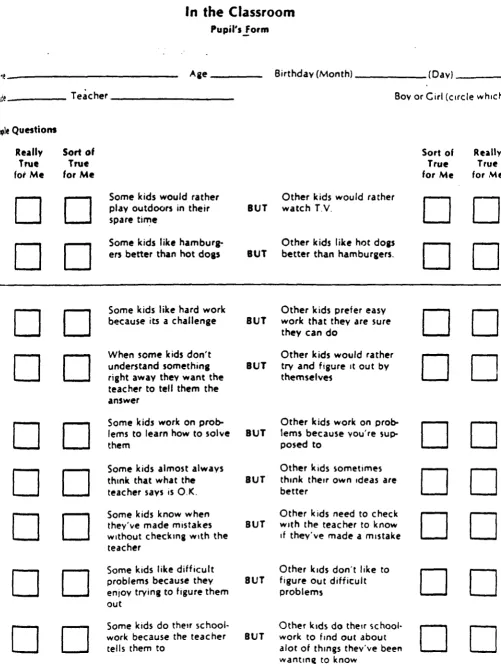
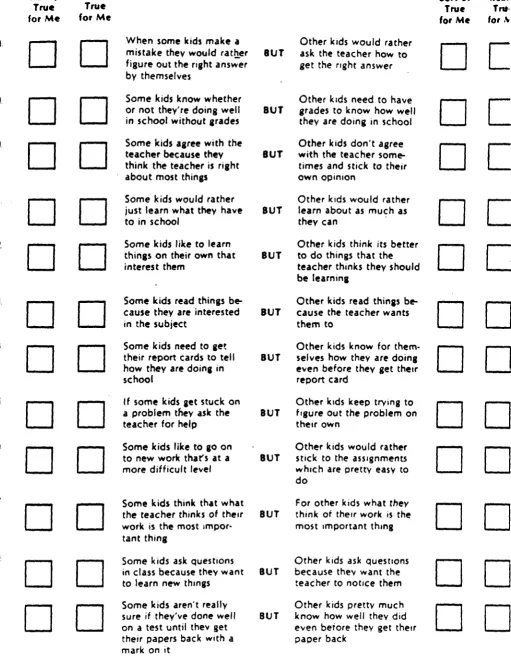
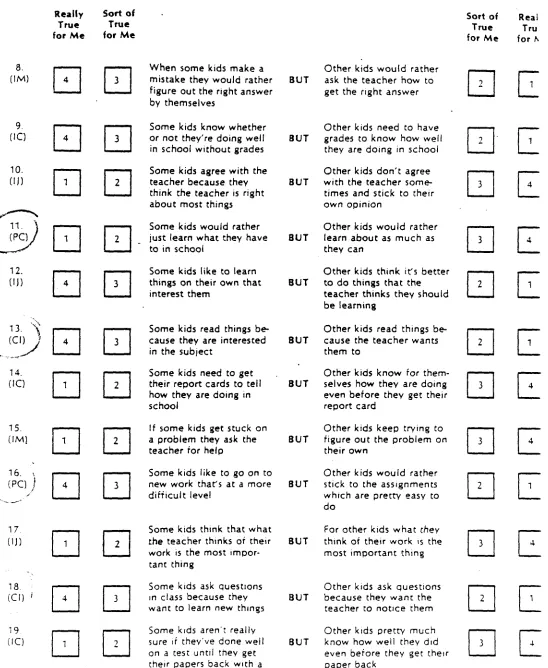
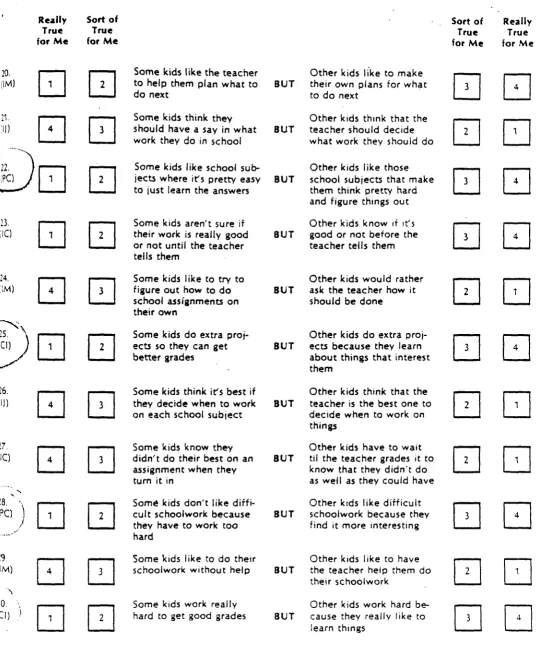
Scale of Intrinsic versus Extrinsic
Motivation in the Classroom... 88
Self-Perception Profile for Children... 90
Interview Questions for Teachers... 93
Interview Questions for Students... 93
Procedure... 95
Pre-test, Posttest... ... ... .... 95
Teacher Interviews... 96
Student Interviews... 97
Data Analysis... 98
Chapter Preference for Challenge and Incentive to Satisfy Curiosity... 98
Self-Perception of Competence... 99 Teacher and Student Interviews ... 1 0 0
IV
The Results 1 01Chapter V Discussion of the Results... 1 2 3
Summary of Results... 1 2 3 Discussion of the Findings for
Questions 1, 2 and 3... 1 2 5 Discussion of Findings from the Interviews... 1 3 6 Problems with Instrumentation... 1 3 8 Problems with Procedure... 1 3 8 Conclusions... 140 Recommendations for Further Research... 1 4 5
References... 1 5 1
Appendices... 1 7 1
A. Interview Questions for Teachers... 1 7 1 B. Interview Questions for Students... 1 7 2 C The Scale of Intrinsic Versus
Extrinsic Orientation... 1 7 3 D. Self-Perception Profile for Children ... 1 7 8 E Scoring Key for The Scale of Intrinsic
Versus Extrinsic Orientation ... 1 8 3 F. Scoring Key for the Self-Perception
AN ANALYSIS OF INTRINSIC MOTIVATION IN A SUMMER ENRICHMENT PROGRAM FOR ECONOMICALLY
DISADVANTAGED URBAN MIDDLE SCHOOL STUDENTS
STATEMENT OF THE PROBLEM
What effect does a summer school enrichment program have on students' intrinsic motivation? Do economically
disadvantaged middle school students become more intrinsically motivated after participating m a summer enrichment program? Does participation in a summer enrichment program enhance preference for challenge and curiosity as measured by a motivation scale? Does
participation in a summer enrichment program enhance perceived scholastic competence as measured by a self-perception scale?
This study attempted to determine whether intrinsic
motivation would, in fact, increase as a result of participation in the five week program which used instruction and
Students were pretested on two subscales of Harter's Scale of Intrinsic Versus Extrinsic Motivation and Harter's Self-Perception Profile in the first week and posttested the final day of the program. Harter's scales were designed to measure the variables of preference for challenge, curiosity, and scholastic competence and were developed for use with this age group. In addition, students and teachers were interviewed to identify specific program features and practices that enhance intrinsic motivation.
This study attempted to answer the questions: Can participation in a middle school summer enrichment program increase economically disadvantaged students' intrinsic
motivation? Can participation in a middle school summer enrichment program increase economically disadvantaged students' self-perceived scholastic competence?
PURPOSE OF THE STUDY
This study had four purposes. The first was to examine intrinsic motivation as a measure to assess the effectiveness of a summer enrichment program for economically
whether economically disadvantaged students' motivational orientation would move in the direction from extrinsic to intrinsic after attending a five week summer enrichment program. The third was to determine whether economically disadvantaged students perceived themselves as more
scholastically competent after attending a five-week summer enrichment program. The fourth purpose was to identify the specific programmatic features used to enhance intrinsic motivation and self-perceived competence in the program.
In examining intrinsic motivation as a measure to assess the effectiveness of the summer enrichment program, this study attempted to show a relationship between intrinsic motivation theory, research strategies to enhance intrinsic motivation, and the goals and practices of the program. According to intrinsic
designed to improve students' skills while motivating them to try difficult tasks. If the program is fulfilling its mission and meeting its goals, students' motivational orientation could be expected to move in the direction from extrinsic to intrinsic as a result of participating in the program. Students could also be expected to perceive themselves as more competent academically as a result of participating in the program. Changes in motivational orientation and competence may be influenced by specific strategies used to challenge students, stimulate curiosity, and foster competence in the summer
enrichment program.
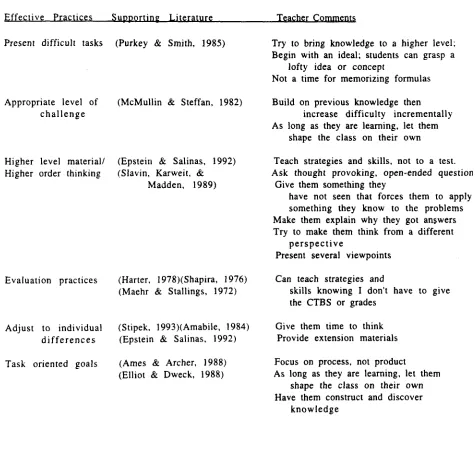
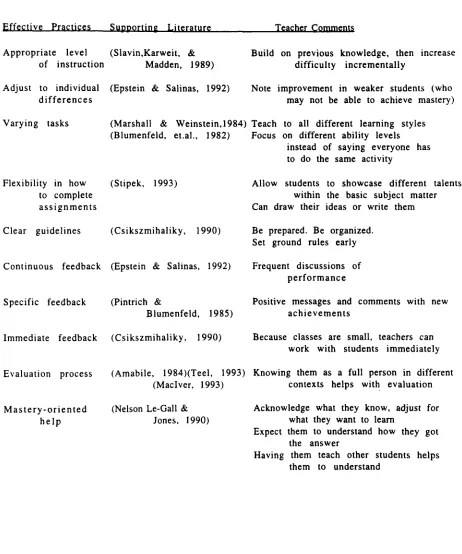
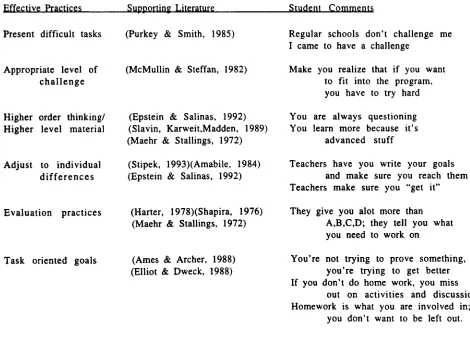
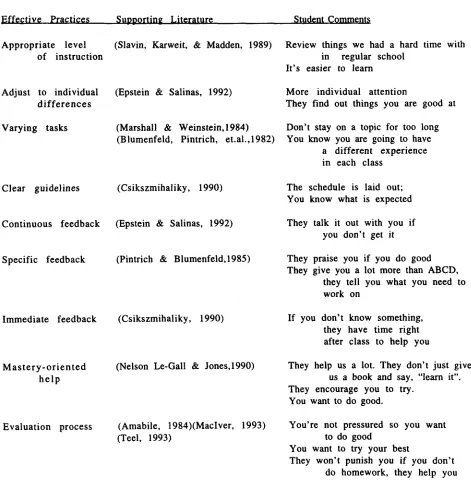
In order to mcrease self-perceived competence and motivation in the program's classes, teachers present difficult tasks in innovative ways to stimulate student curiosity and mcrease student willingness to attempt tasks. Students have flexibility in deciding how to complete assignments. Students
demonstrate their level of competence in written, oral, artistic, social, and organizational skills in a variety of ways such as written assignments, oral presentations, artwork, and group and individual projects. For example, sixth grade
neighborhoods, and design questionnaires to poll the residents of the neighborhoods. Students present the completed
projects by means of oral and written reports. Individually, students show survey results on the computer using tables or graphs. Teachers routinely discuss performance with students, giving specific feedback with the emphasis on strategies.
Students keep portfolios and receive a written evaluation at the end of the five week session.
The strategies used in the summer enrichment program were selected from the effective schools literature. These strategies include encouraging active student participation in challenging tasks designed around situations relevant to the student and presenting lessons with a novel approach
(Brophy, 1987). In effective schools, curriculum is designed to require students to use higher order thinking skills;
further, the curriculum is adjusted to individual differences
(Epstein and Salinas, 1992). Many of the strategies used in the summer enrichment program, such as having task-oriented goals, using a novel approach to introduce tasks, and adjusting to individual differences, are specifically related to the
The motivational, summer enrichment program used effective school strategies to challenge middle school students to improve their skills. This study investigated intrinsic
motivation as a means of evaluating the summer enrichment program. Specifically, this study examined whether
economically disadvantaged, urban middle school students would show a difference in preference for challenge, curiosity, and self-perception of scholastic competence after
participating in the program. Further, this study sought to identify instructional and evaluation practices used to enhance intrinsic motivation in the program.
DEFINITION OF KEY TERMS:
1. Economically disadvantaged: For the purposes of this study, economically disadvantaged, as defined by the summer
enrichment program administators, refers to students whose annual family income is below $35,000 per year.
3. High potential: In this study, high potential is defined by the two on-site directors of the summer enrichment
program based on information from the students' applications to the program and conversations with the students' parents and teachers. Students must meet one or more of the
following criteria to be considered high potential: ( 1) student values an education; (2) student lacks basic reading and
writing skills, but demonstrates higher cognitive skills such as integrating information and applying it to different situations; (3) student recognizes the possibility of learning from
experiences; ( 4) student functions adequately in school (gets promoted) but is bored by school; and/or (5) student has had positive school experiences.
4. Extrinsic motivation: In this study, extrinsic motivation refers to the propensity to engage in an activity for an
external reason or reward such as teacher approval or good grades.
5. Intrinsic motivation: In this study, intrinsic motivation refers to the innate, natural propensity to engage one's
and conquer optimal challenges. Such motivation emerges from internal tendencies and can motivate behavior even without the aid of extrinsic rewards or environmental
controls (Deci, 1985). For the purposes of this study, intrinsic motivation was measured by high scores on The Scale of Intrinsic versus Extrinsic Motivation in the Classroom.
6. Scholastic competence: Scholastic competence Is the perception of ability within the realm of academic
performance. In this study, scholastic competence was measured by high scores on the Self-Perception Profile for Children.
BACKGROUND AND NEED
The publication of a Nation at Risk (1983) created a widespread educational reform movement, with resulting improvements nationwide. Minority students, however, still lag behind the white population in percent of high school completion, standardized test score performance, and college attendance rates. By the year 2000, as many as one third of all children may be disadvantaged and at-risk for failure (Trevino, 1991 ). Due to the increasing numbers of minority and poor students, recommendations for future reforms have focused on improving education for the disadvantaged
student. The question remains as to what constitutes an effective program and how best to evaluate it.
Stricter standards and emphasis on traditional methods have not benefitted students at risk (Cuban, 1992). Proposed solutions, which include more time in school and more rigid academic requirements, are not producing the desired effect of improving grades and standardized test scores and
reducing drop out rates (Means, Chelemer and Knapp, 1991 ).
involving school structure, or the way instruction is delivered, such as varying and/or individualizing tasks (Blumenfeld, Pintrich, Meece and Wessels, 1982; Marshall and Weinstein, 1984 ), have been implemented with middle school students with varying degrees of success.
Recommendations for comprehensive changes in the way instruction is delivered to disadvantaged students are consistent with recent research on all adolescents, not just at-risk students. For many adolescents, the transition to middle school results in increased academic and behavior problems (Eccles, Midgley and Adler, 1984 ), a decline in motivation (Harter, 198la), and a decline in perceived competence (Eccles, et. al., 1984; Gottfried, 1985; Harter, 1992). Recent
studies suggest that changes in the learning environment, such as increased use of whole-class instruction and
decreased use of intellectually challenging material requiring higher level thinking skills, may explain the declines in
school-related measures associated with the junior high
school transition (Eccles, Midgley, Wigfield, Buchanan, Reuman and Mac Iver, 1993 ).
Meta-analyses have been used to identify common characteristics of effective programs for at-risk students.
thinking material for all learners including low achievers, (Epstein and Salinas, 1992; Slavin, Madden and Karweit, 1989), forming small groups to accommodate instruction to meet individual needs, and maximizing direct instruction (Slavin, et al., 1989). Other effective strategies include increasing
students' participation by using "hands on" learning
techniques and focusing on information relevant to students' personal interests and stage of development (Epstein and Salinas, 1992).
This summer program serving economically
disadvantaged middle school students in an urban area, incorporates many of the instructional practices identified as characteristics of effective programs. The enrichment
program uses an interdisciplinary curriculum based on themes designed to be relevant to the students' experiences.
Small class sizes enable the teachers to plan more individualized activities and be more adaptable to the needs of each student. Group problem solving is often used.
Teachers recognize the value of "hands on" learning as
assignment of being archaeologists and determining the culture of the inhabitants by studying artifacts. In other words, they inspect discarded materials in trash cans contributed by different households and try to decide the characteristics of the owners of the trash. Students choose one person to monitor the process, another to record, another to report. For each item, students go through a deductive reasoning process. Because there is no correct solution, there is no risk in trying out different ideas. Students are given the opportunity to use organizational skills, writing skills,
reasoning skills and oral presentation skills in an activity that interests them.
For this summer enrichment program, and for similar programs, success is often measured anecdotally by the enthusiasm of the students and the comments from teachers and parents. Variables such as high school completion rate and college attendance have been documented for a few alumni, but there have been no controlled studies or formal evaluations of the program.
interviews with students and teachers to assess effectiveness (Epstein, 1989; Richardson, Casanova, Placier and Guilfoyle, 1989). Other studies have used combinations of observation, surveys, and teacher reports (Teel, 1993; Springfield,
Winfield, Millsap, Puma, Gamse and Randall, 1994) in an attempt to measure student progress.
Program evaluation can focus on achievement measures such as grades or standardized test scores, or on affective measures, such as self esteem or attitude toward school. According to evaluation theory, the best measures are those which demonstrate that program objectives have been met. Evaluation depends on establishing clear goals. Some
programs aim to reduce the dropout rate; others target
improved grades, higher standardized test scores, or changes in self-concept or attributions.
The summer enrichment program in this study purports to be both a motivational and academic enrichment program which fosters competence in high-potential, economically disadvantaged middle school students. For the purposes of
this study, the focus was on assessing the motivational aspect of the program with emphasis on intrinsic motivation.
1. Intrinsic motivation explains observable behaviors.
2. Intrinsic motivation is an important variable In
assessing program effectiveness.
3. Intrinsic motivation can be related to teaching practices.
4. Intrinsic motivation can be measured.
Intrinsic motivation theory explains observable behaviors such as persistence in challenging situations, curiosity, and learning for its own sake. Intrinsic motivation theory explains the need for competence, how the competence motive develops with age, and what effects reinforcement, failure and socializing agents have on motivation (Harter, 1981 a). The challenge, curiosity, and competence components of intrinsic motivation theory were the focus of the study because the three components correspond with the mission of the summer enrichment program. The program attempts to provide economically disadvantaged middle school students with a challenging educational experience that fosters
Intrinsic motivation is an important variable to measure in assessing program effectiveness because intrinsically motivated learners employ useful learning
strategies. During the last decade, research in motivation has moved away from merely looking at students' performance in school to using other cognitive outcome measures (Schiefele and Csikszentmihalyi, 1993 ). These measures include use of learning stategies (Pintrich and De Groot, 1990), self-efficacy (Ames and Archer, 1988), and mastery behavior (Elliot and Dweck, 1988). Recent studies indicate a focus on intrinsic motivation which may be accounted for by a variety of factors. The pursuit of intrinsic rewards, such as a
self-directed desire to learn takes precedence over the pursuit of extrinsic rewards such as grades (National Council on
Education Standards and Testing, 1992). Society benefits from having graduates who are interested in learning and motivated to use their knowledge to initiate change (Sizer, 1992). The restructured workplace requires problem solvers with initiative who are able to learn new jobs and master new technologies quickly (Wagner, 1995). The intrinsically
Intrinsically motivated learners exhibit more
productive learning behaviors such as greater attention to task (Nichols, 1983) and the use of more complex cognitive strategies (Pintrich and DeGroot, 1990). Intrinsic motivation is an important component of students' choice about becoming cognitively engaged, that is, in using more cognitive strategies such as remembering, practicing, integrating information, and connecting new information to present knowledge. In one study (Pintrich and De Groot, 1990), 173 seventh graders who were motivated to learn the material and believed that their schoolwork was interesting and important reported they were
more likely to use more cognitive strategies in trying to learn and comprehend the material. Accordingly, because
correlational data cannot address causality, students who chose to become cognitively engaged were those who were interested in and valued the tasks they worked on in their classrooms.
because it may lead to more cognitive engagement m the day-to-day work of the classroom.
In addition to attention to task and cognitive
engagement, intrinsic motivation has also been related to creativity in problem solving (Amabile, 1984 ), enhanced conceptual learning (Benware and Deci, 1984 ), and cognitive flexibility (McGraw and McCullers, 1979).
In various studies with students ranging from
elementary to college age, Amabile ( 1984) determined that products such as solutions to problems, artwork, and writing were more creative, as judged by panels of teachers, artists, and writers in situations when intrinsic motivation was
encouraged. Intrinsic motivation was intentionally altered m the studies by variables such as rewarding students for
correct solutions, evaluating the task, creating competition, . and restricting choice. Based on the results of these studies,
Amabile recommended using extrinsic reward sparingly, using informational evaluation, and using individualized intruction to foster intrinsic motivation for greater creativity.
besides performance in school, may better assess desired learning outcomes. Engaging students, having them think and be creative, may require focusing on teaching practices that increase students' intrinsic motivation as well as practices that increase standardized test scores and grades.
Intrinsic motivation can be related to teaching practice in that specific techniques exist to enhance intrinsic motivation. Intrinsic motivation increases with task
complexity (McMullin and Steffen, 1982), as long as efforts can eventually lead to mastery (Harter, 198la). Students are
more likely to be intrinsically motivated when confronting tasks appropriate to their ability level for which goals are clear and feedback immediate (Csikszentmihalyi, 1990). Findings imply that in a school setting designed to promote challenge, intrinsic motivation would likely be enhanced by presenting complex tasks (higher order thinking) with success achievable for individuals (accomodation to individual
differences).
to g1ve students opportunities to develop competencies while maintaining intrinsic motivation are to vary and individualize tasks. When students do the same task at the same time, performance is more comparable and more public. Varying or individualizing tasks puts the focus on learning instead of performance relative to other students (Blumenfeld et al., 1982; Marshall and Weinstein, 1984).
Students are motivated to attempt tasks if evaluation is based on improvement, thereby giving everyone a chance to succeed (Mac Iver, 1993). An evaluation study was
conducted to determine whether the Incentives for
Improvement program raised students' performance levels and fostered their motivation to learn. Twenty three classes from four Baltimore city middle schools participated.
Throughout the year subjects were evaluated individually on the basis of meeting challenging goals. All students had a chance to improve their individualized base scores. Results showed significant improvement in grades, especially for at-risk students. The program also had positive impact on
students' perceptions of intrinsic value of the subject matter
and their self-concept of ability as measured by a twelve item
Classroom goal orientation also affects motivation which, m turn, affects learning strategies (Ames and Archer, 1988).
In a study of 179 junior high and high school students, the goal orientation of the class affected the learning strategies students used. In performance-oriented classes (only a few students get top marks), the focus was on ability and
comparison with other students. Students who perceived classes as mastery oriented (the teacher makes sure all
students understand the work, learn new things and
improve), were more likely to prefer challenging tasks, use more effective learning strategies, and view mistakes as part of learning. When students set their own mastery goals,
failure was an indication of the need for a new strategy.
Instruments to assess intrinsic motivation are
available. These include Harter's Intrinsic Motivation Scale (198lb), Gottfried's Children's Academic Intrinsic Motivation
Inventory ( 1985), and Ryan and Connell's Academic
Self-Regulation Scale ( 1989).
Gottfried's instrument, the CAIMI, consists of 122 items
with four subscales measuring intrinsic motivation in specific subject areas. The scale was developed using 141 white,
focus on subject areas, and population used for
standardization.
Ryan and Connell's 26-item scale focuses on students'
reasons for engaging in typical academic behaviors. The
instrument was standardized on approximately 750 students
in grades three through six in urban, suburban, and rural
elementary schools in New York. The Academic
Self-Regulation Scale was not chosen because of the focus on
perceived locus of control or autonomy and because the grade
levels did not include seventh, eighth, and ninth grades.
For this study, Harter's Scale of Intrinsic Versus
Extrinsic Motivation in the Classroom was used for three
reasons. First, it has fewer items than most scales, including
the CAIMI, making it easier to administer. The instrument
focuses on orientation toward learning in general, instead of
specific subject areas, and measures preference for challenge
and curiosity, both of which relate to this study. Finally, the
scale was developed on a wider (third through ninth grades),
more representative population in urban and suburban areas
in four states. The standardization group included both white
and nonwhite students from predominantly middle class
The Self-Perception Profile, developed by Harter, was
used to measure perceived scholastic competence. The
self-perception scale has the same question format as the Scale of
Intrinsic Versus Extrinsic Motivation. The self-perception
instrument was standardized on a similar population and has
been correlated with the intrinsic motivation scale.
In summary, studies on intrinsic motivation show
students are more intrinsically motivated in environments
that have features linked to increasing perceived competence
such as challenge, novelty, and evaluation based on intrinsic
rewards. Higher order thinking, innovative approaches to
tasks, and accommodation to individual differences have been
recognized as components of effective programs for
disadvantaged students in general and for the program which
is the focus of this study, in particular. The summer
enrichment program also stresses involvement, "hands on"
learning of relevant curriculum and ungraded evaluations of
student performance. Because many techniques and methods
used in the summer enrichment program for economically
disadvantaged students have been shown to enhance intrinsic
motivation, students participating in the program should
show higher levels of intrinsic motivation at the completion of
Of the existing instruments to measure motivation,
Harter's Scale of Intrinsic Versus Extrinsic Orientation in the Classroom was used for this study. Harter's scale focuses on intrinsic rather than achievement motivation, has fewer items than similar scales, and was developed for this age group. Harter's Self-Perception Profile for Children, used to measure scholastic competence, has a similar format and was
standardized on a similar population.
THEORETICAL RATIONALE
Effectance motivation theory (White, 1959), intrinsic
motivation theory (Deci, 1975), and a model of mastery motivation (Harter, 1981 a) contribute to the theoretical rationale of this study. Concepts and definitions from these
theories and models have developed into what ts now known as intrinsic motivation theory. This study was guided
primarily by intrinsic motivation theory, which explains
White ( 1959) first explained effectance motivation as an intrinsic need. According to White:
" ... the behavior which leads to competence is
continued . because it satisfies an intrinsic need to increase competence in dealing with the environment. The urge
toward competence is inferred specifically in behavior that
shows a lasting focalization and has characteristics of exploration and experimentation."
White suggested there is inherent satisfaction m exercising and extending one's capabilities. White referred to the energy behind this activity as effectance motivation and to the
corresponding positive emotion as the feeling of efficacy. Competence is the accumulated result of exploration and
learning.
According to White, effectance motivation subsides when a situation has been explored to the point that it no longer presents new possibilities. Interest wanes when action
begins to have less effect. In the cycle of effectance motivation to action and action to competence, novelty is effective in engaging interest and supporting persistent
behavior.
when students' natural curiosity and interest energize their learning. Deci and Ryan suggest that children are fascinated by novelty and their intrinsic curiosity leads them to explore and manipulate, and experiment in order to make the novel familiar.
Deci (1975) further developed the competence aspect of White's theory to include optimal challenge. According to Deci, the need for competence leads people to seek and conquer challenges that are optimal for their capacities. Competence acquisition results from interacting with stimuli that are challenging.
Harter ( 1981 b) conceptualized intrinsic motivation as
curiosity and an attraction to novelty leading an individual to seek out and master challenging tasks independent of
external reinforcement. Harter (1978) emphasized perceived
competence as important for effectance motivation. If
mastery attempts are optimally challenging and are successful, this leads to perceived competence and a
consequent increase in effectance motivation. In developing a model of effectance motivation, Harter confirmed five
To summarize White's and Deci's theories and Harter's model, individuals engage in tasks for the purpose of
developing competence and experiencing the positive feeling of efficacy associated with successful mastery attempts. Mastery attempts that lead to competence sustain the
competence motive. Efforts toward mastery are affected by novelty and curiosity, optimal challenge, and perceived competence.
Observations of infants lend support to the idea of a competence, or effectance, motive. From the first day of life, infants are inclined to practice newly developing
competencies; and practicing new skills is inherently
satisfying (Piaget, 1952). Infants' attempts at mastery are directed at affecting the environment in some way, that is,
feedback comes directly from the objects they manipulate. For infants, competency is defined by the task. As children get older they increasingly require feedback from other sources to decide whether mastery has been achieved. For older learners, competence, as defined by parents,
For young children, efforts toward mastery are affected
by the degree of challenge offered by the task (Pittman,
Boggiano and Ruble, 1983; Danner and Lonky, 1981). When
children are free to select the activities they prefer to work
on, they select ones that are just beyond their current level of
competence (Danner and Lonky, 1981). Children prefer to
work on tasks of intermediate difficulty when a reward is not
made contingent on their performance (Pittman, et al., 1983).
For older children, however, the tendency to prefer
challenging tasks gradually declines from third grade to sixth
grade, then rapidly declines from sixth grade to seventh
grade (Harter, 1981b).
Efforts toward mastery are also affected by the novelty
of the task. Infants look at and reach for novel shapes more
often than familiar shapes. Children in kindergarten, third
grade, and sixth grade ask more questions about novel and
uncertain illustrated stories than about familiar stories.
Laboratory research with children in nursery school through
fifth grade has shown the motivational effects of novelty
(David and Witryol, 1990). For older children, the tendency
toward curiosity declines from third grade to sixth grade,
then rapidly declines from sixth to seventh grade (Harter,
Perceived competence also affects efforts toward mastery. Younger children do not distinguish between effort and ability. Until age eleven or twelve, students assume that high effort leading to mastery indicates more learning and greater ability. The more individuals believe they have learned, the more competent they feel (Nicholls, 1984). For
adolescents, gains in performance do not always lead to feelings of competence. If others have achieved the gain more quickly or with less effort, older children feel
incompetent in spite of having obtained the same outcome (Nicholls, 1983 ). As a result, students in middle school
attempt to hide what they perceive as their lack of ability, or
competence, by not exerting effort or attempting tasks
(Covington, 1992).
For middle school students, beliefs about competence have an impact on motivational orientation manifested in the classroom (Harter and Connell, 1984 ). If students think they are doing well, they will be more likely to engage in
challenging tasks. Students' self-perception of their competence affects their intrinsic motivation.
competence also decline as students progress through elementary and middle school (Harter and Connell, 1984 ).
The most significant declines occur between sixth and seventh grade. Methods to reverse this trend are necessary if middle school education is to be effective in motivating students to learn.
Differences in instructional practices between
elementary and middle school are associated with declines in motivation (Anderman and Maehr, 1994). Changes in task
organization and type of evaluation in middle schools create an environment which undermines motivation. (Eccles, et al.,
1993 ). Field studies of middle schools that have more appropriate learning environments do not demonstrate the
same declines (Eccles, et al., 1993).
Learning contexts that provide optimal challenge and sources of stimulation (Deci and Ryan, 1985) and increase a sense of self-perceived competence (Gottfried, 1983) can enhance intrinsic motivation. Stipek (1993) suggests a way to
provide optimal challenge and enhance the sense of
competence in the school setting. Task differentiation, having
students work on different tasks at the same time, and varying the nature of tasks from day to day influences
Varying tasks also provides the opportunity to
challenge individual students at varying levels of difficulty.
According to intrinsic motivation theory, the need for
competence leads people to seek and conquer challenges that
are optimal for their capacities. Acquiring competence results
from interacting with stimuli that are challenging (Deci,
1975). Experiences involving an increase in skill level lead to
feelings of competence. Varying tasks reinforces the
tendency for students to seek challenging tasks to develop
new competencies (Dweck, 1986).
The way students are evaluated affects intrinsic
motivation. Deci's studies (1971) supported the hypothesis
that intrinsic motivation for an activity will decrease if
monetary rewards are given and if the rewards are made
contingent on performance. Later studies (Lepper, 1981)
found that using extrinsic rewards to reinforce activities of
initial interest might have detrimental effects on subsequent
intrinsic interest. Other studies have consistently reported
that extrinsic rewards do not have a positive effect on
intrinsic motivation (Ames and Ames, 1984; Butler and Nisan,
1986). When students' performance on a task is rewarded,
they choose easier tasks even though they have demonstrated
who focus on increasing their own competency, rather than on evaluation, seek more challenging tasks that provide
opportunities to develop new competencies whether they perceive themselves to have high or low ability (Dweck, 1986). Students evaluated on personal improvement, or m terms of a predetermined standard, perceive the grading system to be more responsive to effort (Covington and Omelich, 1984).
To motivate students, the summer enrichment program for economically disadvantaged students addresses the
challenge, curiosity, and perception of competence
components of intrinsic motivation. Teachers in the program
use innovative curriculum to stimulate interest, and complex tasks to challenge students to improve skills and develop
their perception of competency. Challenging experiences for students in the program include creative problem solving in math, hands on laboratory work in science, debating ideas in social studies, discussing controversial issues, and conducting
group projects in all subjects.
Teachers in the program establish a learning
clear guidelines for tasks and gtvmg continuous feedback help students to recognize improvement in performance.
Experiences involving an increase in skill level lead to feelings of competence. Teachers also give students opportunities to demonstrate competence in a variety of skills in a variety of
ways. Use of final written evaluations, based on individual performance, reinforces the value of attempting difficult tasks and mastering competencies.
The goal of the summer enrichment program for economically disadvantaged students is to use an innovative curriculum to provide challenging educational experiences in an environment which fosters competence. Aspects of the program such as varying tasks and eliminating grades are conducive to developing competence in students. The focus on learning, using an innovative curriculum with challenging tasks, fosters the curiosity and preference for challenge
RESEARCH QUESTIONS
In measuring economically disadvantaged students'
motivational orientation before and after participation in a
summer enrichment program, the study answered the
question: Does the motivational orientation of students m the
program move in the direction from extrinsic to intrinsic?
Specifically, after participating m a summer enrichment
program:
1. Do students prefer challenging work to easier
assignments?
2. Do students work to satisfy their own interest and
curiosity rather than to satisfy the teacher and get good
grades?
In measuring economically disadvantaged students'
perceived competence before and after participation in the
program, the study answered the question, after participation
m the program:
3. Do students perceive themselves as more
scholastically competent?
By interviewing teachers, the study answered the
4. Can teachers identify specific program features and practices which enhance intrinsic motivation?
By interviewing students, the study answered the question:
5. Can students identify specific program features and practices which enhance intrinsic motivation?
ASSUMPTIONS
This study is based on four assumptions. First, fostering the intrinsic motivation to learn and students' self-perceived competence should be goals of middle school education. Second, motivational orientation is modifiable; specifically, extrinsically motivated learners can move in the direction of
intrinsic motivation. Third, self-perceived scholastic
competence is modifiable; specifically, students can move m the direction of perceiving themselves as more scholastically competent. Fourth, intrinsic motivation and perceived
competence can be enhanced by a variety of techniques and
LIMITATIONS
Subjects were middle school students enrolled in a summer enrichment program in San Francisco. The
population represented one program in one geographic area.
Subjects were self-selected in that they demonstrated a willingness to participate in the summer enrichment program by completing the application and obtaining parental
permission to attend. Generalizations cannot be made to populations required to participate in similar programs.
Thirty six percent of the subjects were African-American and 24 percent were Hispanic. Reported family mcome was below $35,000 per year for 93 percent of the
participants. Results cannot be generalized to other economically disadvantaged, minority populations.
Some of the participants could not be classified as economically disadvantaged by the operational definition (7 percent report annual family income over $35,000).
Data were collected at the beginning and end of a five-week period, during which students participated in the
may not have been sufficient time to compensate for attitudes and perceptions developed over seven to nine years in school.
IMPLICATIONS
This study addressed four needs:
1. the need to evaluate programs using measures other than standardized test scores and grades.
2. the need to develop intrinsic motivation in middle school students, particularly economically disadvantaged, minority students.
3. the need to develop self-perceived competence in economically disadvantaged middle school students.
4. the need to target techniques which foster intrinsic motivation and self-perceived competence.
This study contributed to research which focuses on affective rather than achievement variables to determine program effectiveness. Specifically, this study offered a new way of evaluating programs by using change toward intrinsic
This study contributed to the research examining components of intrinsic motivation such as preference for challenge, curiosity, and perceived scholastic competence as desired outcomes. The study added to the knowledge of classroom strategies and practices that may enhance intrinsic motivation and self-perceived competence. Developing
intrinsic motivation and self-perceived competence can serve as guides for selecting effective classroom strategies.
To some extent, this study contributed to understanding of effective teaching strategies for economically
disadvantaged, minority students. Further investigation
would involve applying the strategies implemented in the summer enrichment program to a similar population which is
CHAPTER II
REVIEW OF THE LITERATURE
Introduction
This literature review is divided into three sections: intrinsic motivation, self-perception of competence, and
effective teaching techniques and practices related to intrinsic motivation and other affective variables of middle school students in general and disadvantaged students in particular.
The studies from the motivation literature are limited to intrinsic motivation to learn in school settings or with school related variables. The motivation literature emphasizes the aspects of intrinsic motivation measured in this study:
preference for challenge and curiosity.
The self-perception of competence literature describes the developmental trends in self-perception of competence. The relationship between self-perception of academic
competence and intrinsic motivation is investigated. The literature on effective techniques and practices includes studies with the general middle school population as
developmental needs of adolescents. The focus is on methods which contribute to affective variables such as students' preference for challenge, curiosity, and self-perceptions of competence.
Research on Motivation
Preference for Challenge
White ( 1959) first explained effectance motivation, the exploratory behavior leading to competence, as an intrinsic
need to master the environment. White suggested there is inherent satisfaction in exercising and extending one's capabilities. However, effectance motivation, the energy behind this activity, subsides when a situation has been
explored to the point that it no longer presents new possibilities or challenges.
White's model lacked operational definitions making it difficult to test empirically. This led Harter to expand on the theory to give it explanatory value and predictive power.
Based on studies demonstrating children's pleasure in completing difficult tasks (Harter, 1974; 1978), Harter developed a model of effectance motivation which included the concept that an optimal degree of challenge would
an attempt to develop measurable variables to support this model, Harter confirmed five dimensions of intrinsic
motivation (1981 b). One is preference for challenge, that is, the tendency to perform harder rather than easier work assigned by the teacher.
Preference for challenge is demonstrated in various studies with different age groups. Harter (1974) examined the relationship between the amount of challenge presented by the task and the degree of pleasure experienced through success. As fifth and sixth grade subjects successfully solved an
anagram task, pleasure was measured by smiling behavior. A positive relationship was obtained between the level of
difficulty of the task and pleasure.
Danner and Lonky ( 1981) showed that children preferred tasks which allowed them to practice newly developing skills.
Ninety 4 to 1 0-year-old children in kindergarten, first, second and fourth grades in a midwestern community were given
with the tasks that were one step ahead of their pretested level of classification skill (z=6.79, p<.01; z=7.00, p<.01; z=6.08, p<.01).
McMullin and Steffen ( 1982) found similar results with college students. For 22 University of Cincinnati
undergraduates, working on puzzles of accelerating difficulty resulted in more subsequent intrinsic motivation than when
the difficulty level remained constant. Results of a 2-way ANOV A, using a matched control group, indicated students who had an accelerated standard spent more time playing the game in a subsequent free-choice situation (p<.05) and made more guesses (p<.001) than students with a constant standard. The researchers interpreted higher number of attempted guesses and more free-time play as evidence of greater intrinsic
interest in the task.
The findings suggest that moderately difficult tasks are
preferred and are more intrinsically motivating. Easy tasks will not give students who complete them a feeling of
developing competence. Once a new skill has been mastered, engaging in the activity no longer results in feelings of
increasing competence, and the activity ceases to be
competence, and will not be motivated to continue to engage m the task.
In a study with elementary school children (Harter,
1978), the range of task difficulty was extended to four difficulty levels. The results indicated a positive linear relationship between smiling and task difficulty for the first three levels only. The initial positive relationship was not obtained at the most difficult level. Subjects were also asked to rate perceived difficulty on a four-point scale for each item. When pleasure was examined as a function of perceived
difficulty, a positive linear relationship was obtained between perceived difficulty and smiling except for the items judged very hard. Smiling dropped off dramatically for the most challenging items. Subjects' responses to inquiry data
supported the idea that they enjoyed problem-solving efforts
more on items that were challenging, but not excessively difficult. The data suggest that a curvilinear model may best describe the relationship between pleasure derived from
success and difficulty level.
Danner and Lonky found the same curvilinear
relationship in a study of 4 to 10-year-olds. In comparisons of
1981 ), students rated the centers one step ahead of their level as most interesting (p<.001). For all three levels the quadratic trends of an inverted U relationship between interest rating and difficulty rating were significant (p<.05). Very easy tasks
and very difficult tasks were considered less interesting. The findings that students displayed more intrinsic interest in moderately difficult tasks may be significant in the school setting. Typically, low-achieving students claim to be less intrinsically interested in schoolwork than high-achieving students (Harter, Whitesell, and Kowalski 1992). The difficulty level of the tasks may explain students' lack of intrinsic
interest and may also explain lack of motivation in situations
which students view as too easy or too challenging.
Miller (1985) demonstrated how describing a task as difficult can enhance students' effort. He gave sixth-grade children a series of matching tasks that were constructed in such a way as to assure failure. Following this failure, behavior was carefully observed. Children who were told that the
subsequent task was moderately difficult completed fewer anagrams on the next task than children who were told that
the anagram task was very difficult.
described as moderately difficult (Miller, 1986). Boys quit trying in this situation. Miller suggests that trying while doing a moderately difficult task was threatening because failure would indicate low ability. Telling the boys that the task was very difficult allowed them to try hard without risk.
The performance of seventh-grade girls was affected by previous failure experiences in a different way. When a task was described as very difficult, girls gave up. Miller suggested that girls interpreted previous failure as evidence of a lack of ability and did not believe that effort on the subsequent task would lead to success. Boys attempted to maintain a
perception of competence while girls gave up.
The preceding studies suggest that, in most situations, students prefer moderately difficult tasks which present a challenge. In a school setting, however, students'
self-perceptions of competence and ability may interfere with risk-taking behavior, causing students to avoid challenges.
Students' negative self-perceptions of competence and ability help explain the steady declines in preference for challenge as students proceed through upper elementary school through middle school (Harter, 1981a).
setting. Studies have supported the idea that a task or mastery
orientation in the class is associated with moderate risk taking and willingness to engage in challenging tasks (Elliot and
Dweck, 1988; Ames and Archer, 1988). Studies also show that evaluation practices influence students' preference for
challenging tasks (Deci, 1971; Lepper, 1981 ).
In one study regarding orientation (Elliot and Dweck, 1988), children who were task-oriented were more likely than performance-oriented children to select a task described to them as difficult but that would promote skill development. Most performance-oriented students selected a task that would not teach them anything new but would demonstrate
competence. One hundred and one 5th graders from semi-rural schools were given feedback that they had high or low ability for a task. Students were given a choice of task
the learning goal condition. In the performance goal condition, 66% chose the task which would demonstrate their competence.
In another study (Ames and Archer, 1988), students who perceived their classrooms as mastery-oriented (focusing on all students learning) claimed they would prefer projects that would be difficult, but result in new learning, over easy projects.
While some recent studies have addressed student and
classroom orientation to task, most research on practices which enhance intrinsic motivation has focused on investigations of rewards on motivation. Until 1972, hypotheses about the effects of extrinsic rewards on intrinsic motivation had been tested but there was little definitive empirical evidence. Deci's studies supported the hypothesis that intrinsic motivation for an activity would decrease if rewards were given for the activity, and if the rewards were made contingent on
performance.
session, the experimenter left to observe the subjects and
record the amount of time they spent on the targeted activity during this period when they were free to do what they
wished. Motivation, as measured by time on task, decreased for the experimental group during the third session while it increased for the control group.
In a similar controlled field experiment (Deci, 1971 ), the results were the same and the effects were still evident during the eight week follow-up after payment stopped. Subjects were newspaper headline writers who, unaware of their participation, were observed for 16 weeks. During the first 4
weeks, baseline measures of intrinsic motivation were taken. During the eighth, ninth, and tenth weeks intrinsic motivation was assessed. A final measure was taken during the 15th and 16th weeks.
The results led to the conclusion that if a person later received an external reward (in this case, money) for an
activity that was originally intrinsically motivated, the degree of intrinsic motivation to perform the activity decreases. Deci's experiment is often cited as evidence for the negative effects of reinforcement on motivation.
challenging tasks (Harter, 1978; Shapira, 1976). In one study, for example, some children were offered an extrinsic reward for correct answers and others were not. Subjects who were offered extrinsic rewards chose significantly less challenging problems than subjects who were not offered rewards for correct answers (Harter, 1978). Under the reward condition, children were less likely to select difficult problems.
Similarly, in a study using college students, Shapira
(1976) found that subjects in "no pay" conditions chose tasks of more than intermediate difficulty. Sixty undergraduates were given puzzle tasks of varying difficulty. Subjects were assigned to a paid or unpaid condition. When difficulty level of choice was compared using the Mann-Whitney U, significant
differences were found (U=lll.5, p<.001, two-tailed test), thereby supporting the hypothesis that unpaid subjects would choose more difficult tasks. Subsequent interviews with the subjects confirmed that subjects being paid chose the tasks
which would maximize the chances of getting more money. Most laboratory research on practices which enhance intrinsic motivation has dealt with investigations of rewards. In school settings, the same types of experiments have been used with evaluation practices. Research suggests that
they are concerned about external evaluation such as grades (Maehr and Stallings, 1972; Harter, 1978; Pearlman, 1984; Hughes, Sullivan, and Mosley, 1985).
Evaluation and task difficulty were relevant factors in a study by Maehr and Stallings (1972). Thirty-two eighth-graders were given easy and difficult forms of a 1 0-item task. Also included was a three-item assessment of continuing motivation measured by willingness to take an alternate form of the test on a subsequent occasion. Students were told either that the results of a task they were given would be reported to the teacher, or that the task was "just for fun."
With the continuing motivation score as a dependent
variable, a significant effect was found for the difficulty by evaluation interaction, F(l ,28)=4.24, p<.05. Students who believed their score would be reported were more interested in doing a subsequent easy task. Students who were told that the task was for fun were more interested in doing a subsequent challenging task. In other words, students showed continued interest in difficult tasks in the "just for fun" condition.
they were playing a game preferred optimally challenging
problems, while students working for grades chose significantly easier anagrams to perform. In the graded condition, subjects also verbalized more anxiety and expressed less pleasure when they solved a problem.
Pearlman ( 1984) found that rewards made contingent on success inhibited students from selecting challenging tasks. Six hundred and twenty four sixth-graders from public schools were divided into contingency and non-contingency groups. The group rewarded for correct solutions and penalized for incorrect solutions to a task, was more likely to choose easier problems than the group with no rewards or penalties.
Hughes, Sullivan, and Mosley ( 1985) report that teacher evaluation may inhibit intrinsic interest in a difficult task. Two hundred and fifty 5th-grade students were given two
difficulty levels of a word-search activity. Students were told that their scores would either be reported to their teacher or would be confidential. Continuing motivation was measured by immediate return to an alternate form of the task. The proportion of subjects returning to the task was significantly
interaction of difficulty level and evaluation resulted in a
significant effect F(l,242)=9.08, p<.005. Only 27% of subjects
assigned to the hard version under teacher evaluation
returned to the task compared to 52% assigned to the easy
versiOn, F(3,242)= 17.07, p<.Ol. Students who were told that
their performance on a difficult task was confidential were
more likely to return to a difficult task voluntarily than
students who were told that their performance would be
reported to their teacher. Teacher evaluations did not
negatively affect intrinsic interest for easy tasks.
In summary, the review of motivation literature
pertaining to preference for challenge indicates that, in most
situations, students prefer moderately challenging tasks.
Students report greater interest and exert more effort when
tasks are not too easy nor too difficult.
Preference for challenge has been shown to decline as
students progress through school. The literature indicates that
evaluation practices may explain these declines. External
rewards and evaluation undermine preference for challenge as
do students' negative perceptions of their ability.
Research suggests ways to enhance intrinsic motivation,
specifically preference for challenge, in school settings.
than performance and evaluation are more conducive to student effort and risk taking behavior.
Incentive to Satisfy Curiosity and Interest
The second measure of intrinsic motivation used in the study was curiosity. Theorists and researchers focusing on curiosity (White, 1959; Berlyne, 1966; Deci and Ryan, 1975)
propose that curiosity leads to exploratory behavior and pleasure is derived from activities and events that provide surprise, incongruity, and complexity.
White (1959) first proposed that attempts to satisfy
effectance motivation contribute to feelings of interest. Interest sustains day to day actions, particularly when tasks have continuing elements of novelty. The effectance
motivation approach assumes that a novel stimulus offers a challenge which the individual attempts to process or
understand.
Pleasure is assumed to derive from creating,
investigating, or processing stimuli that provide an optimal level of curiosity. Stimuli that are not at all discrepant or novel
from the individual's expectations will be ignored or cause anxiety (Berlyne, 1966).
Berlyne and Frommer's study with 144 students from first, third, and fifth grades ( 1966), provided evidence that certain variables such as incongruity and complexity lead to inquiry behavior. Subjects were exposed to materials
representing four categories of curiosity: incongruity, amount of information, uncertainty, and surprisingness. In each category, there were two stimulus items, one expected to generate conceptual conflict (plus) and one not (minus). An analysis of variance revealed a significant effect of age
(F=ll.76, df=2,96, p<.001) as well as a linear trend in a positive direction as they get older. More questions were evoked by plus items (F=30.82, df=1,96, p<.001) over all grades. The authors concluded that the study provided evidence that novelty, incongruity, and surprisingness make children more inclined to ask questions.
Allender, as a result of a study to describe children's
inquiry responses to a task ( 1969), concluded that middle elementary school children will engage in independent inquiry activity. Fifty-one 4th, 5th, and 6th grade students were