Paper: CB
Web-based company directories: A case
study with IT industry
Umakant Gupta and K.T. Anuradha NCSI, IISc, Bangalore 560 012
Abstract
The World Wide Web (WWW) is a popular platform for delivering
digitized information. All types of information sources are
available on WWW such as primary sources (e-journals),
secondary sources (bibliographic databases) and tertiary sources
(directories). Web-based information sources have some specific
features compared to other forms (print, CD-ROM). In this paper
we have discussed the steps involved in setting up a web-based
company directory of Information Technology (IT) industry.
As the first step, a few important web-based company directory
services are analyzed. Based on the analysis, meta tags, indexing
and search features required for effective web-based company
directory service are defined. About 50 company web pages related
to IT industries are retrieved by surfing the Net. The collected
information is compiled and mounted as a MYSQL database.
PERL is used to access the database. The sample directory has
1
Introduction
The World Wide Web (WWW) is a popular platform for delivering digitized information. It allows users to access the information services easily, but the users face the challenge of finding and using information that is accurate and reliable. Browsers such as Netscape and Internet Explorer have demystified the Internet, and made its contents accessible to users who have minimum technical expertise. Consequently, the notion of the Internet as a virtual library available at the click of a mouse is becoming increasingly attractive, particularly to libraries with limited resources and small collections. On the web all type of sources are available like primary sources (E-Journals), secondary sources (Bibliographic databases) and tertiary sources (Directories). However, using the web to access accurate and reliable information is a complicated proposition
.
2
What are Company Directories
Company directories are sources that are defined as a list of companies arranged systematically, usually in alphabetical or classified order giving details such as address, phone number(s), key persons, financial and product information.
to the general public in terms of cost and availability. Another result is the new features that have been added which respond to the possibilities provided by the new technological environment.
3
Locating the Company Directories on the Web
There are many company directories available on the web, some are freely available and some are on subscription basis. Following is a sample list of web -bas ed company directories.
a) Hoover’s Online
http://www.hoovers.com/company/dir/0,2116,4798,00.html
b) Corporate Information www.corporateinformation.com c) Thomas Register www.thomasregister.com
d) Kompass www.kompass.com
e) Lycos Companies Online www.companie sonline.com f) AllBusiness.com www.comfind.com
4
Analysis of Web-Based Company Directories
To judge the impact and reliability of web -based company directories, first three sites are chosen for comparative analysis. These web-based company directories are evaluated both as web sites and informational databases. Here are the some categories chosen for this analysis with examples of types of questions asked during the assessment.
4.1 Authority: Who is responsible for this information? What is the authority/expertise of person or group who created the site?
4.2 Accuracy: How reliable and accurate is the information and data source? Is it clear who has the ultimate responsibility for ensuring accuracy?
4.4 Currency: When was the information created and when is it updated? Are the links up to date?
4.5 Coverage: What is the extent and depth of the information? If there are print equivalents, does the coverage differ?
4.6 Accessibility: How easy/difficult is it to access the site? How easy/difficult is it to find information? How flexible are the searching options?
4.7 Search Features: Which types of search features are provided by the directories?
4.8 Browsing Features : Is the browsing features provided by directories? If yes, then through which fields browsing facility is available.
4.9 Help: Is the help facility is available? Is it user friendly?
The following table shows the comparative analysis of web-based company directories.
Company Directories
Authority Currency Coverage Contents Accessibility
Hoover's Online Provides information about sponsor No information 15,000 (companies all over the world) Exhaustive information Free & subscription Corporate Information ,,
Directories search search Hoover's
Online
And Yes Name, Co.keywords people, news ---
Yes(five approaches)
No
Corporate Information
And, or No Name, ticker Region, categories Automatic truncation Thomas Register And,or, not
Yes Name, brand, product or service
No No
Company Directories Exact match Advanced search Help
Hoover’s Online Yes Yes (only for members) Yes(not examples) Corporate Information No No Yes(with examples)
Thomas Register Yes No No
5
Features of Web-Based Company Directories
On the basis of analysis, following features of web -based company directories are defined:
5.1 Meta Tags (Content Information)
Ø Contact Information: Company name, Contact person, Full address of
the company, E-Mail address, Phone number, Fax number, Toll free number.
Ø General Information: Number of employees, Year established, Symbol. Ø Description (Activities of Company)
Ø Web site: Home page address, Products/services, Downloads, Site
search (with link)
Ø Key persons: Chairman, President, Chief Financial Officer, Secretary. Ø Financial Information: Market Capitalization, Sales and Rate of
Growth, Annual Report, Stock Chart, Earnings / Dividends, Currency, Fiscal Year Ends.
Ø Top Competitors.
5.2 Indexing Features
According to ANSI, “An index is a systematic guide to items contained in, or concepts derived from, a collection. These items or derived concepts are represented by entries arranged in a known or stated searchable order, such as alphabetical, chronological, or numerical.”
To provide proper guidance to find out the required company information, approaches should be provided by company direc tories through company name, ticker, company category, products or services, region. The following features are also considered to fulfill these approaches.
Ø Use of product and service catalogues to standardize the product and service headings.
Ø Provide hierarchical relations among the products and services headings. Ø Index the company name in as many ways as possible.
5.3 Search Features
Following search features should be available in the company directory: Ø Boolean searches.
Ø Feedback searches. Ø Exact matching.
Directories should also support browsing features through categories of company, region as well as the first alphabet of company name so that users can easily find the required company.
6
System Design
6.1 Collect the Required Metadata
To create any database, metadata is required. In this study, the web is used as an information source (company web site and other sources) to collect the required company data such as company name, key persons, financial information, products and services.
6.2 Classify all IT Companies
Classification of IT companies has been made to provide the searching and browsing facility through particular class of the companies. In this study nine broad categories of the IT companies are identified and each category is again classified into subcategories. The following is the list of broad categories:
1) IT Service Providers. 2) Software Products. 3) Hardware Products. 4) Associations & Agencies. 5) Education & Training. 6) Manufactures & Distributors. 7) Internet.
8) Publications.
9) Telecommunication.
6.3 Database Design
MYSQL, a SQL (Structure Query Language) database server that is in public domain, is used to create company database. MYSQL is a client server implementation that consists of a server daemon mysqld and many different clients, programs/libraries.
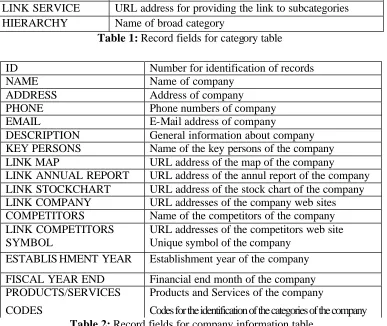
subdivisions) including one table for company information are created under the database “directory”. The structure of all the category tables (twenty-two tables) is the same. An example of category table is given below. The following example shows the record fields for the IT Services category and company information.
ID Number for identification of a particular record CODE Number for identification of group of subcategory SERVICE Name of subcategory
LINK SERVICE URL address for providing the link to subcategories HIERARCHY Name of broad category
Table 1: Record fields for category table
Table 2: Record fields for company information table
6.4 Search Interface
Using PERL and CGI the user interface is created for searching and browsing of the database. The search can be done by company name, products and services or category and this search can be restricted by country and browsing can be done by category of the company and first alphabet of company name. The database supports truncation and search is case insensitive in nature.
ID Number for identification of records
NAME Name of company
ADDRESS Address of company PHONE Phone numbers of company EMAIL E-Mail address of company
DESCRIPTION General information about company KEY PERSONS Name of the key persons of the company LINK MAP URL address of the map of the company
LINK ANNUAL REPORT URL address of the annul report of the company LINK STOCKCHART URL address of the stock chart of the company LINK COMPANY URL addresses of the company web sites COMPETITORS Name of the competitors of the company LINK COMPETITORS URL addresses of the competitors web site SYMBOL Unique symbol of the company
ESTABLIS HMENT YEAR Establishment year of the company FISCAL YEAR END Financial end month of the company PRODUCTS/SERVICES Products and Services of the company
7
References
1. ARMSTRONG (Chris J.). Database Quality Criteria.
Gopher://ukoln.bath.ac.uk:7070/00/BUBL_Main_Menu/H/H2/H2C28/H2C280
02_Database_Quality_Criteria
2. GRASSIAN (Esther). Thinking Critically About World Wide Web Resources.www.library.ucla.edu/libraries/college/instruct/critical.htm
3. Devshed-Mysql. www.devshed.com/Server_Side/MySQL