Book review: The Natural History of Burnet Moths, Part I
G
erhardM. T
arMann11 Naturwissenschaftliche Sammlungen, Sammlungs- und Forschungszentrum der Tiroler Landesmuseen, Krajnc-Straße 1, A-6060 Hall, Austria; [email protected]
http://zoobank.org/FBBF5F94-E71C-40D2-A9D3-7634273B502E
Received 5 August 2016; accepted 15 August 2017; published: 11 November 2017 Subject Editor: Maria Heikkilä.
Preamble. Exactly three weeks have passed since I spotted the parcel with “The Book” in the foyer behind
the entrance door. I had just returned from a five-week field trip to Liguria and Catalonia and was in the best mood. In this emotional moment, after having opened the parcel and seen it for the first time, I thought:
‘Praised be this day! Here it really is! “The Book”!’. These hardcover bound 630 pages with their 3.2 kg
weight meant a lot to me. They are not only the first part (of three) of another book on burnet moths, they are a
piece of the souls of two of my best friends and colleagues both of whom dedicated their lives to the study of Zygaenidae, like myself, and have put all their knowledge and that of many colleagues, friends and supporters together in an impressive monograph on the life history of the Zygaeninae, the burnet moths, the best known
subfamily of this almost mystic group of Lepidoptera.
I had been asked to write a book review for Nota Lepidopterologica earlier and started to read almost
imme-diately. A day later I was not only full of excitement, I was also irritated and emotionally at rock bottom. Too many personal remembrances had mixed with admiration and respect for how such a work could ever have
been written. Only one year ago I had been on a wonderful field trip together with W. G. ‘Gerry’ Tremewan in Italy. We lost Gerry on 1 October 2016 just after Axel Hofmann had managed to show him the first chapters
of their book ready for print. That he will never be able to see the now published printed version is really tragic. However, at least he had had the satisfaction to know this work was in the skillful hands of Axel and
the knowing English editorship of Adrian Spalding, another old friend. During this last field trip to Italy in 2016 Gerry had talked about this book much more than he had on all earlier trips during the 20 years that we
had had together. Every time he spoke about this work he was so full of vivacity and joy that even my own
field work seemed almost irrelevant. It was always the search in the field for the authentic observation that
can only be found by continous personal experiences, exact documentation and meticulous comparison of
facts that Gerry emphasised. He saw taxonomy more as a necessary burden that has also to be dealt with but his heart beat for the life history, genetics, distributional patterns and ecological phenomena. Gerry had found
a congenial joint author in Axel Hofmann, who compiled an enormous amount of information from his and
friends’ own experiences and combined it with all Gerry’s knowledge to create the manuscript, illustrated it with thousands of figures and pictures and finally skilfully edited and laid out the whole book.
It has taken me three weeks to recover from my feelings but this morning (it is the 26 July 2017), when an icy north-east wind of a rainy summer day in the Alps shook my window and the snow could be seen on the
Gerhard M. TarMann: Book review: The Natural History of Burnet Moths, Part I
204
this remarkable book project on burnet moths and which will hopefully enlighten those who are ready and sensitive enough to read themselves deeper into “The Book” that is, without any doubt, a milestone in ento
-mological literature. For me it is not only a personal honour to be allowed to comment on it but also a great challenge. Knowing that I can hardly do justice to this outstanding work and can only do my best considering the shortcomings of a reader who has never dealt with burnets in such depth and is mainly working on other
subfamilies of Zygaenidae, I hope to be able to find the right words to inspire readers to enjoy “The Book” (Fig. 1) with all its unique authentic information and beautiful pictures.
Axel F. Hofmann and W. Gerald Tremewan (2017): The Natural History of
Burnet Moths (
Zygaena
Fabricius, 1775) (Lepidoptera: Zygaenidae). Part 1.
Proceedings of the Museum Witt Munich 6 (1). Munich and Vilnius. 631 pp.,
4663 figures (distribution maps, colour figures, black and white genitalia
figures), 73 tables. Hardback. ISBN 978-3-940732-32-3. Price: 150 €
*.
This book is the first part of three on the natural history of Zygaeninae (Burnet moths). The world’s two most renowned specialists on this group W. Gerald Tremewan (Great Britain) and Axel F. Hofmann (Germany) have combined the results of their life-long studies and produced a breathtak-ing opus that will without doubt significantly influence all further work on Zygaenidae. The book
is dedicated to the two sons of the authors as a symbol to the fact that without the huge support of their families neither the compilation of all the information that is summarised in this book nor the years of production would have been possible.
As acknowledged in the first foreword by Roger L. H. Dennis, the authors, both travellers,
explorers and scientists, have achieved an exceptional result in summarizing their dedicated life’s
work. This book is a culmination of many papers and many journeys, with unselfish scientific
comradeship, integrity and respect for the natural world.
The author of the second foreword, Günther Ebert, himself an experienced author, explorer, traveller and field worker, is impressed by the easy way such immense projects can come to
frui-tion if the right persons come together. After an especially enjoyable collecting day in Morocco in the vicinity of Djebel Ayachi in 1989, both authors were sitting over a good cool bottle of rosé wine at their campsite near Midelt in the High Atlas when the idea to write a book on the natural history on burnet moths was agreed upon between them.
The book starts with a preamble that gives the reader a good impression of the long journey
from the first idea to the final result. Ups and downs, joy and difficulties in the field, dangerous expeditions, meetings with exceptional friends and supporters, always with the final goal in their minds, the authors claim that they only could manage to finish the book within about a quarter of a century due to modern computer- and phototechnology. What an understatement! Alone the
in-credible expeditions of Axel Hofmann to Afghanistan in the last years to clear a few still unknown biologies of rare burnets give us an impression with what dedication the authors followed their agreed goal. The preamble ends with the hope that the reader will have as much pleasure with this
book as the years of fieldwork, research and compilation of the typescript gave to the authors.
Figure 1. Cover of the book.
Two and a half pages of acknowledgements show how much knowledge is combined in this book. Many of the supporters have passed away in the meantime but their contributions will re
-main and most of them would be proud to see that they are present in this book. Each chapter starts with a beautiful double page colour plate.
In the first chapter an overview, with abstracts on the content of all three parts of the whole work, is given after a short introduction. In 22 chapters (1–8 in part I and 9–22 in part II) information on
all relevant contents such as the origin, phylogeny, systematics, distribution, zoogeography, mor
-phology, variation, life history, phenology, reproductive biology, genetics, biochemical specialties, aposematism, mimicry, predators, parasitoids, and conservation of burnets is given. Part 3 of the
book deals with the burnet species one by one in detail. Here all the field and rearing observations
of the authors including the information that they received from others are summarised with spe
Gerhard M. TarMann: Book review: The Natural History of Burnet Moths, Part I
206
Chapter two deals with the origin, phylogeny, outgroups and systematics of the subfamily Zy-gaeninae starting with a close up photo of the first fossil zygaenid specimen that has been published,
Zygaena miocaenica Reiss, 1936. All well preserved fossil Zygaeninae are figured. Phylogenetic
relationships are discussed and graphically explained and the distributions of all Zygaeninae genera are shown in colour maps. This is followed by a beautiful double page colour plate of water colour
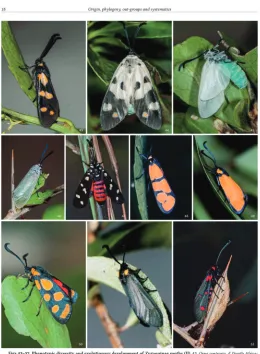
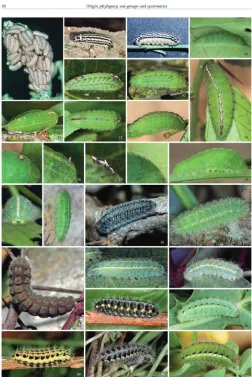
paintings by Crapon de Caprona (1984) in which most of the currently known non-Palaearctic Zygaeninae species are figured. Biotope photos and excellent photos of living specimens by Axel Hofmann and Clas M. Naumann show the phenotypic diversity of adults and larvae (Figs 2–3).
Moreover, the types of oviposition, the diversity of habits of the early stages, and the diversity of
the cocoons including their ultrastructure are figured and discussed. After this overview the genus
Zygaena Fabricius, 1775, is treated in detail. The authors’ opinion on the phylogenetic relationships based on the published tree of Niehuis et al. (2007) is explained and comments on subgeneric and
infrasubgeneric taxonomy are given. The three accepted subgenera Mesembrynus, Agrumenia and
Zygaena are further commented on in detail and the possible origin, differentiation and current cen
-tres of diversity of the genus Zygaena are discussed in depth. Arguments about the possible centre of evolution of the genus are presented and compared, all of it illustrated with informative maps and trees. This is followed by a phylogeographic analysis of stem groups, species groups and species.
A complete checklist of the genus Zygaena Fabricius, 1775, lists 108 currently accepted species but it is also discussed that some species hybridise and their taxonomic position is still not completely clear.
Chapter three deals with one of the most difficult and unclear species groups, the Zygaena
purpuralis/minos complex. This chapter impressively shows the challenge that taxonomists have
to face when characters are not sufficiently known and, even when the morphology, biology and distribution is known, how difficult it is to decide as a scientist how to draw the right conclusions
Gerhard M. TarMann: Book review: The Natural History of Burnet Moths, Part I
208
from the summarised facts. All arguments are nicely accompanied by good illustrations of speci
-mens, larvae and genitalia of males and females.
Chapter four is a real highlight of the book. It is dedicated to zoogeography, the distributional
patterns of the various species, the diversity of habitats, possible historical origins of populations, refugia and distributional pathways, endemism, expansion and invasion of areas and habitats and phylogeography, and concludes with a profound and impressive comparative analysis of the 15 presented and discussed geographic subareas where Zygaena currently lives (Fig. 4). Alone this
chapter could form an impressive book of its own. On 190 pages, illustrated with hundreds of excel
-lent pictures of specimens, habitats, distribution maps, tables, graphics and trees the authors present
a firework of informational highlights showing their great enthusiasm and outstanding knowledge. Chapter five deals with the morphology of the adults and the early stages of Zygaena. The
figures in this part of the book are partly taken from the late Clas M. Naumann’s huge archive
Figure 5. Infraspecific variability in burnet moths on page 341 of the book.
that has been provided to Axel Hofmann by Storai Naumann for publication in this book. Clas
Naumann did a lot of innovative work on zygaenids in his time as professor of zoology in the
university of Bielefeld in the early 1980s including the first series of stereoscan pictures. Many of these results were still unpublished at his death and are presented here for the first time. Throughout their lives both Axel Hofmann and Gerry Tremewan were not just gifted field
work-ers but also keen breedwork-ers of Zygaena and this has led to an archive of photos of eggs, larvae, pupae, cocoons and adults that has no comparison worldwide. Thousands of pages of notes about the habits of all stages are stored in this archive. Only a small part of these treasures could be presented in this book but even that is more than enough to illustrate the peculiarities in structure and life of Zygaena.
Gerhard M. TarMann: Book review: The Natural History of Burnet Moths, Part I
210
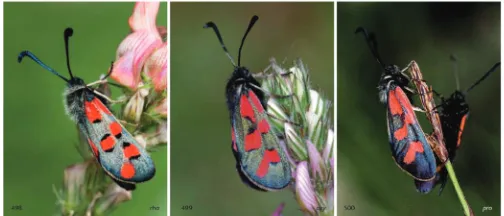
why Zygaena has been one of the most popular genera for collectors and photographers and a
model group for studies about variation. Axel Hofmann’s exceptional selection of specimens for this chapter enables easy understanding of complicated phenomena and shows much skill by the
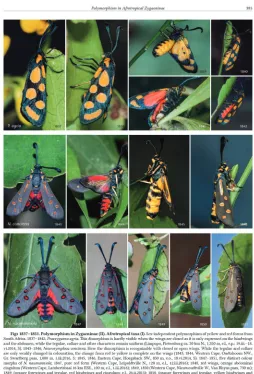
authors in educating the reader to look and understand (Fig. 5). Many non-Palaearctic Zygaenini are also figured showing the same polymorphism as many species of Zygaena (Fig. 6).
Chapter seven is dedicated to geographical patterns and clusters in Zygaena. It deals with the
interesting question of supraspecific phenomena and characters bound to special geographical re-gions, called by the authors ‘pheno-geography’. An important example is the syntopic occurrence
coloration in certain regions. Again the information is perfectly summarized by the authors, richly illustrated and accompanied by informative distribution maps.
Chapter eight gives an overview on historical observations and publications on the biology
of burnet moths, starting with a frontispiece that shows Zygaena species in a ca. 260-year-old oil painting by Otto Marseus van Schrieck housed in the Simferopol Art Museum in Crimea and discussed by Efetov & Tarmann in 2007 [Efetov KA,Tarmann GM (2007) Van Schrieck’s bur-net moth – an image of a Zygaena species (Lepidoptera: Zygaenidae) a century before Linnaeus. Entomologist’s Gazette59: 62–64, figs 1–2]. However, the reader learns that the oldest known
illustration of a Zygaena is figured in Cocharelli’s medieval work Leaves from a prose treatise on
the Seven Vices dated from between 1330 and 1340 which clearly shows a Mediterranean Zygaena
lavandulae. The authors then give a summary starting from pre-Linnaean observations up to today
mentioning all important authors who have dealt, in some way, with the natural history of Zygaena. They illustrate this chapter with original portraits and many reproductions of colour plates. The
fact that Gerry Tremewan was, for many years, the professional editor-in-chief of the British Mu-seum’s Bulletin (Natural History) and in retirement maintained good connections to the world’s best library of old books on natural history was clearly a unique advantage and the deep respect
and love of the authors for history and literature can be felt on each page. The chapter ends with an illustrated report on the 14 international symposia on Zygaenidae held between 1980 and 2014 with a summary of their content.
These eight chapters are followed by a short introduction on the genital morphology of Zygaena
and black and white photos of the relevant diagnostic characters of the male and female genitalia of all known species.
The references, a glossary of special terms and an alphabetic index finish this amazing book.
Conclusion
Hofmann & Tremewan’s ‘The Natural History of Burnet Moths’ is a never before seen monumen
-tal opus on the subfamily Zygaeninae of Zygaenidae in all its diversity and beauty. Already the now
published first part gives the impression of the complete final work as a milestone in entomological history. It is of unique completeness, illustrated with thousands of excellent pictures, graphics and
maps. It is the result of the collaboration of two enthusiastic authors summarising their lifelong studies of literature, collections, observations in nature, rearing experiments, and endless discus
-sions between the authors and other scientists. The spirit of joy for this work can be felt on each page and it is immensely inspiring to go through the chapters step by step learning a lot and being surprised by the sheer unbelievable diversity of life.
Thanks to the financial support of the Thomas-Witt-Stiftung in Munich, the price for this
monu-mental work could be kept on an affordable basis not only for entomologists but also for lovers of beautiful nature books. It only can be heartily recommended to make a present to oneself or friends with this book as a never ending well of joy for the beauty and astonishing diversity of nature.
It is expected from a reviewer to also find some criticism on the work that he is reviewing. But