International Journal of Finance and Managerial Accounting, Vol.4, No.15, Autumn 2019
115
With Cooperation of Islamic Azad University – UAE Branch
Value Stream Costing using a New Theory:
Technology Acceptance Model
Kimia Eslami
Student of Ph.D accounting, department of accounting, Damavand branch, Islamic Azad University, Damavand, Iran [email protected]
Zahra Moradi
b Assistant professor ,department of accounting, Damavand branch, Islamic Azad University, Damavand, Iran (Corresponding Author)
Mohammad Hamed Khanmohammadi
c Assistant professor ,department of accounting, Damavand branch, Islamic Azad University, Damavand, Iran [email protected]
ABSTRACT
Nowadays companies looking for increase of quality, flexibility and timeliness. One way to achieve these goals is lean thinking. To implementation lean production, companies are looking for waste reduction and Continuous improvement. This article Using the technology acceptance model (TAM) examined whether management accountants’ perceptions of the perceived ease of use (PEOU), or perceived usefulness (PU) of value-stream costing may influence on their behavioral intention (BI) to implement value-stream costing. In order to data collection was used the Davis (1989) and Venkatesh and Davis (2000) questionnaire and structural equation model (SEM). Furthermore using PLS and analysis regression. Results show that don’t significance relationship between perceived usefulness (PU) and behavioral intention to implement value-stream costing. But there is significant positive relationship between perceived ease of use (PEOU) and behavioral intention to implement value-stream costing.
Keywords:
1. Introduction
Lean principles and procedures have been widely accepted by many companies since the early 1990’s. Companies today understand that traditional accounting and costing methods can be a barrier to the success of the lean method (li et al,2012).
Lean thinking descriptive is simple but difficult to implement. Lean goal is to provide the highest quality with the minimum delivery time and minimum cost. Lean production has 5 steps (Womak et al., 2003): 1. Identify the correct value for the customer; 2. Identify the value stream and eliminate the waste; 3. Build the production stream; 4. Response to customer (pull);5. Move to perfection. The principles of lean production are derived from lean thinking. Lean thinking is attitude for efficiency and continuous value creation and minimize costs and waste (bakhtiary and godarzi,2009).
Most companies incorrectly focus only on reducing waste. Lean production by reducing processes, it seeks to identify inefficiencies in order to take into account waste areas and strengthen the system. Also to increase competitiveness by reducing delivery times, increasing productivity, higher profitability, and other intangible benefits that are difficult to measure (Bhasin & Burcher,2006).
Lean financial statements are consistent with accepted accounting principles and it is easier to understand and study for non-users. Lean accounting includes all costs, without any distinction between product and period costs. Also this statements report clearly the changes in inventories and revenue-related effects (timm,2015).
Over the past two decades, a significant part of the studies of information management systems are focused on identify the various factors that affect the technology acceptance and application behavior in organization. This has led to emerging number of models, for example Technology Acceptance Model (TAM) by davis (1989), Technology Acceptance Model 2 (TAM2) by venkatesh & davis (2000), Theory of Reasoned Action (TRA) by Ajzen & fishben (1975), and Theory of Planned Behavior (TPB) by ajzen (1991). Can be expressed that the most important of these models is TAM models (Ahmadi deh ghotboddini,2010). This paper seeks to determine the factors using the technology acceptance model that affects the acceptance of lean accounting by accountant and management accountants.
2. Literature Review
The lean principles focus on creating value for customer and remove of waste. Lean accounting effort instead to product costing based on production cycle; value by value stream is created and costing (maskell and katko, 2007). In value stream costing, accountants track actual cost to the value stream and standard cost and deviation are not calculated. Lean accounting is simpler than traditional costing because of it needs very little allocations (horngern et al,2012). Lean companies consider all costs of value stream as direct costs (baggally and maskell,2003).
Unlike standard costing that is complex and wasteful, value stream costing is easy to understand. Standard costing is suitable for mass production, but it can’t accomplish lean goals and this is due to the assumptions of this approach. Value stream costing is simple because details of actual costs are not collected. In this way, costs are allocated to the total value stream and it is usually estimated on a weekly basis (hajiha,2007).
Operational principles and lean accounting tools are segregation into five point: lean and plain business accounting, accounting process that support lean change, timely and clearly communication of information, planning and budgeting from lean perspective and financially beneficial improve (rahnamaye roodposhti, 2008).
Lopez et al (2013) by comparing traditional standard costing, value stream costing and ABC; concluded that value stream costing provides relative information than ABC. They also concluded that value stream techniques, encourages companies to continuous improve operations (lopez et al,2013). Maskell & kennedy (2007) have claimed that traditional management accounting methods are harmful for lean. They have stated that for reasons such as wrong management, incorrect calculation of costs, better decision making, the complexity of the system and focus on customer value; accounting methods should be change (maskell & kennedy,2007). When pursuing lean thinking, companies can’t set performance criteria just on the basis of financial information, it should also include non-financial information (roza & machadow,2013; brosnahan,2008).
categories of factors lead to the adoption of information technology by users which include: internal factors (perceived ease of use, perceived usefulness, behavioral intention and real use) and external factors (support of organization managers, the fit between duty-technology, individual factors and organizational factors, social factors, computer system features as kind of hardware and software, teaching method, the complexity of the system, user experience, voluntary and etc) (Jahangir et al,2014). Behavioral intention (BI) is the person’s readiness to perform a certain act. perceived ease of use (PEOU), the amount is that a person believes is the use of one particular system is simple and effortless (timm, 2015). Perceived usefulness (PU) is also measure that the person believes in the use of a particular system, can improve his job performance (taylor and todd,1995).
In most research, TAM’s Davis are used for describes the adoption and use of information system. Since the introduction of this model so far, more than 400 articles have been published in valid journals and several studies have confirmed the capability of this model. According to Lin (2007) if the main purpose of the research is technology acceptance; must use from TAM and if the main purpose of the research is
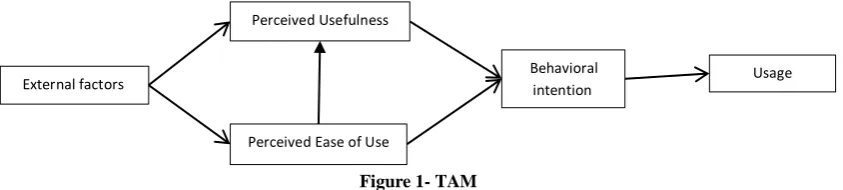
determining the factors influencing behavioral tendencies, we must use the TPB (rendi et al, 2014). In this research also because of the purpose is acceptance of value stream costing from management accountants; TAM has been used. Figure 1 shows the TAM. Since the concepts such as lean production, lean accounting and value stream costing in Iran are new topics and accounting methods are mainly carried out with computer systems; can be expressed, the use of the TAM is justified in accepting value stream costing technique. In order to understand the implementation or non-implementation of lean accounting in Iran, in this paper, we use the TAM (davis,1989) that the effect of perceived ease of use (PEOU) and perceived usefulness (PU) of value stream costing have been investigated on behavioral intention. In fact using the TAM, have been investigated that whether management accountant perception from PEOU and PU of value stream costing, influence on behavioral intention. Understanding the effective factors on accept of value stream costing may increase using from lean accounting in future and lead to the identification of deterrent factors in its implementation.
Figure 1- TAM
Reference: Davis (1989)
Background Research
Zare and Pourzamani (2017) examines the impact of lean environment on of the role of lean production on financial performance from Hofer et al (2012) and analyzing data using structural equation model (SEM) have shown that lean production environment is effective on the performance and value stream costing (Zare and Pourzamani,2017). Also Wohrle and abu shadi (2010) have argued that one of the effects of lean implementation, the rapid decline in inventories that management have incorrect vision that with reduce inventories level, reducing profit; while lead to
improvement in operations and increased space at company level. This article gathering and integrating literature review of lean production, value stream mapping (VSM), simulation and accounting in order to solve the puzzle between the benefits of lean implementation and accounting and financial reporting methods (wohrle and abu shadi,2010).
Shaker ardekani (2015) by reviewing lean production expressed organizations, including the tile and ceramic industry are looking for solutions to reduce waste and enhance power of competition in their industry. He said that lean production can be one
Perceived Usefulness
Perceived Ease of Use
Behavioral intention
of the solutions to achieve this goal. He looking for prioritize the barriers to the lean production in the tile and ceramic industries of Yazd province based on the tools and waste of lean (Shaker ardekani,2015).
Also Ajam (2015) in research of “investigating of factors affecting on settlement and implementation of lean accounting in pharmaceutical companies in Tehran stock exchange”, concluded that the economic and technical components is affected on the
mechanism of non-implementation and
implementation of the lean accounting system. But cultural and organizational components don’t effect on the process of implementation and non-implementation of lean accounting system in these companies. His results show that the economic and technical components hindered the implementation of lean accounting system in these companies (ajam,2015).
Kennedy and widener (2008) following to developing a control framework. They are based on a case study and lean production environment, have developed a theoretical framework that help to understanding control choices, accounting procedures and organizational structure related to lean production. Among the control framework, they have identified multiples mutual and assumptive relationship (kennedy and widener,2008). Fullerton, kennedy and widener (2013) in research of “Management accounting and control practices in a lean manufacturing environment” based on kennedy and widener (2008) and structural equation modeling, has provided evidence that lean production is associated with 5 control practices and management accounting. They with use data from 244 American companies active in lean production, have discovered that there is a positive direct relationship between lean manufacturing implementation and plain strategic reporting system, value stream costing, visual performance and empowerment employee. But has an inverse relationship with tracking inventory (fullerton et al,2013). Moradi (2013) based on kennedy and widener (2008), has studied the relationship between the basic components of management accounting and lean production strategy in food industry of Ardebil province. He achieving to similar result’s kennedy and widener (2008) (moradi,2013).
Kennedy and brewer (2006), in reviewing the choice between traditional and lean institutional, have describing transition of fortune 500 companies from
mass production to lean production and also transform their accounting information systems in order to support this change. They referred to some of the limitations of the traditional accounting practices, which resulted in a transformation to the lean and examined six main factors for successful transition to lean accounting (kennedy and brewer,2006). Also Hajiha (2007) with studying literature review, introduced a lean thinking as a new business paradigm that is based on value creation for the customer. She after expressing concept of waste and stream value in the lean production culture; introduced value stream costing (hajiha,2007).
Rosa and Machado (2012) with reviewing the literature review of lean management philosophy, and this philosophy and management accounting models have been compared. They reviewed the scientific articles related to lean accounting, that published by January 2011. Their results show that according to lean principles, product evaluation should be done just on the basis of value stream costing and product evaluation using ABC isn’t corresponding to goals of lean management. Performance evaluation should be focus on three dimensions: cell work, value stream, and visual management. The researchers of lean philosophy have a critical attention to a balanced score card, but there no explanations for the inconsistencies between these two philosophies (Rosa and Machado,2012). Li et al (2012) in “a comparative study of effects of management accounting systems on lean production implementation” the relative effects of three different management accounting systems on lean production have investigate through the simulation process with one performance measure –net profit. The three management accounting systems studied in this research are: traditional management accounting (TMA), activity based costing (ABC) and value stream costing (VSC). This study compares the three criteria of management accounting using the simulation process and statically designed experimental methods. The result’s li et al, similar to Rosa and Machado (2012) show that value stream costing is a bridge between the operational vision and the lean financial dimension that which will increase the transfer of information from the company level to the management level (li et al, 2012).
and value stream costing in small to medium sized enterprise (SME) enterprises and seeks to identify which one is more appropriate for lean production. This research is based on a case study and has been implemented among 3 sample from (SME) companies (chiarini,2012).
Carens and hedin (2005) presented reasons on the lack of accounting collaboration by the empirical accountants and accounting teachers, they have concluded that management accounting job’s faces very difficult challenges and university accounting programs are very weak for graduating managers (carens and hedin,2005).
Too Basin and burchur (2005) have stated that lean institutions are only when successful if they consider lean as a philosophy, not as a strategy. They are based on literature review, the success or failure of the lean investigated with a combination of methodologies including interviewing, research questionnaire and observation whit participation. They conclude that a combination of different factors is necessary for lean success; namely not only is it necessary to run more lean tools, but also organizational culture must be change. Furthermore, it is necessary this change occur throughout the organization’s value chain (basin & burchur,2005). Guerrero et al (2019) the inventory in process will be analyzed with lean accounting and measure the benefit of lean accounting. Their work is interest to the administrators and managers of the lean team and also for short-term decision making are useful (Guerrero et al,2019).
Safak and sena (2019) survey aspect of lean accounting was analyzed in a wiring harness production firm which is in an automotive supplier industry (Safak and sena,2019).
Carvlho et al (2019) investigated value stream mapping as a lean manufacturing tool. They state that Value stream mapping showed the opportunities in waste reduction mainly in the final goods inventory. they also combined application of two lean manufactured tools: VSM and Kanban and reported results (Carvlho et al,2019).
Timm (2015) lack of acceptance of lean accounting techniques like value stream costing considered in lean institutions. He concludes that there is significant positive relationship between perceptions of the ease of use and perceived usefulness with behavioral intention of value stream costing (timm,2015). Also kellermens and Islam (2004)
recommended that for acceptance activity based costing have used TAM by accountants in US and German (kellermens and Islam,2004). Also moqbel et al (2013) with using TAM, examined whether US collegiate and experts have acceptance IFRS; they using adjusted TPB, not TAM basic variables (moqbel et al,2013).
Hypothesis
H1: There is significant relationship between perceived usefulness and value stream costing adoption, as measured by behavioral intention.
H2: There is significant relationship between perceived ease of use and value stream costing adoption, as measured by behavioral intention.
H3: perceived ease of use of value stream costing will have a positive effect on perceived usefulness of value stream costing.
3. Methodology
4. Results
The results of the descriptive statistics show that 36% of respondents are female and 64% are male. The results also show that 2 of respondents have a bachelor’s degree (1.3%), 68 persons have a master’s degree (45.3%) and 80 persons had ph.D (53.3%). Also, the field of 129 of respondents is accounting (86%), the field of 14 person is management (9.3%) and 7 person is other field (4.7%). Afterwards have stated hypothesis test and other test.
4.1. Sufficiency sample size test
For specifying sufficiency sample size test have used KMO and Bartlett's Test that presented below:
Table1.sufficiency sample size test
KMO and Bartlett's Test
Kaiser-Meyer-Olkin Measure of Sampling
Adequacy. .562 Bartlett's Test of
Sphericity
Approx. Chi-Square 2783.171 Df 1176 Sig. .000
Results show that KMO is 0.562 that presented sufficiency sample size have medium.
4.2. Significance of formative model
weights
Results show that questions 1 , 2 (perceived ease of use) and questions 13, 14, 16 (perceived usefulness) are significance statically. Results t statistics are show below table:
Table 2.Significance of formative model weights
Questions Original
Sample (O) P Values
1 <- perceived ease of use 0.643 0.000 13 <- perceived usefulness -0.354 0.000 14 <- perceived usefulness 0.388 0.000 15 <- perceived usefulness 0.140 0.0780 16 <- perceived usefulness 0.0323 00.00 17 <- perceived usefulness 1.380 0.640 18 <- perceived usefulness 0.590 0.0625
2 <- perceived ease of use 0.508 0.000 25 <- behavioral intention 1.000
3 <- perceived ease of use -0.241 0.730 4 <- perceived ease of use 0.154 0.184 5 <- perceived ease of use -0.038 0.775 6 <- perceived ease of use -0.113 0.356
4.3. Multi-collinearity test
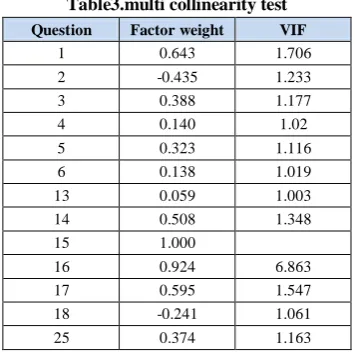
In order to doing this test, must be VIF accounted. According to hair et al (2011), VIF must have below of 5 (hair et al.,2011). Results presented on table 3. Results show that all VIF is below 5, therefore collinearity are acceptable level.
Table3.multi collinearity test
Question Factor weight VIF
1 0.643 1.706 2 -0.435 1.233 3 0.388 1.177 4 0.140 1.02 5 0.323 1.116 6 0.138 1.019 13 0.059 1.003 14 0.508 1.348 15 1.000
16 0.924 6.863 17 0.595 1.547 18 -0.241 1.061 25 0.374 1.163
4.4. Test first hypothesis
This hypothesis relationship between perceived usefulness and value stream costing adoption were examined.
Figure2- structural equation model
4.5. Test second hypothesis
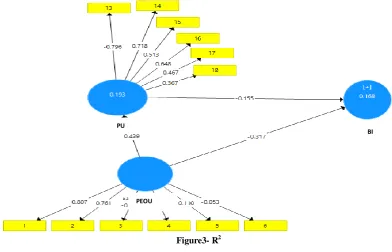
This hypothesis relationship between perceived ease of use and value stream costing adoption were examined. According to the figure 2, t statistics between perceived ease of use and value stream costing adoption is 3.443 that is more than 1.96. Then there is significance relationship between perceived ease of use and value stream costing adoption. That is second hypothesis was confirmed. Also, the results of figure 3 showed that this relationship is negative and significant. In other words, in terms of management accountants, the use of value stream costing is not only easy and effortless, but learning and using it is time-consuming. The reason for this is that in the specialized courses of the accounting field, there are very few things about lean accounting and value stream costing. Even in most books, there is no comprehensive example of value stream costing and value stream mapping.
4.6. Test third hypothesis
This hypothesis examined effect of perceived ease of use of value stream costing on perceived usefulness of value stream costing.
According to the figure 2, t statistics between perceived ease of use and perceived usefulness is 4.893 that is more than 1.96. Then there is significance and positive effect between perceived ease of use and perceived usefulness. That is third hypothesis was confirmed. In other words, if users feel that using a system is effortless and simple, on their understanding of the benefits of the system are affected. Therefore, according to the results of the research, it can be stated that if management accountants feel that the use of value stream costing is simple and cost-effective, it can ultimately lead to acceptance of this costing method by accountants.
4.7.R
2indicator
This indicator shows how many percent of the changes of the endogenous variable is made by the
PEOU
exogenous variable. The values of 0.67, 0.33, and 0.19 for the dependent variables in the structural path model are described, respectively, as significant, moderate and weak (henseler et al.,2009). Results show that R2
of perceived usefulness and behavioral intention are respectively 0.193 and 0.168; that according henseler et al (2009) this amounts are moderate level.
Figure3- R2
4.8.
structural
model
quality
(Q
2indicator)
Structural model quality have measured by indicator of cross-validated redundancy or Q2 indicator.Q2 values above 0, indicate that the observed values have been rebuilt properly and model predictive ability is good. Result show that all the values more than 0 and model have been good quality.
Table 4. Q2 indicator
0.096 Perceived usefulness
0.175 Behavioral intention
4.9.General test of structural equation
model
Goodness of Fit (GOF) indicator recommended by tenenhaus et al (2005) that a criterion to have measure the overall performance of the model. This indicator calculated as follows:
GOF = √ 2 = √
Wetzels et al (2009) presented three values of 0.01, 0.25 and 0.36, respectively, as weak, moderate and strong values for GOF (mohsenin and rahim esfidani,4002). Therefore, it can be stated that the overall performance of the model has a moderate level.
5. Discussion and Conclusions
Lean accounting uses value stream costing to determine the product cost, which is essential for understanding the value stream and costs of the value stream activity and supporting processes. These activities and its costs are allocated to the product family based on the use of each product's family of activities. One of the lean accounting tools is value stream costing, which using for report of profitability and costing. Using the financial information that this costing method provides, it allows good decisions to be made and lean improvements in the total of value stream (Rahnamaye Roodposhti, 2013). Value stream
BI PU
costing, a technique developed from a value chain analysis. In this analysis, all valuable activities in the creative of a product or service are linked together in a chain (nikbakhat and jahroomi,2013).
In Iran, the technology acceptance model has been used mainly in management and banking research. Of course, in previous studies, the technology acceptance model in the application of new systems in organizations, e-learning, electronic games, operating systems, storage data, email (e-mail), acceptance of personal computers, computer software such as Lotus, Chart Master and ...., Banking, Electronic Services and Financial Services, all Internet services such as Internet shopping, e-commerce, ERP, etc. have been used (Gu et al, 2009); but this research is one of the few studies Which examines the implementation or non-implementation of the value stream costing based on a communication and technology model.
The basis of the standard costing system is based on a set of estimates. There are many attempts to make companies compare estimates with reality, but the fact is that the future is not foreseeable. Therefore, lean companies use value stream costing instead of the standard costing system (maskell and katko,2007). Value stream costing, is a technical that has been developed from value chain analysis. In this analysis, all value-added activities are linked to the creation of a product or service in the form of a chain (nikhbakhat and jahromi,1393).
In Iran, the Technology Acceptance Model (TAM) is mainly used in management and banking research. This article is one of the articles that have evaluated the implementation or non-implementation of value stream costing based on a communication and technology model.
This paper, with using the TAM, examines variables that effect on intention to implementation value stream costing. This article is based on the TAM, the effect of variables perceived ease of use and perceived usefulness, on behavioral intention of the implementation of value stream costing has been investigated. In fact, with using TAM, it has been examined whether understanding of management accountants from the perceived usefulness and perceived ease of use of value stream costing, may impressing on their behavioral intention at implementation of this method costing. The results of the first hypothesis indicated that the perceived usefulness doesn’t impress on intention of
implementation and adoption of value stream; which this result is opposite with timm (2015) and venkatesh and davis (2000). But perceived ease of use (second hypothesis) there are a positive and significant effect on intention of implementation value stream costing; which is consistent with timm (2015) and davis (1989). Also there is significance and positive effect between perceived ease of use and perceived usefulness; which is consistent with timm (2015) and davis (1989). Therefore, based on the results of hypothesis, can be argued which perceive of management accountant from ease of use of value stream costing, have positive relationship with intention of implementation value stream costing. Finally we can say that the results of this research, use of TAM for intention of implementation value stream costing is supported and approved by the accountants; as it has been approved in other field and by other researchers (davis,1989; timm,2015). Also, perceived ease of use may predict intention of implementation value stream costing. The result of this research provides further information on how to understand the management accountants about usefulness and ease of use of value stream costing and its impact on the incentive of implementation value stream costing. More use of lean accounting techniques such as value stream costing, the success of lean production will increase and lead to positive social change (fulerton et al,2014). Czabke et al (2008) have argued that lean implementation has led to increased profitability, improving collaboration between managers and employees and creating better culture to solve organizational problems (czabke et al,2008). This research examines the factors affecting on implementation of lean accounting and can provide a model for implementing lean accounting in companies.
This study also expanded the use of TAM at management accounting system. Timm (2015) has suggested that it can use from TAM to investigate of ABC and even accept IFRS (moqbel et al.,2013; kellermens and islam,2004). To successfully implementation lean at organization, company must be accepted lean as its vision and not only look at it as a specific tool to increase efficiency (eslami and moradi, 2019).
accuracy of the answers. That is, respondents may be because of tired, decentralization or avoid from honest answers due to social consequences, don’t respond to questions with complete honesty.
References
1) Ahmadi deh ghotboddini, M. (2010). “structural relation between constructions of TAM’s davis”, new idea at educational science journals, fifth years, second number, 129-142.
2) Ajam, Z. (2015). “A study on the factors affecting the establishment and implementation of lean accounting in companies active in the pharmaceutical industry listed on Tehran Stock Exchange”, master’s thesis, ShaShroud branch, Islamic Azad university.
3) Baggaley, B., & Maskell, B. (2003). Value stream management for lean companies, Part I. Cost Management, 17(2), 23–27.
4) Bakhtiari, J. Godarzi, A. (2009). “lean accounting, lean business management system”, accountant journal, 24 years, 210 number, 64-69.
5) Bhasin, S., & Burcher, P. (2006). Lean viewed as a philosophy. Journal of Manufacturing Technology Management, 17, 56–72. doi:10.1108 /17410380610639506
6) Brosnahan, J. (2008). Unleash the power of lean accounting. Journal of Accountancy, July, 60–66.
Retrieved from
http://www.journalofaccountancy.com/
7) Carnes, K., & Hedin, S. (2005). Accounting for lean manufacturing: Another missed opportunity? Management Accounting Quarterly, 7, 28–46. 8) Carvalho, C. P., Carvalho, D. S., & Silva, M. B.
(2019). Value stream mapping as a lean manufacturing tool: A new account approach for cost saving in a textile company. International Journal of Production Management and Engineering, 7(1), 1-12.
9) Chiarini, A. (2012). Lean production: Mistakes and limitations of accounting systems inside the SME sector. Journal of Manufacturing Technology
Management, 23, 681–700.
doi:10.1108/17410381211234462
10)Czabke, L., Hansen, E., & Doolen, T. (2008). A multisite field study of lean thinking in
11)Davis, F.D. (1989). Perceived usefulness, perceived ease of use, and user acceptance of
information technology. MIS Quarterly, 13( 3), 319- 340.
12)Eslami, K. and Moradi, Z. (2019). “Identifying Factor Influence on Value Stream Costing With Using Technology Acceptance Model (TAM)”, Journal management accounting and auditing knowledge,Article Accepted.
13)Fullerton, R. R., Kennedy, F. A., & Widener, S. K. (2014). Lean manufacturing and firm performance: The incremental contribution of lean management accounting practices. Journal of Operations Management, 32(7-8), 414-428.
14)Fullerton, R., Kennedy, F., & Widener, S. (2013). Management accounting and control practices in a lean manufacturing environment. Accounting, Organizations and Society, 38, 50–71. doi:10.1016/j.aos.2012.10.001
15)Gu, J., Lee , S., Suh, Y., (2009). “Determinants of behavioral intention to mobile banking”,Expert Systems with Applications 36, pp.11605–11616. 16)Guerrero, D. F., Jiménez, J. A., Hernández, S.,
Ruelas, E., Tapia, M., & Figueroa, V. (2019). Inventory Cost Analysis Work in Process (Wip) Under Focus of Lean Accounting, Simulation and Optimization Scenarios. Engineering And Technology Journal, 4(03), 545-551.
17)Hair, J. F., Ringle, C. M., & Sarstedt, M. (2011). PLS-SEM: Indeed a silver bullet. Journal of Marketing theory and Practice, 19(2), 139-152. 18)Hajiha, Z. (2007). “value stream costing, new
approach lean accounting”, audit science journal, 7, 24, 52-63.
19)Henseler, J., Ringle, C. M., & Sinkovics, R. R. (2009). The use of partial least squares path modeling in international marketing. In New challenges to international marketing (pp. 277-319). Emerald Group Publishing Limited.
20)Horngren, C., Datar, S., & Rajan, M. (2012). Cost accounting: A managerial emphasis. Upper Saddle River, NJ: Prentice Hall.
21)Jahangir, G. dayani, M. nokarizi, M. (2015). “he Development of Technology Acceptance Model (TAM) through Measuring the Impact of Self-Efficacy and Dysfunctional Attitudes on the Acceptance of Pajhoohan based on Cognitive-Social Theory”, Library and Information Science Research journal, 5 (2), 52-63.
comparison and system acceptability propositions. Benchmarking, 11, 31–51. doi: 10.1108/ 14635770410520294.
23)Kennedy, F. A., & Brewer, P. C. (2006). The lean enterprise and traditional accounting—Is the honeymoon over?. Journal of Corporate Accounting & Finance, 17(6), 63-74
24)Kennedy, F. A., & Widener, S. K. (2008). A control framework: Insights from evidence on lean accounting. Management Accounting Research, 19(4), 301-323.
25)Li, X., Sawhney, R., Arendt, E. J., & Ramasamy, K. (2012). A comparative analysis of management accounting systems’ impact on lean implementation. International Journal of Technology Management, 57(1/2/3), 33-48. 26)Maskell, B., & Katko, N. (2007). Value stream
costing: The lean solution to standard costing complexity and waste. In J. Stenzel (Ed.), Lean accounting: Best practices for sustainable integration (pp. 155–176) Hoboken, NJ: John Wiley & Sons.
27)Maskell, B., & Kennedy, F. (2007). Why do we need lean accounting and how does it work? Journal of Corporate Accounting & Finance, 18(3), 59–73. doi:10.1002 /jcaf.20293
28)Mohsenin, S. Rahim Esfidani, M. (2014). Smart PLS, Mehraban book pub. First edition.
29)Moqbel, M., Charoensukmongkol, P., & Bakay, A. (2013). Are U.S. academics and professionals ready for IFRS? An explanation using technology acceptance model and theory of planned behavior. Journal of International Business Research, 12(2), 47–60.
30)Moradi, Gh. (2013). “The relationship between the fundamental components of management accounting with lean manufacturing strategy in the food industry of Ardabil”, master’s thesis, Gerami branch, Islamic Azad university.
31) Nikbakhat, M.R. and Jahroomi,M. (2014), “strategic management accounting, savior of management accounting?”, authors: Heydar shah, Malek, Shokat Malek, Accountant Journal, No. 266, pp. 41-43.
32)Rahnamaye roodposhti, F (2013), “strategic management accounting, based on value added cost management”, Azad university pub.
33)Rahnamaye roodposhti, F. (2008), “management accounting based on creation cost management”,
science and research branch Azad university publication, first pub, 551-586.
34)Rendi, V. Khon siavash, M. Masoumi, B. (2014). “Influencing Factors on Internet Customers Purchasing Behavior in Iran Based On Technology Acceptance Model (TAM)”, journal of development evolution management, special issue, 109-118.
35)Rosa, A., & Machado, M. (2013). Lean accounting: Accounting contribution for lean management philosophy. In Proceedings of the tourism and management studies international conference (Vol. 3, pp. 886–895). Algarve, Portugal: University of Algarve.
36)Ruiz-de-Arbulo-Lopez, P., Fortuny-Santos, J., & Cuatrecasas-Arbós, L. (2013). Lean manufacturing: Costing the value stream. Industrial Management & Data Systems, 113, 647–668. doi:10.1108/02635571311324124 37)Safak, K., & Sena, A. (2019). Lean Accounting
and Applications in an Automotive Supplier Industry. In Financial Forum.
38)Shaker Ardekani, A. (2015). “prioritizing lean barriers on based on lean tools and waste on QFD, DEMATEL. Case study: tile and ceramic industry of Yazd province”, master’s thesis, Yazd branch, Islamic Azad university.
39)Taylor, S.,& Todd, P. (1995). Understanding information technology usage: A test of competing models. Information systems research, 6( 2), 144-176
40)Timm, P. H. (2015). Perceptions of value-stream costing and the effect on lean-accounting implementation.U.S. and German secondary wood products manufacturers. Forest Products Journal, 58(9), 77–85.
41)Venkatesh, V., Davis, F.D. (2000). A theoretical extension of the technology acceptance model: Four longitudinal field studies. Management Science, 46( 2), 186-204.
42)Woehrle, S. L., & Abou-Shady, L. (2010). Using dynamic value stream mapping and lean accounting box scores to support lean implementation. American Journal of Business Education, 3(8), 67-76.
43)Womack, J., Jones, D., &Roos, D. (2003) Lean thinking. New York, NY: Simon &Schuster 44)Zare, M. Pourzamani, Z. (2017). “The impact of