ISSN: 2333-6048 (Print), 2333-6056 (Online) Copyright © The Author(s). 2014. All Rights Reserved. Published by American Research Institute for Policy Development DOI: 10.15640/jmpp.v2n3a3 URL: http://dx.doi.org/10.15640/jmpp.v2n3a3
Management of Institutions for Green Economics
Popov Evgeny Vasilievich1 & Semyachkov Konstantin Aleksandrovich2
Abstract
The problem of “green” economy institutions development is considered in the present article at three levels: national, regional and corporative. On the base of “institution” concept designed in institutional economics the concept “green economy institution” is specified. Current institutions are discussed at the regional level, standards and practices in ecosystems are considered in terms of the Sverdlovsk Region. Environmental policy of the region attracts attention among the main institutions. Trends of its transition to an innovative development are offered, in particular, an opinion is expressed that government deregulation in environmental management field should be performed, and market mechanisms should be developed. As follows from the analysis of mining and smelting enterprises performance in the Sverdlovsk Region a number of advanced ecological-economic management institutions can be distinguished and recommendations for their development are given.
Keywords: “Green” economy, institution, ecological-economic management, environment conservancy, innovative environmental policy, environmental protection
Development of modern economics is attended by continuing increase of environmental problems, constituting threat to life and human development. Nowadays scale of production and consumption results in catastrophic imbalances of natural and economic systems.
1 (Yekaterinburg) – corresponding member of Russian Academy of Sciences, head of Economic theory center of Institution of economics, the Ural Branch of Russian Academy of Sciences (620014, 29 Moskovskaya street, Yekaterinburg, Email: [email protected])
According to scientists from different science fields in case of persisting tendencies in economics development in the near future environment will not be able to manage human activities results. [1]
Considering the fact that most environmental problems become apparent long after the reasons which caused these problems, even in case of immediate taking of appropriate measures the environmental quality will be deteriorated over a number of years.
Along with this, understanding of problems severity not only in developed but also in developing countries arises. Ecological component is transformed into full-valid and significant part of national and global strategy and in fact it is intertwined with the whole system of international, national, regional and corporative management.
Consequently, developing process of economy greening and
institutionalization of environmental factor can be mentioned. Economy greening is a process of environmental factor introduction in analysis of economic parameters of development at national, regional and corporative levels. The present process assumes development of accounting procedures of industrial economic losses caused by environment quality deterioration and losses minimization. [2] Some researches call this process as “green” growth, well-balanced ecological-economic development, “green” economy etc. In our view there are no fundamental differences between these terms, because all of them reflect the main concept, notably growth in human prosperity and social safety net and at the same time reduction of environmental risks and deficits.[3,4,5,6]
The advanced line of problem consideration is its consideration from the perspective of institutional economics theory, developed by T.Veblen. It is generally accepted that it was T.Veblen who considered “institution” category as a basis for economy analysis of business activities and intended by this concept “stable customs of thinking, appropriate to great human generality”. [7]
The objective of the present study is development of “green” economy institutions’ system and mechanisms of institutions development at regional and corporative levels.
In majority of sociological, social and economic sources the term “institution” means a stable complex of formal and informal rules, principles and standards, directives, which control different human activities fields and integrate them in system of roles and statuses, forming the social system.
O.S. Suharev writes: “Institutions are formal (lows, constitutions) and informal (customs, traditions, codes of behavior, behavioral stereotypes) norms (restrictions), designed by people, and factors of business behavior enforcement, which present in structured manner interexchange and interaction between economic agents. Therefore they define life quality, the scale of resources consumption and specify development vector”.[8]
E.V. Popov gives more meaningful definition of the term “institution”, where the latter is a set of conventional norms of economic agents interaction.[9,10] Extending the present definition on industrial ecologic-economic activities, we consider “green” economy institutions as conventional norms of economic agents interaction in the field of ecology, environment conservancy and environmental protection.
Transition to well-balanced ecology-economic development as the whole is possible only if sustainable performance of all institutions is provided at all the levels, which in its turn means adoption of ecologic norms by all participants of economic activity.
The facts about existing environment in Russia suggest that by basic ecological indexes situation deteriorates with time, it means that negative impact on environment increases. Nearly 17% of country area can be referred to environmentally unfriendly regions.[11] Poor state of environment is one of the main reasons of population diseases and mortality. [12]
Federal law “Concerning protection of environment”, resolutions of the President and Government of the Russian Federation are the basic instruments of environmental policy at the governmental level. In a greater degree the present instruments are administrative and in the less degree they consider market mechanisms of sustainable development. We believe that formation and development of market institutions of “green” economy are one of the key directions of national environmental policy development.
As noted by A.D. Karnyshev, problems, solved at the regional level should correspond to federal objectives, but consideration of local specifies is also important. In particular, analysis of environmental conditions in the Sverdlovsk region shows that the most effective instruments of “green” economy principles’ development, in the authors’ opinion, should be the following:
- formation of regional market institutions of ecology development; - taking environmental protection measures;
- accomplishment of measures for environmental culture development;
- development of regional industrial system with consideration of up-to-date environmental requirements;[14]
The search and implementation of institutional environmental norms (formal and informal) and customs in different economy management fields should be the base for “green” economy development. Problem complexity is that it is required to achieve interests’ accommodation of different agents [15] of “green” economy. With regard to the above mentioned the following agents groups can be distinguished:
- businessmen, whose interests are inconsistent with environmental values, because production cost increases with orientation on environmental values;
- businessmen, whose business is directly connected with nature and environmental friendliness, therefore it requires nature protection and saving;
- workers of central and local authorities, whose activities to any extent are connected with environmental protection and ecology;
- population of territories, for whom environment is a permanent place of residence, therefore they should be environmentally responsible;
Creation of effective regional system of ecological-economy activities control is necessary for basis formation for market mechanisms’ planning and operation.
Among approaches for “green” economy development mechanisms’ formation at the regional level a set of features can be distinguished:
formation and development of environment conservancy and protection stimulation institutions and also reconsideration of existing system of nature oriented field financing;
modernization of environmental legislation;
development of appropriate system of environmental norms and standards;
development of expert estimation institutions of environmental projects;
formation of complex system of ecological-economy activities management;
reconsideration of ecological responsibility system;
expanding economic growth potential due to business stimulation in development and implementation of “green” technologies;
The key condition of effective development of ecological-economic activities institutions [17] is a mechanism of their assessment. Nowadays the problem of indicators search, which can appropriately estimate variety of processes in ecological-economy activities field, became global, being connected with development of economy, ecology and social activities of human society. Existing indicators system doesn’t display even the processes, which take place in sustainable economy, not to mention transitional economy.[18]
System of indicators for assessment and analysis of any process or effect (including ecological-economic activities) in general case should be hierarchical, revealing general and local processes characteristics.
1. Integrated criterion of ecological-economy development should allow assessment of final results of ecological-economy activities efficiency;
2. Integrated index of ecological-economy development should allow “spreading” the hierarchy of local criteria to achieve at long last an integrated system of ecological-economy activities criteria;
3. Integrated criterion of ecological-economy development should allow defining directions of ecological-economy activities optimization by affection on structural elements in calculation formula;
4. Structure of integrated criterion of ecological-economy development should cover 3 levels: national, regional and corporative.
Institution of state information analysis system concerning environmental activities of the enterprises should be created as a basis for assessment of ecological-economy activities on the region territory. The present institution would help to control factors impact on results of ecological-economy activities and find out key factors affecting ecological-economy development balance. The present system will allow conducting researches in continuous mode. It would be reasonable to impose information gathering on Ministry of Natural Resources and Environmental Protection, Federal State Statistics Services or on centers of environmental conditions monitoring – created just for the present purpose.
Gathering of full-scale information concerning the results of ecological-economy activities and influential factors from all enterprises of the Sverdlovsk region would allow applying superior mathematical methods of information handling for results processing and development models building. In addition, more data points would allow getting closer to determination of functional dependences between factors and results of ecological-economy activities by means of mathematical analysis.
Obtained results should be brought to the notice of business, population, state bodies, being responsible for environmental policy, in order to improve ecological-economy activities control on particular enterprises and control system development at the government level.
1. integrated approach is a basis for sustainable regional development, it means that all living environments of the region should be considered as a system of interconnected components;
2. strategy of sustainable regional development to a significant extent is defined by the size and features of the present region;
3. determination of sustainability points is supposed to be one of the main problems of sustainable regional development, it will allow determination of perspective development trends and focus all efforts on them on the assumption of resources utilization expediency;
4. “interests’ balance” principle is a basic principle of design and implementation mechanism of sustainable regional development, it allows respecting interests of enterprises and companies of different ownership types, state bodies, population.[20]
As noted by M.A. Buchakova, analysis of normative documents concerning environment indicates that there are no common methodological approaches for assessment of regional ecological programs’ efficiency and significance in environment protection measures’ system, conformance to requirements concerning programs adoption and implementation, forms of their implementation control, and there are also no financing sources and common formalized policy. Insufficient scientific and methodic rationale for environmental programs development results in different variations in practical law enforcement, and in many cases it results in formal approach on the part of regional structures and business during their adoption and further implementation. [21]
Nowadays there exist several approaches for development of environmental policy of the region, the most perspective one is called by A.A. Kostylyov an innovation type. [22]
In general, it is valid to say, that innovational environmental policy of the region is in improvement of the certain industrial branch control process on the base of implementation of new innovation approaches, aimed to sustainable social-economic development of the region. Innovativeness of environmental policy may be pronounced at formation and development of institutions system, accumulation of knowledge about regional ecosystems, practical application of innovation technologies and products. During formation of innovative environmental policy such mechanism of areal environmental management as creation of special ecological-economic zones can be applied. The present mechanism assumes formation of market relations in environmental management field. The main goal of the present zone performance is integration of material and financial resources for utilization of areas natural resources with consideration of internal characeristics of the region. The basic measures for this goal achievement are the following:
- organization of interaction between environment protection departments and market structures
- creation of environmental funds
- formation of exemptions and credits system for enterprises, which successfully implement environmental policy
Participants of the present scheme are given different tax breaks, assessable profit is decreased for profit sum, paid for extension and modernization of production on the base of “green” technologies or implementation of social actions. Financial receipts from registration fee payment from economic agents are also possible in case of fees registration on the zone area.
On the base of study of self-organization forms by resources utilization E. Ostrom set up a set of institutional design principles, which make efforts of local communities in common property assets utilization more successful:
1. Group demarcation, it helps participants to have a clear picture with whom they should cooperate.
2. Resource access rules should impose restrictions on volume, time and technology of resources application, distribute profits in accordance with costs. Gaining the benefits without expenses for resource maintenance is not effective.
3. Solutions and «game rules» should be developed by community.
4. Control is implemented on the base of mutual monitoring or by choosing accountable inspectors in each group.
5. The presence of mark-off scale of sanctions, which depend on violation severity, violation character (the first or periodic violation) and context.
6. There should be local sites for effective conflicts resolution.
7. Consumers rights on self-organization should be recognized by local and central authorities.
8. Different social units of different interleaved hierarchical levels, thus imparting sustainability [23], should take place in control of large-scaled resources, used simultaneously by several groups.
The latter is particularly topical for solution of environmental problems in the Sverdlovsk region. In this case decisions should be surely accepted not only by federal authorities but also by local communities – regional community, city, settlement, that is not performed nowadays.
Private industry in its turn is supported by government: it is provided by new orders, new markets of ecological products sale and also risks, connected with projects implementation, are shared with government. It is confirmed by a number of projects in environment protection field, implemented in different regions of Russia.[25]
Assessment of corporative [26] ecological-economic activities is a crucial condition. Nowadays there are no generally-accepted indexes of enterprises efficiency assessment in the certain industry branch. The only obvious thing is that assessment indexes should be relative, and they should reflect environmental, economic, financial characteristics of companies’ activities. We offer coefficient equal to ratio of company revenue to environmental impact fee as one of the most important assessment factors. In this case the present coefficient, being a measure of ecological-economic sustainability of enterprise development, can be defined as environmental turnover rate.
The more environmental turnover rate, the more balanced ecological-economic activity of the enterprise. In our opinion, the present index can depend heavily from industry practices. However, comparative analysis of environmental turnover rates of two similar enterprises referred to one industry branch can reveal differences in efficiency of ecological-economic activities management.
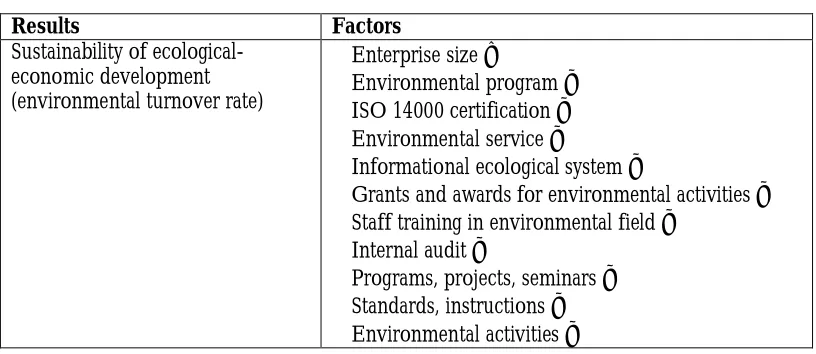
Table 1: Factors Interrelation and Negative Impacts Results
Results Factors
Sustainability of ecological-economic development (environmental turnover rate)
Enterprise size ↑
Environmental program ↓
ISO 14000 certification ↓
Environmental service ↓
Informational ecological system ↓
Grants and awards for environmental activities ↓
Staff training in environmental field ↓
Internal audit ↓
Programs, projects, seminars ↓
Standards, instructions ↓
Environmental activities ↓
* ↑ - factor results in increasing of enterprise negative impact on environment, consequently, decreasing of environmental turnover rate;
** ↓ - factor results in decreasing of enterprise negative impact on environment;
Undertaken study allowed formation of successful enterprise profile. Based on research findings, enterprise with high results of ecological-economic activities has the developed, approved and executable environmental program. Chief ecologist is responsible for environmental activities organization on the present enterprise. Herewith an enterprise is certificated by ecological standards system ISO 14000, has information environmental system, informing interested parties about enterprise activities in environmental field. Among other things enterprises which received governmental grants for environmental activity achieved more notable results.
And what is more, most of employees of enterprise with high results of ecological-economic activities take regular training in environmental field. Based on research findings, internal ecological audit, enterprise participation in environmental programs, projects and seminars and environmental activities are the crucial factors which increase ecological-economic activities results. Herewith successful enterprise is noted for a large amount of ecological standards, instructions, regulations applied during production.
Table 2: Recommendations for Improvement of Ecological-Economic Activities Results of Russian Enterprises
Administrative measures State promotion methods
Development and implementation of environment protection measures by the enterprises
Promotion of “green” production technologies development, formation of “green” goods and services market
Development of environmental program of the enterprise
Environmental strategy design of national development, business promotion for development of environmental programs of manufacturing, meeting long-term goals of well-balanced ecological-economic development Implementation of information ecological system
of the enterprise, its integration with other information systems for operative management of ecological-economic activities control
Implementation of information ecological system, data base with key environmental indexes, which would allow analyzing ecological situation in the territory of RF and accepting competent and well-founded management decisions
Development of environmental activities practices of the enterprises:
Staff training in environmental field
Creation of environmental service
Internal audit
Standards, instructions
Specialists training and retraining in environment conservancy and ecology fields, development of audit system of environmental activity, up-to-date standards and environmental instructions
ISO 14000 certification Development of environmental certification
systems at the governmental level, development of enterprises own ecological quality standards Grants and awards for environmental activities Enterprises subsidy for their modernization and
introduction of ecologically clean technology. In addition, development of economic methods of environmental modernization promotion of production (tax reliefs, reduction of fees for ecologically clean equipment etc.)
Enterprises participation in environmental programs, projects, seminars of different levels
Government participation in environmental programs of the enterprises (for example PPP (Public Private Partnership) mechanism, organization of seminars, environmental programs for the enterprises.
Innovative regional environmental policy, integrating not only state control institutions but also market mechanisms, self-organization and self-control norms should become the main system element. Based on analysis findings concerning regional environmental policy of the Sverdlovsk region, generally for environmental problems solving in the Sverdlovsk region state control institutions are applied, that is inefficient under the current conditions.
The basic conclusion of the study is the following: problem of environmental management and audit systems improvement, application of public private partnership mechanisms and also formation of ecological goods and services market with such market practices as environmental insurance and environmental consulting – is the main problem during transition to an innovative development type.
Empirical study of mining and smelting enterprises in the Sverdlovsk region allowed revealing the most perspective mechanisms of efficiency increasing in environmental field:
1. Development of regular training of enterprises staff
2. Creation of special ecological service (ecological department) in enterprise structure headed by the chief ecologist
3. Development of environmental program of the enterprise
4. Introduction of certification institutions of environmental standards, development of enterprises own environmental standards
5. Regular enterprise participation in environmental programs of federal, regional, municipal level and also in seminars and environmental programs
6. Implementation of environmental activities of the enterprise concerning environment protection
Government structures, interested in optimization of environmental activities results of Russian enterprises, and Russian enterprises managers working in the present directions will result in complete and effective following the well-balanced ecological-economic way of economy development.
References
Piskulova N.A. Influence of environmental factor on global economic development // Official journal of Moscow State Institution of International Relations. 2010. № 6.
Bulgakova L.M., Plotnikova R.N. Problems of economy greening and environment economization // Fundamental researches. 2009. № S5. pp. 121-122.
Measuring the Green Economy. Washington (DC): US Department of Commerce, Economics and Statistics Administration, April 2010.
The Green Race is On: the New Business Agenda. World Business Council for Sustainable Development Annual Report 2009. Geneva: WBCSD, March 2011.
Kennet M. What Green Economics? An age of global transformation – An Age of Green Economics [Электронныйресурс]: 2010. 12 с. URL: http.// www.greeneconomics.
org.uk
World Economic and Social Survey 2011: The Great Green Technological Transformation. Department of Economic and Social Affairs of the United Nations Secretariat (DESA). E/2011/50/Rev. 1 ST/ESA/333. N.Y.: United Nations, 2011.
Veblen T. The Place of Science in Modern Civilization and Other Essays. N.Y.: Huebsch, 1919. pp. 239.
Suharev O.S. Institutional economy: Theory and politics. M., 2008, pp. 838
Popov E.V. Minieconomical institutions // Economy problems. 2005. №12. pp. 96-108. Popov E.V. Institutional Atlas // Atlantic Economic Journal. 2011. Vol. 39. N 4. pp. 445-446. Government report «Concerning environment status and protection in Russian Federation in
2012» [Electronic resource]. URL: http://www.ecogosdoklad.ru/default.aspx
Kazantseva L.K., Tagaeva T.O. Parameters which influence public health of Russian regions population // Region: Economy and Sociology. – 2008. – № 4. – pp. 102-118. Burmatova O.P. Modernization of environmental policy tools and problems of their
implementation // Region: Economy and Sociology. 2011. № 3. pp. 170-194. Government report «Concerning environment status and protection in the Sverdlovsk Region
in 2011». [Electronic resource]. URL: http://www.mprso.ru/ohrana_ap.htm
Commons J. Institutional Economics // American Economic Review. 1931. Vol. 21. P. 649-672.
Karnyshov A.D. Institutional and social-psychological factors of eco-friendly economy // Proceedings of Irkutsk state academy of economics. 2011. № 1. pp. 206-212.
Matthews R.C.O. The Economics of Institutions and Sources of Growth // Economic Journal. 1986. Vol. 96. N 12 (December). P. 903-910.
Startseva O.A., Avakumova N.N. Institutional prerequisites of regions development // The official journal of Tomsk state university. 2009. № 319. pp. 157-160.
Hodgson G.M. What Are Institutions? // Journal of Economic Issues. 2006. Vol. XL. N 1. Shalmuev A.A. Theoretical and methodological backgrounds of regions sustainable
development // Innovations. 2006. № 3. pp. 28-32.
Buchakova M.A. Theoretical and practical issues of regional ecology programs implementation // The official journal of Tomsk state university. 2010. № 332. pp. 100-102.
Kostylyov A.A. Aspects of regions ecological policy formation // The official journal of Tambov university. Section: Liberal sciences. 2010. Т. 81. № 1. pp. 130-135.
Ostrom E. Governing the commons. The Evolution of Institution for Collective Action. N.Y.: Cambridge University Press, 1990.
Zvyagintseva T.V. Region sustainable development: realias and perspectives // Regionological journal of Pskov. 2011. № 11. С. 79-83.