Iranian Journal of Electrical & Electronic Engineering, Vol. 14, No. 2, June 2018 153
Image Retrieval Using Dynamic Weighting of Compressed
High Level Features Framework with LER Matrix
S. Tannaz*(C.A.) and T. Sedghi*
Abstract: In this article, a fabulous method for database retrieval is proposed. The
multi-resolution modified wavelet transform for each of image is computed and the standard deviation and average are utilized as the textural features. Then, the proposed modified bit-based color histogram and edge detectors were utilized to define the high level features. A feedback-based dynamic weighting of shape, color and textural features composition produce a resistant feature vectors for image retrieval and recall. A comprehensive and unified matching scheme based on matrix error rate technique was accomplished for similarity of image and retrieval procedure. The feature vectors size in our algorithm is the least one evaluated to the different techniques. Furthermore, the calculation time of previously published techniques is much more than the presented algorithm which is a benefit in proposed retrieval method. The experimental results illustrates that novel algorithm obtains more precious in retrieval and the efficiency in evaluating with the other techniques and algorithms at Corel color image database.
Keywords: Feature Generation, Retrieval, Recall, LER Matrix, Pattern Recognition.
1 Introduction1
ECENTLY researches have been very much dedicated to the design of efficient content based methods, as image classification and similarity retrieval. For instance, office automation, medical imaging, traffic management, digital library and computer-aided design. Old image retrieval schemes are established on indexing image, file name and keywords [1-3]. These techniques have lots of disadvantages such as, inadequately image content description semantic gaps, and time-consuming process when applied on enormous image sets. So, many feature and classification systems based on image retrieval have been proposed [4-6]. The query image is portioned into various sections based on local features in section based image recall systems [7]. In Ref. [7] the sections are utilized as the major segments for feature generation and similarity test are close to the mankind
Iranian Journal of Electrical & Electronic Engineering, 2018. Paper first received 25 September 2017 and accepted 26 December 2017.
* The authors are with the Department of Electrical Engineering, Urmia Branch, Islamic Azad University, Urmia, Iran.
E-mails: [email protected] and [email protected]. Corresponding Author: S. Tannaz.
insight. The content base process has been demonstrated to be less accurate than aforementioned procedures in retrieval efficiency terms. In Ref. [7], images are studied with section-to-section similarity. The integrated section matching presents similarity methods which are composition all of the sections [8]. Each section is allocated importance worth established on its size. In [9], features of fuzzy are utilized to obtain the descriptors data. Shape specifications are calculated from images and then invariant moments are applied as shape attributes. There recall and classification proficiency have been illustrated to be better than few of integrated section matching systems like [10]. In [11] presents a textural based recall system which compose gradient vector and DWT decomposition. The process affiliates graceful and coarse attribute with images of database. Each specification is generated from the DWT coefficients of image. The rough specification is utilized in the primary level to sieve irrelevant image of database. The rich specification is applied to detect the matching images of database. The aforementioned contemporary scholars clearly depicts that, in image retrieval and classification, spatial features play an important character in specifying the images similarity come with local data of the major subject. The partitioning is not only hard to obtain targets but also
R
Iranian Journal of Electrical & Electronic Engineering, Vol. 14, No. 2, June 2018 154
exigent in shape specification. At Ref. [12], quest in local and spatial is depicted to be more efficient in target-based recall than imprecise partitioning techniques. In this paper, the main goal of the article develops a novel method which captures transformed based textural descriptors with dynamic weighting combination of local specifications in a robust frame. The proposed process computes the edge of image as shape descriptor in terms of edge detection operators and histogram realization. In proposed techniques, the image of database is transformed to various domains for generating simple and effective features. In addition a new framework is utilized for textural and spatial analysis of matrix database features. The computed data on image tiles serve spatial descriptors of combinational textural and shapes features. Sobel and Rabertz modified operators (SRMO) methods are computed at edge of images. These generated features are employed as shape attributes. The composition of attributes shapes outstanding and coarse feature-vectors in classification. After that, adjacency matrix of image graph between the image features is proposed in integrated corresponding process, to yield image similarity. The proposed technique is to some extent equal to combinational methods, but less complicated and time consumer. But whole of the similar procedures are complex because of utilizing various types of complex algorithms which is so time consumer. The extracted outstanding results are evaluated with different techniques and complicated algorithms. The results show that the presented techniques perform the privileged at analogy with different techniques such as [7,9-11].
The article is formed in the following. At Section 2, the presented system is explained. At Section 3, the experimental results are presented and compared with different algorithms. Ultimately, in Section 4 the article is concluded.
2 Presented Robust Technique
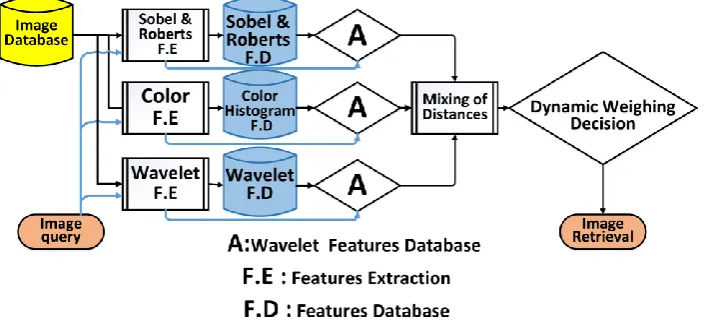
The block diagram for the presented scheme system is illustrated in Fig. 1. The Algorithm procedure is studied thoroughly in different sections as following.
2.1 Textural Feature Set
Wavelets are able to denoise the particular signals far better than conventional filters that are based on Fourier transform design and that do not follow the algebraic rules obeyed by the wavelets. It is best for non-stationary signal analysis, here original signal attach with mother wavelet signal and then makes analysis, means Mother wavelet signal make Zoom of basic signal, then analysis, so result is coming best in comparison to other technique. In this research, all images of database are segmented into various frequency and spatial levels. These frequency and local levels will be employed as the spatial textural specification for the image. The generated feature from the non-linear transformed levels is utilized for textural similarity check. Feature generation techniques are studied in details at the next part. One database is utilized for experimental results that include sizes images both 384×256 and 256×384. It is assumed that low frequencies of the image have the most important information. Lower frequencies contain the most precious data evaluated to the upper frequencies. Therefore, multi resolution transform based procedure is applied in a way that lower frequency of the image emerges in a huge resolution and the image upper frequency in tiny resolution. Hence, it is devoted coefficients to each level, to extract textural descriptors (see Fig. 2). The feature set made of dynamic weighting of texture, colors and shape descriptors generated as follows: In this research, multi-resolution discrete wavelet transform is utilized as the textural features. The Gabor mother filters computations are slower than multi-resolution transform fundamental orthogonal functions. The multi-resolution transformer major benefit in comparison with the complex Gabor filters is that the non-linear transformer is totally shift and rotation invariant, and Gabor filters is shift invariant. Furthermore, multi-resolution transformer generates different separate sub-bands of frequencies for different orientations. The typical real Gabor has the lack of shift invariance, needy orientations choosing, and cannot be
Fig. 1 Block diagram of the proposed method.
Iranian Journal of Electrical & Electronic Engineering, Vol. 14, No. 2, June 2018 155
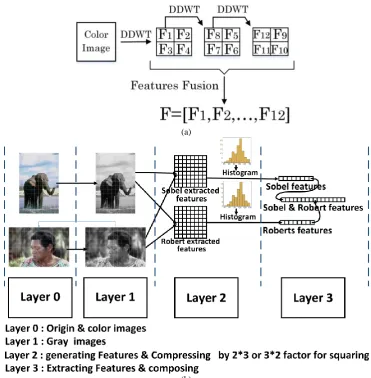
distinguished among 45˚ and −45˚ directional. Besides that, the multi-resolution wavelet transforms redundance permits aliasing terms decreasing that leads to be shift invariance. Rotation yields changes at the coefficients phases, but the amplitude of coefficients are constant. Utilizing different forms of filters in multi-resolution transform, it is probable to obtain complex impulse responses with symmetric real parts and asymmetric imaginary. The multi-resolution transform is presented in symmetric form among the functions of different transform filters. The images of the database are de-composed into different frequency sub-bands utilizing multi-resolution transformer. Textural feature generation procedure is described as follows:
I. Decompose the entire image database into different frequency sub bands utilizing multi-resolution transformer.
II. Perform for i = 1: different frequency number sub-bands, perform for j = 1: levels number (in this work j = 20)
III. Gather of different frequency sub-band coefficients dirs.
IV. Calculate σ and E of dirs.
V. Gather feature Fi.
VI. Gather extracted feature vector F
The standard deviation and energy are calculated for each different frequency sub-band of multi-resolution transform. At the different frequency of image sub-band, the standard deviation (σl) and energy (El) are
achieved as follows:
2
1 1
2
1 1
1
( . ) ,
1
( . )
M N
M N l
l l l
k j
l
k j
M k j MN
E M k j
MN
(1)where Ml (i,j) is frequency sub band of multi-resolution
transformer, M×N is the size of each window dimension of sub band that is assumed 10×10, and μj is the frequency sub-band mean value. The major feature set is generated utilizing the sub bands of several levels of transformed data. A feature set for image is extracted using σ and E of different frequency sub-bands as follows:
(a)
(b)
Fig. 2 a) The textural feature extraction and feature fusion and b) the shape feature extractor for SRMO.
Iranian Journal of Electrical & Electronic Engineering, Vol. 14, No. 2, June 2018 156
1 2 1 2
[ , ,..., , , ,..., ]
k k k k k k k
E L L
f E E E (2)
The generated feature size are 2L, a generated feature size has 40 elements for each image database. The above proposed dynamic composition decreases the memory usage because of the chief feature vector size reduction. Feature vectors with huge dimensions would make more considerable expand in memory usage that is a major problem in studied database. The presented process is applied for total images, after that the textural features are calculated, generated and stored.
2.2 Shape Feature Generation
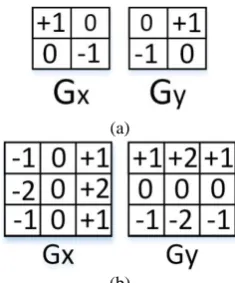
The proposed shape feature extraction scheme is calculated as a fusion of the Sobel and Roberts operators of a gray level derived from the image databases. This layout has two masks which has simplicity in computation, low memory usage and sufficient efficiency. In this method, Sobel and Roberts (SRO) operators, evaluate 8 and 4 neighbors information respectively. Fig. 3 illustrates RMO and SMO masks. The extracted information is orthogonal to each other, and different vertical, horizontal and diagonal gradients are computed. So, the combination of operators is great value in extraction shape features. Operator’s gives outstanding results on the image edge pixels. The analytical and simulated results depict much better effective than the previous methods for instance, moments of Zernike and hue [14]. Edge pixels of image calculation process are proposed as follow:
I. Transform the color image to gray level image. II. Calculate SRMO for phase information (see Fig. 2).
III. Reduce the size of shape descriptors for low memory usage, following process describe the reduction steps:
III.a Square the database image to 256×256 (some of image were vertical and horizontal). III.b Average the four generated matrix to one 128×128 matrix in order to reduce the number of extracted matrixes.
III.c Compare four times of 64×64 matrixes instead of 128×128 matrixes for decreasing time calculation of features.
IV. Create histogram for each line of SMO and RMO generated Matrixes.
V. Generate modified SRMO in feature sets. In this paper, SMO is employed to generate shift invariant SMO matrix. The SMO matrix is compressed in order to low memory usage and squaring the feature matrix. Histogram method is applied on all columns of SMO matrix to generate optimized and modified SMO vector features. This procedure is repeated for RMO matrix to generate modified RMO vector features. Finally, SMO & RMO vectors are composed for shape descriptors (See Fig. 2). At the edge map of image, the scale, translation, and rotation invariant normalized
one-dimensional SRMO are calculated.
2.3 Color Feature Generation
The histogram descriptor explains linearly computed features are making of color histogram and quantization specification. This operation would permit histogram with non-uniform quantization and different numbers of bins for specific color-space. Using one feature set would limit interoperability between different information extractions of descriptors. The bin values are uniformly quantized to a 10 bit values. Of course, the accuracy of the description is highly related to the number of bits used. This technique gets complete interoperability among different resolutions for color representation, the experiments have shown that good retrieval percentages are still achievable utilizing only 10 bits. Besides that, excellent results can be obtained using medium resolution of the proposed descriptor. A different kind of scalability is attained by scaling the quantized representation of the coefficients to different numbers of bits. The sign part is retained as the magnitude part can be scaled by the most significant bits. Using this method leads to a compact representation, while good retrieval efficiency is achieved. So it is possible to scale to different resolution levels. If the lowest bits are discarded in the scalable bit representation, only 4 bits remain to encode the absolute value. With this presented descriptors the ultimate color features in RGB color space are so efficient for retrieval accuracy.
3 Retrieval and Recall Procedure Based on Dynamic Weighting
The least error rate (LER) standard among the query image feature vector and images of data base is calculated for computing the retrieval accuracy. In LER, the retrieved image that has the less error rate from the feature vector of query image is chosen as the favorite image. The Euclidean distance is calculated among the feature vectors of query and target images for similarity process. The recall procedure is evaluated based on textural, shape and color features vectors separately. The retrieval procedure is introduced in the following:
(a)
(b)
Fig. 3 a) RMO masks and b) SMO masks.
Iranian Journal of Electrical & Electronic Engineering, Vol. 14, No. 2, June 2018 157
1) The error rate vectors for each image query among the data base images features are calculated individually.
2) The error rate matrix is generated by three rows of LER vectors.
3) The retrieval process is calculated for each LER vectors.
4) Evaluation of generated results accuracy shows the number of correct image class.
5) Multiplications of extracted numbers vector with LER matrix give final LER vectors.
6) The ultimate selection of retrieval image is based on final LER vector.
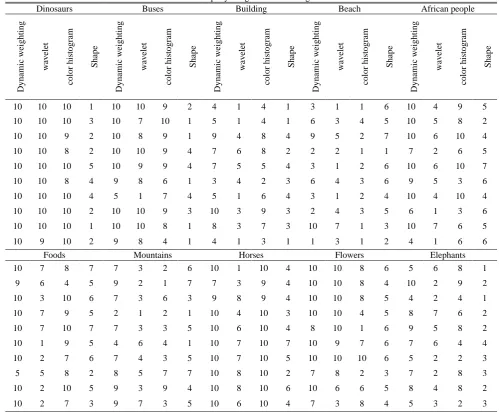
The average retrieval accuracy is illustrated at The Table 1. In this table, the proficiency of the new technique is evaluated for generating the dynamic weights. It is understood from Table 1, the individual features are not sufficient for retrieval process but dynamic weight combination of features are excellent choice. When one layer of feature is extracted from
image the considerable data is missed so, to enhance the accuracy rate, composition set of features are generated. Beside that dynamic weighting leads to excellent results when various images are recalled from database.
3.1 Dynamic Weighting Process Feature
Combination Steps
I. Choose the random confidents for weighting of extracted feature vectors.
II. Optimize the weighting confidents based on least error rate matrix.
III. Apply final optimized coefficients to retrieval process in order to maximize the precision percentage. Finally, using the dynamic weighting process feature combination leads to high efficient robust retrieval accuracy in comparison with Gabor and standard wavelets, and shift in variant complex wavelet transforms [7,9], and Lin’s method [11].
Table 1 Number of corrected retrieval for 10 different query images when 10 images are returned from database.
African people Beach Building Buses Dinosaurs Shape col or h istogra m wave let Dynami c weighting Shape col or h istogra m wave let Dynami c weighting Shape col or h istogra m wave let Dynami c weighting Shape col or h istogra m wave let Dynami c weighting Shape col or h istogra m wave let Dynami c weighting 5 9 4 10 6 1 1 3 1 4 1 4 2 9 10 10 1 10 10 10 2 8 5 10 5 4 3 6 1 4 1 5 1 10 7 10 3 10 10 10 4 10 6 10 7 2 5 9 4 8 4 9 1 9 8 10 2 9 10 10 5 6 2 7 1 1 2 2 2 8 6 7 4 9 10 10 2 8 10 10 7 10 6 10 6 2 1 3 4 5 5 7 4 9 9 10 5 10 10 10 6 3 5 9 6 3 4 6 3 2 4 3 1 6 8 9 4 8 10 10 4 10 4 10 4 2 1 3 4 6 1 5 4 7 1 5 4 10 10 10 6 3 1 6 5 3 4 2 3 9 3 10 3 9 10 10 2 10 10 10 5 6 7 10 3 1 7 10 3 7 3 8 1 8 10 10 1 10 10 10 6 6 1 4 2 1 3 1 1 3 1 4 1 4 8 9 2 10 9 10 Elephants Flowers Horses Mountains Foods 1 8 6 5 6 8 10 10 4 10 1 10 6 2 3 7 7 8 7 10 2 9 2 10 4 8 10 10 4 9 3 7 7 1 2 9 5 4 6 9 1 4 2 4 5 8 10 10 4 9 8 9 3 6 3 7 6 10 3 10 2 6 7 8 5 4 10 10 3 10 4 10 1 2 1 2 5 9 7 10 2 8 5 9 6 1 10 8 4 10 6 10 5 3 3 7 7 10 7 10 4 4 6 7 6 7 9 10 7 10 7 10 1 4 6 4 5 9 1 10 3 2 2 5 6 10 10 10 5 10 7 10 5 3 4 7 6 7 2 10 3 8 2 7 3 2 8 7 2 10 8 10 7 7 5 8 2 8 5 5 2 8 4 8 5 6 6 10 6 10 8 10 4 9 3 9 5 10 2 10 3 2 3 5 4 8 3 7 4 10 6 10 5 3 7 9 3 7 2 10
Iranian Journal of Electrical & Electronic Engineering, Vol. 14, No. 2, June 2018 158 4 Results Evaluation in Experimental Framework
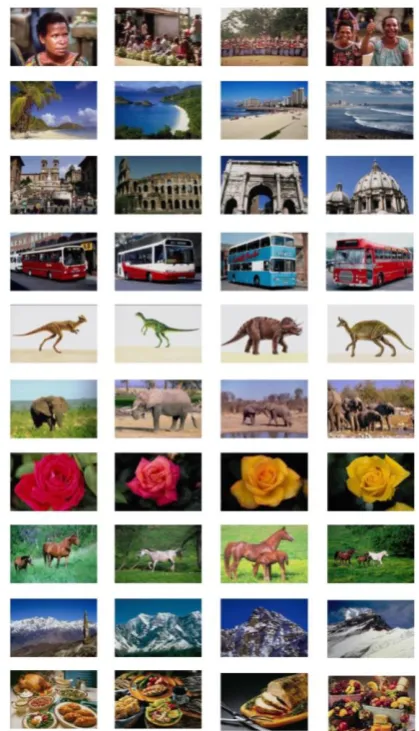
The performance and comparison of the presented outstanding technique with the previously published scholars are studied in this part. The image set contains 1000 Corel images in ten classes, each class has 100 different images. The images sizes are 384×256 or 256×384. Some randomly chosen images from data base is shown in Fig. 4. The ten class’s semantic names are presented in Table 2. Among the all database images and recalled image, LER Matrix and Euclidian distance are computed, afterwards, the target image which has the minimum value of LER vectors values with the query image vectors is selected as final system categorized images. The precision of query image m, and the average precision are the standard for calculating accuracy, described in Eqs. (3) and (4) respectively:
1 100, ( ) ( ), ( , ) 100
1
( ) 1
100 k ID k ID m
r m k
precision m
(3)
( ) , 1 1000
1
( ) 100
t
ID m t m
precision
P m
(4)
where precision(i) is the average precision ID(k) and
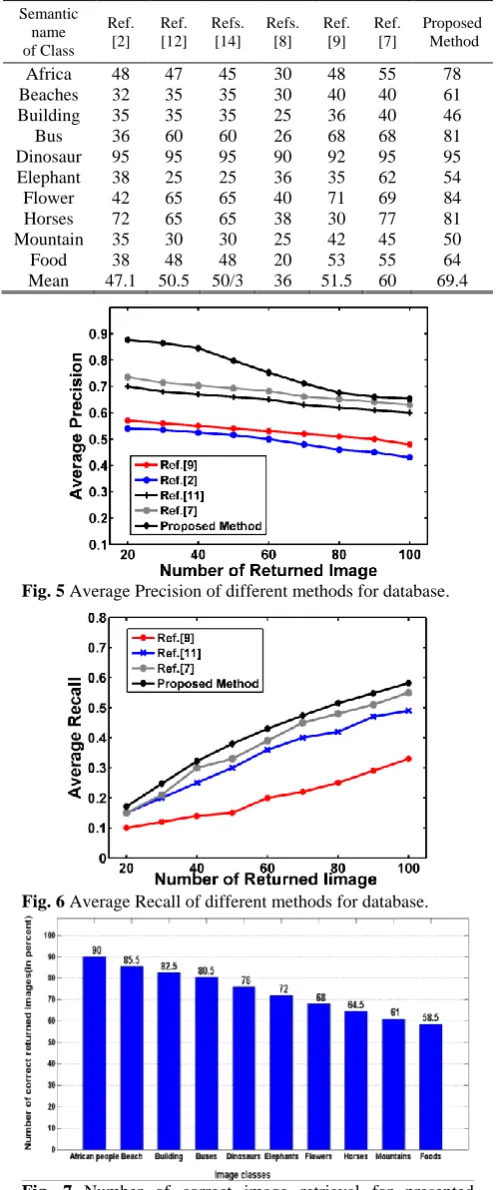
ID(m) are the class numbers of images (in the range of 1–10). This percentage illustrates the images belong to the class in 100 recalled images. Table 3 demonstrates the performance of systems [2,7-9,12,14] in evaluation of proposed techniques. The techniques of previously published papers obtain less precision than the presented algorithm, for Corel database. For first class, presented techniques have 78% precious, and whole of the other algorithms containing [2,7-9,12,14] shows less accuracy. Lots of endeavors have been performed to enhance the precious in the scholars because the African class is more complicated. In evaluation among the proposed techniques and Ref.s [2,7-9,12,14], in all classes is apperceived that presented algorithm has better characteristics. The presented full system algorithm is feedback-based dynamic weighting method that non-textural and textural sections are analyzed differently with various forms of feature vectors recombination. Therefore experimental consequences are declared to be much better than the generic techniques [7-9]. Besides that, proposed system is much better than the Refs. [2,7,9,11]. In Figs. 5 and 6 illustrate the mean accuracy of the recall and retrieval with versus of the called images number. The experimental consequences obviously divulge that for the different number of called images in the 1,000 database images, the novel algorithm is notably premiere to the previously published techniques. Figs. 7 and 8 show our algorithm efficiency when dynamic weighting is utilized in presented method, because in dynamic weighting the features with high degree of data
have larger weights that lead to final impressive features with small vector size. In both figures our method is much more superior with traditional and conventional algorithms.
5 Computational Cost
The calculation complication of the presented algorithm and the Ref. [7] is studied at Table 4. It is understood that the presented technique has the same complexity and evaluation. But the processing time is decreased by the factor of 2. The proposed scheme was executed on 2.7 GHz Corei7 CPU processor and 4 GB
Fig. 4 Randomly selected images from different classes of database.
Table 2 Ten classes of image database Semantic name.
Iranian Journal of Electrical & Electronic Engineering, Vol. 14, No. 2, June 2018 159
DDR3 Ram. The experimental consequences illustrate that the proposed recall process has 20ms and Refs. [7,9,11] have nearly 40ms for database image. So, presented robust algorithm is much faster than [7,9,11]. Ultimately, for huge database, the processing time of [7,9,11] will be more than the new retrieval algorithm. It is deduced that the main feature vector size is the least one evaluated to DWT, Gabor, and [7,9,11]. It is noted that incrementing the final feature vectors dimension cause to the high memory usage and complexity but it will produce much better retrieval and accuracy results.
6 Conclusion
In this paper, a robust feature generation and dynamic weighting recombination methods for image retrieval is presented. Non-linear dynamic weighting combinational techniques is presented, such as; generated multi-resolution modified wavelet functions, improved bit-based color histogram and Sobel-Roberts modified operators. These extracted features are recomposed with different weights to generate a unique feature, which proposes a marvelous frequency statistic specification and spatial signals dominion. The computational impressive algorithm of multi-resolution wavelet is calculated. The generated features are deviation of standard and mean values for transformed of two dimensional signals in different layers. The modified bit-based color histogram is utilized, because the color object detection algorithms are more effective than the gray image scale schemes. At the last step of feature extraction, Sobel-Roberts modified edge detection is applied to all image of database, these operators use simple central gradient estimation, thus for a point on Cartesian grid and its neighbor value is calculated on each image. The features drawn from images of database with proposed new features, employed as spatial specification of textures, colors and shapes. This spatial and frequency domain information is captured for all layouts of image set that propose various information of the images. Textural features compositions of color, shape prepare a resistant feature vectors for retrieval of database. This scheme illustrates high proficiency in Wang’s image set. The experimental results depict the accuracy and efficacy of the method. The experimental results are evaluated with different prior scholars and are discovered to be outstanding.
Acknowledgments
This research is the consequence of a project agreed with research committee at Urmia Branch, Islamic Azad University, Urmia, Iran. Authors would like to appreciate, Urmia branch, Islamic Azad University, Urmia, Iran for its supports.
Table 3 Comparison of average precision (%) of the proposed
method and the other standard retrieval systems when 100 retrievable images of database.
Semantic name of Class
Ref. [2]
Ref. [12]
Refs. [14]
Refs. [8]
Ref. [9]
Ref. [7]
Proposed Method
Africa 48 47 45 30 48 55 78
Beaches 32 35 35 30 40 40 61
Building 35 35 35 25 36 40 46
Bus 36 60 60 26 68 68 81
Dinosaur 95 95 95 90 92 95 95
Elephant 38 25 25 36 35 62 54
Flower 42 65 65 40 71 69 84
Horses 72 65 65 38 30 77 81
Mountain 35 30 30 25 42 45 50
Food 38 48 48 20 53 55 64
Mean 47.1 50.5 50/3 36 51.5 60 69.4
Fig. 5 Average Precision of different methods for database.
Fig. 6 Average Recall of different methods for database.
Fig. 7 Number of correct image retrieval for presented algorithm (result in 10 random queries).
Iranian Journal of Electrical & Electronic Engineering, Vol. 14, No. 2, June 2018 160
Fig. 8 Number of correct image retrieval for different algorithm (comparing 4 methods in 100 random queries).
Table 4 Calculation complexity per pixel of image.
Addition Multiplication Comparison
Ref. [7] 38.2 18.6 1.5
Proposed method 35.2 15.6 1.5
References
[1] X. Zhang, J. Zhao and J. Tian, “A robust conversion model for soil moisture retrieval from multisensory data,” IEEE Transactions on Geoscience and Remote Sensing, Vol. 52, No. 8, pp. 5230–5237, 2014.
[2] G. Takacs, V. Chandrasekhar, S. S. Tsai, D. Chen, R. Grzeszczuk and B. Girod, “Fast computation of rotation-invariant image features by an approximate radial gradient transform,” IEEE Transactions on Image Processing, Vol. 22, No. 8, pp. 2970–2982, 2013.
[3] S. Gai, M. Wan, L. Wang and C. Yang, “Reduced quaternion matrix for color texture classification,”
Neural Computing and Applications, Vol. 25, No. 3-4, pp. 945–953-4, 2014.
[4] W. Chen, “Single-shot imaging without reference wave using binary intensity pattern for optically-secured-based correlation,” IEEE Photonics Journal, Vol. 8, No. 1, pp. 1-9, 2016.
[5] S. Paraiso-Medina, D. Perez-Rey, A. Bucur, B. Claerhout and R. Alonso-Calvo, “Semantic normalization and query abstraction based on SNOMED-CT and HL7: Supporting metacentric clinical trials,” IEEE Journal of Biomedical and Health Informatics, Vol. 19, No. 3, pp. 1061–1067, 2015.
[6] J. Liang, Q. Hu, W. Wang and Y. Han, “Semi supervised online multi kernel similarity learning for image retrieval”, IEEE Transactions on Multimedia, Vol. 19, No. 5, pp. 1077–1089, 2017.
[7] T. Sedghi, “A fast and effective model for cyclic analysis and its application in classification,”
Arabian Journal for Science and Engineering, Vol. 38, No. 4, pp. 927–935, 2013.
[8] M. Stricker and M. Orengo, “Similarity of color images,” In Proceedings SPIE Storage and Retrieval for Image and Video Databases, pp. 381–392, 2002. [9] Y. Chen and J. Z. Wang, “A region-based fuzzy
feature matching approach to content- based image retrieval,” IEEE Transactions on Pattern Analysis and Machine Intelligence, Vol. 24, No. 9, pp. 1252– 1267, 2002.
[10]L. Peng and R. Peng, “Partial randomness hashing for large-scale remote sensing image retrieval,”
IEEE Geoscience and Remote Sensing Letters, Vol. 14, No. 3, pp. 464–468, 2017.
[11]L. Peizhong, G. Jing-Ming, W. Chi-Yi and C. Danlin, “Fusion of deep learning and compressed domain features for content-based image retrieval,”
IEEE Transactions on Image Processing, Vol. 26, No. 12, pp. 5706–5717, 2017.
[12]N. Jhanwar, S. Chaudhurib, G. Seetharamanc and B. Zavidovique, “Content based image retrieval using motif co-occurrence matrix,” Image and Vision Computing, Vol. 22, No. 14, pp. 1211–1220, 2004.
[13]S. Fadaei, R. Amirfattahi and M. R. Ahmadzadeh, “New content-based image retrieval system based on optimised integration of DCD, wavelet and curve let features,” IET Image Processing, Vol. 11, No. 2, pp. 89– 98, 2017.
[14]D. Zhang and G. Lu, “Review of shape representation and description techniques,” Pattern Recognition, Vol. 37, No. 1, pp. 1–19, 2004. [15]X. Wangming, W. Shiqian, Er. Meng Joo,
Zh. Chaobing and Q. Yimin, “New non-negative sparse feature learning approach for content-based image retrieval,” IET Image Processing, Vol. 11, No. 9, pp. 724–733, 2017.
[16]Zh. Lei, Sh. Jialie, X. Liang and Ch. Zhiyong, “Unsupervised visual hashing with semantic assistant for content-based image retrieval,” IEEE Transactions on Knowledge and Data Engineering, Vol. 29, No. 2, pp. 472–486, 2017.
Iranian Journal of Electrical & Electronic Engineering, Vol. 14, No. 2, June 2018 161
S. Tannaz received the B.Sc. degree in Electronic Engineering from Iran University of Science and Technology, Tehran, Iran, in 1990. He received M.Sc. degree in Electrical Engineering from Sharif University of Technology, Tehran, Iran, in 1994. His research interests include image processing, pattern recognition, radar application, intelligent computing and steg analysis. Now he is lecturer at department of Electrical Engineering, Urmia Branch. Islamic Azad University.
T. Sedghi received the B.Sc. degree in Electronic Engineering from IAU, Urmia Branch, Urmia, Iran, in 2007. He received M.Sc. degree in electrical engineering in University of Urmia, Iran in 2009. Now he got his Ph.D. student in IAU science research branch in 2015. His research interests include radar application, intelligent computing, data compression, image coding and steg analysis. He has published more than thirty papers in his referred international journal and more than fifteen papers in national/international conferences. Now he is assistant professor at department of Electrical Engineering, Urmia branch, Islamic Azad University.